- Base Value(2025): 3.6 Bn
- Estimated Value(2025): 3.6 Bn
- Forecast Value (2035): 6.3 Bn
- CAGR (2025 - 2035): 5.8%
Fertilizer Bags Market Forecast and Outlook 2025 to 2035
The global fertilizer bags market is projected to reach USD 6.3 billion by 2035, recording an absolute increase of USD 2.7 billion over the forecast period. The market is valued at USD 3.6 billion in 2025 and is set to rise at a CAGR of 5.8% during the assessment period.
The overall market size is expected to grow by 1.8 times during the same period, supported by increasing demand from agricultural input distribution operations and expanding applications in fertilizer packaging solutions across both developed and emerging agricultural markets.
Quick Stats for Fertilizer Bags Market
- Fertilizer Bags Market Value (2025): USD 3.6 billion
- Fertilizer Bags Market Forecast Value (2035): USD 6.3 billion
- Fertilizer Bags Market Forecast CAGR: 5.8%
- Leading Material in Fertilizer Bags Market: Polypropylene (56.0%)
- Key Growth Regions in Fertilizer Bags Market: Asia Pacific, North America, and Latin America
- Top Players in Fertilizer Bags Market: Amcor plc, ProAmpac, CDF Corporation, Türkkraft, CarePac, MST Packaging Co., Ltd., Tex-Trude, Miller Weldmaster, Turf Care Supply, LLC, Balcan Innovations Inc.
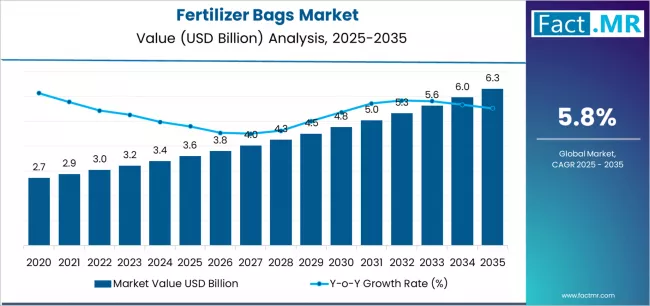
Fertilizer Bags Market Market Value Analysis | Source: Fact.MR
Growing application diversity in chemical fertilizer packaging, organic fertilizer distribution, and agrochemical containment creates expanding opportunities for packaging innovation and specialized bags development. Rising global fertilizer consumption, coupled with expanding agricultural production capacity through modern farming operations and commercial fertilizer distribution infrastructure, further accelerate market penetration across diverse agricultural segments.
The growing global demand for packaged fertilizers, particularly in retail distribution and smallholder farmer applications, generates sustained requirements for durable packaging materials and moisture-resistant bags solutions. Technical advancements in polypropylene woven bags technologies demonstrating measurable improvements in tear resistance, reduced material costs, and UV stability optimization reinforce manufacturer confidence in fertilizer bags economics, while sustainable agriculture sector trends toward efficient input delivery expand addressable market opportunities beyond traditional bulk distribution into packaged retail supply chains.
Fertilizer manufacturers and agricultural input distributors increasingly incorporate specialized packaging into product offerings, brand positioning strategies, and distribution optimization programs, creating mainstream adoption channels that extend beyond commodity packaging applications into value-added agricultural markets. Fluctuating raw material costs for polymer resins and increasing competition from alternative packaging formats may pose challenges to market expansion.
Environmental regulations regarding plastic packaging waste in certain regions and recycling infrastructure limitations also influence packaging material selection, requiring manufacturers to develop sustainable packaging strategies and circular economy approaches catering to specific regulatory requirements across different geographical markets.
Supply chain complexity during polymer procurement and the technical requirements for printing quality, bags sealing integrity, and handling durability operations may limit accessibility among smaller packaging converters in developing regions with limited infrastructure for advanced flexible packaging manufacturing and quality control systems.
Fertilizer Bags Market Year-over-Year Forecast 2025 to 2035
Between 2025 and 2030, the fertilizer bags market is projected to expand from USD 3.6 billion to USD 4.8 billion, resulting in a value increase of USD 1.2 billion, which represents 44.4% of the total forecast growth for the decade. This phase of development will be shaped by rising demand for packaged fertilizer products and agricultural input distribution expansion, product innovation in UV-stabilized materials and moisture-barrier formulations, as well as expanding integration with branded fertilizer initiatives and retail distribution platforms. Companies are establishing competitive positions through investment in advanced weaving technology development, high-quality printing capabilities, and strategic market expansion across fertilizer manufacturing operations, agricultural distribution segments, and retail packaging applications.
From 2030 to 2035, the market is forecast to grow from USD 4.8 billion to USD 6.3 billion, adding another USD 1.5 billion, which constitutes 55.6% of the overall ten-year expansion. This period is expected to be characterized by the expansion of specialized fertilizer packaging solutions, including targeted barrier properties and customized size configurations tailored for specific distribution requirements, strategic collaborations between bags manufacturers and fertilizer producers, and an enhanced focus on sustainable packaging materials and recyclability enhancement programs. The growing emphasis on agricultural sustainability and packaging waste reduction will drive demand for high-performance fertilizer bags solutions across diverse agricultural and distribution applications.
Fertilizer Bags Market Key Takeaways
| Metric | Value |
|---|---|
| Market Value (2025) | USD 3.6 billion |
| Market Forecast Value (2035) | USD 6.3 billion |
| Forecast CAGR (2025-2035) | 5.8% |
Source: Fact.MR analysis. Updated Dec 1, 2025
Why is the Fertilizer Bags Market Experiencing Steady Growth?
The fertilizer bags market grows by enabling fertilizer manufacturers, agricultural distributors, and farming cooperatives to access durable packaging solutions that support product integrity while meeting agricultural demand for reliable containment and convenient handling specifications.
Fertilizer producers and distribution companies face mounting pressure to develop effective packaging systems with proven moisture protection and mechanical strength characteristics, with polypropylene woven bags typically providing 50-100 kg capacity options essential for fertilizer storage, transportation, and retail distribution, making these packaging solutions essential for competitive positioning in agricultural inputs, chemical fertilizers, and organic amendment categories.
The agricultural industry's need for cost-effective packaging materials and consistent product protection creates demand for diverse bags specifications that can provide superior durability, maintain product quality across different storage conditions, and ensure handling convenience without compromising distribution economics or material performance.
Government initiatives promoting agricultural productivity and efficient input delivery drive adoption in fertilizer manufacturing facilities, agricultural distribution networks, and farming cooperative operations, where packaging quality has a direct impact on product preservation outcomes and distribution efficiency.
The agricultural sector's growing focus on smallholder farmer access and retail fertilizer availability further expands market opportunities, with distribution research demonstrating measurable advantages from packaged fertilizers, including improved handling convenience and reduced product waste.
Supply chain complexity during polymer resin sourcing and the technical requirements for bags manufacturing processes, printing quality control, and sealing integrity validation may limit accessibility among smaller packaging producers and developing regions with limited infrastructure for advanced flexible packaging production and quality assurance systems.
Segmental Analysis
The market is segmented by material, size, closure type, application, and region. By material, the market is divided into polypropylene, polyethylene, jute, paper, and non-woven fabric. By size, the market includes less than 10 kg, 10-25 kg, 25-50 kg, 50-100 kg, and more than 100 kg.
By closure type, the market covers sewn closure, plastic tie, drawstring, wire tie, and glued closure. By application, the market encompasses chemical fertilizers, organic fertilizers, seed treatment, and agrochemicals. Regionally, the market is divided into Asia Pacific, North America, Europe, Latin America, and Middle East & Africa.
What Makes Polypropylene the Dominant Material Segment in the Fertilizer Bags Market?
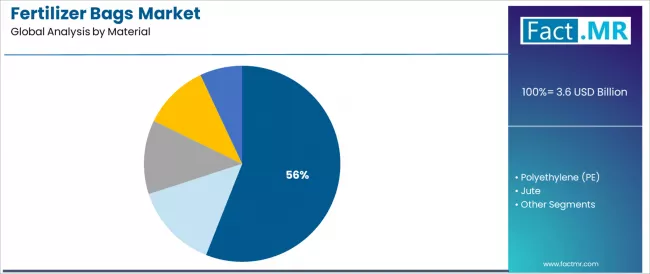
Fertilizer Bags Market Analysis By Material | Source: Fact.MR
Polypropylene represents the dominant force in the fertilizer bags market, capturing 56.0% of the market share in 2025. This established material category encompasses solutions featuring critical strength and durability properties for fertilizer containment, including woven PP, laminated PP, and UV-stabilized PP formulations that enable superior load-bearing capacity and weather resistance across all agricultural packaging applications.
Polypropylene’s market leadership stems from its essential role in cost-effective packaging delivery, with PP woven bags capable of meeting diverse fertilizer packaging requirements while maintaining economical production and operational reliability across all distribution environments. Within the polypropylene segment, woven PP bags account for the largest consumption share, driven by optimal strength-to-weight ratios and widespread manufacturing infrastructure across global packaging markets.
Polyethylene maintains a substantial 18.0% market share, serving manufacturers who require flexible packaging solutions with enhanced moisture barrier properties and superior sealing characteristics for specialized applications. These materials offer versatile packaging options for hygroscopic fertilizers, fine particle products, and premium packaging requirements while providing sufficient processing flexibility to meet performance demands and functional specifications.
The jute, paper, and non-woven fabric segments account for the remaining market share, serving niche applications requiring biodegradable materials, natural fiber solutions, and specialized breathable properties for specific fertilizer formulations.
Key advantages driving the polypropylene segment include:
- Established manufacturing infrastructure with integrated weaving operations that reduce production complexity and ensure consistent material availability
- Superior strength characteristics allowing reliable fertilizer containment across different bags sizes without significant material cost penalties
- Proven weather resistance, delivering durable performance while maintaining competitiveness against alternative packaging materials
- Broad industry acceptance enabling straightforward material specification and quality standards across multiple agricultural markets
Which Size Category Leads in the Fertilizer Bags Market?
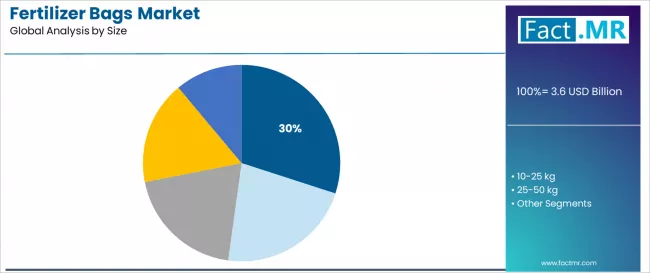
Fertilizer Bags Market Analysis By Size | Source: Fact.MR
The 50-100 kg segment captures approximately 30.0% of the market share, driven by widespread adoption in commercial agriculture and wholesale fertilizer distribution requiring large-capacity packaging for field application efficiency.
These bags sizes offer optimal balance between handling convenience and loading capacity, enabling efficient transportation and storage while supporting mechanized handling systems across agricultural supply chains. The 50-100 kg segment demonstrates strength in developing agricultural markets where bulk purchasing and manual handling requirements create compelling operational advantages.
The 25-50 kg segment maintains approximately 26.0% market share, serving retail distribution channels and smallholder farmers requiring manageable package sizes for manual handling and precise application dosing. These medium-capacity bags provide accessibility for individual farmers and small-scale operations while maintaining economical packaging costs per unit weight.
The less than 10 kg, 10-25 kg, and more than 100 kg segments account for the remaining market share, serving home gardening applications, specialized retail formats, and industrial bulk distribution requiring extreme size configurations across diverse agricultural and horticultural uses.
How do Closure Technologies Shape Market Demand?
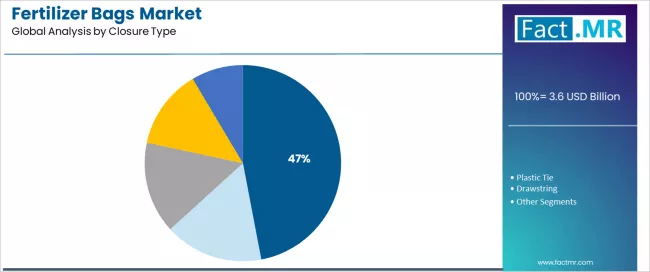
Fertilizer Bags Market Analysis By Closure Type | Source: Fact.MR
The sewn closure segment dominates with a 47.0% market share, reflecting traditional bags closing methods providing reliable sealing performance and established manufacturing infrastructure across packaging operations. Sewn closures offer proven reliability through single-stitch and double-stitch configurations, enabling cost-effective closing operations that minimize equipment investment requirements while maintaining acceptable seal integrity.
The segment benefits from widespread adoption across agricultural packaging industries and compatibility with existing filling and closing equipment in fertilizer production facilities. The plastic tie segment captures approximately 22.0% market share, driven by rapid closing capabilities and reusable opening features supporting retail distribution and partial usage applications.
Plastic tie closures provide user-friendly opening mechanisms through clip tie and zip tie designs, offering convenience advantages for customers requiring multiple access events and product portioning capabilities. The drawstring, wire tie, and glued closure segments account for the remaining market share, serving specialized applications requiring specific sealing characteristics and closure performance tailored to handling requirements and distribution scenarios.
Which Application Category Dominates Market Utilization?
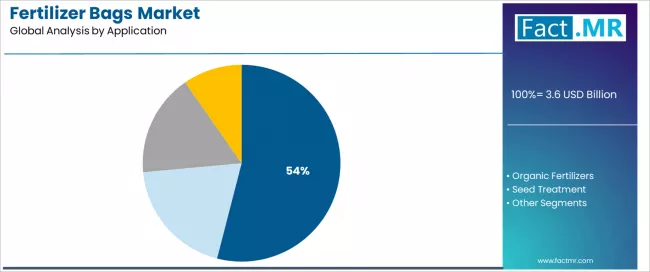
Fertilizer Bags Market Analysis By Application | Source: Fact.MR
The chemical fertilizers segment leads with a 54.0% market share, reflecting substantial global consumption of synthetic nutrient products requiring reliable packaging for NPK formulations, urea products, and phosphate fertilizers across agricultural production systems.
Chemical fertilizer packaging particularly drives this segment, with packaging requirements delivering essential product protection against moisture absorption and nutrient degradation across diverse climatic conditions. The segment benefits from established global fertilizer manufacturing infrastructure and continuous agricultural intensification trends supporting synthetic nutrient adoption.
The organic fertilizers segment captures approximately 21.0% market share, driven by sustainable agriculture adoption and natural farming practices requiring packaging for manure-based organic and compost-based organic products across environmentally conscious agricultural markets.
Organic fertilizer packaging enables natural amendment distribution with appropriate breathability characteristics and product integrity maintenance supporting organic certification requirements. The seed treatment and agrochemicals segments account for the remaining market share, serving specialized agricultural input applications requiring modified packaging specifications and chemical compatibility tailored to specific product formulations and regulatory requirements.
What are the Drivers, Restraints, and Key Trends of the Fertilizer Bags Market?
The market is driven by three concrete demand factors tied to agricultural development and distribution modernization. First, increasing global fertilizer consumption and agricultural intensification create growing demand for packaging solutions, with worldwide fertilizer usage expanding by 2-3% annually in major agricultural regions worldwide, requiring comprehensive packaging infrastructure. Second, expanding retail fertilizer distribution and smallholder farmer market penetration drives increased adoption of packaged fertilizer products, with many agricultural markets implementing comprehensive rural distribution networks for branded fertilizer products by 2030. Third, technological advancements in polymer processing and bags manufacturing enable more effective and efficient packaging production that reduces material costs while improving bags strength and moisture resistance capabilities.
Market restraints include volatile polymer resin pricing that can deter packaging manufacturers from maintaining competitive pricing strategies, particularly in regions where raw material costs face significant fluctuations or supply constraints. Environmental concerns regarding plastic packaging waste pose another significant challenge, as polypropylene bags contribute to agricultural plastic accumulation, potentially causing increased regulatory scrutiny and demand for alternative materials. Limited recycling infrastructure for agricultural packaging materials creates additional market challenges for sustainability positioning, demanding ongoing investment in collection systems and circular economy program development.
Key trends indicate accelerated demand growth in Asia Pacific markets, particularly India and China, where agricultural modernization and fertilizer subsidy programs drive comprehensive packaged fertilizer adoption. Technology integration trends toward UV-stabilized formulations with extended outdoor durability, moisture-barrier lamination technologies, and high-quality printing capabilities enable optimized packaging approaches that enhance brand visibility and product protection. However, the market thesis could face disruption if significant advances in bulk fertilizer distribution systems or major shifts in agricultural practices reduce reliance on bagsged fertilizer products in commercial farming operations.
Analysis of the Fertilizer Bags Market by Key Countries
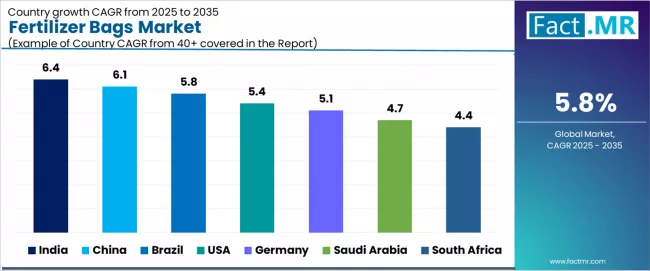
Fertilizer Bags Market Cagr Analysis By Country | Source: Fact.MR
| Country | CAGR (2025 to 2035) |
|---|---|
| India | 6.4% |
| China | 6.1% |
| Brazil | 5.8% |
| USA | 5.4% |
| Germany | 5.1% |
| Saudi Arabia | 4.7% |
| South Africa | 4.4% |
Source: Fact.MR analysis. Updated Dec 1, 2025
The fertilizer bags market is expanding steadily, with India leading at a 6.4% CAGR through 2035, driven by high fertilizer consumption rates and comprehensive government subsidy programs supporting packaged fertilizer distribution. China follows at 6.1%, supported by agricultural modernization initiatives and substantial export packaging demand for fertilizer products. Brazil records 5.8%, reflecting soybean and sugarcane production growth driving fertilizer consumption expansion.
USA posts 5.4%, anchored by precision farming adoption and packaged fertilizer demand across retail agricultural markets. Germany grows at 5.1%, with EU sustainability regulations and quality packaging standards supporting market development. Saudi Arabia advances at 4.7%, emphasizing fertilizer import requirements and desert farming expansion programs, while South Africa grows steadily at 4.4%, focusing on agro-input distribution network development and commercial agriculture growth.
India Leads Global Market Expansion
India demonstrates the strongest growth potential in the fertilizer bags market with a CAGR of 6.4% through 2035. The country's leadership position stems from massive fertilizer consumption volumes, extensive government subsidy programs, and substantial smallholder farmer population enabling mainstream packaged fertilizer adoption.
Growth is concentrated in major agricultural states, including Uttar Pradesh, Maharashtra, Madhya Pradesh, and Punjab, where fertilizer manufacturing clusters and expanding rural distribution infrastructure are implementing comprehensive packaging programs for retail fertilizer distribution applications.
Distribution channels through agricultural input dealers, farming cooperatives, and rural retail networks expand deployment across agricultural regions. The country's fertilizer subsidy system provides comprehensive support for packaged fertilizer distribution, including direct benefit transfer programs and nutrient-based subsidy frameworks.
Key market factors:
- Packaging demand concentrated in fertilizer manufacturing hubs and agricultural distribution centers with comprehensive rural reach
- Infrastructure development through rural road networks and agricultural market yard improvements
- Comprehensive agricultural input ecosystem, including established fertilizer distribution networks with proven retail capabilities
- Technology integration featuring advanced printing systems, lamination technologies, and quality control processes
China Emerges as Production Powerhouse
In major fertilizer manufacturing provinces including Hubei, Shandong, Henan, and Sichuan, the production and consumption of fertilizer bags is accelerating across domestic distribution and export packaging operations, driven by integrated fertilizer industry and massive agricultural production systems. The market demonstrates strong growth momentum with a CAGR of 6.1% through 2035, linked to agricultural modernization policies, expanding mechanized farming operations, and sustained export demand for packaged fertilizer products.
Chinese manufacturers are implementing advanced fertilizer bags production technologies and automated packaging systems to enhance production efficiency while meeting growing demand in domestic agricultural markets and international fertilizer trade. The country's agricultural development initiatives create persistent demand for packaging materials, while increasing emphasis on branded fertilizer products drives adoption of high-quality printing and packaging specifications.
Key development areas:
- Fertilizer manufacturing and agricultural distribution sectors leading bags consumption with comprehensive packaging programs
- Integrated supply chains providing efficient material flow with extensive manufacturing infrastructure
- Technology partnerships between packaging manufacturers and fertilizer producers are expanding market integration
- Integration of automated packaging lines and comprehensive quality management protocols
Brazil Shows Agricultural Expansion
Brazil's market expansion is driven by robust agricultural sector growth, including expanding soybean and sugarcane cultivation in major production states, and increasing fertilizer consumption across multiple crop production systems. The country demonstrates promising growth potential with a CAGR of 5.8% through 2035, supported by large-scale commercial agriculture operations, increasing fertilizer imports, and growing domestic fertilizer manufacturing capacity.
Brazilian agricultural markets face packaging challenges related to distribution logistics and storage conditions, requiring investment in UV-stabilized materials and support from international packaging technology providers. However, substantial agricultural production volumes and continuous cropland expansion create compelling business cases for fertilizer bags consumption, particularly in regions where commercial farming operations have a direct impact on fertilizer distribution requirements.
Key market characteristics:
- Commercial agriculture and fertilizer import distribution showing fastest growth with substantial packaging requirements
- Regional expansion trends focused on agricultural frontier regions in central and northern states
- Future projections indicate the need for expanded packaging manufacturing capacity and improved material specifications
- Growing emphasis on large-capacity bags and mechanized handling compatibility
USA Demonstrates Retail Market Strength
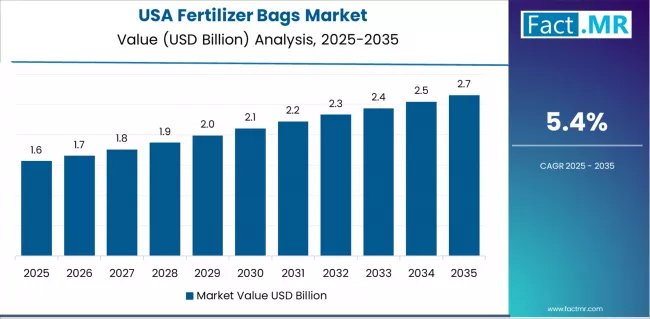
Fertilizer Bags Market Country Value Analysis | Source: Fact.MR
The USA’s market leads in packaged fertilizer distribution based on integration with retail agricultural markets and precision farming practices for enhanced input management. The country shows solid potential with a CAGR of 5.4% through 2035, driven by established agricultural retail infrastructure, strong branded fertilizer presence, and the expansion of specialty fertilizer products in major agricultural regions, including Midwest, Great Plains, and California.
American agricultural retailers are adopting comprehensive packaged fertilizer assortments and convenience packaging formats, particularly in regions with diverse crop production and specialty agriculture demanding comprehensive nutrient management solutions. Technology deployment channels through agricultural retail chains and farm supply cooperatives expand coverage across commercial farming operations and specialty crop producers.
Leading market segments:
- Agricultural retail operations and specialty fertilizer manufacturers implementing comprehensive packaging programs
- Strategic partnerships with packaging suppliers, achieving consistent quality specifications and brand presentation standards
- Collaborative initiatives between fertilizer companies and packaging converters are expanding innovation capabilities
- Focus on sustainability messaging and recycling program integration
Germany Emphasizes Quality Standards
In major agricultural regions including Bavaria, Lower Saxony, North Rhine-Westphalia, and Baden-Württemberg, fertilizer distributors and agricultural cooperatives are implementing comprehensive packaging strategies to optimize product presentation and meet regulatory requirements, with documented adoption of high-quality printing technologies achieving enhanced brand visibility and product information communication. The market shows steady growth potential with a CAGR of 5.1% through 2035, linked to stringent EU packaging regulations, established quality standards, and ongoing environmental compliance requirements in agricultural markets.
German agricultural suppliers are adopting consistent packaging specifications and quality assurance protocols to enhance product positioning while maintaining performance standards demanded by environmental regulations and agricultural industry requirements. The country's regulated agricultural market creates persistent demand for compliant packaging solutions and quality consistency that integrate with existing distribution systems.
Market development factors:
- Agricultural cooperatives and fertilizer distributors leading packaging consumption across Germany
- Regulatory frameworks and environmental standards providing comprehensive compliance requirements
- Strategic relationships between German agricultural suppliers and European packaging manufacturers are expanding supply security
- Emphasis on recyclability features and environmental certification across packaging materials
Saudi Arabia Shows Import Distribution Growth
Saudi Arabia's fertilizer bags market demonstrates competitive positioning focused on fertilizer import distribution and expanding desert agriculture operations, with documented adoption of moisture-resistant packaging achieving product integrity maintenance in harsh climatic conditions across major agricultural development projects in Eastern Province and northern regions.
The country maintains steady growth momentum with a CAGR of 4.7% through 2035, driven by substantial fertilizer import volumes, government agricultural development programs, and strategic investments in protected agriculture and irrigation-based farming. Major distribution hubs, including operations in Dammam, Riyadh, and Jeddah, showcase advanced deployment of packaged fertilizer distribution where import logistics support comprehensive agricultural input supply programs.
Key market characteristics:
- Fertilizer import operations and agricultural development projects driving packaging adoption with emphasis on climate protection
- Distribution infrastructure enabling comprehensive rural delivery with expanding logistics networks
- Technology collaboration between Saudi agricultural companies and international packaging suppliers is expanding capabilities
- Emphasis on UV protection and moisture barrier properties for extreme climate conditions
South Africa Shows Distribution Network Development
South Africa's fertilizer bags market demonstrates expanding landscape focused on agro-input distribution network development, with documented growth of packaged fertilizer availability achieving improved farmer access and product quality across major agricultural provinces including Mpumalanga, Free State, and KwaZulu-Natal. The country shows steady growth momentum with a CAGR of 4.4% through 2035, driven by commercial agriculture expansion, smallholder farmer development programs, and strategic investment in agricultural retail infrastructure.
South Africa's emphasis on agricultural productivity improvement creates requirements for accessible fertilizer packaging solutions that support comprehensive input delivery initiatives and farmer service programs. The market benefits from strong partnerships between fertilizer manufacturers and agricultural cooperatives, creating comprehensive distribution ecosystems that prioritize product availability and farmer convenience.
Key market characteristics:
- Agricultural cooperatives and input retailers driving packaging requirements with emphasis on distribution accessibility
- Rural distribution programs enabling comprehensive farmer reach with expanding retail networks
- Technology collaboration between South African agricultural companies and regional packaging manufacturers is expanding capabilities
- Emphasis on affordable packaging solutions and handling convenience methodologies
Europe Market Split by Country
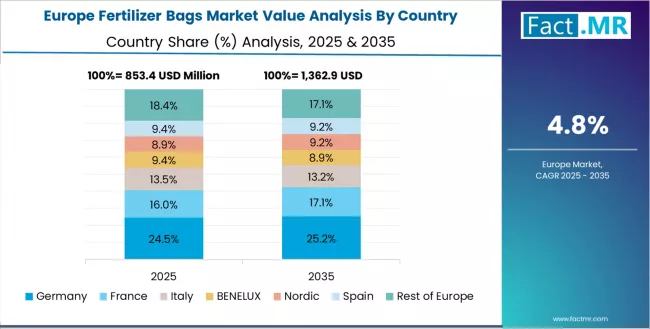
Fertilizer Bags Market Europe Country Market Share Analysis, 2025 & 2035 | Source: Fact.MR
The fertilizer bags market in Europe is projected to grow from USD 782.4 million in 2025 to USD 1.3 billion by 2035, registering a CAGR of 5.3% over the forecast period. Germany is expected to maintain its leadership position with a 28.2% market share in 2025, supported by its advanced agricultural cooperative infrastructure, comprehensive quality standards, and strong fertilizer distribution presence across major agricultural regions.
France follows with a 23.6% share in 2025, driven by extensive agricultural production operations and integrated fertilizer manufacturing sectors. Poland holds a 17.8% share in 2025 through its expanding agricultural modernization and EU integration benefits.
The Netherlands commands a 15.1% share, while rest of Europe accounts for 15.3% in 2025. By 2035, Germany is projected to hold 27.8% share, France 23.9%, Poland 18.2%, Netherlands 15.3%, and Rest of Europe 14.8%, reflecting sustained growth momentum across all major European markets and increasing fertilizer bags adoption in diversified agricultural operations implementing comprehensive input distribution programs.
Competitive Landscape of the Fertilizer Bags Market
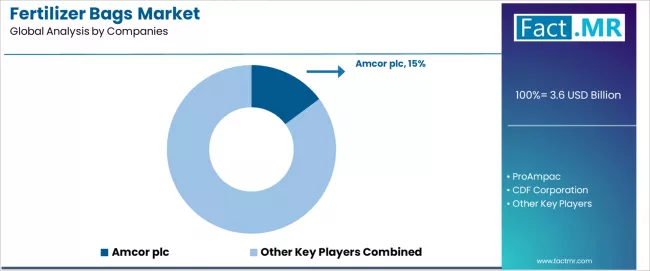
Fertilizer Bags Market Analysis By Company | Source: Fact.MR
The fertilizer bags market features approximately 20-30 meaningful players with moderate concentration, where the top three companies control roughly 35-45% of global production capacity through established manufacturing operations and extensive customer relationships across agricultural packaging sectors.
Market leaders include Amcor plc, ProAmpac, and CDF Corporation, which maintain competitive advantages through comprehensive flexible packaging portfolios, global manufacturing networks, and deep expertise in the agricultural packaging and polymer processing sectors, creating strong customer relationships among fertilizer manufacturers and agricultural distributors.
These companies leverage established production facilities and ongoing capacity expansion initiatives to defend market positions while expanding into adjacent agricultural packaging applications and emerging markets. Amcor plc commands a 14.8% market share through integrated packaging solutions and strategic positioning in agricultural markets.
Challengers encompass Türkkraft, CarePac, and MST Packaging Co., Ltd., which compete through specialized manufacturing capabilities and strong regional presence in key agricultural markets. Specialty packaging producers, including Tex-Trude, Miller Weldmaster, and Turf Care Supply, LLC, focus on specific product categories or geographic regions, offering differentiated capabilities in custom printing, specialized materials, and technical support services.
Regional players and emerging manufacturers create competitive pressure through cost-competitive production capabilities and localized market presence, particularly in high-growth markets including India and China, where proximity to fertilizer manufacturing operations provides advantages in logistics optimization and customer service.
Market dynamics favor companies that combine efficient manufacturing technologies with comprehensive quality management systems that address the complete value chain from polymer procurement through bags production, printing operations, and delivery logistics. Strategic investments in automated weaving equipment and lamination capabilities enable cost optimization and product quality enhancement across packaging operations.
Global Fertilizer Bags Market - Stakeholder Contribution Framework
Fertilizer bags represent critical packaging materials that enable fertilizer manufacturers, agricultural distributors, and farming operations to ensure product integrity and handling convenience without substantial distribution modifications, typically providing essential containment functionality and moisture protection capabilities while supporting diverse agricultural applications.
With the market projected to grow from USD 3.6 billion in 2025 to USD 6.3 billion by 2035 at a 5.8% CAGR, these products offer compelling advantages - cost-effective packaging, reliable product protection, and convenient handling characteristics - making them essential for chemical fertilizer distribution (largest segment), organic fertilizer packaging (expanding adoption), and diverse agricultural input applications seeking proven containment solutions. Scaling production capacity and market development requires coordinated action across industrial policy, industry standards, packaging manufacturers, agricultural companies, and sustainability initiatives.
How Governments Could Spur Sustainable Packaging and Infrastructure?
- Packaging Standards Development: Include sustainable packaging specifications in agricultural policy frameworks, providing guidelines for recyclable materials in agricultural applications and supporting packaging manufacturers through recycling infrastructure development programs.
- Agricultural Input Distribution Support: Implement comprehensive rural distribution infrastructure improvements, provide logistics support for agricultural input delivery, and establish quality standards that facilitate efficient fertilizer distribution while ensuring product integrity.
- Recycling Infrastructure Investment: Create collection systems for agricultural packaging waste across farming regions, establish recycling facilities for polypropylene materials, and develop extended producer responsibility programs that facilitate circular economy implementation in agricultural packaging.
- Industry Development Programs: Fund packaging technology improvements for domestic manufacturers, support capacity expansion initiatives, and invest in training programs that bridge polymer processing expertise with agricultural packaging requirements.
How Industry Bodies Could Support Market Development?
- Quality Standards & Specifications: Define standardized performance requirements for fertilizer packaging across different fertilizer types and climatic conditions, establish universal testing protocols and strength metrics, and create certification programs for packaging quality that manufacturers can rely on.
- Sustainability Guidelines & Practices: Lead communication initiatives that demonstrate sustainable packaging approaches, emphasizing proven recyclability options, material efficiency improvements, and waste reduction strategies compared to alternative packaging formats.
- Technical Standards Development: Develop comprehensive packaging specifications for moisture barrier properties, UV stability requirements, and mechanical strength benchmarks, ensuring reliable performance across different agricultural environments and distribution systems.
How Manufacturers and Agricultural Companies Could Strengthen the Ecosystem?
- Material Innovation & Development: Develop next-generation polymer formulations with enhanced sustainability characteristics, improved recyclability features, and application-specific properties that enhance packaging performance while reducing environmental impact and material costs.
- Quality Assurance Systems: Provide comprehensive manufacturing quality control that integrates raw material testing, process monitoring, finished product validation, and performance documentation, enabling customers to maximize packaging reliability and product protection.
- Circular Economy Programs: Offer collection arrangements for used packaging materials, including take-back programs, recycling partnerships, and reprocessing initiatives that keep agricultural packaging materials in productive use and minimize environmental impacts.
Key Players in the Fertilizer Bags Market
- Amcor plc
- ProAmpac
- CDF Corporation
- Türkkraft
- CarePac
- MST Packaging Co., Ltd.
- Tex-Trude
- Miller Weldmaster
- Turf Care Supply, LLC
- Balcan Innovations Inc.
Segmentation
Scope of the Report
| Items | Values |
|---|---|
| Quantitative Units | USD 3.6 Billion |
| Material | Polypropylene, Polyethylene, Jute, Paper, Non-woven Fabric |
| Size | Less than 10 kg, 10-25 kg, 25-50 kg, 50-100 kg, More than 100 kg |
| Closure Type | Sewn Closure, Plastic Tie, Drawstring, Wire Tie, Glued Closure |
| Application | Chemical Fertilizers, Organic Fertilizers, Seed Treatment, Agrochemicals |
| Regions Covered | Asia Pacific, North America, Europe, Latin America, Middle East & Africa |
| Country Covered | India, China, Brazil, USA, Germany, Saudi Arabia, South Africa, and 40+ countries |
| Key Companies Profiled | Amcor plc, ProAmpac, CDF Corporation, Türkkraft, CarePac, MST Packaging Co., Ltd., Tex-Trude, Miller Weldmaster, Turf Care Supply, LLC, Balcan Innovations Inc. |
| Additional Attributes | Dollar sales by material categories, size configurations, and application segments, regional production trends across Asia Pacific, Latin America, and Europe, competitive landscape with packaging manufacturers and flexible packaging companies, material specifications and quality requirements, integration with fertilizer distribution systems and agricultural retail operations. |
Source: Fact.MR analysis. Updated Dec 1, 2025
Fertilizer Bags Market by Segments
-
Material :
- Polypropylene (PP)
- Woven PP
- Laminated PP
- UV-stabilized PP
- Polyethylene (PE)
- LDPE
- HDPE
- Jute
- Paper
- Non-woven Fabric
- Polypropylene (PP)
-
Size :
- Less than 10 kg
- 10-25 kg
- 10-20 kg
- 20-25 kg
- 25-50 kg
- 25-35 kg
- 35-50 kg
- 50-100 kg
- 50-70 kg
- 70-100 kg
- More than 100 kg
-
Closure Type :
- Sewn Closure
- Single-stitch
- Double-stitch
- Plastic Tie
- Clip tie
- Zip tie
- Drawstring
- Wire Tie
- Glued Closure
- Sewn Closure
-
Application :
- Chemical Fertilizers
- NPK
- Urea
- Phosphate
- Organic Fertilizers
- Manure-based Organic
- Compost-based Organic
- Seed Treatment
- Agrochemicals
- Chemical Fertilizers
-
Region :
- Asia Pacific
- India
- China
- Japan
- Australia & New Zealand
- Rest of Asia Pacific
- North America
- USA
- Canada
- Mexico
- Europe
- Germany
- France
- Poland
- Netherlands
- Rest of Europe
- Latin America
- Brazil
- Argentina
- Rest of Latin America
- Middle East & Africa
- Saudi Arabia
- Other GCC Countries
- Turkey
- South Africa
- Rest of Middle East & Africa
- Asia Pacific
Frequently Asked Questions
How big is the fertilizer bags market in 2025?
What will be the size of fertilizer bags market in 2035?
How much will be the fertilizer bags market growth between 2025 and 2035?
What are the key product types in the fertilizer bags market?
Which size segment to contribute significant share in the fertilizer bags market in 2025?
Who worked on this report


Preview the report firsthand - request a free sample
Free SampleGet the brochure for pricing and purchase details
Download PDF