- Market Value (2025): USD 957.6 Mn
- Estimated Value (2026): USD 1040.0 Mn
- Forecast Value (2036): USD 2373.2 Mn
- CAGR (2026-2036): 8.6%
What is the Thermally Conductive Epoxies Market forecast to be worth by 2036?
USD 2373.2 million by 2036 at 8.6% CAGR.
- The Thermally Conductive Epoxies Market reached USD 957.6 million in 2025.
- Demand is projected to increase from USD 1040.0 million in 2026 to USD 2373.2 million by 2036.
- The market is forecast to record a 8.6% CAGR from 2026 to 2036.
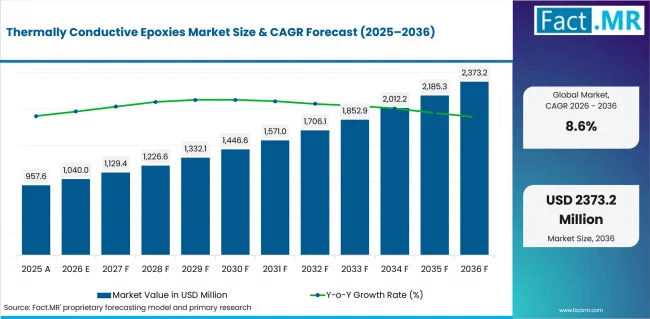
Thermally Conductive Epoxies Market Value Analysis | Source: Fact.MR
What are the defining numbers behind Thermally Conductive Epoxies Market growth?
An absolute opportunity of USD 1,340.0 million is expected between 2026 and 2036.
- Demand Drivers in the Market
- Thermally conductive epoxies create a permanent bond while moving heat from power modules, LEDs and control electronics into heat spreaders or baseplates, removing the need for a separate structural adhesive at the interface.
- Alumina and other ceramic fillers raise thermal conductivity while preserving electrical insulation, which is important around high-voltage inverters and converters.
- Power-electronics heat density is rising as EVs, renewable-energy systems and industrial drives use more compact switching modules, increasing demand for bonded interfaces that remain stable through thermal cycling.
- Electrified vehicles and renewable-power equipment increase production of inverters, converters and charging electronics, adding more joints where heat transfer and mechanical retention must be qualified together.
- Automated dispensing and bond-line control reduce excess material and help manufacturers maintain repeatable thermal resistance across production assemblies.
- Key Segments Analyzed
- 2-4 W/mK accounts for 29.0% of Conductivity Range in 2026 because it provides useful heat transfer without the processing difficulty associated with very high filler loading.
- Alumina-filled holds 34.0% of Filler Type in 2026 because alumina improves thermal conduction while maintaining electrical insulation for power-electronics assemblies.
- Power module bonding represents 42.0% of Application in 2026 because the adhesive must secure the module and provide a stable heat path to the baseplate through thermal cycling.
- Power electronics captures 35.0% of End User in 2026 as inverters and converters concentrate heat in compact assemblies that require bonded thermal interfaces.
- Analyst Opinion at Fact.MR
- Shambhu Nath Jha, Principal Consultant at Fact.MR, states, "Buyer decisions in the Thermally Conductive Epoxies Market will centre on a permanent structural bond that also creates a reliable heat path through thermal cycling. Buyers will compare the 2026 segment leaders with qualification evidence and the operating cost of the full process. Suppliers that support application trials and preserve formulation or equipment consistency can move more quickly into repeat production."
- Strategic Implications
- Suppliers should document the process conditions that allow 2-4 W/mK to deliver repeatable performance.
- Customer trials should use the intended substrate, fluid path or process stream before commercial qualification.
- Regional technical support is important in China and Germany because adoption depends on local production or infrastructure conditions.
- Commercial positioning should distinguish qualified application performance from general material or equipment capability.
- Parker LORD reflects current Parker Hannifin ownership.
How does the Thermally Conductive Epoxies Market break down by segment?
The market is segmented by Conductivity Range, Filler Type, Application and End User.
Why does 2-4 W/mK lead Conductivity Range?
2-4 W/mK is projected to account for a 28.6% share in 2026.
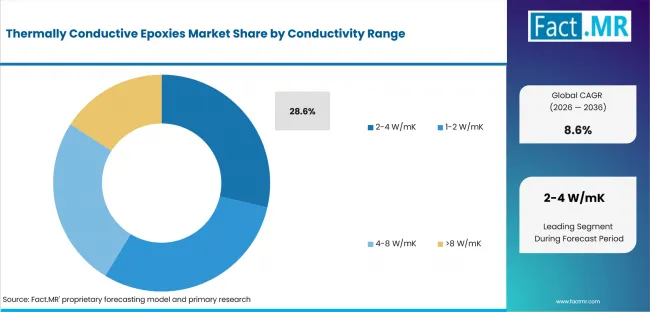
Thermally Conductive Epoxies Market Analysis By Conductivity Range | Source: Fact.MR
The 2-4 W/mK range balances heat transfer with workable viscosity, allowing conventional dispensing equipment to form controlled bond lines.
Higher conductivity usually requires more filler, which can increase viscosity and reduce wetting, so buyers move upward only when the thermal load justifies the processing burden.
Why does Alumina-filled lead Filler Type?
Alumina-filled is projected to account for a 33.5% share in 2026.
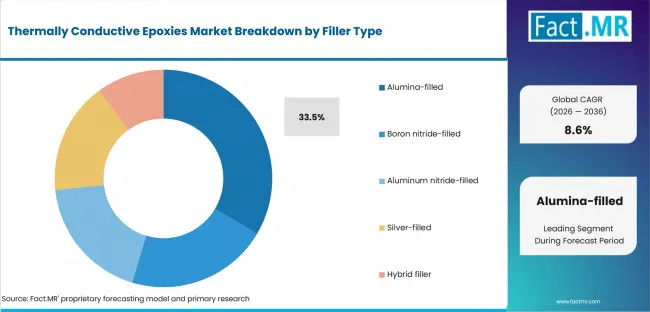
Thermally Conductive Epoxies Market Analysis By Filler Type | Source: Fact.MR
Alumina raises thermal conductivity without creating an electrically conductive path between energized components and the cooling structure.
The filler can also be adjusted to balance viscosity and cured stiffness across automotive, industrial and renewable power modules.
Why does Power module bonding lead Application?
Power module bonding is projected to account for a 42.1% share in 2026.
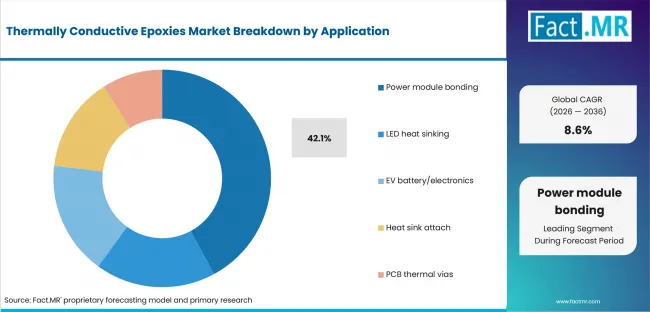
Thermally Conductive Epoxies Market Analysis By Application | Source: Fact.MR
Power module bonding combines structural attachment with heat transfer from the semiconductor package into a baseplate or heat spreader.
Thermal cycling stresses the joint as adjoining materials expand at different rates, so adhesion retention and thermal resistance are qualified together.
Why do Power electronics lead End User?
Power electronics are projected to account for a 35.3% share in 2026.
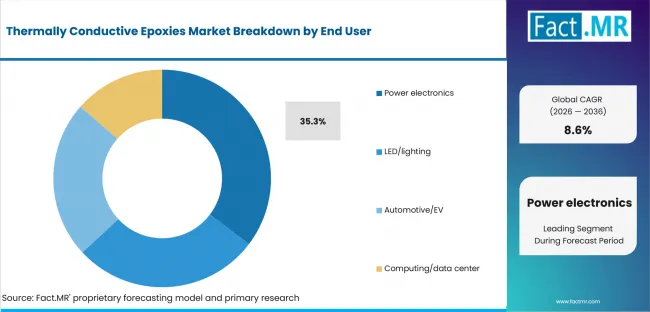
Thermally Conductive Epoxies Market Analysis By End User | Source: Fact.MR
Power-electronics manufacturers use thermally conductive epoxies around inverters, converters and modules where compact packaging increases heat flux and electrical isolation remains essential.
These users also qualify dielectric performance and thermal-cycling stability, favouring suppliers that maintain filler dispersion and viscosity from lot to lot.
What is accelerating Thermally Conductive Epoxies Market adoption, and what is holding it back?
Drivers Impact Analysis
| Factor | (~) % Impact on CAGR | Geographic Relevance | Impact Timeline |
|---|---|---|---|
| Power electronics using 2-4 W/mK | +2.3% | China | Short term (<= 2 years) |
| Insulating Alumina-filled systems | +1.9% | Germany | Medium term (2-4 years) |
| EV and renewable conversion | +1.4% | South Korea | Long term (>= 4 years) |
Opportunity Impact Analysis
| Factor | (~) % Impact on CAGR | Geographic Relevance | Impact Timeline |
|---|---|---|---|
| Lower-viscosity thermal epoxy | +1.2% | China | Short term (<= 2 years) |
| Higher-conductivity ceramic fillers | +0.9% | Germany | Medium term (2-4 years) |
| Automated bond-line control | +0.7% | South Korea | Long term (>= 4 years) |
Restraints Impact Analysis
| Factor | (~) % Impact on CAGR | Geographic Relevance | Impact Timeline |
|---|---|---|---|
| High filler viscosity | -1.1% | China | Short term (<= 2 years) |
| Thermal-cycling delamination | -0.9% | Germany | Medium term (2-4 years) |
| Thermal test-method variation | -0.6% | South Korea | Long term (>= 4 years) |
Which countries are scaling the Thermally Conductive Epoxies Market through 2036?
- China: China combines electronics assembly with semiconductor and component manufacturing, creating a broad qualification base for the in-scope material or equipment.
- Germany: Germany has a substantial automotive and industrial-electronics base where repeatability and equipment integration influence selection.
- South Korea: South Korea combines memory, display and electronics manufacturing with automotive and battery investment.
- Japan: Japan has established semiconductor, automotive and precision-electronics production with demanding reliability requirements.
- USA: The USA combines advanced packaging investment with aerospace, medical and power-electronics applications.
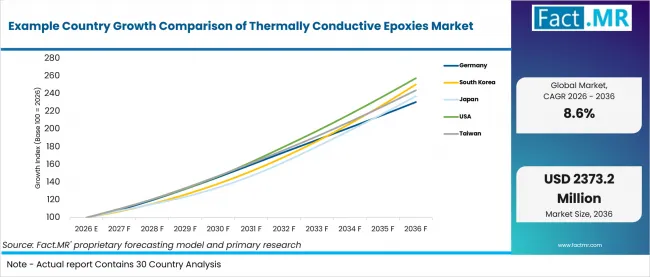
Example Country Growth Comparison Of Thermally Conductive Epoxies Market | Source: Fact.MR
Country CAGR (2026-2036)
| Country | CAGR (2026-2036) |
|---|---|
| Germany | 9.0% |
| South Korea | 9.5% |
| Japan | 9.1% |
| USA | 9.6% |
What is driving Germany's growth through 2036?
Germany is forecast to expand at a 9.0% CAGR from 2026 to 2036.
Germany's automotive, machinery and electrical-equipment sectors maintain a strong base for qualified materials and automated assembly; recent orders also showed growth in electrical equipment.
Electrified vehicle platforms add power modules that require electrically insulating thermal bonds able to survive repeated temperature cycling.
What is driving South Korea's growth through 2036?
South Korea is forecast to expand at a 9.5% CAGR from 2026 to 2036.
South Korea combines semiconductor, display, battery and automotive manufacturing, while public programmes continue to support materials, components and equipment capability.
The local qualification ecosystem gives epoxy suppliers more opportunities to work with device and module manufacturers on filler loading and cure performance.
What is driving Japan's growth through 2036?
Japan is forecast to expand at a 9.1% CAGR from 2026 to 2036.
Japan combines automotive and precision-electronics manufacturing with new semiconductor investment, creating production environments where repeatability and supplier qualification are central.
New semiconductor pilot and production activity adds assemblies that require qualified thermal-interface bonding materials.
What is driving the USA's growth through 2036?
The USA is forecast to expand at a 9.6% CAGR from 2026 to 2036.
U.S. manufacturing includes electronics, aerospace and industrial equipment, while current semiconductor and advanced-packaging investment is adding new pilot and production capacity.
CHIPS-funded packaging and manufacturing programmes create qualification environments where thermal resistance and dielectric performance must be demonstrated on actual hardware.
Who leads the Thermally Conductive Epoxies Market?
Henkel is positioned as a leading supplier through formulation breadth and technical support. Master Bond and Dow compete through application-specific materials for electronics or industrial equipment.
Competition is determined by cured performance and process consistency. Buyers assess viscosity and cure profile together with thermal, dielectric or mechanical requirements.
Qualification history and lot control create switching costs, so suppliers with stable formulations and local process support retain stronger positions.
Parker LORD reflects current Parker Hannifin ownership.
Which companies are the key providers?
Key companies profiled include Henkel; Master Bond; Dow; Parker Lord; Epoxy Technology (Epo-Tek); and Aremco Products.
- Henkel
- Master Bond
- Dow
- Parker Lord
- Epoxy Technology (Epo-Tek)
- Aremco Products
Bibliography
- U.S. Department of Energy. (2025). Power Electronics Thermal Management Research and Development. U.S. Government.
- National Renewable Energy Laboratory. (2025). Thermal Management for Power Electronics and Electric Drive Systems. U.S. Department of Energy.
- National Institute of Standards and Technology. (2026). Thermal Property Measurements for Electronic Materials. U.S. Department of Commerce.
- U.S. Department of Commerce. (2025). CHIPS for America Advanced Packaging Manufacturing Program. U.S. Government.
- IPC. (2024). Electronics Assembly Process Control and Materials Standards. IPC.
- Ministry of Industry and Information Technology, China. (2026). Development of the Electronic Information Manufacturing Industry in 2025. Government of China.
- Federal Ministry for Economic Affairs and Climate Action, Germany. (2025). Industrial and Automotive Transformation Programmes. Government of Germany.
- Ministry of Trade, Industry and Energy, Republic of Korea. (2025). High-Tech Strategic Industry and Materials Development Measures. Government of the Republic of Korea.
- Ministry of Economy, Trade and Industry, Japan. (2025). Strategy for Semiconductor and Digital Industry Revitalization. Government of Japan.
- Henkel. (2026). Thermally Conductive Epoxy Adhesives. Henkel.
- Parker Hannifin. (2026). Parker LORD Thermal Management Materials. Parker Hannifin.
This Report Answers
- The report examines demand across Conductivity Range, Filler Type, Application, End User.
- Segment analysis explains the operating reason behind each leading category.
- Country analysis evaluates the listed markets and adoption conditions through 2036.
- Competitive analysis reviews the listed companies and clarifies ownership or research roles where relevant.
- The analysis considers qualification, process control and application fit that influence purchasing decisions.
What does the Thermally Conductive Epoxies Market cover?
Thermally conductive epoxy adhesives and potting compounds providing heat dissipation with structural bonding for power electronics, LEDs, EV and thermal-management assemblies.
The assessment follows the stated segmentation by Conductivity Range, Filler Type, Application, End User. Revenue is counted only where the stated product or equipment is sold for the listed applications.
What is included in the scope?
The scope includes 1-2 W/mK, 2-4 W/mK, 4-8 W/mK, >8 W/mK.
It also covers Alumina-filled, Boron nitride-filled, Aluminum nitride-filled, Silver-filled, Hybrid filler.
Demand is assessed across Application: Power module bonding, LED heat sinking, EV battery/electronics, Heat sink attach, PCB thermal vias; End User: Power electronics, LED/lighting, Automotive/EV, Computing/data center.
What is excluded from the scope?
Materials that do not meet the defined viscosity, electrical, thermal, vacuum or chemistry requirement are excluded.
Standalone mixers, dispensers and curing equipment are excluded from material revenue.
General construction resins are outside the market unless sold into the listed application.
How Was the Analysis Built?
The analysis combines product scope, segment demand, country outlook and supplier coverage.
- Primary Research: Interviews focus on formulators, distributors, equipment suppliers and end users responsible for bonding, potting or thermal management.
- Desk Research: The review covers technical standards, government manufacturing programmes and company product literature.
- Market Sizing and Forecasting: Estimates combine application volume, material use per part, formulation mix, pack size and realized pricing.
- Data Validation and Update Cycle: Findings are checked against public evidence and supplier portfolios. Updates review formulation changes, ownership changes and manufacturing shifts.
What is the report's scope and coverage?
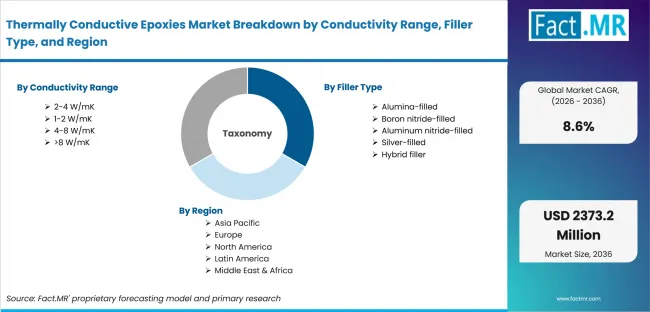
Thermally Conductive Epoxies Market Breakdown By Conductivity Range, Filler Type, And Region | Source: Fact.MR
| Attribute | Details |
|---|---|
| Quantitative Units | USD Million |
| Market Definition | Thermally conductive epoxy adhesives and potting compounds providing heat dissipation with structural bonding for power electronics, LEDs, EV and thermal-management assemblies. |
| Segments Covered | Conductivity Range; Filler Type; Application; End User |
| Regions Covered | North America; Latin America; Europe; East Asia; South Asia and Oceania; Middle East and Africa |
| Countries Covered | China; Germany; South Korea; Japan; USA |
| Key Companies Profiled | Henkel; Master Bond; Dow; Parker Lord; Epoxy Technology (Epo-Tek); Aremco Products |
| Forecast Period | 2026 to 2036 |
| Base Year | 2025 |
| Market Value, 2026 | USD 1,040.0 million |
| Market Value, 2036 | USD 2,380.0 million |
| CAGR, 2026-2036 | 8.6% |
| Absolute Opportunity | USD 1,340.0 million |
| Approach | Combines application volume, material use per part, formulation mix, pack size and realized pricing. |
How is the market segmented?
-
By Conductivity Range
- 1-2 W/mK
- 2-4 W/mK
- 4-8 W/mK
- >8 W/mK
-
By Filler Type
- Alumina-filled
- Boron nitride-filled
- Aluminum nitride-filled
- Silver-filled
- Hybrid filler
-
By Application
- Power module bonding
- LED heat sinking
- EV battery/electronics
- Heat sink attach
- PCB thermal vias
-
By End User
- Power electronics
- LED/lighting
- Automotive/EV
- Computing/data center
-
By Region
- North America
- Latin America
- Western Europe
- Eastern Europe
- East Asia
- South Asia and Pacific
- Middle East & Africa