Trauma Care Centers Market Size, Share, Growth and Forecast (2026 - 2036)
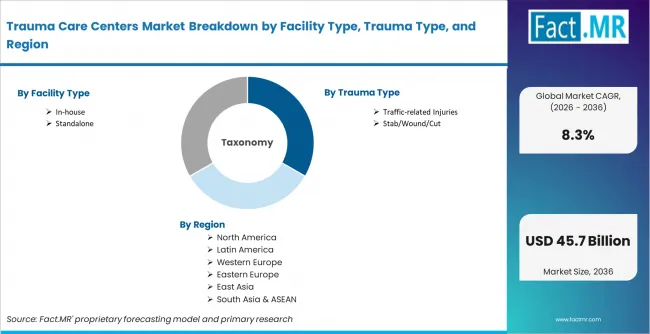
The Trauma Care Centers Market is segmented by Facility Type (In-house and Standalone), Trauma Type (Falls, Traffic-related Injuries, Stab/Wound/Cut, Burn Injury, Brain Injury, and Other Injuries), End User (Inpatient, Outpatient, and Rehabilitation), Trauma Center Level (Level I, Level II, Level III, and Level IV), Service Type (Emergency Services, Surgical Services, Post-trauma Rehabilitation, and Diagnostic Services), and Region. Forecast for 2026 to 2036.
Fact.MR suggests that the trauma care centers market is moving toward a structural capacity shift. Rising road accident cases are increasing pressure on existing trauma infrastructure, especially in emerging markets. Many Level III and IV centers remain under-resourced, limiting their ability to manage complex cases effectively.
Trauma Care Centers Market Forecast and Outlook By Fact.MR
- In 2025, the trauma care centers market was valued at USD 17.5 billion.
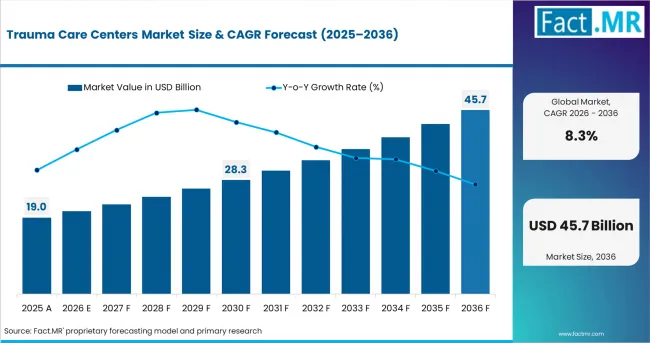
- Based on Fact.MR analysis, demand for trauma care center services and infrastructure is estimated to grow to USD 19.0 billion in 2026 and USD 42.2 billion by 2036.
- FACT.MR projects a CAGR of 8.3% during the forecast period.
| Metric | Value |
|---|---|
| Estimated Value in 2026 | USD 19.0 billion |
| Forecast Value in 2036 | USD 42.2 billion |
| Forecast CAGR (2026 to 2036) | 8.3% |
Summary of Trauma Care Centers Market
- Market Definition
- The market covers certified trauma care facilities delivering emergency surgery, critical care, and rehabilitation services across Level I to Level IV designations, spanning in-house hospital units and standalone trauma centers globally.
- Demand Drivers
- Rising global road traffic accident incidence, particularly in South and Southeast Asia, is increasing demand for Level I and Level II trauma surgical capacity and emergency stabilization services at integrated hospital networks.
- Government-led emergency care infrastructure programmes in China, the United Kingdom, and Gulf states are directing capital investment toward trauma center upgrades and regional trauma network expansion.
- Ageing population cohorts in high-income markets are generating higher fall-related trauma admission volumes, sustaining inpatient surgical demand at Level II and Level III trauma centers in North America and Western Europe.
- Key Segments Analyzed
- By Facility Type: In-house trauma centers hold approximately 70% share in 2026, reflecting their structural integration within multi-specialty hospital networks providing surgical and ICU access.
- By Trauma Type: Traffic-related injuries lead with approximately 35% share in 2026, driven by high road accident incidence in emerging economies requiring urgent specialized intervention.
- By End User: Inpatient care dominates with approximately 60% share in 2026, as severe trauma cases require hospitalization, surgical intervention, and continuous monitoring.
- By Trauma Center Level: Level I trauma centers hold approximately 45% share in 2026, underpinned by 24/7 surgical team availability and advanced critical care capability.
- By Service Type: Emergency services account for approximately 40% share in 2026, as immediate stabilization and life-saving interventions define the core function of trauma centers.
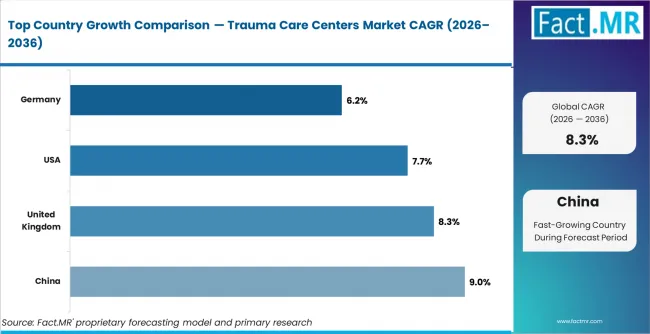
- By Geography: China leads at 9.0% CAGR, driven by national emergency medical service expansion and hospital infrastructure investment under the Healthy China 2030 initiative.
- Analyst Opinion at FACT.MR
- Shambhu Nath Jha, Principal Consultant at Fact.MR, opines, 'CXOs will see a clear divide emerging between advanced, fully integrated Level I trauma centers and under-resourced standalone facilities. This gap is shaping where growth and value will concentrate over the next decade. Well-equipped hospital networks are better positioned to handle complex cases and attract higher patient volumes.’
- Strategic Implications
- Invest in Level I and Level II trauma center capacity expansion within multi-specialty hospital networks in emerging markets to capture rising road accident-driven surgical volumes at premium reimbursement rates.
- Develop integrated post-trauma rehabilitation programmes within inpatient networks to extend patient revenue cycles beyond acute care episodes and improve long-term facility utilization rates.
- Build government partnership frameworks targeting national emergency care infrastructure programmes in China, Gulf states, and Sub-Saharan Africa to secure early-stage facility development contracts.
- Methodology
- Market sizing uses WHO road safety data, national trauma registry admission volumes, and average revenue per patient episode benchmarks, validated against hospital network revenue disclosures from 2024 to 2025.
- Analysis incorporates CMS DRG reimbursement schedules, NHS Major Trauma Network annual reports, KHIDI health infrastructure data, and national trauma surgical society annual statistics.
- Forecasts account for trauma admission volume trends by injury type, government capital programme timelines, Level I to IV designation upgrade rates, and payer reimbursement structure evolution by country.
The market is projected to generate USD 23.2 billion in incremental revenue over the forecast period. Growth reflects rising trauma incidence volumes, increasing investments in Level I and II trauma infrastructure, and government-led emergency care programmes across Asia Pacific and the Middle East. Healthcare system expansion in high-growth economies continues to sustain demand.
Structural constraints persist across multiple regions. Public funding limitations affect trauma center upgrades in lower-income countries. Workforce shortages in trauma surgery and critical care nursing are limiting throughput capacity at existing centers. Reimbursement variability across payer systems creates uneven revenue certainty for standalone operators.
China leads at 9.0% CAGR through 2036, driven by national emergency medical service network expansion and hospital infrastructure investment under the Healthy China 2030 initiative. The United Kingdom follows at 8.3%, supported by NHS Major Trauma Network restructuring. The United States grows at 7.7%, anchored by Level I center capacity expansion and trauma system consolidation. Germany records 6.2%, supported by DRG reimbursement reform and hospital restructuring programmes.
Segmental Analysis
Trauma Care Centers Market Analysis by Facility Type
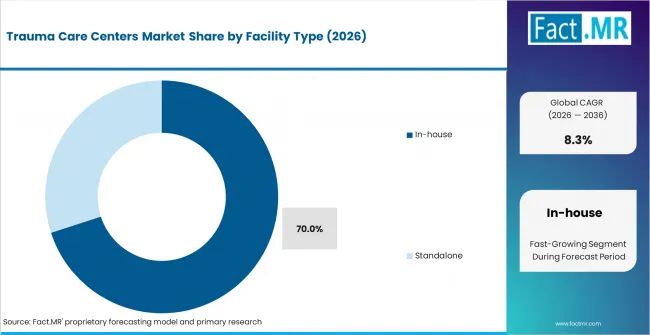
Based on FACT.MR's trauma care centers market report, in-house trauma centers are estimated to hold approximately 70% share in 2026. Their dominance reflects structural integration within multi-specialty hospitals, enabling immediate access to surgical teams, ICU support, and advanced diagnostic infrastructure.
- HCA Healthcare Facility Investment: HCA Healthcare disclosed in its fiscal year 2024 annual report that it continued targeted capital investment in trauma center infrastructure across its Level I and Level II designated hospital network in the United States, including surgical suite upgrades and trauma bay expansions at high-volume facilities in Florida and Texas. [4]
- Apollo Hospitals Trauma Integration: Apollo Hospitals reported in its fiscal year 2024–25 results that it expanded integrated trauma care capabilities at its multi-specialty campuses in Chennai and Hyderabad, citing rising road accident admission volumes and increasing patient preference for comprehensive in-house trauma management over standalone facilities. [5]
- Standalone Center Consolidation Trend: The American Trauma Society noted in its 2024 annual report that standalone Level III and Level IV trauma centers in rural U.S. markets face ongoing financial viability challenges, with merger and acquisition activity by regional hospital networks accelerating as standalone operators seek capital for mandatory compliance upgrades. [6]
Trauma Care Centers Market Analysis by Trauma Type
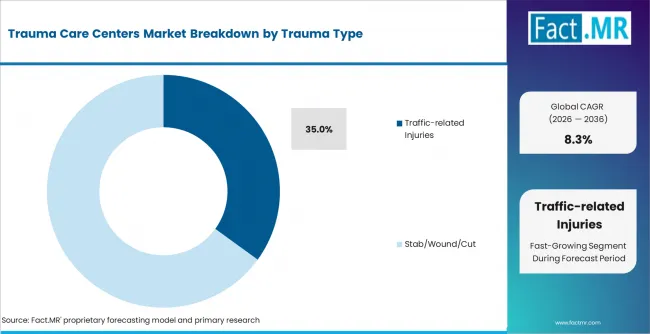
Based on FACT.MR's report, traffic-related injuries are estimated to account for approximately 35% share in 2026. This reflects high global road accident incidence, particularly across emerging economies in Asia and Africa.
- WHO Road Accident Burden Data: The WHO 2024 Global Status Report on Road Safety confirmed that approximately 1.19 million deaths annually result from road traffic crashes, with over 90% concentrated in low- and middle-income countries. This sustains structural demand for traffic injury-focused trauma surgical services across South Asia, Sub-Saharan Africa, and Southeast Asia. [1]
- Fortis Healthcare Trauma Capacity: Fortis Healthcare disclosed in its fiscal year 2024–25 investor communications that its trauma and emergency medicine division handled rising volumes of road accident cases across its Delhi NCR and Mumbai facilities, prompting expansion of trauma bay capacity and neurosurgical staffing at key campuses. [7]
- Brain Injury Care Development: The Brain Trauma Foundation updated its clinical guidelines for severe traumatic brain injury management in 2024, introducing new protocols for neuromonitoring and ICP management that are increasing equipment and training investment requirements at Level I trauma centers globally. [8]
Trauma Care Centers Market Analysis by End User
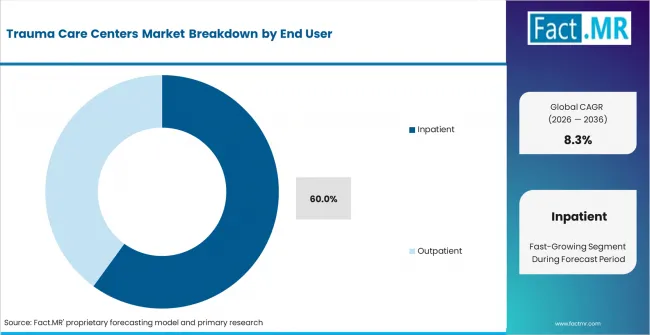
Based on FACT.MR's report, inpatient care dominates with approximately 60% share in 2026. Severe trauma cases require hospitalization, surgical intervention, and continuous monitoring, generating high per-episode revenue. The complexity and acuity of trauma admissions sustain inpatient volumes as the primary revenue driver for trauma centers at all designation levels.
- Tenet Healthcare Inpatient Revenue: Tenet Healthcare reported in its fiscal year 2024 results that trauma-related inpatient admissions continued to represent a high-acuity, high-revenue patient category across its hospital network, with Level I trauma centers generating above-average DRG reimbursement rates relative to general inpatient surgical cases. [9]
- Outpatient Trauma Follow-Up Growth: Community Health Systems disclosed in its 2024 annual report that outpatient trauma follow-up clinic volumes at affiliated Level II centers increased year-on-year, driven by shorter inpatient stays and expanded structured post-discharge monitoring programmes aligned with CMS value-based care initiatives. [10]
- Rehabilitation Programme Expansion: The Commission on Accreditation of Rehabilitation Facilities reported in its 2024 programme data that inpatient rehabilitation facility admissions for traumatic injury diagnoses, including TBI and spinal cord injury, increased in the United States, reflecting greater post-acute care integration within Level I and Level II trauma hospital networks. [11]
Trauma Care Centers Market Analysis by Trauma Center Level
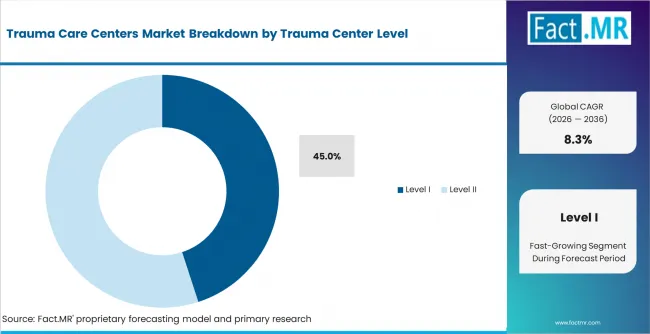
Based on FACT.MR's report, Level I trauma centers hold approximately 45% share in 2026. Their comprehensive capabilities, including 24/7 surgical team availability, advanced critical care, and full specialist coverage, position them as the highest-acuity and highest-revenue designation within the trauma center hierarchy.
- Cleveland Clinic Trauma Program: Cleveland Clinic disclosed in its 2024 annual community benefit report that its Level I Trauma Center at the main campus managed a high volume of complex multi-system trauma cases, with ongoing investment in trauma resuscitation infrastructure and hybrid operating room capability to support damage control surgery. [12]
- Level II Center Designation Activity: The American College of Surgeons Committee on Trauma reported in its 2024 verification programme data that Level II trauma center applications and reverification activity increased in the United States, reflecting health system investment in formalizing trauma designation for community hospital campuses with growing trauma volumes
- Level III and IV Rural Coverage: Mayo Clinic's trauma programme documentation from 2024 highlights the ongoing role of Level III and Level IV centers as critical initial stabilization and transfer nodes in rural and semi-urban catchment areas, sustaining demand for structured triage protocols and transfer agreements with Level I facilities.
Trauma Care Centers Market Analysis by Service Type
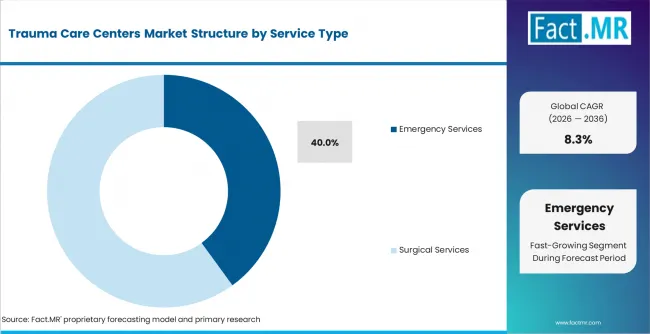
Based on FACT.MR's report, emergency services account for approximately 40% share in 2026. Immediate stabilization and life-saving intervention are the defining functions of trauma centers.
- Diagnostic Service Technology Adoption: Diagnostic technology adoption is increasing. Siemens Healthineers reported higher demand for trauma CT and point-of-care imaging in 2024, driven by Level I and II center requirements.
- Surgical Service Capacity Investment: Surgical capacity investment is expanding. HCA Healthcare added hybrid operating rooms in 2024, enabling combined surgical procedures and higher revenue per case.
- Post-Trauma Rehabilitation Integration: Rehabilitation integration is strengthening. American Congress of Rehabilitation Medicine updated 2025 guidelines promoting early inpatient rehab, increasing integration within trauma centers.
Drivers, Restraints, and Opportunities
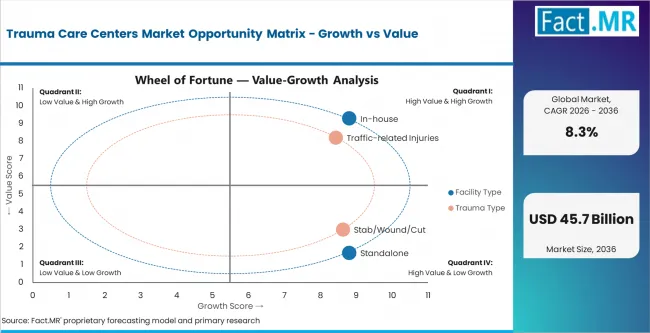
FACT.MR analysts observe the trauma care centers market is in a sustained structural growth phase anchored by rising injury burden in emerging economies and organized trauma system development in high-income markets.
Standalone trauma centers are facing financial pressure from high fixed costs and inconsistent reimbursement. Integrated hospital-based trauma programs are absorbing market share by offering full service continuity from emergency intake through rehabilitation.
- WHO Road Safety Investment Framework: The WHO 2024 Global Status Report on Road Safety identified Sub-Saharan Africa and South Asia as regions with the highest unmet trauma care capacity gaps, prompting multilateral investment in trauma infrastructure under the UN Decade of Action on Road Safety 2021–2030. This is directly driving facility development contracts across priority countries. [1]
- NHS Major Trauma Network Expansion: NHS England announced in January 2025 the continuation of its Major Trauma Network investment cycle, allocating capital toward regional trauma unit upgrades across underserved areas in the North and Midlands. This sustains facility modernisation demand in the UK market and reinforces integrated hospital network operators as primary beneficiaries. [2]
- Healthy China 2030 Emergency Care Programme: China's National Health Commission expanded its emergency medical service infrastructure targets under the Healthy China 2030 plan in 2024, prioritising Level II and Level III trauma center accreditation across secondary cities. This is accelerating hospital network capital deployment and creating vendor opportunities in diagnostic equipment, surgical infrastructure, and critical care technology. [3]
Regional Analysis
The trauma care centers market is assessed across North America, Europe, Asia Pacific, Latin America, and Middle East and Africa, covering major countries with demand shaped by trauma incidence rates, hospital infrastructure investment, government emergency care programmes, and reimbursement frameworks. The full report provides market attractiveness analysis by region and country.
.webp)
| Country | CAGR (2026 to 2036) |
|---|---|
| China | 9.0% |
| United States | 7.7% |
| Germany | 6.2% |
| United Kingdom | 8.3% |
Source: Fact.MR (FACT.MR) analysis, based on proprietary forecasting model and primary research
North America Trauma Care Centers Market Analysis
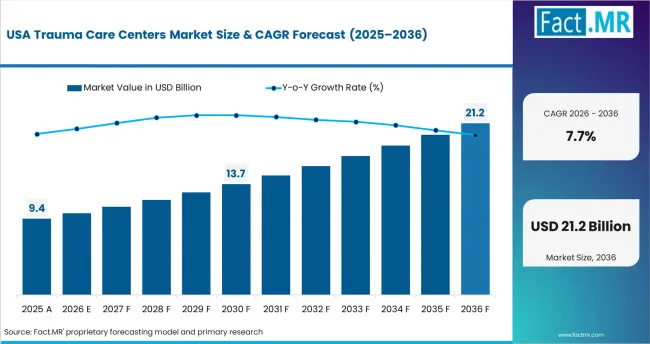
North America represents the most structured and consolidated trauma care ecosystem, supported by formal verification systems, reimbursement maturity, and strong hospital network integration.
- United States: The United States market is evolving through capacity expansion at advanced trauma centers and rising admission complexity, with growth estimated at around 7.7% CAGR through 2036. Expansion is concentrated in Level I and Level II facilities, supported by increasing trauma cases linked to an ageing population. CMS revised trauma DRG reimbursement weights in 2024, improving revenue per high-acuity case. HCA Healthcare continued investment in flagship trauma campuses, including operating suite upgrades. The American College of Surgeons Committee on Trauma expanded its Level II reverification programme, prompting broader compliance investments among community hospitals.
Fact.MR analysis for North America highlights Level I consolidation, reimbursement evolution, and hospital network capital deployment across the United States and Canada.
Asia Pacific Trauma Care Centers Market Analysis
Asia Pacific is witnessing rapid expansion in trauma care capacity, driven by rising accident rates and strong government-led infrastructure development.
China: China’s trauma care system is scaling through national healthcare planning and accelerated facility accreditation, progressing at approximately 9.0% CAGR through 2036. The National Health Commission expanded Level II and III accreditation targets across secondary cities under the Healthy China 2030 initiative. The 14th Five-Year Plan allocated capital toward emergency network upgrades, including trauma center construction in underserved regions.
Fact.MR analysis for Asia Pacific highlights accreditation expansion, public infrastructure investment, and rising surgical volumes across China, India, and Southeast Asia.
Europe Trauma Care Centers Market Analysis
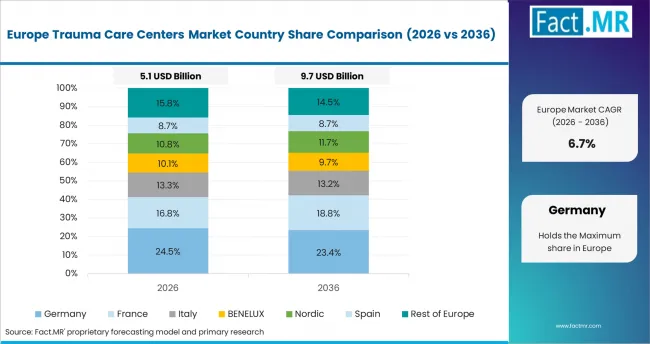
Europe operates within a highly regulated framework, where national trauma networks and reimbursement reforms shape infrastructure development and care delivery models.
- United Kingdom: The United Kingdom market is progressing through continued NHS investment in regional trauma networks, expanding at an estimated 8.3% CAGR through 2036. The Major Trauma Network is undergoing further upgrades, with capital allocated in 2025 toward regional unit expansion. Performance reviews highlighted improved survival rates at advanced centers and recommended deeper network integration.
- Germany: Germany’s trauma care landscape is being shaped by certification expansion and reimbursement restructuring, growing at around 6.2% CAGR through 2036. The DGU TraumaNetzwerk programme added new certified centers in 2024, strengthening regional coverage. Ongoing DRG reform under the Hospital Care Improvement Act is refining revenue structures for compliant facilities. Siemens Healthineers and Lumenis expanded imaging and surgical system deployments across certified trauma centers, supporting capability upgrades.
Fact.MR analysis for Europe includes the United Kingdom, Germany, France, Italy, Spain, and Nordic countries, covering trauma network expansion, reimbursement reform, and infrastructure development trends.
Competitive Aligners for Market Players
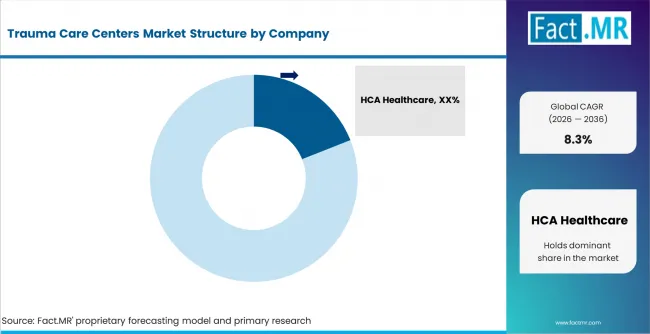
Companies operating in the trauma care centers market are navigating a system that is becoming more structured and capacity-driven. Growth is no longer just about adding more beds. It is about building integrated, high-acuity care capabilities that can handle complex trauma cases efficiently.
Large hospital networks are gaining a clear advantage. They have the scale to invest in advanced infrastructure, such as hybrid operating rooms, imaging systems, and specialized trauma teams. This allows them to attract higher patient volumes and improve clinical outcomes. Smaller standalone facilities often struggle to match this level of capability.
Standardization is becoming important. Multi-site operators are aligning treatment protocols, procurement systems, and staffing models across facilities. This helps reduce costs and improve consistency in care delivery. It also strengthens their position when negotiating with suppliers and payers.
Reimbursement remains a key factor. Facilities that align with DRG structures and meet compliance standards are better positioned to capture higher revenue per case. Understanding regulatory requirements and adapting quickly is essential for sustained growth.Partnerships are also evolving. Collaboration with technology providers, rehabilitation centers, and emergency response networks is helping improve the overall care pathway. This creates a more connected system and enhances patient outcomes. Thus, the market is becoming more competitive and organized. Success depends on scale, operational efficiency, and the ability to deliver high-quality, integrated trauma care services consistently.
Key Players
- HCA Healthcare
- Tenet Healthcare
- Community Health Systems
- Apollo Hospitals
- Fortis Healthcare
- Cleveland Clinic
- Mayo Clinic
Bibliography
- [1] World Health Organization. Global Status Report on Road Safety 2024: road traffic death estimates, injury burden by region, and trauma care capacity gap assessment; 2024. Available from: who.int/publications/i/item/9789241565684
- [2] NHS England. Major Trauma Network Investment Update: regional trauma unit capital allocation for North and Midlands facilities; January 2025. Available from: england.nhs.uk/major-trauma
- [3] National Health Commission of China. Healthy China 2030 Emergency Medical Service Infrastructure Targets: Level II and Level III trauma center accreditation expansion programme; 2024. Available from: nhc.gov.cn
- [4] HCA Healthcare Inc. Fiscal Year 2024 Annual Report and Q4 2024 Earnings Release: trauma center capital investment, Level I facility upgrades, and surgical throughput data; 2024. Available from: hcahealthcare.com/investors
- [5] Apollo Hospitals Enterprise Ltd. Fiscal Year 2024–25 Annual Report: trauma and emergency medicine division expansion, campus-level surgical capability investment; 2025. Available from: apollohospitals.com/investors
- [6] American Trauma Society. 2024 Annual Report: standalone trauma center financial viability, Level III and IV merger and acquisition activity, and rural trauma coverage gaps; 2024. Available from: amtrauma.org
- [7] Fortis Healthcare Ltd. Fiscal Year 2024–25 Investor Communications: trauma and emergency medicine admission volumes and facility capacity expansion in Delhi NCR and Mumbai; 2025. Available from: fortishealthcare.com/investors
- [8] Brain Trauma Foundation. Guidelines for the Management of Severe Traumatic Brain Injury: updated neuromonitoring and ICP management protocols; 2024. Available from: braintrauma.org/guidelines
- [9] Tenet Healthcare Corporation. Fiscal Year 2024 Annual Report: trauma inpatient admission revenue, Level I DRG reimbursement performance, and hospital network operational data; 2024. Available from: tenethealth.com/investors
- [10] Community Health Systems Inc. 2024 Annual Report: outpatient trauma follow-up clinic volume trends and value-based care programme alignment at Level II affiliated facilities; 2024. Available from: chs.net/investors
- [11] Commission on Accreditation of Rehabilitation Facilities (CARF). 2024 Annual Report: inpatient rehabilitation admissions for traumatic injury diagnoses and programme accreditation trends; 2024. Available from: carf.org
- [12] Cleveland Clinic. 2024 Annual Community Benefit Report: Level I Trauma Center case volume, damage control surgery investment, and hybrid operating room capability; 2024. Available from: clevelandclinic.org/about/community-benefit
This Report Addresses
- Strategic demand intelligence across the United States, China, United Kingdom, and Germany covering trauma admission trends, facility designation activity, and government infrastructure programme timelines by country.
- Market size forecast from USD 19.0 billion in 2026 to USD 42.2 billion by 2036, at 8.3% CAGR, with absolute dollar opportunity of USD 23.2 billion.
- Growth opportunity mapping across U.S. DRG reimbursement reform, China Healthy China 2030 emergency care targets, UK NHS Major Trauma Network investment cycles, and Germany DGU certification expansion.
- Segment forecasts by facility type, trauma type, end user, trauma center level, and service type, covering in-house and standalone facilities across Level I to Level IV designations in hospital and independent operator channels.
- Competitive analysis of HCA Healthcare, Tenet Healthcare, Community Health Systems, Apollo Hospitals, Fortis Healthcare, Cleveland Clinic, and Mayo Clinic.
- Technology tracking on hybrid operating room adoption, advanced trauma imaging procurement, post-trauma rehabilitation programme integration, and Level I designation compliance investment across key markets.
- Regulatory impact analysis covering CMS DRG trauma reimbursement revisions, NHS Major Trauma Network designation frameworks, DGU TraumaNetzwerk certification standards, and WHO emergency care capacity benchmarks.
- Report delivery in PDF, Excel, and presentation formats with validated data from primary interviews, national trauma registries, and hospital network revenue disclosures.
Trauma Care Centers Market Definition
The trauma care centers market covers specialized medical facilities that provide emergency diagnosis, surgical intervention, critical care, and post-acute rehabilitation for patients with life-threatening and severe injuries.
Trauma Care Centers Market Inclusions
Covers global and regional forecasts from 2026 to 2036, segmented by facility type, trauma type, end user, trauma center level, and service type. Includes in-house and standalone trauma centers across Level I to Level IV designations. Covers emergency, surgical, diagnostic, and rehabilitation service revenue streams across hospital networks and independent operators.
Trauma Care Centers Market Exclusions
Excludes general emergency departments without designated trauma center certification. Omits non-trauma critical care units, elective surgical facilities, and outpatient urgent care clinics not classified under trauma care protocols.
Trauma Care Centers Market Research Methodology
- Primary Research
- Interviews with trauma surgeons, hospital administrators, emergency care directors, and health ministry procurement officers across key markets.
- Desk Research
- Uses WHO Global Status Report on Road Safety, national trauma registry data, CMS reimbursement records, NHS Major Trauma Network reports, and company annual reports from 2024 to 2025.
- Market Sizing and Forecasting
- Hybrid top-down and bottom-up model using trauma admission volume data by facility type, average revenue per patient episode by geography, and capital expenditure disclosures by major hospital networks.
- Data Validation and Update Cycle
- Validated against hospital network revenue disclosures and national trauma registry annual statistics. Updated using government health infrastructure programme announcements and primary inputs from trauma surgical society registries.
Scope of Report

| Attribute | Details |
|---|---|
| Quantitative Units | USD 19.0 billion (2026) to USD 42.2 billion (2036), at a CAGR of 8.3% |
| Market Definition | Certified trauma care facilities providing emergency surgery, critical care, and rehabilitation for severe injuries, spanning in-house hospital units and standalone centers across Level I to Level IV designations. |
| Facility Type Segmentation | In-house, Standalone |
| Trauma Type Segmentation | Falls, Traffic-related Injuries, Stab/Wound/Cut, Burn Injury, Brain Injury, Other Injuries |
| End User Segmentation | Inpatient, Outpatient, Rehabilitation |
| Trauma Center Level Segmentation | Level I, Level II, Level III, Level IV |
| Service Type Segmentation | Emergency Services, Surgical Services, Post-trauma Rehabilitation, Diagnostic Services |
| Regions Covered | North America, Europe, Asia Pacific, Latin America, Middle East and Africa |
| Countries Covered | USA, Canada, Mexico, Germany, UK, France, Italy, Spain, Nordic, BENELUX, China, Japan, South Korea, India, ASEAN, Australia and New Zealand, Brazil, Argentina, Saudi Arabia, GCC, Turkey, South Africa, Rest of MEA |
| Key Companies Profiled | HCA Healthcare, Tenet Healthcare, Community Health Systems, Apollo Hospitals, Fortis Healthcare, Cleveland Clinic, Mayo Clinic |
| Forecast Period | 2026 to 2036 |
| Approach | Hybrid top-down and bottom-up model using WHO road safety data, national trauma registry volumes, average revenue per patient episode by geography, and primary interviews with trauma surgeons and hospital administrators. |
Trauma Care Centers Market By Segment
-
By Facility Type
- In-house
- Standalone
-
By Trauma Type
- Falls
- Traffic-related Injuries
- Stab/Wound/Cut
- Burn Injury
- Brain Injury
- Other Injuries
-
By End User
- Inpatient
- Outpatient
- Rehabilitation
-
By Trauma Center Level
- Level I
- Level II
- Level III
- Level IV
-
By Service Type
- Emergency Services
- Surgical Services
- Post-trauma Rehabilitation
- Diagnostic Services
-
By Region
- North America
- United States
- Canada
- Mexico
- Latin America
- Brazil
- Argentina
- Rest of Latin America
- Western Europe
- Germany
- United Kingdom
- France
- Italy
- Spain
- Nordic Countries
- BENELUX
- Rest of Western Europe
- Eastern Europe
- Russia
- Poland
- Rest of Eastern Europe
- East Asia
- China
- Japan
- South Korea
- South Asia and Pacific
- India
- ASEAN
- Australia and New Zealand
- Rest of South Asia and Pacific
- Middle East and Africa
- Kingdom of Saudi Arabia
- Other GCC Countries
- Turkey
- South Africa
- Rest of Middle East and Africa
- North America
- Frequently Asked Questions -
How large is the global trauma care centers market in 2025?
The global trauma care centers market was valued at USD 17.5 billion in 2025.
What will the market size be in 2026?
Based on Fact.MR analysis, the market is estimated to reach USD 19.0 billion in 2026.
What is the projected market size by 2036?
The market is projected to reach USD 42.2 billion by 2036, generating USD 23.2 billion in absolute dollar opportunity over the forecast period.
What is the expected CAGR from 2026 to 2036?
FACT.MR projects a CAGR of 8.3% for the global trauma care centers market during the 2026 to 2036 forecast period.
Which facility type is poised to lead the market?
In-house trauma centers lead with approximately 70% share in 2026, driven by their integration within multi-specialty hospital networks providing immediate surgical and critical care access.
Which trauma type drives the highest admission volumes?
Traffic-related injuries account for approximately 35% share in 2026, driven by high road accident incidence in emerging economies requiring urgent specialized trauma intervention.
Which end user segment holds the largest share?
Inpatient care dominates with approximately 60% share in 2026, reflecting the high acuity and hospitalization requirements of severe trauma cases.
Which trauma center level generates the highest revenue?
Level I trauma centers hold approximately 45% share in 2026, underpinned by comprehensive surgical capabilities, 24/7 specialist availability, and higher DRG reimbursement per episode.
Which country shows the fastest growth?
China leads at 9.0% CAGR through 2036, driven by national emergency medical service expansion and hospital infrastructure investment under the Healthy China 2030 initiative.
Who are the key market players?
Key players include HCA Healthcare, Tenet Healthcare, Community Health Systems, Apollo Hospitals, Fortis Healthcare, Cleveland Clinic, and Mayo Clinic.
Table of Content
- Executive Summary
- Global Market Outlook
- Demand to side Trends
- Supply to side Trends
- Technology Roadmap Analysis
- Analysis and Recommendations
- Market Overview
- Market Coverage / Taxonomy
- Market Definition / Scope / Limitations
- Research Methodology
- Chapter Orientation
- Analytical Lens and Working Hypotheses
- Market Structure, Signals, and Trend Drivers
- Benchmarking and Cross-market Comparability
- Market Sizing, Forecasting, and Opportunity Mapping
- Research Design and Evidence Framework
- Desk Research Programme (Secondary Evidence)
- Company Annual and Sustainability Reports
- Peer-reviewed Journals and Academic Literature
- Corporate Websites, Product Literature, and Technical Notes
- Earnings Decks and Investor Briefings
- Statutory Filings and Regulatory Disclosures
- Technical White Papers and Standards Notes
- Trade Journals, Industry Magazines, and Analyst Briefs
- Conference Proceedings, Webinars, and Seminar Materials
- Government Statistics Portals and Public Data Releases
- Press Releases and Reputable Media Coverage
- Specialist Newsletters and Curated Briefings
- Sector Databases and Reference Repositories
- Fact.MR Internal Proprietary Databases and Historical Market Datasets
- Subscription Datasets and Paid Sources
- Social Channels, Communities, and Digital Listening Inputs
- Additional Desk Sources
- Expert Input and Fieldwork (Primary Evidence)
- Primary Modes
- Qualitative Interviews and Expert Elicitation
- Quantitative Surveys and Structured Data Capture
- Blended Approach
- Why Primary Evidence is Used
- Field Techniques
- Interviews
- Surveys
- Focus Groups
- Observational and In-context Research
- Social and Community Interactions
- Stakeholder Universe Engaged
- C-suite Leaders
- Board Members
- Presidents and Vice Presidents
- R&D and Innovation Heads
- Technical Specialists
- Domain Subject-matter Experts
- Scientists
- Physicians and Other Healthcare Professionals
- Governance, Ethics, and Data Stewardship
- Research Ethics
- Data Integrity and Handling
- Primary Modes
- Tooling, Models, and Reference Databases
- Desk Research Programme (Secondary Evidence)
- Data Engineering and Model Build
- Data Acquisition and Ingestion
- Cleaning, Normalisation, and Verification
- Synthesis, Triangulation, and Analysis
- Quality Assurance and Audit Trail
- Market Background
- Market Dynamics
- Drivers
- Restraints
- Opportunity
- Trends
- Scenario Forecast
- Demand in Optimistic Scenario
- Demand in Likely Scenario
- Demand in Conservative Scenario
- Opportunity Map Analysis
- Product Life Cycle Analysis
- Supply Chain Analysis
- Investment Feasibility Matrix
- Value Chain Analysis
- PESTLE and Porter’s Analysis
- Regulatory Landscape
- Regional Parent Market Outlook
- Production and Consumption Statistics
- Import and Export Statistics
- Market Dynamics
- Global Market Analysis 2021 to 2025 and Forecast, 2026 to 2036
- Historical Market Size Value (USD Million) Analysis, 2021 to 2025
- Current and Future Market Size Value (USD Million) Projections, 2026 to 2036
- Y to o to Y Growth Trend Analysis
- Absolute $ Opportunity Analysis
- Global Market Pricing Analysis 2021 to 2025 and Forecast 2026 to 2036
- Global Market Analysis 2021 to 2025 and Forecast 2026 to 2036, By Product Type
- Introduction / Key Findings
- Historical Market Size Value (USD Million) Analysis By Product Type , 2021 to 2025
- Current and Future Market Size Value (USD Million) Analysis and Forecast By Product Type , 2026 to 2036
- Processed
- Unprocessed
- Processed
- Y to o to Y Growth Trend Analysis By Product Type , 2021 to 2025
- Absolute $ Opportunity Analysis By Product Type , 2026 to 2036
- Global Market Analysis 2021 to 2025 and Forecast 2026 to 2036, By Application
- Introduction / Key Findings
- Historical Market Size Value (USD Million) Analysis By Application, 2021 to 2025
- Current and Future Market Size Value (USD Million) Analysis and Forecast By Application, 2026 to 2036
- Sauces, Dressings, Dips, and Condiments
- Bakery & Confectionery
- Snacks & Cereals
- Ready Meals
- Sweet & Savory Snacks
- Sauces, Dressings, Dips, and Condiments
- Y to o to Y Growth Trend Analysis By Application, 2021 to 2025
- Absolute $ Opportunity Analysis By Application, 2026 to 2036
- Global Market Analysis 2021 to 2025 and Forecast 2026 to 2036, By Form
- Introduction / Key Findings
- Historical Market Size Value (USD Million) Analysis By Form, 2021 to 2025
- Current and Future Market Size Value (USD Million) Analysis and Forecast By Form, 2026 to 2036
- Grated & Powdered
- Shaved
- Slices
- Cubes
- Blocks
- Grated & Powdered
- Y to o to Y Growth Trend Analysis By Form, 2021 to 2025
- Absolute $ Opportunity Analysis By Form, 2026 to 2036
- Global Market Analysis 2021 to 2025 and Forecast 2026 to 2036, By End Use
- Introduction / Key Findings
- Historical Market Size Value (USD Million) Analysis By End Use, 2021 to 2025
- Current and Future Market Size Value (USD Million) Analysis and Forecast By End Use, 2026 to 2036
- Foodservice
- Food Manufacturers
- HoReCa
- Specialty Retail
- Household
- Foodservice
- Y to o to Y Growth Trend Analysis By End Use, 2021 to 2025
- Absolute $ Opportunity Analysis By End Use, 2026 to 2036
- Global Market Analysis 2021 to 2025 and Forecast 2026 to 2036, By Sales Channel
- Introduction / Key Findings
- Historical Market Size Value (USD Million) Analysis By Sales Channel, 2021 to 2025
- Current and Future Market Size Value (USD Million) Analysis and Forecast By Sales Channel, 2026 to 2036
- Supermarkets & Hypermarkets
- Specialty Stores
- Online Retail
- Foodservice Distributors
- Direct Factory Sales
- Supermarkets & Hypermarkets
- Y to o to Y Growth Trend Analysis By Sales Channel, 2021 to 2025
- Absolute $ Opportunity Analysis By Sales Channel, 2026 to 2036
- Global Market Analysis 2021 to 2025 and Forecast 2026 to 2036, By Region
- Introduction
- Historical Market Size Value (USD Million) Analysis By Region, 2021 to 2025
- Current Market Size Value (USD Million) Analysis and Forecast By Region, 2026 to 2036
- North America
- Latin America
- Western Europe
- Eastern Europe
- East Asia
- South Asia and Pacific
- Middle East & Africa
- Market Attractiveness Analysis By Region
- North America Market Analysis 2021 to 2025 and Forecast 2026 to 2036, By Country
- Historical Market Size Value (USD Million) Trend Analysis By Market Taxonomy, 2021 to 2025
- Market Size Value (USD Million) Forecast By Market Taxonomy, 2026 to 2036
- By Country
- USA
- Canada
- Mexico
- By Product Type
- By Application
- By Form
- By End Use
- By Sales Channel
- By Country
- Market Attractiveness Analysis
- By Country
- By Product Type
- By Application
- By Form
- By End Use
- By Sales Channel
- Key Takeaways
- Latin America Market Analysis 2021 to 2025 and Forecast 2026 to 2036, By Country
- Historical Market Size Value (USD Million) Trend Analysis By Market Taxonomy, 2021 to 2025
- Market Size Value (USD Million) Forecast By Market Taxonomy, 2026 to 2036
- By Country
- Brazil
- Chile
- Rest of Latin America
- By Product Type
- By Application
- By Form
- By End Use
- By Sales Channel
- By Country
- Market Attractiveness Analysis
- By Country
- By Product Type
- By Application
- By Form
- By End Use
- By Sales Channel
- Key Takeaways
- Western Europe Market Analysis 2021 to 2025 and Forecast 2026 to 2036, By Country
- Historical Market Size Value (USD Million) Trend Analysis By Market Taxonomy, 2021 to 2025
- Market Size Value (USD Million) Forecast By Market Taxonomy, 2026 to 2036
- By Country
- Germany
- UK
- Italy
- Spain
- France
- Nordic
- BENELUX
- Rest of Western Europe
- By Product Type
- By Application
- By Form
- By End Use
- By Sales Channel
- By Country
- Market Attractiveness Analysis
- By Country
- By Product Type
- By Application
- By Form
- By End Use
- By Sales Channel
- Key Takeaways
- Eastern Europe Market Analysis 2021 to 2025 and Forecast 2026 to 2036, By Country
- Historical Market Size Value (USD Million) Trend Analysis By Market Taxonomy, 2021 to 2025
- Market Size Value (USD Million) Forecast By Market Taxonomy, 2026 to 2036
- By Country
- Russia
- Poland
- Hungary
- Balkan & Baltic
- Rest of Eastern Europe
- By Product Type
- By Application
- By Form
- By End Use
- By Sales Channel
- By Country
- Market Attractiveness Analysis
- By Country
- By Product Type
- By Application
- By Form
- By End Use
- By Sales Channel
- Key Takeaways
- East Asia Market Analysis 2021 to 2025 and Forecast 2026 to 2036, By Country
- Historical Market Size Value (USD Million) Trend Analysis By Market Taxonomy, 2021 to 2025
- Market Size Value (USD Million) Forecast By Market Taxonomy, 2026 to 2036
- By Country
- China
- Japan
- South Korea
- By Product Type
- By Application
- By Form
- By End Use
- By Sales Channel
- By Country
- Market Attractiveness Analysis
- By Country
- By Product Type
- By Application
- By Form
- By End Use
- By Sales Channel
- Key Takeaways
- South Asia and Pacific Market Analysis 2021 to 2025 and Forecast 2026 to 2036, By Country
- Historical Market Size Value (USD Million) Trend Analysis By Market Taxonomy, 2021 to 2025
- Market Size Value (USD Million) Forecast By Market Taxonomy, 2026 to 2036
- By Country
- India
- ASEAN
- Australia & New Zealand
- Rest of South Asia and Pacific
- By Product Type
- By Application
- By Form
- By End Use
- By Sales Channel
- By Country
- Market Attractiveness Analysis
- By Country
- By Product Type
- By Application
- By Form
- By End Use
- By Sales Channel
- Key Takeaways
- Middle East & Africa Market Analysis 2021 to 2025 and Forecast 2026 to 2036, By Country
- Historical Market Size Value (USD Million) Trend Analysis By Market Taxonomy, 2021 to 2025
- Market Size Value (USD Million) Forecast By Market Taxonomy, 2026 to 2036
- By Country
- Kingdom of Saudi Arabia
- Other GCC Countries
- Turkiye
- South Africa
- Other African Union
- Rest of Middle East & Africa
- By Product Type
- By Application
- By Form
- By End Use
- By Sales Channel
- By Country
- Market Attractiveness Analysis
- By Country
- By Product Type
- By Application
- By Form
- By End Use
- By Sales Channel
- Key Takeaways
- Key Countries Market Analysis
- USA
- Pricing Analysis
- Market Share Analysis, 2025
- By Product Type
- By Application
- By Form
- By End Use
- By Sales Channel
- Canada
- Pricing Analysis
- Market Share Analysis, 2025
- By Product Type
- By Application
- By Form
- By End Use
- By Sales Channel
- Mexico
- Pricing Analysis
- Market Share Analysis, 2025
- By Product Type
- By Application
- By Form
- By End Use
- By Sales Channel
- Brazil
- Pricing Analysis
- Market Share Analysis, 2025
- By Product Type
- By Application
- By Form
- By End Use
- By Sales Channel
- Chile
- Pricing Analysis
- Market Share Analysis, 2025
- By Product Type
- By Application
- By Form
- By End Use
- By Sales Channel
- Germany
- Pricing Analysis
- Market Share Analysis, 2025
- By Product Type
- By Application
- By Form
- By End Use
- By Sales Channel
- UK
- Pricing Analysis
- Market Share Analysis, 2025
- By Product Type
- By Application
- By Form
- By End Use
- By Sales Channel
- Italy
- Pricing Analysis
- Market Share Analysis, 2025
- By Product Type
- By Application
- By Form
- By End Use
- By Sales Channel
- Spain
- Pricing Analysis
- Market Share Analysis, 2025
- By Product Type
- By Application
- By Form
- By End Use
- By Sales Channel
- France
- Pricing Analysis
- Market Share Analysis, 2025
- By Product Type
- By Application
- By Form
- By End Use
- By Sales Channel
- India
- Pricing Analysis
- Market Share Analysis, 2025
- By Product Type
- By Application
- By Form
- By End Use
- By Sales Channel
- ASEAN
- Pricing Analysis
- Market Share Analysis, 2025
- By Product Type
- By Application
- By Form
- By End Use
- By Sales Channel
- Australia & New Zealand
- Pricing Analysis
- Market Share Analysis, 2025
- By Product Type
- By Application
- By Form
- By End Use
- By Sales Channel
- China
- Pricing Analysis
- Market Share Analysis, 2025
- By Product Type
- By Application
- By Form
- By End Use
- By Sales Channel
- Japan
- Pricing Analysis
- Market Share Analysis, 2025
- By Product Type
- By Application
- By Form
- By End Use
- By Sales Channel
- South Korea
- Pricing Analysis
- Market Share Analysis, 2025
- By Product Type
- By Application
- By Form
- By End Use
- By Sales Channel
- Russia
- Pricing Analysis
- Market Share Analysis, 2025
- By Product Type
- By Application
- By Form
- By End Use
- By Sales Channel
- Poland
- Pricing Analysis
- Market Share Analysis, 2025
- By Product Type
- By Application
- By Form
- By End Use
- By Sales Channel
- Hungary
- Pricing Analysis
- Market Share Analysis, 2025
- By Product Type
- By Application
- By Form
- By End Use
- By Sales Channel
- Kingdom of Saudi Arabia
- Pricing Analysis
- Market Share Analysis, 2025
- By Product Type
- By Application
- By Form
- By End Use
- By Sales Channel
- Turkiye
- Pricing Analysis
- Market Share Analysis, 2025
- By Product Type
- By Application
- By Form
- By End Use
- By Sales Channel
- South Africa
- Pricing Analysis
- Market Share Analysis, 2025
- By Product Type
- By Application
- By Form
- By End Use
- By Sales Channel
- USA
- Market Structure Analysis
- Competition Dashboard
- Competition Benchmarking
- Market Share Analysis of Top Players
- By Regional
- By Product Type
- By Application
- By Form
- By End Use
- By Sales Channel
- Competition Analysis
- Competition Deep Dive
- Saputo Inc.
- Overview
- Product Portfolio
- Profitability by Market Segments (Product/Age /Sales Channel/Region)
- Sales Footprint
- Strategy Overview
- Marketing Strategy
- Product Strategy
- Channel Strategy
- The Kraft Heinz Company
- BelGioioso Cheese Inc.
- Kerry Group PLC
- Organic Valley
- Aar Kay Food Products Ltd.
- Panos Brands LLC
- Sartori Cheese
- Lactalis Group
- Sargento Foods Inc.
- Saputo Inc.
- Competition Deep Dive
- Assumptions & Acronyms Used
List Of Table
- Table 1: Global Market Value (USD Million) Forecast by Region, 2021 to 2036
- Table 2: Global Market Value (USD Million) Forecast by Product Type, 2021 to 2036
- Table 3: Global Market Value (USD Million) Forecast by Application, 2021 to 2036
- Table 4: Global Market Value (USD Million) Forecast by Form, 2021 to 2036
- Table 5: Global Market Value (USD Million) Forecast by End Use, 2021 to 2036
- Table 6: Global Market Value (USD Million) Forecast by Sales Channel, 2021 to 2036
- Table 7: North America Market Value (USD Million) Forecast by Country, 2021 to 2036
- Table 8: North America Market Value (USD Million) Forecast by Product Type, 2021 to 2036
- Table 9: North America Market Value (USD Million) Forecast by Application, 2021 to 2036
- Table 10: North America Market Value (USD Million) Forecast by Form, 2021 to 2036
- Table 11: North America Market Value (USD Million) Forecast by End Use, 2021 to 2036
- Table 12: North America Market Value (USD Million) Forecast by Sales Channel, 2021 to 2036
- Table 13: Latin America Market Value (USD Million) Forecast by Country, 2021 to 2036
- Table 14: Latin America Market Value (USD Million) Forecast by Product Type, 2021 to 2036
- Table 15: Latin America Market Value (USD Million) Forecast by Application, 2021 to 2036
- Table 16: Latin America Market Value (USD Million) Forecast by Form, 2021 to 2036
- Table 17: Latin America Market Value (USD Million) Forecast by End Use, 2021 to 2036
- Table 18: Latin America Market Value (USD Million) Forecast by Sales Channel, 2021 to 2036
- Table 19: Western Europe Market Value (USD Million) Forecast by Country, 2021 to 2036
- Table 20: Western Europe Market Value (USD Million) Forecast by Product Type, 2021 to 2036
- Table 21: Western Europe Market Value (USD Million) Forecast by Application, 2021 to 2036
- Table 22: Western Europe Market Value (USD Million) Forecast by Form, 2021 to 2036
- Table 23: Western Europe Market Value (USD Million) Forecast by End Use, 2021 to 2036
- Table 24: Western Europe Market Value (USD Million) Forecast by Sales Channel, 2021 to 2036
- Table 25: Eastern Europe Market Value (USD Million) Forecast by Country, 2021 to 2036
- Table 26: Eastern Europe Market Value (USD Million) Forecast by Product Type, 2021 to 2036
- Table 27: Eastern Europe Market Value (USD Million) Forecast by Application, 2021 to 2036
- Table 28: Eastern Europe Market Value (USD Million) Forecast by Form, 2021 to 2036
- Table 29: Eastern Europe Market Value (USD Million) Forecast by End Use, 2021 to 2036
- Table 30: Eastern Europe Market Value (USD Million) Forecast by Sales Channel, 2021 to 2036
- Table 31: East Asia Market Value (USD Million) Forecast by Country, 2021 to 2036
- Table 32: East Asia Market Value (USD Million) Forecast by Product Type, 2021 to 2036
- Table 33: East Asia Market Value (USD Million) Forecast by Application, 2021 to 2036
- Table 34: East Asia Market Value (USD Million) Forecast by Form, 2021 to 2036
- Table 35: East Asia Market Value (USD Million) Forecast by End Use, 2021 to 2036
- Table 36: East Asia Market Value (USD Million) Forecast by Sales Channel, 2021 to 2036
- Table 37: South Asia and Pacific Market Value (USD Million) Forecast by Country, 2021 to 2036
- Table 38: South Asia and Pacific Market Value (USD Million) Forecast by Product Type, 2021 to 2036
- Table 39: South Asia and Pacific Market Value (USD Million) Forecast by Application, 2021 to 2036
- Table 40: South Asia and Pacific Market Value (USD Million) Forecast by Form, 2021 to 2036
- Table 41: South Asia and Pacific Market Value (USD Million) Forecast by End Use, 2021 to 2036
- Table 42: South Asia and Pacific Market Value (USD Million) Forecast by Sales Channel, 2021 to 2036
- Table 43: Middle East & Africa Market Value (USD Million) Forecast by Country, 2021 to 2036
- Table 44: Middle East & Africa Market Value (USD Million) Forecast by Product Type, 2021 to 2036
- Table 45: Middle East & Africa Market Value (USD Million) Forecast by Application, 2021 to 2036
- Table 46: Middle East & Africa Market Value (USD Million) Forecast by Form, 2021 to 2036
- Table 47: Middle East & Africa Market Value (USD Million) Forecast by End Use, 2021 to 2036
- Table 48: Middle East & Africa Market Value (USD Million) Forecast by Sales Channel, 2021 to 2036
List Of Figures
- Figure 1: Global Market Pricing Analysis
- Figure 2: Global Market Value (USD Million) Forecast 2021-2036
- Figure 3: Global Market Value Share and BPS Analysis by Product Type, 2026 and 2036
- Figure 4: Global Market Y-o-Y Growth Comparison by Product Type, 2026 to 2036
- Figure 5: Global Market Attractiveness Analysis by Product Type
- Figure 6: Global Market Value Share and BPS Analysis by Application, 2026 and 2036
- Figure 7: Global Market Y-o-Y Growth Comparison by Application, 2026 to 2036
- Figure 8: Global Market Attractiveness Analysis by Application
- Figure 9: Global Market Value Share and BPS Analysis by Form, 2026 and 2036
- Figure 10: Global Market Y-o-Y Growth Comparison by Form, 2026 to 2036
- Figure 11: Global Market Attractiveness Analysis by Form
- Figure 12: Global Market Value Share and BPS Analysis by End Use, 2026 and 2036
- Figure 13: Global Market Y-o-Y Growth Comparison by End Use, 2026 to 2036
- Figure 14: Global Market Attractiveness Analysis by End Use
- Figure 15: Global Market Value Share and BPS Analysis by Sales Channel, 2026 and 2036
- Figure 16: Global Market Y-o-Y Growth Comparison by Sales Channel, 2026 to 2036
- Figure 17: Global Market Attractiveness Analysis by Sales Channel
- Figure 18: Global Market Value (USD Million) Share and BPS Analysis by Region, 2026 and 2036
- Figure 19: Global Market Y-o-Y Growth Comparison by Region, 2026 to 2036
- Figure 20: Global Market Attractiveness Analysis by Region
- Figure 21: North America Market Incremental Dollar Opportunity, 2026 to 2036
- Figure 22: Latin America Market Incremental Dollar Opportunity, 2026 to 2036
- Figure 23: Western Europe Market Incremental Dollar Opportunity, 2026 to 2036
- Figure 24: Eastern Europe Market Incremental Dollar Opportunity, 2026 to 2036
- Figure 25: East Asia Market Incremental Dollar Opportunity, 2026 to 2036
- Figure 26: South Asia and Pacific Market Incremental Dollar Opportunity, 2026 to 2036
- Figure 27: Middle East & Africa Market Incremental Dollar Opportunity, 2026 to 2036
- Figure 28: North America Market Value Share and BPS Analysis by Country, 2026 and 2036
- Figure 29: North America Market Value Share and BPS Analysis by Product Type, 2026 and 2036
- Figure 30: North America Market Y-o-Y Growth Comparison by Product Type, 2026 to 2036
- Figure 31: North America Market Attractiveness Analysis by Product Type
- Figure 32: North America Market Value Share and BPS Analysis by Application, 2026 and 2036
- Figure 33: North America Market Y-o-Y Growth Comparison by Application, 2026 to 2036
- Figure 34: North America Market Attractiveness Analysis by Application
- Figure 35: North America Market Value Share and BPS Analysis by Form, 2026 and 2036
- Figure 36: North America Market Y-o-Y Growth Comparison by Form, 2026 to 2036
- Figure 37: North America Market Attractiveness Analysis by Form
- Figure 38: North America Market Value Share and BPS Analysis by End Use, 2026 and 2036
- Figure 39: North America Market Y-o-Y Growth Comparison by End Use, 2026 to 2036
- Figure 40: North America Market Attractiveness Analysis by End Use
- Figure 41: North America Market Value Share and BPS Analysis by Sales Channel, 2026 and 2036
- Figure 42: North America Market Y-o-Y Growth Comparison by Sales Channel, 2026 to 2036
- Figure 43: North America Market Attractiveness Analysis by Sales Channel
- Figure 44: Latin America Market Value Share and BPS Analysis by Country, 2026 and 2036
- Figure 45: Latin America Market Value Share and BPS Analysis by Product Type, 2026 and 2036
- Figure 46: Latin America Market Y-o-Y Growth Comparison by Product Type, 2026 to 2036
- Figure 47: Latin America Market Attractiveness Analysis by Product Type
- Figure 48: Latin America Market Value Share and BPS Analysis by Application, 2026 and 2036
- Figure 49: Latin America Market Y-o-Y Growth Comparison by Application, 2026 to 2036
- Figure 50: Latin America Market Attractiveness Analysis by Application
- Figure 51: Latin America Market Value Share and BPS Analysis by Form, 2026 and 2036
- Figure 52: Latin America Market Y-o-Y Growth Comparison by Form, 2026 to 2036
- Figure 53: Latin America Market Attractiveness Analysis by Form
- Figure 54: Latin America Market Value Share and BPS Analysis by End Use, 2026 and 2036
- Figure 55: Latin America Market Y-o-Y Growth Comparison by End Use, 2026 to 2036
- Figure 56: Latin America Market Attractiveness Analysis by End Use
- Figure 57: Latin America Market Value Share and BPS Analysis by Sales Channel, 2026 and 2036
- Figure 58: Latin America Market Y-o-Y Growth Comparison by Sales Channel, 2026 to 2036
- Figure 59: Latin America Market Attractiveness Analysis by Sales Channel
- Figure 60: Western Europe Market Value Share and BPS Analysis by Country, 2026 and 2036
- Figure 61: Western Europe Market Value Share and BPS Analysis by Product Type, 2026 and 2036
- Figure 62: Western Europe Market Y-o-Y Growth Comparison by Product Type, 2026 to 2036
- Figure 63: Western Europe Market Attractiveness Analysis by Product Type
- Figure 64: Western Europe Market Value Share and BPS Analysis by Application, 2026 and 2036
- Figure 65: Western Europe Market Y-o-Y Growth Comparison by Application, 2026 to 2036
- Figure 66: Western Europe Market Attractiveness Analysis by Application
- Figure 67: Western Europe Market Value Share and BPS Analysis by Form, 2026 and 2036
- Figure 68: Western Europe Market Y-o-Y Growth Comparison by Form, 2026 to 2036
- Figure 69: Western Europe Market Attractiveness Analysis by Form
- Figure 70: Western Europe Market Value Share and BPS Analysis by End Use, 2026 and 2036
- Figure 71: Western Europe Market Y-o-Y Growth Comparison by End Use, 2026 to 2036
- Figure 72: Western Europe Market Attractiveness Analysis by End Use
- Figure 73: Western Europe Market Value Share and BPS Analysis by Sales Channel, 2026 and 2036
- Figure 74: Western Europe Market Y-o-Y Growth Comparison by Sales Channel, 2026 to 2036
- Figure 75: Western Europe Market Attractiveness Analysis by Sales Channel
- Figure 76: Eastern Europe Market Value Share and BPS Analysis by Country, 2026 and 2036
- Figure 77: Eastern Europe Market Value Share and BPS Analysis by Product Type, 2026 and 2036
- Figure 78: Eastern Europe Market Y-o-Y Growth Comparison by Product Type, 2026 to 2036
- Figure 79: Eastern Europe Market Attractiveness Analysis by Product Type
- Figure 80: Eastern Europe Market Value Share and BPS Analysis by Application, 2026 and 2036
- Figure 81: Eastern Europe Market Y-o-Y Growth Comparison by Application, 2026 to 2036
- Figure 82: Eastern Europe Market Attractiveness Analysis by Application
- Figure 83: Eastern Europe Market Value Share and BPS Analysis by Form, 2026 and 2036
- Figure 84: Eastern Europe Market Y-o-Y Growth Comparison by Form, 2026 to 2036
- Figure 85: Eastern Europe Market Attractiveness Analysis by Form
- Figure 86: Eastern Europe Market Value Share and BPS Analysis by End Use, 2026 and 2036
- Figure 87: Eastern Europe Market Y-o-Y Growth Comparison by End Use, 2026 to 2036
- Figure 88: Eastern Europe Market Attractiveness Analysis by End Use
- Figure 89: Eastern Europe Market Value Share and BPS Analysis by Sales Channel, 2026 and 2036
- Figure 90: Eastern Europe Market Y-o-Y Growth Comparison by Sales Channel, 2026 to 2036
- Figure 91: Eastern Europe Market Attractiveness Analysis by Sales Channel
- Figure 92: East Asia Market Value Share and BPS Analysis by Country, 2026 and 2036
- Figure 93: East Asia Market Value Share and BPS Analysis by Product Type, 2026 and 2036
- Figure 94: East Asia Market Y-o-Y Growth Comparison by Product Type, 2026 to 2036
- Figure 95: East Asia Market Attractiveness Analysis by Product Type
- Figure 96: East Asia Market Value Share and BPS Analysis by Application, 2026 and 2036
- Figure 97: East Asia Market Y-o-Y Growth Comparison by Application, 2026 to 2036
- Figure 98: East Asia Market Attractiveness Analysis by Application
- Figure 99: East Asia Market Value Share and BPS Analysis by Form, 2026 and 2036
- Figure 100: East Asia Market Y-o-Y Growth Comparison by Form, 2026 to 2036
- Figure 101: East Asia Market Attractiveness Analysis by Form
- Figure 102: East Asia Market Value Share and BPS Analysis by End Use, 2026 and 2036
- Figure 103: East Asia Market Y-o-Y Growth Comparison by End Use, 2026 to 2036
- Figure 104: East Asia Market Attractiveness Analysis by End Use
- Figure 105: East Asia Market Value Share and BPS Analysis by Sales Channel, 2026 and 2036
- Figure 106: East Asia Market Y-o-Y Growth Comparison by Sales Channel, 2026 to 2036
- Figure 107: East Asia Market Attractiveness Analysis by Sales Channel
- Figure 108: South Asia and Pacific Market Value Share and BPS Analysis by Country, 2026 and 2036
- Figure 109: South Asia and Pacific Market Value Share and BPS Analysis by Product Type, 2026 and 2036
- Figure 110: South Asia and Pacific Market Y-o-Y Growth Comparison by Product Type, 2026 to 2036
- Figure 111: South Asia and Pacific Market Attractiveness Analysis by Product Type
- Figure 112: South Asia and Pacific Market Value Share and BPS Analysis by Application, 2026 and 2036
- Figure 113: South Asia and Pacific Market Y-o-Y Growth Comparison by Application, 2026 to 2036
- Figure 114: South Asia and Pacific Market Attractiveness Analysis by Application
- Figure 115: South Asia and Pacific Market Value Share and BPS Analysis by Form, 2026 and 2036
- Figure 116: South Asia and Pacific Market Y-o-Y Growth Comparison by Form, 2026 to 2036
- Figure 117: South Asia and Pacific Market Attractiveness Analysis by Form
- Figure 118: South Asia and Pacific Market Value Share and BPS Analysis by End Use, 2026 and 2036
- Figure 119: South Asia and Pacific Market Y-o-Y Growth Comparison by End Use, 2026 to 2036
- Figure 120: South Asia and Pacific Market Attractiveness Analysis by End Use
- Figure 121: South Asia and Pacific Market Value Share and BPS Analysis by Sales Channel, 2026 and 2036
- Figure 122: South Asia and Pacific Market Y-o-Y Growth Comparison by Sales Channel, 2026 to 2036
- Figure 123: South Asia and Pacific Market Attractiveness Analysis by Sales Channel
- Figure 124: Middle East & Africa Market Value Share and BPS Analysis by Country, 2026 and 2036
- Figure 125: Middle East & Africa Market Value Share and BPS Analysis by Product Type, 2026 and 2036
- Figure 126: Middle East & Africa Market Y-o-Y Growth Comparison by Product Type, 2026 to 2036
- Figure 127: Middle East & Africa Market Attractiveness Analysis by Product Type
- Figure 128: Middle East & Africa Market Value Share and BPS Analysis by Application, 2026 and 2036
- Figure 129: Middle East & Africa Market Y-o-Y Growth Comparison by Application, 2026 to 2036
- Figure 130: Middle East & Africa Market Attractiveness Analysis by Application
- Figure 131: Middle East & Africa Market Value Share and BPS Analysis by Form, 2026 and 2036
- Figure 132: Middle East & Africa Market Y-o-Y Growth Comparison by Form, 2026 to 2036
- Figure 133: Middle East & Africa Market Attractiveness Analysis by Form
- Figure 134: Middle East & Africa Market Value Share and BPS Analysis by End Use, 2026 and 2036
- Figure 135: Middle East & Africa Market Y-o-Y Growth Comparison by End Use, 2026 to 2036
- Figure 136: Middle East & Africa Market Attractiveness Analysis by End Use
- Figure 137: Middle East & Africa Market Value Share and BPS Analysis by Sales Channel, 2026 and 2036
- Figure 138: Middle East & Africa Market Y-o-Y Growth Comparison by Sales Channel, 2026 to 2036
- Figure 139: Middle East & Africa Market Attractiveness Analysis by Sales Channel
- Figure 140: Global Market - Tier Structure Analysis
- Figure 141: Global Market - Company Share Analysis