- Estimated Value(2026): 3.0 Bn
- Forecast Value (2036): 6.5 Bn
- CAGR (2026 - 2036): 8.1%
Truck Mounted Cranes Market Forecast and Outlook 2026 to 2036
In 2025, the truck mounted cranes market surpassed a valuation of USD 2.8 billion. Based on Fact.MR analysis, demand for truck mounted cranes is estimated to grow to USD 3.0 billion in 2026 and USD 6.5 billion by 2036. Fact.MR projects a CAGR of 8.1% during the forecast period.
Between 2026 and 2036, the market is projected to generate an absolute dollar opportunity of USD 3.5 billion. This expansion reflects non-discretionary infrastructure investment cycles across North America, Europe, and Asia Pacific combined with rising rental fleet modernisation demand. Structural constraints include steel price volatility, driver-certification bottlenecks, and emissions compliance retrofit costs in Euro VI and EPA Tier 4 markets.
As Ove Hansson, President of Palfinger AG's Industrial segment, noted regarding equipment demand outlook, Palfinger reported record revenues exceeding EUR 2.36 billion in 2024, driven by strong performance in crane and loader solutions underpinned by global infrastructure investment and rental fleet expansion. [1]
Country growth reflects infrastructure spending intensity, rental fleet renewal cycles, and emissions regulation maturity. The United States leads at 9.1% CAGR anchored by the Infrastructure Investment and Jobs Act deployment and grid modernisation lifting demand. Germany follows at 8.9% driven by Energiewende wind energy installation crane requirements and emissions compliance fleet upgrades. China posts 8.5% supported by Belt and Road-linked construction crane procurement and domestic OEM export programmes. India grows at 8.0% as National Infrastructure Pipeline project execution accelerates crane fleet demand. Brazil registers 7.8% as hydroelectric and energy infrastructure tendering expands equipment procurement cycles.
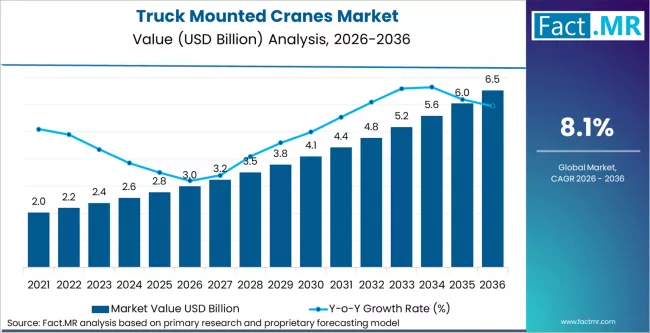
Truck Mounted Cranes Market Market Value Analysis | Source: Fact.MR
| Metric | Value |
|---|---|
| Estimated Value in 2026 | USD 3.0 billion |
| Forecast Value in 2036 | USD 6.5 billion |
| Forecast CAGR (2026 to 2036) | 8.1% |
Source: Fact.MR analysis. Updated Mar 9, 2026
Market Definition
Truck mounted cranes are mobile lifting machines installed on truck chassis for on-site lifting without additional transport. They range from compact knuckle-boom units to heavy telescopic cranes above 50-ton capacity. Key users include construction contractors, utilities, rental fleets, and industrial logistics operators.
Market Inclusions
Includes global and regional revenue forecasts from 2026 to 2036 by crane capacity, application, and end-use sector. Covers telescopic, knuckle boom, and lattice boom truck mounted crane types. Also analyzes pricing trends, rental versus ownership dynamics, telematics adoption, and emissions-compliant fleet transitions.
Market Exclusions
Excludes all-terrain and crawler cranes transported separately from carriers. Tower cranes, overhead cranes, and marine deck cranes are also outside scope. Spare parts, accessories, training services, and maintenance contracts sold independently are not included.
Research Methodology
- Primary Research: Interviews with crane OEM sales executives, rental fleet managers, construction procurement heads, utility equipment managers, and crane certification specialists across North America, Europe, and Asia Pacific.
- Desk Research: Sources include OEM financial disclosures, infrastructure spending records, fleet association data, emissions regulation publications, and equipment industry reports from 2024 and 2025.
- Market Sizing and Forecasting: Hybrid model combining infrastructure investment forecasts with average crane prices by capacity class and application. Rental fleet replacement cycles and OEM order backlog trends supported demand projections.
- Data Validation and Update Cycle: Forecasts validated using OEM revenue data, rental fleet investment disclosures, and infrastructure project databases. Annual updates reflect commodity price changes and evolving emissions regulations.
Summary
- Market Definition
- Truck mounted cranes are self-deployable mobile lifting systems integrated onto truck chassis, serving construction, utilities, oil and gas, and infrastructure maintenance sectors across capacity classes from under 15 tons to above 50 tons.
- Demand Drivers
- Global infrastructure investment programmes, particularly the US Infrastructure Investment and Jobs Act and India's National Infrastructure Pipeline, are generating sustained crane procurement demand across construction and utilities applications.
- Equipment rental fleet modernisation driven by emissions compliance mandates in the EU and North America is accelerating replacement of older non-compliant crane units with Euro VI and EPA Tier 4 platforms.
- Offshore wind and grid expansion projects across Europe and North America require specialised high-capacity truck mounted crane deployment for tower segment and cable installation operations.
- Key Segments Analyzed
- By Crane Capacity: 15-30 Ton systems lead with approximately 40% market share, reflecting their versatility across construction and infrastructure applications without requiring heavy-transport permits.
- By Application: Construction and infrastructure development holds 58% of total market value, anchored by sustained government infrastructure programme execution across all major geographies.
- By End Use: Construction companies hold the largest end-use share, while rental services represent the fastest-growing segment driven by fleet modernisation and CAPEX-averse procurement models.
- By Geography: North America leads in value terms while Asia Pacific leads in volume growth, with India and China contributing the highest unit procurement expansion rates.
- Analyst Opinion at FACT.MR
- Shambhu Nath Jha, Principal Consultant at Fact.MR, opines, 'The truck mounted cranes market's next competitive battleground will be defined by telematics integration and electrification readiness, with OEMs that embed load-monitoring, remote diagnostics, and hybrid-drive capability into mid-capacity platforms achieving sustainable margin separation from commodity crane manufacturers.'
- Strategic Implications
- OEMs should invest in telematics and remote load-monitoring software as standard platform features to increase switching costs and recurring service revenue from rental fleet operators.
- Manufacturers should develop emissions-compliant electric and hybrid crane configurations targeting the European market where Euro VI compliance and urban access restrictions are accelerating fleet transition.
- Companies should establish equipment rental partnerships in India and Brazil to capitalise on infrastructure project-driven crane demand without requiring buyers to commit to full ownership capital expenditure.
- Methodology
- Revenue modelling combined average unit price benchmarking by capacity class with infrastructure project award data across key geographies, validated through OEM order backlog disclosures.
- Rental fleet replacement cycle data and equipment age distribution statistics from industry associations informed demand projections for 2024-2025.
- Regional forecasts validated through government infrastructure disbursement records, OEM earnings guidance, and primary interviews with fleet procurement managers.
Segmental Analysis
Truck Mounted Cranes Market Analysis by Crane Capacity
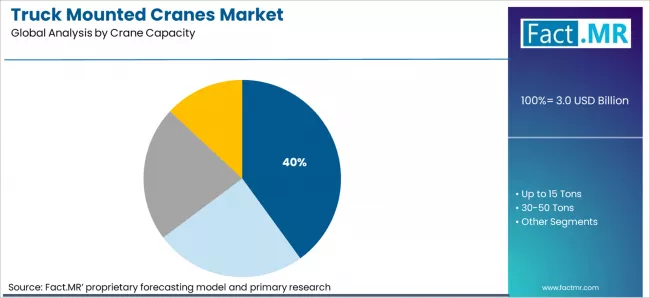
Truck Mounted Cranes Market Analysis By Crane Capacity | Source: Fact.MR
Based on FACT.MR's report, 15-30-ton crane systems are estimated to hold about 40% share in 2026. This segment dominates because it balances road transport flexibility with sufficient lifting capacity for most construction and utility projects.
- Tadano Capacity Expansion: In February 2025, Tadano expanded production at its Shido facility in Japan to increase output of 15-30-ton truck mounted cranes for Asia Pacific and export markets. [5]
- Liebherr LTF Telematics Platform: In 2024, Liebherr launched the LTF 1030-4.1 truck mounted crane with LICCON3 control system offering real-time load monitoring and remote diagnostics for fleet operators. [6]
- Rental Fleet 15-30T Growth: United Rentals reported 14% growth in specialty crane rental revenue in Q3 2024, driven by demand for mid-capacity cranes in grid and infrastructure projects. [7]
Truck Mounted Cranes Market Analysis by Application
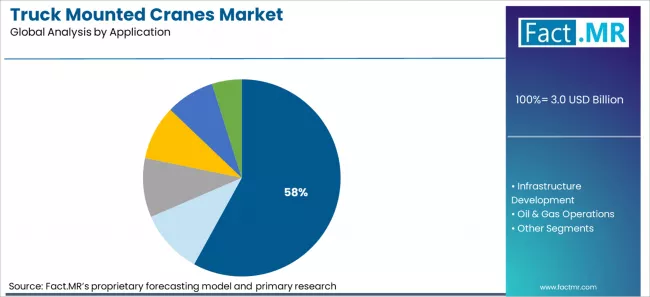
Truck Mounted Cranes Market Analysis By Application | Source: Fact.MR
Based on FACT.MR's report, construction and infrastructure applications are estimated to hold about 58% share of market value in 2026. Demand is driven by government-funded infrastructure projects that require consistent crane deployment over multi-year timelines.
- Manitowoc Infrastructure Contract: In Q4 2024, Manitowoc announced multi-unit crane supply agreements linked to US highway bridge replacement projects funded by federal infrastructure programmes. [8]
- XCMG Oil and Gas Expansion: In January 2025, XCMG expanded its heavy-capacity truck mounted crane range for oil and gas pipeline and drilling projects in the Middle East and Central Asia. [9]
- Utility Maintenance Spend Growth: The American Public Power Association reported a 22% increase in US utility capital spending on grid infrastructure in 2024, supporting crane demand for maintenance and installation work. [10]
Key Dynamics
Drivers, Restraints, and Opportunities
FACT.MR analysts observe that the truck mounted cranes market is shifting from a cyclical equipment segment to one supported by long-term infrastructure investment.
The market faces a balance between premium telematics-enabled and electrification-ready crane platforms and lower-cost standard units. Competitive pricing from Chinese manufacturers including XCMG and Zoomlion is increasing pressure in volume segments, moderating global average selling price growth despite higher-margin premium equipment.
- Infrastructure Spending Supercycle: The US Infrastructure Investment and Jobs Act allocates over USD 550 billion for infrastructure projects. By early 2025, more than USD 220 billion of projects had entered construction, driving crane demand for bridge, utility, and energy installation work. [2]
- EU Emissions Regulation Fleet Pressure: The EU Stage V NRMM emissions regulation enforced from January 2025 requires fleet operators to replace non-compliant equipment. This is accelerating crane fleet replacement across Germany, France, and the United Kingdom. [3]
- Offshore Wind Crane Demand: REPowerEU offshore wind expansion requires cranes for port logistics and component handling. Europe recorded around 18 GW of offshore wind capacity under installation in 2024, supporting demand for high-capacity truck mounted cranes. [4]
Regional Analysis
The truck mounted cranes market is analysed across Asia Pacific, Europe, North America, Latin America, and Middle East and Africa, spanning 40+ countries with distinct demand profiles shaped by infrastructure investment cycles, emissions regulations, rental market maturity, and crane procurement structures. The full report offers market attractiveness analysis across all segments and countries.
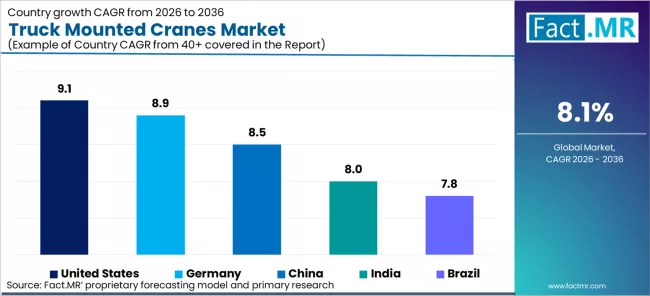
Truck Mounted Cranes Market Cagr Analysis By Country | Source: Fact.MR
| Country | CAGR (2026-2036) |
|---|---|
| United States | 9.1% |
| Germany | 8.9% |
| China | 8.5% |
| India | 8.0% |
| Brazil | 7.8% |
Source: Fact.MR analysis. Updated Mar 9, 2026
Source: Fact.MR (FACT.MR) analysis, based on proprietary forecasting model and primary research
North America Truck Mounted Cranes Market Analysis
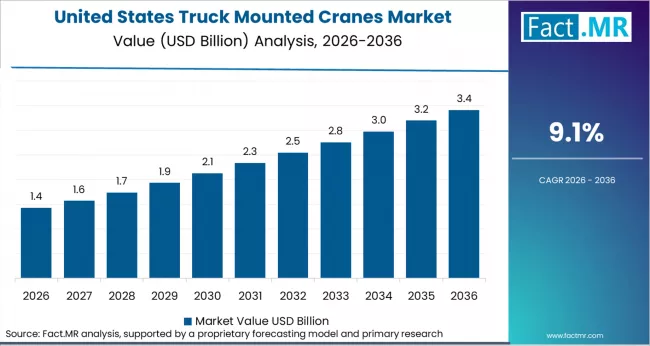
Truck Mounted Cranes Market Country Value Analysis | Source: Fact.MR
North America represents a high-value market for truck mounted cranes supported by federal infrastructure spending, grid modernisation projects, and a mature rental equipment ecosystem. Manitex International, Altec Industries, and Link-Belt Construction Equipment maintain strong regional presence through service networks and rental partnerships.
- United States: The United States truck mounted cranes market is forecast to expand at about 9.1% CAGR through 2036. Infrastructure Investment and Jobs Act projects continue to drive crane deployment across transportation and utility sectors. By early 2025, the Federal Highway Administration reported over USD 65 billion in active road and bridge construction projects. The Department of Energy allocated USD 3.9 billion in 2024 for grid resilience programmes across multiple states.
FACT.MR's North American analysis of the truck mounted cranes market covers the United States and Canada. Readers can find IIJA project timelines, utility investment benchmarks, rental fleet data, and emissions compliance adoption trends.
Europe Truck Mounted Cranes Market Analysis
Europe is characterised by emissions-compliant equipment adoption and growing offshore wind infrastructure. Stage V regulations and renewable energy investment are driving crane fleet upgrades and new procurement across the region. Liebherr Group, Palfinger AG, and Tadano maintain strong competitive presence.
- Germany: Germany is expected to witness around 8.9% CAGR growth through 2036 in truck mounted cranes demand. The Energiewende programme continues to expand renewable capacity and grid transmission networks requiring crane deployment for turbine installation and transmission towers. The Federal Network Agency approved around 84 GW of renewable capacity additions by 2024.
FACT.MR's European analysis of the truck mounted cranes market covers Germany, France, the United Kingdom, Italy, Spain, the Nordics, and Rest of Europe. Readers can find Stage V fleet transition trends, offshore wind demand forecasts, and country-level growth projections.
Asia Pacific Truck Mounted Cranes Market Analysis
Asia Pacific serves as both a high-volume consumption region and a global manufacturing hub for truck mounted cranes. China and India drive regional demand through infrastructure expansion while OEMs such as XCMG, Zoomlion, Tadano, and Kobelco maintain strong market positions.
- China: China’s truck mounted cranes market is likely to grow at nearly 8.5% CAGR through 2036. Infrastructure spending under the 14th Five-Year Plan continues to support crane procurement. The National Development and Reform Commission approved infrastructure projects worth about CNY 4.2 trillion by mid-2024. XCMG reported strong crane division revenue growth supported by domestic infrastructure and export demand. Zoomlion expanded production capacity at its Changsha facility to serve domestic and Middle East markets.
- India: India is anticipated to record close to 8.0% CAGR growth in truck mounted cranes demand through 2036. The National Infrastructure Pipeline targeting USD 1.4 trillion in investment is increasing crane deployment across roads, railways, and urban development projects. NHAI awarded highway contracts worth INR 2.8 trillion in FY2024-25. Tadano India expanded its distribution network while ACE Limited reported strong revenue growth supported by infrastructure procurement.
FACT.MR's Asia Pacific analysis of the truck mounted cranes market covers China, India, Japan, South Korea, ASEAN, Australia and New Zealand, and Rest of Asia Pacific. Readers can find NIP investment timelines, OEM production trends, export market developments, and country-level CAGR projections.
Latin America Truck Mounted Cranes Market Analysis
Latin America is emerging as a growth corridor supported by energy infrastructure projects, urban development, and expansion of the equipment rental sector. Brazil remains the largest market in the region.
- Brazil: Brazil is projected to register approximately 7.8% CAGR growth in truck mounted crane demand through 2036. The relaunched PAC infrastructure programme includes about BRL 1.7 trillion in project commitments covering energy, transport, and urban development. Transmission projects awarded in 2024 are increasing crane rental demand for tower installation.
FACT.MR's Latin American analysis of the truck mounted cranes market covers Brazil, Mexico, Colombia, and Rest of Latin America. Readers can find PAC project timelines, energy infrastructure investment trends, and rental market development benchmarks.
Competitive Aligners for Market Players
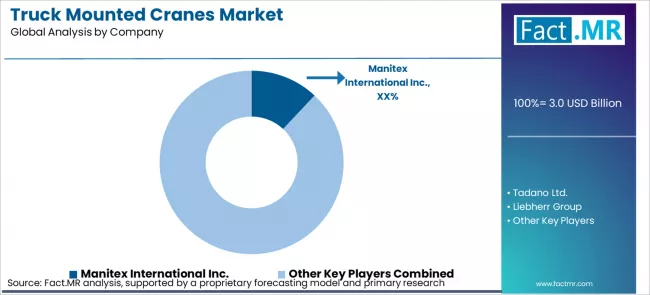
Truck Mounted Cranes Market Analysis By Company | Source: Fact.MR
The global truck mounted cranes market is moderately concentrated, with a mix of European, Japanese, and Chinese manufacturers shaping the competitive landscape. Companies such as Liebherr Group, Tadano Ltd., Palfinger AG, Terex Corporation, and Manitex International lead the premium and mid-range segments. At the same time, Chinese producers such as XCMG Group and Zoomlion Heavy Industry compete strongly in global markets by offering competitively priced units for high-volume applications.
Competition today is not determined only by lifting capacity. Buyers increasingly evaluate cranes based on telematics capability, emissions compliance, and the availability of strong service networks. Manufacturers that produce key components in-house, such as booms, hydraulics, and outrigger systems, gain cost control and faster customization for large fleet buyers.
Service infrastructure is also becoming a decisive advantage. Companies with global maintenance networks can secure long-term relationships with customers by providing reliable spare parts and technical support. Large equipment rental firms such as United Rentals, Sunbelt Rentals, and Loxam increasingly standardize fleets around a small number of trusted OEM partners to simplify maintenance and negotiate better pricing.
Recent Development
- In February 2025, Tadano Ltd. announced a strategic partnership with Volvo Trucks to co-develop electrified truck mounted crane carrier configurations for European urban construction and utility markets, targeting Stage V and anticipated Stage VI emissions compliance through hybrid-electric drivetrain integration.
- In January 2025, XCMG Group announced the commercial launch of its XCT25L6 truck mounted crane with intelligent load-sensing hydraulics and integrated telematics targeting Southeast Asian infrastructure markets, representing the company's highest-specification export crane configuration to date.
Key Players
- Manitex International Inc.
- Tadano Ltd.
- Liebherr Group
- Terex Corporation
- Palfinger AG
- XCMG Group
- Zoomlion Heavy Industry
- Link-Belt Construction Equipment
- Kobelco Construction Machinery
- Altec Industries Inc.
Bibliography
- [1] Palfinger AG. 2025. Annual Results 2024: Record Revenue Announcement and Crane Segment Performance. Palfinger AG Investor Relations Press Release, February 2025.
- [2] Federal Highway Administration, US Department of Transportation. 2025. Infrastructure Investment and Jobs Act: Active Construction Project Award Status Report. January 2025. fhwa.dot.gov
- [3] European Commission. 2024. Regulation (EU) 2016/1628 Stage V Non-Road Mobile Machinery Emissions Requirements: Enforcement Update and Compliance Status. Official Journal of the European Union, December 2024.
- [4] WindEurope. 2024. Wind Energy in Europe: 2024 Statistics and the Outlook for 2025-2029. WindEurope Annual Report, December 2024. windeurope.org
- [5] Tadano Ltd. 2025. Business Update: Shido Manufacturing Facility Capacity Expansion for Truck Mounted Crane Production. Tadano Investor Relations Announcement, February 2025. tadano.com
- [6] Liebherr Group. 2024. Product Launch: LTF 1030-4.1 Telescopic Truck Mounted Crane with LICCON3 Control System. Liebherr Press Release, October 2024. liebherr.com
- [7] United Rentals Inc. 2024. Q3 2024 Earnings Release: Specialty Crane Segment Revenue and Demand Commentary. United Rentals Investor Relations, October 2024. unitedrentals.com
- [8] The Manitowoc Company. 2024. Q4 2024 Earnings Call Transcript: Infrastructure Contract Order Update and IIJA Procurement Pipeline. Manitowoc Investor Relations, November 2024. manitowoccranes.com
- [9] XCMG Group. 2025. Press Release: Heavy-Capacity Truck Mounted Crane Range Expansion for Oil and Gas Markets in Middle East and Central Asia. XCMG Corporate Communications, January 2025. xcmg.com
- [10] American Public Power Association. 2024. 2024 Transmission and Distribution Infrastructure Investment Survey: Capital Spending Trends and Grid Hardening Priorities. APPA Research Publication, September 2024. publicpower.org
This Report Addresses
- Strategic insights on infrastructure crane demand in the United States, emissions-driven fleet replacement in Germany, Belt and Road construction activity in China, NIP infrastructure projects in India, and PAC energy investment in Brazil.
- Market forecast from USD 3.0 billion in 2026 to USD 6.5 billion by 2036 at an 8.1% CAGR across crane capacity, application, end use, and region.
- Growth opportunities in 15-30-ton fleet modernisation, telematics integration, electrified truck cranes, offshore wind installation demand, and rental fleet expansion in emerging markets.
- Country growth outlook covering United States (9.1%), Germany (8.9%), China (8.5%), India (8.0%), and Brazil (7.8%) with infrastructure and regulatory drivers.
- Competitive analysis of Liebherr Group, Tadano Ltd., Palfinger AG, XCMG Group, Manitex International, Terex Corporation, Zoomlion Heavy Industry, Altec Industries, Link-Belt Cranes, and Kobelco Construction Machinery.
- Technology tracking covering Stage V compliant cranes, telematics upgrades, electrified telescopic boom development, AI-based load monitoring, and smart hydraulic systems.
- Regulatory analysis including EU Stage V NRMM enforcement, US EPA Tier 4 Final compliance, India NIP investment rollout, China 14th Five-Year Plan infrastructure spending, and Brazil PAC project execution.
- Report delivered in Excel datasets, PowerPoint summary, and detailed PDF supported by OEM financial disclosures, infrastructure databases, equipment association statistics, rental market benchmarks, and primary interviews.
Segmentation
Scope of Report
| Items | Values |
|---|---|
| Quantitative Units | USD 3.0 billion (2026) to USD 6.5 billion (2036), at a CAGR of 8.1% |
| Market Definition | Truck mounted cranes are mobile lifting systems integrated onto carrier truck chassis, combining road mobility with on-site lifting capability, spanning capacity classes from under 15 tons to above 50 tons for construction, infrastructure, utility, oil and gas, and material handling applications. |
| Crane Capacity | Up to 15 Tons, 15-30 Tons, 30-50 Tons, Above 50 Tons |
| Application | Construction, Infrastructure Development, Oil & Gas Operations, Utilities Maintenance, Material Handling, Others |
| End Use | Construction Companies, Rental Services, Utilities Companies, Manufacturing Industries, Others |
| Application Coverage | Structural element placement in construction, bridge and highway infrastructure erection, oil and gas drilling equipment positioning, utility pole and transformer installation, wind energy component handling, and manufacturing plant equipment logistics. |
| Regions Covered | Asia Pacific, Europe, North America, Latin America, Middle East and Africa |
| Countries Covered | United States, Germany, China, India, Brazil, Canada, Japan, South Korea, France, United Kingdom, Italy, Spain, ASEAN, Australia & New Zealand, Rest of regions |
| Key Companies Profiled | Manitex International Inc., Tadano Ltd., Liebherr Group, Terex Corporation, Palfinger AG, XCMG Group, Zoomlion Heavy Industry, Link-Belt Construction Equipment, Kobelco Construction Machinery, Altec Industries Inc. |
| Forecast Period | 2026 to 2036 |
| Approach | A hybrid top-down and bottom-up model was applied. Top-down inputs included infrastructure spending timelines, construction output forecasts, emissions-driven fleet replacement schedules, and rental market penetration. Bottom-up inputs analysed average crane prices by capacity class, OEM order backlogs, rental yield trends, and fleet replacement cycles from operator interviews. |
Source: Fact.MR analysis. Updated Mar 9, 2026
Truck Mounted Cranes Market by Segments
-
Crane Capacity :
- Up to 15 Tons
- 15-30 Tons
- 30-50 Tons
- Above 50 Tons
-
Application :
- Construction
- Infrastructure Development
- Oil & Gas Operations
- Utilities Maintenance
- Material Handling
- Others (Emergency Services, Telecommunications)
-
End Use :
- Construction Companies
- Rental Services
- Utilities Companies
- Manufacturing Industries
- Others
-
Region :
- North America
- USA
- Canada
- Mexico
- Latin America
- Brazil
- Chile
- Rest of Latin America
- Western Europe
- Germany
- UK
- Italy
- Spain
- France
- Nordic
- BENELUX
- Rest of Western Europe
- Eastern Europe
- Russia
- Poland
- Hungary
- Balkan & Baltic
- Rest of Eastern Europe
- East Asia
- China
- Japan
- South Korea
- South Asia and Pacific
- India
- ASEAN
- Australia & New Zealand
- Rest of South Asia and Pacific
- Middle East & Africa
- Kingdom of Saudi Arabia
- Other GCC Countries
- Turkiye
- South Africa
- Other African Union
- Rest of Middle East & Africa
- North America
Frequently Asked Questions
How large is the truck mounted cranes market in 2025?
What will the market size be in 2026?
What is the projected market size by 2036?
What is the expected CAGR?
Which crane capacity class leads the market?
Which application segment dominates?
Which country shows the fastest growth?
What is the primary end-use segment?
What is the primary restraint in this market?
How does Stage V emissions regulation impact market dynamics?
Who worked on this report


Preview the report firsthand - request a free sample
Free SampleGet the brochure for pricing and purchase details
Download PDF