Autonomous Quarry Off-Highway Trucks Market
Autonomous Quarry Off-Highway Trucks Market Size and Share Forecast Outlook 2026 to 2036
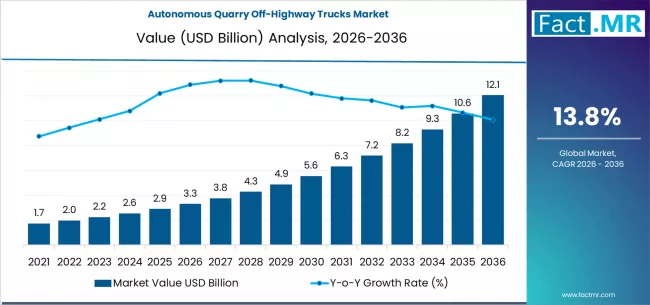
Autonomous quarry off-highway trucks market is projected to grow from USD 3.3 billion in 2026 to USD 12.1 billion by 2036, at a CAGR of 13.8%. <50 tons will dominate with a 19.0% market share, while l2 – assisted autonomy will lead the autonomy level segment with a 26.0% share.
Autonomous Quarry Off-Highway Trucks Market Forecast and Outlook 2026 to 2036
The autonomous quarry truck market is projected to surge from USD 3.31 billion in 2026 to USD 12.06 billion by 2036, growing at a 13.8% CAGR. This acceleration is driven by a compelling economic return on investment, achieved through 24/7 operation, optimized routing for fuel and tire savings, and consistent performance.
Key Takeaways from the Autonomous Quarry Off-Highway Trucks Market
- Market Value for 2026: USD 3.31 Billion
- Market Value for 2036: USD 12.06 Billion
- Forecast CAGR (2026-2036): 13.8%
- Leading Application Segment (2026): Quarry Operations (41%)
- Leading Autonomy Level Segment (2026): L2 - Assisted Autonomy (26%)
- Leading Payload Capacity Segment (2026): <50 tons (19%)
- Key Growth Countries: China (16.20% CAGR), India (15.80% CAGR), USA (13.60% CAGR), Germany (12.90% CAGR), Japan (12.30% CAGR)
- Key Players in the Market: Komatsu Ltd. (Autonomous Solutions), Caterpillar Inc. (Cat® Command), Volvo Construction Equipment, Hexagon AB (Autonomy Systems), Hitachi Construction Machinery

A key trend is the shift from pilot projects to integrated, site-wide autonomous ecosystems, where trucks interoperate with drills and dozers under a central management system. Another is the move from retrofit kits to purpose-built, factory-integrated trucks designed for harsh quarry conditions, enhancing reliability and safety by removing personnel from hazards.
China leads growth (16.20% CAGR), propelled by state-led smart mining mandates. India follows (15.80%), driven by efficiency needs in its aggregates sector. Markets like the USA and Germany are focused on refining productivity and data integration from established deployments.
Metric
| Metric | Value |
|---|---|
| Market Value (2026) | USD 3.31 Billion |
| Market Forecast Value (2036) | USD 12.06 Billion |
| Forecast CAGR (2026-2036) | 13.8% |
Category
| Category | Segments |
|---|---|
| Payload Capacity | <50 tons, 50-100 tons, 100-150 tons, >150 tons |
| Autonomy Level | L2 - Assisted Autonomy, L3 - Conditional Autonomy, L4 - High Autonomy, L5 - Full Autonomy |
| Application | Quarry Operations, Open-Pit Mining, Construction Aggregates, Specialty Earthworks |
| Region | North America, Latin America, Western Europe, Eastern Europe, East Asia, South Asia & Pacific, MEA |
Segmental Analysis
By Application, Which Segment is the Immediate Commercial Frontier?
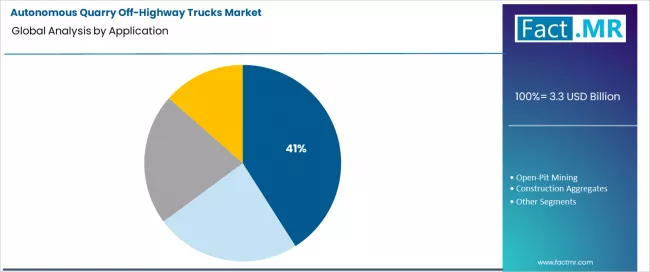
Quarry operations hold the leading 41% share, serving as the primary commercial testing and adoption ground for this technology. The contained, repetitive, and well-defined haul cycles within a quarry present an ideal operational environment for autonomous systems.
The high-volume, low-margin nature of aggregate production creates intense pressure to reduce per-ton costs, making the efficiency gains from autonomy financially compelling. This segment’s success is providing the operational data and business case to drive adoption in adjacent applications.
By Autonomy Level, Which Stage Represents the Pragmatic Adoption Curve?
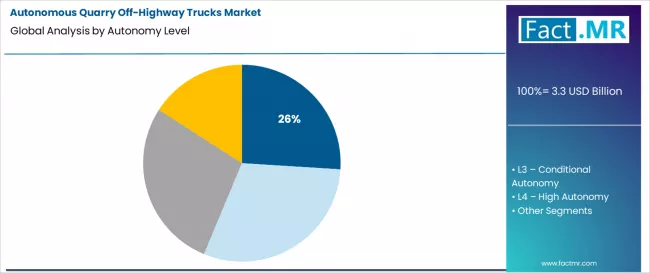
Level 2 (Assisted Autonomy) commands a 26% share, reflecting the pragmatic first step for many operators. L2 systems, offering features like assisted loading, dumping, and haul road following with human supervision, allow sites to capture initial benefits, such as reduced operator fatigue, improved consistency, without a full leap into driverless operations.
This tier lowers the barrier to entry, builds operator and management comfort with the technology, and provides a pathway for future upgrades to higher autonomy levels as confidence grows.
By Payload Capacity, Which Category Balances Flexibility and Scale?
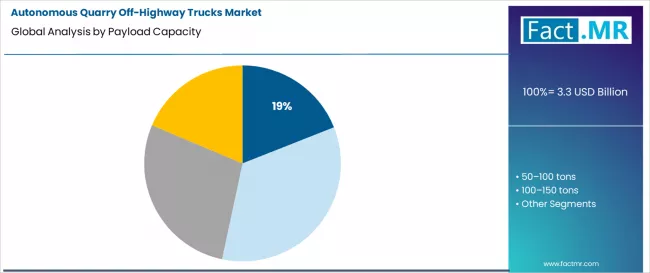
The <50 tons capacity segment leads with 19% share. This range is particularly relevant for mid-sized quarries, construction aggregate sites, and complex terrain where maneuverability is key.
Smaller trucks are often the first targets for retrofit autonomy solutions and are seen as lower-risk investments. Their shorter, more frequent cycles also provide more data points for system learning and optimization, accelerating the improvement of the autonomous fleet’s overall efficiency.
What are the Drivers, Restraints, Opportunities, and Key Trends?
| Aspect | Description |
|---|---|
| Driver | The urgent need to achieve a lower, more predictable cost per ton of material moved. Autonomy directly addresses major cost centers: eliminating shift-change downtime, optimizing fuel and tire usage through consistent driving patterns, and reducing damage from operator error. |
| Restraint | The substantial upfront capital investment required for autonomous systems, whether for new vehicles or retrofits, coupled with the complexity of integrating new technology into legacy site IT/OT infrastructure and established workforce workflows. This creates a significant financial and operational barrier. |
| Opportunity | The emergence of autonomy-as-a-service (AaaS) and retrofit kit providers. This model allows quarry operators to adopt autonomy without the massive capex of buying new trucks, paying instead on a per-hour or per-ton basis. It democratizes access for smaller operators and de-risks the adoption process. |
| Key Trend | The development of resilient autonomy - systems that can maintain operational safety and efficiency in challenging conditions like heavy dust, rain, fog, or temporary GPS denial. This involves sensor fusion (LiDAR, radar, camera) and AI-powered perception that can understand and navigate dynamic site environments. |
Analysis of the Autonomous Quarry Off-Highway Trucks Market by Key Countries
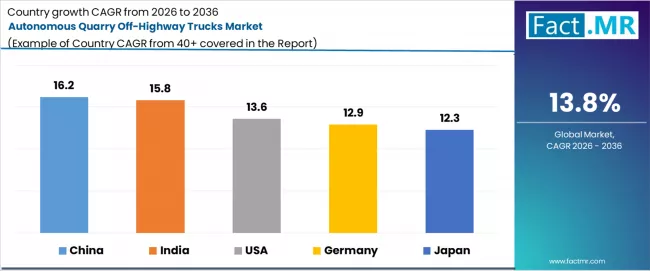
| Country | CAGR (2026-2036) |
|---|---|
| China | 16.20% |
| India | 15.80% |
| USA | 13.60% |
| Germany | 12.90% |
| Japan | 12.30% |
How is China's Top-Down Smart Mine Policy Driving Adoption?
China's leading 16.20% CAGR is a direct result of national industrial policy. Government guidelines actively promote unmanned, smart mines as a matter of safety and efficiency. Large, state-influenced mining and quarrying conglomerates have the scale and mandate to implement autonomy across multiple sites rapidly. Domestic technology providers are being nurtured, creating a synergistic ecosystem that drives down costs and accelerates iterative development.
What is Fueling India's Rapid Growth Trajectory?
India's 15.80% growth is propelled by an insatiable demand for construction aggregates from its infrastructure boom. Quarry operators face rising costs and increasing difficulty in finding skilled truck operators.
Autonomy presents a solution to both, ensuring consistent production to meet demand while stabilizing operational expenses. The market is highly cost-conscious, favoring scalable solutions and retrofit options that offer a clear, fast payback period.
Why is the USA a Leader in High-Value Deployment?
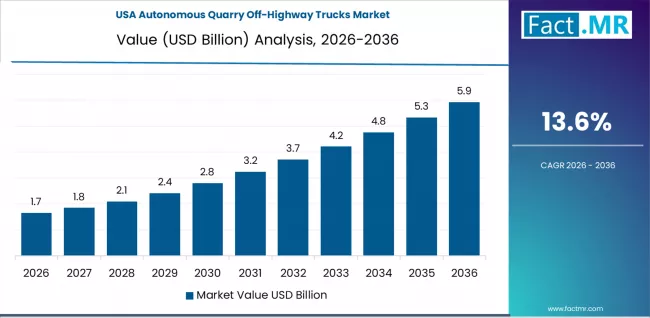
The USA's 13.60% growth is characterized by deployments in large-scale, high-value operations. Early adopters in the copper, iron ore, and aggregates sectors have proven the business case, creating a roadmap for others.
The market is driven by a focus on data analytics, using information from autonomous fleets to perform predictive maintenance, optimize site layouts, and achieve sustainability targets through reduced fuel burn and emissions.
How does Germany's Engineering Precision Shape its Market?
Germany's 12.90% CAGR reflects its focus on precision engineering and system integration. German operators and technology suppliers emphasize flawless interoperability, cybersecurity, and system redundancy to meet the highest safety standards.
The market is less about being first and more about implementing the most reliable, thoroughly validated autonomous systems that can withstand rigorous operational and regulatory scrutiny.
What is the Nature of Demand in Japan's Technologically Advanced Sector?
Japan's 12.30% growth is driven by its need to maintain industrial competitiveness amid a shrinking workforce and high labor costs. Japanese engineering focuses on precision, miniaturization of components, and the development of autonomy systems for smaller, more confined quarry sites common in the country. There is significant interest in remote operation centers where a single operator can supervise multiple machines across different sites.
Competitive Landscape and Strategic Recommendations
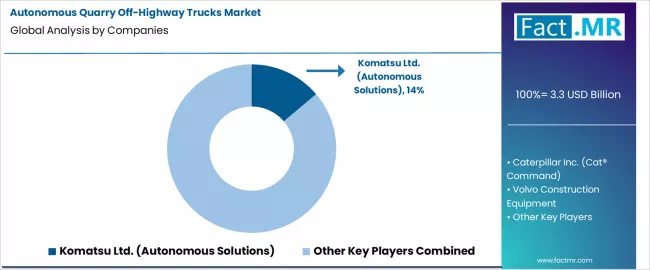
The landscape is divided between full-system OEMs (Komatsu, Caterpillar) offering integrated vehicle-plus-autonomy solutions and technology specialists (Hexagon) providing agnostic hardware and software platforms. Competition centers on total system reliability, depth of data analytics, and the ability to deliver a measurable ROI.
| Attribute | Recommendation |
|---|---|
| Develop Hybrid Fleet Management Capabilities | Create systems that can seamlessly manage a mixed fleet of autonomous and conventionally operated vehicles. This is the reality for most sites during transition and allows operators to scale autonomy at their own pace without creating operational silos. |
| Invest in "Digital Twin" Site Integration | Move beyond fleet management to offer a live digital twin of the entire quarry. Integrate autonomous truck data with geological models, processing plant status, and market demand to enable dynamic, profit-optimized production planning. |
| Pioneer New Business and Service Models | Lead the shift towards outcome-based contracting, such as guaranteed cost-per-ton contracts powered by autonomy. Expand offerings to include full remote operations center services for clients who prefer not to manage the technology in-house. |
| Build Open Architecture for Specialized Attachments | Ensure the autonomous platform can easily integrate with a wide range of third-party dumping bodies, tire monitoring systems, and payload sensors. This flexibility will be key to serving diverse quarrying and earthworks applications. |
Key Players in the Autonomous Quarry Off-Highway Trucks Market
- Komatsu Ltd. (Autonomous Solutions)
- Caterpillar Inc. (Cat® Command)
- Volvo Construction Equipment
- Hexagon AB (Autonomy Systems)
- Hitachi Construction Machinery
Scope of Report
| Items | Values |
|---|---|
| Quantitative Units | USD Billion |
| Payload Capacity | <50 tons, 50-100 tons, 100-150 tons, >150 tons |
| Autonomy Level | L2 - Assisted Autonomy, L3 - Conditional Autonomy, L4 - High Autonomy, L5 - Full Autonomy |
| Application | Quarry Operations, Open-Pit Mining, Construction Aggregates, Specialty Earthworks |
| Key Countries | China, India, USA, Germany, Japan |
| Key Companies | Komatsu Ltd. (Autonomous Solutions), Caterpillar Inc. (Cat® Command), Volvo Construction Equipment, Hexagon AB (Autonomy Systems), Hitachi Construction Machinery |
| Additional Analysis | Comparative Total Cost of Ownership (TCO) analysis for retrofitted vs. factory-built autonomous trucks; cybersecurity risk assessment and mitigation frameworks for autonomous industrial fleets; impact of autonomy on local employment and required skills transition; analysis of liability and insurance models for autonomous vehicle operations in private industrial areas. |
Market by Segments
-
Payload Capacity :
- <50 tons
- 50-100 tons
- 100-150 tons
- 150 tons
-
Autonomy Level :
- L2 - Assisted Autonomy
- L3 - Conditional Autonomy
- L4 - High Autonomy
- L5 - Full Autonomy
-
Application :
- Quarry Operations
- Open-Pit Mining
- Construction Aggregates
- Specialty Earthworks
-
Region :
- North America
- USA
- Canada
- Latin America
- Brazil
- Mexico
- Argentina
- Rest of Latin America
- Western Europe
- Germany
- UK
- France
- Spain
- Italy
- BENELUX
- Rest of Western Europe
- Eastern Europe
- Russia
- Poland
- Czech Republic
- Rest of Eastern Europe
- East Asia
- China
- Japan
- South Korea
- Rest of East Asia
- South Asia & Pacific
- India
- ASEAN
- Australia
- Rest of South Asia & Pacific
- MEA
- Saudi Arabia
- UAE
- Turkiye
- Rest of MEA
- North America
References
- International Council on Mining and Metals (ICMM). (2024). Innovation in Mining: The Pathway to Autonomous and Remote Operations. ICMM Report.
- Liang, Z., & Zhang, Y. (2023). Sensor fusion and path planning for autonomous haul trucks in unstructured mining environments. Robotics and Autonomous Systems, 167, 104492.
- Parreira, J., & Meech, J. (2024). The socio-economic impact of autonomous vehicles in mining: A case study framework. The Extractive Industries and Society, 18, 101325.
- Ralston, J. C., & Hainsworth, D. W. (2023). Automation in the mining industry: The case for remote and autonomous systems. CRC Press.
- World Economic Forum. (2024). Transforming the Energy, Materials and Mobility Industries: The Role of Autonomy. WEF White Paper.
Table of Content
- Executive Summary
- Global Market Outlook
- Demand to side Trends
- Supply to side Trends
- Technology Roadmap Analysis
- Analysis and Recommendations
- Market Overview
- Market Coverage / Taxonomy
- Market Definition / Scope / Limitations
- Market Background
- Market Dynamics
- Drivers
- Restraints
- Opportunity
- Trends
- Scenario Forecast
- Demand in Optimistic Scenario
- Demand in Likely Scenario
- Demand in Conservative Scenario
- Opportunity Map Analysis
- Product Life Cycle Analysis
- Supply Chain Analysis
- Investment Feasibility Matrix
- Value Chain Analysis
- PESTLE and Porter’s Analysis
- Regulatory Landscape
- Regional Parent Market Outlook
- Production and Consumption Statistics
- Import and Export Statistics
- Market Dynamics
- Global Market Analysis 2021 to 2025 and Forecast, 2026 to 2036
- Historical Market Size Value (USD Million) Analysis, 2021 to 2025
- Current and Future Market Size Value (USD Million) Projections, 2026 to 2036
- Y to o to Y Growth Trend Analysis
- Absolute $ Opportunity Analysis
- Global Market Pricing Analysis 2021 to 2025 and Forecast 2026 to 2036
- Global Market Analysis 2021 to 2025 and Forecast 2026 to 2036, By Payload Capacity
- Introduction / Key Findings
- Historical Market Size Value (USD Million) Analysis By Payload Capacity, 2021 to 2025
- Current and Future Market Size Value (USD Million) Analysis and Forecast By Payload Capacity, 2026 to 2036
- <50 tons
- 50-100 tons
- 100-150 tons
- >150 tons
- <50 tons
- Y to o to Y Growth Trend Analysis By Payload Capacity, 2021 to 2025
- Absolute $ Opportunity Analysis By Payload Capacity, 2026 to 2036
- Global Market Analysis 2021 to 2025 and Forecast 2026 to 2036, By Autonomy Level
- Introduction / Key Findings
- Historical Market Size Value (USD Million) Analysis By Autonomy Level, 2021 to 2025
- Current and Future Market Size Value (USD Million) Analysis and Forecast By Autonomy Level, 2026 to 2036
- L2 - Assisted Autonomy
- L3 - Conditional Autonomy
- L4 - High Autonomy
- L5 - Full Autonomy
- L2 - Assisted Autonomy
- Y to o to Y Growth Trend Analysis By Autonomy Level, 2021 to 2025
- Absolute $ Opportunity Analysis By Autonomy Level, 2026 to 2036
- Global Market Analysis 2021 to 2025 and Forecast 2026 to 2036, By Application
- Introduction / Key Findings
- Historical Market Size Value (USD Million) Analysis By Application, 2021 to 2025
- Current and Future Market Size Value (USD Million) Analysis and Forecast By Application, 2026 to 2036
- Quarry Operations
- Open-Pit Mining
- Construction Aggregates
- Specialty Earthworks
- Quarry Operations
- Y to o to Y Growth Trend Analysis By Application, 2021 to 2025
- Absolute $ Opportunity Analysis By Application, 2026 to 2036
- Global Market Analysis 2021 to 2025 and Forecast 2026 to 2036, By Region
- Introduction
- Historical Market Size Value (USD Million) Analysis By Region, 2021 to 2025
- Current Market Size Value (USD Million) Analysis and Forecast By Region, 2026 to 2036
- North America
- Latin America
- Western Europe
- Eastern Europe
- East Asia
- South Asia and Pacific
- Middle East & Africa
- Market Attractiveness Analysis By Region
- North America Market Analysis 2021 to 2025 and Forecast 2026 to 2036, By Country
- Historical Market Size Value (USD Million) Trend Analysis By Market Taxonomy, 2021 to 2025
- Market Size Value (USD Million) Forecast By Market Taxonomy, 2026 to 2036
- By Country
- USA
- Canada
- Mexico
- By Payload Capacity
- By Autonomy Level
- By Application
- By Country
- Market Attractiveness Analysis
- By Country
- By Payload Capacity
- By Autonomy Level
- By Application
- Key Takeaways
- Latin America Market Analysis 2021 to 2025 and Forecast 2026 to 2036, By Country
- Historical Market Size Value (USD Million) Trend Analysis By Market Taxonomy, 2021 to 2025
- Market Size Value (USD Million) Forecast By Market Taxonomy, 2026 to 2036
- By Country
- Brazil
- Chile
- Rest of Latin America
- By Payload Capacity
- By Autonomy Level
- By Application
- By Country
- Market Attractiveness Analysis
- By Country
- By Payload Capacity
- By Autonomy Level
- By Application
- Key Takeaways
- Western Europe Market Analysis 2021 to 2025 and Forecast 2026 to 2036, By Country
- Historical Market Size Value (USD Million) Trend Analysis By Market Taxonomy, 2021 to 2025
- Market Size Value (USD Million) Forecast By Market Taxonomy, 2026 to 2036
- By Country
- Germany
- UK
- Italy
- Spain
- France
- Nordic
- BENELUX
- Rest of Western Europe
- By Payload Capacity
- By Autonomy Level
- By Application
- By Country
- Market Attractiveness Analysis
- By Country
- By Payload Capacity
- By Autonomy Level
- By Application
- Key Takeaways
- Eastern Europe Market Analysis 2021 to 2025 and Forecast 2026 to 2036, By Country
- Historical Market Size Value (USD Million) Trend Analysis By Market Taxonomy, 2021 to 2025
- Market Size Value (USD Million) Forecast By Market Taxonomy, 2026 to 2036
- By Country
- Russia
- Poland
- Hungary
- Balkan & Baltic
- Rest of Eastern Europe
- By Payload Capacity
- By Autonomy Level
- By Application
- By Country
- Market Attractiveness Analysis
- By Country
- By Payload Capacity
- By Autonomy Level
- By Application
- Key Takeaways
- East Asia Market Analysis 2021 to 2025 and Forecast 2026 to 2036, By Country
- Historical Market Size Value (USD Million) Trend Analysis By Market Taxonomy, 2021 to 2025
- Market Size Value (USD Million) Forecast By Market Taxonomy, 2026 to 2036
- By Country
- China
- Japan
- South Korea
- By Payload Capacity
- By Autonomy Level
- By Application
- By Country
- Market Attractiveness Analysis
- By Country
- By Payload Capacity
- By Autonomy Level
- By Application
- Key Takeaways
- South Asia and Pacific Market Analysis 2021 to 2025 and Forecast 2026 to 2036, By Country
- Historical Market Size Value (USD Million) Trend Analysis By Market Taxonomy, 2021 to 2025
- Market Size Value (USD Million) Forecast By Market Taxonomy, 2026 to 2036
- By Country
- India
- ASEAN
- Australia & New Zealand
- Rest of South Asia and Pacific
- By Payload Capacity
- By Autonomy Level
- By Application
- By Country
- Market Attractiveness Analysis
- By Country
- By Payload Capacity
- By Autonomy Level
- By Application
- Key Takeaways
- Middle East & Africa Market Analysis 2021 to 2025 and Forecast 2026 to 2036, By Country
- Historical Market Size Value (USD Million) Trend Analysis By Market Taxonomy, 2021 to 2025
- Market Size Value (USD Million) Forecast By Market Taxonomy, 2026 to 2036
- By Country
- Kingdom of Saudi Arabia
- Other GCC Countries
- Turkiye
- South Africa
- Other African Union
- Rest of Middle East & Africa
- By Payload Capacity
- By Autonomy Level
- By Application
- By Country
- Market Attractiveness Analysis
- By Country
- By Payload Capacity
- By Autonomy Level
- By Application
- Key Takeaways
- Key Countries Market Analysis
- USA
- Pricing Analysis
- Market Share Analysis, 2025
- By Payload Capacity
- By Autonomy Level
- By Application
- Canada
- Pricing Analysis
- Market Share Analysis, 2025
- By Payload Capacity
- By Autonomy Level
- By Application
- Mexico
- Pricing Analysis
- Market Share Analysis, 2025
- By Payload Capacity
- By Autonomy Level
- By Application
- Brazil
- Pricing Analysis
- Market Share Analysis, 2025
- By Payload Capacity
- By Autonomy Level
- By Application
- Chile
- Pricing Analysis
- Market Share Analysis, 2025
- By Payload Capacity
- By Autonomy Level
- By Application
- Germany
- Pricing Analysis
- Market Share Analysis, 2025
- By Payload Capacity
- By Autonomy Level
- By Application
- UK
- Pricing Analysis
- Market Share Analysis, 2025
- By Payload Capacity
- By Autonomy Level
- By Application
- Italy
- Pricing Analysis
- Market Share Analysis, 2025
- By Payload Capacity
- By Autonomy Level
- By Application
- Spain
- Pricing Analysis
- Market Share Analysis, 2025
- By Payload Capacity
- By Autonomy Level
- By Application
- France
- Pricing Analysis
- Market Share Analysis, 2025
- By Payload Capacity
- By Autonomy Level
- By Application
- India
- Pricing Analysis
- Market Share Analysis, 2025
- By Payload Capacity
- By Autonomy Level
- By Application
- ASEAN
- Pricing Analysis
- Market Share Analysis, 2025
- By Payload Capacity
- By Autonomy Level
- By Application
- Australia & New Zealand
- Pricing Analysis
- Market Share Analysis, 2025
- By Payload Capacity
- By Autonomy Level
- By Application
- China
- Pricing Analysis
- Market Share Analysis, 2025
- By Payload Capacity
- By Autonomy Level
- By Application
- Japan
- Pricing Analysis
- Market Share Analysis, 2025
- By Payload Capacity
- By Autonomy Level
- By Application
- South Korea
- Pricing Analysis
- Market Share Analysis, 2025
- By Payload Capacity
- By Autonomy Level
- By Application
- Russia
- Pricing Analysis
- Market Share Analysis, 2025
- By Payload Capacity
- By Autonomy Level
- By Application
- Poland
- Pricing Analysis
- Market Share Analysis, 2025
- By Payload Capacity
- By Autonomy Level
- By Application
- Hungary
- Pricing Analysis
- Market Share Analysis, 2025
- By Payload Capacity
- By Autonomy Level
- By Application
- Kingdom of Saudi Arabia
- Pricing Analysis
- Market Share Analysis, 2025
- By Payload Capacity
- By Autonomy Level
- By Application
- Turkiye
- Pricing Analysis
- Market Share Analysis, 2025
- By Payload Capacity
- By Autonomy Level
- By Application
- South Africa
- Pricing Analysis
- Market Share Analysis, 2025
- By Payload Capacity
- By Autonomy Level
- By Application
- USA
- Market Structure Analysis
- Competition Dashboard
- Competition Benchmarking
- Market Share Analysis of Top Players
- By Regional
- By Payload Capacity
- By Autonomy Level
- By Application
- Competition Analysis
- Competition Deep Dive
- Komatsu Ltd. (Autonomous Solutions)
- Overview
- Product Portfolio
- Profitability by Market Segments (Product/Age /Sales Channel/Region)
- Sales Footprint
- Strategy Overview
- Marketing Strategy
- Product Strategy
- Channel Strategy
- Caterpillar Inc. (Cat® Command)
- Volvo Construction Equipment
- Hexagon AB (Autonomy Systems)
- Hitachi Construction Machinery
- Others
- Komatsu Ltd. (Autonomous Solutions)
- Competition Deep Dive
- Assumptions & Acronyms Used
- Research Methodology
List Of Table
- Table 1: Global Market Value (USD Million) Forecast by Region, 2021 to 2036
- Table 2: Global Market Value (USD Million) Forecast by Payload Capacity, 2021 to 2036
- Table 3: Global Market Value (USD Million) Forecast by Autonomy Level, 2021 to 2036
- Table 4: Global Market Value (USD Million) Forecast by Application, 2021 to 2036
- Table 5: North America Market Value (USD Million) Forecast by Country, 2021 to 2036
- Table 6: North America Market Value (USD Million) Forecast by Payload Capacity, 2021 to 2036
- Table 7: North America Market Value (USD Million) Forecast by Autonomy Level, 2021 to 2036
- Table 8: North America Market Value (USD Million) Forecast by Application, 2021 to 2036
- Table 9: Latin America Market Value (USD Million) Forecast by Country, 2021 to 2036
- Table 10: Latin America Market Value (USD Million) Forecast by Payload Capacity, 2021 to 2036
- Table 11: Latin America Market Value (USD Million) Forecast by Autonomy Level, 2021 to 2036
- Table 12: Latin America Market Value (USD Million) Forecast by Application, 2021 to 2036
- Table 13: Western Europe Market Value (USD Million) Forecast by Country, 2021 to 2036
- Table 14: Western Europe Market Value (USD Million) Forecast by Payload Capacity, 2021 to 2036
- Table 15: Western Europe Market Value (USD Million) Forecast by Autonomy Level, 2021 to 2036
- Table 16: Western Europe Market Value (USD Million) Forecast by Application, 2021 to 2036
- Table 17: Eastern Europe Market Value (USD Million) Forecast by Country, 2021 to 2036
- Table 18: Eastern Europe Market Value (USD Million) Forecast by Payload Capacity, 2021 to 2036
- Table 19: Eastern Europe Market Value (USD Million) Forecast by Autonomy Level, 2021 to 2036
- Table 20: Eastern Europe Market Value (USD Million) Forecast by Application, 2021 to 2036
- Table 21: East Asia Market Value (USD Million) Forecast by Country, 2021 to 2036
- Table 22: East Asia Market Value (USD Million) Forecast by Payload Capacity, 2021 to 2036
- Table 23: East Asia Market Value (USD Million) Forecast by Autonomy Level, 2021 to 2036
- Table 24: East Asia Market Value (USD Million) Forecast by Application, 2021 to 2036
- Table 25: South Asia and Pacific Market Value (USD Million) Forecast by Country, 2021 to 2036
- Table 26: South Asia and Pacific Market Value (USD Million) Forecast by Payload Capacity, 2021 to 2036
- Table 27: South Asia and Pacific Market Value (USD Million) Forecast by Autonomy Level, 2021 to 2036
- Table 28: South Asia and Pacific Market Value (USD Million) Forecast by Application, 2021 to 2036
- Table 29: Middle East & Africa Market Value (USD Million) Forecast by Country, 2021 to 2036
- Table 30: Middle East & Africa Market Value (USD Million) Forecast by Payload Capacity, 2021 to 2036
- Table 31: Middle East & Africa Market Value (USD Million) Forecast by Autonomy Level, 2021 to 2036
- Table 32: Middle East & Africa Market Value (USD Million) Forecast by Application, 2021 to 2036
List Of Figures
- Figure 1: Global Market Pricing Analysis
- Figure 2: Global Market Value (USD Million) Forecast 2021 to 2036
- Figure 3: Global Market Value Share and BPS Analysis by Payload Capacity, 2026 and 2036
- Figure 4: Global Market Y to o to Y Growth Comparison by Payload Capacity, 2026 to 2036
- Figure 5: Global Market Attractiveness Analysis by Payload Capacity
- Figure 6: Global Market Value Share and BPS Analysis by Autonomy Level, 2026 and 2036
- Figure 7: Global Market Y to o to Y Growth Comparison by Autonomy Level, 2026 to 2036
- Figure 8: Global Market Attractiveness Analysis by Autonomy Level
- Figure 9: Global Market Value Share and BPS Analysis by Application, 2026 and 2036
- Figure 10: Global Market Y to o to Y Growth Comparison by Application, 2026 to 2036
- Figure 11: Global Market Attractiveness Analysis by Application
- Figure 12: Global Market Value (USD Million) Share and BPS Analysis by Region, 2026 and 2036
- Figure 13: Global Market Y to o to Y Growth Comparison by Region, 2026 to 2036
- Figure 14: Global Market Attractiveness Analysis by Region
- Figure 15: North America Market Incremental Dollar Opportunity, 2026 to 2036
- Figure 16: Latin America Market Incremental Dollar Opportunity, 2026 to 2036
- Figure 17: Western Europe Market Incremental Dollar Opportunity, 2026 to 2036
- Figure 18: Eastern Europe Market Incremental Dollar Opportunity, 2026 to 2036
- Figure 19: East Asia Market Incremental Dollar Opportunity, 2026 to 2036
- Figure 20: South Asia and Pacific Market Incremental Dollar Opportunity, 2026 to 2036
- Figure 21: Middle East & Africa Market Incremental Dollar Opportunity, 2026 to 2036
- Figure 22: North America Market Value Share and BPS Analysis by Country, 2026 and 2036
- Figure 23: North America Market Value Share and BPS Analysis by Payload Capacity, 2026 and 2036
- Figure 24: North America Market Y to o to Y Growth Comparison by Payload Capacity, 2026 to 2036
- Figure 25: North America Market Attractiveness Analysis by Payload Capacity
- Figure 26: North America Market Value Share and BPS Analysis by Autonomy Level, 2026 and 2036
- Figure 27: North America Market Y to o to Y Growth Comparison by Autonomy Level, 2026 to 2036
- Figure 28: North America Market Attractiveness Analysis by Autonomy Level
- Figure 29: North America Market Value Share and BPS Analysis by Application, 2026 and 2036
- Figure 30: North America Market Y to o to Y Growth Comparison by Application, 2026 to 2036
- Figure 31: North America Market Attractiveness Analysis by Application
- Figure 32: Latin America Market Value Share and BPS Analysis by Country, 2026 and 2036
- Figure 33: Latin America Market Value Share and BPS Analysis by Payload Capacity, 2026 and 2036
- Figure 34: Latin America Market Y to o to Y Growth Comparison by Payload Capacity, 2026 to 2036
- Figure 35: Latin America Market Attractiveness Analysis by Payload Capacity
- Figure 36: Latin America Market Value Share and BPS Analysis by Autonomy Level, 2026 and 2036
- Figure 37: Latin America Market Y to o to Y Growth Comparison by Autonomy Level, 2026 to 2036
- Figure 38: Latin America Market Attractiveness Analysis by Autonomy Level
- Figure 39: Latin America Market Value Share and BPS Analysis by Application, 2026 and 2036
- Figure 40: Latin America Market Y to o to Y Growth Comparison by Application, 2026 to 2036
- Figure 41: Latin America Market Attractiveness Analysis by Application
- Figure 42: Western Europe Market Value Share and BPS Analysis by Country, 2026 and 2036
- Figure 43: Western Europe Market Value Share and BPS Analysis by Payload Capacity, 2026 and 2036
- Figure 44: Western Europe Market Y to o to Y Growth Comparison by Payload Capacity, 2026 to 2036
- Figure 45: Western Europe Market Attractiveness Analysis by Payload Capacity
- Figure 46: Western Europe Market Value Share and BPS Analysis by Autonomy Level, 2026 and 2036
- Figure 47: Western Europe Market Y to o to Y Growth Comparison by Autonomy Level, 2026 to 2036
- Figure 48: Western Europe Market Attractiveness Analysis by Autonomy Level
- Figure 49: Western Europe Market Value Share and BPS Analysis by Application, 2026 and 2036
- Figure 50: Western Europe Market Y to o to Y Growth Comparison by Application, 2026 to 2036
- Figure 51: Western Europe Market Attractiveness Analysis by Application
- Figure 52: Eastern Europe Market Value Share and BPS Analysis by Country, 2026 and 2036
- Figure 53: Eastern Europe Market Value Share and BPS Analysis by Payload Capacity, 2026 and 2036
- Figure 54: Eastern Europe Market Y to o to Y Growth Comparison by Payload Capacity, 2026 to 2036
- Figure 55: Eastern Europe Market Attractiveness Analysis by Payload Capacity
- Figure 56: Eastern Europe Market Value Share and BPS Analysis by Autonomy Level, 2026 and 2036
- Figure 57: Eastern Europe Market Y to o to Y Growth Comparison by Autonomy Level, 2026 to 2036
- Figure 58: Eastern Europe Market Attractiveness Analysis by Autonomy Level
- Figure 59: Eastern Europe Market Value Share and BPS Analysis by Application, 2026 and 2036
- Figure 60: Eastern Europe Market Y to o to Y Growth Comparison by Application, 2026 to 2036
- Figure 61: Eastern Europe Market Attractiveness Analysis by Application
- Figure 62: East Asia Market Value Share and BPS Analysis by Country, 2026 and 2036
- Figure 63: East Asia Market Value Share and BPS Analysis by Payload Capacity, 2026 and 2036
- Figure 64: East Asia Market Y to o to Y Growth Comparison by Payload Capacity, 2026 to 2036
- Figure 65: East Asia Market Attractiveness Analysis by Payload Capacity
- Figure 66: East Asia Market Value Share and BPS Analysis by Autonomy Level, 2026 and 2036
- Figure 67: East Asia Market Y to o to Y Growth Comparison by Autonomy Level, 2026 to 2036
- Figure 68: East Asia Market Attractiveness Analysis by Autonomy Level
- Figure 69: East Asia Market Value Share and BPS Analysis by Application, 2026 and 2036
- Figure 70: East Asia Market Y to o to Y Growth Comparison by Application, 2026 to 2036
- Figure 71: East Asia Market Attractiveness Analysis by Application
- Figure 72: South Asia and Pacific Market Value Share and BPS Analysis by Country, 2026 and 2036
- Figure 73: South Asia and Pacific Market Value Share and BPS Analysis by Payload Capacity, 2026 and 2036
- Figure 74: South Asia and Pacific Market Y to o to Y Growth Comparison by Payload Capacity, 2026 to 2036
- Figure 75: South Asia and Pacific Market Attractiveness Analysis by Payload Capacity
- Figure 76: South Asia and Pacific Market Value Share and BPS Analysis by Autonomy Level, 2026 and 2036
- Figure 77: South Asia and Pacific Market Y to o to Y Growth Comparison by Autonomy Level, 2026 to 2036
- Figure 78: South Asia and Pacific Market Attractiveness Analysis by Autonomy Level
- Figure 79: South Asia and Pacific Market Value Share and BPS Analysis by Application, 2026 and 2036
- Figure 80: South Asia and Pacific Market Y to o to Y Growth Comparison by Application, 2026 to 2036
- Figure 81: South Asia and Pacific Market Attractiveness Analysis by Application
- Figure 82: Middle East & Africa Market Value Share and BPS Analysis by Country, 2026 and 2036
- Figure 83: Middle East & Africa Market Value Share and BPS Analysis by Payload Capacity, 2026 and 2036
- Figure 84: Middle East & Africa Market Y to o to Y Growth Comparison by Payload Capacity, 2026 to 2036
- Figure 85: Middle East & Africa Market Attractiveness Analysis by Payload Capacity
- Figure 86: Middle East & Africa Market Value Share and BPS Analysis by Autonomy Level, 2026 and 2036
- Figure 87: Middle East & Africa Market Y to o to Y Growth Comparison by Autonomy Level, 2026 to 2036
- Figure 88: Middle East & Africa Market Attractiveness Analysis by Autonomy Level
- Figure 89: Middle East & Africa Market Value Share and BPS Analysis by Application, 2026 and 2036
- Figure 90: Middle East & Africa Market Y to o to Y Growth Comparison by Application, 2026 to 2036
- Figure 91: Middle East & Africa Market Attractiveness Analysis by Application
- Figure 92: Global Market - Tier Structure Analysis
- Figure 93: Global Market - Company Share Analysis
- FAQs -
How big is the autonomous quarry off-highway trucks market in 2026?
The global autonomous quarry off-highway trucks market is estimated to be valued at USD 3.3 billion in 2026.
What will be the size of autonomous quarry off-highway trucks market in 2036?
The market size for the autonomous quarry off-highway trucks market is projected to reach USD 12.1 billion by 2036.
How much will be the autonomous quarry off-highway trucks market growth between 2026 and 2036?
The autonomous quarry off-highway trucks market is expected to grow at a 13.8% CAGR between 2026 and 2036.
What are the key product types in the autonomous quarry off-highway trucks market?
The key product types in autonomous quarry off-highway trucks market are <50 tons, 50–100 tons, 100–150 tons and >150 tons.
Which autonomy level segment to contribute significant share in the autonomous quarry off-highway trucks market in 2026?
In terms of autonomy level, l2 – assisted autonomy segment to command 26.0% share in the autonomous quarry off-highway trucks market in 2026.