- Market Value (2025): USD 1.3 Bn
- Estimated Value (2026): USD 1.4 Bn
- Forecast Value (2036): USD 3.0 Bn
- CAGR (2026-2036): 7.6%
What is the Two Part Urethanes Market forecast to be worth by 2036?
USD 3.0 billion by 2036 at 7.6% CAGR.
- The Two Part Urethanes Market reached USD 1.3 billion in 2025.
- Demand is projected to increase from USD 1.4 billion in 2026 to USD 3.0 billion by 2036.
- The market is forecast to record a 7.6% CAGR from 2026 to 2036.
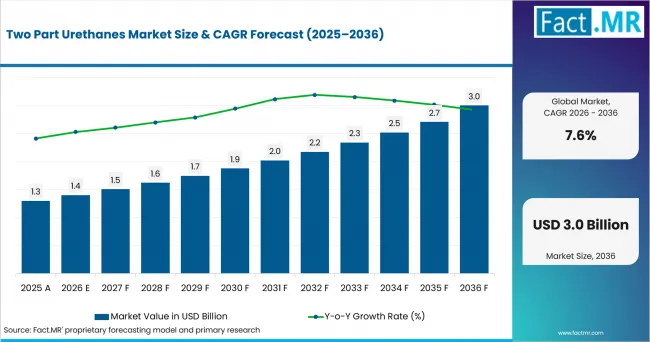
Two Part Urethanes Market Value Analysis | Source: Fact.MR
What are the defining numbers behind Two Part Urethanes Market growth?
An absolute opportunity of USD 1.6 billion is expected between 2026 and 2036.
- Demand Drivers in the Market
- Potting and encapsulation fill irregular housings and cure into a protective mass that can be tailored from soft to relatively tough for electronics and industrial assemblies.
- Flexible polyurethane absorbs impact and thermal movement, reducing mechanical load on components and cable entries compared with more rigid encapsulants.
- Room-temperature cure allows large or heat-sensitive assemblies to be processed without ovens, supporting repair work and high-mix production.
- Electronics and automotive manufacturers use two-part urethane where moisture resistance, impact performance and abrasion resistance matter alongside electrical protection.
- Automated meter-mix systems reduce off-ratio cure and trapped air, improving repeatability when polyurethane is dispensed into housings at production scale.
- Key Segments Analyzed
- Potting & encapsulation accounts for 37.0% of Product Function in 2026 because polyurethane fills irregular housings and provides impact, moisture and vibration protection around components.
- Flexible/low-stress holds 42.0% of Property Focus in 2026 because urethane absorbs mechanical shock and thermal movement while limiting stress on embedded parts.
- Room-temperature cure represents 30.0% of Cure Profile in 2026 because large or heat-sensitive assemblies can be processed without oven exposure.
- Electronics manufacturers capture 36.0% of End User in 2026 because they control mix ratio, dispense volume and cure acceptance on the production line.
- Analyst Opinion at Fact.MR
- Shambhu Nath Jha, Senior Consultant at Fact.MR, states, "Buyer decisions in the Two Part Urethanes Market will centre on flexible potting with impact resistance and room-temperature processing. Buyers will compare the 2026 segment leaders with qualification evidence and the operating cost of the full process. Suppliers that support application trials and preserve formulation or equipment consistency can move more quickly into repeat production."
- Strategic Implications
- Suppliers should document the process conditions that allow Potting & encapsulation to deliver repeatable performance.
- Customer trials should use the intended substrate, fluid path or process stream before commercial qualification.
- Regional technical support is important in China and Germany because adoption depends on local production or infrastructure conditions.
- Commercial positioning should distinguish qualified application performance from general material or equipment capability.
How does the Two Part Urethanes Market break down by segment?
The market is segmented by Product Function, Property Focus, Cure Profile and End User.
Why does Potting & encapsulation lead Product Function?
Potting & encapsulation is projected to account for a 37.0% share in 2026.
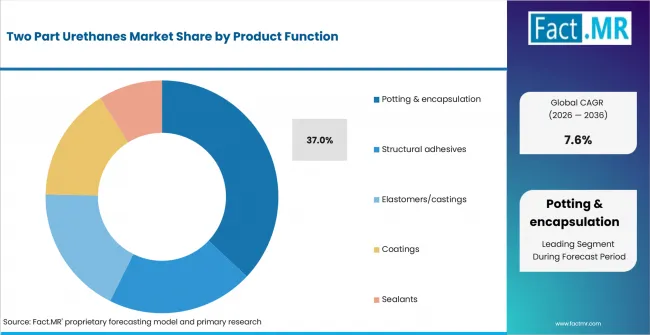
Two Part Urethanes Market Analysis By Product Function | Source: Fact.MR
Potting allows polyurethane to fill complex housings around boards, connectors and cables, producing a protective mass that resists moisture and vibration.
The chemistry can be formulated across different hardness levels, giving manufacturers room to balance impact resistance with stress on embedded parts.
Why do Flexible/low-stress lead Property Focus?
Flexible/low-stress are projected to account for a 42.0% share in 2026.
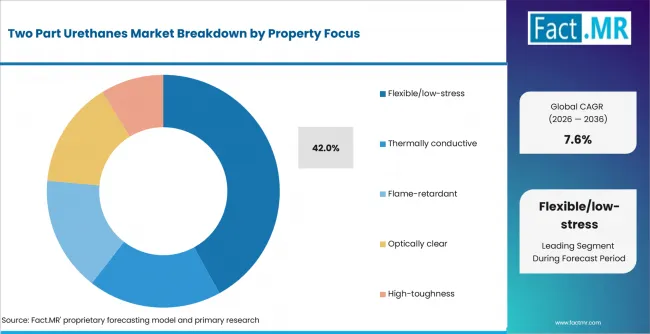
Two Part Urethanes Market Analysis By Property Focus | Source: Fact.MR
Flexible polyurethane absorbs vibration and impact while accommodating differences in thermal expansion between metals, polymers and electronic components.
This reduces stress concentration around solder joints and cable entries in assemblies exposed to repeated movement or temperature changes.
Why does Room-temperature cure lead Cure Profile?
Room-temperature cure is projected to account for a 30.0% share in 2026.
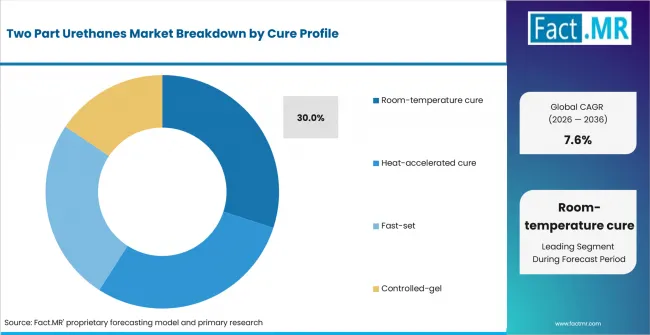
Two Part Urethanes Market Analysis By Cure Profile | Source: Fact.MR
Room-temperature systems eliminate the need to move large housings or heat-sensitive assemblies through an oven, simplifying production and field repair.
Users still qualify working time and property-development time against the production cycle because ambient cure is slower than heat-accelerated processing.
Why do Electronics manufacturers lead End User?
Electronics manufacturers are projected to account for a 36.0% share in 2026.
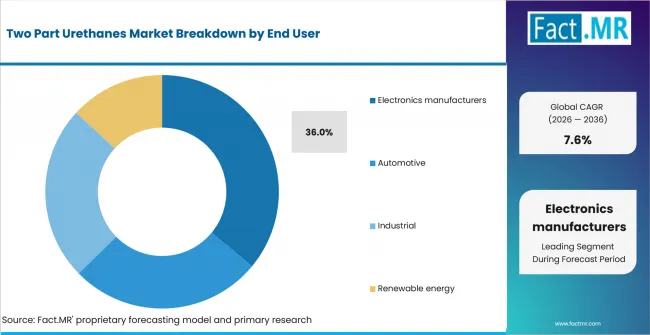
Two Part Urethanes Market Analysis By End User | Source: Fact.MR
Electronics manufacturers use urethane for potting and module protection where impact resistance matters alongside dielectric performance.
They also carry the cost of moisture-driven foaming or incomplete cure, making trials on actual meter-mix equipment and housings central to approval.
What is accelerating Two Part Urethanes Market adoption, and what is holding it back?
Drivers Impact Analysis
| Factor | (~) % Impact on CAGR | Geographic Relevance | Impact Timeline |
|---|---|---|---|
| Flexible protection using Flexible/low-stress | +2.1% | China | Short term (<= 2 years) |
| Volume demand in Potting & encapsulation | +1.7% | Germany | Medium term (2-4 years) |
| Room-temperature processing | +1.2% | USA | Long term (>= 4 years) |
Opportunity Impact Analysis
| Factor | (~) % Impact on CAGR | Geographic Relevance | Impact Timeline |
|---|---|---|---|
| Lower-moisture-sensitivity urethane | +1.1% | China | Short term (<= 2 years) |
| Thermally conductive potting | +0.8% | Germany | Medium term (2-4 years) |
| Meter-mix deployment | +0.6% | USA | Long term (>= 4 years) |
Restraints Impact Analysis
| Factor | (~) % Impact on CAGR | Geographic Relevance | Impact Timeline |
|---|---|---|---|
| Moisture-driven foaming | -1.0% | China | Short term (<= 2 years) |
| Off-ratio cure | -0.8% | Germany | Medium term (2-4 years) |
| Long property development | -0.5% | USA | Long term (>= 4 years) |
Which countries are scaling the Two Part Urethanes Market through 2036?
- Germany: Germany combines automotive production with electrical equipment and industrial automation.
- USA: The USA has diverse electrical-equipment, power-electronics and industrial applications.
- Japan: Japan has precision electrical and automotive manufacturing with established supplier qualification.
Country CAGR (2026-2036)
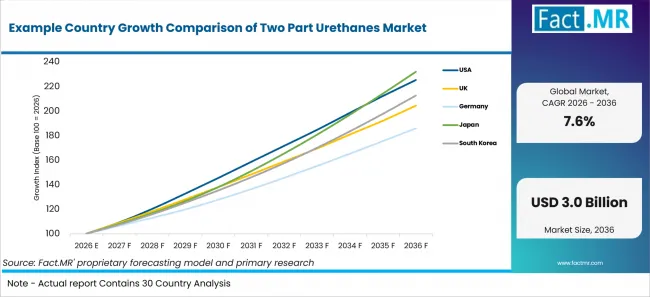
Example Country Growth Comparison Of Two Part Urethanes Market | Source: Fact.MR
| Country | CAGR (2026-2036) |
|---|---|
| Germany | 8.1% |
| USA | 8.5% |
| Japan | 8.1% |
What is driving Germany's growth through 2036?
Germany is forecast to expand at an 8.1% CAGR from 2026 to 2036.
Germany's automotive, machinery and electrical-equipment sectors maintain a strong base for qualified materials and automated assembly; recent orders also showed growth in electrical equipment.
Polyurethane fits modules that must tolerate vibration and moisture while limiting stress on components.
What is driving the USA's growth through 2036?
The USA is forecast to expand at an 8.5% CAGR from 2026 to 2036.
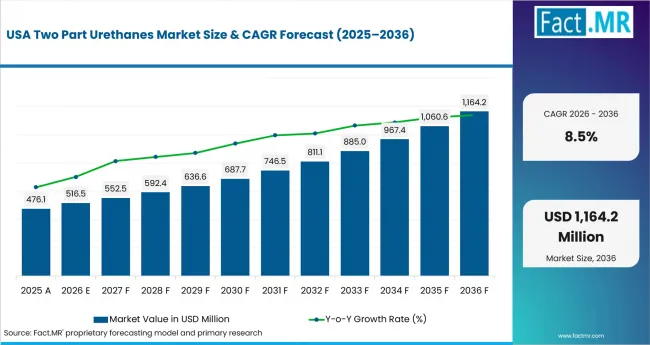
Two Part Urethanes Market Country Value Analysis | Source: Fact.MR
U.S. manufacturing includes electronics, aerospace and industrial equipment, while current semiconductor and advanced-packaging investment is adding new pilot and production capacity.
Two-part urethane is used where impact-resistant potting and sealing are needed across electronics, aerospace and industrial equipment.
What is driving Japan's growth through 2036?
Japan is forecast to expand at an 8.1% CAGR from 2026 to 2036.
Japan combines automotive and precision-electronics manufacturing with new semiconductor investment, creating production environments where repeatability and supplier qualification are central.
The market benefits from demand for low-stress encapsulation with controlled hardness and room-temperature processing.
Who leads the Two Part Urethanes Market?
Henkel is positioned as a leading supplier through formulation breadth and technical support. Huntsman and Covestro compete through application-specific materials for electronics or industrial equipment.
Competition is determined by cured performance and process consistency. Buyers assess viscosity and cure profile together with thermal, dielectric or mechanical requirements.
Qualification history and lot control create switching costs, so suppliers with stable formulations and local process support retain stronger positions.
Which companies are the key providers?
- Henkel
- Huntsman
- Covestro
- BASF
- Epic Resins
- Sika
Bibliography
- International Electrotechnical Commission. (2025). Electrical Insulation and Encapsulation Standards. IEC.
- U.S. Department of Energy. (2025). Advanced Manufacturing and Automation Programmes. U.S. Government.
- National Institute of Standards and Technology. (2025). Smart Manufacturing Systems and Process Control. U.S. Department of Commerce.
- U.S. Department of Commerce. (2025). Electronics Manufacturing Programmes. U.S. Government.
- IPC. (2024). Electronics Assembly Process Control and Materials Standards. IPC.
- Ministry of Industry and Information Technology, China. (2026). Development of the Electronic Information Manufacturing Industry in 2025. Government of China.
- Federal Ministry for Economic Affairs and Climate Action, Germany. (2025). Industrial and Automotive Transformation Programmes. Government of Germany.
- U.S. Department of Commerce. (2025). CHIPS for America Advanced Packaging Manufacturing Program. U.S. Government.
- Ministry of Economy, Trade and Industry, Japan. (2025). Strategy for Semiconductor and Digital Industry Revitalization. Government of Japan.
- Ministry of Electronics and Information Technology, India. (2025). Electronics Manufacturing and Components Programme. Government of India.
- Covestro. (2026). Polyurethane Raw Materials for Electrical Encapsulation. Covestro.
- Huntsman Corporation. (2026). Two-Component Polyurethane Encapsulation Systems. Huntsman.
This Report Answers
- The report examines demand across Product Function, Property Focus, Cure Profile, End User.
- Segment analysis explains the operating reason behind each leading category.
- Country analysis evaluates the listed markets and adoption conditions through 2036.
- Competitive analysis reviews the listed companies and clarifies ownership or research roles where relevant.
- The analysis considers qualification, process control and application fit that influence purchasing decisions.
What does the Two Part Urethanes Market cover?
Two-part polyurethane systems for potting, encapsulation, adhesives and elastomers offering toughness, flexibility and abrasion resistance across electronics and industrial uses.
The assessment follows the stated segmentation by Product Function, Property Focus, Cure Profile, End User. Revenue is counted only where the stated product or equipment is sold for the listed applications.
What is included in the scope?
The scope includes Potting & encapsulation, Structural adhesives, Elastomers/castings, Coatings, Sealants.
It also covers Flexible/low-stress, Thermally conductive, Flame-retardant, Optically clear, High-toughness.
Demand is assessed across Cure Profile: Room-temperature cure, Heat-accelerated cure, Fast-set, Controlled-gel; End User: Electronics manufacturers, Automotive, Industrial, Renewable energy.
What is excluded from the scope?
Materials that do not meet the defined viscosity, electrical, thermal, vacuum or chemistry requirement are excluded.
Standalone mixers, dispensers and curing equipment are excluded from material revenue.
General construction resins are outside the market unless sold into the listed application.
How Was the Analysis Built?
The analysis combines product scope, segment demand, country outlook and supplier coverage.
- Primary Research: Interviews focus on formulators, distributors, equipment suppliers and end users responsible for bonding, potting or thermal management.
- Desk Research: The review covers technical standards, government manufacturing programmes and company product literature.
- Market Sizing and Forecasting: Estimates combine application volume, material use per part, formulation mix, pack size and realized pricing.
- Data Validation and Update Cycle: Findings are checked against public evidence and supplier portfolios. Updates review formulation changes, ownership changes and manufacturing shifts.
What is the report's scope and coverage?
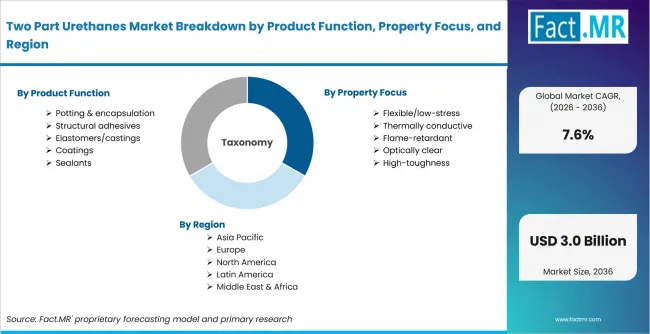
Two Part Urethanes Market Breakdown By Product Function, Property Focus, And Region | Source: Fact.MR
| Attribute | Details |
|---|---|
| Quantitative Units | USD 1.4 billion in 2026 to USD 3.0 billion by 2036 at a 7.6% CAGR |
| Market Definition | Two-part polyurethane systems for potting, encapsulation, adhesives and elastomers offering toughness, flexibility and abrasion resistance across electronics and industrial uses. |
| Segments Covered | Product Function; Property Focus; Cure Profile; End User |
| Regions Covered | North America; Latin America; Europe; East Asia; South Asia and Oceania; Middle East and Africa |
| Countries Covered | China; Germany; USA; Japan; India |
| Key Companies Profiled | Henkel; Huntsman; Covestro; BASF; Epic Resins; Sika |
| Forecast Period | 2026 to 2036 |
| Base Year | 2025 |
| Market Value, 2026 | USD 1.4 billion |
| Market Value, 2036 | USD 3.0 billion |
| CAGR, 2026-2036 | 7.6% |
| Absolute Opportunity | USD 1.6 billion |
| Approach | Combines application volume, material use per part, formulation mix, pack size and realized pricing. |
How is the market segmented?
-
By Product Function
- Potting & encapsulation
- Structural adhesives
- Elastomers/castings
- Coatings
- Sealants
-
By Property Focus
- Flexible/low-stress
- Thermally conductive
- Flame-retardant
- Optically clear
- High-toughness
-
By Cure Profile
- Room-temperature cure
- Heat-accelerated cure
- Fast-set
- Controlled-gel
-
By End User
- Electronics manufacturers
- Automotive
- Industrial
- Renewable energy
-
By Region
- North America
- Latin America
- Western Europe
- Eastern Europe
- East Asia
- South Asia and Pacific
- Middle East & Africa