- Base Value(2025): 14.4 Bn
- Estimated Value(2025): 14.4 Bn
- Forecast Value (2035): 29.7 Bn
- CAGR (2025 - 2035): 7.5%
Fracking Fluids and Chemicals Industry Analysis in the USA 2025 to 2035
The demand for fracking fluids and chemicals in USA is projected to grow from USD 14.4 billion in 2025 to approximately USD 29.7 billion by 2035, recording an absolute increase of USD 15.3 billion over the forecast period. This translates into total growth of 106.3%, with demand forecast to expand at a compound annual growth rate (CAGR) of 7.5% between 2025 and 2035.
Overall sales are expected to grow by nearly 2.06X during the same period, supported by rising shale gas production, increasing unconventional drilling activity, and growing demand for enhanced recovery solutions across oil and gas applications. The USA, characterized by substantial energy infrastructure and advanced hydraulic fracturing technologies, continues to demonstrate robust growth potential driven by energy independence and unconventional resource development.
Quick Stats on the USA Fracking Fluids and Chemicals Industry
- USA Fracking Fluids and Chemicals Sales Value (2025): USD 14.4 billion
- USA Fracking Fluids and Chemicals Forecast Value (2035): USD 29.7 billion
- USA Fracking Fluids and Chemicals Forecast CAGR: 7.5%
- Leading Fluid Type in USA Fracking Fluids and Chemicals Demand: Water-Based (73.8%)
- Key Growth Regions in USA Fracking Fluids and Chemicals Demand: West, Northeast, South, and Midwest
- Regional Leadership: West holds the leading position in demand
- Top Key Players in USA Fracking Fluids and Chemicals Demand: Halliburton Company, Schlumberger Limited, Baker Hughes Company, Weatherford International plc, Calfrac Well Services Ltd.
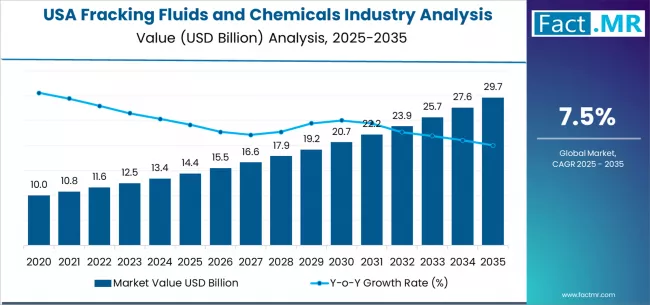
Usa Fracking Fluids And Chemicals Industry Analysis Market Value Analysis | Source: Fact.MR
Between 2025 and 2030, the fracking fluids and chemicals industry in USA is projected to expand from USD 14.4 billion to USD 20.7 billion, resulting in a value increase of USD 6.3 billion, which represents 41.2% of the total forecast growth for the decade. This phase of growth will be shaped by rising unconventional oil and gas production across the USA, particularly in regions where shale formations and horizontal drilling are accelerating fracking fluid adoption.
Increasing deployment of advanced chemical technologies and growing adoption of environmentally responsible formulations continue to drive demand. Energy companies are expanding their drilling solution capabilities to address the growing complexity of modern extraction requirements and environmental challenges, with USA operations leading investments in next-generation fracking systems.
From 2030 to 2035, demand is forecast to grow from USD 20.7 billion to USD 29.7 billion, adding another USD 9.0 billion, which constitutes 58.8% of the overall ten-year expansion. This period is expected to be characterized by expansion of eco-friendly formulations, integration of advanced chemical and monitoring infrastructure, and development of specialized applications across different drilling operations.
The growing adoption of sustainable extraction principles and enhanced performance requirements, particularly in West and Northeast regions, will drive demand for more sophisticated chemical systems and specialized formulation capabilities.
Between 2020 and 2025, the USA fracking fluids and chemicals ecosystem experienced accelerating expansion, driven by increasing unconventional drilling adoption in energy sectors and growing awareness of chemical enhancement benefits for extraction efficiency and well productivity.
The landscape developed as oil and gas companies and drilling service providers, especially in major shale corridors, recognized the need for advanced chemical solutions and performance optimization to meet production expectations while maintaining cost effectiveness and operational efficiency. Chemical manufacturers and distributors began emphasizing proper formulation techniques and performance optimization to maintain extraction effectiveness and commercial viability.
USA Fracking Fluids and Chemicals Industry Key Takeaways
| Metric | Value |
|---|---|
| USA Fracking Fluids and Chemicals Sales Value (2025) | USD 14.4 billion |
| USA Fracking Fluids and Chemicals Forecast Value (2035) | USD 29.7 billion |
| USA Fracking Fluids and Chemicals Forecast CAGR (2025-2035) | 7.5% |
Source: Fact.MR analysis. Updated Nov 11, 2025
Why is the USA’s Fracking Fluids and Chemicals Industry Growing?
Demand expansion is being supported by the accelerating emphasis on unconventional energy production and drilling efficiency enhancement nationwide, with the USA maintaining its position as an energy technology innovation and unconventional resource leadership region, and the corresponding need for effective chemical systems for extraction optimization, well productivity, and drilling performance achievement toward competitive energy operations.
Modern energy strategies rely on fracking fluids and chemicals to ensure well performance, extraction efficiency, and optimal production achievement toward energy independence. Unconventional drilling requires comprehensive chemical solutions including water-based fluids, oil-based alternatives, and specialized additives to address diverse formation applications and drilling requirements.
The growing efficiency of shale gas production and increasing unconventional drilling adoption, particularly ambitious energy production commitments across the USA, are driving demand for fracking fluid products from proven chemical suppliers with appropriate formulation expertise and drilling capabilities.
Energy companies and drilling professionals are increasingly investing in advanced chemical solutions and integrated drilling systems to enhance production yields, access cost benefits, and demonstrate operational leadership in competitive energy environments.
Energy trends and production requirements are establishing standardized chemical expectations that require formulation technologies and proper handling, with USA energy operations often pioneering large-scale implementation of advanced chemical systems.
Segmental Analysis
The industry is segmented by fluid type, chemical type, application, and well type. By fluid type, the landscape is divided into water-based, oil-based, and foam-based. By chemical type, the landscape’s segmentation includes gelling agents, friction reducers, biocides, and others. By application, the industry is divided into horizontal wells and vertical wells. By well type, the ecosystem is categorized into onshore and offshore operations.
Why are Water-based Fracking Fluids and Chemicals Gaining Traction in USA?

Usa Fracking Fluids And Chemicals Industry Analysis Analysis By Fluid Type | Source: Fact.MR
Water-based fracking fluids and chemicals account for 73.8% of USA’s demand in 2025. This dominance reflects the versatile drilling applications of water-based fluids in fracking processes where their environmental profile provides optimal performance characteristics and regulatory compliance.
In the USA, where diverse drilling operations require environmentally acceptable fluid solutions without complete formulation modification, water-based fluids provide practical solutions for extraction enhancement while maintaining environmental standards.
Continuous innovations are improving water-based fluid performance, chemical effectiveness, and environmental safety characteristics, enabling energy companies to achieve high production standards while minimizing environmental impact penalties. The segment's strong position is reinforced by the extensive drilling usage requiring reliable supply and growing availability of chemical suppliers with proven drilling experience.
- Environmental versatility and regulatory compliance make water-based fluids the preferred fluid type for diverse drilling applications and energy production consumption.
- Technology maturity and commercial availability track records are enhancing energy company confidence and sourcing reliability across large-scale energy distribution initiatives.
By Well Type, Which Category is Expected to Remain Dominant?

Usa Fracking Fluids And Chemicals Industry Analysis Analysis By Well Type | Source: Fact.MR
Horizontal wells are expected to represent 68.7% of USA’s fracking fluids and chemicals demand in 2025. Horizontal well facilities including shale formations, tight gas reservoirs, and unconventional plays provide concentrated chemical consumption that is technically and economically favorable for drilling applications.
The segment benefits from production efficiency characteristics that often provide higher recovery rates compared to vertical drilling, increasing chemical complexity and importance. Horizontal well applications also access enhanced production positioning through advanced drilling that improve extraction economics and production optimization.
In the USA, where unconventional drilling represents substantial portions of total energy production, horizontal well channels require fracking fluids availability across diverse drilling operations. In West and South regions, where shale formations are significant, horizontal well demand is sustained by emphasis on maintaining production efficiency while achieving extraction optimization targets.
- Production efficiency and advanced drilling make this the largest application segment for fracking fluids and chemicals consumption.
- Unconventional drilling and extraction optimization drive sustained demand across shale gas production, tight oil extraction, and unconventional drilling facilities.
What are the Drivers, Restraints, and Key Trends in the USA Fracking Fluids and Chemicals Demand?
The fracking fluids and chemicals demand in USA is advancing robustly due to increasing unconventional energy production and growing recognition of chemical necessity for extraction enhancement, with West region serving as a key driver of environmental innovation and sustainable chemical development.
The industry faces challenges including environmental concerns regarding chemical composition, need for extensive waste management infrastructure development, and ongoing concerns regarding water usage and groundwater protection. Energy generation trends and environmental requirements, particularly sustainability-focused operations in West and Northeast regions, continue to influence chemical selection and formulation patterns.
Expansion of Environmentally Responsible and Biodegradable Formulations
The enhancement of environmentally responsible methods, gaining particular significance through environmental stewardship initiatives and sustainable chemical preferences, is enabling chemical manufacturers to achieve regulatory positioning without prohibitive formulation costs, providing differentiated revenue streams through environmental certifications and sustainable product development.
Enhanced environmentally responsible methods offering premium environmental standards and biodegradable profiles provide foundational economics while allowing manufacturers to secure energy agreements and environmental partnerships. These approaches are particularly valuable for green drilling projects and premium environmental development that require substantial chemical investments without immediate regulatory returns.
Integration of Advanced Monitoring and Smart Chemical Technologies
Modern chemical companies and energy organizations are establishing advanced monitoring systems and smart chemical technologies that improve drilling outcomes through innovation sharing and performance awareness. Integration of real-time monitoring methods, chemical optimization techniques, and coordinated smart innovations enables more efficient drilling management across multiple energy segments.
Advanced monitoring concepts also support next-generation chemical development including IoT integration, regional performance optimization, and coordinated energy networks that optimize system-level drilling benefits while enabling comprehensive performance maintenance across energy regions, with USA developments increasingly adopting collaborative monitoring models to reduce individual energy company costs and accelerate technology adoption.
Analysis of USA Fracking Fluids and Chemicals Demand by Key Region
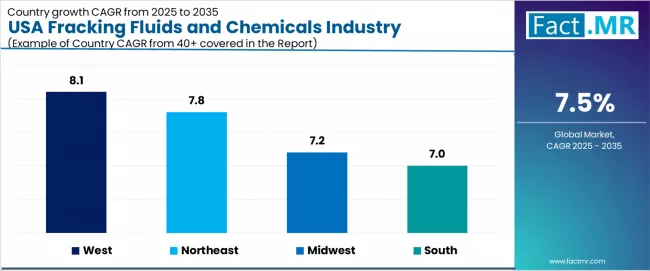
Usa Fracking Fluids And Chemicals Industry Analysis Cagr Analysis By Country | Source: Fact.MR
| Region | CAGR (2025-2035) |
|---|---|
| West | 8.1% |
| Northeast | 7.8% |
| South | 7.0% |
| Midwest | 7.2% |
Source: Fact.MR analysis. Updated Nov 11, 2025
The USA fracking fluids and chemicals industry is witnessing robust growth, supported by rising unconventional drilling activity, expanding shale gas production, and the deployment of advanced chemical technologies across regions. West leads the nation with an 8.1% CAGR, reflecting progressive drilling operations, substantial technology adoption, and early implementation of innovative chemical technologies.
The Northeast follows with a 7.8% CAGR, driven by intensive shale development, advanced drilling infrastructure, and concentration of energy expertise that enhance distribution. Midwest grows at 7.2%, as unconventional drilling operations and energy capabilities continue to drive consumption. South demonstrates growth at 7.0%, supported by expanding energy infrastructure and drilling technology development.
West Leads National Growth with Technology Innovation and Advanced Drilling
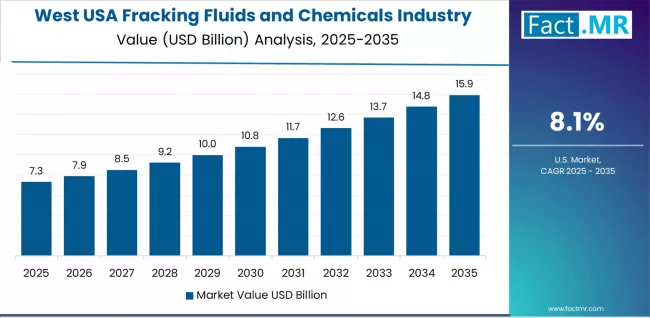
Usa Fracking Fluids And Chemicals Industry Analysis Country Value Analysis | Source: Fact.MR
Demand for fracking fluids and chemicals in the West is projected to exhibit exceptional growth with a CAGR of 8.1% through 2035, driven by progressive drilling operations, substantial advanced technology integration creating sophisticated chemical demand, and concentration of energy innovation across California, Colorado, and surrounding states.
As the leading region with extensive advanced energy infrastructure and drilling expertise, the West's emphasis on environmental stewardship and advanced drilling is creating significant demand for specialized chemical varieties with proven performance standards and environmental potential. Major chemical companies and energy technology developers are establishing comprehensive formulation programs to support advanced chemical development and environmental certification across diverse applications.
- Energy innovation and advanced technology are requiring comprehensive sophisticated chemical strategies and environmental formulation methods, driving demand for chemical varieties with demonstrated performance benefits and environmental integration capabilities throughout technology-focused drilling operations.
- Innovation ecosystem strength and advanced chemical availability are supporting deployment of specialized chemical formulations and novel drilling pathways that enhance chemical differentiation, reduce environmental costs, and create new performance opportunities across energy technology processing and premium drilling applications, positioning West as a national energy leadership region.
Northeast Demonstrates Strong Potential with Intensive Shale Development
Demand for fracking fluids and chemicals in the Northeast is expanding at a CAGR of 7.8%, supported by intensive shale development including Marcellus formation, Utica shale, and unconventional plays generating consistent chemical consumption streams favorable for energy distribution.
The region's energy characteristics, featuring advanced drilling sophistication and premium chemical preferences, provide natural advantages for intensive consumption development. Energy and drilling expertise concentrated in Pennsylvania, West Virginia, and northeastern states facilitates chemical management and distribution operations. Energy companies and drilling organizations are implementing comprehensive supply chain strategies to serve expanding intensive drilling requirements throughout Northeast.
- Drilling sophistication and premium chemical economics are creating opportunities for intensive energy operations that can integrate chemical products with existing sophisticated drilling infrastructure and leverage proximity to energy professionals across shale development and unconventional drilling complexes.
- Energy synergies and chemical capacity are building regional competitive advantages in sophisticated drilling infrastructure, enabling comprehensive premium chemical network development and energy cluster enhancement that meets sophisticated drilling targets while accessing energy-focused distribution systems.
The Midwest Maintains Robust Growth with Unconventional Energy Development
Demand for fracking fluids and chemicals in the Midwest is growing at a CAGR of 7.2%, driven by substantial unconventional energy development from drilling operations, energy processing facilities, and drilling networks requiring consistent chemical pathways.
The region's energy base, supporting critical unconventional production output, is consistently adopting advanced chemical technology to maintain competitiveness while meeting production expectations. Energy operators and chemical companies are investing in chemical system integration and regional storage infrastructure to address growing drilling requirements.
- Energy capabilities and unconventional competitiveness concerns are facilitating adoption of advanced chemical technology that enable continued drilling operations while achieving performance improvements across unconventional drilling and energy processing facilities.
- Unconventional energy opportunities including drilling supply and energy distribution are creating consistent regional advantages and established chemical types throughout Midwest energy operations.
South Shows Progressive Adoption with Energy Infrastructure Expansion
Demand for fracking fluids and chemicals in South is advancing at a CAGR of 7.0%, supported by energy infrastructure expansion, regional drilling traditions including participation in energy development programs, and growing emphasis on drilling efficiency across the corridor.
Energy transformation and drilling facility modernization are driving consideration of advanced chemicals as production pathways. Energy operators and chemical suppliers are developing regional capabilities to support emerging efficiency-focused requirements.
- Energy development and chemical preferences are creating economic drivers for efficiency enhancement technologies and chemical deployment across energy facilities and drilling operations seeking production pathways.
- Regional energy cooperation and coordinated distribution frameworks are establishing consistent production environments and shared chemical infrastructure development that support cross-state chemical distribution throughout South energy operations.
Competitive Landscape of the USA Fracking Fluids and Chemicals Industry
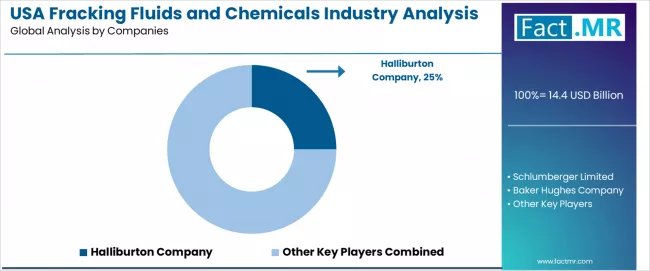
Usa Fracking Fluids And Chemicals Industry Analysis Analysis By Company | Source: Fact.MR
The USA fracking fluids and chemicals landscape is defined by competition among integrated oilfield service companies, specialized chemical manufacturers, and drilling solution providers, with major energy service corporations maintaining significant influence through chemical capacity and drilling expertise.
Companies are investing in chemical technology development, performance characterization, environmental compliance structures, and comprehensive drilling services to deliver effective, reliable, and high-performance chemical solutions across USA energy and drilling operations.
Strategic partnerships, regional chemical development, and advanced formulation practices are central to strengthening competitive positioning and presence across energy production, drilling transformation, and unconventional extraction applications.
The Halliburton Company, a globally-based oilfield services and chemical leader, offers comprehensive fracking fluids production including chemical innovation, quality management, and distribution services with focus on drilling applications, performance reliability, and extraction optimization across USA operations. Schlumberger Limited, operating internationally with extensive USA distribution, provides integrated oilfield solutions leveraging chemical expertise, drilling development, and large-scale manufacturing capabilities.
Baker Hughes Company delivers full-service chemical processing including drilling innovation, performance management, and supply chain coordination serving USA and international energy projects. Weatherford International plc emphasizes comprehensive drilling solutions with advanced chemicals, product innovation, and distribution capabilities leveraging energy expertise. Calfrac Well Services Ltd. offers specialized chemical processing and premium drilling operations for energy production and extraction applications across USA operations.
Key Players in the USA Fracking Fluids and Chemicals Industry
- Halliburton Company
- Schlumberger Limited
- Baker Hughes Company
- Weatherford International plc
- Calfrac Well Services Ltd.
- BASF SE
- Dow Inc.
- Chevron Phillips Chemical Company
- AkzoNobel N.V.
- Clariant AG
Segmentation
Scope of the Report
| Item | Value |
|---|---|
| Quantitative Units | USD 29.7 Billion |
| Fluid Type | Water-based, oil-based, foam-based |
| Chemical Type | Gelling agents, friction reducers, biocides, others |
| Application | Horizontal wells, vertical wells |
| Well Type | Onshore, offshore |
| Regions Covered | West, Midwest, Northeast, South |
| Key Companies Profiled | Halliburton Company, Schlumberger Limited, Baker Hughes Company, Weatherford International plc, Calfrac Well Services Ltd., BASF SE, Dow Inc., Chevron Phillips Chemical Company, AkzoNobel N.V., Clariant AG |
| Additional Attributes | Sales by fluid type and application segment, regional demand trends across West, Northeast, South, and Midwest, competitive landscape with established oilfield service companies and specialized chemical manufacturers, drilling preferences for water-based versus oil-based fluids, integration with environmental programs and sustainable formulations particularly prominent in West region, innovations in chemical efficiency and environmental responsibility, and adoption of premium formulation models, advanced chemical structures, and comprehensive supply chain solutions for enhanced performance and commercial viability across energy production, drilling services, and specialty applications throughout USA energy initiatives |
Source: Fact.MR analysis. Updated Nov 11, 2025
USA Fracking Fluids and Chemicals Industry by Key Segments
-
Fluid Type :
- Water-Based
- Oil-Based
- Foam-Based
-
Chemical Type :
- Gelling Agents
- Friction Reducers
- Biocides
- Others
-
Well Type :
- Horizontal Wells
- Vertical Wells
-
Application :
- Onshore
- Offshore
-
Region :
- West
- Northeast
- South
- Midwest
Frequently Asked Questions
How big is the USA fracking fluids and chemicals industry analysis in 2025?
What will be the size of USA fracking fluids and chemicals industry analysis in 2035?
How much will be the USA fracking fluids and chemicals industry analysis growth between 2025 and 2035?
What are the key product types in the USA fracking fluids and chemicals industry analysis?
Which well type segment to contribute significant share in the USA fracking fluids and chemicals industry analysis in 2025?
Who worked on this report


Preview the report firsthand - request a free sample
Free SampleGet the brochure for pricing and purchase details
Download PDF