- Base Value(2025): 1.8 Bn
- Estimated Value(2025): 1.8 Bn
- Forecast Value (2035): 2.8 Bn
- CAGR (2025 - 2035): 4.3%
Tapioca Starch Industry Analysis in the USA 2025 to 2035
The demand for tapioca starch in the USA is projected to grow from USD 1.8 billion in 2025 to approximately USD 2.75 billion by 2035, recording an absolute increase of USD 950 million over the forecast period. This translates into total growth of 52.8%, with demand forecast to expand at a compound annual growth rate (CAGR) of 4.3% between 2025 and 2035.
Quick Stats for the USA Tapioca Starch Industry
- USA Tapioca Starch Sales Value (2025): USD 1.8 billion
- USA Tapioca Starch Forecast Value (2035): USD 2.75 billion
- USA Tapioca Starch Forecast CAGR: 4.3%
- Leading Type in USA Tapioca Starch Demand: Native Tapioca Starch (67.9%)
- Key Growth Regions in USA Tapioca Starch Demand: West, Northeast, and Midwest
- USA Regional Leadership: West holds the highest growth rate at 4.6%
- Top Key Players in USA Tapioca Starch Demand: Cargill Inc., Ingredion Incorporated, Tate & Lyle, Archer-Daniels-Midland Company
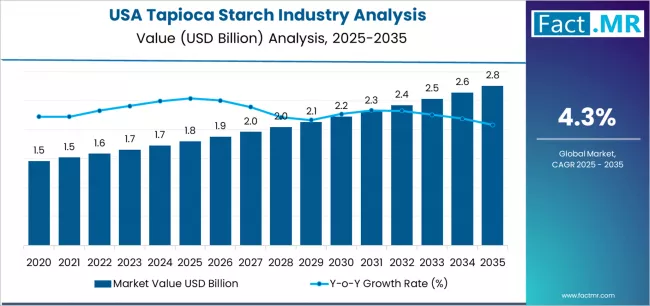
Usa Tapioca Starch Industry Analysis Market Value Analysis | Source: Fact.MR
Overall sales are expected to grow by nearly 1.53X during the same period, supported by rising USA tapioca starch activities, increasing demand for gluten-free and natural starch solutions, and growing utilization across food & beverages, industrial, and animal feed applications. USA, led by the West and Northeast regions, continues to demonstrate steady growth potential driven by health consciousness and clean-label food initiatives.
Between 2025 and 2030, sales of tapioca starch in the USA are projected to expand from USD 1.8 billion to USD 2.22 billion, resulting in a value increase of USD 420 million, which represents 44.2% of the total forecast growth for the decade. This phase of growth will be shaped by rising tapioca starch consumption where native tapioca starch trends and food & beverage applications are accelerating consumption adoption.
Increasing utilization of powder formats and growing adoption of food manufacturer applications continue to drive demand. Food manufacturers are expanding their starch capabilities to address the growing complexity of modern tapioca starch operations and processing requirements, with American food processing operations leading investments in advanced starch technologies.
From 2030 to 2035, demand is forecast to grow from USD 2.22 billion to USD 2.75 billion, adding another USD 530 million, which constitutes 55.8% of the overall ten-year expansion. This period is expected to be characterized by expansion of specialty tapioca starch offerings, integration of advanced processing systems and enhanced functional formulations, and development of standardized quality protocols across different starch applications. The growing adoption of native tapioca starch practices and processing enhancement approaches, particularly in USA and North America, will drive demand for more sophisticated processing solutions and specialized tapioca starch capabilities.
Between 2020 and 2025, USA tapioca starch demand experienced steady expansion, driven by increasing USA tapioca starch activities in food processing facilities and industrial manufacturers and growing awareness of starch benefits for texture enhancement and processing optimization. The sector developed as food processing operations, especially in USA, recognized the need for specialized starch processing approaches and advanced technologies to improve product quality while meeting stringent food safety and processing enhancement regulations. Processors and starch suppliers began emphasizing proper starch sourcing criteria and processing innovations to maintain functional effectiveness and regulatory compliance.
USA Tapioca Starch Industry Key Takeaways
| Metric | Value |
|---|---|
| USA Tapioca Starch Sales Value (2025) | USD 1.8 billion |
| USA Tapioca Starch Forecast Value (2035) | USD 2.75 billion |
| USA Tapioca Starch Forecast CAGR (2025-2035) | 4.3% |
Source: Fact.MR analysis. Updated Nov 11, 2025
Why is the USA Tapioca Starch Industry Growing?
Demand expansion is being supported by the continued growth in USA tapioca starch activities, with USA maintaining its position as a clean-label innovation and functional ingredient leadership region, and the corresponding need for specialized starch solutions for texture enhancement, gluten-free formulation, and processing satisfaction activities. Modern food processing operations rely on advanced starch modalities to ensure consistent functional levels, processing benefits, and optimal food outcomes. USA tapioca starch requires comprehensive processing systems including starch selection, functional optimization, quality preservation, and distribution programs to maintain processing effectiveness and food excellence.
The growing complexity of USA tapioca starch operations and increasing clean-label standards, particularly stringent requirements in USA, are driving demand for advanced tapioca starch products from certified processors with appropriate food safety expertise and starch processing knowledge. Health-conscious manufacturers are increasingly investing in clean-label algorithms and tapioca starch technologies to improve food outcomes, enhance processing satisfaction, and optimize functional cost utilization in challenging USA tapioca starch environments. Quality guidelines and food product specifications are establishing standardized processing procedures that require specialized capabilities and trained food practitioners, with American operations often setting benchmark standards for global tapioca starch practices.
Opportunity Pathways - Demand for Tapioca Starch in USA
The USA tapioca starch demand stands at a pivotal juncture of food and innovation. With demand projected to grow from USD 1.8 billion in 2025 to USD 2.75 billion by 2035, a steady 52.8% increase, the sector is being reshaped by manufacturer-centric clean-label imperatives, starch processing innovation, and the pursuit of functional excellence. As health-conscious manufacturers rise and tapioca starch options expand, the starch solutions that enable authentic, high-quality functionally enhanced alternatives become mission-critical food infrastructure rather than optional ingredients.
USA, led by the West region (4.6% CAGR) and supported by Northeast's health consciousness and Midwest's food processing growth initiatives, represents not just a geography of demand but a laboratory of innovation where advanced starch techniques, enhanced functional formulations, and integrated food operations are moving from specialty development to mainstream adoption. The confluence of robust health awareness established food processing networks, and functional imperatives creates fertile ground for premium starch solutions that deliver measurable food advantages.
Strategic pathways encompassing native starch development, specialty applications, food manufacturing integration, and starch innovation offer substantial revenue enhancement opportunities, particularly for food processing companies and processors positioned at the innovation frontier.
- Pathway A - Premium Native Tapioca Starch and Specialty Development. Health-conscious manufacturers face growing demand for native tapioca starch products, driven by clean-label requirements, functional considerations, and processing needs. Processing companies who pioneer reliable native tapioca starch products for specialty applications, enhanced starch technologies, superior functional profiles, texture enhancement methods, can command 35-45% price premiums while capturing manufacturer retention opportunities across American food processing operations. Expected revenue pool: USD 511-716 million.
- Pathway B - Food & Beverage and Consumer Integration. Health-conscious manufacturers, food companies, and processing demands are accelerating adoption of tapioca starch products through food & beverage channels and consumer applications. Systems enabling comprehensive food positioning, functional enhancement, application-specific formulations, and food partnerships reduce formulation barriers while improving manufacturer adoption by 40-55%. Volume positioning for food solutions: USD 581-813 million.
- Pathway C - Food Manufacturing and Production Integration. As food manufacturers seek starch alternatives with superior functionality, advanced starch technologies incorporating consistent texture enhancement, enhanced functional characteristics, and superior processing properties become essential manufacturing infrastructure. Differentiated products with proven performance in food applications and processing stability can secure 25-35% margin premiums in food manufacturing applications. Revenue opportunity: USD 387-541 million.
- Pathway D - Powder Form and Professional Integration. Health-conscious manufacturers increasingly seek tapioca starch partners through powder format channels, technical recommendations, and processing-focused positioning. Suppliers offering comprehensive powder platforms, technical professional endorsements, manufacturer education support, and premium formulations can capture growing share among food manufacturers and processors while generating recurring revenue streams with 30-40% EBITDA margins. Demand potential: USD 452-633 million.
- Pathway E - Native Tapioca Starch Segment Leadership. Native tapioca starch type represents 67.9% of type demand and requires continuous innovation enhancement through improved starch techniques, enhanced functional standards, and comprehensive functionality optimization. Suppliers enabling 30-40% performance improvements while maintaining competitive pricing can secure dominant purchasing preference across food processing and manufacturing operations. Addressable opportunity: USD 1,867-2,614 million.
Segmental Analysis
The tapioca starch industry in USA is segmented by type, application, form, and end-user. By type, the segmentation includes native tapioca starch and modified tapioca starch formulations.
By application, it includes food & beverages, industrial, and animal feed uses. By form, the landscape is segmented into powder and liquid formats. By end-user, the segmentation includes food manufacturers, paper industry, textile industry, and others.
Which Tapioca Starch Type Dominates in the USA?
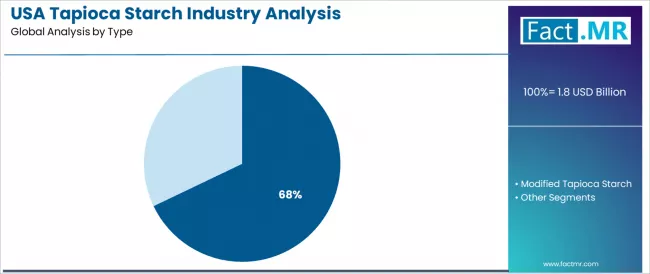
Usa Tapioca Starch Industry Analysis Analysis By Type | Source: Fact.MR
Native tapioca starch type is projected to account for 67.9% of tapioca starch demand in the USA in 2025. This dominance reflects the critical importance of natural functional ingredients in American food applications, where manufacturer preference for clean-label characteristics and functional benefits supports native starch adoption.
In the USA, food processing guidelines recommend native tapioca starch as primary functional enhancement, ensuring the widespread adoption of this type across food manufacturers, processing companies, and food facilities. Continuous processing innovations are improving the consistency of native tapioca starch, uniformity of functional distribution, and manufacturer satisfaction, enabling suppliers to maintain product functionality while optimizing food outcomes.
Advancements in starch technologies and processing systems are improving product appeal by enhancing functional content while maintaining processing effectiveness. The segment's strong position is reinforced by the rising clean-label emphasis on natural alternatives and increasing commercial processing participation in health-focused food preparation, which require increasingly sophisticated starch development measures.
- Clean-label characteristics and functional benefits make native tapioca starch indispensable in American health food processing operations.
- Processing innovation in starch technologies is improving consistency, functional uniformity, and manufacturer satisfaction across food processing applications.
Why do Food & Beverage Applications Comprise the Bulk of all Tapioca Starch Use in the USA?
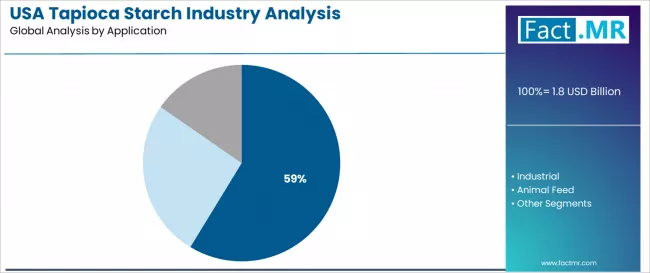
Usa Tapioca Starch Industry Analysis Analysis By Application | Source: Fact.MR
Tapioca starch applications in food & beverages are expected to represent 58.7% of USA’S demand in 2025, highlighting their critical role as the dominant application sector. Food manufacturers and beverage processors, particularly in USA and health-focused areas, serve as primary utilization points for starch incorporation, formulation development, and food operations.
Tapioca starch enables processors to achieve comprehensive texture enhancement, clean-label positioning, and functional benefits for diverse food products. The segment is also fueled by increasing manufacturer preference for functionally enhanced food ingredients, with food & beverage operations prioritizing tapioca starch convenience that integrates functional benefits, clean-label value, and processing appeal.
In the USA, food processors are spearheading adoption of comprehensive functional enhancement pathways and advanced food technologies to enhance product health appeal, improve manufacturer satisfaction, and ensure competitive differentiation. Such strategies not only enhance functional effectiveness but also ensure compliance with evolving clean-label food standards.
- Comprehensive texture enhancement provides optimal clean-label positioning and functional benefits for processors compared to conventional starch alternatives.
- American food & beverage operations are application leaders, driving health-based adoption of tapioca starch and functional enhancement protocols.
How are Food Manufacturers Leveraging Tapioca Starch for Various Purposes?
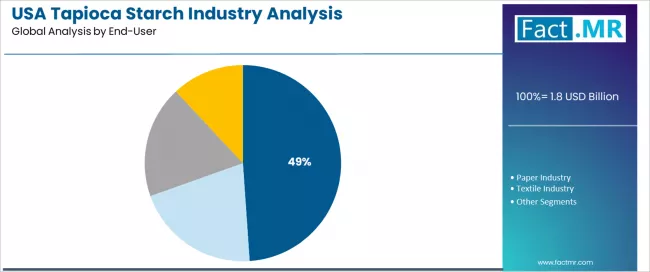
Usa Tapioca Starch Industry Analysis Analysis By End User | Source: Fact.MR
Food manufacturers contribute 48.9% of all tapioca starch end-user demand in the USA in 2025. Food manufacturers use tapioca starch for specialized processing competency including proper functional integration, formulation modification expertise, and quality control knowledge to sustain effective and consistent operations.
In the USA and North America, food manufacturer applications serve diverse product development needs where industrial processing provides optimal scale efficiency and functional consistency. Advanced manufacturing operations rely heavily on standardized tapioca starch protocols that integrate functionality specifications, processing parameters, and comprehensive technical guidance to maintain production standards.
The segment also benefits from robust functional awareness supporting tapioca starch benefits and sustained demand from manufacturers seeking clean-label, functionally enhanced ingredient alternatives. Despite competition from paper industry alternatives, food manufacturer demand is sustained by superior production efficiency, processing advantages, and strong manufacturer preference for scalable starch solutions.
- Food manufacturers' superior production efficiency and processing scalability make it a major end-user segment for tapioca starch demand.
- Ongoing technical education and functional development programs drive sustained demand across food manufacturer applications.
What are the Drivers, Restraints, and Key Trends of the USA Tapioca Starch?
The USA tapioca starch segment is advancing steadily due to continued USA tapioca starch activities and sustained recognition of functional and clean-label benefits, with USA serving as a mature demand region with focus on starch processing innovation and manufacturer access.
The segment also faces challenges including higher production costs for some starch methods, need for manufacturer education about functional benefits, and varying functionality levels compared to conventional starch alternatives and traditional processing systems. Novel starch development initiatives and functional processing programs, particularly advanced in American operations, continue to influence product specifications and manufacturer acceptance patterns.
Expansion of Clean-Label Enhancement and Functional Ingredient Trends
The growing adoption of clean-label enhancement formulations and functional ingredient consumption, gaining significant traction in the USA and health-focused manufacturer areas, is enabling tapioca starch to access mainstream positioning segments without extensive marketing requirements, providing improved functional appeal and enhanced clean-label benefits.
Health-focused manufacturers equipped with functional awareness services offer product adoption and clean-label positioning while allowing processors to enhance products based on health values. These trends are particularly valuable for texture enhancement and functional food applications where manufacturers require clean-label options without extensive conventional limitations or traditional starch restrictions.
Integration of Advanced Starch and Processing Technologies
Modern food processors, led by American and specialty companies, are incorporating advanced starch systems and processing technologies that provide improved food profiles, enhanced functional characteristics, and superior processing performance. Integration of starch innovations, standardized processing protocols, and comprehensive quality monitoring enables more effective functional delivery and reduced application complexity.
Advanced starch technologies also support next-generation processing paradigms including commercial applications and enhanced functionality optimization that eliminate traditional usage limitations, with American processing practices increasingly adopting these technologies to meet manufacturer preferences for versatile functional enhancement and application convenience.
Analysis of the USA Tapioca Starch Industry by Key Regions
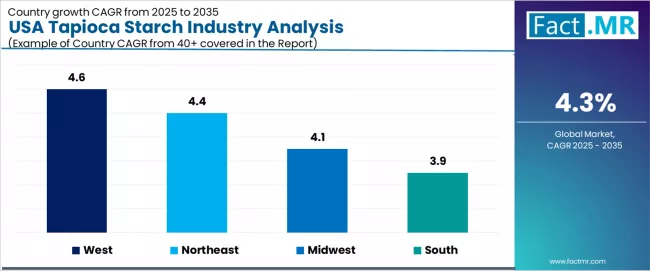
Usa Tapioca Starch Industry Analysis Cagr Analysis By Country | Source: Fact.MR
| Region | CAGR (2025-2035) |
|---|---|
| West | 4.6% |
| Northeast | 4.4% |
| Midwest | 4.1% |
| South | 3.9% |
Source: Fact.MR analysis. Updated Nov 11, 2025
The USA tapioca starch industry is witnessing steady growth, supported by sustained manufacturer awareness, health consciousness, and the integration of tapioca starch approaches across regions. West leads the country with a 4.6% CAGR, reflecting strong concentration of health-conscious manufacturers, early adoption of tapioca starch, and robust food networks supporting manufacturer access.
The Northeast region follows with a 4.4% CAGR, driven by functional awareness and expanding food processing infrastructure that enhances consumption opportunities. Midwest grows at 4.1%, as established food systems continue integrating tapioca starch protocols across manufacturer and distribution practices.
West Leads American Growth with Food Innovation and Clean-Label Focus
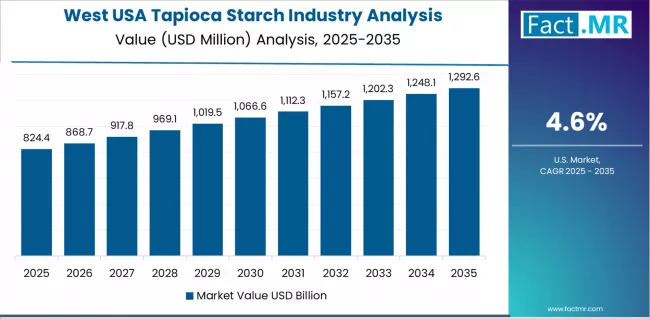
Usa Tapioca Starch Industry Analysis Country Value Analysis | Source: Fact.MR
Demand for tapioca starch in the West region is projected to exhibit steady growth with a CAGR of 4.6% through 2035, driven by ongoing USA tapioca starch operations across food processing facilities, manufacturing companies, and integrated food applications, concentration of health-conscious manufacturers and functional enhancement advocates, and increasing adoption of premium starch systems and native starch enhancement technologies.
As the leading American region with the highest growth rate, the area's emphasis on food innovation and comprehensive manufacturing networks is creating consistent demand for advanced starch solutions with proven health features and functional performance profiles. Major food processing companies and health-focused manufacturers are establishing comprehensive supply protocols to support food excellence and manufacturer satisfaction across American operations.
- Health consciousness and functional enhancement culture are creating advanced food demand with comprehensive starch features and processing capabilities throughout USA tapioca starch operations across the West region.
- Food adoption programs are supporting integration of tapioca starch and native starch enhancement methods that enhance functional benefits, reduce conventional limitations, and improve manufacturer satisfaction across USA tapioca starch activities, positioning West as an American food leader.
Northeast Demonstrates Strong American Potential with Health Awareness and Food Processing
Demand for tapioca starch in the Northeast region is expanding at a CAGR of 4.4%, supported by extensive USA tapioca starch operations in food processing facilities, starch companies, and health-focused food activities.
The region's food processing sector, representing a crucial component of American food service delivery, is experiencing growth driven by health awareness, starch ingredient education, and rising functional ingredient consciousness. Health-focused food processors and starch companies are maintaining comprehensive supply programs to serve expanding USA tapioca starch activities throughout Northeast and broader national demand.
- Health awareness and food processing infrastructure development are creating opportunities for suppliers that can support expanding manufacturer volumes and diverse food settings including food processing facilities and health-focused manufacturers across Northeast and American territories.
- Starch ingredient education integration programs are enhancing product adoption among food processing practitioners and health manufacturers, enabling comprehensive tapioca starch utilization that meets health expectations and manufacturer food requirements, strengthening Northeast's position within American food delivery.
Midwest Maintains Growing Performance with Food Manufacturing and Regional Integration
Demand for tapioca starch in the Midwest region is growing at a CAGR of 4.1%, driven by established USA tapioca starch operations in food manufacturing facilities, processing chains, and distribution networks.
The region's food manufacturing sector, an integral part of American food production delivery, is maintaining expanding starch ingredient availability through growing processing networks and comprehensive distribution coverage. Food manufacturers and starch representatives are sustaining starch education and product availability to address increasing manufacturer requirements and support Midwest manufacturing operations.
- Food manufacturing presence is facilitating adoption of tapioca starch protocols that support comprehensive USA tapioca starch capabilities across manufacturing operations and coordinated distribution networks, maintaining Midwest's integration within American food production delivery.
- Starch ingredient implementation programs are enhancing starch consistency among manufacturing practitioners, enabling food delivery that meets functional standards and manufacturer outcome expectations in expanding American manufacturing operations.
South Demonstrates Steady Performance with Processing Focus
Demand for tapioca starch in the South region is advancing at a CAGR of 3.9%, supported by USA tapioca starch operations in processing facilities, food companies, and established distribution systems.
The region's processing infrastructure and health-focused consumption are maintaining steady tapioca starch volumes. Processing distributors are serving manufacturer populations through established supply networks and comprehensive processing relationships.
- Processing concentration and health-focused consumption are sustaining product availability and reliable manufacturer access capabilities that support consumption advancement across South territories.
- Established processing networks and mature manufacturing coverage policies are maintaining reliable product access and consistent functional delivery standards throughout processing and manufacturing settings.
Competitive Landscape of the USA Tapioca Starch
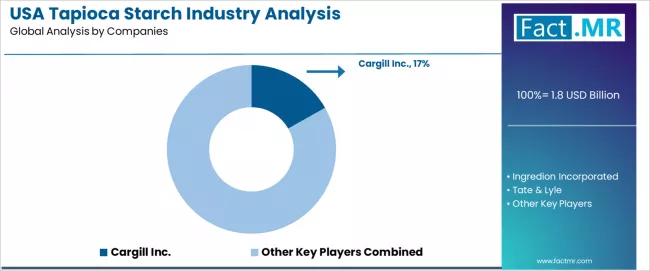
Usa Tapioca Starch Industry Analysis Analysis By Company | Source: Fact.MR
The USA tapioca starch landscape is defined by competition among specialty processors, ingredient companies, and health-focused suppliers, with American and international companies maintaining significant influence.
Ingredient companies offering starch ingredients are investing in advanced starch techniques, quality assurance programs, functional enhancement pathways, and comprehensive manufacturer education networks to deliver reliable, high-quality, and functionally enhanced starch solutions across the USA and international operations.
Strategic partnerships, functional innovation certification development, and manufacturer education programs are central to strengthening product portfolios and presence across USA and international ingredient processing applications.
Cargill Inc., an American ingredient company holding a 16.8% share, offers comprehensive USA tapioca starch solutions including native starch product lines, enhanced starch technologies, and quality assurance programs with focus on functional functionality, clean-label quality, and manufacturer partnership across American and regional operations.
Ingredion Incorporated, operating as a major ingredient company with focus on starch products, provides established USA tapioca starch products, advanced starch innovations, and manufacturer education resources with emphasis on application differentiation and processing excellence.
Tate & Lyle, ingredient processing company with American distribution presence, delivers comprehensive tapioca starch products including specialty formulations and complementary starch ingredients serving American and regional manufacturer populations. Archer-Daniels-Midland Company, ingredient brand with proven starch expertise, emphasizes premium starch solutions with strong functional performance and reliable clean-label formats for American and regional manufacturers.
Key Players in the USA Tapioca Starch Industry
- Cargill Inc.
- Ingredion Incorporated
- Tate & Lyle
- Archer-Daniels-Midland Company
- Agrana Group
- Avebe
- National Starch and Chemical Company
- Roquette Frères
- SPAC Starch Products
- CP Kelco
Segmentation
Scope of the Report
| Item | Value |
|---|---|
| Quantitative Units | USD 2.75 Billion |
| Type | Native tapioca starch, modified tapioca starch formulations |
| Application | Food & beverages, industrial, animal feed uses |
| Form | Powder, liquid formats |
| End-User | Food manufacturers, paper industry, textile industry, others |
| Regions Covered | USA |
| Regions Analyzed | West, Northeast, Midwest, South |
| Key Companies Profiled | Cargill Inc., Ingredion Incorporated, Tate & Lyle, Archer-Daniels-Midland Company, Agrana Group, Avebe, National Starch and Chemical Company, Roquette Frères, SPAC Starch Products, CP Kelco |
| Additional Attributes | Dollar sales by type, application, form, end-user, regional demand trends across American regions including West, Northeast, and Midwest, competitive landscape with established specialty processors and ingredient companies, manufacturer preferences for functional and clean-label starch formats, integration with quality assurance protocols and food safety systems particularly advanced in American food processing settings, innovations in starch technologies and functional enhancement programs, and adoption of health-focused positioning platforms, functional innovation certification programs, and quality assurance protocols for enhanced functional delivery and manufacturer satisfaction across American food processing operations |
Source: Fact.MR analysis. Updated Nov 11, 2025
USA Tapioca Starch Industry by Key Segments
-
Type :
- Native Tapioca Starch
- Modified Tapioca Starch
-
Application :
- Food & Beverages
- Industrial
- Animal Feed
-
Form :
- Powder
- Liquid
-
End-User :
- Food Manufacturers
- Paper Industry
- Textile Industry
- Others
-
Region :
- West
- Northeast
- Midwest
- South
Frequently Asked Questions
How big is the USA tapioca starch industry analysis in 2025?
What will be the size of USA tapioca starch industry analysis in 2035?
How much will be the USA tapioca starch industry analysis growth between 2025 and 2035?
What are the key product types in the USA tapioca starch industry analysis?
Which application segment to contribute significant share in the USA tapioca starch industry analysis in 2025?
Who worked on this report


Preview the report firsthand - request a free sample
Free SampleGet the brochure for pricing and purchase details
Download PDF