Wholesale and Cash-and-Carry Logistics Optimization Services Market
The Wholesale and Cash-and-Carry Logistics Optimization Services Market is analyzed by service type, including warehouse & inventory optimization and transportation & route optimization, forecast 2026 to 2036.
By Fact.MR Technology DeskLead analyst:
Ganesh PaiPublished :
14 min read
Fact-checked under the Fact.MR editorial process
Wholesale and Cash-and-Carry Logistics Optimization Services Market Forecast and Outlook By Fact.MR
In 2025, the wholesale and cash-and-carry logistics optimization services market was valued at USD 7.4 billion.
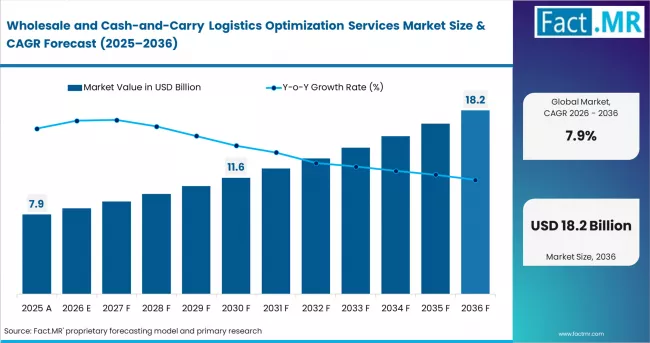
Based on Fact.MR analysis, demand for wholesale and cash-and-carry logistics optimization services is estimated to grow to USD 7.9 billion in 2026 and USD 16.9 billion by 2036.
FACT.MR projects a CAGR of 7.9% during the forecast period.
Wholesale And Cash And Carry Logistics Optimization Services Market Market Value Analysis | Source: Fact.MR
Metric
Value
Estimated Value in 2026
USD 7.9 billion
Forecast Value in 2036
USD 16.9 billion
Forecast CAGR (2026 to 2036)
7.9%
Source: Fact.MR analysis. Updated May 8, 2026
Summary of Wholesale and Cash-and-Carry Logistics Optimization Services Market
Market Definition
The market covers cloud-based and on-premise logistics optimization platforms and services used by wholesale and cash-and-carry operators for warehouse management, route optimization, and demand-driven replenishment globally.
Demand Drivers
Wholesale margin compression is accelerating platform adoption. Operators are deploying route and inventory optimization to recover 2–4% logistics cost reductions across high-volume distribution networks.
FMCG supplier mandates for real-time replenishment data are increasing wholesale digitization spend. Adoption is driven by shelf availability compliance requirements from major consumer goods manufacturers.
India and China wholesale modernization programmes are generating structured procurement cycles for optimization platforms. Both markets are expanding organized trade through government-backed logistics infrastructure schemes.
Key Segments Analyzed
By Service Type: Warehouse & Inventory Optimization leads at 35% in 2026. Driven by bulk handling, pallet optimization, and storage cost control in wholesale operations.
By Deployment Model: Cloud-based optimization platforms lead at 63% in 2026. Driven by scalability requirements and lower upfront capital deployment for mid-size wholesalers.
By End User: Cash-and-carry wholesalers lead at 40% in 2026. Driven by high SKU density, rapid replenishment cycles, and route density optimization needs.
Analyst Opinion at FACT.MR
Shambhu Nath Jha, Principal Consultant at Fact.MR, opines, 'CXOs will find a clear split between integrated cloud optimization platforms capturing route-to-market efficiency gains and standalone legacy warehouse tools losing contract value in large-scale cash-and-carry and FMCG wholesale procurement.'
Strategic Implications
Invest in cloud-based warehouse and route optimization platform development targeting cash-and-carry and FMCG wholesale operators with high SKU density.
Develop demand forecasting and replenishment modules for B2B foodservice distributors aligned with real-time FMCG supplier availability compliance requirements.
Separate cloud-native and legacy migration product lines. Capture premium contract value in large wholesale networks integrating optimization across transport and inventory simultaneously.
Methodology
Market sizing based on platform subscription revenues and operator deployment volumes. Validated with 2024–2025 financial and procurement data.
Supported by Metro AG, DHL, and Blue Yonder disclosure data, FMCG wholesale logistics cost benchmarks, and India and China trade modernization statistics.
Forecasts include wholesale sector digitization rates, cloud platform adoption curves, and expert inputs from distribution network operators.
The market is set to generate USD 9.0 billion in incremental revenue over the forecast period. Growth is structural and margin-driven. Thin wholesale operating margins are accelerating adoption of route, inventory, and replenishment optimization. Persistent labour cost inflation and fuel price volatility remain the primary constraints on faster adoption, particularly among mid-tier distributors with limited IT budgets.
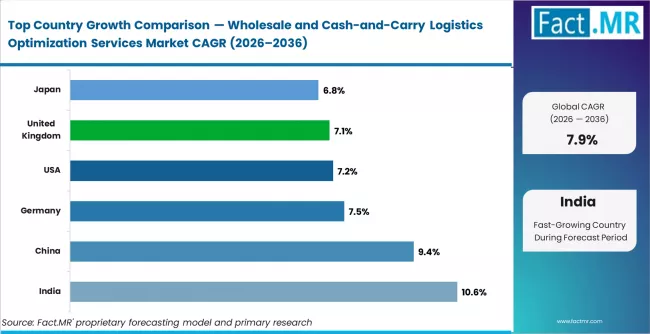
India leads at 10.6% CAGR through 2036, driven by rapid fragmented wholesale sector digitization and expanding organized retail distribution networks. China follows at 9.4%, anchored by wholesale market modernization and nationwide logistics platform roll-outs. Germany grows at 7.5%, supported by strong B2B industrial wholesale networks and SAP-led ERP integration. The United States records 7.2%, supported by large contract logistics networks and mature third-party optimization deployments. The United Kingdom follows at 7.1%, driven by cash-and-carry and foodservice wholesale growth. Japan records 6.8%, reflecting mature logistics infrastructure with slower incremental optimization uptake.
Segmental Analysis
Wholesale and Cash-and-Carry Logistics Optimization Services Market Analysis by Service Type
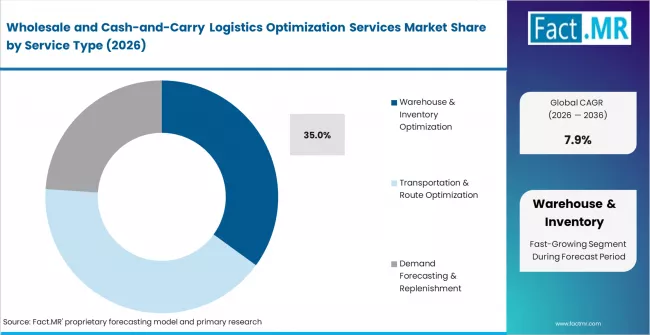
Wholesale And Cash And Carry Logistics Optimization Services Market Analysis By Service Type | Source: Fact.MR
Based on FACT.MR analysis, Warehouse & Inventory Optimization holds 35% share in 2026. This service leads due to bulk handling complexity. Pallet and storage cost control are primary drivers. Integration with replenishment platforms is increasing. Operators prioritize documented cost reduction per SKU.
DHL Investment: DHL Supply Chain expanded its warehouse optimization technology programme in 2024, deploying AI-based inventory management across 30+ wholesale distribution centres in Europe and Asia Pacific, targeting 12% storage cost reduction [1].
Manhattan Associates Development: Manhattan Associates launched an updated Warehouse Management System for wholesale and cash-and-carry in Q1 2025, incorporating real-time pallet slotting and bulk replenishment modules targeting FMCG distributors in North America and Europe [2].
Inventory Optimization Trend: Wholesale warehouse optimization platform adoption grew 18% in 2024, driven by SKU proliferation in cash-and-carry and rising FMCG supplier fill-rate compliance requirements across major markets [3].
Wholesale and Cash-and-Carry Logistics Optimization Services Market Analysis by Deployment Model
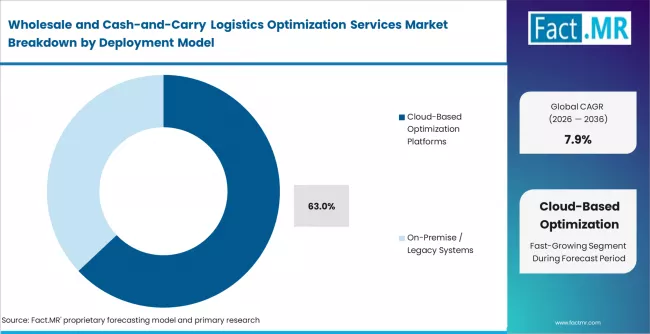
Wholesale And Cash And Carry Logistics Optimization Services Market Analysis By Deployment Model | Source: Fact.MR
Based on FACT.MR analysis, cloud-based optimization platforms hold 63% share in 2026. This deployment model leads due to scalability and lower capital cost. SaaS-based platforms allow phased rollout. Wholesale operators are migrating from legacy ERP modules. Cloud platforms enable real-time network visibility.
Blue Yonder Expansion: Blue Yonder expanded its cloud-native supply chain platform for wholesale distribution in 2024, adding demand sensing and inventory optimization modules specifically targeting cash-and-carry and FMCG wholesale operators across North America and EMEA [4].
SAP Cloud Migration: SAP announced its S/4HANA Wholesale Logistics Cloud Migration Programme in early 2025, offering transition incentives to legacy on-premise wholesale ERP customers, targeting 5,000+ mid-size wholesale distributors in Europe and Asia [5].
Cloud Adoption Trend: Cloud-based logistics optimization platform subscriptions in wholesale distribution grew 22% globally in 2024, outpacing on-premise deployment growth by a factor of four, driven by SaaS cost models and remote integration capabilities [6].
Drivers, Restraints, and Opportunities
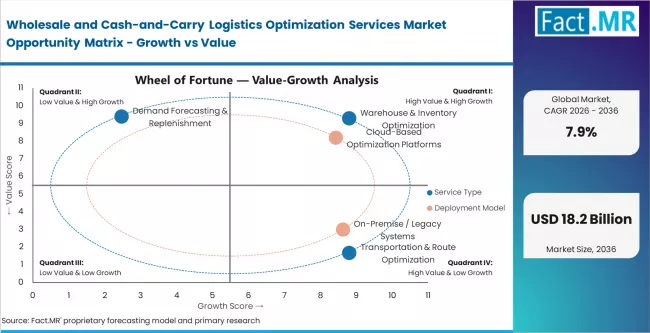
Wholesale And Cash And Carry Logistics Optimization Services Market Opportunity Matrix Growth Vs Value | Source: Fact.MR
FACT.MR analysts observe that this market is structurally sound and margin-driven. Demand is anchored in warehouse inventory management and route optimization. FMCG and foodservice distribution are core segments.
Pressure on wholesale margins is persistent. Real-time replenishment requirements are increasing. Cloud platform adoption is accelerating across networks. Growth remains consistent across high-volume, multi-location wholesale operations globally.
Wholesale Margin Recovery: Persistent fuel and labour inflation is forcing wholesale operators to adopt route and inventory optimization. Blue Yonder reported a 15% increase in wholesale platform deployments in 2024, driven by logistics cost recovery demand across European and North American FMCG distributors [7].
Cloud Platform Mandates: SAP's 2025 Logistics Intelligence suite update introduced AI-driven replenishment for wholesale ERP customers, accelerating cloud migration among mid-size distributors. Deployment uptake grew 20% in EMEA across B2B foodservice and FMCG wholesale segments [8].
India Wholesale Digitization: India's PM GatiShakti logistics scheme expanded coverage in 2024, creating structured procurement demand for route and network optimization platforms among organized wholesale distributors. Adoption is fastest in tier-2 city FMCG wholesale hubs [9].
Regional Analysis
The wholesale and cash-and-carry logistics optimization services market is assessed across Asia Pacific, North America, Europe, Latin America, and Middle East and Africa, covering 40+ countries with distinct demand profiles shaped by wholesale digitization maturity, cloud platform adoption rates, FMCG distribution complexity, and logistics infrastructure investment levels. The full report offers market attractiveness analysis by region and country.
Top Country Growth Comparison Wholesale And Cash And Carry Logistics Optimization Services Market Cagr (2026 2036) | Source: Fact.MR
Country
CAGR (2026 to 2036)
India
10.6%
China
9.4%
Germany
7.5%
United States
7.2%
United Kingdom
7.1%
Japan
6.8%
Source: Fact.MR analysis. Updated May 8, 2026
Source: Fact.MR (FACT.MR) analysis, based on proprietary forecasting model and primary research
Wholesale And Cash And Carry Logistics Optimization Services Market Cagr Analysis By Country | Source: Fact.MR
Asia Pacific Wholesale and Cash-and-Carry Logistics Optimization Services Market Analysis
Asia Pacific is the fastest-growing region for wholesale logistics digitization. Growth is driven by fragmented trade modernization and organized wholesale expansion. Adoption is rising across cash-and-carry and FMCG channels. Buyers are prioritizing integrated inventory and route optimization. Government infrastructure programs are supporting cloud platform procurement.
India: Growth is projected at 10.6% CAGR through 2036. PM GatiShakti National Master Plan expanded logistics coverage, driving optimization adoption. Open Network for Digital Commerce mandates are pushing real-time inventory systems. Reliance Retail scaled cloud-based replenishment across tier-2 cities. Expansion is mandate-driven and supported by rapid digitization of mid-tier wholesalers.
China: Expansion is projected at 9.4% CAGR through 2036. The Ministry of Commerce extended wholesale modernization programs. Cainiao Network scaled AI-driven routing across wholesale hubs. Cold chain compliance standards are tightening for food distributors. Growth is driven by state-backed modernization and platform scale.
Japan: Progress is projected at 6.8% CAGR through 2036. The Ministry of Land issued freight efficiency guidelines in 2024. Aeon Group deployed network optimization across B2B distribution. Adoption remains gradual due to high baseline efficiency and legacy system cycles.
Fact.MR’s Asia Pacific analysis covers India, China, Japan, ASEAN, South Korea, and ANZ. It includes infrastructure trends, modernization benchmarks, and cloud adoption data.
Europe Wholesale and Cash-and-Carry Logistics Optimization Services Market Analysis
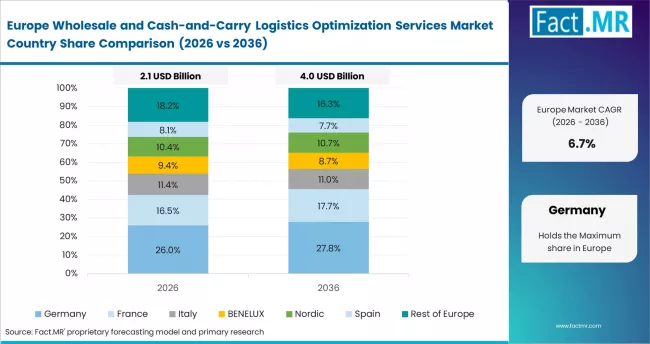
Wholesale And Cash And Carry Logistics Optimization Services Market Europe Country Market Share Analysis, 2026 & 2036 | Source: Fact.MR
Europe is a compliance-driven market with structured procurement. Growth is tied to FMCG supplier mandates and ERP integration. Adoption is concentrated among cash-and-carry and foodservice operators.
Germany: Growth is projected at 7.5% CAGR through 2036. Metro AG demonstrated cost recovery through logistics optimization rollout. SAP introduced AI-driven replenishment modules. Federal benchmarks are shaping procurement standards. Expansion is driven by compliance and automation leadership.
United Kingdom: Expansion is projected at 7.1% CAGR through 2036. Booker Wholesale expanded optimization across its network. The Food and Drink Federation issued digital compliance guidelines. Driver shortages are increasing reliance on route efficiency platforms. Growth is driven by labor constraints and supply chain digitization.
Fact.MR’s Europe analysis covers Germany, United Kingdom, France, Italy, Spain, Nordic Countries, and BENELUX. It includes compliance trends, ERP benchmarks, and optimization adoption data.
North America Wholesale and Cash-and-Carry Logistics Optimization Services Market Analysis
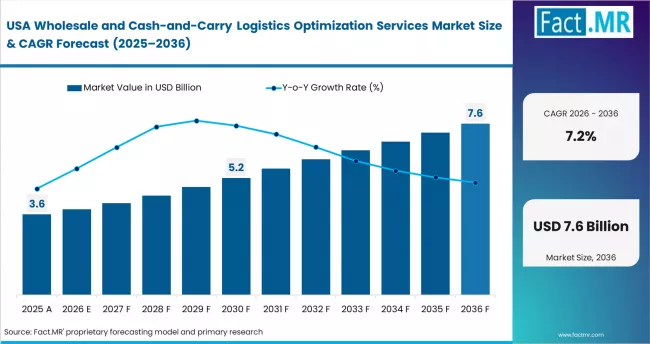
Wholesale And Cash And Carry Logistics Optimization Services Market Country Value Analysis | Source: Fact.MR
North America is a mature and performance-driven market. Adoption is led by large-scale wholesale distributors and contract logistics players. Procurement is tied to measurable cost reduction outcomes.
United States: Growth is projected at 7.2% CAGR through 2036. Walmart expanded Blue Yonder integration across wholesale networks. XPO Logistics enhanced route optimization for FMCG clients. The EPA SmartWay program updated efficiency benchmarks. Expansion is driven by cost optimization and performance compliance.
Fact.MR’s North America analysis covers United States, Canada, and Mexico. It includes platform adoption, contract logistics benchmarks, and regional deployment trends.
Competitive Aligners for Market Players
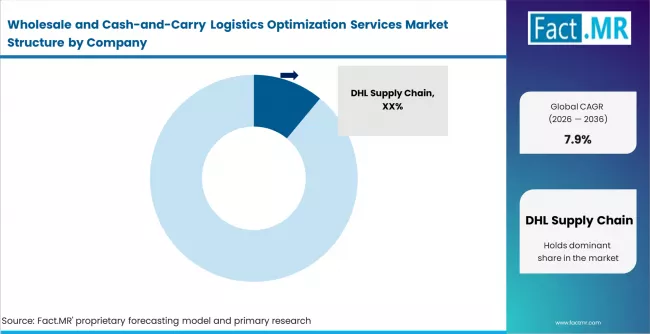
Wholesale And Cash And Carry Logistics Optimization Services Market Analysis By Company | Source: Fact.MR
The wholesale and cash-and-carry logistics optimization services market is moderately concentrated at the top, but still competitive underneath. Players like Blue Yonder, Manhattan Associates, and SAP hold a strong position in platform licensing and managed services. Their advantage comes from long-standing relationships with wholesale distributors, deep ERP integration, and proven performance across large distribution networks. Below this tier, the market becomes fragmented, with smaller vendors focusing on niche capabilities like route optimization or demand forecasting.
What really sets the top players apart is how tightly their platforms are embedded into existing systems. SAP, for example, integrates logistics optimization directly within its S/4HANA environment, making it difficult for customers to switch. Blue Yonder benefits from strong AI capabilities backed by Panasonic, enabling more advanced forecasting and routing decisions. Manhattan Associates has built long-term managed service contracts with major wholesale distributors, creating steady recurring revenue and high retention. On the buyer side, influence varies by scale. Large operators such as Metro AG, Costco, and Walmart have strong negotiating power and can secure favorable enterprise agreements. Mid-sized wholesalers, however, are more dependent on bundled solutions. Many are adopting cloud-based platforms through logistics partners like DHL, Kuehne + Nagel, and DB Schenker, which offer integrated services. This is creating indirect sales channels and making access to optimization tools easier for smaller players.
Key Players
DHL Supply Chain
Kuehne + Nagel
DB Schenker
XPO Logistics
Blue Yonder
Manhattan Associates
SAP
Metro AG
Costco Wholesale
Walmart
Bibliography
[1] DHL Supply Chain. 2024. Warehouse Optimization Technology Programme Expansion Report. Bonn: Deutsche Post DHL Group.
[2] Manhattan Associates. 2025. Warehouse Management System Update for Wholesale Distribution. Atlanta: Manhattan Associates Inc.
[3] Global Wholesale Logistics Industry Consortium. 2024. Warehouse Optimization Adoption Trends in Cash-and-Carry and FMCG Distribution. London: GWLIC.
[4] Blue Yonder. 2024. Cloud-Native Supply Chain Platform Expansion for Wholesale Distribution. Scottsdale: Blue Yonder Group Inc.
[6] International Logistics Technology Association. 2024. Global Cloud Adoption Trends in Wholesale Logistics Optimization Platforms. Geneva: ILTA.
[7] Blue Yonder. 2024. Wholesale Platform Deployment and Cost Optimization Report. Scottsdale: Blue Yonder Group Inc.
[8] SAP. 2025. Logistics Intelligence Suite Update and Deployment Trends. Walldorf: SAP SE.
[9] PM GatiShakti National Master Plan. 2024. Logistics Infrastructure Expansion and Digital Procurement Report. New Delhi: Government of India.
This Report Addresses
Strategic intelligence on wholesale and cash-and-carry logistics optimization service demand across warehouse management, route optimization, demand forecasting, and network design platforms for FMCG, foodservice, and industrial wholesale globally.
Market forecast from USD 7.9 billion in 2026 to USD 16.9 billion by 2036, at a CAGR of 7.9%.
Growth opportunity mapping across India wholesale digitization, China market modernization, Germany SAP-led integration, U.S. contract logistics expansion, UK cash-and-carry optimization, and Japan incremental platform adoption.
Segment analysis by service type (warehouse optimization, route optimization, demand forecasting, network design), deployment model (cloud, on-premise), and end user (cash-and-carry, FMCG wholesale, foodservice, industrial).
Regional outlook covering Asia Pacific high-growth digitization, North America mature platform deployment, and Europe compliance- and supplier-mandate-driven adoption.
Competitive analysis of DHL, Kuehne + Nagel, Blue Yonder, Manhattan Associates, SAP, Metro AG, Costco, and Walmart. Focus on platform integration depth, contract logistics bundling, and cloud migration value proposition.
Regulatory and compliance analysis covering India PM GatiShakti logistics mandates, China wholesale modernization standards, EU FMCG supplier compliance guidelines, U.S. EPA SmartWay freight benchmarks, and UK Food and Drink Federation digital supply chain requirements.
Report delivered in PDF, Excel, and presentation formats. Supported by primary interviews, wholesale logistics cost records, platform vendor disclosures, and procurement benchmarks.
Wholesale and Cash-and-Carry Logistics Optimization Services Market Definition
The market covers software platforms and managed services used to optimize warehousing, inventory, transportation routing, demand forecasting, and distribution network design for wholesale and cash-and-carry operators.
Wholesale and Cash-and-Carry Logistics Optimization Services Market Inclusions
Covers global and regional forecasts from 2026 to 2036. Includes service type, deployment model, and end-user segments. Covers cloud-based platforms, on-premise systems, and managed optimization services for cash-and-carry, FMCG wholesale, foodservice, and industrial distributors. Includes OEM platform licensing and system integration channels.
Wholesale and Cash-and-Carry Logistics Optimization Services Market Exclusions
Excludes retail logistics optimization and direct-to-consumer last-mile delivery platforms. Omits general-purpose ERP systems not adapted for wholesale logistics workflows. Also excludes cold chain management software unless integrated with wholesale route or inventory optimization. Focus remains on optimization services directly serving wholesale and cash-and-carry distribution models.
Wholesale and Cash-and-Carry Logistics Optimization Services Market Research Methodology
Primary Research:Interviews with logistics optimization platform vendors, wholesale distribution operators, and procurement technology teams. Covers FMCG wholesale, cash-and-carry operators, and B2B foodservice distributors.
Desk Research:Uses Blue Yonder, Manhattan Associates, and SAP disclosure data. Includes wholesale logistics cost benchmarks and cloud platform adoption statistics from 2024–2025.
Market-Sizing and Forecasting:Uses a hybrid top-down and bottom-up model. Based on platform subscription revenues and operator deployment volumes. Segmented by service type and end-user category.
Data Validation and Update Cycle:Validated using platform vendor revenues and wholesale operator logistics cost data. Cross-checked with procurement records and expert interviews. Updated regularly.
Market Breakdown
Segmentation
Scope of Report
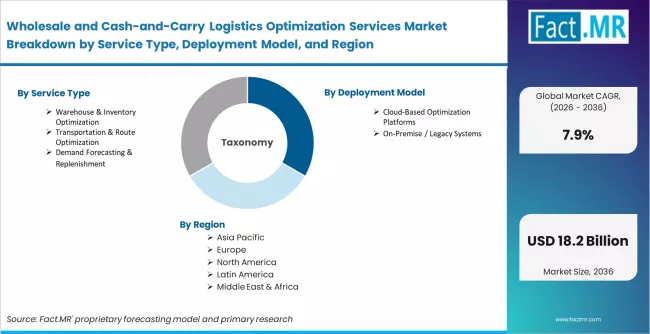
Wholesale And Cash And Carry Logistics Optimization Services Market Breakdown By Service Type, Deployment Model, And Region | Source: Fact.MR
Attribute
Details
Quantitative Units
USD 7.9 billion (2026) to USD 16.9 billion (2036), at a CAGR of 7.9%
Market Definition
Cloud-based and on-premise logistics optimization platforms and managed services supplied for warehouse and inventory management, transportation route optimization, demand forecasting, and network design across wholesale and cash-and-carry distribution operations globally.
North America, Europe, Asia Pacific, Latin America, Middle East and Africa
Countries Covered
USA, Canada, Mexico, Germany, UK, France, Italy, Spain, Nordic, BENELUX, China, Japan, South Korea, India, ASEAN, Australia and New Zealand, Brazil, Argentina, Chile, Saudi Arabia, GCC, Turkey, South Africa, Rest of MEA
Key Companies Profiled
DHL Supply Chain, Kuehne + Nagel, DB Schenker, XPO Logistics, Blue Yonder, Manhattan Associates, SAP, Metro AG, Costco Wholesale, Walmart
Forecast Period
2026 to 2036
Approach
Hybrid top-down and bottom-up model using platform subscription revenues, wholesale operator logistics cost benchmarks, cloud deployment volumes by service type, FMCG wholesale replenishment procurement benchmarks, and primary interviews with cash-and-carry and distribution network operators.
Source: Fact.MR analysis. Updated May 8, 2026
Wholesale and Cash-and-Carry Logistics Optimization Services Market by Segments
By Service Type:
Warehouse & Inventory Optimization
Transportation & Route Optimization
Demand Forecasting & Replenishment
Network Design & Flow Optimization
By Deployment Model:
Cloud-Based Optimization Platforms
On-Premise / Legacy Systems
By End User:
Cash-and-Carry Wholesalers
FMCG Wholesale Distributors
B2B Foodservice Distributors
Industrial Wholesale
By Region:
North America
United States
Canada
Mexico
Latin America
Brazil
Mexico
Argentina
Chile
Rest of Latin America
Western Europe
Germany
United Kingdom
France
Italy
Spain
Nordic Countries
BENELUX
Rest of Western Europe
Eastern Europe
Russia
Poland
Hungary
Balkan and Baltic
Rest of Eastern Europe
East Asia
China
Japan
South Korea
South Asia and Pacific
India
ASEAN
Australia and New Zealand
Rest of South Asia and Pacific
Middle East and Africa
Kingdom of Saudi Arabia
Other GCC Countries
Turkey
South Africa
Rest of Middle East and Africa
Questions Answered
Frequently Asked Questions
How large is the wholesale and cash-and-carry logistics optimization services market in 2025?
The market was valued at USD 7.4 billion in 2025.
What will the market size be in 2026?
The market is estimated to reach USD 7.9 billion in 2026.
What is the projected market size by 2036?
The market is projected to reach USD 16.9 billion by 2036.
What is the expected CAGR of the wholesale and cash-and-carry logistics optimization services market?
The market is expected to grow at a CAGR of 7.9% from 2026 to 2036.
What is the absolute dollar opportunity in this market?
The market is expected to create an absolute dollar opportunity of USD 9.0 billion between 2026 and 2036.
Which service type segment leads the market?
Warehouse & Inventory Optimization leads with approximately 35% share in 2026, driven by bulk handling complexity, pallet cost management, and storage efficiency requirements across large-format wholesale and cash-and-carry distribution operations.
Which deployment model is poised to lead?
Cloud-based optimization platforms lead with approximately 63% share in 2026, driven by SaaS cost models, scalability for multi-site wholesale networks, and accelerating migration from legacy on-premise ERP modules across FMCG and foodservice wholesale operators.
Which country shows the fastest growth?
India leads with approximately 10.6% CAGR through 2036, driven by fragmented wholesale sector digitization, PM GatiShakti logistics infrastructure expansion, and organized trade growth creating structured demand for route and inventory optimization platforms.
.webp "Top Country Growth Comparison Wholesale And Cash And Carry Logistics Optimization Services Market Cagr (2026 2036)")