Xylitol Building Block Market Size, Share, Growth and Forecast (2026 - 2036)

The Xylitol Building Block Market is segmented by Source (Hardwood, Agricultural Residues, and Softwood), by Grade (Food Grade, Industrial Grade, and Pharmaceutical Grade), by Application, by Processing Route, by Feedstock Form, by Sales Channel, and by Region. Forecast for 2026 to 2036.

Fact.MR states that the xylitol building block market is moving toward controlled biomass conversion and clear purity records. Food formulators and oral care brands need traceable polyol inputs. Industrial users are testing hemicellulose streams to reduce dependence on starch-derived sugar alcohols.

Xylitol Building Block Market Forecast and Outlook by Fact.MR

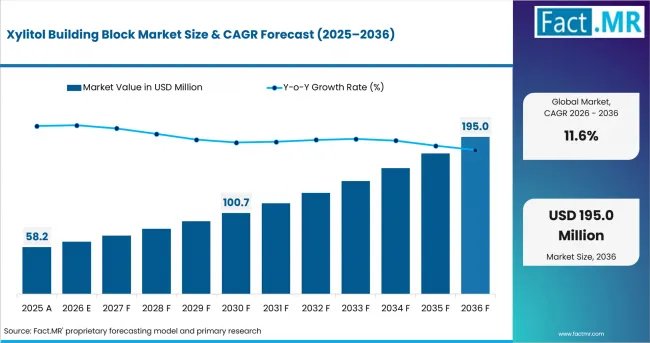
  • The xylitol building block market crossed a valuation of USD 58.2 million in 2025. Based on Fact.MR analysis, demand is estimated to grow to USD 65.0 million in 2026 and USD 195.0 million by 2036. Fact.MR projects a CAGR of 11.6% during the forecast period.
  • The market is projected to generate an incremental revenue opportunity of USD 130.0 million between 2026 and 2036.
  • Market demand is rising as food formulators and oral care producers seek traceable xylitol inputs. Biomass processors are using hardwood and farm residues to develop lower-cost conversion routes.
  • Safety reviews around xylitol intake may slow use in some health-positioned formulas.
Xylitol Building Block Market Value Analysis

Summary of Xylitol Building Block Market

  • Demand Drivers
    • Food and beverage formulators use xylitol building blocks in sugar-reduced products. FDA states sugar alcohols range from 25% to 100% as sweet as sugar, supporting use in candies and chewing gums [1].
    • Pharma excipient users prefer documented xylitol grades for oral dosage forms. Roquette lists XYLISORB 90 as a coating and filler excipient for pharmaceutical and nutraceutical oral dosage products.
    • Biomass processors are showing more interest in xylitol conversion from pulp and crop residues. Biomass interest supports hemicellulose-derived xylitol as a specialty route in the sugar alcohol chain.
  • Key Segments Analyzed
    • By Sales Channel: Direct supply holds 61.0% share in 2026 as large users require certificates and batch-level supply records from producers.
    • By Processing Route: Chemical hydrogenation leads with 58.0% share in 2026 since existing xylose assets support predictable output and lower scale-up risk.
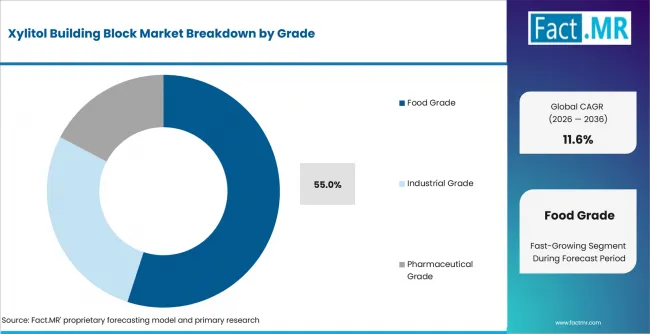
    • By Grade: Food grade captures 55.0% share in 2026 as sweetener and oral care use requires defined impurity limits.
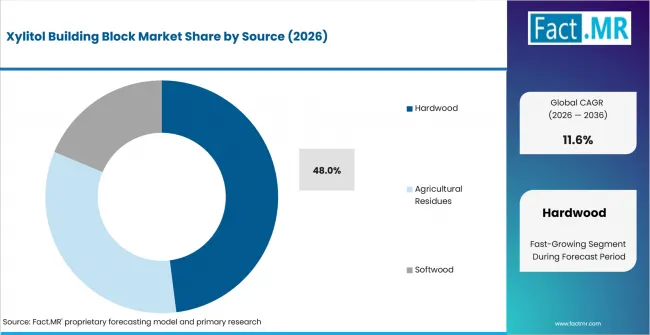
    • By Source: Hardwood represents 48.0% share in 2026 because consistent xylan content supports repeatable conversion yield.
    • By Application: Food and beverage holds 42.0% share in 2026 as confectionery and sugar-reduced formats use xylitol for bulk sweetness.
    • By Feedstock Form: Biomass hydrolysate accounts for 46.0% share in 2026 since converters value liquid streams that reduce pretreatment steps.
  • Analyst Opinion at Fact.MR
    • Shambhu Nath Jha, Principal Consultant at Fact.MR, opines, “CXOs will see xylitol building block demand move toward verified feedstock control and clear purity records. Producers with biomass access and food-grade qualification will be preferred in high-volume formulations.”
  • Strategic Implications
    • Manufacturers can prioritize food-grade material and direct supply programs. These routes make qualification easier for large ingredient users.
    • Producers can secure hardwood and crop residue inputs before adding conversion capacity. Feedstock consistency affects yield and cost.
    • Suppliers can provide clear batch documents and impurity profiles. Food and pharma users need traceable inputs before changing from conventional xylose sources.
Metric Value
Estimated Value in 2026 USD 65.0 million
Forecast Value in 2036 USD 195.0 million
Forecast CAGR (2026 to 2036) 11.6% CAGR

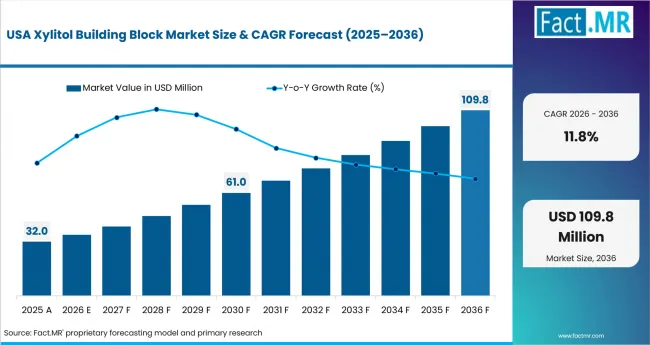
China is likely to record 13.2% CAGR through 2036 as corn-cob processing and local sweetener output support faster commercial use. Finland follows at 12.5% CAGR from 2026 to 2036 as pulp streams and oat side streams provide steady biomass input. The United States is likely to grow at 11.8% CAGR by 2036 as food additive use and pharma excipient demand support qualification work. Brazil advances at 11.2% CAGR through 2036 as sugarcane residue processing creates lower-cost feedstock options. India records 10.9% CAGR from 2026 to 2036 as oral care producers and tablet manufacturers test sugar alcohol ingredients for taste and mouthfeel. Germany expands at 10.7% CAGR by 2036 as chemical and food ingredient users prefer documented inputs under strict EU compliance systems. Japan grows at 10.3% CAGR from 2026 to 2036 as ingredient firms serve oral care and health-food applications with high-purity polyol inputs.

Segmental Analysis

Xylitol Building Block Market Analysis by Source
Xylitol Building Block Market Analysis By Source

Hardwood is projected to account for 48.0% share in 2026 because steady xylan content supports cleaner xylose recovery. Finland’s forest industry used 66.1 million cubic metres of roundwood in 2025, keeping pulp side streams available for Nordic biorefinery projects [3].

  • Hardwood Demand Outlook: Pulp-linked converters prefer hardwood streams because stable composition reduces process adjustments during xylitol building block production.
  • Agricultural Residue Use: Corn cobs and bagasse gain interest in regions with dense crop processing and lower collection cost.
  • Softwood Limit: Softwood streams need stronger pretreatment control before they can match hardwood yield consistency.

Xylitol Building Block Market Analysis by Grade
Xylitol Building Block Market Analysis By Grade

Food grade is likely to hold 55.0% share in 2026 because food formulators and oral care brands need clear purity records. The same specification pressure supports sugar alcohol suppliers that can provide clean documentation for sweetener users.

  • Food Grade Qualification: Food producers prefer certified purity and traceability before changing sweetener inputs in production.
  • Pharma Grade Pull: Pharma excipient demand is rising as oral dosage makers need good taste masking.
  • Industrial Grade Role: Industrial grade material serves specialty blends that need polyol function without food contact approval.

Xylitol Building Block Market Analysis by Application
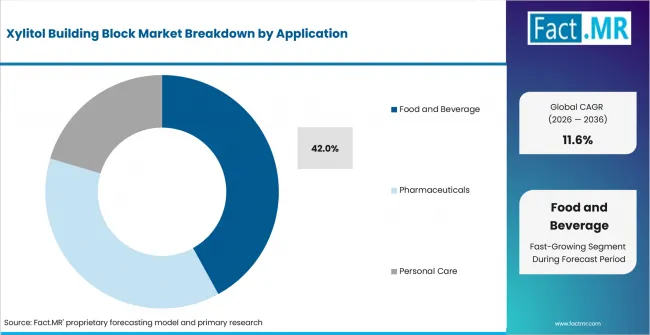
Xylitol Building Block Market Analysis By Application

Food and beverage is projected to account for 42.0% share in 2026 as confectionery and reduced-sugar formats use xylitol for bulk sweetness. Demand comes from foods that need sugar-like taste and texture.

  • Confectionery Pull: Gum and candy makers use xylitol for sweetness and cooling effect in sugar-reduced products.
  • Pharma Use: Tablet and lozenge producers test xylitol grades to mask bitter taste and improve oral comfort.
  • Personal Care Shift: Toothpaste and mouth rinse formulators use xylitol for sweetness and dental-friendly positioning.

Xylitol Building Block Market Analysis by Processing Route
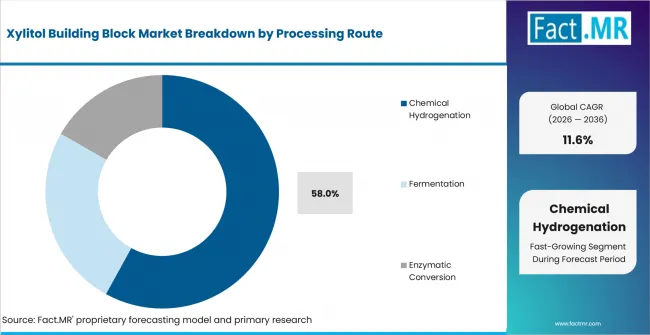
Xylitol Building Block Market Analysis By Processing Route

Chemical hydrogenation is projected to account for 58.0% share in 2026 because xylose conversion plants already use tested equipment and catalyst systems. This route lowers scale-up risk for producers serving food and pharma users.

  • Hydrogenation Scale: Existing xylose hydrogenation assets help producers raise output with fewer process changes and faster qualification.
  • Fermentation Testing: Fermentation routes gain pilot interest as biomass programs improve plant-fiber breakdown knowledge.
  • Enzymatic Conversion: Enzyme-based routes stay small as producers work on yield control and purification cost.

Xylitol Building Block Market Analysis by Feedstock Form
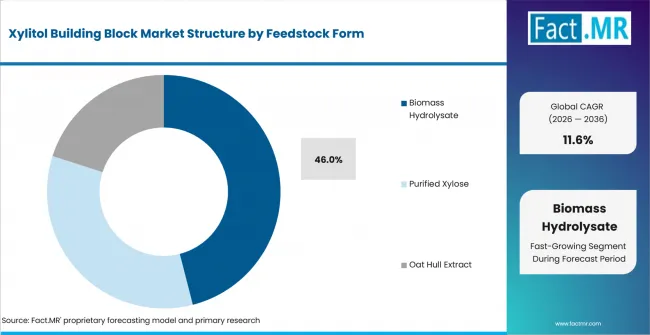
Xylitol Building Block Market Analysis By Feedstock Form

Biomass hydrolysate is likely to hold 46.0% share in 2026 because liquid xylose-rich streams reduce early processing steps. Brazil is forecast to produce 675 million metric tons of sugarcane in MY2026/27, supporting bagasse availability for biomass trials [4].

  • Hydrolysate Preference: Processors favor liquid hydrolysate because it reduces handling steps and moves faster into conversion vessels.
  • Purified Xylose Role: Purified xylose stays important for users with strict impurity limits in pharma and oral care materials.
  • Oat Hull Extract: Oat-based routes depend on producer learning and local cereal side-stream supply.

Xylitol Building Block Market Analysis by Sales Channel
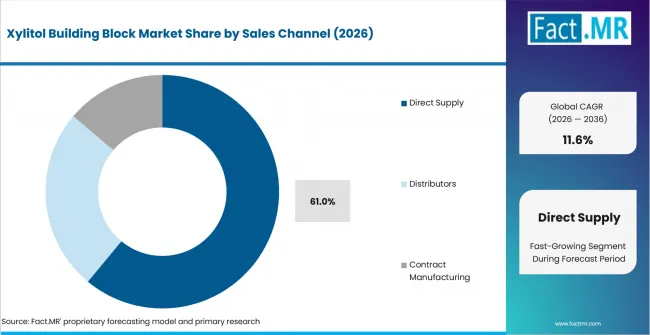
Xylitol Building Block Market Analysis By Sales Channel

Direct supply is projected to hold 61.0% share in 2026 because large food and pharma users prefer producer contact for specifications and audits. Direct supply is preferred because qualification records shape approved vendor lists.

  • Direct Supply Preference: Large formulators prefer direct producer contracts because batch records and food-contact documents reduce approval time.
  • Distributor Role: Regional distributors serve smaller users that need packaged quantities and shorter delivery schedules.
  • Contract Manufacturing: Toll conversion gains use among biomass owners that have feedstock but lack purification assets.

Drivers, Restraints, and Opportunities
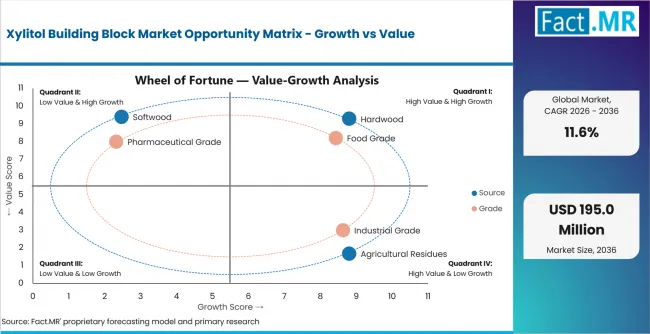
Xylitol Building Block Market Opportunity Matrix Growth Vs Value

The xylitol building block market grows because biomass feedstock can support high-purity sweetener use. Oral care and reduced-sugar food manufacturers need ingredients that work like sugar and keep formulations simple. Food additive acceptance gives suppliers a clear route into sugar-free food formats.

Bio-based processing is creating new supply options as pulp mills and crop processors look for better use of side streams. China’s corn crop is forecast at 307.0 million tons in 2026/27, which supports corn-cob residue availability for xylose conversion [5]. This keeps China ahead in scale-based xylitol building block development.

  • Feedstock Conversion Driver: Biomass processors are using residue streams for hydroxypropyl cellulose and xylitol building block work to improve plant economics.
  • Safety Review Restraint: A June 2024 study covered more than 3,300 cardiovascular patients and found a 57% higher serious cardiac event risk among patients with elevated xylitol levels [2].
  • Pharma Excipient Opportunity: Pharmaceutical excipients for taste masking create a higher-value outlet as oral dosage producers need sweetness and mouthfeel control.

Regional Analysis

The xylitol building block market is assessed across North America and Europe. East Asia and Latin America form the other core regions. The full report covers 40+ countries by source and grade. Application and processing route are treated as linked forecast cuts.

Top Country Growth Comparison Xylitol Building Block Market Cagr (2026 2036)

Country CAGR (2026 to 2036)
China 13.2%
Finland 12.5%
United States 11.8%
Brazil 11.2%
India 10.9%
Germany 10.7%
Japan 10.3%

Source: Fact.MR analysis, based on proprietary forecasting model and primary research
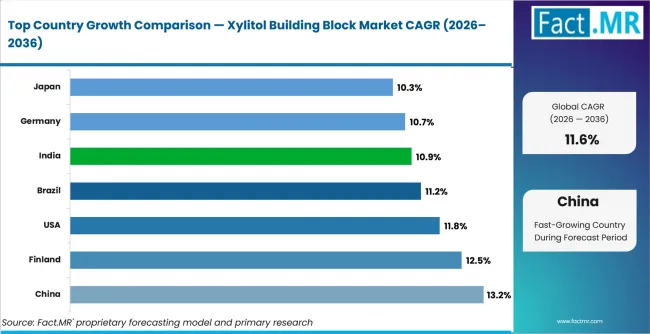
Xylitol Building Block Market Cagr Analysis By Country

East Asia Xylitol Building Block Market Analysis
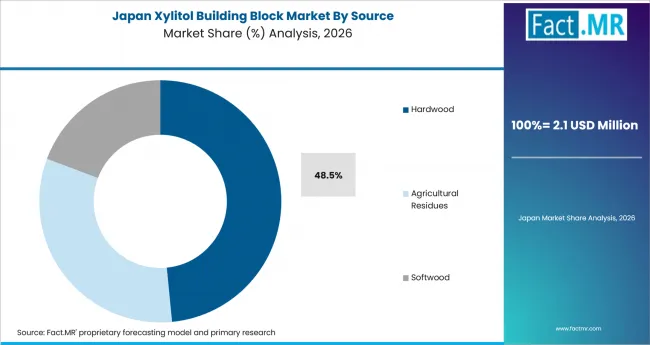
Xylitol Building Block Market Japan Market Share Analysis By Source

East Asia is the fastest-growing regional market for xylitol building blocks. Large agricultural residue streams support xylose recovery and xylitol conversion. China leads regional activity through corn-cob processing and local sweetener production.

  • China: China is likely to grow at 13.2% CAGR from 2026 to 2036. Corn-cob processing supports higher xylitol conversion across local production sites. Domestic sweetener output raises demand for food-grade xylitol building blocks. Gum, confectionery, and oral care users need consistent sweetness and purity.
  • Japan: Japan is projected to grow at 10.3% CAGR through 2036. Ingredient firms serve oral care and health-food applications with high-purity polyol inputs. Mitsubishi Corporation Life Sciences offers xylitol among polyols for food and health uses. Smaller batch production and strict documentation needs keep the market focused on specialty-grade supply.

Europe Xylitol Building Block Market Analysis
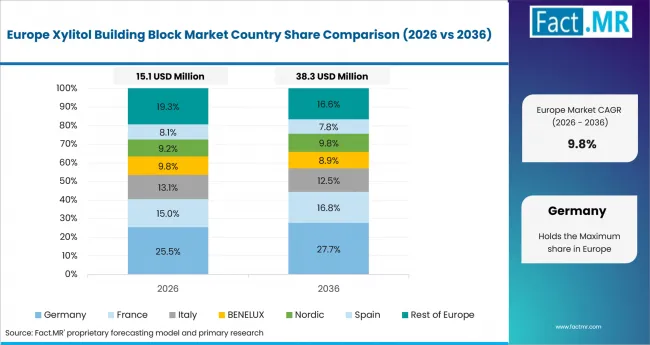
Xylitol Building Block Market Europe Country Market Share Analysis, 2026 & 2036

Europe uses pulp and cereal side streams for xylitol building block development. Forest residues and food-processing by-products support biomass conversion in selected countries. Strict ingredient checks keep demand focused on documented food and pharma grades.

  • Finland: Finland is likely to record 12.5% CAGR by 2036. Forest side streams and oat hull use support local biomass conversion. Fazer reported that 67% of steam at its Lahti bakery was produced with biomass from oat kernel husks in 2024 [8]. Side-stream use is becoming part of local industrial site planning.
  • Germany: Germany is projected to record 10.7% CAGR through 2036. Chemical and food ingredient users prefer documented inputs under strict European Union rules. Supplier qualification and import checks support demand for high-purity xylitol building blocks. Food and pharma-grade imports from European and Asian producers stay important for local users.

North America Xylitol Building Block Market Analysis
Xylitol Building Block Market Country Value Analysis

North America combines food additive acceptance with specialty ingredient qualification. Sugar-free foods and oral dosage products support controlled xylitol use. Domestic corn and starch processing strengthen the regional biomass supply base.

  • United States: The United States is likely to record 11.8% CAGR from 2026 to 2036. Sugar-free foods and oral dosage products use xylitol in controlled amounts. USDA listed United States food, seed, and industrial corn use at 7.0 billion bushels in 2026/27 [6]. This supports the domestic biomass and starch-processing supply chain.

Latin America Xylitol Building Block Market Analysis

Latin America is a feedstock-led region for future xylitol building block supply. Sugarcane residue availability supports trial inputs for xylose recovery. Ethanol-sector experience can support biochemical process learning across the region.

  • Brazil: Brazil is projected to grow at 11.2% CAGR through 2036. Bagasse and sugarcane residue streams provide trial inputs for xylose recovery. Residue scale and ethanol-sector process knowledge support the country’s value. Local conversion activity can expand as biochemical processing reaches commercial scale.

South Asia Xylitol Building Block Market Analysis

South Asia is smaller today but gains from confectionery output and pharmaceutical formulation activity. Distributor-led imports are likely to support near-term supply. Local conversion can improve as ingredient qualification and formulation demand increase.

  • India: India is likely to post 10.9% CAGR from 2026 to 2036. Oral care producers and tablet manufacturers are testing sugar alcohol ingredients for taste and mouthfeel. Demand may build through distributor-led imports before local conversion gains scale. Pharmaceutical formulation activity and confectionery production support future xylitol building block use.

Competitive Aligners for Market Players
Xylitol Building Block Market Analysis By Company

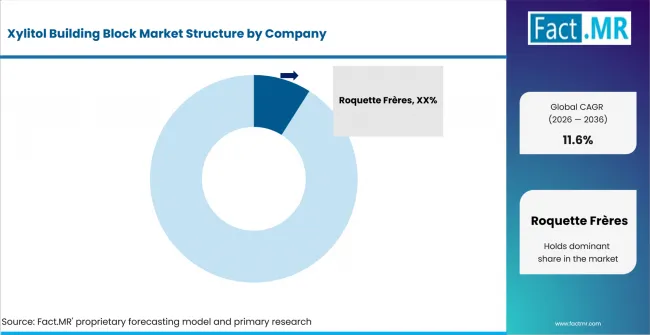
Xylitol building block suppliers compete on feedstock control and purity documents. Application support also helps suppliers qualify with food, oral care, and pharma users. Roquette lists XYLISORB 90 xylitol as a coating and filler excipient. It cites a cooling effect from dissolution enthalpy of 153 J/g [7]. This supports pharma and nutraceutical use in oral dosage forms.

Food and oral care users prefer suppliers that can prove batch stability. Producers with hardwood access and xylose purification assets have an advantage in food-grade material. Companies serving sustained-release excipients and oral solid dosage products have a clearer route into pharma applications.

Feedstock diversification is another competitive route. Fazer and pulp-linked suppliers show how cereal and wood side streams can support xylitol work. China-based producers such as Futaste and Huakang use scale as an advantage. European firms focus on documentation and specialty-grade support.

Roquette and IFF hold major positions in polyols and health excipients for oral dosage materials. Their portfolios connect xylitol building blocks with higher-purity ingredient use. 

Key Players

  • Roquette Frères
  • International Flavors & Fragrances Inc.
  • Futaste Pharmaceutical Co., Ltd.
  • Zhejiang Huakang Pharmaceutical Co., Ltd.
  • Shandong Longlive Bio-Technology Co., Ltd.
  • Fazer Group
  • Mitsubishi Corporation Life Sciences Ltd.

Bibliography

  • [1] U.S. Food and Drug Administration. (2025, February 27). Aspartame and other sweeteners in food.
  • [2] German Centre for Cardiovascular Research. (2024, June 7). New study: The sweetener xylitol is associated with an increased risk of heart problems.
  • [3] Natural Resources Institute Finland. (2026, April 28). Forest industries’ wood consumption 2025.
  • [4] U.S. Department of Agriculture, Foreign Agricultural Service. (2026, April 20). Sugar annual: Brazil (Report No. BR2026-0020).
  • [5] U.S. Department of Agriculture, Foreign Agricultural Service. (2026, May). Grain: World markets and trade.
  • [6] U.S. Department of Agriculture, Office of the Chief Economist. (2026, May 13). World agricultural supply and demand estimates: WASDE-671 [Revised].
  • [7] Roquette Frères. (n.d.). XYLISORB® 90 - XYLITOL. 
  • [8] Fazer Group. (2025, March 10). Annual review 2024.

This Report Addresses

  • Strategic demand analysis for xylitol building blocks across food and beverage, pharmaceutical, personal care, oral care, and specialty chemical applications globally.
  • Market forecast from USD 65.0 million in 2026 to USD 195.0 million by 2036 at 11.6% CAGR, with segment-level analysis by source, grade, application, processing route, feedstock form, and sales channel.
  • Opportunity mapping across China, Finland, the United States, Brazil, India, Germany, and Japan based on biomass availability, food-grade qualification, and xylitol conversion activity.
  • Segment analysis by hardwood, agricultural residues, food grade, chemical hydrogenation, biomass hydrolysate, and direct supply with regional and country-level forecasts through 2036.
  • Competitive analysis of Roquette Frères, International Flavors & Fragrances Inc., Futaste Pharmaceutical Co. Ltd., Zhejiang Huakang Pharmaceutical Co. Ltd., Shandong Longlive Bio-Technology Co. Ltd., Fazer Group, and Mitsubishi Corporation Life Sciences Ltd.
  • Regulatory and safety impact analysis covering food additive acceptance, pharma excipient documentation, EU ingredient compliance, xylitol safety review activity, and biomass feedstock traceability.
  • Report delivery in PDF, Excel, and presentation formats supported by supplier product data, food additive records, pharma excipient documentation, and ingredient industry interviews.

Xylitol Building Block Market Definition

The xylitol building block market covers xylitol intermediate streams and purified xylitol inputs produced from hemicellulose rich biomass. These materials serve food and beverage formulations and pharmaceutical excipients. Oral care products and specialty chemical applications are covered when xylitol is the direct revenue component.

Xylitol Building Block Market Inclusions

Covers global and regional market forecasts from 2026 to 2036 by source, grade and application. Processing route, feedstock form and sales channel are included as linked forecast cuts. Includes hardwood, agricultural residues and softwood sources. Covers food grade, industrial grade and pharmaceutical grade xylitol building blocks. Includes chemical hydrogenation, fermentation and enzymatic conversion routes. Covers biomass hydrolysate, purified xylose and oat hull extract feedstock forms across direct supply, distributors and contract manufacturing channels.

Xylitol Building Block Market Exclusions

Excludes finished consumer products where xylitol is only a minor ingredient. Omits chewing gum, toothpaste and confectionery revenue unless xylitol building block supply is measured separately. Excludes unrelated sugar alcohols such as sorbitol and erythritol. Excludes downstream oral care formulations and pharma products unless the xylitol input is the direct revenue generating component.

Xylitol Building Block Market Research Methodology

  • Primary Research
    • Interviews with xylitol producers, food ingredient buyers and pharma excipient users across China and Finland. Inputs were gathered from biomass processors, oral care formulators and specialty chemical suppliers in the United States, Brazil, India, Germany and Japan.
  • Desk Research
    • Analysis of Roquette Frères, International Flavors & Fragrances Inc., Futaste Pharmaceutical Co. Ltd. and Zhejiang Huakang Pharmaceutical Co. Ltd. public product information. Supplemented by U.S. Food and Drug Administration sweetener guidance, United States Department of Agriculture crop outlooks and company annual review data from Fazer Group.
  • Market-Sizing and Forecasting
    • Hybrid model combining top-down specialty ingredient revenue estimates with bottom-up conversion volume checks by source and grade. Average selling prices by processing route and feedstock form were modeled separately. Regional values were aggregated across food, pharmaceutical and personal care applications.
  • Data Validation and Update Cycle
    • Validated through supplier product catalogs, food additive records and pharma excipient documentation. Feedstock assumptions were checked through crop residue availability and pulp side stream data. Updated annually with producer capacity changes, regulatory updates and application qualification records.

Scope of the Report

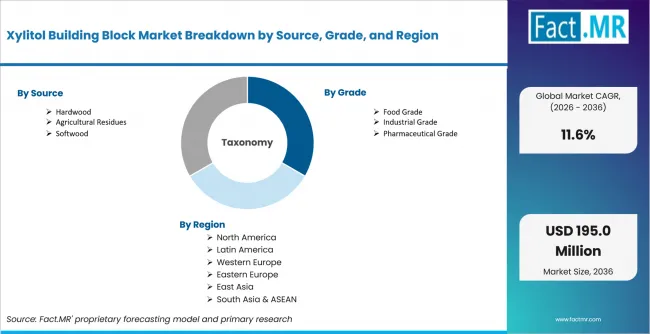
Xylitol Building Block Market Breakdown By Source, Grade, And Region

Attribute Details
Quantitative Units USD 65.0 million (2026) to USD 195.0 million (2036), at a CAGR of 11.6%
Market Definition Xylitol building blocks and xylitol intermediate streams made from hemicellulose-rich biomass for food and pharma use. Oral care and specialty chemical use is covered separately.
Source Segmentation Hardwood, Agricultural Residues, Softwood
Grade Segmentation Food Grade, Industrial Grade, Pharmaceutical Grade
Application Coverage Food and Beverage, Pharmaceuticals, Personal Care, Others
Processing Route Segmentation Chemical Hydrogenation, Fermentation, Enzymatic Conversion
Feedstock Form Segmentation Biomass Hydrolysate, Purified Xylose, Oat Hull Extract
Sales Channel Segmentation Direct Supply, Distributors, Contract Manufacturing
Regions Covered North America, Europe, East Asia, Latin America, South Asia, Middle East and Africa
Countries Covered United States, Canada, Mexico, China, Japan, South Korea, Finland, Germany, France, United Kingdom, Brazil, India, GCC, Rest of World
Key Companies Profiled Roquette Frères, International Flavors & Fragrances, Futaste Pharmaceutical, Zhejiang Huakang, Shandong Longlive Bio-Technology, Fazer Group, Mitsubishi Corporation Life Sciences
Forecast Period 2026 to 2036
Approach Hybrid top-down and bottom-up model using feedstock availability and conversion yield. Grade mix and application qualification were checked through supplier interviews.

Xylitol Building Block Market by Segment

  • By Source

    • Hardwood
    • Agricultural Residues
    • Softwood
  • By Grade

    • Food Grade
    • Industrial Grade
    • Pharmaceutical Grade
  • By Application

    • Food and Beverage
    • Pharmaceuticals
    • Personal Care
    • Others
  • By Processing Route

    • Chemical Hydrogenation
    • Fermentation
    • Enzymatic Conversion
  • By Feedstock Form

    • Biomass Hydrolysate
    • Purified Xylose
    • Oat Hull Extract
  • By Sales Channel

    • Direct Supply
    • Distributors
    • Contract Manufacturing
  • By Region

    • North America
    • Europe
    • East Asia
    • Latin America
    • South Asia
    • Middle East and Africa

- Frequently Asked Questions -

How large is the global xylitol building block market in 2025?

The global xylitol building block market was valued at USD 58.2 million in 2025.

What will the xylitol building block market size be in 2026?

Based on Fact.MR analysis, demand for xylitol building blocks is estimated to reach USD 65.0 million in 2026.

What is the projected xylitol building block market size by 2036?

The xylitol building block market is forecast to reach USD 195.0 million by 2036, creating USD 130.0 million in incremental opportunity.

What is the expected CAGR for the xylitol building block market from 2026 to 2036?

Fact.MR projects 11.6% CAGR for the global xylitol building block market during the forecast period.

Which source segment leads the xylitol building block market?

Hardwood leads with 48.0% share in 2026 as steady xylan content helps producers achieve repeatable xylose recovery and conversion yield.

Which application leads the xylitol building block market?

Food and beverage leads with 42.0% share in 2026 as confectionery and sugar-reduced formats use xylitol for bulk sweetness.

Which country shows the fastest growth in the xylitol building block market?

China leads at 13.2% CAGR through 2036 as corn-cob processing and local sweetener production support faster commercial xylitol conversion.

Table of Content

  1. Executive Summary
    • Global Market Outlook
    • Demand to side Trends
    • Supply to side Trends
    • Technology Roadmap Analysis
    • Analysis and Recommendations
  2. Market Overview
    • Market Coverage / Taxonomy
    • Market Definition / Scope / Limitations
  3. Research Methodology
    • Chapter Orientation
    • Analytical Lens and Working Hypotheses
      • Market Structure, Signals, and Trend Drivers
      • Benchmarking and Cross-market Comparability
      • Market Sizing, Forecasting, and Opportunity Mapping
    • Research Design and Evidence Framework
      • Desk Research Programme (Secondary Evidence)
        • Company Annual and Sustainability Reports
        • Peer-reviewed Journals and Academic Literature
        • Corporate Websites, Product Literature, and Technical Notes
        • Earnings Decks and Investor Briefings
        • Statutory Filings and Regulatory Disclosures
        • Technical White Papers and Standards Notes
        • Trade Journals, Industry Magazines, and Analyst Briefs
        • Conference Proceedings, Webinars, and Seminar Materials
        • Government Statistics Portals and Public Data Releases
        • Press Releases and Reputable Media Coverage
        • Specialist Newsletters and Curated Briefings
        • Sector Databases and Reference Repositories
        • Fact.MR Internal Proprietary Databases and Historical Market Datasets
        • Subscription Datasets and Paid Sources
        • Social Channels, Communities, and Digital Listening Inputs
        • Additional Desk Sources
      • Expert Input and Fieldwork (Primary Evidence)
        • Primary Modes
          • Qualitative Interviews and Expert Elicitation
          • Quantitative Surveys and Structured Data Capture
          • Blended Approach
        • Why Primary Evidence is Used
        • Field Techniques
          • Interviews
          • Surveys
          • Focus Groups
          • Observational and In-context Research
          • Social and Community Interactions
        • Stakeholder Universe Engaged
          • C-suite Leaders
          • Board Members
          • Presidents and Vice Presidents
          • R&D and Innovation Heads
          • Technical Specialists
          • Domain Subject-matter Experts
          • Scientists
          • Physicians and Other Healthcare Professionals
        • Governance, Ethics, and Data Stewardship
          • Research Ethics
          • Data Integrity and Handling
      • Tooling, Models, and Reference Databases
    • Data Engineering and Model Build
      • Data Acquisition and Ingestion
      • Cleaning, Normalisation, and Verification
      • Synthesis, Triangulation, and Analysis
    • Quality Assurance and Audit Trail
  4. Market Background
    • Market Dynamics
      • Drivers
      • Restraints
      • Opportunity
      • Trends
    • Scenario Forecast
      • Demand in Optimistic Scenario
      • Demand in Likely Scenario
      • Demand in Conservative Scenario
    • Opportunity Map Analysis
    • Product Life Cycle Analysis
    • Supply Chain Analysis
    • Investment Feasibility Matrix
    • Value Chain Analysis
    • PESTLE and Porter’s Analysis
    • Regulatory Landscape
    • Regional Parent Market Outlook
    • Production and Consumption Statistics
    • Import and Export Statistics
  5. Global Market Analysis 2021 to 2025 and Forecast, 2026 to 2036
    • Historical Market Size Value (USD Million) Analysis, 2021 to 2025
    • Current and Future Market Size Value (USD Million) Projections, 2026 to 2036
      • Y to o to Y Growth Trend Analysis
      • Absolute $ Opportunity Analysis
  6. Global Market Pricing Analysis 2021 to 2025 and Forecast 2026 to 2036
  7. Global Market Analysis 2021 to 2025 and Forecast 2026 to 2036, By Product
    • Introduction / Key Findings
    • Historical Market Size Value (USD Million) Analysis By Product , 2021 to 2025
    • Current and Future Market Size Value (USD Million) Analysis and Forecast By Product , 2026 to 2036
      • T-Shirts
      • Bottom Wear
      • Innerwear
      • One-piece Apparel
      • Others (Bibs, Capes, Protective)
    • Y to o to Y Growth Trend Analysis By Product , 2021 to 2025
    • Absolute $ Opportunity Analysis By Product , 2026 to 2036
  8. Global Market Analysis 2021 to 2025 and Forecast 2026 to 2036, By End User
    • Introduction / Key Findings
    • Historical Market Size Value (USD Million) Analysis By End User, 2021 to 2025
    • Current and Future Market Size Value (USD Million) Analysis and Forecast By End User, 2026 to 2036
      • Women
      • Men
      • Kids
    • Y to o to Y Growth Trend Analysis By End User, 2021 to 2025
    • Absolute $ Opportunity Analysis By End User, 2026 to 2036
  9. Global Market Analysis 2021 to 2025 and Forecast 2026 to 2036, By Distribution Channel
    • Introduction / Key Findings
    • Historical Market Size Value (USD Million) Analysis By Distribution Channel, 2021 to 2025
    • Current and Future Market Size Value (USD Million) Analysis and Forecast By Distribution Channel, 2026 to 2036
      • Offline
      • Specialty Stores
      • Medical Supply Stores
      • Online
    • Y to o to Y Growth Trend Analysis By Distribution Channel, 2021 to 2025
    • Absolute $ Opportunity Analysis By Distribution Channel, 2026 to 2036
  10. Global Market Analysis 2021 to 2025 and Forecast 2026 to 2036, By Closure Type
    • Introduction / Key Findings
    • Historical Market Size Value (USD Million) Analysis By Closure Type, 2021 to 2025
    • Current and Future Market Size Value (USD Million) Analysis and Forecast By Closure Type, 2026 to 2036
      • Velcro Closures
      • Magnetic Closures
      • Zipper Adaptations
      • Snap Closures
    • Y to o to Y Growth Trend Analysis By Closure Type, 2021 to 2025
    • Absolute $ Opportunity Analysis By Closure Type, 2026 to 2036
  11. Global Market Analysis 2021 to 2025 and Forecast 2026 to 2036, By Application
    • Introduction / Key Findings
    • Historical Market Size Value (USD Million) Analysis By Application, 2021 to 2025
    • Current and Future Market Size Value (USD Million) Analysis and Forecast By Application, 2026 to 2036
      • Elderly Care Apparel
      • Disability Support Apparel
      • Post-Surgical Clothing
      • Rehabilitation Apparel
    • Y to o to Y Growth Trend Analysis By Application, 2021 to 2025
    • Absolute $ Opportunity Analysis By Application, 2026 to 2036
  12. Global Market Analysis 2021 to 2025 and Forecast 2026 to 2036, By Region
    • Introduction
    • Historical Market Size Value (USD Million) Analysis By Region, 2021 to 2025
    • Current Market Size Value (USD Million) Analysis and Forecast By Region, 2026 to 2036
      • North America
      • Latin America
      • Western Europe
      • Eastern Europe
      • East Asia
      • South Asia and Pacific
      • Middle East & Africa
    • Market Attractiveness Analysis By Region
  13. North America Market Analysis 2021 to 2025 and Forecast 2026 to 2036, By Country
    • Historical Market Size Value (USD Million) Trend Analysis By Market Taxonomy, 2021 to 2025
    • Market Size Value (USD Million) Forecast By Market Taxonomy, 2026 to 2036
      • By Country
        • USA
        • Canada
        • Mexico
      • By Product
      • By End User
      • By Distribution Channel
      • By Closure Type
      • By Application
    • Market Attractiveness Analysis
      • By Country
      • By Product
      • By End User
      • By Distribution Channel
      • By Closure Type
      • By Application
    • Key Takeaways
  14. Latin America Market Analysis 2021 to 2025 and Forecast 2026 to 2036, By Country
    • Historical Market Size Value (USD Million) Trend Analysis By Market Taxonomy, 2021 to 2025
    • Market Size Value (USD Million) Forecast By Market Taxonomy, 2026 to 2036
      • By Country
        • Brazil
        • Chile
        • Rest of Latin America
      • By Product
      • By End User
      • By Distribution Channel
      • By Closure Type
      • By Application
    • Market Attractiveness Analysis
      • By Country
      • By Product
      • By End User
      • By Distribution Channel
      • By Closure Type
      • By Application
    • Key Takeaways
  15. Western Europe Market Analysis 2021 to 2025 and Forecast 2026 to 2036, By Country
    • Historical Market Size Value (USD Million) Trend Analysis By Market Taxonomy, 2021 to 2025
    • Market Size Value (USD Million) Forecast By Market Taxonomy, 2026 to 2036
      • By Country
        • Germany
        • UK
        • Italy
        • Spain
        • France
        • Nordic
        • BENELUX
        • Rest of Western Europe
      • By Product
      • By End User
      • By Distribution Channel
      • By Closure Type
      • By Application
    • Market Attractiveness Analysis
      • By Country
      • By Product
      • By End User
      • By Distribution Channel
      • By Closure Type
      • By Application
    • Key Takeaways
  16. Eastern Europe Market Analysis 2021 to 2025 and Forecast 2026 to 2036, By Country
    • Historical Market Size Value (USD Million) Trend Analysis By Market Taxonomy, 2021 to 2025
    • Market Size Value (USD Million) Forecast By Market Taxonomy, 2026 to 2036
      • By Country
        • Russia
        • Poland
        • Hungary
        • Balkan & Baltic
        • Rest of Eastern Europe
      • By Product
      • By End User
      • By Distribution Channel
      • By Closure Type
      • By Application
    • Market Attractiveness Analysis
      • By Country
      • By Product
      • By End User
      • By Distribution Channel
      • By Closure Type
      • By Application
    • Key Takeaways
  17. East Asia Market Analysis 2021 to 2025 and Forecast 2026 to 2036, By Country
    • Historical Market Size Value (USD Million) Trend Analysis By Market Taxonomy, 2021 to 2025
    • Market Size Value (USD Million) Forecast By Market Taxonomy, 2026 to 2036
      • By Country
        • China
        • Japan
        • South Korea
      • By Product
      • By End User
      • By Distribution Channel
      • By Closure Type
      • By Application
    • Market Attractiveness Analysis
      • By Country
      • By Product
      • By End User
      • By Distribution Channel
      • By Closure Type
      • By Application
    • Key Takeaways
  18. South Asia and Pacific Market Analysis 2021 to 2025 and Forecast 2026 to 2036, By Country
    • Historical Market Size Value (USD Million) Trend Analysis By Market Taxonomy, 2021 to 2025
    • Market Size Value (USD Million) Forecast By Market Taxonomy, 2026 to 2036
      • By Country
        • India
        • ASEAN
        • Australia & New Zealand
        • Rest of South Asia and Pacific
      • By Product
      • By End User
      • By Distribution Channel
      • By Closure Type
      • By Application
    • Market Attractiveness Analysis
      • By Country
      • By Product
      • By End User
      • By Distribution Channel
      • By Closure Type
      • By Application
    • Key Takeaways
  19. Middle East & Africa Market Analysis 2021 to 2025 and Forecast 2026 to 2036, By Country
    • Historical Market Size Value (USD Million) Trend Analysis By Market Taxonomy, 2021 to 2025
    • Market Size Value (USD Million) Forecast By Market Taxonomy, 2026 to 2036
      • By Country
        • Kingdom of Saudi Arabia
        • Other GCC Countries
        • Turkiye
        • South Africa
        • Other African Union
        • Rest of Middle East & Africa
      • By Product
      • By End User
      • By Distribution Channel
      • By Closure Type
      • By Application
    • Market Attractiveness Analysis
      • By Country
      • By Product
      • By End User
      • By Distribution Channel
      • By Closure Type
      • By Application
    • Key Takeaways
  20. Key Countries Market Analysis
    • USA
      • Pricing Analysis
      • Market Share Analysis, 2025
        • By Product
        • By End User
        • By Distribution Channel
        • By Closure Type
        • By Application
    • Canada
      • Pricing Analysis
      • Market Share Analysis, 2025
        • By Product
        • By End User
        • By Distribution Channel
        • By Closure Type
        • By Application
    • Mexico
      • Pricing Analysis
      • Market Share Analysis, 2025
        • By Product
        • By End User
        • By Distribution Channel
        • By Closure Type
        • By Application
    • Brazil
      • Pricing Analysis
      • Market Share Analysis, 2025
        • By Product
        • By End User
        • By Distribution Channel
        • By Closure Type
        • By Application
    • Chile
      • Pricing Analysis
      • Market Share Analysis, 2025
        • By Product
        • By End User
        • By Distribution Channel
        • By Closure Type
        • By Application
    • Germany
      • Pricing Analysis
      • Market Share Analysis, 2025
        • By Product
        • By End User
        • By Distribution Channel
        • By Closure Type
        • By Application
    • UK
      • Pricing Analysis
      • Market Share Analysis, 2025
        • By Product
        • By End User
        • By Distribution Channel
        • By Closure Type
        • By Application
    • Italy
      • Pricing Analysis
      • Market Share Analysis, 2025
        • By Product
        • By End User
        • By Distribution Channel
        • By Closure Type
        • By Application
    • Spain
      • Pricing Analysis
      • Market Share Analysis, 2025
        • By Product
        • By End User
        • By Distribution Channel
        • By Closure Type
        • By Application
    • France
      • Pricing Analysis
      • Market Share Analysis, 2025
        • By Product
        • By End User
        • By Distribution Channel
        • By Closure Type
        • By Application
    • India
      • Pricing Analysis
      • Market Share Analysis, 2025
        • By Product
        • By End User
        • By Distribution Channel
        • By Closure Type
        • By Application
    • ASEAN
      • Pricing Analysis
      • Market Share Analysis, 2025
        • By Product
        • By End User
        • By Distribution Channel
        • By Closure Type
        • By Application
    • Australia & New Zealand
      • Pricing Analysis
      • Market Share Analysis, 2025
        • By Product
        • By End User
        • By Distribution Channel
        • By Closure Type
        • By Application
    • China
      • Pricing Analysis
      • Market Share Analysis, 2025
        • By Product
        • By End User
        • By Distribution Channel
        • By Closure Type
        • By Application
    • Japan
      • Pricing Analysis
      • Market Share Analysis, 2025
        • By Product
        • By End User
        • By Distribution Channel
        • By Closure Type
        • By Application
    • South Korea
      • Pricing Analysis
      • Market Share Analysis, 2025
        • By Product
        • By End User
        • By Distribution Channel
        • By Closure Type
        • By Application
    • Russia
      • Pricing Analysis
      • Market Share Analysis, 2025
        • By Product
        • By End User
        • By Distribution Channel
        • By Closure Type
        • By Application
    • Poland
      • Pricing Analysis
      • Market Share Analysis, 2025
        • By Product
        • By End User
        • By Distribution Channel
        • By Closure Type
        • By Application
    • Hungary
      • Pricing Analysis
      • Market Share Analysis, 2025
        • By Product
        • By End User
        • By Distribution Channel
        • By Closure Type
        • By Application
    • Kingdom of Saudi Arabia
      • Pricing Analysis
      • Market Share Analysis, 2025
        • By Product
        • By End User
        • By Distribution Channel
        • By Closure Type
        • By Application
    • Turkiye
      • Pricing Analysis
      • Market Share Analysis, 2025
        • By Product
        • By End User
        • By Distribution Channel
        • By Closure Type
        • By Application
    • South Africa
      • Pricing Analysis
      • Market Share Analysis, 2025
        • By Product
        • By End User
        • By Distribution Channel
        • By Closure Type
        • By Application
  21. Market Structure Analysis
    • Competition Dashboard
    • Competition Benchmarking
    • Market Share Analysis of Top Players
      • By Regional
      • By Product
      • By End User
      • By Distribution Channel
      • By Closure Type
      • By Application
  22. Competition Analysis
    • Competition Deep Dive
      • Tommy Hilfiger Adaptive
        • Overview
        • Product Portfolio
        • Profitability by Market Segments (Product/Age /Sales Channel/Region)
        • Sales Footprint
        • Strategy Overview
          • Marketing Strategy
          • Product Strategy
          • Channel Strategy
      • Silverts
      • Zappos Adaptive
      • Unhidden
      • The Able Label
      • No Limbits
  23. Assumptions & Acronyms Used

List Of Table

  • Table 1: Global Market Value (USD Million) Forecast by Region, 2021 to 2036
  • Table 2: Global Market Value (USD Million) Forecast by Product , 2021 to 2036
  • Table 3: Global Market Value (USD Million) Forecast by End User, 2021 to 2036
  • Table 4: Global Market Value (USD Million) Forecast by Distribution Channel, 2021 to 2036
  • Table 5: Global Market Value (USD Million) Forecast by Closure Type, 2021 to 2036
  • Table 6: Global Market Value (USD Million) Forecast by Application, 2021 to 2036
  • Table 7: North America Market Value (USD Million) Forecast by Country, 2021 to 2036
  • Table 8: North America Market Value (USD Million) Forecast by Product , 2021 to 2036
  • Table 9: North America Market Value (USD Million) Forecast by End User, 2021 to 2036
  • Table 10: North America Market Value (USD Million) Forecast by Distribution Channel, 2021 to 2036
  • Table 11: North America Market Value (USD Million) Forecast by Closure Type, 2021 to 2036
  • Table 12: North America Market Value (USD Million) Forecast by Application, 2021 to 2036
  • Table 13: Latin America Market Value (USD Million) Forecast by Country, 2021 to 2036
  • Table 14: Latin America Market Value (USD Million) Forecast by Product , 2021 to 2036
  • Table 15: Latin America Market Value (USD Million) Forecast by End User, 2021 to 2036
  • Table 16: Latin America Market Value (USD Million) Forecast by Distribution Channel, 2021 to 2036
  • Table 17: Latin America Market Value (USD Million) Forecast by Closure Type, 2021 to 2036
  • Table 18: Latin America Market Value (USD Million) Forecast by Application, 2021 to 2036
  • Table 19: Western Europe Market Value (USD Million) Forecast by Country, 2021 to 2036
  • Table 20: Western Europe Market Value (USD Million) Forecast by Product , 2021 to 2036
  • Table 21: Western Europe Market Value (USD Million) Forecast by End User, 2021 to 2036
  • Table 22: Western Europe Market Value (USD Million) Forecast by Distribution Channel, 2021 to 2036
  • Table 23: Western Europe Market Value (USD Million) Forecast by Closure Type, 2021 to 2036
  • Table 24: Western Europe Market Value (USD Million) Forecast by Application, 2021 to 2036
  • Table 25: Eastern Europe Market Value (USD Million) Forecast by Country, 2021 to 2036
  • Table 26: Eastern Europe Market Value (USD Million) Forecast by Product , 2021 to 2036
  • Table 27: Eastern Europe Market Value (USD Million) Forecast by End User, 2021 to 2036
  • Table 28: Eastern Europe Market Value (USD Million) Forecast by Distribution Channel, 2021 to 2036
  • Table 29: Eastern Europe Market Value (USD Million) Forecast by Closure Type, 2021 to 2036
  • Table 30: Eastern Europe Market Value (USD Million) Forecast by Application, 2021 to 2036
  • Table 31: East Asia Market Value (USD Million) Forecast by Country, 2021 to 2036
  • Table 32: East Asia Market Value (USD Million) Forecast by Product , 2021 to 2036
  • Table 33: East Asia Market Value (USD Million) Forecast by End User, 2021 to 2036
  • Table 34: East Asia Market Value (USD Million) Forecast by Distribution Channel, 2021 to 2036
  • Table 35: East Asia Market Value (USD Million) Forecast by Closure Type, 2021 to 2036
  • Table 36: East Asia Market Value (USD Million) Forecast by Application, 2021 to 2036
  • Table 37: South Asia and Pacific Market Value (USD Million) Forecast by Country, 2021 to 2036
  • Table 38: South Asia and Pacific Market Value (USD Million) Forecast by Product , 2021 to 2036
  • Table 39: South Asia and Pacific Market Value (USD Million) Forecast by End User, 2021 to 2036
  • Table 40: South Asia and Pacific Market Value (USD Million) Forecast by Distribution Channel, 2021 to 2036
  • Table 41: South Asia and Pacific Market Value (USD Million) Forecast by Closure Type, 2021 to 2036
  • Table 42: South Asia and Pacific Market Value (USD Million) Forecast by Application, 2021 to 2036
  • Table 43: Middle East & Africa Market Value (USD Million) Forecast by Country, 2021 to 2036
  • Table 44: Middle East & Africa Market Value (USD Million) Forecast by Product , 2021 to 2036
  • Table 45: Middle East & Africa Market Value (USD Million) Forecast by End User, 2021 to 2036
  • Table 46: Middle East & Africa Market Value (USD Million) Forecast by Distribution Channel, 2021 to 2036
  • Table 47: Middle East & Africa Market Value (USD Million) Forecast by Closure Type, 2021 to 2036
  • Table 48: Middle East & Africa Market Value (USD Million) Forecast by Application, 2021 to 2036

List Of Figures

  • Figure 1: Global Market Pricing Analysis
  • Figure 2: Global Market Value (USD Million) Forecast 2021-2036
  • Figure 3: Global Market Value Share and BPS Analysis by Product, 2026 and 2036
  • Figure 4: Global Market Y-o-Y Growth Comparison by Product,2026 to 2036
  • Figure 5: Global Market Attractiveness Analysis by Product
  • Figure 6: Global Market Value Share and BPS Analysis by End User, 2026 and 2036
  • Figure 7: Global Market Y-o-Y Growth Comparison by End User,2026 to 2036
  • Figure 8: Global Market Attractiveness Analysis by End User
  • Figure 9: Global Market Value Share and BPS Analysis by Distribution Channel, 2026 and 2036
  • Figure 10: Global Market Y-o-Y Growth Comparison by Distribution Channel,2026 to 2036
  • Figure 11: Global Market Attractiveness Analysis by Distribution Channel
  • Figure 12: Global Market Value Share and BPS Analysis by Closure Type, 2026 and 2036
  • Figure 13: Global Market Y-o-Y Growth Comparison by Closure Type,2026 to 2036
  • Figure 14: Global Market Attractiveness Analysis by Closure Type
  • Figure 15: Global Market Value Share and BPS Analysis by Application, 2026 and 2036
  • Figure 16: Global Market Y-o-Y Growth Comparison by Application,2026 to 2036
  • Figure 17: Global Market Attractiveness Analysis by Application
  • Figure 18: Global Market Value (USD Million) Share and BPS Analysis by Region, 2026 and 2036
  • Figure 19: Global Market Y-o-Y Growth Comparison by Region,2026 to 2036
  • Figure 20: Global Market Attractiveness Analysis by Region
  • Figure 21: North America Market Incremental Dollar Opportunity,2026 to 2036
  • Figure 22: Latin America Market Incremental Dollar Opportunity,2026 to 2036
  • Figure 23: Western Europe Market Incremental Dollar Opportunity,2026 to 2036
  • Figure 24: Eastern Europe Market Incremental Dollar Opportunity,2026 to 2036
  • Figure 25: East Asia Market Incremental Dollar Opportunity,2026 to 2036
  • Figure 26: South Asia and Pacific Market Incremental Dollar Opportunity,2026 to 2036
  • Figure 27: Middle East & Africa Market Incremental Dollar Opportunity,2026 to 2036
  • Figure 28: North America Market Value Share and BPS Analysis by Country, 2026 and 2036
  • Figure 29: North America Market Value Share and BPS Analysis by Product, 2026 and 2036
  • Figure 30: North America Market Y-o-Y Growth Comparison by Product,2026 to 2036
  • Figure 31: North America Market Attractiveness Analysis by Product
  • Figure 32: North America Market Value Share and BPS Analysis by End User, 2026 and 2036
  • Figure 33: North America Market Y-o-Y Growth Comparison by End User,2026 to 2036
  • Figure 34: North America Market Attractiveness Analysis by End User
  • Figure 35: North America Market Value Share and BPS Analysis by Distribution Channel, 2026 and 2036
  • Figure 36: North America Market Y-o-Y Growth Comparison by Distribution Channel,2026 to 2036
  • Figure 37: North America Market Attractiveness Analysis by Distribution Channel
  • Figure 38: North America Market Value Share and BPS Analysis by Closure Type, 2026 and 2036
  • Figure 39: North America Market Y-o-Y Growth Comparison by Closure Type,2026 to 2036
  • Figure 40: North America Market Attractiveness Analysis by Closure Type
  • Figure 41: North America Market Value Share and BPS Analysis by Application, 2026 and 2036
  • Figure 42: North America Market Y-o-Y Growth Comparison by Application,2026 to 2036
  • Figure 43: North America Market Attractiveness Analysis by Application
  • Figure 44: Latin America Market Value Share and BPS Analysis by Country, 2026 and 2036
  • Figure 45: Latin America Market Value Share and BPS Analysis by Product, 2026 and 2036
  • Figure 46: Latin America Market Y-o-Y Growth Comparison by Product,2026 to 2036
  • Figure 47: Latin America Market Attractiveness Analysis by Product
  • Figure 48: Latin America Market Value Share and BPS Analysis by End User, 2026 and 2036
  • Figure 49: Latin America Market Y-o-Y Growth Comparison by End User,2026 to 2036
  • Figure 50: Latin America Market Attractiveness Analysis by End User
  • Figure 51: Latin America Market Value Share and BPS Analysis by Distribution Channel, 2026 and 2036
  • Figure 52: Latin America Market Y-o-Y Growth Comparison by Distribution Channel,2026 to 2036
  • Figure 53: Latin America Market Attractiveness Analysis by Distribution Channel
  • Figure 54: Latin America Market Value Share and BPS Analysis by Closure Type, 2026 and 2036
  • Figure 55: Latin America Market Y-o-Y Growth Comparison by Closure Type,2026 to 2036
  • Figure 56: Latin America Market Attractiveness Analysis by Closure Type
  • Figure 57: Latin America Market Value Share and BPS Analysis by Application, 2026 and 2036
  • Figure 58: Latin America Market Y-o-Y Growth Comparison by Application,2026 to 2036
  • Figure 59: Latin America Market Attractiveness Analysis by Application
  • Figure 60: Western Europe Market Value Share and BPS Analysis by Country, 2026 and 2036
  • Figure 61: Western Europe Market Value Share and BPS Analysis by Product, 2026 and 2036
  • Figure 62: Western Europe Market Y-o-Y Growth Comparison by Product,2026 to 2036
  • Figure 63: Western Europe Market Attractiveness Analysis by Product
  • Figure 64: Western Europe Market Value Share and BPS Analysis by End User, 2026 and 2036
  • Figure 65: Western Europe Market Y-o-Y Growth Comparison by End User,2026 to 2036
  • Figure 66: Western Europe Market Attractiveness Analysis by End User
  • Figure 67: Western Europe Market Value Share and BPS Analysis by Distribution Channel, 2026 and 2036
  • Figure 68: Western Europe Market Y-o-Y Growth Comparison by Distribution Channel,2026 to 2036
  • Figure 69: Western Europe Market Attractiveness Analysis by Distribution Channel
  • Figure 70: Western Europe Market Value Share and BPS Analysis by Closure Type, 2026 and 2036
  • Figure 71: Western Europe Market Y-o-Y Growth Comparison by Closure Type,2026 to 2036
  • Figure 72: Western Europe Market Attractiveness Analysis by Closure Type
  • Figure 73: Western Europe Market Value Share and BPS Analysis by Application, 2026 and 2036
  • Figure 74: Western Europe Market Y-o-Y Growth Comparison by Application,2026 to 2036
  • Figure 75: Western Europe Market Attractiveness Analysis by Application
  • Figure 76: Eastern Europe Market Value Share and BPS Analysis by Country, 2026 and 2036
  • Figure 77: Eastern Europe Market Value Share and BPS Analysis by Product, 2026 and 2036
  • Figure 78: Eastern Europe Market Y-o-Y Growth Comparison by Product,2026 to 2036
  • Figure 79: Eastern Europe Market Attractiveness Analysis by Product
  • Figure 80: Eastern Europe Market Value Share and BPS Analysis by End User, 2026 and 2036
  • Figure 81: Eastern Europe Market Y-o-Y Growth Comparison by End User,2026 to 2036
  • Figure 82: Eastern Europe Market Attractiveness Analysis by End User
  • Figure 83: Eastern Europe Market Value Share and BPS Analysis by Distribution Channel, 2026 and 2036
  • Figure 84: Eastern Europe Market Y-o-Y Growth Comparison by Distribution Channel,2026 to 2036
  • Figure 85: Eastern Europe Market Attractiveness Analysis by Distribution Channel
  • Figure 86: Eastern Europe Market Value Share and BPS Analysis by Closure Type, 2026 and 2036
  • Figure 87: Eastern Europe Market Y-o-Y Growth Comparison by Closure Type,2026 to 2036
  • Figure 88: Eastern Europe Market Attractiveness Analysis by Closure Type
  • Figure 89: Eastern Europe Market Value Share and BPS Analysis by Application, 2026 and 2036
  • Figure 90: Eastern Europe Market Y-o-Y Growth Comparison by Application,2026 to 2036
  • Figure 91: Eastern Europe Market Attractiveness Analysis by Application
  • Figure 92: East Asia Market Value Share and BPS Analysis by Country, 2026 and 2036
  • Figure 93: East Asia Market Value Share and BPS Analysis by Product, 2026 and 2036
  • Figure 94: East Asia Market Y-o-Y Growth Comparison by Product,2026 to 2036
  • Figure 95: East Asia Market Attractiveness Analysis by Product
  • Figure 96: East Asia Market Value Share and BPS Analysis by End User, 2026 and 2036
  • Figure 97: East Asia Market Y-o-Y Growth Comparison by End User,2026 to 2036
  • Figure 98: East Asia Market Attractiveness Analysis by End User
  • Figure 99: East Asia Market Value Share and BPS Analysis by Distribution Channel, 2026 and 2036
  • Figure 100: East Asia Market Y-o-Y Growth Comparison by Distribution Channel,2026 to 2036
  • Figure 101: East Asia Market Attractiveness Analysis by Distribution Channel
  • Figure 102: East Asia Market Value Share and BPS Analysis by Closure Type, 2026 and 2036
  • Figure 103: East Asia Market Y-o-Y Growth Comparison by Closure Type,2026 to 2036
  • Figure 104: East Asia Market Attractiveness Analysis by Closure Type
  • Figure 105: East Asia Market Value Share and BPS Analysis by Application, 2026 and 2036
  • Figure 106: East Asia Market Y-o-Y Growth Comparison by Application,2026 to 2036
  • Figure 107: East Asia Market Attractiveness Analysis by Application
  • Figure 108: South Asia and Pacific Market Value Share and BPS Analysis by Country, 2026 and 2036
  • Figure 109: South Asia and Pacific Market Value Share and BPS Analysis by Product, 2026 and 2036
  • Figure 110: South Asia and Pacific Market Y-o-Y Growth Comparison by Product,2026 to 2036
  • Figure 111: South Asia and Pacific Market Attractiveness Analysis by Product
  • Figure 112: South Asia and Pacific Market Value Share and BPS Analysis by End User, 2026 and 2036
  • Figure 113: South Asia and Pacific Market Y-o-Y Growth Comparison by End User,2026 to 2036
  • Figure 114: South Asia and Pacific Market Attractiveness Analysis by End User
  • Figure 115: South Asia and Pacific Market Value Share and BPS Analysis by Distribution Channel, 2026 and 2036
  • Figure 116: South Asia and Pacific Market Y-o-Y Growth Comparison by Distribution Channel,2026 to 2036
  • Figure 117: South Asia and Pacific Market Attractiveness Analysis by Distribution Channel
  • Figure 118: South Asia and Pacific Market Value Share and BPS Analysis by Closure Type, 2026 and 2036
  • Figure 119: South Asia and Pacific Market Y-o-Y Growth Comparison by Closure Type,2026 to 2036
  • Figure 120: South Asia and Pacific Market Attractiveness Analysis by Closure Type
  • Figure 121: South Asia and Pacific Market Value Share and BPS Analysis by Application, 2026 and 2036
  • Figure 122: South Asia and Pacific Market Y-o-Y Growth Comparison by Application,2026 to 2036
  • Figure 123: South Asia and Pacific Market Attractiveness Analysis by Application
  • Figure 124: Middle East & Africa Market Value Share and BPS Analysis by Country, 2026 and 2036
  • Figure 125: Middle East & Africa Market Value Share and BPS Analysis by Product, 2026 and 2036
  • Figure 126: Middle East & Africa Market Y-o-Y Growth Comparison by Product,2026 to 2036
  • Figure 127: Middle East & Africa Market Attractiveness Analysis by Product
  • Figure 128: Middle East & Africa Market Value Share and BPS Analysis by End User, 2026 and 2036
  • Figure 129: Middle East & Africa Market Y-o-Y Growth Comparison by End User,2026 to 2036
  • Figure 130: Middle East & Africa Market Attractiveness Analysis by End User
  • Figure 131: Middle East & Africa Market Value Share and BPS Analysis by Distribution Channel, 2026 and 2036
  • Figure 132: Middle East & Africa Market Y-o-Y Growth Comparison by Distribution Channel,2026 to 2036
  • Figure 133: Middle East & Africa Market Attractiveness Analysis by Distribution Channel
  • Figure 134: Middle East & Africa Market Value Share and BPS Analysis by Closure Type, 2026 and 2036
  • Figure 135: Middle East & Africa Market Y-o-Y Growth Comparison by Closure Type,2026 to 2036
  • Figure 136: Middle East & Africa Market Attractiveness Analysis by Closure Type
  • Figure 137: Middle East & Africa Market Value Share and BPS Analysis by Application, 2026 and 2036
  • Figure 138: Middle East & Africa Market Y-o-Y Growth Comparison by Application,2026 to 2036
  • Figure 139: Middle East & Africa Market Attractiveness Analysis by Application
  • Figure 140: Global Market - Tier Structure Analysis
  • Figure 141: Global Market - Company Share Analysis

Xylitol Building Block Market