- Base Value(2025): 58 Mn
- Estimated Value(2026): 65 Mn
- Forecast Value (2036): 195 Mn
- CAGR (2026 - 2036): 11.6%
Hemicellulose-Derived Xylitol Intermediates Market Forecast and Outlook 2026 to 2036
In 2025, the hemicellulose-derived xylitol intermediates market was valued at USD 58 million. Based on Fact.MR analysis, demand for hemicellulose-derived xylitol intermediates is estimated to reach USD 65 million in 2026 and USD 195 million by 2036. Fact.MR projects a CAGR of 11.6% during the forecast period. Market expansion reflects rising utilization of bio-derived polyol intermediates across food, pharmaceutical, and personal care formulations, where non-corn feedstocks and supply diversification are increasingly prioritised.
The market adds approximately USD 137 million in absolute value over the forecast horizon, indicating sustained compounding supported by capacity scaling rather than one-time substitution. Early-period growth is driven by food-grade uptake linked to sugar-reduction formulations in confectionery and beverages. Mid-period expansion aligns with pharmaceutical-grade qualification for excipient and oral care applications. In later years, value growth is reinforced by industrial-grade penetration into personal care and specialty chemical blends, where hemicellulose-based sourcing supports differentiated procurement strategies.
China leads growth at 13.2% CAGR, supported by integrated biomass processing and fermentation infrastructure. Finland follows at 12.5%, driven by hardwood-based pulp and biorefinery feedstock availability. The United States records 11.8%, reflecting adoption shaped by food and pharmaceutical demand, while Brazil posts 11.2%, supported by agricultural residue utilisation and expanding bio-based chemical processing capacity.
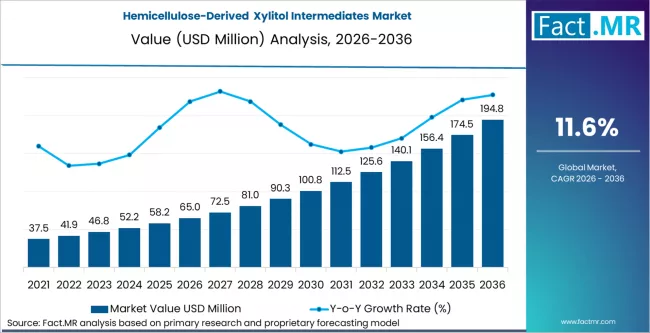
Hemicellulose Derived Xylitol Intermediates Market Market Value Analysis | Source: Fact.MR
Hemicellulose Derived Xylitol Intermediates Market Definition
The hemicellulose derived xylitol intermediates market covers chemical intermediates produced from hemicellulose rich biomass through hydrolysis and hydrogenation processes that yield xylitol and xylitol based derivatives. These intermediates are used as inputs in food ingredients, pharmaceuticals, oral care products, and chemical formulations. Hemicellulose sourced from agricultural residues and wood processing streams serves as the primary raw material. Chemical handling, food grade use, and industrial safety requirements are governed under frameworks administered by the US Food and Drug Administration and chemical substance oversight programs managed by the US Environmental Protection Agency.[1]
Hemicellulose Derived Xylitol Intermediates Market Inclusions
The report covers global and regional market size estimates in volume and value terms with a forecast period from 2026 to 2036. Segmentation includes intermediate type, production route from hemicellulose hydrolysates, application across food ingredients, pharmaceuticals, and specialty chemicals, and end use industries including food processing and healthcare. The scope also includes regional demand patterns, pricing benchmarks, and international trade flows for bio based chemical intermediates.
Hemicellulose Derived Xylitol Intermediates Market Exclusions
The scope excludes finished consumer products such as chewing gum, confectionery, pharmaceuticals, and oral care items containing xylitol as an ingredient. Synthetic xylitol produced entirely from petrochemical routes is not included. Raw biomass feedstocks, enzymes, catalysts, and processing equipment are excluded. Laboratory scale research production, pilot trials without commercial output, fermentation services, and downstream formulation services are also outside the scope.
Hemicellulose Derived Xylitol Intermediates Market Research Methodology
- Primary Research: Primary research involved interviews with biomass processors, xylitol intermediate manufacturers, chemical engineers, and procurement managers across food and pharmaceutical supply chains.
- Desk Research: Desk research used food additive regulations and safety evaluations published by the US Food and Drug Administration and chemical substance documentation issued by the US Environmental Protection Agency, along with company annual reports and regulatory filings.
- Market Sizing and Forecasting: Market sizing applied a hybrid top down and bottom up model using reported biomass processing capacities, conversion yields for hemicellulose derived sugars, and intermediate consumption rates by application.
- Data Validation and Update Cycle: Outputs were cross checked against regulatory registrations, trade statistics, company disclosures, and publicly available chemical production data, with updates applied when verified public sources issue revisions.
Summary of hemicellulose-derived xylitol intermediates market
-
Market definition
- The hemicellulose-derived xylitol intermediates market covers production and commercial supply of polyol intermediates obtained from hemicellulose-rich biomass through hydrolysis and hydrogenation for use in food, pharmaceutical, and specialty chemical value chains.
-
Demand drivers
- Rising sugar-reduction formulations in confectionery and beverages are increasing procurement of food-grade xylitol intermediates derived from non-corn lignocellulosic feedstocks.
- Pharmaceutical and oral care manufacturers are qualifying hemicellulose-derived intermediates as excipient inputs where traceability and purity standards are required.
- Chemical reporting and compliance obligations under frameworks such as the U.S. EPA TSCA inventory influence scale-up and distribution planning.
-
Key segments analyzed
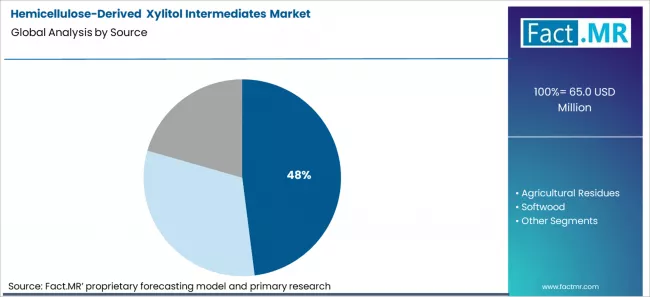
- Source: Hardwood accounts for about 48% share due to consistent xylan content and compatibility with pulp and biorefinery infrastructure.
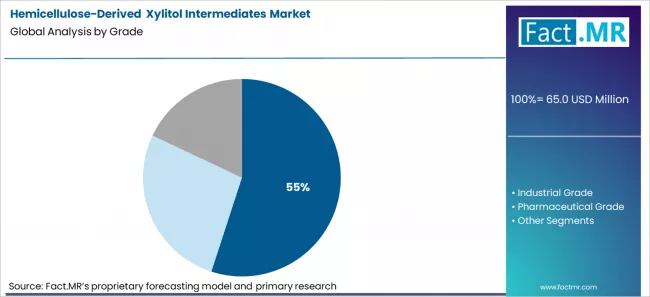
- Grade: Food grade leads with nearly 55% share, reflecting defined purity thresholds and regulatory alignment for ingredient manufacturing.
- Geography: China, Finland, the United States, and Brazil show higher growth linked to biomass availability, integrated biorefinery capacity, and downstream ingredient demand.
-
Analyst opinion at Fact.MR
- Shambhu Nath Jha, Principal Consultant at Fact.MR, opines, ‘CXOs will find this report useful for understanding how feedstock access, conversion efficiency, and grade qualification pathways are shaping scale economics in hemicellulose-derived xylitol intermediates.’
-
Strategic implications / executive takeaways
- Secure long-term hardwood and agricultural residue supply agreements to stabilize raw material cost and quality.
- Prioritize food-grade and pharmaceutical-grade purification capability to capture higher-margin segments.
- Align commercialization with food additive and ingredient regulatory pathways. [2]
-
Methodology
- Market sizing based on biomass processing capacity, xylose recovery yields, and intermediate consumption by application.
- Validation through regulatory registrations, trade statistics, and producer disclosures.
- Forecasts developed using reproducible top-down and bottom-up models grounded in verified biochemical processing benchmarks.
Segmental Analysis
Hemicellulose-Derived Xylitol Intermediates Market Analysis by Source
Hemicellulose Derived Xylitol Intermediates Market Analysis By Source | Source: Fact.MR
Based on Fact.MR analysis, consumption of hardwood-derived hemicellulose feedstock is estimated to hold 48% share of the global xylitol intermediates market. Fact.MR analysts note that hardwood leads due to higher and more consistent xylan content, which supports predictable hydrolysis and hydrogenation yields. As per Fact.MR, hardwood sources address processor requirements for stable raw material supply, uniform composition, and compatibility with existing pulping and biorefinery infrastructure used in large-scale sugar alcohol intermediate production facilities worldwide today.
- Forestry oversight: Hardwood sourcing and utilization are governed by national forest management and biomass utilization frameworks.[3]
- Process efficiency: Fact.MR analysts note hardwood hemicellulose streams provide consistent xylose recovery.
- Supply stability: Established hardwood supply chains support continuous industrial processing.
Hemicellulose-Derived Xylitol Intermediates Market Analysis by Grade
Hemicellulose Derived Xylitol Intermediates Market Analysis By Grade | Source: Fact.MR
Based on Fact.MR analysis, consumption of food grade hemicellulose-derived xylitol intermediates is estimated to hold 55% share of the global market. Fact.MR opines that this grade leads due to demand from sweetener, food formulation, and oral care applications requiring defined purity thresholds. As per Fact.MR, food grade material addresses manufacturer requirements for regulatory compliance, traceability, and suitability for direct or further refined use in consumable products, supporting large-volume production aligned with food processing and ingredient manufacturing standards globally today.
- Food regulation: Production of food grade sugar alcohol intermediates is subject to food safety and additive regulations.[4]
- End-use focus: Fact.MR analysts note food grade output serves sweetener and formulation markets.
- Quality control: Food grade production requires tighter impurity and residue limits.
Hemicellulose-Derived Xylitol Intermediates Market Drivers, Restraints, And Opportunities
Fact.MR analysis indicates that the hemicellulose-derived xylitol intermediates market exists as a specialty bio-based chemical segment with applications in sweeteners, pharmaceutical excipients, and oral care formulations. As per Fact.MR assessment, xylitol produced from hemicellulose streams is positioned against sugar alcohols derived from starch or hydrogenation of xylose; industrial production and distribution are influenced by chemical registration requirements such as inclusion in the U.S. Environmental Protection Agency’s Toxic Substances Control Act (TSCA) inventory, which governs reporting, use, and compliance obligations for chemicals manufactured or imported into the United States. Fact.MR analysts observe that the current market scale is tied to production economics of biomass feedstocks, processing pathway efficiency, and acceptance among food and pharmaceutical manufacturers that require documented purity and performance characteristics.
Fact.MR is of the opinion that current market dynamics reflect a transition from conventional sugar alcohol sources toward renewable hemicellulose streams where commercial processing yields and feedstock availability align. Based on Fact.MR assessment, traditional xylitol supply derived from chemical hydrogenation of isolated xylose continues to dominate volume because of established infrastructure and cost structures, while hemicellulose-derived xylitol grows in applications where sustainability criteria and traceability matter to buyers. Hemicellulose-derived intermediates typically carry higher per-unit pricing because of processing complexity and downstream purification requirements, which can support realised market value growth even where shipment volumes grow at a measured pace. Fact.MR analysis suggests that this balance between moderate volume uptake and premium unit economics defines near-term market behaviour.
- Chemical regulatory compliance: Fact.MR analysts note that inclusion in frameworks such as the U.S. EPA TSCA inventory influences how manufacturers list, report, and manage hemicellulose-derived xylitol intermediates in regulated markets, shaping commercial planning and data obligations.
- Bio-based processing trends: Based on Fact.MR assessment, increasing interest in renewable feedstock processing supports adoption of hemicellulose-derived xylitol intermediates where sustainability attributes and value chain traceability are specified.
- EU chemical framework impacts: Fact.MR opines that compliance with chemical control frameworks such as the European Union REACH regulation influences registration, safety data, and importer obligations for hemicellulose-derived xylitol intermediates in European markets.
Regional Analysis
Based on regional assessment, the hemicellulose derived xylitol intermediates sector is analyzed across North America, Europe, East Asia, Latin America, and other major bio-based chemical markets, spanning more than 40 countries. Regional performance varies according to availability of lignocellulosic feedstock, investment in biorefinery infrastructure, and demand from sweeteners, pharmaceuticals, and specialty chemical applications. The analysis also presents a comparative market attractiveness evaluation grounded in region-specific demand trends.
Hemicellulose Derived Xylitol Intermediates Market CAGR Analysis by Country (2026-2036)
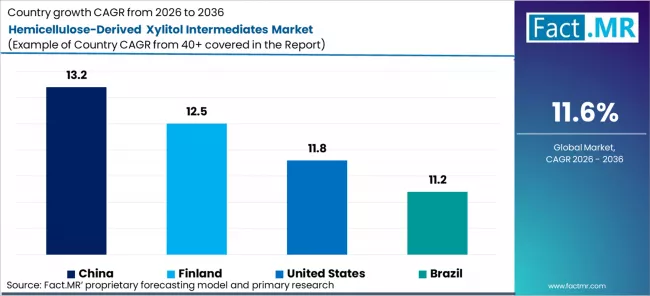
Hemicellulose Derived Xylitol Intermediates Market Cagr Analysis By Country | Source: Fact.MR
| Country | CAGR |
|---|---|
| China | 13.2% |
| Finland | 12.5% |
| United States | 11.8% |
| Brazil | 11.2% |
Source: Fact.MR analysis. Updated Feb 23, 2026
Source: Fact.MR analysis, based on proprietary forecasting models and primary research.
Asia Pacific Hemicellulose-Derived Xylitol Intermediates Market Analysis
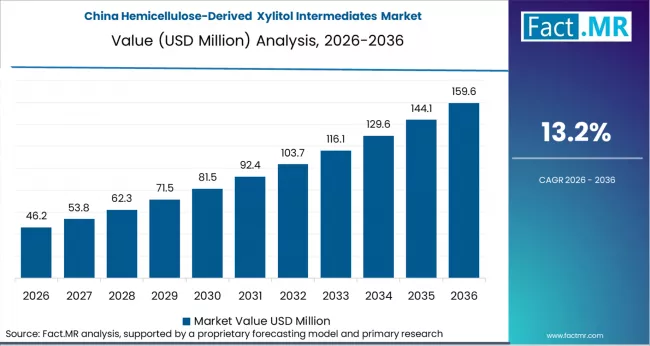
Hemicellulose Derived Xylitol Intermediates Market Country Value Analysis | Source: Fact.MR
Asia Pacific operates as a biomass valorization driven region for hemicellulose derived xylitol intermediates supported by agricultural residue availability and biochemical processing capacity. Market activity centers on pretreatment hydrolysis and fermentation integration within sugar alcohol value chains. Adoption is concentrated in China where producers link pulp residues and corn cobs to downstream sweetener and polyol production. Growth reflects pilot scaling supply agreements and alignment with domestic bioeconomy programs across industrial biotechnology clusters supporting regional feedstock utilization and process economics improvements.
- China: Demand for hemicellulose derived xylitol intermediates in China is projected to rise at 13.2% CAGR through 2036. Activity links pulp residues and corn cobs to biochemical conversion lines supplying sweetener and polyol producers, as per Fact.MR.
Fact.MR’s analysis of the Hemicellulose-Derived Xylitol Intermediates Market in Asia Pacific consists of country-wise assessment that includes China. Readers can find feedstock sourcing patterns, pilot scaling activity, and biochemical processing references.
Europe Hemicellulose-Derived Xylitol Intermediates Market Analysis
Europe functions as a pulp and biorefinery aligned region for hemicellulose derived xylitol intermediates shaped by forestry resources and established chemical processing. Activity emphasizes extraction purification and conversion of hemicellulose streams from pulp mills. Adoption is centered in Nordic countries with Finland prominent through integrated biorefinery operations. Growth reflects long term supply contracts process optimization investments and compliance with regional bioeconomy strategies within mature specialty chemical manufacturing networks across Northern European industrial clusters and export oriented value chains today regionwide.
- Finland: Demand for hemicellulose derived xylitol intermediates in Finland is projected to rise at 12.5% CAGR through 2036. Production leverages integrated pulp mill streams and biorefinery processing supplying specialty ingredient markets, according to Fact.MR.
Fact.MR’s analysis of the Hemicellulose-Derived Xylitol Intermediates Market in Europe consists of country-wise assessment that includes Finland. Readers can find biorefinery integration models and specialty ingredient supply references.
North America Hemicellulose-Derived Xylitol Intermediates Market Analysis
North America operates as a commercialization oriented region for hemicellulose derived xylitol intermediates supported by biochemical technology development and diversified feedstocks. Market activity focuses on pilot to commercial transitions integration with sweetener and pharmaceutical intermediates and supply to specialty applications. Adoption is concentrated in the United States where producers emphasize process yields regulatory compliance and customer qualification. Growth reflects private investment partnerships and scaling pathways within established chemical and food ingredient manufacturing ecosystems across national value chains and contract production.
- United States: Demand for hemicellulose derived xylitol intermediates in the United States is projected to rise at 11.8% CAGR through 2036. Adoption reflects pilot to early commercial operations supplying pharmaceutical and specialty food applications, as per Fact.MR.
Fact.MR’s analysis of the Hemicellulose-Derived Xylitol Intermediates Market in North America consists of country-wise assessment that includes the United States. Readers can find commercialization pathways, customer qualification practices, and application-level demand insights.
Latin America Hemicellulose-Derived Xylitol Intermediates Market Analysis
Latin America functions as an emerging biomass processing region for hemicellulose derived xylitol intermediates influenced by agricultural residues and pulp capacity. Market activity centers on feasibility projects technology transfer and integration with sugar and ethanol infrastructure. Adoption is led by Brazil where producers link bagasse and forestry byproducts to biochemical pathways. Growth reflects incremental capacity additions policy support and partnerships enabling pilot scaling within regional industrial biotechnology initiatives supporting feedstock utilization process learning and export oriented specialty ingredient development regionwide.
- Brazil: Demand for hemicellulose derived xylitol intermediates in Brazil is projected to rise at 11.2% CAGR through 2036. Activity connects bagasse and forestry residues to biochemical pathways supporting pilot scale production, according to Fact.MR.
Fact.MR’s analysis of the Hemicellulose-Derived Xylitol Intermediates Market in Latin America consists of country-wise assessment that includes Brazil. Readers can find feedstock integration approaches, pilot development trends, and biochemical processing references.
Competitive Landscape of Hemicellulose-Derived Xylitol Intermediates Market
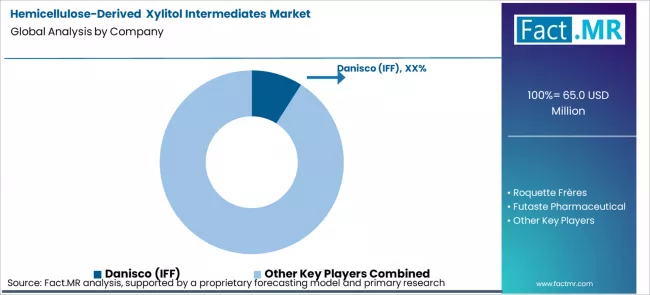
Hemicellulose Derived Xylitol Intermediates Market Analysis By Company | Source: Fact.MR
As per Fact.MR analysis, the 2026 hemicellulose-derived xylitol intermediates market is defined by validated production efficiency, feedstock versatility, and regulatory compliance, which determine competitive advantage. Danisco (IFF) and Roquette Frères lead with large-scale fermentation and catalytic hydrogenation technologies, which strengthen adoption in food, pharmaceutical, and oral care applications. Futaste Pharmaceutical and Huakang Pharma focus on high-purity intermediates with documented consistency and yield, which improves reliability for downstream xylitol production. Shandong Longlive Bio emphasizes validated multi-feedstock conversion and cost-effective processing, which enables scalable production across regional markets. Other smaller players provide specialty intermediates with verified chemical and microbiological quality, which addresses niche applications in functional foods and pharmaceuticals. Across the market, validated production performance, feedstock flexibility, and adherence to multi-region regulatory standards create enduring competitive moats, reducing reliance on pricing or isolated process claims while supporting long-term industrial adoption.
Recent Industry Developments
- Fazer - Circular Xylitol From Oat-Hull Side Streams (Finland): Fazer’s Annual Review (FY2024, published March 10, 2025) discusses its xylitol operations in Lahti and the company’s work on upcycling side streams, including oat hulls, into higher-value food ingredients supporting the “oat-based circular xylitol” positioning (but the document does not explicitly claim “full operational capacity” in 2025-26). [5]
- Roquette - Completion Of Iff Pharma Solutions Acquisition (Polyols/Excipients Expansion): Roquette’s official press release confirms it completed the acquisition of IFF Pharma Solutions on May 1, 2025, expanding Roquette’s portfolio and positioning in pharma excipients and drug-delivery solutions relevant for higher-purity polyol/intermediate capabilities and downstream excipient demand alignment. [6]
Key Players in Hemicellulose-Derived Xylitol Intermediates Market
- Danisco (IFF)
- Roquette Frères
- Futaste Pharmaceutical
- Huakang Pharma
- Shandong Longlive Bio
- Others
Bibliography
- [1] U.S. Food and Drug Administration. (2024). Food additive petitions and ingredient approval framework. U.S. Department of Health and Human Services.
- [2] U.S. Food and Drug Administration. (2024). Food additives and ingredients: Regulatory requirements. U.S. Department of Health and Human Services.
- [3] U.S. Department of Agriculture, Forest Service. (2024). Forest products and biomass utilization. U.S. Department of Agriculture.
- [4] U.S. Food and Drug Administration. (2024). Food additives and ingredients: Safety and compliance. U.S. Department of Health and Human Services.
- [5] U.S. Environmental Protection Agency. (2024). Toxic Substances Control Act (TSCA) inventory. U.S. Environmental Protection Agency.
- [6] Roquette Frères. (2025). Roquette completes acquisition of IFF Pharma Solutions [Press release]. Roquette.
Segmentation
Scope of the Report
| Metric | Value |
|---|---|
| Quantitative Units | USD 65 million (2026) to USD 195 million (2036), CAGR 11.6% |
| Market Definition | The hemicellulose-derived xylitol intermediates market covers production and sale of chemical intermediates produced from hemicellulose-rich biomass through hydrolysis and hydrogenation processes. These intermediates are used in food ingredients, pharmaceuticals, oral care products, and specialty chemicals. Feedstocks include hardwood, softwood, and agricultural residues. Regulatory oversight is governed by the US FDA and US EPA. |
| Source Segmentation | Hardwood, Agricultural Residues, Softwood |
| Grade Segmentation | Food Grade, Industrial Grade, Pharmaceutical Grade |
| Application Segmentation | Food & Beverage, Pharmaceuticals, Personal Care, Others |
| Regions Covered | Asia Pacific, Europe, North America, Latin America, Middle East & Africa |
| Countries Covered | India, China, Japan, South Korea, Indonesia, Australia & New Zealand, ASEAN, Rest of Asia Pacific, Germany, Italy, France, United Kingdom, Spain, Benelux, Nordics, Central & Eastern Europe, Rest of Europe, United States, Canada, Mexico, Brazil, Argentina, Chile, Rest of Latin America, Kingdom of Saudi Arabia, United Arab Emirates, South Africa, Turkey, Rest of Middle East & Africa |
| Key Companies Profiled | Danisco (IFF), Roquette Frères, Futaste Pharmaceutical, Huakang Pharma, Shandong Longlive Bio, Others |
| Forecast Period | 2026 to 2036 |
| Approach | Hybrid top-down and bottom-up modeling validated through interviews with biomass processors, xylitol intermediate manufacturers, chemical engineers, and procurement managers. Market sizing based on biomass availability, feedstock conversion efficiency, production yield, and downstream application demand. |
Source: Fact.MR analysis. Updated Feb 23, 2026
Hemicellulose-Derived Xylitol Intermediates Market Analysis by Segments
-
By Source :
- Hardwood
- Agricultural Residues
- Softwood
-
By Grade :
- Food Grade
- Industrial Grade
- Pharmaceutical Grade
-
By Application :
- Food & Beverage
- Pharmaceuticals
- Personal Care
- Others
-
Region :
- Asia Pacific
- India
- China
- Japan
- South Korea
- Indonesia
- Australia & New Zealand
- ASEAN
- Rest of Asia Pacific
- Europe
- Germany
- Italy
- France
- United Kingdom
- Spain
- Benelux
- Nordics
- Central & Eastern Europe
- Rest of Europe
- North America
- United States
- Canada
- Mexico
- Latin America
- Brazil
- Argentina
- Chile
- Rest of Latin America
- Middle East & Africa
- Kingdom of Saudi Arabia
- United Arab Emirates
- South Africa
- Turkey
- Rest of Middle East & Africa
- Asia Pacific
Frequently Asked Questions
How large is the hemicellulose-derived xylitol intermediates market in 2026?
What will the global market size be by 2036?
What is the expected CAGR for this market during 2026–2036?
How much absolute value is the market expected to add over the forecast window?
What factors are primarily driving market growth?
Which source segment accounts for the largest share of supply?
Why does hardwood dominate hemicellulose sourcing?
Which grade leads demand in the hemicellulose-derived xylitol intermediates market?
What explains the dominance of food-grade xylitol intermediates?
Which application segment is driving early-period market growth?
How important is pharmaceutical-grade material to mid-period expansion?
Which country is expected to grow the fastest globally?
What supports strong market growth in China?
How does Finland compare in terms of growth outlook?
What is the growth rate expected for the United States?
How significant is Brazil in the global growth landscape?
What role do industrial-grade intermediates play in later-stage growth?
How does feedstock availability influence market scalability?
Why does this market show sustained compounding rather than short-term volatility?
What are the key priorities for companies entering this market?
Who worked on this report


Preview the report firsthand - request a free sample
Free SampleGet the brochure for pricing and purchase details
Download PDF