- Market Value (2025): USD 4.6 Bn
- Estimated Value (2026): USD 4.9 Bn
- Forecast Value (2036): USD 8.5 Bn
- CAGR (2026-2036): 5.7%
What is the Humus Concentrate Market forecast to be worth by 2036?
USD 8.5 billion by 2036 at a 5.7% CAGR.
- The Humus Concentrate Market was valued at approximately USD 4.6 billion in 2025.
- Demand is projected to increase from USD 4.9 billion in 2026 to USD 8.5 billion by 2036.
- The market is forecast to expand at a 5.7% CAGR from 2026 to 2036.
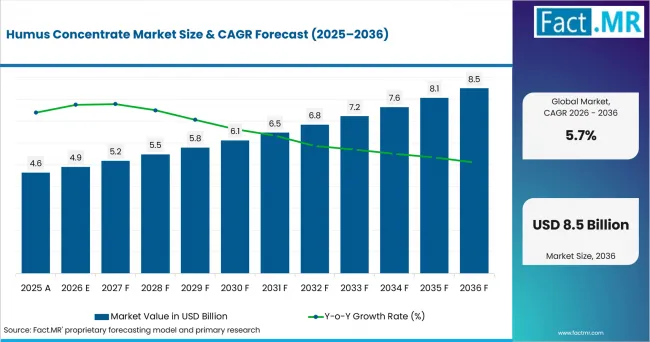
Humus Concentrate Market Value Analysis | Source: Fact.MR
What are the defining numbers behind Humus Concentrate Market growth?
An absolute opportunity of USD 3.6 billion is expected between 2026 and 2036.
- Demand Drivers in the Market
- Soil organic-matter management supports demand for concentrated soil conditioners. USDA NRCS identifies organic matter as a contributor to nutrient retention, soil structure and water-holding capacity. Concentrated humic products give growers a measured input that can be added to soil-treatment or irrigation programs when soil condition is limiting root-zone performance.
- European soil policy is increasing attention to organic carbon and soil health. The EU Soil Monitoring Law, in force since December 2025, covers loss of soil organic matter and requires member states to monitor soil health. This increases the value of products that provide clear composition, application rates and soil-function claims.
- Plant-biostimulant regulation gives suppliers a defined commercial framework for documented agronomic functions. Regulation (EU) 2019/1009 recognizes nutrient-use efficiency, tolerance to abiotic stress and nutrient availability among plant-biostimulant functions. Humic products sold within this framework need claims that match demonstrated effects.
- Horticulture creates a practical repeat-purchase route because fruit, vegetable and floriculture systems use frequent irrigation and nutrient applications. Powders can be dissolved for fertigation, while liquids can be introduced directly into irrigation-linked programs. This allows growers to test a product on a defined crop block before extending use.
- Application flexibility broadens demand across managed soils. Powder can be dry blended, granules can be broadcast and liquids can be applied through irrigation or soil drench. The same humic-substance category can therefore serve horticulture, landscaping and selected remediation projects without relying on one delivery format.
- Key Segments Analyzed
- Powder accounts for 33.9% of Product in 2026 because it is practical for storage, dry blending and measured field application.
- Soil Structuring represents 27.1% of Function in 2026 as humic substances are used to support aggregation and moisture behavior in cultivated soils.
- Horticulture accounts for 46.8% of End Use in 2026 because high-value crop systems can justify repeated soil-conditioning inputs and precise application programs.
- Analyst Opinion at Fact.MR
- Shambhu Nath Jha, Principal Consultant at Fact.MR, states, “Humus concentrate demand will depend on measurable soil response and product consistency. Horticultural growers need clear information on humic content, solubility and application rate before they repeat a purchase.”
- Strategic Implications
- Powder suppliers should publish consistent assay and solubility information so distributors can match products with dry-blend and soil-application programs.
- Horticulture-focused suppliers should support field validation by crop and soil condition. Repeat purchasing depends on whether the product fits the grower’s irrigation and nutrient program.
- Drought-related positioning should be tied to root-zone water behavior and application guidance instead of broad yield claims.
- Products sold as biostimulants in regulated markets should align composition and stated functions with the applicable product classification and label requirements.
How does the Humus Concentrate Market break down by segment?
The market is segmented by Product, Function and End Use.
Why does Powder lead Product?
Powder is projected to account for a 33.9% share of Product in 2026.
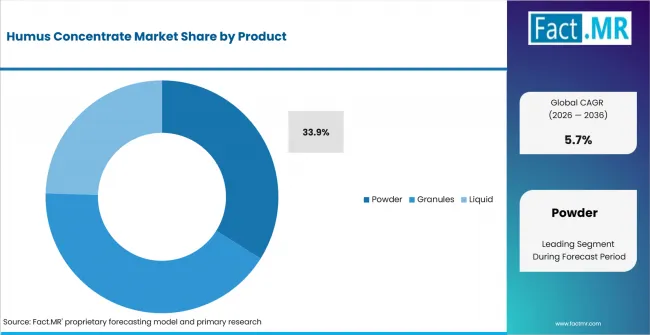
Humus Concentrate Market Analysis By Product | Source: Fact.MR
Powder leads because concentrated dry material is easier to store and transport than water-heavy formulations. It can be dosed into soil blends or dissolved for application, giving distributors and growers flexibility across field and horticultural settings.
Humusolver supplies a soluble humic and fulvic acid concentrate powder that can be mixed into water, while Humintech markets water-soluble humic products for agricultural use. Granules remain useful for broadcast application, while liquids fit fertigation and soil-drench programs.
Why does Soil Structuring lead Function?
Soil Structuring is projected to account for a 27.1% share of Function in 2026.
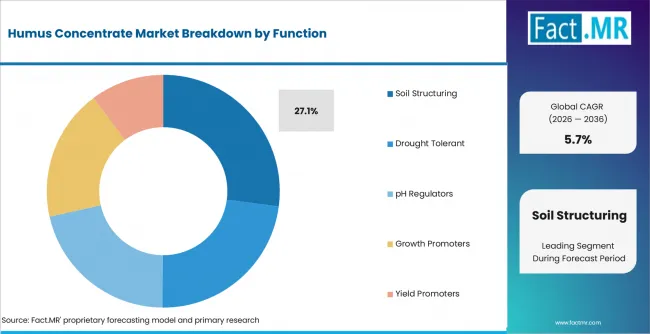
Humus Concentrate Market Analysis By Function | Source: Fact.MR
Soil Structuring leads because root-zone physical condition affects infiltration and aeration before any crop-response claim is considered. Germany’s Federal Environment Agency identifies humus as important to soil structure and as a storage and buffering medium for water and nutrients.
This gives growers a direct reason to use concentrated humic material where weak aggregation or low water-holding capacity is affecting management. Drought Tolerant, pH Regulators, Growth Promoters and Yield Promoters address narrower agronomic objectives and depend more heavily on crop response and product-specific evidence.
Why does Horticulture lead End Use?
Horticulture is projected to account for a 46.8% share of End Use in 2026.
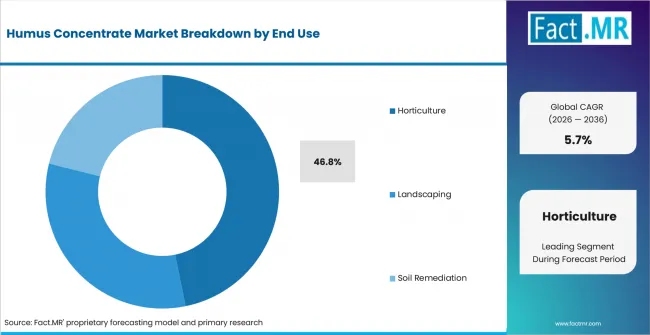
Humus Concentrate Market Analysis By End Use | Source: Fact.MR
Horticulture leads because fruit, vegetable and floriculture systems commonly use intensive irrigation and repeated nutrient applications. Growers can add small measured doses of humic products to soil-treatment or fertigation programs, making product performance easier to trial across defined crop areas.
Humintech identifies horticulture and greenhouse production among the applications for its humic products, with granular, powder and liquid options. Landscaping and Soil Remediation create separate use cases, but purchasing can be more project-specific than routine horticultural application.
What is accelerating Humus Concentrate Market adoption, and what is holding it back?
Adoption is supported by soil organic-matter management, organic and horticultural production, and clearer biostimulant frameworks. Product inconsistency, claim compliance and substitution by lower-cost organic amendments can constrain demand.
Drivers Impact Analysis
| Factor | (~) % Impact on CAGR | Geographic Relevance | Impact Timeline |
|---|---|---|---|
| Soil organic matter restoration demand | +1.4% | Global | Short term (≤ 2 years) |
| Organic farming and soil-health programs | +1.1% | USA; Germany; U.K. | Short term (≤ 2 years) |
| Horticulture use of concentrated soil conditioners | +0.9% | Global | Medium term (2–4 years) |
| Standardized humic-content claims and application guidance | +0.7% | USA; U.K.; Germany | Medium term (2–4 years) |
| Compatibility with blended fertilizer and irrigation programs | +0.5% | Global | Long term (≥ 4 years) |
Opportunity Impact Analysis
| Factor | (~) % Impact on CAGR | Geographic Relevance | Impact Timeline |
|---|---|---|---|
| Water-conservation applications in drought-prone cultivation | +0.8% | Global | Medium term (2–4 years) |
| Crop-specific humic and fulvic formulations | +0.7% | USA; U.K.; Germany | Medium term (2–4 years) |
| Landscaping and soil-remediation channel expansion | +0.5% | Global | Long term (≥ 4 years) |
| Soil-health and biostimulant regulatory alignment | +0.4% | Europe; USA; Japan | Long term (≥ 4 years) |
Restraints Impact Analysis
| Factor | (~) % Impact on CAGR | Geographic Relevance | Impact Timeline |
|---|---|---|---|
| Variation in humic content and source material | -0.9% | Global | Short term (≤ 2 years) |
| Product classification and claim compliance | -0.7% | USA; U.K.; Germany | Short term (≤ 2 years) |
| Substitution by compost and lower-cost organic amendments | -0.6% | Price-sensitive markets | Medium term (2–4 years) |
| Bulk transport and raw-material consistency | -0.4% | Global | Long term (≥ 4 years) |
Which countries are scaling the Humus Concentrate Market through 2036?
- USA: USDA NRCS identifies soil organic matter as a direct influence on nutrient retention, soil structure and water-holding capacity. This gives growers a measurable soil-management reason to evaluate concentrated humic inputs where root-zone condition limits water or nutrient efficiency.
- U.K.: The Sustainable Farming Incentive 2026 includes paid organic-management actions for horticultural land with an explicit soil-health objective. This supports a professional horticulture channel where soil conditioners can be evaluated within certified organic management plans.
- France: France had 2.7 million hectares under organic production in 2024, equal to about 10% of agricultural area. This established organic farming base broadens the potential customer pool for soil conditioners used in horticulture and other managed-crop systems.
- Germany: The Federal Environment Agency identifies humus as important to soil structure and water or nutrient storage, while German soil-protection principles require maintenance of site-typical humus content. This supports demand for products sold around measurable soil-structuring functions.
- Italy: Italian organic agricultural area exceeded 2.5 million hectares in 2024 and represented about one-fifth of national agricultural area. The scale of certified organic production supports demand for compatible soil inputs across horticulture, orchards and other intensive crops.
- South Korea: Public agricultural research is developing regenerative organic soil-management methods that include soil carbon and soil-quality assessment. This strengthens the technical basis for using documented soil-conditioning inputs within broader soil-management programs.
- Japan: The MIDORI strategy targets a 30% reduction in chemical fertilizer use and expansion of organic farming. Soil-building guidance also emphasizes diagnosis-based use of soil-improvement materials, creating a clearer role for concentrated humic products with defined application instructions.
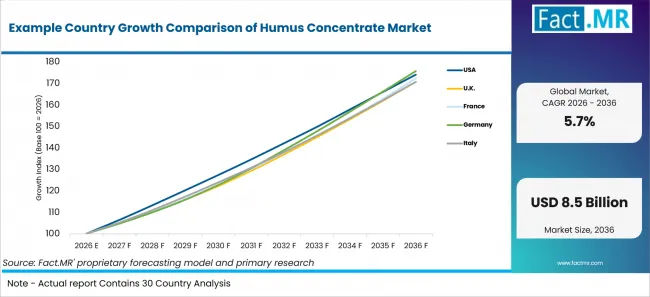
Example Country Growth Comparison Of Humus Concentrate Market | Source: Fact.MR
Country CAGR (2026-2036)
| Country | CAGR |
|---|---|
| USA | 5.7% |
| U.K. | 5.5% |
| France | 5.6% |
| Germany | 5.8% |
| Italy | 5.5% |
| South Korea | 5.9% |
| Japan | 5.7% |
What is driving USA’s growth through 2036?
The USA is forecast to expand at a 5.7% CAGR from 2026 to 2036.
USDA NRCS treats soil organic matter as a core soil-health variable because it affects structure, nutrient retention and water-holding capacity. That creates a direct management trigger for products positioned around root-zone condition rather than general crop enhancement.
USDA’s 2025 Organic Situation Report also documents a developed organic market and continued federal attention to organic transition. Horticulture and landscaping provide practical channels for concentrated products where users can apply measured doses and monitor response over repeated cycles.
What is driving U.K.’s growth through 2036?
The U.K. is forecast to expand at a 5.5% CAGR from 2026 to 2036.
England’s Sustainable Farming Incentive 2026 includes an organic-land-management action for horticultural land that pays participating farms to maintain organic management and explicitly aims to improve soil health. This keeps soil condition tied to farm-management decisions in a commercially important end-use segment.
Soil assessment and organic-matter testing remain part of the wider SFI soil-management framework. Growers that identify weak structure or low organic matter can compare concentrated soil conditioners against a defined soil-management plan rather than purchasing on an undifferentiated soil-health claim.
What is driving France’s growth through 2036?
France is forecast to expand at a 5.6% CAGR from 2026 to 2036.
French agriculture had 2.7 million hectares under organic production in 2024, representing about 10% of agricultural area, with more than 61,000 farms engaged in organic production. This creates a sizeable user base for compatible soil inputs where growers need documented formulations and repeatable application.
Horticulture provides the more direct route for humus concentrate because fruit and vegetable growers can integrate soil conditioners with irrigation or nutrient programs. Products with clear concentration and dosing information are easier to incorporate into repeated crop cycles.
What is driving Germany’s growth through 2036?
Germany is forecast to expand at a 5.8% CAGR from 2026 to 2036.
Germany’s Federal Environment Agency identifies humus as important to soil structure and biological function, while also describing its role in water and nutrient storage. German soil-protection principles require maintenance of the site-typical humus content of agricultural soils.
These conditions support soil-structuring products with measurable humic content. Horticulture, turf and managed-soil applications can use concentrated products where operators want predictable dosing without transporting large volumes of bulk organic matter.
What is driving Italy’s growth through 2036?
Italy is forecast to expand at a 5.5% CAGR from 2026 to 2036.
Italian organic agricultural area exceeded 2.5 million hectares in 2024 and represented about 20% of national agricultural area. This broad certified production base supports demand for compatible soil inputs across crop systems where soil fertility and structure are managed over repeated production cycles.
Humus concentrate fits orchard and horticultural programs where soil conditioners can be applied in measured doses. Dry and liquid forms give distributors options for open-field application as well as irrigation-linked use.
What is driving South Korea’s growth through 2036?
South Korea is forecast to expand at a 5.9% CAGR from 2026 to 2036.
The National Institute of Agricultural Sciences is developing regenerative organic soil-management technologies that include soil-carbon work and soil-quality assessment. This research direction raises the value of products that can be evaluated against measurable soil indicators.
Humus concentrate can therefore be positioned as one input within a soil-management program instead of as a stand-alone yield additive. Suppliers that document concentration and application response are better suited to technically managed horticultural programs.
What is driving Japan’s growth through 2036?
Japan is forecast to expand at a 5.7% CAGR from 2026 to 2036.
Japan’s MIDORI strategy targets a 30% reduction in chemical fertilizer use and a long-term expansion of organic farming. MAFF soil-building guidance also emphasizes physical, chemical and biological soil improvement based on diagnosis.
Humus concentrate can fit this direction where growers need a concentrated soil-improvement material that can be applied with existing nutrient programs. Demand is likely to favor products with clear labeling and technical guidance for horticultural or specialty-crop use.
Who Leads the Humus Concentrate Market?
Humintech, Novihum, Humusolver, Fertrell, Ohio Earth Food, Sustainable Farming, Plasmabiotec, Organic Approach, Nature’s Force Organics, AgriEnergy Resources and King Humus Plus are among the companies operating in the Humus Concentrate Market.
Humintech competes through a dedicated humic-substance portfolio that includes granular, powder and liquid soil conditioners and biostimulants. Its agricultural application material covers horticulture and greenhouse production, giving the company products that map across the Product and End Use categories in this report.
Humusolver offers soluble powder and granular humic or fulvic concentrates. Fertrell and Ohio Earth Food participate through concentrated liquid humus or humate products, while other suppliers compete through organic-input distribution and soil-conditioning formulations.
Competition depends on source consistency, stated humic concentration and application fit. Buyers compare cost per treated area, solubility and compatibility with irrigation or fertilizer programs. Products with clear assay and dosing information have a stronger procurement case than products described only through broad soil-health claims.
Which companies are the key providers?
Key companies profiled include Humintech; Novihum; Humusolver; Fertrell; Ohio Earth Food; Sustainable Farming; Plasmabiotec; Organic Approach; Nature’s Force Organics; AgriEnergy Resources; and King Humus Plus.
- Humintech
- Novihum
- Humusolver
- Fertrell
- Ohio Earth Food
- Sustainable Farming
- Plasmabiotec
- Organic Approach
- Nature’s Force Organics
- AgriEnergy Resources
- King Humus Plus
Bibliography
- Food and Agriculture Organization of the United Nations. (2005). The Importance of Soil Organic Matter: Key to Drought-resistant Soil and Sustained Food Production. FAO.
- European Commission. (2026). Soil Monitoring Law. Directorate-General for Environment.
- European Union. (2019). Regulation (EU) 2019/1009 Laying Down Rules on the Making Available on the Market of EU Fertilising Products. Official Journal of the European Union.
- U.S. Department of Agriculture, Natural Resources Conservation Service. (2026). Role of Organic Matter. USDA.
- U.S. Department of Agriculture, Economic Research Service. (2025). Organic Situation Report, 2025 Edition. USDA.
- Department for Environment, Food & Rural Affairs and Rural Payments Agency. (2026). OFM5: Organic Land Management - Horticultural Land. UK Government.
- Rural Payments Agency. (2025). How to Do the SFI Actions for Soils. UK Government.
- Ministry of Agriculture, Food and Food Sovereignty, France. (2026). Organic Agriculture: 2024 Figures. Government of France.
- German Federal Environment Agency. (2024). Humusstatus der Böden. Umweltbundesamt.
- Istituto Nazionale di Statistica. (2026). Innovation and Sustainable Practices in Agriculture, 2024. Istat.
- National Institute of Agricultural Sciences, Republic of Korea. (2026). Department of Agricultural Environment: Regenerative Organic Soil Management. Rural Development Administration.
- Ministry of Agriculture, Forestry and Fisheries, Japan. (2026). Soil Building Related Information. Government of Japan.
- Ministry of Agriculture, Forestry and Fisheries, Japan. (2025). MIDORI Strategy for Sustainable Food Systems. Government of Japan.
- Humintech GmbH. (2026). Humic Substances Based Products and Horticulture Applications. Humintech GmbH.
- Humusolver. (2026). Humic and Fulvic Acid Concentrate Products. Humusolver.
- The Fertrell Company. (2026). Bio-Hume: Concentrated Liquid Humus. The Fertrell Company.
- Ohio Earth Food. (2026). K Humate 26 Concentrated Liquid Humus. Ohio Earth Food.
This Report Answers
- How demand changes across Product, Function and End Use categories.
- Why Powder, Soil Structuring and Horticulture account for the stated 2026 segment shares.
- How soil-health policy and organic-production programs influence purchasing across the listed countries.
- How suppliers compete through composition control, application flexibility and technical support.
- Which applications fall within humus concentrate and which adjacent soil amendments remain outside the market.
What does the Humus Concentrate Market cover?
The Humus Concentrate Market covers concentrated humic-substance products sold in powder, granule or liquid form for the functions and end uses included in the segmentation. Products may contain humic and fulvic fractions derived from mineral or biological sources when they are sold as concentrated soil-conditioning or plant-support inputs within the stated market scope.
The market covers Soil Structuring, Drought Tolerant, pH Regulators, Growth Promoters and Yield Promoters. End-use demand is measured across Horticulture, Landscaping and Soil Remediation.
What is included in the scope?
The scope includes powder humus concentrates, including Mineral Based Powder and Biological Powder. Organic Granules and Mineral Granules are included under Granules, while Humic Liquid and Biostimulant Liquid are included under Liquid.
Functional coverage includes Soil Aggregation and Soil Conditioning. Water Conservation, Stress Resistance, Acidifying Solutions, Alkalinity Management, Root Development, Vegetative Growth, Flowering Enhancement and Productivity Enhancement are included under their defined parent segments.
End-use coverage includes Fruit Cultivation, Vegetable Cultivation and Floriculture within Horticulture. Commercial Landscaping and Residential Landscaping are included under Landscaping. Contaminated Land Restoration and Soil Health Improvement are included under Soil Remediation.
What is excluded from the scope?
The scope excludes bulk compost and raw manure sold without a concentrated humic-product specification. General organic fertilizers are excluded when the product is purchased primarily for nutrient content instead of the humus-concentrate functions defined in this report.
Standalone microbial inoculants and conventional mineral fertilizers are outside the market. Biochar is excluded unless it is formulated and sold as part of a humus concentrate that fits the Product taxonomy. General soil-remediation services are also excluded when no humus concentrate is sold as an input.
How Was the Analysis Built?
The analysis draws on more than 120 sources, over 35 company portfolios and more than 20 industry interviews across at least 25 countries.
- Primary Research: Interviews cover humic-substance producers and agricultural-input distributors, along with horticultural growers. Landscaping contractors and soil-remediation specialists provide input on application-specific purchasing criteria.
- Desk Research: The review covers government soil-health policy, organic-farming statistics and fertilising-product regulation. Agronomic research and company product documentation are used to explain product functions and commercial use.
- Market Sizing and Forecasting: Estimates combine product pricing with application rates and distributor sales. Horticultural demand is assessed separately from landscaping and remediation use, with country growth applied to the supplied market framework.
- Data Validation and Update Cycle: Updates review changes in product classification, organic-farming programs, raw-material availability and humic-product portfolios.
What is the report's scope and coverage?
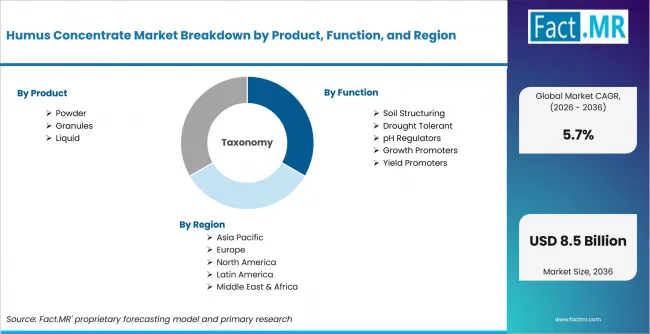
Humus Concentrate Market Breakdown By Product, Function, And Region | Source: Fact.MR
| Attribute | Details |
|---|---|
| Quantitative Units | USD Billion |
| Market Definition | Concentrated humic-substance products sold across the defined Product, Function and End Use categories |
| Segments Covered | Product; Function; End Use |
| Regions Covered | North America; Latin America; Europe; East Asia; South Asia and Pacific; Middle East and Africa |
| Countries Covered | USA; U.K.; France; Germany; Italy; South Korea; Japan |
| Key Companies Profiled | Humintech; Novihum; Humusolver; Fertrell; Ohio Earth Food; Sustainable Farming; Plasmabiotec; Organic Approach; Nature’s Force Organics; AgriEnergy Resources; King Humus Plus |
| Forecast Period | 2026 to 2036 |
| Base Year | 2025 |
| Market Value, 2026 | USD 4.9 billion |
| Market Value, 2036 | USD 8.5 billion |
| CAGR, 2026-2036 | 5.7% |
| Absolute Opportunity | USD 3.6 billion |
| Approach | Hybrid top-down and bottom-up approach using product-form demand, application rates, pricing, end-use adoption and country growth. |
How is the market segmented?
-
By Product
- Powder
- Mineral Based Powder
- Biological Powder
- Granules
- Organic Granules
- Mineral Granules
- Liquid
- Humic Liquid
- Biostimulant Liquid
- Powder
-
By Function
- Soil Structuring
- Soil Aggregation
- Soil Conditioning
- Drought Tolerant
- Water Conservation
- Stress Resistance
- pH Regulators
- Acidifying Solutions
- Alkalinity Management
- Growth Promoters
- Root Development
- Vegetative Growth
- Yield Promoters
- Flowering Enhancement
- Productivity Enhancement
- Soil Structuring
-
By End Use
- Horticulture
- Fruit Cultivation
- Vegetable Cultivation
- Floriculture
- Landscaping
- Commercial Landscaping
- Residential Landscaping
- Soil Remediation
- Contaminated Land Restoration
- Soil Health Improvement
- Horticulture
-
By Region:
- North America
- Latin America
- Western Europe
- Eastern Europe
- East Asia
- South Asia and Pacific
- Middle East & Africa