- Market Value (2025): USD 81.7 Mn
- Estimated Value (2026): USD 84.4 Mn
- Forecast Value (2036): USD 115.9 Mn
- CAGR (2026-2036): 3.3%
What is the Concentrated Liquid Smoke Market forecast to be worth by 2036?
USD 84.4 million in 2026 to USD 115.9 million by 2036, at a 3.3% CAGR.
- The market reached USD 81.7 million in 2025.
- Demand is projected to increase from USD 84.4 million in 2026 to USD 115.9 million by 2036.
- The market is forecast to record a 3.3% CAGR from 2026 to 2036, creating an absolute opportunity of USD 31.5 million.
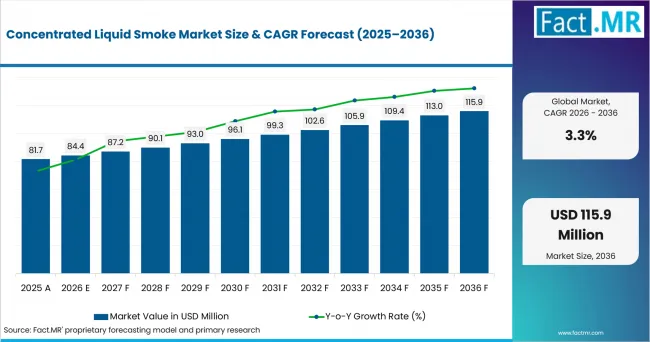
Concentrated Liquid Smoke Market Value Analysis | Source: Fact.MR
What are the defining numbers behind Concentrated Liquid Smoke Market growth?
USD 31.5 million absolute opportunity is expected between 2026 and 2036.
- Demand Drivers in the Market
- Smoked-flavour demand in sauces, marinades, meat products as well as snacks and plant-based foods keeps the category active even when total growth remains moderate.
- Concentrated formats help processors and foodservice buyers dose flavour consistently without installing smoking equipment or extending production time.
- Online sales widen access for small restaurants, home cooks, and specialty-food users that want specific profiles such as hickory as well as mesquite or applewood.
- Regulatory and labelling rules influence formulation choices, especially in markets where smoke flavourings must be declared or authorised.
- Key Segments Analyzed
- By Type: Hickory Liquid Smoke is the leading type, accounting for 65.6% share in 2026.
- By Application: Online Sales leads with 32.2% share in 2026.
- Analyst Opinion at Fact.MR
- Concentrated liquid smoke is bought for control rather than novelty alone. Food companies and foodservice buyers want a familiar smoked taste, predictable dosage, and documentation that fits local labelling rules. Suppliers gain preference when they explain flavour strength, permitted use, application limits and pack-size economics in the same conversation. Shambhu Nath Jha, Sr. Consultant, Fact.MR.
- Strategic Implications
- Buyers should match smoke profile and concentration to the finished application, especially where label claims or smoke-flavoured positioning matter.
- Suppliers can differentiate by providing clear dosage guidance, application testing, and documentation for meat as well as poultry as well as sauce as well as snack and plant-based formats.
- Distribution planning should reflect the rise of online ingredient buying, because concentrated smoke is often a specialty item rather than a high-frequency supermarket staple.
The UK records the highest country CAGR at 5.7%, followed by Australia at 5.6%. The USA is projected at 5.0%, while Canada advances at 4.4%. Germany is forecast to expand at 3.5% through 2036.
How does the Concentrated Liquid Smoke Market break down by segment?
Hickory Liquid Smoke leads Type with 65.6% share and Online Sales leads Application with 32.2% share in 2026.
Why does Hickory Liquid Smoke lead Type?
Hickory Liquid Smoke is projected to account for 65.6% share in 2026.
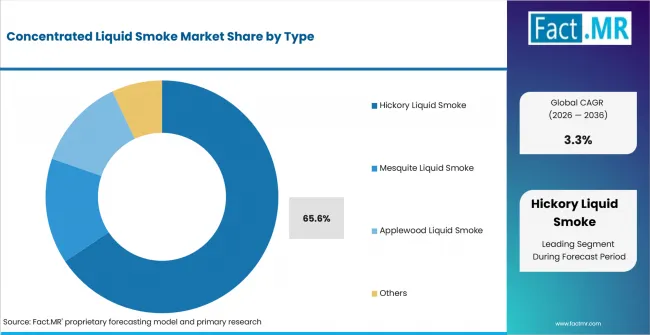
Concentrated Liquid Smoke Market Analysis By Type | Source: Fact.MR
Hickory leads because it is the most recognisable smoke cue for barbecue sauces, smoked meats, marinades and savoury snack seasonings. It gives processors a strong flavour identity at low dosage and works across retail bottles, foodservice packs, and industrial formulations. Mesquite and applewood still have clear roles, but they are more occasion-specific. Hickory therefore becomes the safer default where buyers need a familiar smoked profile that translates across applications.
Why does Online Sales lead Application?
Online Sales is projected to account for 32.2% share in 2026.
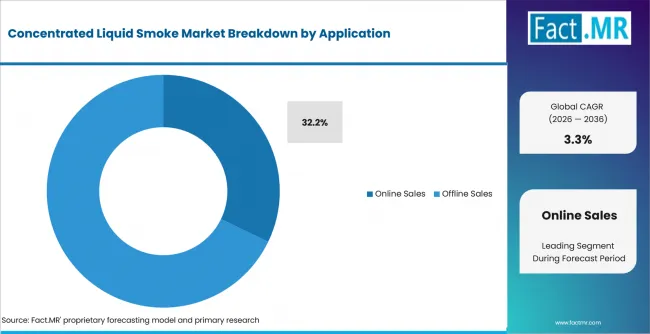
Concentrated Liquid Smoke Market Analysis By Application | Source: Fact.MR
Online sales lead because concentrated liquid smoke is a specification-led purchase. Buyers often compare flavour type, concentration, pack size as well as ingredient declaration and use instructions before ordering. That behaviour suits digital shelves better than routine grocery placement, especially for home barbecue users, small restaurants as well as cloud kitchens and specialty-food makers. Offline sales remain important for established retail bottles and distributor accounts, but online channels carry the wider flavour range.
What is accelerating Concentrated Liquid Smoke Market adoption, and what is holding it back?
Adoption is helped by demand for controllable smoked flavour in products that cannot depend on slow smoking. It is held back by regulation, label sensitivity, and the need to prove that the ingredient fits the finished food rather than simply adding a smoke note.
Drivers Impact Analysis
| DRIVER | (~) % IMPACT ON CAGR | GEOGRAPHIC RELEVANCE | IMPACT TIMELINE |
|---|---|---|---|
| Controlled smoke flavour | +0.8% | UK, Australia and USA | Short term (<= 2 years) |
| Home barbecue and cooking culture | +0.7% | Australia, USA and Canada | Short term (<= 2 years) |
| Foodservice flexibility | +0.5% | UK, Australia and USA | Medium term (2-4 years) |
| Online availability | +0.4% | Global sourcing and import-dependent markets | Medium term (2-4 years) |
Source: Fact.MR analysis. Updated Aug 5, 2026
- Controlled smoke flavour: Concentrated liquids let manufacturers reproduce the same smoke note across batches, which matters in sauces, meat products as well as snacks and ready meals.
- Home barbecue and cooking culture: Small bottles allow consumers to add smoke flavour indoors, in sauces, or in marinades without specialised equipment.
- Foodservice flexibility: Restaurants and takeaway kitchens can use liquid smoke to build smoked profiles in limited kitchen space.
- Online availability: Digital channels make niche profiles and small packs easier to find than conventional retail shelves.
Opportunity Impact Analysis
| OPPORTUNITY | (~) % IMPACT ON CAGR | GEOGRAPHIC RELEVANCE | IMPACT TIMELINE |
|---|---|---|---|
| Application-specific technical support | +0.6% | UK, Australia and USA | Medium term (2-4 years) |
| Regulatory and labelling support | +0.4% | UK, Australia and USA | Medium term (2-4 years) |
| Pack-size differentiation | +0.3% | USA, Canada and Germany | Long term (>= 4 years) |
Source: Fact.MR analysis. Updated Aug 5, 2026
- Suppliers can support growth by offering application notes for barbecue sauce, poultry, pork as well as vegan meat alternativesas well as cheese-style products and snacks.
- Clear labelling and regulatory support can become a selling point, particularly for buyers serving the USA, UK as well as EU as well as Canada and Australia.
- Pack-size differentiation remains open: home cooks need small bottles, while industrial users need predictable drums or concentrates with technical support.
Restraints Impact Analysis
| RESTRAINT | (~) % IMPACT ON CAGR | GEOGRAPHIC RELEVANCE | IMPACT TIMELINE |
|---|---|---|---|
| EU regulatory changes | -0.6% | UK, Australia and USA | Short term (<= 2 years) |
| Artificial-smoke labelling limits | -0.5% | UK, Australia and USA | Short term (<= 2 years) |
| Dosage-control risk | -0.4% | Established and price-sensitive markets | Medium term (2-4 years) |
Source: Fact.MR analysis. Updated Aug 5, 2026
- EU smoke-flavouring changes increase reformulation pressure and can slow new launches in markets such as Germany.
- Artificial-smoke labelling can limit claims when a brand wants to market an item as traditionally smoked.
- The ingredient is powerful at low dosage, so poor use can create harsh flavour and reduce repeat purchasing.
Which countries are scaling the Concentrated Liquid Smoke Market fastest?
Country growth rates differ from the global 3.3% CAGR. The UK, Australia, USA and Canada sit above the global rate. In contrast, Germany remains slightly above it. The rates describe forecast pace, not identical demand structures.
- The UK leads the country set at 5.7% CAGR.
- Australia follows at 5.6% CAGR.
- The USA records 5.0% CAGR.
- Canada advances at 4.4% CAGR.
- Germany expands at 3.5% CAGR.
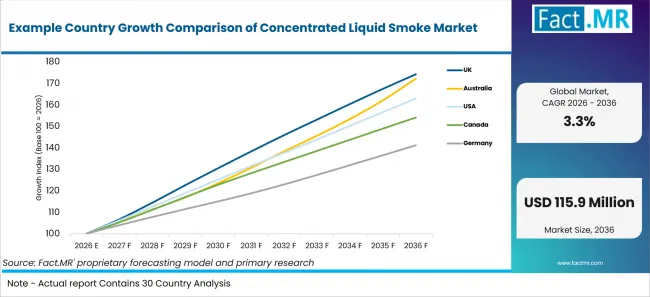
Example Country Growth Comparison Of Concentrated Liquid Smoke Market | Source: Fact.MR
| COUNTRY | CAGR, 2026 to 2036 |
|---|---|
| UK | 5.7% |
| Australia | 5.6% |
| USA | 5.0% |
| Canada | 4.4% |
| Germany | 3.5% |
Source: Fact.MR analysis. Updated Aug 5, 2026
What is driving the UK's growth through 2036?
The UK is forecast to record 5.7% CAGR through 2036. Growth is supported by a strong sauce and condiment base, rising foodservice expenditure, and a consumer shift toward bolder cooking flavours. GOV.UK reports that UK consumer expenditure on food and alcoholic drinks reached GBP 303.3 billion in 2025, with expenditure on food and drink eaten out increasing from GBP 134.7 billion in 2024 to GBP 137.7 billion in 2025. Agriculture and Agri-Food Canada also reports that the UK sauces, dips, and condiments retail market grew from USD 4.53 billion in 2020 to USD 5.37 billion in 2024. This includes cooking and table sauces forecast to remain the fastest-moving sauce group. For liquid smoke, this matters because the ingredient usually travels through barbecue sauces, marinades as well as ready meals and online specialty packs rather than through broad everyday grocery demand.
What is driving Australia's growth through 2036?
Australia is forecast to grow at 5.6% CAGR through 2036. The demand route is tied to sauces, prepared condiments, barbecue-style cooking and online food retail. Agriculture and Agri-Food Canada reports that Australia imported Can$771.2 million of sauces and condiments in 2024, with prepared sauces accounting for Can$594.8 million, or 77.1% of the category. The Australian Bureau of Statistics also reported seasonally adjusted food online sales of AUD 1,449.9 million in June 2025. That combination supports concentrated liquid smoke because it is often purchased as a flavour-building ingredient for sauces and marinades, then replenished through online or specialty channels.
What is driving the USA's growth through 2036?
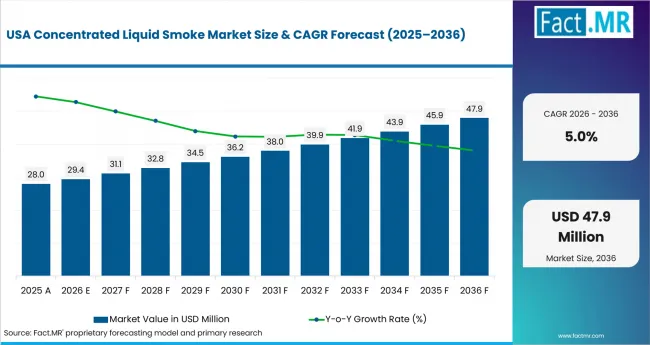
Concentrated Liquid Smoke Market Country Value Analysis | Source: Fact.MR
The USA is projected to expand at 5.0% CAGR through 2036. The market is mature, but it has the deepest base of barbecue sauces, smoked meat products as well as poultry formulations as well as snacks and foodservice applications. USDA Economic Research Service data show that food sales at foodservice outlets reached USD 1.41 trillion in 2025, while limited-service establishments rose strongly over the long term. U.S. labelling rules also give suppliers a defined route: 21 CFR 101.22 states that pyroligneous acid or other artificial smoke flavours may be declared as artificial flavour or artificial smoke flavour, but products cannot imply true smoking when that claim is not supported. This keeps growth commercially useful but technically controlled.
What is driving Canada's growth through 2036?
Canada is forecast to grow at 4.4% CAGR through 2036. Growth is helped by foodservice recovery and the country’s active sauce and condiment trade, but the pace remains below the UK and Australia because the category is more application-specific. Statistics Canada reported that annual sales of food services and drinking places reached CAD 101.4 billion in 2025, up 5.6% from 2024. That supports demand for smoky flavours in restaurants, takeaway kitchens, marinades and prepared foods. Liquid smoke also benefits where brands want a shelf-stable flavour input that can be used in sauces and protein products without adding a smoking step.
What is driving Germany's growth through 2036?
Germany is forecast to expand at 3.5% CAGR through 2036, slightly above the global rate. The market has a large food-processing base, but growth is more cautious because EU smoke-flavouring rules are in a transition period. The European Commission states that smoke flavourings or foods containing them may not be placed on the market if an unauthorised primary product is present, and Implementing Regulation (EU) 2024/2067 deleted several entries from the Union list of authorised smoke flavouring primary products. Germany still offers a solid base for processed foods and foodservice, with USDA FAS reporting USD 270.1 billion in processed food and beverage output in 2024 and USD 93.7 billion in foodservice sales. The result is steady demand, but suppliers must manage reformulation and compliance more carefully than in less restricted markets.
Who leads the Concentrated Liquid Smoke Market?
Kerry Red Arrow is the largest named company in the assessed set, with 9.7% share. Other listed participants are Baumer Foods, Azelis, B&G Foods and Ruitenberg.
Competition is shaped by flavour development capability, regulatory documentation, application support and reliable supply. Buyers are likely to compare whether a supplier can support a finished application such as sauce, meat, poultry as well as snack seasoning or plant-based food as well as rather than selecting only by smoke profile.
Which companies are the key providers?
Key companies include Kerry Red Arrow; Baumer Foods; Azelis; B&G Foods; Ruitenberg; QST Smoke Flavors; MSK; Flavourstream; Besmoke; Frutarom Savory Solutions; SOSA; Colgin; Create Flavors; and Jinan Hua Lu Food.
- Kerry Red Arrow
- Baumer Foods
- Azelis
- B&G Foods
- Ruitenberg
- QST Smoke Flavors
- MSK
- Flavourstream
- Besmoke
- Frutarom Savory Solutions
- SOSA
- Colgin
- Create Flavors
- Jinan Hua Lu Food
Bibliography
- Agriculture and Agri-Food Canada. (2025, September 17). Sector Trend Analysis: Sauces, dips and condiment trends in Australia. Government of Canada.
- Agriculture and Agri-Food Canada. (2025, October 15). Sector Trend Analysis: Sauces, dips and condiment trends in the United Kingdom. Government of Canada.
- Australian Bureau of Statistics. (2025, March 28). Apparent Consumption of Selected Foodstuffs, Australia, 2023-24 financial year.
- Australian Bureau of Statistics. (2025, July 31). Retail Trade, Australia, June 2025.
- European Commission. (2024). Smoke flavouring renewals - existing. Directorate-General for Health and Food Safety.
- Electronic Code of Federal Regulations. (2026). 21 CFR 101.22 - Foods; labeling of spices, flavorings, colorings and chemical preservatives.
- Government Publishing Office. (2018). 9 CFR 381.119 - Declaration of artificial flavoring or coloring.
- GOV.UK. (2026). Food statistics in your pocket. Department for Environment, Food and Rural Affairs.
- Statistics Canada. (2026, February 25). Food services and drinking places, December 2025. Government of Canada.
- U.S. Department of Agriculture, Economic Research Service. (2026, July 8). Food Service Industry: Market Segments.
- U.S. Department of Agriculture, Foreign Agricultural Service. (2026, March 30). Food Processing Ingredients Annual: Germany.
This Report Answers
- The report provides strategic intelligence on the Concentrated Liquid Smoke Market across Type and Application choices that shape flavour selection and channel planning.
- Segment analysis covers Hickory Liquid Smoke and Online Sales as the share leaders within the 2026 market.
- Country outlook evaluates the UK and Australia alongside the USA and Canada. Germany completes the growth comparison across the profiled markets.
- Competitive analysis profiles Kerry Red Arrow and Baumer Foods alongside Azelis and B&G Foods. Ruitenberg completes the provider view.
- Channel assessment covers Online Sales and Offline Sales. Product-profile review considers how smoke flavour and pack format affect selection.
What does the Concentrated Liquid Smoke Market cover?
The market covers concentrated liquid smoke products and related offerings across the defined type, application, and region categories.
What is included in the scope?
The scope includes liquid smoke concentrates and related smoke-flavour products sold across the listed type and application categories.
What is excluded from the scope?
Products and services outside the defined type, application, and region categories are excluded. Traditional smoking equipment, smokehouses, wood chips and unrelated barbecue condiments are not counted unless they are sold as concentrated liquid smoke products.
How Was the Analysis Built?
The analysis combines structured desk research, company and product mapping, expert validation. Demand-side checks across major regions.
- Primary Research: Interviews with buyers, suppliers, integrators and technical specialists test purchasing criteria as well as operating constraints as well as adoption barriers and replacement behavior.
- Desk Research: Public regulatory material, standards, trade information as well as company literature and technical publications establish market boundaries and demand context.
- Market Sizing and Forecasting: Demand indicators, channel patterns, application intensity and supplier participation are reconciled across top-down and bottom-up views.
- Data Validation and Update Cycle: Findings are cross-checked across independent evidence routes and reviewed when material market, regulatory, or company changes occur.
Segmentation
What is the report's scope and coverage?
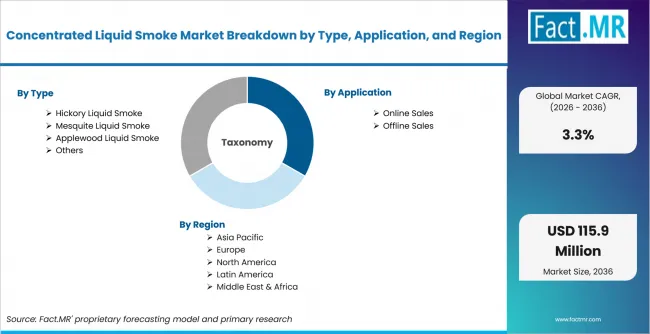
Concentrated Liquid Smoke Market Breakdown By Type, Application, And Region | Source: Fact.MR
| Attribute | Details |
|---|---|
| Quantitative Units | USD 84.4 million in 2026 to USD 115.9 million by 2036, at a 3.3% CAGR |
| Market Definition | Concentrated Liquid Smoke products and related offerings across the assessed categories |
| Type | Hickory Liquid Smoke; Mesquite Liquid Smoke; Applewood Liquid Smoke; Others |
| Application | Online Sales; Offline Sales |
| Regions Covered | North America; Latin America; Europe; East Asia; South Asia & Oceania; Middle East & Africa |
| Countries Covered | UK; Australia; USA; Canada; Germany |
| Key Companies Profiled | Kerry Red Arrow; Baumer Foods; Azelis; B&G Foods; Ruitenberg; QST Smoke Flavors; and others |
| Forecast Period | 2026 to 2036 |
| Approach | Hybrid top-down and bottom-up market assessment |
Source: Fact.MR analysis. Updated Aug 5, 2026
How is the market segmented?
-
By Type
- Hickory Liquid Smoke
- Mesquite Liquid Smoke
- Applewood Liquid Smoke
- Others
-
By Application
- Online Sales
- Offline Sales
-
By Region
- North America
- USA
- Canada
- Latin America
- Europe
- Germany
- UK
- East Asia
- South Asia & Oceania
- Australia
- Middle East & Africa
- North America
Frequently Asked Questions
How big is the Concentrated Liquid Smoke Market in 2026?
What is the CAGR of the Concentrated Liquid Smoke Market from 2026 to 2036?
Which type leads the Concentrated Liquid Smoke Market?
How much will the Concentrated Liquid Smoke Market add between 2026 and 2036?
Who are the leading companies in the Concentrated Liquid Smoke Market?
Who worked on this report


Preview the report firsthand - request a free sample
Free SampleGet the brochure for pricing and purchase details
Download PDF