Belt Loaders Market Size, Share, Growth and Forecast (2026 - 2036)

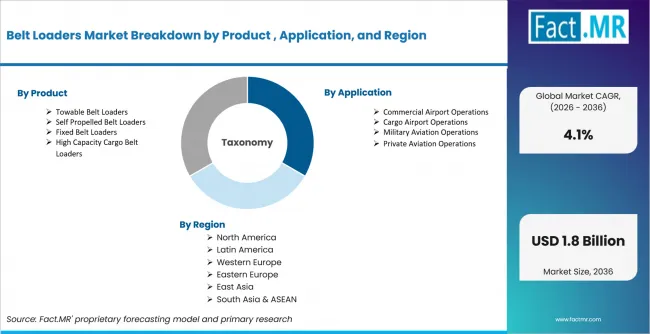
Belt Loaders Market is segmented by Product (Towable Belt Loaders, Self Propelled Belt Loaders, Fixed Belt Loaders, High Capacity Cargo Belt Loaders), Application (Commercial Airport Operations, Cargo Airport Operations, Military Aviation Operations, Private Aviation Operations), End Use (Airports, Cargo Operators, Defense Aviation Bases, Ground Handling Companies), and Region, with forecasts covering the period from 2026 to 2036.

Belt Loaders Analysis and Forecast by Fact.MR

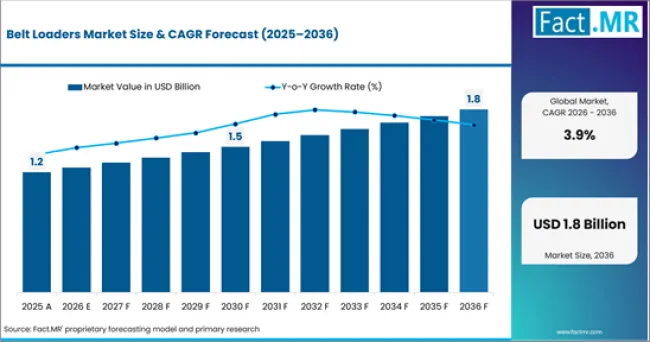
  • The Belt Loaders Market is expected to grow from USD 1.2 billion in 2026 to USD 1.8 billion by 2036, at a 3.9% CAGR.
  • Driven by rising global air passenger and cargo traffic volumes, airport fleet transition from diesel to electric belt loaders, and automation features reducing fuselage-damage risk and turnaround time.
  • Towable Belt Loaders accounting for 42.8% share and Commercial Airport Operations contributing 71.3% share as providers prioritize earlier detection, treatment-selection accuracy, and resource efficiency across clinical settings.
Belt Loaders Market Value Analysis

Summary of the Belt Loaders Market 

  • Market Snapshot
    • In 2025, the global Belt Loaders Market was valued at approximately USD 1.2 billion.
    • The market is estimated to reach USD 1.2 billion in 2026 and is projected to attain USD 1.8 billion by 2036.
    • The market is likely to expand at a CAGR of 3.9% during the forecast period.
    • The market is anticipated to create an absolute dollar opportunity of USD 0.6 billion between 2026 and 2036.
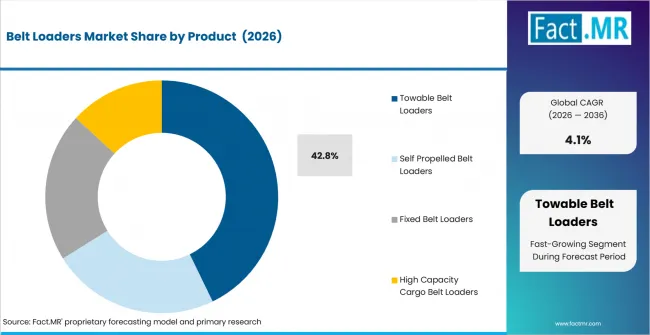
    • Towable Belt Loaders accounts for 42.8% of product share in 2026.
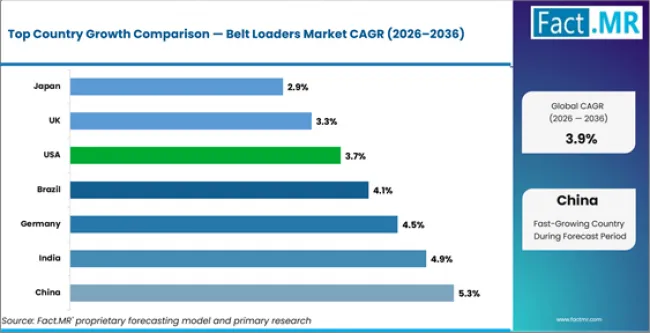
    • China (5.3%) and India (4.9%) are the key growth markets during the forecast period.
  • Demand and Growth Drivers
    • Rising global air passenger and cargo traffic volumes are sustaining demand for belt loaders across commercial and cargo airport operations.
    • Airport infrastructure modernization and green-airport initiatives are driving transition from diesel to electric belt loaders, supported by carbon-reduction targets.
    • Automation features including auto-height adjustment and patented vertical-lift boom designs are lifting average selling prices and reducing fuselage-damage risk.
    • Electric fleet transition mandates at major airports create sustained replacement demand over a multi-year period.
    • Cargo airport expansion driven by e-commerce growth opens high-capacity belt loader procurement.
  • Product and Segment View
    • Towable Belt Loaders accounts for 42.8% of the product segment in 2026, emerging as the leading category.
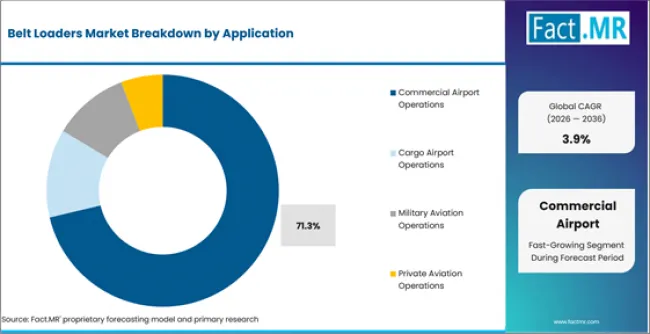
    • Commercial Airport Operations accounts for 71.3% of the application segment in 2026, making it the dominant use setting.
  • Key segmentation includes:
    • Product: Towable Belt Loaders, Self Propelled Belt Loaders, Fixed Belt Loaders, High Capacity Cargo Belt Loaders
    • Application: Commercial Airport Operations, Cargo Airport Operations, Military Aviation Operations, Private Aviation Operations
    • End Use: Airports, Cargo Operators, Defense Aviation Bases, Ground Handling Companies
    • Technology: Electromechanical Drive Systems, Electric Propulsion Systems, Automation Control Systems, Safety Integration Systems
    • Formulation: Heavy Duty Structural Design, Lightweight Composite Design, Ergonomic Operator Design
    • Distribution Channel: Direct OEM Sales, Industrial Equipment Distributors, Online Industrial Platforms
    • These systems enable:
      • Efficient baggage and cargo loading
      • Automated aircraft interface adjustment
      • Electric-powered ground handling operation
  • Geography and Competitive Outlook
    • North America leads poration, TLD Group (ALVEST), Textron Ground Support Equipment, Mallaghan Engineering Ltd., Fast Global Solutions Inc., Trepel Airport Equipment GmbH.
    • on aviation infrastructure investment, GSE fleet modernization, and early electric belt loader adoption.
    • Europe demand reflects EU carbon-reduction targets, green-airport initiatives, and the presence of major GSE manufacturers.
    • Asia Pacific posts the steepest growth, with rapid aviation infrastructure development in China and India and air cargo expansion widening belt loader demand.
    • China (5.3%) and India (4.9%) lead country growth, with other major markets showing steady demand.
    • Key companies include JBT Cor
  • Analyst Opinion
    • Shambhu Nath Jha, Principal Consultant at Fact.MR, says 'Belt loader demand tracks two forces: air traffic growth and the electric fleet transition mandated by green-airport programs. Towable models still lead, but self-propelled electric loaders with automation features are where value is moving. Long GSE replacement cycles mean the transition is measured in years, not quarters, but the direction is clear. China and India scale fastest on aviation infrastructure build-out. The suppliers best positioned combine electric propulsion with safety-integrated automation and dependable aftermarket service, since airports procure fleets and service relationships rather than individual units.'

Key Growth Drivers, Constraints, and Opportunities
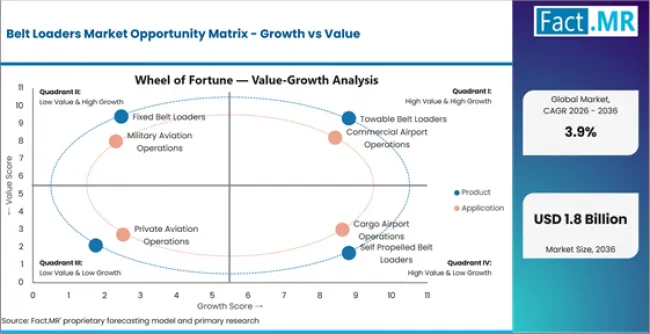
Belt Loaders Market Opportunity Matrix Growth Vs Value

Key Factors Driving Growth

  • Rising global air passenger and cargo traffic volumes are sustaining demand for belt loaders across commercial and cargo airport operations.
  • Airport infrastructure modernization and green-airport initiatives are driving transition from diesel to electric belt loaders, supported by carbon-reduction targets.
  • Automation features including auto-height adjustment and patented vertical-lift boom designs are lifting average selling prices and reducing fuselage-damage risk.

Key Market Constraints

  • Long GSE replacement cycles and fleet-life extension practices slow new-unit demand in mature markets.
  • High capital cost of electric and automated belt loaders limits adoption among smaller airports and regional operators.
  • Supply-chain constraints on battery and electric-drive components create lead-time challenges for electric fleet transition.

Key Opportunity Areas

  • Electric fleet transition mandates at major airports create sustained replacement demand over a multi-year period.
  • Cargo airport expansion driven by e-commerce growth opens high-capacity belt loader procurement.
  • Automated and safety-integrated designs create premium differentiation and reduce ground-handling incident cost.

Segment-wise Analysis of the Belt Loaders

  • Towable Belt Loaders holds 42.8% of the product segment in 2026, supported by clinical preference and procurement scale.
  • Commercial Airport Operations represents 71.3% of the application segment in 2026, anchored by its dominant care setting.

The Belt Loaders Market is segmented by product, application, end use, technology, formulation, distribution channel. Demand is shaped by clinical pathway choices, reimbursement exposure, and procurement structure, with leading segments anchored in higher-volume care settings while faster-growing categories capture incremental demand as adoption broadens.

Which Product Segment Dominates the Belt Loaders?
Belt Loaders Market Analysis By Product

Towable Belt Loaders lead the product segment with 42.8% share in 2026, reflecting their established role across airport ground handling operations where cost-effectiveness and operational simplicity sustain demand.

The segment is expected to retain volume leadership, though self-propelled and electric models gain share as airports transition to green fleets. High-capacity cargo belt loaders also grow through e-commerce-driven cargo expansion.

Which Application Segment Dominates the Belt Loaders?
Belt Loaders Market Analysis By Application

Commercial Airport Operations lead the application segment with 71.3% share in 2026, driven by the concentration of passenger and baggage handling demand across major hub and regional airports.

The application is likely to hold its dominant share as air traffic growth sustains ground handling demand. Cargo and military aviation operations grow alongside, but commercial airports anchor the largest belt loader demand pool.

Which Product Trend is Shaping the Next Phase of Growth in the Belt Loaders?

Towable Belt Loaders lead the product segment at 42.8%, but the defining shift is the transition toward self-propelled and electric models that improve turnaround efficiency and meet carbon-reduction targets. Electromechanical drive systems anchor the largest technology share, while electric propulsion grows as green-airport mandates reshape fleet procurement at major hubs.

The most consequential shift is automation. Features such as automatic height adjustment, vertical-lift booms, and integrated safety systems reduce fuselage damage risk and labor intensity, supporting premium pricing. Commercial airport operations anchor the largest demand pool, while cargo airport expansion driven by e-commerce growth opens high-capacity belt loader procurement.

Regional Outlook Across Key Markets

  • North America leads on aviation infrastructure investment, GSE fleet modernization, and early electric belt loader adoption.
  • Europe demand reflects EU carbon-reduction targets, green-airport initiatives, and the presence of major GSE manufacturers.
  • Asia Pacific posts the steepest growth, with rapid aviation infrastructure development in China and India and air cargo expansion widening belt loader demand.
  • Japan and the Middle East show steady demand anchored in airport expansion and fleet modernization.

Top Country Growth Comparison Belt Loaders Market Cagr (2026 2036)

CAGR Table

Country CAGR (%)
China 5.3%
India 4.9%
Germany 4.5%
Brazil 4.1%
U.S. 3.7%
UK 3.3%
Japan 2.9%

Source: Fact MR (FMR) analysis, based on proprietary forecasting model and primary research.
Belt Loaders Market Cagr Analysis By Country

Market Outlook for Belt Loaders in China

The China Belt Loaders market is projected to grow at a CAGR of 5.3% through 2036. Rapid aviation infrastructure development and air cargo growth driven by e-commerce are widening demand for high-capacity belt loaders across new and expanding airports. Domestic GSE manufacturing and competitive pricing support adoption of electromechanical drive belt loaders, while electric propulsion gains traction at major hub airports.

  • Aviation infrastructure expansion is lifting demand for high-capacity cargo belt loaders.
  • Domestic GSE manufacturing supports cost-competitive electromechanical belt loader supply.

India Belt Loaders Demand Trends

The India Belt Loaders market is projected to grow at a CAGR of 4.9% through 2036. Demand is shaped by airport expansion programs and rising passenger and cargo traffic that widen ground handling equipment requirements. Cost-effectiveness favors towable belt loaders, while self-propelled and electric models gain ground at major international airports with modernization mandates.

  • Airport expansion programs are widening belt loader demand across new and modernized terminals.
  • Rising cargo traffic supports procurement of high-capacity belt loaders at major airports.

Belt Loaders Growth Assessment in Germany

The Germany Belt Loaders market is projected to grow at a CAGR of 4.5% through 2036. EU carbon-reduction targets and green-airport initiatives shape belt loader fleet procurement across German airports. The presence of European GSE manufacturers and compliance with safety and emissions standards support demand for electric propulsion and automation-integrated belt loaders.

  • EU carbon-reduction targets are driving electric belt loader fleet transition at German airports.
  • European GSE manufacturers anchor supply of automation-integrated belt loader systems.

United States Belt Loaders Market Opportunity Outlook
Belt Loaders Market Country Value Analysis

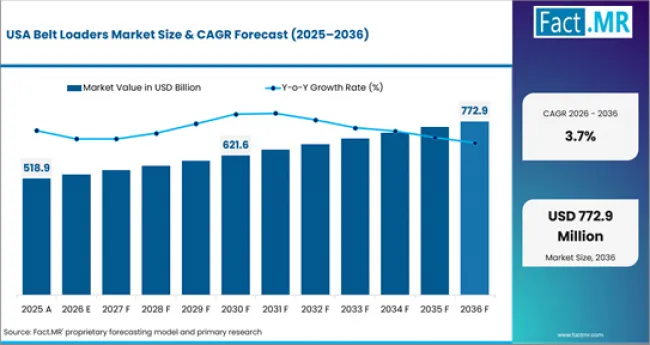
The United States Belt Loaders market is projected to grow at a CAGR of 3.7% through 2036. The GSE fleet at major airports is mature, so growth is led by electric fleet transition and automation upgrades rather than first-time capacity build-out. FAA regulatory requirements and airline sustainability commitments shape fleet procurement, while e-commerce cargo growth sustains demand for high-capacity belt loaders.

  • Electric fleet transition mandates drive belt loader replacement at major airports.
  • E-commerce cargo growth sustains demand for high-capacity belt loaders.

Belt Loaders Demand Analysis in Japan
Belt Loaders Market Japan Market Share Analysis By Product

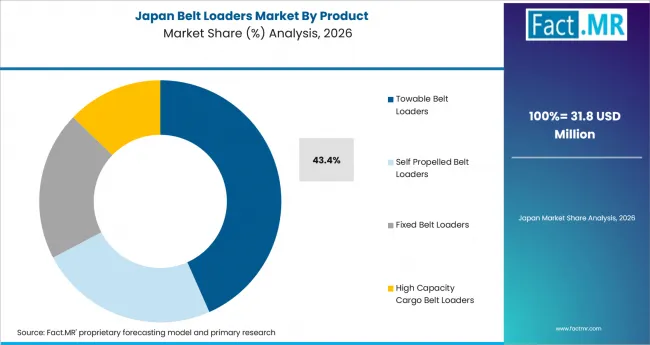
The Japan Belt Loaders market is projected to grow at a CAGR of 2.9% through 2036. Airport modernization programs and safety-focused procurement shape belt loader demand. Preference for quality-compliant electric and automated systems supports premium positioning, while advanced automation and safety integration features align with stringent ground handling standards.

  • Airport modernization programs sustain demand for electric and automated belt loaders.
  • Safety-focused procurement favors premium automation-integrated systems.

Competitive Benchmarking and Company Positioning
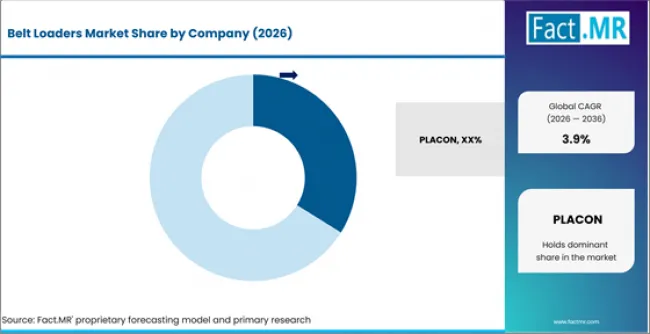
Belt Loaders Market Analysis By Company

Belt Loaders Analysis By Company

  • JBT, TLD Group, and Textron GSE hold leading positions through broad ground support equipment portfolios, global service networks, and entrenched airport relationships.
  • Mallaghan, Fast Global Solutions, and Trepel compete through product innovation, electric-fleet capability, and regional manufacturing strength.
  • Electric and automated belt loader development increasingly separates leaders from commodity suppliers as airports mandate fleet transition.

The competitive landscape is moderately concentrated among established GSE manufacturers, with differentiation driven by electric-fleet capability, automation features, and airport service reach. JBT, TLD Group, and Textron GSE lead through portfolio breadth, fleet-management support, and long-standing airport relationships.

Below the leaders, Mallaghan, Fast Global Solutions, Trepel, Power Stow, and Mulag maintain positions through innovation and regional strength. Mallaghan's introduction of a vertical-lift boom belt loader reflects the automation frontier shaping competitive standing.

Electric fleet transition is the central competitive dynamic. Suppliers that combine electric propulsion with automation features, safety integration, and dependable aftermarket support are positioned to capture multi-year fleet-replacement programs at major airports.

Key Companies in the Belt Loaders

  • Leading companies in the belt loaders market include JBT Corporation, TLD Group (ALVEST), Textron Ground Support Equipment, Mallaghan Engineering Ltd., which hold strong positions through portfolio breadth, clinical evidence, and broad distribution.
  • Fast Global Solutions Inc., Trepel Airport Equipment GmbH, Power Stow A/S, Mulag Fahrzeugwerk GmbH maintain established positions across specific segments and channels, competing on assay or product performance, service, and regional reach.
  • Weihai Guangtai Airport Equipment Co., Ltd., Aviogei Airport Equipment S.r.l. and other specialists compete through focused offerings and niche strength, reinforcing relevance in a competitive but evolving market.

Recent Industry Developments

  • Mallaghan Engineering Ltd. - Introduction of SkyBelt Vertical-Lift Belt Loader (April 2024)
    • In April 2024, Mallaghan introduced the SkyBelt, a fully electric, self-propelled belt loader with a patented vertical-lift boom that eliminates lateral movement and reduces fuselage-damage risk. The launch represents a significant automation advance in belt loader design.
  • Industry Trend - Electric Fleet Transition at Major Airports (2025)
    • Through 2025, major airports continued transitioning ground support fleets to electric power under green-airport initiatives and carbon-reduction mandates. The trend sustains replacement demand for electric belt loaders across established hubs.
  • Industry Trend - Cargo Airport Expansion Driven by E-Commerce (2025)
    • Through 2025, e-commerce-driven air cargo growth continued supporting expansion of cargo airports and terminals, generating demand for high-capacity belt loaders. The activity widens the equipment base beyond passenger-airport applications.

Leading Companies Shaping the Belt Loaders

  • JBT Corporation
  • TLD Group (ALVEST)
  • Textron Ground Support Equipment
  • Mallaghan Engineering Ltd.
  • Fast Global Solutions Inc.
  • Trepel Airport Equipment GmbH
  • Power Stow A/S
  • Mulag Fahrzeugwerk GmbH
  • Weihai Guangtai Airport Equipment Co., Ltd.
  • Aviogei Airport Equipment S.r.l.

Sources and Research References

  • International Air Transport Association. Air traffic and airport infrastructure references.
  • International Civil Aviation Organization. Ground handling and safety references.
  • JBT Corporation, TLD Group, and Mallaghan. Product and fleet references.
  • Airport operations and ground support equipment publications.
  • Primary interviews with airport operators, ground handlers, GSE manufacturers, and fleet managers.

This bibliography is provided for reader reference and is not exhaustive. The full report contains the complete reference list and detailed citations.

Key Questions This Report Addresses

  • What is the current and future size of the Belt Loaders Market?
  • How fast is the Belt Loaders Market expected to grow between 2026 and 2036?
  • Which product segment is likely to lead the market by 2026?
  • Which application segment is expected to account for the highest demand by 2026?
  • What factors are driving demand in the belt loaders market globally?
  • Which countries are projected to show the fastest growth through 2036?
  • What is driving market expansion in China and India?
  • Who are the key companies active in the belt loaders market?
  • How is electric fleet transition reshaping belt loader procurement at major airports?
  • What role does automation play in reducing ground handling incidents?
  • How does Fact.MR estimate and validate the belt loaders market forecast?

Belt Loaders Market Definition

The belt loaders market covers towable, self-propelled, fixed, and high-capacity cargo belt loaders used in commercial, cargo, military, and private aviation ground handling. It spans electromechanical, electric propulsion, automation control, and safety integration technologies delivered through heavy-duty, lightweight composite, and ergonomic operator design formats across airports, cargo operators, defense aviation bases, and ground handling companies.

Belt Loaders Market Inclusions

  • The scope covers global and regional market size and forecasts for 2026 to 2036 across product type, application, end use, technology, formulation, and distribution channel.
  • It includes demand tied to global air traffic growth, airport infrastructure modernization, and electric ground support equipment transition.
  • Pricing analysis spans towable and self-propelled belt loaders across OEM, distributor, and fleet-management channels.
  • Coverage includes electric and hybrid propulsion systems and automated height-adjustment technologies.

Belt Loaders Market Exclusions

  • The scope excludes general airport infrastructure outside the belt loader equipment definition.
  • It excludes cargo handling equipment such as pallet loaders, tugs, and high-lift trucks.
  • Non-aviation conveyor belt systems are excluded.
  • Aircraft boarding bridges and passenger handling equipment are excluded.

Belt Loaders Market Research Methodology

  • The methodology combines secondary research, primary interviews, and demand-side modeling.
  • It draws on 100 plus secondary sources and benchmarks 40 plus GSE product portfolios.
  • Market sizing covers 30 plus countries through an air-traffic-volume and GSE fleet model with top-down validation.
  • Key inputs include passenger and cargo air traffic volumes, airport expansion projects, GSE replacement cycles, and electric fleet transition rates.
  • The model cross-checks demand with GSE fleet sizes, OEM order books, and airport capital expenditure.
  • Primary validation includes 20 plus interviews across airport operators, ground handlers, GSE manufacturers, and fleet managers.
  • Final estimates pass through fleet-cycle review and sensitivity testing.

Scope of Analysis

Belt Loaders Market Breakdown By Product, Application, And Region

Parameter Details
Quantitative Units USD 1.2 billion to USD 1.8 billion, at a CAGR of 3.9%
Market Definition The belt loaders market covers towable, self-propelled, fixed, and high-capacity cargo belt loaders used in aviation ground handling across commercial, cargo, military, and private airport operations.
Regions Covered North America, Latin America, Europe, East Asia, South Asia and Pacific, Middle East and Africa
Countries Covered China, India, Germany, Brazil, U.S., UK, Japan, 30 plus countries
Key Companies JBT Corporation, TLD Group (ALVEST), Textron Ground Support Equipment, Mallaghan Engineering Ltd., Fast Global Solutions Inc., Trepel Airport Equipment GmbH, Power Stow A/S, Mulag Fahrzeugwerk GmbH, Weihai Guangtai Airport Equipment Co., Ltd., Aviogei Airport Equipment S.r.l.
Forecast Period 2026 to 2036
Approach Hybrid demand-side and top-down methodology built on country-level demand, product and assay benchmarking, pricing analysis, shipment validation, and primary interviews across providers, laboratories, distributors, and end users

Belt Loaders Segmentation

  • Belt Loaders Market Segmented by Product:

    • Towable Belt Loaders
      • Low Capacity Towable Units
        • Light Aircraft Loading Belts
        • Regional Aircraft Service Belts
      • Heavy Duty Towable Units
        • Wide Body Aircraft Loaders
        • Cargo Handling Belt Systems
    • Self Propelled Belt Loaders
      • Diesel Powered Loaders
        • High Torque Drive Systems
        • Long Distance Apron Mobility Units
      • Electric Powered Loaders
        • Battery Operated Belt Systems
        • Low Emission Airport Loaders
    • Fixed Belt Loaders
      • Stationary Loading Systems
        • Dock Mounted Belt Systems
        • Gate Side Loading Platforms
      • Semi Fixed Conveyor Units
        • Adjustable Height Belt Systems
        • Modular Loading Platforms
    • High Capacity Cargo Belt Loaders
      • Freight Handling Systems
        • Air Cargo Container Loaders
        • Bulk Cargo Belt Systems
      • Special Cargo Loaders
        • Oversized Baggage Loaders
        • Irregular Cargo Handling Units
  • Belt Loaders Market Segmented by Application:

    • Commercial Airport Operations
      • Passenger Aircraft Handling
        • Narrow Body Aircraft Loading
        • Wide Body Aircraft Loading
      • Baggage Handling Operations
        • Checked Luggage Transfer Systems
        • Oversized Baggage Handling
    • Cargo Airport Operations
      • Air Freight Handling
        • Containerized Cargo Loading
        • Bulk Freight Handling
      • Express Cargo Operations
        • Courier Air Freight Systems
        • Time Sensitive Cargo Loading
    • Military Aviation Operations
      • Defense Aircraft Logistics
        • Military Transport Aircraft Loading
        • Aerial Supply Operations
      • Field Airbase Operations
        • Forward Base Cargo Handling
        • Tactical Deployment Loading
    • Private Aviation Operations
      • Business Jet Handling
        • Corporate Aircraft Support
        • Private Charter Loading Systems
      • Helicopter Cargo Support
        • Rotorcraft Cargo Handling
        • Special Mission Aircraft Loading
  • Belt Loaders Market Segmented by End Use:

    • Airports
      • International Airports
        • Major Hub Airports
        • Global Transit Airports
      • Domestic Airports
        • Regional Commercial Airports
        • Secondary City Airports
    • Cargo Operators
      • Air Cargo Companies
        • Global Freight Forwarders
        • Integrated Cargo Airlines
      • Logistics Service Providers
        • Air Freight Handling Firms
        • Express Logistics Operators
    • Defense Aviation Bases
      • Military Airbases
        • Air Force Cargo Bases
        • Strategic Airlift Bases
      • Defense Logistics Units
        • Military Supply Command Centers
        • Aerial Deployment Units
    • Ground Handling Companies
      • Airport Service Contractors
        • Third Party Ground Handlers
        • Ramp Service Operators
      • Aircraft Maintenance Providers
        • Line Maintenance Operators
        • Aircraft Service Contractors
  • Belt Loaders Market Segmented by Technology:

    • Electromechanical Drive Systems
      • Motor Driven Conveyor Systems
        • High Torque Belt Motors
        • Variable Speed Drive Systems
      • Hydraulic Lift Systems
        • Load Elevation Hydraulic Units
        • Precision Height Adjustment Systems
    • Electric Propulsion Systems
      • Battery Drive Systems
        • Lithium Ion Power Units
        • Fast Charge Battery Modules
      • Hybrid Drive Systems
        • Dual Power Belt Loaders
        • Fuel Electric Hybrid Units
    • Automation Control Systems
      • Sensor Based Automation
        • Load Detection Sensors
        • Height Adjustment Sensors
      • Digital Control Interfaces
        • Smart Operator Panels
        • Remote Monitoring Systems
    • Safety Integration Systems
      • Collision Avoidance Systems
        • Proximity Warning Systems
        • Auto Stop Safety Controls
      • Load Stability Systems
        • Weight Balance Monitoring
        • Dynamic Load Adjustment Systems
  • Belt Loaders Market Segmented by Formulation:

    • Heavy Duty Structural Design
      • Reinforced Steel Frame Systems
        • High Load Bearing Structures
        • Anti Corrosion Coated Frames
      • Modular Frame Construction
        • Segmented Belt Loader Frames
        • Expandable Structural Systems
    • Lightweight Composite Design
      • Aluminium Alloy Structures
        • Aviation Grade Lightweight Frames
        • Fuel Efficient Load Systems
      • Composite Reinforced Materials
        • Fiber Reinforced Panels
        • High Strength Polymer Components
    • Ergonomic Operator Design
      • Adjustable Height Systems
        • Operator Comfort Platforms
        • Low Vibration Handling Systems
      • Human Machine Interface Design
        • Smart Control Consoles
        • Intuitive Operation Panels
  • Belt Loaders Market Segmented by Distribution Channel:

    • Direct OEM Sales
      • Aircraft Manufacturer Contracts
        • Commercial Aircraft OEM Deals
        • Cargo Aircraft OEM Supply
      • Airport Authority Procurement
        • Government Airport Tenders
        • Public Aviation Infrastructure Contracts
    • Industrial Equipment Distributors
      • Aviation Equipment Dealers
        • Ground Support Equipment Distributors
        • Airport Equipment Resellers
      • Regional Distributors
        • Local Airport Suppliers
        • Independent Aviation Equipment Dealers
    • Online Industrial Platforms
      • B2B Aviation Marketplaces
        • Digital Equipment Procurement Portals
        • Cloud Based Aviation Supply Platforms
      • Manufacturer Direct Platforms
        • OEM Ordering Systems
        • Subscription Equipment Leasing Portals
  • Belt Loaders Market by Region:

    • North America
      • USA
      • Canada
      • Mexico
    • Latin America
      • Brazil
      • Chile
      • Rest of Latin America
    • Western Europe
      • Germany
      • UK
      • Italy
      • Spain
      • France
      • Nordic
      • BENELUX
      • Rest of Western Europe
    • Eastern Europe
      • Russia
      • Poland
      • Hungary
      • Balkan & Baltic
      • Rest of Eastern Europe
    • East Asia
      • China
      • Japan
      • South Korea
    • South Asia and Pacific
      • India
      • ASEAN
      • Australia & New Zealand
      • Rest of South Asia and Pacific
    • Middle East & Africa
      • Kingdom of Saudi Arabia
      • Other GCC Countries
      • Turkiye
      • South Africa
      • Other African Union
      • Rest of Middle East & Africa

- Frequently Asked Questions -

How big is the belt loaders market in 2026?

The global belt loaders market is estimated to be valued at USD 1.2 billion in 2026.

What will be the size of belt loaders market in 2036?

The market size for the belt loaders market is projected to reach USD 1.8 billion by 2036.

How much will be the belt loaders market growth between 2026 and 2036?

The belt loaders market is expected to grow at a 3.9% CAGR between 2026 and 2036.

What are the key product in the belt loaders market?

The key product in belt loaders market are Towable Belt Loaders, Self Propelled Belt Loaders, Fixed Belt Loaders and High Capacity Cargo Belt Loaders.

Which application segment is expected to contribute significant share in the belt loaders market in 2026?

In terms of application, commercial airport operations segment is expected to command 71.3% share in the belt loaders market in 2026.

Table of Content

  1. Key Takeaways
    • Market Size and CAGR
    • Top Growth Driver
    • Fastest Growing Segment
    • Leading Region
    • Key Companies
    • Emerging Opportunities
  2. Executive Summary
    • Global Market Outlook
    • Demand-side Trends
    • Supply-side Trends
    • Technology Roadmap Analysis
    • Analysis and Recommendations
    • Analyst Perspective (What is happening? Why now? What should investors know?)
    • Key Questions Answered
      • How large is the market?
      • What is the CAGR?
      • What are key trends?
      • Which region dominates?
      • Who are the leaders?
  3. Market Overview
    • Market Coverage / Taxonomy
    • Market Definition / Scope / Limitations
  4. Research Methodology
    • Chapter Orientation
    • Analytical Lens and Working Hypotheses
      • Market Structure, Signals, and Trend Drivers
      • Benchmarking and Cross-market Comparability
      • Market Sizing, Forecasting, and Opportunity Mapping
    • Research Design and Evidence Framework
      • Desk Research Programme (Secondary Evidence)
      • Expert Input and Fieldwork (Primary Evidence)
      • Tooling, Models, and Reference Databases
    • Data Engineering and Model Build
    • Quality Assurance and Audit Trail
  5. Market Background
    • Market Dynamics (Drivers, Restraints, Opportunity, Trends)
    • Scenario Forecast (Optimistic, Likely, Conservative)
    • Impact Analysis
      • AI Impact
      • Sustainability Impact
      • Regulatory Impact
      • Technology Impact
    • Consumer / Buyer Analysis
      • Purchase Drivers
      • Adoption Barriers
      • Buyer Journey
    • Opportunity Map Analysis
    • Product Life Cycle Analysis
    • Supply Chain Analysis
    • Investment Feasibility Matrix
    • Value Chain Analysis
    • PESTLE and Porter's Analysis
    • Regulatory Landscape
    • Regional Parent Market Outlook
    • Production and Consumption Statistics
    • Import and Export Statistics
  6. Global Market Analysis and Forecast, 2021 to 2036
    • Historical Market Size Value (USD Million) Analysis, 2021 to 2025
    • Current and Future Market Size Value (USD Million) Projections, 2026 to 2036
      • Y-o-Y Growth Trend Analysis
      • Absolute $ Opportunity Analysis
  7. Global Market Pricing Analysis, 2021 to 2036
  8. Global Market Analysis and Forecast, By Product, 2021 to 2036
    • Introduction / Key Findings
    • Historical Market Size Value (USD Million) Analysis By Product, 2021 to 2025
    • Current and Future Market Size Value (USD Million) Analysis and Forecast By Product, 2026 to 2036
      • Towable Belt Loaders
        • Low Capacity Towable Value (USD Million)s
        • Heavy Duty Towable Value (USD Million)s
      • Self Propelled Belt Loaders
        • Diesel Powered Loaders
        • Electric Powered Loaders
      • Fixed Belt Loaders
        • Stationary Loading Systems
        • Semi Fixed Conveyor Value (USD Million)s
      • High Capacity Cargo Belt Loaders
        • Freight Handling Systems
        • Special Cargo Loaders
    • Y-o-Y Growth Trend Analysis By Product, 2021 to 2025
    • Absolute $ Opportunity Analysis By Product, 2026 to 2036
  9. Global Market Analysis and Forecast, By Application, 2021 to 2036
    • Introduction / Key Findings
    • Historical Market Size Value (USD Million) Analysis By Application, 2021 to 2025
    • Current and Future Market Size Value (USD Million) Analysis and Forecast By Application, 2026 to 2036
      • Commercial Airport Operations
        • Passenger Aircraft Handling
        • Baggage Handling Operations
      • Cargo Airport Operations
        • Air Freight Handling
        • Express Cargo Operations
      • Military Aviation Operations
        • Defense Aircraft Logistics
        • Field Airbase Operations
      • Private Aviation Operations
        • Business Jet Handling
        • Helicopter Cargo Support
    • Y-o-Y Growth Trend Analysis By Application, 2021 to 2025
    • Absolute $ Opportunity Analysis By Application, 2026 to 2036
  10. Global Market Analysis and Forecast, By End Use, 2021 to 2036
    • Introduction / Key Findings
    • Historical Market Size Value (USD Million) Analysis By End Use, 2021 to 2025
    • Current and Future Market Size Value (USD Million) Analysis and Forecast By End Use, 2026 to 2036
      • Airports
        • International Airports
        • Domestic Airports
      • Cargo Operators
        • Air Cargo Companies
        • Logistics Service Providers
      • Defense Aviation Bases
        • Military Airbases
        • Defense Logistics Value (USD Million)s
      • Ground Handling Companies
        • Airport Service Contractors
        • Aircraft Maintenance Providers
    • Y-o-Y Growth Trend Analysis By End Use, 2021 to 2025
    • Absolute $ Opportunity Analysis By End Use, 2026 to 2036
  11. Global Market Analysis and Forecast, By Technology, 2021 to 2036
    • Introduction / Key Findings
    • Historical Market Size Value (USD Million) Analysis By Technology, 2021 to 2025
    • Current and Future Market Size Value (USD Million) Analysis and Forecast By Technology, 2026 to 2036
      • Electromechanical Drive Systems
        • Motor Driven Conveyor Systems
        • Hydraulic Lift Systems
      • Electric Propulsion Systems
        • Battery Drive Systems
        • Hybrid Drive Systems
      • Automation Control Systems
        • Sensor Based Automation
        • Digital Control Interfaces
      • Safety Integration Systems
        • Collision Avoidance Systems
        • Load Stability Systems
    • Y-o-Y Growth Trend Analysis By Technology, 2021 to 2025
    • Absolute $ Opportunity Analysis By Technology, 2026 to 2036
  12. Global Market Analysis and Forecast, By Formulation, 2021 to 2036
    • Introduction / Key Findings
    • Historical Market Size Value (USD Million) Analysis By Formulation, 2021 to 2025
    • Current and Future Market Size Value (USD Million) Analysis and Forecast By Formulation, 2026 to 2036
      • Heavy Duty Structural Design
        • Reinforced Steel Frame Systems
        • Modular Frame Construction
      • Lightweight Composite Design
        • Aluminium Alloy Structures
        • Composite Reinforced Materials
      • Ergonomic Operator Design
        • Adjustable Height Systems
        • Human Machine Interface Design
    • Y-o-Y Growth Trend Analysis By Formulation, 2021 to 2025
    • Absolute $ Opportunity Analysis By Formulation, 2026 to 2036
  13. Global Market Analysis and Forecast, By Distribution Channel
    • Introduction / Key Findings
    • Historical Market Size Value (USD Million) Analysis By Distribution Channel, 2021 to 2025
    • Current and Future Market Size Value (USD Million) Analysis and Forecast By Distribution Channel, 2026 to 2036
      • Direct OEM Sales
        • Aircraft Manufacturer Contracts
        • Airport Authority Procurement
      • Industrial Equipment Distributors
        • Aviation Equipment Dealers
        • Regional Distributors
      • Online Industrial Platforms
        • B2B Aviation Marketplaces
        • Manufacturer Direct Platforms
    • Y-o-Y Growth Trend Analysis By Distribution Channel, 2021 to 2025
    • Absolute $ Opportunity Analysis By Distribution Channel, 2026 to 2036
  14. Global Market Analysis and Forecast, By Region, 2021 to 2036
    • Introduction
    • Historical Market Size Value (USD Million) Analysis By Region, 2021 to 2025
    • Current Market Size Value (USD Million) Analysis and Forecast By Region, 2026 to 2036
      • North America
      • Latin America
      • Western Europe
      • Eastern Europe
      • East Asia
      • South Asia and Pacific
      • Middle East & Africa
    • Market Attractiveness Analysis By Region
  15. North America Market Analysis and Forecast, By Country, 2021 to 2036
    • Historical Market Size Value (USD Million) Trend Analysis By Market Taxonomy, 2021 to 2025
    • Market Size Value (USD Million) Forecast By Market Taxonomy, 2026 to 2036
      • By Country
        • USA
        • Canada
        • Mexico
      • By Product
      • By Application
      • By End Use
      • By Technology
      • By Formulation
      • By Distribution Channel
    • Market Attractiveness Analysis
      • By Country
      • By Product
      • By Application
      • By End Use
      • By Technology
      • By Formulation
      • By Distribution Channel
    • Key Takeaways
  16. Latin America Market Analysis and Forecast, By Country
    • Historical Market Size Value (USD Million) Trend Analysis By Market Taxonomy, 2021 to 2025
    • Market Size Value (USD Million) Forecast By Market Taxonomy, 2026 to 2036
      • By Country
        • Brazil
        • Chile
        • Rest of Latin America
      • By Product
      • By Application
      • By End Use
      • By Technology
      • By Formulation
      • By Distribution Channel
    • Market Attractiveness Analysis
      • By Country
      • By Product
      • By Application
      • By End Use
      • By Technology
      • By Formulation
      • By Distribution Channel
    • Key Takeaways
  17. Western Europe Market Analysis and Forecast, By Country
    • Historical Market Size Value (USD Million) Trend Analysis By Market Taxonomy, 2021 to 2025
    • Market Size Value (USD Million) Forecast By Market Taxonomy, 2026 to 2036
      • By Country
        • Germany
        • UK
        • Italy
        • Spain
        • France
        • Nordic
        • BENELUX
        • Rest of Western Europe
      • By Product
      • By Application
      • By End Use
      • By Technology
      • By Formulation
      • By Distribution Channel
    • Market Attractiveness Analysis
      • By Country
      • By Product
      • By Application
      • By End Use
      • By Technology
      • By Formulation
      • By Distribution Channel
    • Key Takeaways
  18. Eastern Europe Market Analysis and Forecast, By Country
    • Historical Market Size Value (USD Million) Trend Analysis By Market Taxonomy, 2021 to 2025
    • Market Size Value (USD Million) Forecast By Market Taxonomy, 2026 to 2036
      • By Country
        • Russia
        • Poland
        • Hungary
        • Balkan & Baltic
        • Rest of Eastern Europe
      • By Product
      • By Application
      • By End Use
      • By Technology
      • By Formulation
      • By Distribution Channel
    • Market Attractiveness Analysis
      • By Country
      • By Product
      • By Application
      • By End Use
      • By Technology
      • By Formulation
      • By Distribution Channel
    • Key Takeaways
  19. East Asia Market Analysis and Forecast, By Country
    • Historical Market Size Value (USD Million) Trend Analysis By Market Taxonomy, 2021 to 2025
    • Market Size Value (USD Million) Forecast By Market Taxonomy, 2026 to 2036
      • By Country
        • China
        • Japan
        • South Korea
      • By Product
      • By Application
      • By End Use
      • By Technology
      • By Formulation
      • By Distribution Channel
    • Market Attractiveness Analysis
      • By Country
      • By Product
      • By Application
      • By End Use
      • By Technology
      • By Formulation
      • By Distribution Channel
    • Key Takeaways
  20. South Asia and Pacific Market Analysis and Forecast, By Country
    • Historical Market Size Value (USD Million) Trend Analysis By Market Taxonomy, 2021 to 2025
    • Market Size Value (USD Million) Forecast By Market Taxonomy, 2026 to 2036
      • By Country
        • India
        • ASEAN
        • Australia & New Zealand
        • Rest of South Asia and Pacific
      • By Product
      • By Application
      • By End Use
      • By Technology
      • By Formulation
      • By Distribution Channel
    • Market Attractiveness Analysis
      • By Country
      • By Product
      • By Application
      • By End Use
      • By Technology
      • By Formulation
      • By Distribution Channel
    • Key Takeaways
  21. Middle East & Africa Market Analysis and Forecast, By Country
    • Historical Market Size Value (USD Million) Trend Analysis By Market Taxonomy, 2021 to 2025
    • Market Size Value (USD Million) Forecast By Market Taxonomy, 2026 to 2036
      • By Country
        • Kingdom of Saudi Arabia
        • Other GCC Countries
        • Turkiye
        • South Africa
        • Other African Union
        • Rest of Middle East & Africa
      • By Product
      • By Application
      • By End Use
      • By Technology
      • By Formulation
      • By Distribution Channel
    • Market Attractiveness Analysis
      • By Country
      • By Product
      • By Application
      • By End Use
      • By Technology
      • By Formulation
      • By Distribution Channel
    • Key Takeaways
  22. Key Countries Market Analysis
    • USA
      • Pricing Analysis
      • Market Share Analysis, 2025
        • By Product
        • By Application
        • By End Use
        • By Technology
        • By Formulation
        • By Distribution Channel
    • Canada
      • Pricing Analysis
      • Market Share Analysis, 2025
        • By Product
        • By Application
        • By End Use
        • By Technology
        • By Formulation
        • By Distribution Channel
    • Mexico
      • Pricing Analysis
      • Market Share Analysis, 2025
        • By Product
        • By Application
        • By End Use
        • By Technology
        • By Formulation
        • By Distribution Channel
    • Brazil
      • Pricing Analysis
      • Market Share Analysis, 2025
        • By Product
        • By Application
        • By End Use
        • By Technology
        • By Formulation
        • By Distribution Channel
    • Chile
      • Pricing Analysis
      • Market Share Analysis, 2025
        • By Product
        • By Application
        • By End Use
        • By Technology
        • By Formulation
        • By Distribution Channel
    • Germany
      • Pricing Analysis
      • Market Share Analysis, 2025
        • By Product
        • By Application
        • By End Use
        • By Technology
        • By Formulation
        • By Distribution Channel
    • UK
      • Pricing Analysis
      • Market Share Analysis, 2025
        • By Product
        • By Application
        • By End Use
        • By Technology
        • By Formulation
        • By Distribution Channel
    • Italy
      • Pricing Analysis
      • Market Share Analysis, 2025
        • By Product
        • By Application
        • By End Use
        • By Technology
        • By Formulation
        • By Distribution Channel
    • Spain
      • Pricing Analysis
      • Market Share Analysis, 2025
        • By Product
        • By Application
        • By End Use
        • By Technology
        • By Formulation
        • By Distribution Channel
    • France
      • Pricing Analysis
      • Market Share Analysis, 2025
        • By Product
        • By Application
        • By End Use
        • By Technology
        • By Formulation
        • By Distribution Channel
    • India
      • Pricing Analysis
      • Market Share Analysis, 2025
        • By Product
        • By Application
        • By End Use
        • By Technology
        • By Formulation
        • By Distribution Channel
    • ASEAN
      • Pricing Analysis
      • Market Share Analysis, 2025
        • By Product
        • By Application
        • By End Use
        • By Technology
        • By Formulation
        • By Distribution Channel
    • Australia & New Zealand
      • Pricing Analysis
      • Market Share Analysis, 2025
        • By Product
        • By Application
        • By End Use
        • By Technology
        • By Formulation
        • By Distribution Channel
    • China
      • Pricing Analysis
      • Market Share Analysis, 2025
        • By Product
        • By Application
        • By End Use
        • By Technology
        • By Formulation
        • By Distribution Channel
    • Japan
      • Pricing Analysis
      • Market Share Analysis, 2025
        • By Product
        • By Application
        • By End Use
        • By Technology
        • By Formulation
        • By Distribution Channel
    • South Korea
      • Pricing Analysis
      • Market Share Analysis, 2025
        • By Product
        • By Application
        • By End Use
        • By Technology
        • By Formulation
        • By Distribution Channel
    • Russia
      • Pricing Analysis
      • Market Share Analysis, 2025
        • By Product
        • By Application
        • By End Use
        • By Technology
        • By Formulation
        • By Distribution Channel
    • Poland
      • Pricing Analysis
      • Market Share Analysis, 2025
        • By Product
        • By Application
        • By End Use
        • By Technology
        • By Formulation
        • By Distribution Channel
    • Hungary
      • Pricing Analysis
      • Market Share Analysis, 2025
        • By Product
        • By Application
        • By End Use
        • By Technology
        • By Formulation
        • By Distribution Channel
    • Kingdom of Saudi Arabia
      • Pricing Analysis
      • Market Share Analysis, 2025
        • By Product
        • By Application
        • By End Use
        • By Technology
        • By Formulation
        • By Distribution Channel
    • Turkiye
      • Pricing Analysis
      • Market Share Analysis, 2025
        • By Product
        • By Application
        • By End Use
        • By Technology
        • By Formulation
        • By Distribution Channel
    • South Africa
      • Pricing Analysis
      • Market Share Analysis, 2025
        • By Product
        • By Application
        • By End Use
        • By Technology
        • By Formulation
        • By Distribution Channel
  23. Market Structure Analysis
    • Competition Dashboard
    • Competition Benchmarking
    • Market Share Analysis of Top Players
      • By Regional
      • By Product
      • By Application
      • By End Use
      • By Technology
      • By Formulation
      • By Distribution Channel
      • Emerging Startups
      • Innovation Benchmarking
    • Competition Analysis
      • Competition Deep Dive
        • PLACON
          • Overview
          • Product Portfolio
          • Profitability by Market Segments (Product/Age /Sales Channel/Region)
          • Sales Footprint
          • Strategy Overview
            • Marketing Strategy
            • Product Strategy
            • Channel Strategy
        • AL Mehtab Industries
        • Bantam Materials
        • Clean Tech U.K. Ltd
        • DuFor
        • Libolon
        • Peninsula Plastics Recycling
        • Portage Plastics
        • uma Naturals
        • Verdeco Recycling, Inc.
    • Case Studies
    • Success Stories
    • Recent Developments
  24. Assumptions & Acronyms Used

List Of Table

  • Table 1: Global Market Value (USD Million) Forecast by Region, 2021 to 2036
  • Table 2: Global Market Value (USD Million) Forecast by Product, 2021 to 2036
  • Table 3: Global Market Value (USD Million) Forecast by Application, 2021 to 2036
  • Table 4: Global Market Value (USD Million) Forecast by End Use, 2021 to 2036
  • Table 5: Global Market Value (USD Million) Forecast by Technology, 2021 to 2036
  • Table 6: Global Market Value (USD Million) Forecast by Formulation, 2021 to 2036
  • Table 7: Global Market Value (USD Million) Forecast by Distribution Channel, 2021 to 2036
  • Table 8: Global Market rma_anu Forecast by rma_anu, 2021 to 2036
  • Table 9: North America Market Value (USD Million) Forecast by Country, 2021 to 2036
  • Table 10: North America Market Value (USD Million) Forecast by Product, 2021 to 2036
  • Table 11: North America Market Value (USD Million) Forecast by Application, 2021 to 2036
  • Table 12: North America Market Value (USD Million) Forecast by End Use, 2021 to 2036
  • Table 13: North America Market Value (USD Million) Forecast by Technology, 2021 to 2036
  • Table 14: North America Market Value (USD Million) Forecast by Formulation, 2021 to 2036
  • Table 15: North America Market Value (USD Million) Forecast by Distribution Channel, 2021 to 2036
  • Table 16: Latin America Market Value (USD Million) Forecast by Country, 2021 to 2036
  • Table 17: Latin America Market Value (USD Million) Forecast by Product, 2021 to 2036
  • Table 18: Latin America Market Value (USD Million) Forecast by Application, 2021 to 2036
  • Table 19: Latin America Market Value (USD Million) Forecast by End Use, 2021 to 2036
  • Table 20: Latin America Market Value (USD Million) Forecast by Technology, 2021 to 2036
  • Table 21: Latin America Market Value (USD Million) Forecast by Formulation, 2021 to 2036
  • Table 22: Latin America Market Value (USD Million) Forecast by Distribution Channel, 2021 to 2036
  • Table 23: Western Europe Market Value (USD Million) Forecast by Country, 2021 to 2036
  • Table 24: Western Europe Market Value (USD Million) Forecast by Product, 2021 to 2036
  • Table 25: Western Europe Market Value (USD Million) Forecast by Application, 2021 to 2036
  • Table 26: Western Europe Market Value (USD Million) Forecast by End Use, 2021 to 2036
  • Table 27: Western Europe Market Value (USD Million) Forecast by Technology, 2021 to 2036
  • Table 28: Western Europe Market Value (USD Million) Forecast by Formulation, 2021 to 2036
  • Table 29: Western Europe Market Value (USD Million) Forecast by Distribution Channel, 2021 to 2036
  • Table 30: Eastern Europe Market Value (USD Million) Forecast by Country, 2021 to 2036
  • Table 31: Eastern Europe Market Value (USD Million) Forecast by Product, 2021 to 2036
  • Table 32: Eastern Europe Market Value (USD Million) Forecast by Application, 2021 to 2036
  • Table 33: Eastern Europe Market Value (USD Million) Forecast by End Use, 2021 to 2036
  • Table 34: Eastern Europe Market Value (USD Million) Forecast by Technology, 2021 to 2036
  • Table 35: Eastern Europe Market Value (USD Million) Forecast by Formulation, 2021 to 2036
  • Table 36: Eastern Europe Market Value (USD Million) Forecast by Distribution Channel, 2021 to 2036
  • Table 37: East Asia Market Value (USD Million) Forecast by Country, 2021 to 2036
  • Table 38: East Asia Market Value (USD Million) Forecast by Product, 2021 to 2036
  • Table 39: East Asia Market Value (USD Million) Forecast by Application, 2021 to 2036
  • Table 40: East Asia Market Value (USD Million) Forecast by End Use, 2021 to 2036
  • Table 41: East Asia Market Value (USD Million) Forecast by Technology, 2021 to 2036
  • Table 42: East Asia Market Value (USD Million) Forecast by Formulation, 2021 to 2036
  • Table 43: East Asia Market Value (USD Million) Forecast by Distribution Channel, 2021 to 2036
  • Table 44: South Asia and Pacific Market Value (USD Million) Forecast by Country, 2021 to 2036
  • Table 45: South Asia and Pacific Market Value (USD Million) Forecast by Product, 2021 to 2036
  • Table 46: South Asia and Pacific Market Value (USD Million) Forecast by Application, 2021 to 2036
  • Table 47: South Asia and Pacific Market Value (USD Million) Forecast by End Use, 2021 to 2036
  • Table 48: South Asia and Pacific Market Value (USD Million) Forecast by Technology, 2021 to 2036
  • Table 49: South Asia and Pacific Market Value (USD Million) Forecast by Formulation, 2021 to 2036
  • Table 50: South Asia and Pacific Market Value (USD Million) Forecast by Distribution Channel, 2021 to 2036
  • Table 51: Middle East & Africa Market Value (USD Million) Forecast by Country, 2021 to 2036
  • Table 52: Middle East & Africa Market Value (USD Million) Forecast by Product, 2021 to 2036
  • Table 53: Middle East & Africa Market Value (USD Million) Forecast by Application, 2021 to 2036
  • Table 54: Middle East & Africa Market Value (USD Million) Forecast by End Use, 2021 to 2036
  • Table 55: Middle East & Africa Market Value (USD Million) Forecast by Technology, 2021 to 2036
  • Table 56: Middle East & Africa Market Value (USD Million) Forecast by Formulation, 2021 to 2036
  • Table 57: Middle East & Africa Market Value (USD Million) Forecast by Distribution Channel, 2021 to 2036

List Of Figures

  • Figure 1: Global Market Pricing Analysis
  • Figure 2: Global Market Value (USD Million) Forecast 2021 to 2036
  • Figure 3: Global Market Value Share and BPS Analysis by Product, 2026 and 2036
  • Figure 4: Global Market Y-o-Y Growth Comparison by Product, 2026 to 2036
  • Figure 5: Global Market Attractiveness Analysis by Product
  • Figure 6: Global Market Value Share and BPS Analysis by Application, 2026 and 2036
  • Figure 7: Global Market Y-o-Y Growth Comparison by Application, 2026 to 2036
  • Figure 8: Global Market Attractiveness Analysis by Application
  • Figure 9: Global Market Value Share and BPS Analysis by End Use, 2026 and 2036
  • Figure 10: Global Market Y-o-Y Growth Comparison by End Use, 2026 to 2036
  • Figure 11: Global Market Attractiveness Analysis by End Use
  • Figure 12: Global Market Value Share and BPS Analysis by Technology, 2026 and 2036
  • Figure 13: Global Market Y-o-Y Growth Comparison by Technology, 2026 to 2036
  • Figure 14: Global Market Attractiveness Analysis by Technology
  • Figure 15: Global Market Value Share and BPS Analysis by Formulation, 2026 and 2036
  • Figure 16: Global Market Y-o-Y Growth Comparison by Formulation, 2026 to 2036
  • Figure 17: Global Market Attractiveness Analysis by Formulation
  • Figure 18: Global Market Value Share and BPS Analysis by Distribution Channel, 2026 and 2036
  • Figure 19: Global Market Y-o-Y Growth Comparison by Distribution Channel, 2026 to 2036
  • Figure 20: Global Market Attractiveness Analysis by Distribution Channel
  • Figure 21: Global Market Value (USD Million) Share and BPS Analysis by Region, 2026 and 2036
  • Figure 22: Global Market Y-o-Y Growth Comparison by Region, 2026 to 2036
  • Figure 23: Global Market Attractiveness Analysis by Region
  • Figure 24: North America Market Incremental Dollar Opportunity, 2026 to 2036
  • Figure 25: Latin America Market Incremental Dollar Opportunity, 2026 to 2036
  • Figure 26: Western Europe Market Incremental Dollar Opportunity, 2026 to 2036
  • Figure 27: Eastern Europe Market Incremental Dollar Opportunity, 2026 to 2036
  • Figure 28: East Asia Market Incremental Dollar Opportunity, 2026 to 2036
  • Figure 29: South Asia and Pacific Market Incremental Dollar Opportunity, 2026 to 2036
  • Figure 30: Middle East & Africa Market Incremental Dollar Opportunity, 2026 to 2036
  • Figure 31: North America Market Value Share and BPS Analysis by Country, 2026 and 2036
  • Figure 32: North America Market Value Share and BPS Analysis by Product, 2026 and 2036
  • Figure 33: North America Market Y-o-Y Growth Comparison by Product, 2026 to 2036
  • Figure 34: North America Market Attractiveness Analysis by Product
  • Figure 35: North America Market Value Share and BPS Analysis by Application, 2026 and 2036
  • Figure 36: North America Market Y-o-Y Growth Comparison by Application, 2026 to 2036
  • Figure 37: North America Market Attractiveness Analysis by Application
  • Figure 38: North America Market Value Share and BPS Analysis by End Use, 2026 and 2036
  • Figure 39: North America Market Y-o-Y Growth Comparison by End Use, 2026 to 2036
  • Figure 40: North America Market Attractiveness Analysis by End Use
  • Figure 41: North America Market Value Share and BPS Analysis by Technology, 2026 and 2036
  • Figure 42: North America Market Y-o-Y Growth Comparison by Technology, 2026 to 2036
  • Figure 43: North America Market Attractiveness Analysis by Technology
  • Figure 44: North America Market Value Share and BPS Analysis by Formulation, 2026 and 2036
  • Figure 45: North America Market Y-o-Y Growth Comparison by Formulation, 2026 to 2036
  • Figure 46: North America Market Attractiveness Analysis by Formulation
  • Figure 47: North America Market Value Share and BPS Analysis by Distribution Channel, 2026 and 2036
  • Figure 48: North America Market Y-o-Y Growth Comparison by Distribution Channel, 2026 to 2036
  • Figure 49: North America Market Attractiveness Analysis by Distribution Channel
  • Figure 50: Latin America Market Value Share and BPS Analysis by Country, 2026 and 2036
  • Figure 51: Latin America Market Value Share and BPS Analysis by Product, 2026 and 2036
  • Figure 52: Latin America Market Y-o-Y Growth Comparison by Product, 2026 to 2036
  • Figure 53: Latin America Market Attractiveness Analysis by Product
  • Figure 54: Latin America Market Value Share and BPS Analysis by Application, 2026 and 2036
  • Figure 55: Latin America Market Y-o-Y Growth Comparison by Application, 2026 to 2036
  • Figure 56: Latin America Market Attractiveness Analysis by Application
  • Figure 57: Latin America Market Value Share and BPS Analysis by End Use, 2026 and 2036
  • Figure 58: Latin America Market Y-o-Y Growth Comparison by End Use, 2026 to 2036
  • Figure 59: Latin America Market Attractiveness Analysis by End Use
  • Figure 60: Latin America Market Value Share and BPS Analysis by Technology, 2026 and 2036
  • Figure 61: Latin America Market Y-o-Y Growth Comparison by Technology, 2026 to 2036
  • Figure 62: Latin America Market Attractiveness Analysis by Technology
  • Figure 63: Latin America Market Value Share and BPS Analysis by Formulation, 2026 and 2036
  • Figure 64: Latin America Market Y-o-Y Growth Comparison by Formulation, 2026 to 2036
  • Figure 65: Latin America Market Attractiveness Analysis by Formulation
  • Figure 66: Latin America Market Value Share and BPS Analysis by Distribution Channel, 2026 and 2036
  • Figure 67: Latin America Market Y-o-Y Growth Comparison by Distribution Channel, 2026 to 2036
  • Figure 68: Latin America Market Attractiveness Analysis by Distribution Channel
  • Figure 69: Western Europe Market Value Share and BPS Analysis by Country, 2026 and 2036
  • Figure 70: Western Europe Market Value Share and BPS Analysis by Product, 2026 and 2036
  • Figure 71: Western Europe Market Y-o-Y Growth Comparison by Product, 2026 to 2036
  • Figure 72: Western Europe Market Attractiveness Analysis by Product
  • Figure 73: Western Europe Market Value Share and BPS Analysis by Application, 2026 and 2036
  • Figure 74: Western Europe Market Y-o-Y Growth Comparison by Application, 2026 to 2036
  • Figure 75: Western Europe Market Attractiveness Analysis by Application
  • Figure 76: Western Europe Market Value Share and BPS Analysis by End Use, 2026 and 2036
  • Figure 77: Western Europe Market Y-o-Y Growth Comparison by End Use, 2026 to 2036
  • Figure 78: Western Europe Market Attractiveness Analysis by End Use
  • Figure 79: Western Europe Market Value Share and BPS Analysis by Technology, 2026 and 2036
  • Figure 80: Western Europe Market Y-o-Y Growth Comparison by Technology, 2026 to 2036
  • Figure 81: Western Europe Market Attractiveness Analysis by Technology
  • Figure 82: Western Europe Market Value Share and BPS Analysis by Formulation, 2026 and 2036
  • Figure 83: Western Europe Market Y-o-Y Growth Comparison by Formulation, 2026 to 2036
  • Figure 84: Western Europe Market Attractiveness Analysis by Formulation
  • Figure 85: Western Europe Market Value Share and BPS Analysis by Distribution Channel, 2026 and 2036
  • Figure 86: Western Europe Market Y-o-Y Growth Comparison by Distribution Channel, 2026 to 2036
  • Figure 87: Western Europe Market Attractiveness Analysis by Distribution Channel
  • Figure 88: Eastern Europe Market Value Share and BPS Analysis by Country, 2026 and 2036
  • Figure 89: Eastern Europe Market Value Share and BPS Analysis by Product, 2026 and 2036
  • Figure 90: Eastern Europe Market Y-o-Y Growth Comparison by Product, 2026 to 2036
  • Figure 91: Eastern Europe Market Attractiveness Analysis by Product
  • Figure 92: Eastern Europe Market Value Share and BPS Analysis by Application, 2026 and 2036
  • Figure 93: Eastern Europe Market Y-o-Y Growth Comparison by Application, 2026 to 2036
  • Figure 94: Eastern Europe Market Attractiveness Analysis by Application
  • Figure 95: Eastern Europe Market Value Share and BPS Analysis by End Use, 2026 and 2036
  • Figure 96: Eastern Europe Market Y-o-Y Growth Comparison by End Use, 2026 to 2036
  • Figure 97: Eastern Europe Market Attractiveness Analysis by End Use
  • Figure 98: Eastern Europe Market Value Share and BPS Analysis by Technology, 2026 and 2036
  • Figure 99: Eastern Europe Market Y-o-Y Growth Comparison by Technology, 2026 to 2036
  • Figure 100: Eastern Europe Market Attractiveness Analysis by Technology
  • Figure 101: Eastern Europe Market Value Share and BPS Analysis by Formulation, 2026 and 2036
  • Figure 102: Eastern Europe Market Y-o-Y Growth Comparison by Formulation, 2026 to 2036
  • Figure 103: Eastern Europe Market Attractiveness Analysis by Formulation
  • Figure 104: Eastern Europe Market Value Share and BPS Analysis by Distribution Channel, 2026 and 2036
  • Figure 105: Eastern Europe Market Y-o-Y Growth Comparison by Distribution Channel, 2026 to 2036
  • Figure 106: Eastern Europe Market Attractiveness Analysis by Distribution Channel
  • Figure 107: East Asia Market Value Share and BPS Analysis by Country, 2026 and 2036
  • Figure 108: East Asia Market Value Share and BPS Analysis by Product, 2026 and 2036
  • Figure 109: East Asia Market Y-o-Y Growth Comparison by Product, 2026 to 2036
  • Figure 110: East Asia Market Attractiveness Analysis by Product
  • Figure 111: East Asia Market Value Share and BPS Analysis by Application, 2026 and 2036
  • Figure 112: East Asia Market Y-o-Y Growth Comparison by Application, 2026 to 2036
  • Figure 113: East Asia Market Attractiveness Analysis by Application
  • Figure 114: East Asia Market Value Share and BPS Analysis by End Use, 2026 and 2036
  • Figure 115: East Asia Market Y-o-Y Growth Comparison by End Use, 2026 to 2036
  • Figure 116: East Asia Market Attractiveness Analysis by End Use
  • Figure 117: East Asia Market Value Share and BPS Analysis by Technology, 2026 and 2036
  • Figure 118: East Asia Market Y-o-Y Growth Comparison by Technology, 2026 to 2036
  • Figure 119: East Asia Market Attractiveness Analysis by Technology
  • Figure 120: East Asia Market Value Share and BPS Analysis by Formulation, 2026 and 2036
  • Figure 121: East Asia Market Y-o-Y Growth Comparison by Formulation, 2026 to 2036
  • Figure 122: East Asia Market Attractiveness Analysis by Formulation
  • Figure 123: East Asia Market Value Share and BPS Analysis by Distribution Channel, 2026 and 2036
  • Figure 124: East Asia Market Y-o-Y Growth Comparison by Distribution Channel, 2026 to 2036
  • Figure 125: East Asia Market Attractiveness Analysis by Distribution Channel
  • Figure 126: South Asia and Pacific Market Value Share and BPS Analysis by Country, 2026 and 2036
  • Figure 127: South Asia and Pacific Market Value Share and BPS Analysis by Product, 2026 and 2036
  • Figure 128: South Asia and Pacific Market Y-o-Y Growth Comparison by Product, 2026 to 2036
  • Figure 129: South Asia and Pacific Market Attractiveness Analysis by Product
  • Figure 130: South Asia and Pacific Market Value Share and BPS Analysis by Application, 2026 and 2036
  • Figure 131: South Asia and Pacific Market Y-o-Y Growth Comparison by Application, 2026 to 2036
  • Figure 132: South Asia and Pacific Market Attractiveness Analysis by Application
  • Figure 133: South Asia and Pacific Market Value Share and BPS Analysis by End Use, 2026 and 2036
  • Figure 134: South Asia and Pacific Market Y-o-Y Growth Comparison by End Use, 2026 to 2036
  • Figure 135: South Asia and Pacific Market Attractiveness Analysis by End Use
  • Figure 136: South Asia and Pacific Market Value Share and BPS Analysis by Technology, 2026 and 2036
  • Figure 137: South Asia and Pacific Market Y-o-Y Growth Comparison by Technology, 2026 to 2036
  • Figure 138: South Asia and Pacific Market Attractiveness Analysis by Technology
  • Figure 139: South Asia and Pacific Market Value Share and BPS Analysis by Formulation, 2026 and 2036
  • Figure 140: South Asia and Pacific Market Y-o-Y Growth Comparison by Formulation, 2026 to 2036
  • Figure 141: South Asia and Pacific Market Attractiveness Analysis by Formulation
  • Figure 142: South Asia and Pacific Market Value Share and BPS Analysis by Distribution Channel, 2026 and 2036
  • Figure 143: South Asia and Pacific Market Y-o-Y Growth Comparison by Distribution Channel, 2026 to 2036
  • Figure 144: South Asia and Pacific Market Attractiveness Analysis by Distribution Channel
  • Figure 145: Middle East & Africa Market Value Share and BPS Analysis by Country, 2026 and 2036
  • Figure 146: Middle East & Africa Market Value Share and BPS Analysis by Product, 2026 and 2036
  • Figure 147: Middle East & Africa Market Y-o-Y Growth Comparison by Product, 2026 to 2036
  • Figure 148: Middle East & Africa Market Attractiveness Analysis by Product
  • Figure 149: Middle East & Africa Market Value Share and BPS Analysis by Application, 2026 and 2036
  • Figure 150: Middle East & Africa Market Y-o-Y Growth Comparison by Application, 2026 to 2036
  • Figure 151: Middle East & Africa Market Attractiveness Analysis by Application
  • Figure 152: Middle East & Africa Market Value Share and BPS Analysis by End Use, 2026 and 2036
  • Figure 153: Middle East & Africa Market Y-o-Y Growth Comparison by End Use, 2026 to 2036
  • Figure 154: Middle East & Africa Market Attractiveness Analysis by End Use
  • Figure 155: Middle East & Africa Market Value Share and BPS Analysis by Technology, 2026 and 2036
  • Figure 156: Middle East & Africa Market Y-o-Y Growth Comparison by Technology, 2026 to 2036
  • Figure 157: Middle East & Africa Market Attractiveness Analysis by Technology
  • Figure 158: Middle East & Africa Market Value Share and BPS Analysis by Formulation, 2026 and 2036
  • Figure 159: Middle East & Africa Market Y-o-Y Growth Comparison by Formulation, 2026 to 2036
  • Figure 160: Middle East & Africa Market Attractiveness Analysis by Formulation
  • Figure 161: Middle East & Africa Market Value Share and BPS Analysis by Distribution Channel, 2026 and 2036
  • Figure 162: Middle East & Africa Market Y-o-Y Growth Comparison by Distribution Channel, 2026 to 2036
  • Figure 163: Middle East & Africa Market Attractiveness Analysis by Distribution Channel
  • Figure 164: Global Market - Tier Structure Analysis
  • Figure 165: Global Market - Company Share Analysis

Belt Loaders Market

About The Report

down arrow