- Market Value (2025): 3.4 Bn
- Estimated Value (2026): 3.6 Bn
- Forecast Value (2036): 6.9 Bn
- CAGR (2026-2036): 6.7%
What is the Primary Reforming Catalyst Market forecast to be worth by 2036?
USD 3.6 billion in 2026 to USD 6.9 billion by 2036 at a 6.7% CAGR.
- The Primary Reforming Catalyst Market is valued at USD 3.6 billion in 2026.
- Demand is projected to increase to USD 6.9 billion by 2036.
- The market is forecast to record a 6.7% CAGR from 2026 to 2036 and create an absolute opportunity of USD 3.3 billion.
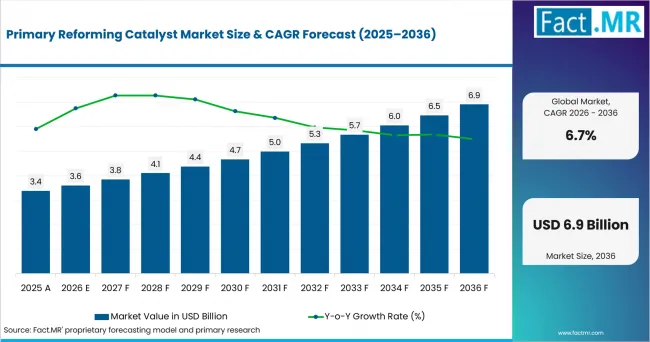
Primary Reforming Catalyst Market Value Analysis | Source: Fact.MR
What are the defining numbers behind Primary Reforming Catalyst Market growth?
An absolute opportunity of USD 3.3 billion is expected between 2026 and 2036.
Global hydrogen demand exceeded 100 million tonnes in 2025, with established industrial uses continuing to account for most consumption. Refining and chemical production remain central hydrogen-demand centers, which keeps reforming assets commercially relevant even as low-emission production pathways expand.
- Demand Drivers in the Market
- Installed hydrogen-production infrastructure: Steam-methane reforming remains a mature route for converting natural gas into hydrogen. Existing reformers require catalysts that maintain conversion, thermal stability and mechanical integrity over long operating cycles.
- Ammonia and methanol production: Reforming is an important front-end process for producing synthesis gas used in ammonia and methanol plants. Commercial catalyst suppliers offer dedicated nickel-based reforming systems for these applications.
- Refinery hydrogen requirements: Hydrogen use remains concentrated in traditional sectors, including refining. Hydroprocessing and other refinery operations therefore support demand for reforming capacity and associated catalyst replacement.
- Efficiency and run-length requirements: Catalyst selection affects conversion, pressure drop and reformer performance. Operators therefore evaluate catalyst geometry, nickel distribution and mechanical stability against production targets and furnace constraints.
- CCUS-enabled hydrogen investment: Carbon capture is being integrated with steam-methane reforming projects, creating a route for existing reforming technology to participate in lower-carbon hydrogen projects.
- Key Segments Analyzed
- By Product: Nickel Based Reforming Catalysts are projected to account for 77.3% share in 2026.
- By Application: Hydrogen Production is forecast to hold 42.6% share in 2026.
- By End Use: Petroleum Refineries are anticipated to account for 69.8% share in 2026.
- By Technology: Fixed Bed Catalytic Reforming is projected to hold 58.9% share in 2026.
- By Formulation: Pellet Catalyst Formulations are forecast to account for 64.1% share in 2026.
- By Distribution Channel: Direct Catalyst Sales are projected to represent 46.7% share in 2026.
- Analyst Opinion at Fact.MR
- Shambhu Nath Jha, Sr. Consultant at Fact.MR, states, “Primary reforming catalyst procurement is closely linked to the economics of the entire reformer rather than catalyst price in isolation. A catalyst that supports stable methane conversion, manageable pressure drop and long operating cycles can protect production availability across hydrogen, ammonia and methanol plants. Suppliers therefore need to prove performance under the buyer’s feed composition and reformer conditions. As carbon-intensity requirements tighten, catalyst design will increasingly be evaluated alongside furnace efficiency and carbon-capture integration.” Fact.MR opines that suppliers able to connect catalyst performance with longer run length and lower reformer energy intensity will strengthen their position through 2036.
- Strategic Implications
- Catalyst suppliers should qualify products against the actual feedstock, reformer configuration and operating severity of each plant instead of relying on generic activity claims.
- Hydrogen producers should evaluate catalyst replacement alongside furnace efficiency and carbon-capture modifications because changes to one part of the reformer can alter operating conditions elsewhere.
- Ammonia and methanol producers should include pressure drop and catalyst mechanical stability in lifecycle-cost comparisons, particularly where extended campaigns are commercially important.
- Refinery buyers should connect catalyst selection with planned turnaround cycles so replacement decisions do not create avoidable plant downtime.
- Suppliers should strengthen technical service around loading patterns, start-up procedures and operating diagnostics because product performance depends on how the reformer is operated.
Germany records the highest listed country CAGR at 7.71%. Brazil follows at 7.04%, while the USA is projected at 6.37%. The UK advances at 5.7% and Japan at 5.03% through 2036.
How does the Primary Reforming Catalyst Market break down by segment?
Nickel Based Reforming Catalysts lead Product with 77.3% share in 2026. Hydrogen Production leads Application at 42.6%. Petroleum Refineries account for 69.8% of End Use. Fixed Bed Catalytic Reforming leads Technology at 58.9%, while Pellet Catalyst Formulations lead Formulation at 64.1%. Direct Catalyst Sales account for 46.7% of Distribution Channel demand.
Why do Nickel Based Reforming Catalysts lead Product?
Nickel Based Reforming Catalysts are projected to account for 77.3% share in 2026.
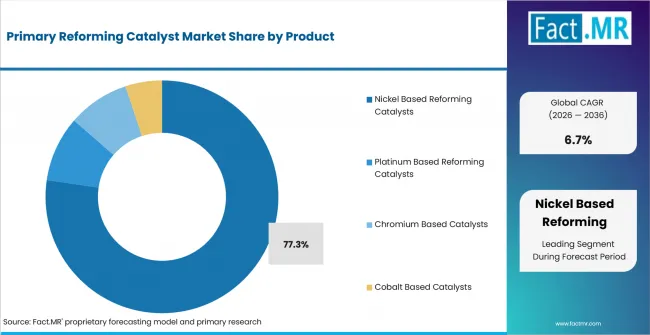
Primary Reforming Catalyst Market Analysis By Product | Source: Fact.MR
Nickel-based systems fit established steam-reforming duties because nickel provides the catalytic activity required to convert hydrocarbon feeds with steam under high-temperature conditions. Johnson Matthey identifies nickel oxide supported on alumina or calcium aluminate in its steam-reforming range. Topsoe also lists nickel-based catalysts for reforming applications, while Clariant supplies nickel-based ReforMax products for hydrogen, ammonia and methanol production.
Promoted Nickel Catalysts are used where catalyst formulation is adjusted for operating requirements such as feed composition or resistance to carbon formation. Bimetallic Nickel Catalysts provide another route for tuning catalyst behavior within defined process environments.
Platinum Based Reforming Catalysts, Chromium Based Catalysts and Cobalt Based Catalysts remain within the assessed Product taxonomy for applications requiring alternative catalyst chemistry.
Why does Hydrogen Production lead Application?
Hydrogen Production is forecast to account for 42.6% share in 2026.
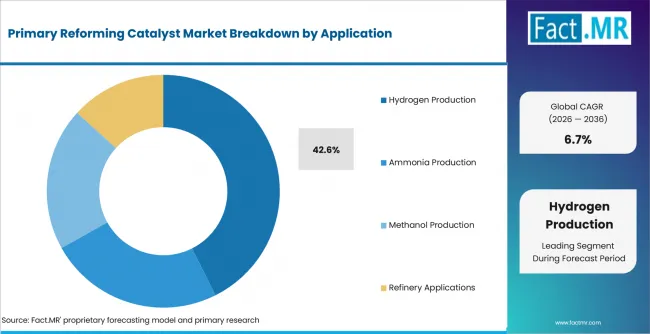
Primary Reforming Catalyst Market Analysis By Application | Source: Fact.MR
Steam-methane reforming remains a mature industrial method for producing hydrogen from natural gas. The process combines methane with steam at elevated temperature in the presence of a catalyst before downstream shift and purification stages produce the required hydrogen stream.
Demand is supported by established hydrogen consumption in refining and chemical production. IEA data show that global hydrogen demand remains concentrated in traditional industrial uses, while new applications still represent a comparatively small part of consumption.
Ammonia Production uses reforming to generate synthesis gas for fertilizer production. Methanol Production requires syngas with a composition suitable for downstream methanol synthesis. Refinery Applications use reforming-derived hydrogen in hydroprocessing and related fuel-upgrading operations.
Why do Petroleum Refineries lead End Use?
Petroleum Refineries are projected to account for 69.8% share in 2026.
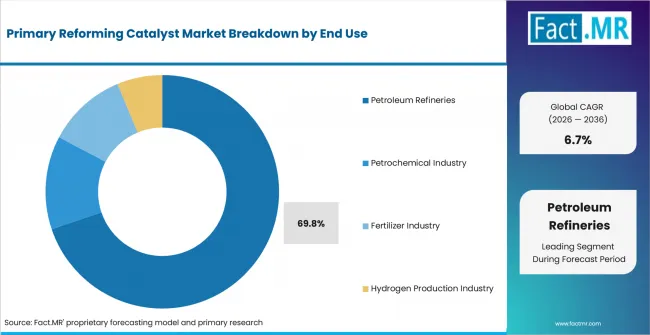
Primary Reforming Catalyst Market Analysis By End Use | Source: Fact.MR
Refineries use hydrogen for hydrotreating and other processing duties that remove impurities or upgrade hydrocarbon streams. Established refinery hydrogen demand supports operation of on-site or merchant reforming plants and creates recurring catalyst requirements over plant operating cycles. The IEA continues to identify refining as a core hydrogen-consuming sector.
Integrated Refinery Complexes can operate large hydrogen networks serving multiple process units, increasing the importance of reformer availability. Independent Refining Companies may procure catalyst against specific hydrogen-unit turnaround schedules and feed conditions.
Petrochemical Industry demand is linked to syngas and basic chemical production. Fertilizer Industry consumption is connected to ammonia and urea plants. Hydrogen Production Industry demand includes industrial gas companies and energy-transition projects using reforming where hydrocarbon-based hydrogen remains part of the selected production route.
Why does Fixed Bed Catalytic Reforming lead Technology?
Fixed Bed Catalytic Reforming is projected to hold 58.9% share in 2026.
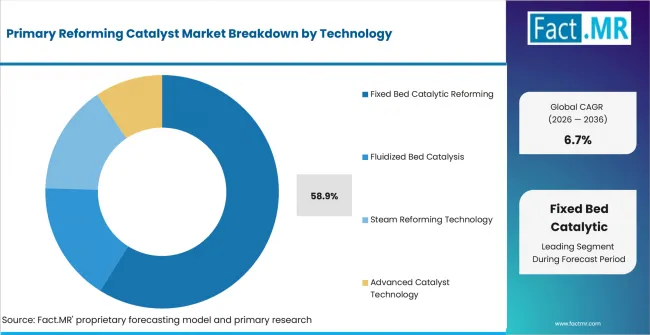
Primary Reforming Catalyst Market Analysis By Technology | Source: Fact.MR
Tubular steam reformers use catalyst-filled tubes where hydrocarbons react with steam as heat is supplied through the reformer furnace. Fixed catalyst beds allow plant operators to design loading patterns around conversion requirements, tube geometry and pressure-drop limits. Commercial catalyst suppliers therefore offer pellets and shaped catalysts engineered for tubular reformer service.
Packed Bed Reactor Systems represent established fixed-bed configurations. Multi Bed Reactor Systems allow catalyst loading to be adapted across separate reactor sections or duties.
Fluidized Bed Catalysis serves applications requiring dynamic catalyst movement. Steam Reforming Technology includes Primary Steam Reformers and Secondary Reforming Systems. Advanced Catalyst Technology covers Nano Structured Catalysts and Promoted Catalyst Systems intended to improve activity or operating performance within defined process conditions.
Why do Pellet Catalyst Formulations lead Formulation?
Pellet Catalyst Formulations are forecast to account for 64.1% share in 2026.
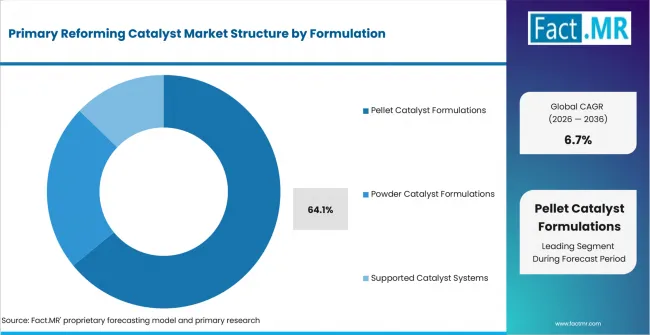
Primary Reforming Catalyst Market Analysis By Formulation | Source: Fact.MR
Pellet geometry matters because reformer operators have to balance exposed catalytic surface with pressure drop and mechanical strength. Commercial steam-reforming catalysts are therefore offered in engineered shapes that seek to improve gas flow while retaining structural integrity through high-temperature operation. Johnson Matthey’s reforming portfolio illustrates the continued commercial focus on engineered pellet geometry and nickel distribution.
Extruded Catalyst Pellets and Spherical Catalyst Pellets serve different reactor-loading and flow requirements. Powder Catalyst Formulations include Fine Powder Catalysts and Granular Catalyst Systems. Supported Catalyst Systems include Alumina Supported Systems and Silica Supported Systems.
Why do Direct Catalyst Sales lead Distribution Channel?
Direct Catalyst Sales are projected to account for 46.7% share in 2026.
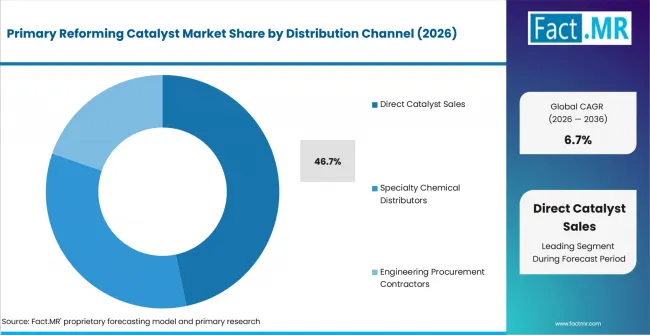
Primary Reforming Catalyst Market Analysis By Distribution Channel | Source: Fact.MR
Large reforming plants require catalyst selection to be connected with operating conditions and technical service. Direct commercial relationships allow suppliers to evaluate feed composition, reformer geometry and expected campaign length before recommending catalyst loading.
OEM Supply Agreements support repeat procurement where catalyst specifications are tied to a process design. Enterprise Procurement Deals cover multi-site or large-volume arrangements.
Specialty Chemical Distributors provide regional access where direct supplier infrastructure is limited. Engineering Procurement Contractors influence catalyst selection during new plants, revamps and major process modifications. Technology Licensing Channels connect catalyst supply with process packages where catalyst performance is integrated into licensed operating conditions.
What is accelerating Primary Reforming Catalyst Market adoption, and what is holding it back?
Demand is being supported by established hydrogen production, continuing refinery consumption and synthesis-gas requirements in ammonia and methanol plants. Growth is also linked to efficiency upgrades and CCUS-enabled reforming projects. Expansion is constrained by decarbonization pressure on unabated fossil-based hydrogen, feedstock-cost volatility and operating risks such as catalyst poisoning or carbon formation.
Which drivers have the greatest commercial effect?
| Driver | (~) % Impact on CAGR | Geographic Relevance | Impact Timeline |
|---|---|---|---|
| Expansion and replacement of industrial hydrogen reforming capacity | +1.8% | USA; Germany; Japan | Near term |
| Ammonia and methanol production requirements | +1.3% | Brazil; USA; Germany | Near to mid term |
| Refinery hydrogen consumption and turnaround-linked catalyst replacement | +0.9% | USA; Japan; UK | Near term |
| Higher reformer efficiency and longer catalyst run length | +0.7% | Global industrial plants | Mid term |
| CCUS-enabled steam-methane reforming projects | +0.6% | USA; UK; Germany | Mid to long term |
- Industrial hydrogen reforming capacity: Existing reformers continue to require catalyst replacement, while new units add installed catalyst volume.
- Ammonia and methanol production: Both sectors depend on synthesis-gas generation, creating direct demand for reforming catalysts suited to plant-specific feed and operating conditions.
- Refinery hydrogen consumption: Refining remains a major established use of hydrogen, sustaining demand for reliable reformer operation.
- Reformer efficiency: Higher activity and lower pressure drop can improve the operating economics of the reformer without requiring a complete process replacement.
- CCUS-enabled reforming: NETL is evaluating carbon-capture configurations for SMR and ATR plants, showing that reforming assets can be combined with carbon-management systems.
Where are the clearest market opportunities?
| Opportunity | (~) % Impact on CAGR | Geographic Relevance | Impact Timeline |
|---|---|---|---|
| Catalyst replacement in CCUS-enabled hydrogen reformers | +1.0% | USA; UK; Germany | Mid term |
| Higher-activity catalysts for lower energy consumption | +0.8% | Germany; Japan; USA | Mid term |
| Reforming of broader hydrocarbon feedstocks | +0.6% | USA; Brazil; refinery markets | Near to mid term |
| Advanced catalyst shapes and loading optimization | +0.5% | Global large-scale plants | Near term |
| Catalyst-service packages for lifecycle performance | +0.4% | Global | Mid term |
- CCUS-enabled hydrogen reformers: Existing SMR assets can become targets for carbon-capture retrofits where project economics and carbon standards permit. DOE and NETL have supported engineering work around carbon capture from reformer-based hydrogen production.
- Higher-activity catalysts: Catalyst suppliers can differentiate through formulations that maintain conversion while addressing pressure drop and mechanical stability.
- Feedstock flexibility: Commercial reforming catalyst portfolios cover feedstocks ranging from natural gas to heavier hydrocarbons, creating opportunities in plants with changing feed availability.
- Loading optimization: Engineered catalyst shapes provide a route to balance catalytic surface and gas-flow resistance inside reformer tubes.
- Lifecycle service: Technical support around loading and operating diagnostics can increase supplier involvement beyond the initial catalyst sale.
Which restraints limit wider growth?
| (~) % Impact on CAGR | Geographic Relevance | Impact Timeline | |
|---|---|---|---|
| Shift toward electrolytic hydrogen in new low-carbon projects | -1.1% | Germany; UK; Japan | Long term |
| Natural gas and reformer-energy cost volatility | -0.8% | Global | Near term |
| Carbon-intensity regulation for fossil-based hydrogen | -0.7% | Europe; Japan; USA | Mid term |
| Catalyst poisoning, carbon formation and thermal degradation | -0.6% | Global reformer operators | Near to mid term |
| Long catalyst operating campaigns limiting replacement frequency | -0.4% | Mature industrial plants | Mid term |
- Electrolytic hydrogen substitution: Governments are supporting electrolysis as part of low-carbon hydrogen strategies, which can reduce the share of new hydrogen projects requiring conventional primary reforming catalysts over the longer term. Germany targets at least 10 GW of domestic electrolyser capacity by 2030, while the UK states that at least half of its 10 GW low-carbon hydrogen ambition should come from electrolytic hydrogen.
- Energy-cost exposure: Steam reforming requires hydrocarbon feed and substantial process heat, so changes in natural-gas economics can influence plant utilization and investment decisions.
- Carbon-intensity requirements: Governments are setting frameworks that differentiate hydrogen by lifecycle emissions, increasing pressure on unabated reforming assets. Brazil has established a legal framework for low-carbon hydrogen, while the UK uses a Low Carbon Hydrogen Standard.
- Catalyst degradation: Sulfur and other contaminants can affect reforming catalyst performance. Feed purification and disciplined operating conditions are therefore important for maintaining catalyst life.
- Replacement-cycle length: Catalyst improvements that extend run length benefit the operator but can reduce replacement frequency for suppliers.
Which countries are scaling the Primary Reforming Catalyst Market fastest?
The listed country outlook reflects differences in refinery assets, chemical-production infrastructure and hydrogen policy. Germany records the highest CAGR at 7.71%, followed by Brazil at 7.04%. The USA is projected at 6.37%, while the UK records 5.7% and Japan 5.03%.
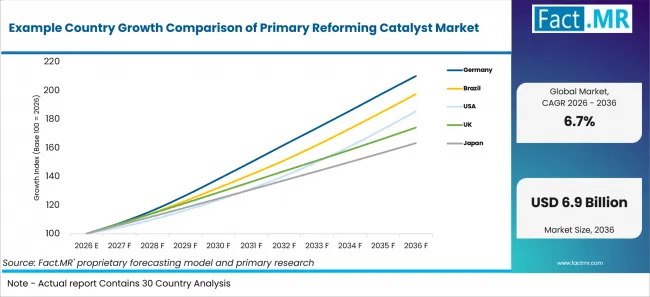
Example Country Growth Comparison Of Primary Reforming Catalyst Market | Source: Fact.MR
| Country | CAGR (2026-2036) |
|---|---|
| Germany | 7.71% |
| Brazil | 7.04% |
| USA | 6.37% |
| UK | 5.7% |
| Japan | 5.03% |
What is driving Germany's growth through 2036?
7.71% CAGR, supported by hydrogen infrastructure development and industrial decarbonization requirements.
Germany’s hydrogen strategy anticipates national demand for hydrogen and hydrogen derivatives of 95 to 130 TWh by 2030. The strategy also targets at least 10 GW of domestic electrolyser capacity. For the reforming-catalyst market, this creates a mixed effect. Industrial hydrogen demand supports catalyst-related activity in existing chemical and refining systems, while the shift toward electrolytic hydrogen creates longer-term substitution pressure for conventional reforming.
Catalyst suppliers can therefore compete around efficiency and transition-compatible reforming solutions, particularly where an existing plant remains economically useful during a staged move toward lower-carbon feedstocks or production routes.
What supports Brazil's growth?
7.04% CAGR, supported by refinery activity, fertilizer requirements and emerging low-carbon hydrogen investment.
Brazil has established a national legal framework for low-carbon hydrogen. The framework introduces certification and regulatory mechanisms intended to support hydrogen-sector development.
For reforming catalysts, near-term demand remains tied to established industrial uses such as refining and chemical production. New low-carbon requirements can increase interest in reformer efficiency and carbon-management integration where hydrocarbon reforming remains part of the project configuration.
How does the USA scale demand?
6.37% CAGR, driven by existing steam-methane reforming infrastructure and refinery hydrogen consumption.
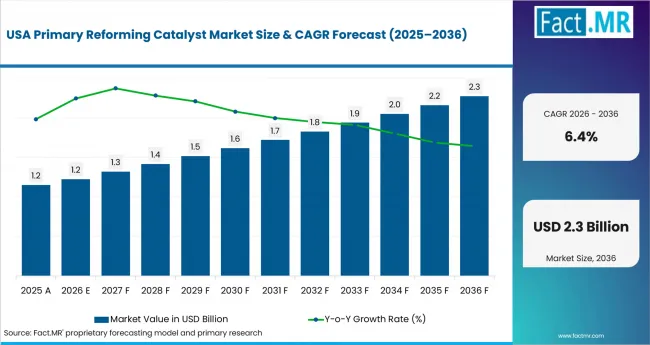
Primary Reforming Catalyst Market Country Value Analysis | Source: Fact.MR
The U.S. Department of Energy describes steam-methane reforming as a mature hydrogen-production process and notes that most hydrogen produced in the United States has historically been made through this route.
The country also provides an important test bed for integrating carbon capture with existing hydrogen reformers. NETL has supported engineering work for capture systems at steam-methane reforming facilities, creating opportunities for catalyst replacement and operating optimization alongside decarbonization upgrades.
What is driving the UK's growth?
5.7% CAGR, supported by industrial hydrogen requirements and development of CCUS-enabled production.
The UK is targeting up to 10 GW of low-carbon hydrogen production capacity by 2030, subject to affordability and value for money. Government policy provides for both electrolytic hydrogen and CCUS-enabled production.
This creates a pathway for reforming catalysts where methane reforming is paired with carbon capture. The opportunity is therefore concentrated in projects that can meet low-carbon requirements rather than unrestricted expansion of conventional unabated reforming.
What is shaping Japan's growth?
5.03% CAGR, supported by established refining and chemical demand alongside a broader hydrogen strategy.
Japan’s revised Basic Hydrogen Strategy sets supply ambitions extending through 2030 and 2040 as the country develops hydrogen and ammonia value chains.
Primary reforming catalyst demand remains connected with existing refinery and chemical infrastructure. Suppliers face a market in which conventional reforming must increasingly demonstrate operating efficiency while buyers evaluate imported hydrogen, ammonia and other lower-carbon alternatives.
Who are the key companies in the Primary Reforming Catalyst Market?
The company set includes Johnson Matthey; Haldor Topsoe; Honeywell International Inc.; Süd-Chemie; TANAKA HOLDINGS Co., Ltd; ThyssenKrupp AG; Chempack; Clariant; and China Petroleum & Chemical Corporation.
Johnson Matthey offers steam-methane reforming catalysts for ammonia, methanol and hydrogen production, with catalyst ranges engineered for different feedstocks and reformer duties.
Haldor Topsoe is included in the supplied competitive set. Topsoe’s current reforming portfolio includes nickel-based catalysts for tubular, secondary and autothermal reforming duties.
Clariant offers ReforMax nickel-based catalysts for steam reforming of hydrocarbon feedstocks used in ammonia, hydrogen and methanol production.
Competition is shaped by catalyst activity and mechanical stability, along with technical support over the operating cycle. Feedstock tolerance and pressure-drop management also affect qualification. Fact.MR opines that suppliers able to document plant-level operating outcomes will have stronger commercial positioning than suppliers relying on catalyst chemistry alone.
Which companies are the key providers?
Key companies include Johnson Matthey; Haldor Topsoe; Honeywell International Inc.; Süd-Chemie; TANAKA HOLDINGS Co., Ltd.; ThyssenKrupp AG; Chempack; Clariant; and China Petroleum & Chemical Corporation.
- Johnson Matthey
- Haldor Topsoe
- Honeywell International Inc.
- Süd-Chemie
- TANAKA HOLDINGS Co., Ltd
- ThyssenKrupp AG
- Chempack
- Clariant
- China Petroleum & Chemical Corporation
What is the report's scope and coverage?
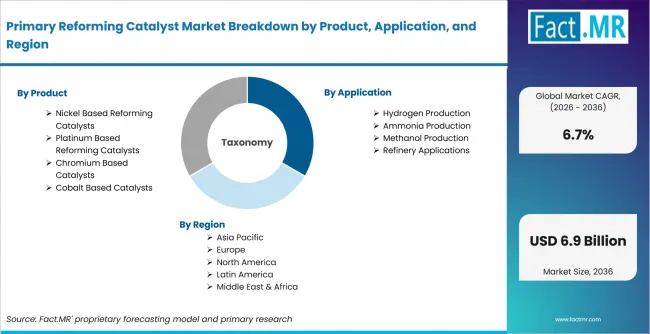
Primary Reforming Catalyst Market Breakdown By Product, Application, And Region | Source: Fact.MR
| Attribute | Details |
|---|---|
| Quantitative Units | USD Billion |
| Market Definition | Reforming catalysts supplied for primary hydrocarbon reforming and associated hydrogen or synthesis-gas production duties |
| Product | Nickel Based Reforming Catalysts; Platinum Based Reforming Catalysts; Chromium Based Catalysts; Cobalt Based Catalysts |
| Application | Hydrogen Production; Ammonia Production; Methanol Production; Refinery Applications |
| End Use | Petroleum Refineries; Petrochemical Industry; Fertilizer Industry; Hydrogen Production Industry |
| Technology | Fixed Bed Catalytic Reforming; Fluidized Bed Catalysis; Steam Reforming Technology; Advanced Catalyst Technology |
| Formulation | Pellet Catalyst Formulations; Powder Catalyst Formulations; Supported Catalyst Systems |
| Distribution Channel | Direct Catalyst Sales; Specialty Chemical Distributors; Engineering Procurement Contractors |
| Countries Covered | Germany; Brazil; USA; UK; Japan |
| Key Companies Profiled | Johnson Matthey; Haldor Topsoe; Honeywell International Inc.; Süd-Chemie; TANAKA HOLDINGS Co., Ltd; ThyssenKrupp AG; Chempack; Clariant; China Petroleum & Chemical Corporation |
| Forecast Period | 2026 to 2036 |
| Base Year | 2025 |
How is the market segmented?
-
By Product
- Nickel Based Reforming Catalysts
- Promoted Nickel Catalysts
- Bimetallic Nickel Catalysts
- Platinum Based Reforming Catalysts
- Platinum Alumina Catalysts
- Platinum Rhenium Catalysts
- Chromium Based Catalysts
- Chromium Oxide Catalysts
- Mixed Metal Chromium Catalysts
- Cobalt Based Catalysts
- Cobalt Alumina Catalysts
- Cobalt Nickel Hybrid Catalysts
- Nickel Based Reforming Catalysts
-
By Application
- Hydrogen Production
- Steam Reforming Processes
- Hydrogen Purification Systems
- Ammonia Production
- Syngas Generation Applications
- Fertilizer Production Plants
- Methanol Production
- Syngas to Methanol Conversion
- Chemical Intermediate Production
- Refinery Applications
- Hydrocarbon Reforming Units
- Fuel Upgrading Systems
- Hydrogen Production
-
By End Use
- Petroleum Refineries
- Integrated Refinery Complexes
- Independent Refining Companies
- Petrochemical Industry
- Basic Chemical Producers
- Specialty Chemical Manufacturers
- Fertilizer Industry
- Ammonia Producers
- Urea Manufacturing Plants
- Hydrogen Production Industry
- Industrial Gas Companies
- Energy Transition Companies
- Petroleum Refineries
-
By Technology
- Fixed Bed Catalytic Reforming
- Packed Bed Reactor Systems
- Multi Bed Reactor Systems
- Fluidized Bed Catalysis
- Circulating Catalyst Systems
- Dynamic Bed Systems
- Steam Reforming Technology
- Primary Steam Reformers
- Secondary Reforming Systems
- Advanced Catalyst Technology
- Nano Structured Catalysts
- Promoted Catalyst Systems
- Fixed Bed Catalytic Reforming
-
By Formulation
- Pellet Catalyst Formulations
- Extruded Catalyst Pellets
- Spherical Catalyst Pellets
- Powder Catalyst Formulations
- Fine Powder Catalysts
- Granular Catalyst Systems
- Supported Catalyst Systems
- Alumina Supported Systems
- Silica Supported Systems
- Pellet Catalyst Formulations
-
By Distribution Channel
- Direct Catalyst Sales
- OEM Supply Agreements
- Enterprise Procurement Deals
- Specialty Chemical Distributors
- Regional Distributors
- Global Chemical Distributors
- Engineering Procurement Contractors
- EPC Project Supply Chains
- Technology Licensing Channels
- Direct Catalyst Sales
Bibliography
- U.S. Department of Energy. Hydrogen Production: Natural Gas Reforming.
- U.S. Department of Energy. Hydrogen Production Pathways.
- National Energy Technology Laboratory. Point Source Carbon Capture from Industrial Sources.
- International Energy Agency. Global Hydrogen Review 2026: Demand.
- International Energy Agency. Global Hydrogen Review 2026: Executive Summary.
- Federal Ministry for Economic Affairs and Climate Action, Germany. The National Hydrogen Strategy.
- Brazil National Agency of Petroleum, Natural Gas and Biofuels. Brazil Hydrogen Legal and Regulatory Framework.
- UK Department for Energy Security and Net Zero. Hydrogen Production Delivery Roadmap.
- UK Department for Energy Security and Net Zero. UK Hydrogen Strategy.
- Japan Ministry of Economy, Trade and Industry. Basic Hydrogen Strategy and GX Transition Framework.
- Johnson Matthey. Steam Methane Reforming Catalysts.
- Topsoe. Syngas Reforming and Reforming Catalyst Portfolio.
- Clariant. ReforMax Steam Reforming Catalysts.
- Fact.MR Research Analysis, 2026.
This Report Answers
- How primary reforming catalyst demand is developing across the forecast period.
- How Product choices differ across catalyst chemistry and supported systems.
- Which applications are shaping demand across hydrogen, ammonia, methanol and refinery reforming.
- How catalyst demand differs across refinery, petrochemical and fertilizer users.
- How fixed-bed and other reforming technologies affect catalyst selection.
- Which formulation characteristics influence reactor loading and operating performance.
- How direct supply and EPC procurement channels shape commercial access.
- How growth conditions differ across the listed country markets.
- Which companies participate across reforming catalyst supply.
- Which demand drivers and operating restraints influence procurement decisions.
What does the Primary Reforming Catalyst Market cover?
The market covers catalysts sold for primary reforming and associated hydrocarbon-to-syngas duties within the defined Product, Application, End Use, Technology, Formulation and Distribution Channel taxonomy.
Coverage includes catalysts used in hydrogen-production reformers and syngas generation for ammonia or methanol plants. Refinery reforming applications are included where the catalyst revenue falls within the defined market. Catalyst formulations include pellet, powder and supported systems.
The country assessment covers Germany, Brazil, the USA, the UK and Japan. Company coverage is limited to the listed provider set.
What is included in the scope?
The scope includes Nickel Based Reforming Catalysts, Platinum Based Reforming Catalysts, Chromium Based Catalysts and Cobalt Based Catalysts.
- Application coverage includes Hydrogen Production, Ammonia Production, Methanol Production and Refinery Applications.
- End Use covers Petroleum Refineries, Petrochemical Industry, Fertilizer Industry and Hydrogen Production Industry.
- Technology coverage includes Fixed Bed Catalytic Reforming, Fluidized Bed Catalysis, Steam Reforming Technology and Advanced Catalyst Technology.
- Formulation coverage includes Pellet Catalyst Formulations, Powder Catalyst Formulations and Supported Catalyst Systems.
- Distribution Channel coverage includes Direct Catalyst Sales, Specialty Chemical Distributors and Engineering Procurement Contractors.
What is excluded from the scope?
The scope excludes catalysts used solely in downstream synthesis reactions when they are sold separately from the defined primary reforming catalyst market.
Methanol synthesis catalysts are excluded when their only function is conversion of synthesis gas into methanol after reforming. Ammonia synthesis catalysts used exclusively in the Haber-Bosch synthesis loop are excluded.
Hydrogen purification media and shift catalysts are excluded when sold as independent products outside the defined reforming catalyst system. Stand-alone carbon-capture equipment, reformer furnaces and hydrogen purification hardware are outside the catalyst revenue assessment unless their catalyst component is separately attributable to the defined market.
General refinery catalysts used exclusively for catalytic cracking, hydrocracking or hydrotreating are outside the scope when they do not perform a reforming duty covered by the market definition.
How Was the Analysis Built?
The analysis combines primary research with public technical records, company product information and country-level industrial evidence. Market sizing is reconciled against the supplied quantitative forecast and segment structure.
- Primary Research: Primary research considers catalyst suppliers, process licensors, engineering contractors, hydrogen producers, refinery operators and chemical-plant users. Discussions focus on catalyst replacement timing, feedstock conditions, operating life and procurement criteria.
- Desk Research: Desk research reviews government hydrogen policies, energy-agency publications, technical documents and company catalyst portfolios. External evidence is used for market context rather than replacing the quantitative forecast.
- Market Sizing and Forecasting: Market sizing evaluates catalyst demand across Product, Application, End Use, Technology, Formulation and Distribution Channel. Forecast interpretation considers installed reformer capacity, replacement requirements and hydrogen-production investment.
- Data Validation and Update Cycle: Findings are checked for consistency between market definition, segment hierarchy, country outlook and company scope. Quantitative values are reviewed against the stated 2026 and 2036 market positions.