- Market Value (2025): USD 5.1 Bn
- Estimated Value (2026): USD 5.4 Bn
- Forecast Value (2036): USD 9.1 Bn
- CAGR (2026-2036): 5.4%
What is the Beverage Encapsulants Market forecast to be worth by 2036?
USD 5.4 billion in 2026 to USD 9.1 billion by 2036 at 5.4% CAGR.
- The beverage encapsulants market crossed a valuation of USD 5.1 billion in 2025 as beverage brands reformulated around taste stability and ingredient protection.
- Demand is projected to increase from USD 5.4 billion in 2026 to USD 9.1 billion by 2036.
- The market is forecast to record 5.4% CAGR from 2026 to 2036 as soft drink manufacturers and functional beverage teams require cleaner flavor delivery.
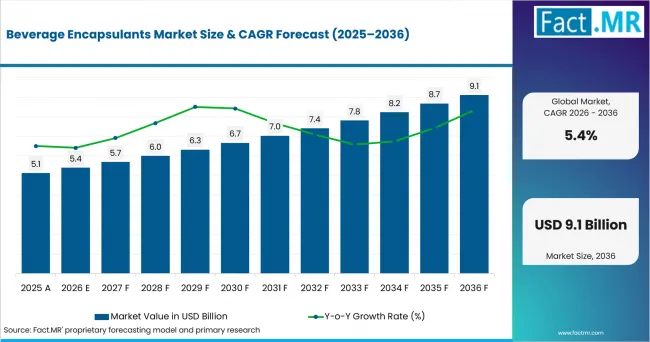
Beverage Encapsulants Market Value Analysis | Source: Fact.MR
What are the defining numbers behind Beverage Encapsulants Market growth?
USD 3.7 billion absolute opportunity by 2036, led by Flavor Encapsulants, Carbonated Soft Drinks and Direct Industrial Sales.
- Demand Drivers in the Market
- Soft drink formulators need protected flavors so citrus, cola and botanical notes survive carbonation and storage.
- Functional beverage teams require vitamin and caffeine systems that mask harsh taste while keeping active ingredients stable. In September 2025, the U.S. FDA made its order effective for vitamin D3 at up to 178 IU per 100 g in yogurt and other cultured dairy products, giving dairy beverage developers another fortification reference.
- Dairy beverage manufacturers depend on encapsulated colors and flavors to control separation and heat-processing losses.
- Procurement teams prefer direct industrial sales where formulation support and repeat supply can be tested before scale-up.
- Key Segments Analyzed
- By Product: Flavor Encapsulants are expected to hold 68.40% share in 2026 owing to daily use in taste protection and release control.
- By Application: Carbonated Soft Drinks are projected to account for 42.60% share in 2026 due to large-volume flavor dosing needs.
- By End Use: Beverage Manufacturers are anticipated to capture 61.90% share in 2026 as in-house plants buy encapsulants for routine formulation work.
- By Technology: Spray Dry Encapsulation Technology is estimated to represent 54.30% share in 2026 because it suits commercial powder handling.
- By Formulation: Powder Based Formulations are forecast to hold 47.80% share in 2026 supported by storage stability and simple dosing.
- By Distribution Channel: Direct Industrial Sales are expected to reach 66.20% share in 2026 as technical teams work directly with beverage plants.
- Analyst Opinion at Fact.MR
- Shambhu Nath Jha, Principal Consultant at Fact.MR, states, “Beverage encapsulants are becoming a formulation control tool, not just a carrier. Suppliers are expected to gain preference when release behavior and stability are proven in the customer’s beverage base.”
- Strategic Implications
- Beverage brands should test encapsulated flavors under carbonation and thermal conditions before committing to full plant trials.
- Ingredient suppliers should document release behavior and shelf-life protection for each beverage format they target.
- Contract manufacturers should align powder handling, storage and dosing systems with encapsulant moisture limits.
- Investors should separate direct encapsulation exposure from general flavor or sweetener sales when reviewing suppliers.
Germany is expected to record 6.2% CAGR through 2036 as no-alcohol beer raises protected flavor needs. Brazil is projected to post 5.7% CAGR as beverage variety expands. The USA is anticipated at 5.1% CAGR as color reformulation continues. The UK is estimated at 4.6% CAGR under sugar levy pressure. Japan is forecast at 4.1% CAGR as premium runs require clean release.
How does the Beverage Encapsulants Market break down by segment?
Flavor Encapsulants lead at 68.40%; Carbonated Soft Drinks lead at 42.60%.
Which product dominates?
Flavor Encapsulants are projected to account for 68.40% share in 2026.
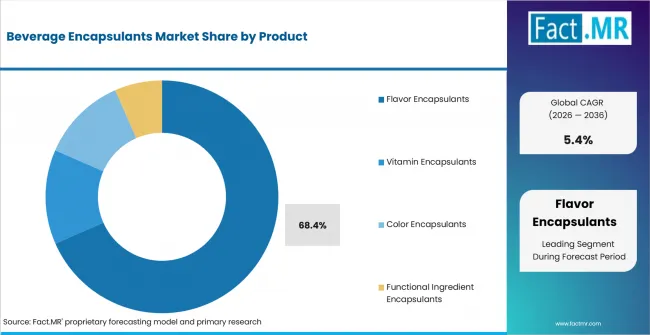
Beverage Encapsulants Market Analysis By Product | Source: Fact.MR
Flavor Encapsulants are projected to lead Product owing to their role in cola, citrus and fruit aroma protection. Spray Dried Flavor Encapsulants suit high-volume powders, while Microencapsulated Liquid Flavors support delayed release in premium beverages.
What leads the Application segment?
Carbonated Soft Drinks are expected to hold 42.60% share in 2026.
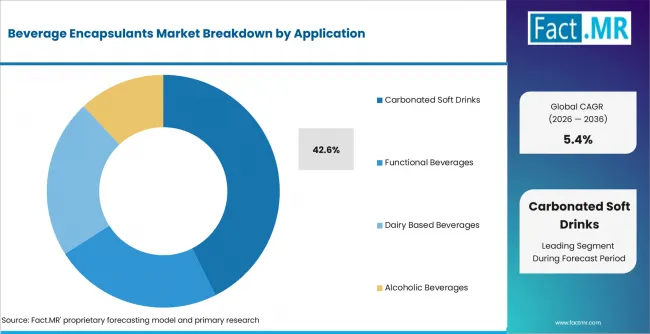
Beverage Encapsulants Market Analysis By Application | Source: Fact.MR
Carbonated Soft Drinks are expected to hold the main Application share due to repeat flavor dosing. Cola Based Beverages need stable flavor under carbonation. Fruit Flavored Soft Drinks use encapsulation to protect aroma.
How does End Use shape demand?
Beverage Manufacturers are anticipated to lead with 61.90% share in 2026.
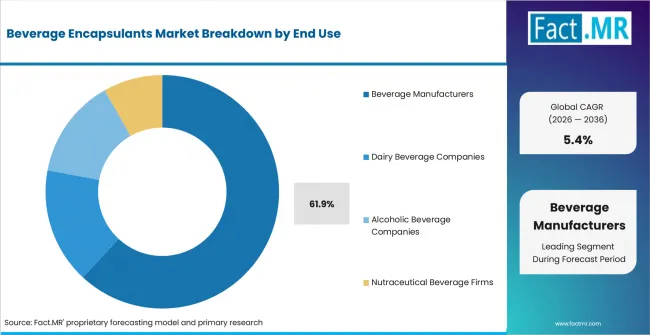
Beverage Encapsulants Market Analysis By End Use | Source: Fact.MR
Beverage Manufacturers are anticipated to lead End Use as they buy encapsulated systems for recurring production and plant-level trials. Functional Beverage Companies require active protection, while Dairy Beverage Companies use encapsulated systems for heat-treated drinks.
What supports Spray Dry Encapsulation Technology?
Spray Dry Encapsulation Technology is estimated to represent 54.30% share in 2026.
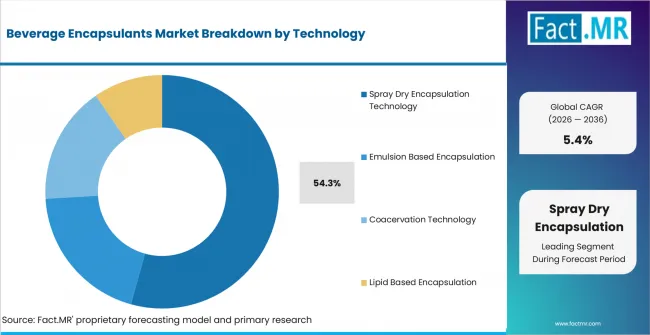
Beverage Encapsulants Market Analysis By Technology | Source: Fact.MR
Spray Dry Encapsulation Technology is estimated to lead Technology because it converts flavor emulsions into stable powders at commercial scale. Controlled Particle Formation is useful when dispersibility affects mouthfeel.
What supports Powder Based Formulations?
Powder Based Formulations are forecast to hold 47.80% share in 2026.
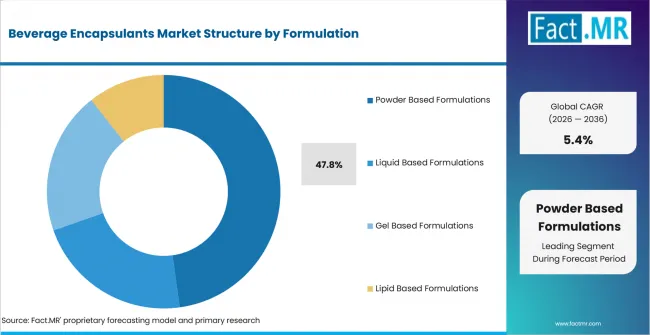
Beverage Encapsulants Market Analysis By Formulation | Source: Fact.MR
Powder Based Formulations are forecast to lead Formulation due to shelf stability and easier handling. Spray Dried Powders suit contract manufacturers, while Granulated Powder Systems reduce dust and improve flow.
Which Distribution Channel leads?
Direct Industrial Sales are expected to account for 66.20% share in 2026.
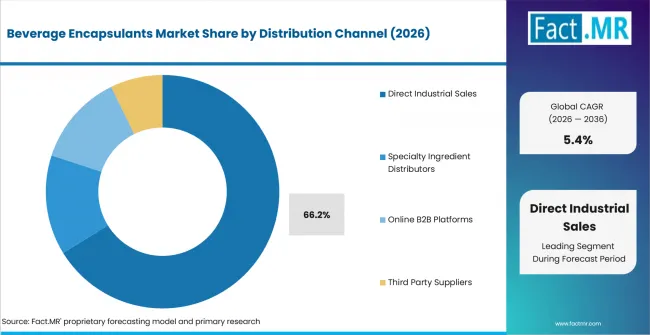
Beverage Encapsulants Market Analysis By Distribution Channel | Source: Fact.MR
Direct Industrial Sales are expected to lead Distribution Channel as beverage manufacturers need application support before purchase orders scale. Beverage Manufacturer Contracts create repeat business when a formulation is locked.
What is accelerating Beverage Encapsulants Market adoption, and what is holding it back?
Flavor protection drives it; regulatory and stability limits restrain it.
Drivers Impact Analysis
| DRIVER | (~) % IMPACT ON CAGR | GEOGRAPHIC RELEVANCE | IMPACT TIMELINE |
|---|---|---|---|
| Carbonated flavor stability | +1.3% | USA, Brazil, Germany | Short term (<= 2 years) |
| Functional ingredient masking | +1.0% | USA, UK, Japan | Short term (<= 2 years) |
| Natural color reformulation | +0.8% | USA and Europe | Medium term (2-4 years) |
| Powder handling and storage | +0.6% | Global beverage plants | Medium term (2-4 years) |
| Direct technical selling | +0.4% | Large manufacturers | Long term (>= 4 years) |
- Carbonated flavor stability: Carbonated soft drinks place pressure on flavor systems because volatile notes can fade during storage. Encapsulation is expected to favor suppliers that prove release after carbonation and chilled distribution.
- Functional ingredient masking: Vitamins, caffeine and botanicals often create bitterness in water, dairy and sports drink bases. Encapsulants help mask off-notes while reducing interaction with acids and minerals.
- Natural color reformulation: Color Encapsulants gain value when brands move away from synthetic colors. In October 2025, Sensient reported Color Group revenue of USD 178.2 million for Q3 2025, up USD 16.1 million from Q3 2024. The U.S. FDA also listed Gardenia (Genipin) Blue as permanently exempt from certification for sport drinks, flavored or enhanced noncarbonated water, fruit drinks and ready-to-drink teas effective August 29, 2025.
- Powder handling and storage: Powder systems support concentrated flavor logistics for plants that run several beverage lines. Better flow and lower moisture sensitivity are expected to reduce waste in ingredient rooms.
- Direct technical selling: Direct industrial sales remain valuable because beverage encapsulants behave differently in each drink base. Supplier labs can adjust wall materials, particle size and carriers before commercialization.
Opportunity Impact Analysis
| OPPORTUNITY | (~) % IMPACT ON CAGR | GEOGRAPHIC RELEVANCE | IMPACT TIMELINE |
|---|---|---|---|
| No-alcohol beverage flavor systems | +0.7% | Germany, UK, Japan | Short term (<= 2 years) |
| Encapsulated natural colors | +0.6% | USA and Europe | Medium term (2-4 years) |
| Premix and functional powders | +0.5% | USA and East Asia | Medium term (2-4 years) |
| Regional beverage application labs | +0.4% | Brazil and Asia Pacific | Long term (>= 4 years) |
- No-alcohol beverage flavor systems: No-alcohol beer and mocktail concepts need flavor protection without ethanol masking. Suppliers that prove clean release in low-sugar bases are expected to gain trial work. In September 2025, IFF launched SipScape for adult beverage innovation, covering product design, flavor modulation and sweetness reduction in no- and low-alcohol beverages.
- Encapsulated natural colors: Natural colors create opportunity where brands need visual appeal and label compliance. Encapsulation helps limit fading and ingredient interaction in acidic beverages.
- Premix and functional powders: Functional beverage premixes need stable vitamins and masked minerals in easy-dose formats. Powder encapsulants are expected to fit stick packs and ready-to-mix beverages. In October 2025, Balchem said it had approvals to build a food ingredient and nutraceutical microencapsulation facility in Orange County, New York, planned to more than double capacity for its fast-growing microencapsulation technologies.
Restraints Impact Analysis
| RESTRAINT | (~) % IMPACT ON CAGR | GEOGRAPHIC RELEVANCE | IMPACT TIMELINE |
|---|---|---|---|
| Cost versus standard flavors | -0.8% | Price-sensitive beverage plants | Short term (<= 2 years) |
| Regulatory reformulation risk | -0.6% | USA, UK, Europe | Short term (<= 2 years) |
| Sensory release mismatch | -0.5% | Functional drinks | Medium term (2-4 years) |
| Powder dispersion limits | -0.3% | Dairy and acidic drinks | Medium term (2-4 years) |
- Cost versus standard flavors: Encapsulated systems cost more than many liquid flavors. Smaller brands are expected to delay adoption where the sensory benefit is hard to prove.
- Regulatory reformulation risk: Color rules are expected to create reformulation work across natural and certified systems. In April 2025, HHS and the FDA announced measures to eliminate six remaining petroleum-based synthetic dyes from the U.S. food supply. Beverage developers are expected to need replacement colors that meet stability and labeling checks.
- Sensory release mismatch: Encapsulation fails when flavor releases too early or creates a powdery mouthfeel. Functional drinks are more exposed because caffeine, botanicals and minerals already make balancing difficult.
- Powder dispersion limits: Some encapsulated powders disperse slowly in cold, acidic or high-solids beverages. Poor dispersion can push customers back to liquid systems even when powders look cheaper.
Which countries are scaling Beverage Encapsulants Market fastest?
- The country comparison spans 2.1 percentage points across the forecast period, with Germany leading the displayed markets at 6.2% CAGR.
- Germany remains 0.5 percentage point above Brazil through no-alcohol beer growth, premium beverage reformulation and protected flavor requirements.
- Brazil remains 0.6 percentage point above the USA as beer variety, soft drink localization and regional beverage development support encapsulant demand.
- The USA remains 0.5 percentage point above the UK through natural color reformulation, functional beverage trials and expanding application support.
- The UK remains 0.5 percentage point above Japan as sugar levy reformulation and clean-label requirements sustain flavor and sweetness-modulation work.
- Japan closes the displayed range at 4.1% CAGR through premium beverage formats, compact manufacturing runs and demand for clean sensory release.
Comparable CAGRs can create different entry conditions because beverage formats, regulatory requirements, formulation priorities and technical-support needs vary by country. Full report coverage includes North America, Latin America, Europe, East Asia, South Asia and Pacific, and Middle East and Africa.
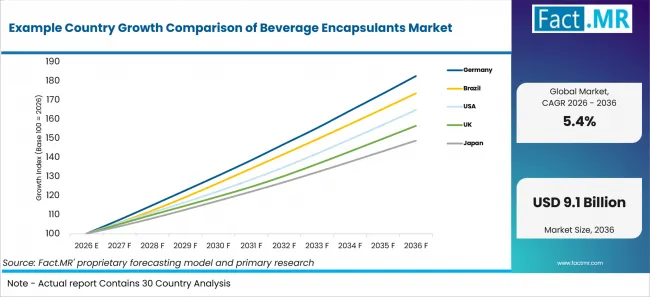
Example Country Growth Comparison Of Beverage Encapsulants Market | Source: Fact.MR
| Country | CAGR (2026-2036) |
|---|---|
| Germany | 6.2% |
| Brazil | 5.7% |
| USA | 5.1% |
| UK | 4.6% |
| Japan | 4.1% |
What is powering Germany's lead?
6.2% CAGR through 2036, driven by no-alcohol beer and premium beverage reformulation.
Germany’s growth reflects rising demand for protected hop, malt and fruit flavor systems as no-alcohol beer expands its sensory range. In July 2025, Destatis reported that Germany produced nearly 579 million liters of non-alcoholic beer in 2024, up 96.1% over ten years. Carbonated soft drink and beer-mix producers use encapsulated flavors to limit aroma loss during storage and chilled distribution, while ingredient teams are expected to favor direct supplier trials where powder flow and sensory release can be tested in local drink bases.
How is Brazil scaling Beverage Encapsulants demand?
5.7% CAGR through 2036, supported by beer variety and soft drink localization.
Brazil’s growth is supported by breweries and beverage brands that need encapsulated flavors to manage fruit, malt and botanical profiles across regional formulas. Local beverage development is expected to keep direct industrial sales relevant where suppliers adapt flavors to tropical and low-sugar formats. Small breweries can still limit adoption because technical trials and minimum order volumes are harder to justify, while imported encapsulants face freight, currency and lead-time pressure when regional distributors cannot hold enough stock. Regulatory filing and label review can also slow launches when color or active ingredients must be documented under MAPA beverage rules.
What supports the USA outlook?
5.1% CAGR through 2036, driven by color reformulation and functional beverage trials.
The USA’s growth reflects rising application trials as vitamins, caffeine and botanicals often require taste masking in beverage formulations. In May 2025, the FDA listed Galdieria extract blue for non-alcoholic beverages and dairy smoothies, with the listing also covering fruit drinks and nutritional beverages. Beverage developers are expected to demand more proof as natural colors and encapsulated actives move into mainstream drinks.
How does the UK market perform?
4.6% CAGR through 2036, shaped by sugar levy reformulation and clean-label pressure.
The UK’s growth is shaped by soft drink producers using encapsulated flavors and sweetness modulators to maintain acceptable taste after sugar reduction. HMRC guidance updated in March 2026 listed the higher SDIL rate at GBP 2.59 per 10 liters from April 2025 for drinks with at least 8g sugar per 100ml. Smaller brands are expected to choose simpler flavors when encapsulated systems add cost to short production runs, while natural color approvals and documentation can slow launches when brands need clean-label claims and stable appearance.
What underpins Japan's growth?
4.1% CAGR through 2036, led by premium beverage formats and compact manufacturing runs.
Japan’s growth is supported by smaller premium launches where taste precision and active stability carry more weight than bulk volume. Ready-to-drink teas, dairy drinks and functional beverages create steady need for encapsulated vitamins and flavors that disperse cleanly, while Japanese beverage manufacturers are expected to value suppliers that support low-dose powders and clean sensory release. Japan’s strict sensory expectations can still slow adoption when encapsulated powders affect aroma release or mouthfeel. Low-volume product cycles are expected to limit scale benefits for encapsulant suppliers unless they offer small-batch technical support, while imported specialty systems can face longer qualification where local documentation and food additive review are required.
Who leads the Beverage Encapsulants Market?
Kerry Group plc and dsm-firmenich lead direct beverage flavor coverage, while Givaudan SA and IFF strengthen taste and application support.
Kerry Group plc, dsm-firmenich, Givaudan SA and IFF carry broad flavor portfolios and beverage application support. These companies help drink brands test taste masking, flavor release and clean-label color replacement before scale-up.
Ingredion and Cargill add carrier depth for spray dried and powder based systems. Tate & Lyle and ADM add formulation support. Competition is expected to depend on release testing, regulatory files and customer trials before scale-up. Lycored added natural color coverage in July 2025 when it debuted 3 superstable nature-based color emulsions for food, beverage and dietary supplement products, including shades positioned for juice beverages, concentrates and clear beverages.
Which companies are the key providers?
Kerry Group plc and dsm-firmenich are key providers. Givaudan SA, IFF, Symrise AG and Sensient Technologies Corporation are also profiled. The wider company set includes carrier, color, flavor and formulation specialists.
- Kerry Group plc
- Ingredion Incorporated
- Cargill, Incorporated
- Tate & Lyle PLC
- dsm-firmenich
- Symrise AG
- International Flavors & Fragrances Inc. (IFF)
- Givaudan SA
- Sensient Technologies Corporation
- Lycored Ltd.
- Archer Daniels Midland (ADM)
- Balchem Corporation
- Roquette Frères
- Nexira SAS
- FrieslandCampina Ingredients
- AnaBio Technologies
- Robertet Group
- MANE Group
What is the report’s scope and coverage?
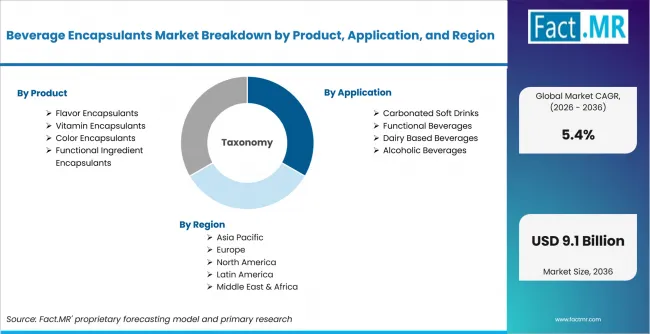
Beverage Encapsulants Market Breakdown By Product, Application, And Region | Source: Fact.MR
| Attribute | Details |
|---|---|
| Quantitative Units | USD billion |
| Market Definition | Encapsulated flavors, colors, vitamins, caffeine, probiotics and other protected beverage ingredients used to control release, taste, stability and shelf life |
| Product | Flavor Encapsulants; Vitamin Encapsulants; Color Encapsulants; Functional Ingredient Encapsulants |
| Application | Carbonated Soft Drinks; Functional Beverages; Dairy Based Beverages; Alcoholic Beverages |
| End Use | Beverage Manufacturers; Dairy Beverage Companies; Alcoholic Beverage Companies; Nutraceutical Beverage Firms |
| Technology | Spray Dry Encapsulation Technology; Emulsion Based Encapsulation; Coacervation Technology; Lipid Based Encapsulation |
| Formulation | Powder Based Formulations; Liquid Based Formulations; Gel Based Formulations; Lipid Based Formulations |
| Distribution Channel | Direct Industrial Sales; Specialty Ingredient Distributors; Online B2B Platforms; Third Party Suppliers |
| Regions Covered | North America; Latin America; Europe; East Asia; South Asia and Pacific; Middle East and Africa |
| Countries Covered | Germany; Brazil; USA; UK; Japan |
| Key Companies Profiled | Kerry Group plc; Ingredion Incorporated; Cargill, Incorporated; Tate & Lyle PLC; dsm-firmenich; Symrise AG; International Flavors & Fragrances Inc. (IFF); Givaudan SA; Sensient Technologies Corporation; Lycored Ltd.; Archer Daniels Midland (ADM); Balchem Corporation; Roquette Frères; Nexira SAS; FrieslandCampina Ingredients; AnaBio Technologies; Robertet Group; MANE Group |
| Forecast Period | 2026 to 2036 |
| Approach | Hybrid top-down and bottom-up approach using beverage production signals; ingredient formulation needs; encapsulation technology use; segment shares; country adoption patterns; supplier portfolios; regulatory changes; and company developments |
Bibliography
- dsm-firmenich. (2025, August 26). dsm-firmenich unveils major plant investments, emphasizing commitment to shaping the future of flavor in India.
- U.S. Department of Health and Human Services. (2025, April 22). HHS, FDA to phase out petroleum-based synthetic dyes in nation’s food supply.
- U.S. Food and Drug Administration. (2025, January 16). Color additive petition from Center for Science in the Public Interest, et al.; Request to revoke color additive listing for use of FD&C Red No. 3 in food and ingested drugs.
- U.S. Food and Drug Administration. (2025, May 12). Listing of color additives exempt from certification; Galdieria extract blue.
- Givaudan. (2025, October 8). Givaudan Taste & Wellbeing breaks ground on new production facility near Cincinnati, Ohio.
- HM Revenue & Customs. (2026, January 30). Soft Drinks Industry Levy statistics commentary 2026.
- HM Revenue & Customs. (2026, March 25). Check if your drink is liable for the Soft Drinks Industry Levy.
- Kerry. (2025, September 30). Kerry launches Smart Taste™ to help customers navigate market complexities without compromising on taste.
This Report Addresses
- The report provides strategic intelligence on the Beverage Encapsulants Market across Product and Application choices that shape beverage formulation programs.
- Segment analysis covers Flavor Encapsulants and Carbonated Soft Drinks as the share leaders within the 2026 market.
- Country outlook evaluates Germany and Brazil alongside the USA, UK and Japan across the profiled markets.
- Competitive analysis profiles Kerry Group plc and dsm-firmenich alongside Givaudan SA and IFF. Ingredient and carrier companies complete the provider set.
- Technology assessment covers Spray Dry Encapsulation Technology and Emulsion Based Encapsulation. Coacervation and lipid systems complete the process view.
What does the Beverage Encapsulants Market cover?
Beverage encapsulants cover protected ingredient systems used in drink production where flavor release, color stability and active protection determine product quality.
The market covers encapsulated flavors and protected colors used in beverages. It includes vitamin systems and probiotic systems. It aligns with flavor encapsulation and microencapsulated food ingredients where release control is the commercial requirement.
What is included in the scope?
The scope includes Product, Application, End Use, Technology, Formulation and Distribution Channel. Coverage spans food flavors, protected colors and active ingredient carriers that are directly tied to beverage stability or release.
Coverage also includes no-alcohol and low-alcohol beverages when encapsulated flavors are used to replace ethanol masking. Vitamin and mineral systems are included where beverage developers use encapsulation to support fortified foods and drinkable nutrition formats.
What is excluded from the scope?
General beverage ingredients are excluded when they do not use encapsulation. Sweeteners are excluded unless commercial use depends on protected release or masking. Packaging-only solutions and ingredients without beverage-specific stability remain outside the market.
How Was the Analysis Built?
The analysis draws on 120+ sources, 35+ company portfolios, 25+ countries, and more than 20 industry interviews.
- Primary Research: Primary research includes discussions with beverage manufacturers, ingredient suppliers, distributors, contract manufacturers, procurement teams and formulation specialists. These discussions examine purchase criteria, stability testing, taste release, scale-up risk and supplier selection.
- Desk Research: Desk research covers government statistics, food additive rules, beverage tax releases, company announcements, product portfolios and official institutional sources. Every source used in the analysis is documented in the bibliography.
- Market Sizing and Forecasting: Market estimates combine historical performance, demand indicators, segment shares, company participation, country growth, regulations and barriers to adoption.
- Data Validation and Update Cycle: Findings are validated against public data, company activity, regulatory changes and beverage formulation trends. Regular updates review product launches, capacity changes, tax rules and shifts in commercial adoption.
How is the market segmented?
-
By Product:
- Flavor Encapsulants
- Spray Dried Flavor Encapsulants
- Microencapsulated Liquid Flavors
- Vitamin Encapsulants
- Fat Soluble Vitamin Systems
- Water Soluble Vitamin Systems
- Color Encapsulants
- Natural Color Encapsulation
- Synthetic Color Encapsulation
- Functional Ingredient Encapsulants
- Probiotic Encapsulation Systems
- Caffeine Encapsulation Systems
- Flavor Encapsulants
-
By Application:
- Carbonated Soft Drinks
- Cola Based Beverages
- Fruit Flavored Soft Drinks
- Functional Beverages
- Energy Drinks
- Sports Drinks
- Dairy Based Beverages
- Flavored Milk Drinks
- Fermented Dairy Drinks
- Alcoholic Beverages
- Flavored Alcoholic Drinks
- Ready to Drink Cocktails
- Carbonated Soft Drinks
-
By End Use:
- Beverage Manufacturers
- Soft Drink Manufacturers
- Functional Beverage Companies
- Dairy Beverage Companies
- Milk Processing Companies
- Yogurt Drink Manufacturers
- Alcoholic Beverage Companies
- Beer Manufacturers
- Wine & Spirits Companies
- Nutraceutical Beverage Firms
- Health Supplement Beverage Makers
- Pharmaceutical Beverage Developers
- Beverage Manufacturers
-
By Technology:
- Spray Dry Encapsulation Technology
- Hot Air Drying Systems
- Controlled Particle Formation
- Emulsion Based Encapsulation
- Oil in Water Emulsification
- Water in Oil Emulsification
- Coacervation Technology
- Simple Coacervation Systems
- Complex Coacervation Systems
- Lipid Based Encapsulation
- Solid Lipid Systems
- Liquid Lipid Systems
- Spray Dry Encapsulation Technology
-
By Formulation:
- Powder Based Formulations
- Spray Dried Powders
- Granulated Powder Systems
- Liquid Based Formulations
- Emulsion Systems
- Suspension Systems
- Gel Based Formulations
- Hydrogel Encapsulation Systems
- Biopolymer Gel Systems
- Lipid Based Formulations
- Solid Lipid Matrices
- Liquid Lipid Carriers
- Powder Based Formulations
-
By Distribution Channel:
- Direct Industrial Sales
- Beverage Manufacturer Contracts
- Ingredient Procurement Teams
- Specialty Ingredient Distributors
- Regional Distributors
- Technical Solution Providers
- Online B2B Platforms
- Digital Ingredient Marketplaces
- Manufacturer Direct Platforms
- Third Party Suppliers
- Contract Manufacturing Suppliers
- Direct Industrial Sales
-
By Region:
- North America
- USA
- Latin America
- Brazil
- Europe
- Germany
- UK
- East Asia
- Japan