- Market Value (2025): USD 2579.0 Mn
- Estimated Value (2026): USD 2707.9 Mn
- Forecast Value (2036): USD 4707.2 Mn
- CAGR (2026-2036): 5.0%
What is the Beverage Whitener Market forecast to be worth by 2036?
USD 2707.9 million in 2026 to USD 4707.2 million by 2036 at 5.0% CAGR.
- The beverage whitener market reached USD 2579.0 million in 2025.
- Demand is projected to increase from USD 2707.9 million in 2026 to USD 4707.2 million by 2036.
- The market is forecast to record 5.0% CAGR from 2026 to 2036.
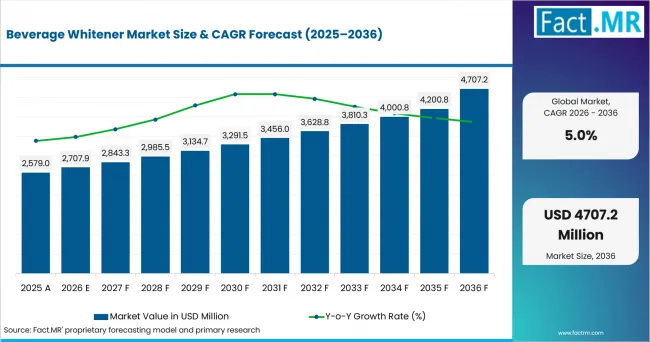
Beverage Whitener Market Value Analysis | Source: Fact.MR
What are the defining numbers behind Beverage Whitener Market growth?
USD 1999.3 million absolute opportunity is expected between 2026 and 2036, led by Whole Milk Powder and Coffee and Tea use.
- Demand Drivers in the Market
- Powdered drink preparation is expected to support repeat demand since users need whitening ingredients that mix cleanly in hot beverages.
- Coffee and tea use gives the category a steady base as buyers work with familiar beverage routines and existing preparation formats.
- Retail and foodservice distribution is anticipated to widen access for packaged whiteners that need shelf stability and simple handling.
- Ingredient buyers are expected to test taste and dispersion before selecting a whitener for larger beverage programs.
- Key Segments Analyzed
- By Type: Whole Milk Powder is expected to hold 61.2% share in 2026 due to its familiar dairy profile in whitening beverages.
- By Application: Coffee and Tea is projected to account for 62.0% share in 2026 as these drinks carry frequent use occasions.
- Analyst Opinion at Fact.MR
- Shambhu Nath Jha, Senior Consultant at Fact.MR, states, “Beverage whitener demand is expected to follow everyday drink preparation more than product novelty. Suppliers that keep flavor and solubility consistent are likely to win repeat orders from foodservice and packaged beverage customers.”
- Strategic Implications
- Manufacturers can maintain formulation consistency before adding new pack sizes or channel-specific products.
- Buyers gain clearer performance proof by testing whitening strength in the intended beverage before signing larger contracts.
- Distributors need coffee and tea applications at the center of retail, vending and foodservice positioning.
he UK leads at 6.7% CAGR through retail beverage use and foodservice powder formats. Australia follows at 7.0% with cafe and vending use. The USA records 7.2% as coffee routines support wider creamer applications. Canada reaches 6.8% with office and household beverage use. Germany posts 4.9% as mature dairy products channels keep demand steady.creamer applicationsdairy products
How does the Beverage Whitener Market break down by segment?
Whole Milk Powder is expected to lead Type with 61.2% share in 2026. Coffee and Tea is projected to lead Application with 62.0% share in 2026.
Which type dominates?
Whole Milk Powder is projected to account for 61.2% share in 2026.
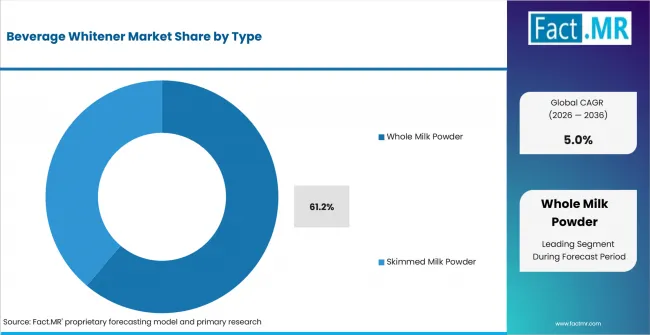
Beverage Whitener Market Analysis By Type | Source: Fact.MR
A richer dairy profile gives Whole Milk Powder the strongest position within Type. It supports visible whitening and creamy taste in beverage formulations where full-bodied dairy character matters. Skimmed Milk Powder serves a different need, mainly for buyers seeking lighter formulations and lower fat content.
Why does Coffee and Tea lead Application?
Coffee and Tea is expected to hold 62.0% share in 2026.
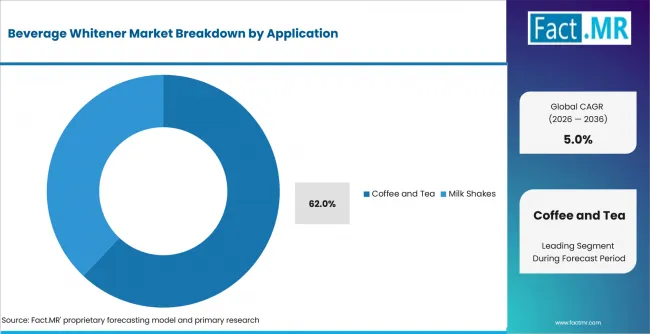
Beverage Whitener Market Analysis By Application | Source: Fact.MR
Frequent consumption keeps Coffee and Tea ahead of other applications. Whiteners help balance bitterness and improve drink appearance across homes, cafés and foodservice counters. Milk Shakes contribute additional demand through texture and body, while instant coffee and coffee pods create new usage occasions.
What is accelerating Beverage Whitener Market adoption, and what is holding it back?
Demand is expected to grow as everyday beverages need easy-to-use whitening ingredients. Changing raw material costs and labeling checks may slow growth. Suppliers need stable taste and solubility across coffee, tea and milk shakes.
Drivers Impact Analysis
| DRIVER | (~) % IMPACT ON CAGR | GEOGRAPHIC RELEVANCE | IMPACT TIMELINE |
|---|---|---|---|
| Coffee and tea usage | +1.5% | UK, USA and Canada | Short term (<= 2 years) |
| Powder handling and shelf stability | +1.1% | Australia and Germany | Short term (<= 2 years) |
| Foodservice and vending demand | +0.9% | Urban retail and office channels | Medium term (2-4 years) |
| Application-specific formulation | +0.7% | Packaged beverage producers | Medium term (2-4 years) |
| Private-label dry mixes | +0.5% | Retail and distributor programs | Long term (>= 4 years) |
Source: Fact.MR analysis. Updated Aug 4, 2026
- Coffee and tea usage is expected to keep the main demand pool active because beverage whitener serves a simple drink occasion.
- Powder handling is expected to matter in retail and foodservice channels. A dry format helps storage and measuring when refrigeration is limited.
- Application-specific formulation is anticipated to become more important as buyers compare whitening power against taste and solubility.
Opportunity Impact Analysis
| OPPORTUNITY | (~) % IMPACT ON CAGR | GEOGRAPHIC RELEVANCE | IMPACT TIMELINE |
|---|---|---|---|
| Foodservice pack-size alignment | +1.0% | Cafe, vending and office channels | Short term (<= 2 years) |
| Clean-label communication | +0.8% | Developed retail markets | Medium term (2-4 years) |
| Private-label beverage mixes | +0.6% | Retail and distributor programs | Medium term (2-4 years) |
| Broader dry beverage systems | +0.4% | Ingredient buyers and processors | Long term (>= 4 years) |
Source: Fact.MR analysis. Updated Aug 4, 2026
- Foodservice pack-size alignment is expected to create room for suppliers that understand operator buying habits.
- Clean-label communication is projected to influence how suppliers present ingredients.
- Private-label beverage mixes offer a route for manufacturers that can provide stable powder systems.
Restraints Impact Analysis
| RESTRAINT | (~) % IMPACT ON CAGR | GEOGRAPHIC RELEVANCE | IMPACT TIMELINE |
|---|---|---|---|
| Raw material price movement | -0.9% | Global dairy and oil inputs | Short term (<= 2 years) |
| Label and allergen expectations | -0.7% | Developed retail markets | Medium term (2-4 years) |
| Taste variation across beverages | -0.6% | Coffee, tea and milk-shake applications | Medium term (2-4 years) |
| Switching resistance in existing blends | -0.4% | Foodservice and private-label buyers | Long term (>= 4 years) |
Source: Fact.MR analysis. Updated Aug 4, 2026
- Raw material price movement is expected to limit faster margin expansion because whitener formulas rely on dairy inputs and other ingredients.
- Label and allergen expectations are anticipated to increase review time for products with milk-derived ingredients.
- Taste variation across beverages creates a practical barrier because one whitener does not perform the same way in every drink.
Which countries are scaling the Beverage Whitener Market fastest?
- The country comparison spans 2.1 percentage points and forms two practical growth bands across the forecast period.
- The UK remains 0.3 percentage point above Australia through stronger retail beverage and foodservice powder use.
- Australia stays 0.4 percentage point above the USA as cafe routines support repeat powder preparation.
- The USA remains 0.3 percentage point above Canada through coffee-centered creamer and whitener habits.
- Canada stays 1.1 percentage points above Germany through household and office beverage routines.
- Germany closes the displayed range through mature dairy ingredient channels and slower switching behavior.
Comparable CAGRs can create different entry conditions due to channel mix and product expectations. Full report coverage includes North America; Latin America; Europe; East Asia; South Asia & Oceania; Middle East and Africa.
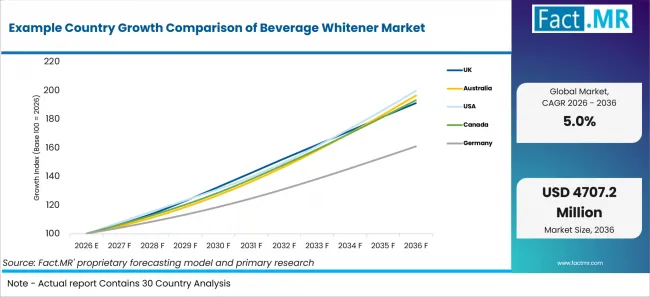
Example Country Growth Comparison Of Beverage Whitener Market | Source: Fact.MR
| Country | CAGR (2026-2036) |
|---|---|
| UK | 6.7% |
| Australia | 7.0% |
| USA | 7.2% |
| Canada | 6.8% |
| Germany | 4.9% |
Source: Fact.MR analysis. Updated Aug 4, 2026
What supports UK adoption?
6.7% CAGR, supported by retail beverage use and foodservice powder formats.
UK adoption is expected to benefit from compact retail packs and out-of-home drink preparation. Coffee and tea remain the main use setting for whiteners. Buyers are likely to value fast dispersion before adding new pack formats. Suppliers that serve both household and operator needs should gain better channel access.
How is Australia scaling demand?
7.0% CAGR, backed by cafe habits and dry beverage preparation needs.
Australia is projected to record the second-fastest pace in the listed set. Cafe routines create a clear reason to test powder whiteners for drink consistency. Foodservice buyers are expected to favor products that store easily. Product approval is likely to depend on cup quality and stable whitening.
What is driving USA growth from 2026 to 2036?
7.2% CAGR, shaped by coffee use and wider creamer product familiarity.
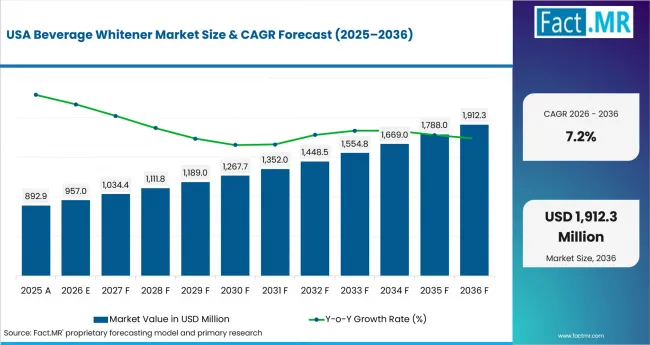
Beverage Whitener Market Country Value Analysis | Source: Fact.MR
The USA is forecast to expand above the global rate as beverage whiteners compete within a larger creamer culture. Buyers are expected to compare powder performance with liquid creamers and flavor add-ins. Clear positioning against coffee alternatives is likely to matter more than broad dairy claims.
How is Canada developing demand?
6.8% CAGR, driven by office and household beverage routines.
Canada’s growth reflects a steady preparation base instead of a sudden shift in product use. Office pantry programs are expected to support repeat purchases. Retail packs should remain useful for household drink routines. Suppliers are likely to focus on solubility and reliable stock availability.
How does Germany perform?
4.9% CAGR, led by mature dairy ingredient channels and careful product selection.
Germany is expected to grow at the slowest pace among the listed countries. The market is still forecast above the global CAGR. Demand is likely to come from established dairy ingredient channels and selective beverage applications. Buyers are expected to require clear specification support before changing existing formulas.
Who leads the Beverage Whitener Market?
Arkadia Beverages and Mokate Ingredients stand out for their direct focus on powdered drink systems, while Nestlé and FrieslandCampina Ingredients add scale through broader dairy and beverage ingredient portfolios.
Arkadia Beverages serves café, vending and retail programs that require easy-mixing whitener formats. Mokate Ingredients brings experience in dry beverage blends and private-label supply. Jiahe Foods Industry adds manufacturing depth for powdered creamer and whitener applications. Drytech Processes strengthens the industrial side through spray-dried ingredient production. Nestlé expands category reach through familiar beverage brands, while FrieslandCampina Ingredients contributes dairy formulation expertise. Goodrich Foods India and Aarkay Food Products widen regional supply for coffee, tea and milk-shake uses.
Which companies are the key providers?
Key companies include Arkadia Beverages; Mokate Ingredients; Jiahe Foods Industry; Drytech Processes (I) Pvt. Ltd.; Nestlé S.A.; FrieslandCampina Ingredients; Goodrich Foods India Ltd.; and Aarkay Food Products Ltd.
- Arkadia Beverages
- Mokate Ingredients
- Jiahe Foods Industry
- Drytech Processes (I) Pvt. Ltd.
- Nestlé S.A.
- FrieslandCampina Ingredients
- Goodrich Foods India Ltd.
- Aarkay Food Products Ltd.
How is the market segmented?
-
By Type
- Whole Milk Powder
- Skimmed Milk Powder
-
By Application
- Coffee and Tea
- Milk Shakes
-
By Region
- North America
- Latin America
- Europe
- East Asia
- South Asia and Oceania
- Middle East and Africa
Bibliography
- OECD/FAO. (2025, July 15). OECD-FAO Agricultural Outlook 2025-2034. OECD Publishing; Paris/FAO; Rome.
- U.S. Food and Drug Administration. (2025, January). Guidance for industry: Questions and answers regarding food allergen labeling (Edition 5).
- U.S. Food and Drug Administration. (2025, January 6). FDA releases allergen, food safety, and plant-based alternative labeling guidances.
- Nestlé S.A. (2025, February 13). Solid 2024 performance; executing on plan to accelerate growth.
This Report Answers
- The report provides strategic intelligence on the Beverage Whitener Market across Type and Application choices that shape beverage formulation and purchasing.
- Segment analysis covers Whole Milk Powder and Coffee and Tea as the share leaders within the 2026 market.
- Country outlook evaluates the UK and Australia alongside the USA and Canada. Germany completes the growth comparison across the profiled markets.
- Competitive analysis profiles Arkadia Beverages and Mokate Ingredients. Jiahe Foods Industry; Drytech Processes (I) Pvt. Ltd.; Nestlé S.A.; FrieslandCampina Ingredients; Goodrich Foods India Ltd.; and Aarkay Food Products Ltd. complete the provider set.
- Application assessment covers Coffee and Tea alongside Milk Shakes. It emphasizes taste, solubility and product handling.
What does the Beverage Whitener Market cover?
Beverage whiteners are dry ingredients used to lighten drinks and improve mouthfeel in hot or cold beverage applications.
The Beverage Whitener Market covers Whole Milk Powder and Skimmed Milk Powder used in beverage preparation. Coverage extends to Coffee and Tea as the leading application. Milk Shakes are included where the product supports body and whitening effect. The market includes retail, foodservice and ingredient channels where beverage whitener is sold or used as part of a dry beverage system.
What is included in the scope?
The scope includes Type and Application alongside regional and country coverage. It covers Whole Milk Powder and Skimmed Milk Powder when used as beverage whitening ingredients.
Coffee and Tea applications are included because they represent the leading use case. Milk Shakes are included where whitening and mouthfeel support the finished drink. The scope includes the listed companies and the countries shown in the CAGR table.
What is excluded from the scope?
Products outside beverage whitening use remain outside the scope of this market.
General dairy powders are excluded when they are sold only for bakery or nutrition uses without a beverage whitening role. Liquid creamers are excluded unless they are assessed as competitive context. Company revenue unrelated to beverage whitener or dry beverage preparation is excluded.
How Was the Analysis Built?
The analysis draws on 120+ sources and 35+ company portfolios. The review covers 25+ countries and more than 20 industry interviews.
- Primary Research: Primary research includes discussions with manufacturers and service providers. The same process covers technology developers and distributors. It then reviews end users, procurement teams and subject-matter experts. These conversations examine purchasing priorities and product adoption. They review operating challenges and approval requirements. They then assess competitive positioning and the factors that influence wider market acceptance.
- Desk Research: Desk research covers government statistics and regulatory publications. The review covers company filings and trade data. Technical studies and industry associations are checked next. Standards and public policy are reviewed before final selection. Every source used in the analysis is documented in the bibliography.
- Market Sizing and Forecasting: Market estimates combine historical performance and demand indicators. They review pricing trends and volume patterns. Segment shares, company participation and country-level growth are assessed separately. Adoption patterns and expansion barriers are reviewed before final sizing.
- Data Validation and Update Cycle: Findings are validated by comparing primary interviews with public data. Company activity and regulatory changes are reviewed in the same pass. Trade patterns and industry developments are checked separately. Regular updates review product launches and capacity changes. They check partnerships and approvals. Procurement trends and shifts in commercial adoption are reviewed after that.
Segmentation
What is the report’s scope and coverage?
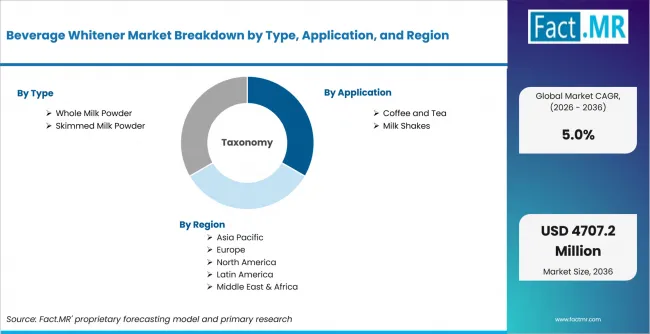
Beverage Whitener Market Breakdown By Type, Application, And Region | Source: Fact.MR
| Attribute | Details |
|---|---|
| Quantitative Units | USD million in 2026 to USD million by 2036 at CAGR |
| Market Definition | Dry whitening ingredients used to improve color, mouthfeel and body in beverages across the defined product and application categories |
| Type | Whole Milk Powder; Skimmed Milk Powder |
| Application | Coffee and Tea; Milk Shakes |
| Regions Covered | North America; Latin America; Europe; East Asia; South Asia and Pacific; Middle East and Africa |
| Countries Covered | UK; Australia; USA; Canada; Germany |
| Key Companies Profiled | Arkadia Beverages; Mokate Ingredients; Jiahe Foods Industry; Drytech Processes (I) Pvt. Ltd.; Nestlé S.A.; FrieslandCampina Ingredients; Goodrich Foods India Ltd.; Aarkay Food Products Ltd. |
| Forecast Period | 2026 to 2036 |
| Approach | Hybrid top-down and bottom-up approach using beverage whitener demand indicators; type and application shares; country-level growth; channel participation; formulation requirements; product fit; supplier participation and company portfolio review |
Source: Fact.MR analysis. Updated Aug 4, 2026
Frequently Asked Questions
Which type leads the Beverage Whitener Market?
Which application leads the market?
Which country records the highest listed CAGR?
What is the primary driver in this market?
What is the main restraint?
Why does Whole Milk Powder lead demand?
Who worked on this report


Preview the report firsthand - request a free sample
Free SampleGet the brochure for pricing and purchase details
Download PDF