- Market Value (2025): USD 387.60 Bn
- Estimated Value (2026): USD 402.3 Bn
- Forecast Value (2036): USD 583.3 Bn
- CAGR (2026-2036): 3.8%
What is the 24-Hour Nursing Care Facilities Market forecast to be worth by 2036?
USD 402.3 billion in 2026 to USD 583.3 billion by 2036 at a 3.8% CAGR.
- The valuation of the 24-hour nursing care facilities market was USD 387.60 billion in 2025, with long-stay residents funded by public programs making up the core of facility income.
- Spending will expand from USD 402.3 billion in 2026 to USD 583.3 billion in 2036, as the number of people over 80 grows faster than any other age band.
- Nursing home revenue will advance at a 3.8% CAGR through 2036, held in check by tight public reimbursement even as resident need deepens.
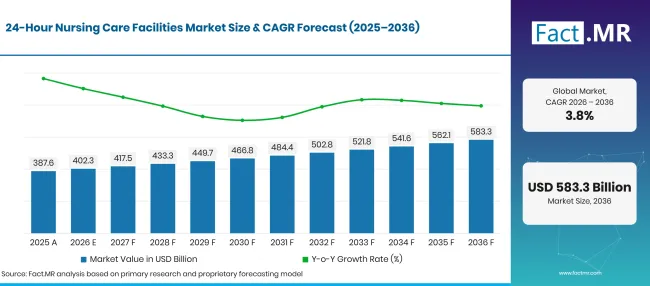
24 Hour Nursing Care Facilities Market Forecast Global | Source: Fact.MR
| Year | Basis | Market Value (USD billion) |
|---|---|---|
| 2025 | Actual | 387.60 |
| 2026 | Estimate | 402.3 |
| 2036 | Forecast | 583.3 |
| CAGR 2026 to 2036 | Forecast period | 3.8% |
Source: Fact.MR analysis. Updated Oct 23, 2026
What are the defining numbers behind 24-Hour Nursing Care Facilities Market growth?
The 2026 to 2036 window adds USD 181.0 billion, much of it from long-stay and dementia care.
- Demand Drivers in the Market
- Population ageing is the base driver of nursing home demand. The World Health Organization reported that the global population aged 80 and older will triple between 2020 and 2050 to reach 426 million [1]. People in this age band are the most likely to need help with bathing, eating and moving around the clock.
- Dementia care needs push families toward round-the-clock supervision. WHO stated that 57 million people were living with dementia worldwide in 2021, with nearly 10 million new cases every year [2]. Wandering, night-time confusion and swallowing risks are hard to manage at home once the disease advances.
- Skilled nursing spending keeps growing in the United States. The Centers for Medicare & Medicaid Services reported that spending on nursing care facilities and continuing care retirement communities increased by 7.3% in 2024 to $219.9 billion [3]. Higher wage bills and more complex residents explain much of that increase.
- Hospitals discharge patients earlier and rely on post-acute beds to finish recovery. Joint replacement, stroke and cardiac patients often move to a nursing facility for therapy before they return home.
- Smaller family networks reduce the pool of unpaid carers. Adult children who live far away or work full time often cannot provide night care, so a facility placement becomes the practical choice.
- Key Segments Analyzed
- By Service Type: Skilled Nursing Care will hold 38.4% share in 2026, since residents with wounds, feeding tubes and complex medication schedules need a licensed nurse on every shift.
- By Resident Type: Long-Term will account for 58.8% share in 2026, as people with dementia and frailty tend to stay in one facility for months or years.
- By Payment Source: Medicaid will command 43.7% share in 2026, given that most long-stay residents exhaust their savings and qualify for public coverage.
- By Facility Type: Freestanding will capture 78.4% share in 2026 through a wide network of community nursing homes run by chains and independent owners.
- Analyst Opinion at Fact.MR
- Shambhu Nath Jha, Principal Consultant at Fact.MR, states, “Demand for nursing home beds is not the constraint in this market; staffing and public payment rates are. Operators that can recruit and keep nurses will fill beds that others must leave empty. Growth will favor groups that combine short-stay rehabilitation with dementia and long-stay care under one roof.”
- Strategic Implications
- Facility operators should build in-house training routes for care aides and nurses, since vacancy rates now limit admissions more than bed supply does.
- Public payers should link nursing home rates to wage costs and resident acuity, so that facilities serving high-need residents remain viable.
- Hospital systems should agree discharge pathways with nearby skilled nursing providers to shorten bed waits for post-acute patients.
- Investors should favor purpose-built homes with single rooms and dementia units, given that older buildings face rising upgrade costs.
With a 4.6% CAGR, the United Kingdom heads the five-country set, as councils and self-funders pay for more nursing placements. Japan comes second at 4.2%, where a super-aged society keeps public care homes close to full. Germany will advance at 3.8% with rising spending on inpatient care and a growing nursing workforce. Brazil follows at 3.1% as its older population expands quickly from a low base of formal facilities. The United States trails at 2.8%, reflecting a mature bed network funded mostly by Medicaid.
How does the 24-Hour Nursing Care Facilities Market break down by segment?
Skilled Nursing Care will lead Service Type at 38.4%; Long-Term will head Resident Type at 58.8%; Medicaid will top Payment Source at 43.7%; Freestanding will rank first in Facility Type at 78.4%.
Which Service Type dominates?
Skilled Nursing Care takes 38.4% of 2026 revenue.
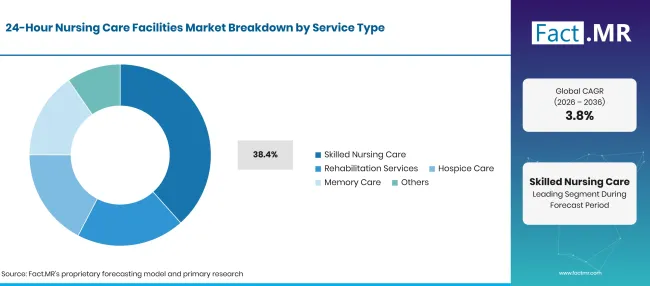
24 Hour Nursing Care Facilities Market Breakdown Service Type | Source: Fact.MR
| Service Type | Share (2026) |
|---|---|
| Skilled Nursing Care (Leading segment) | 38.4% |
| Other segments combined | 61.6%* |
| Total | 100.0% |
Source: Fact.MR analysis. Updated Oct 23, 2026
Residents with pressure ulcers, IV therapy or post-surgical wounds need clinical tasks that only registered or licensed practical nurses can perform. Skilled nursing units also bill above-average daily rates, because staffing ratios and supply costs are higher than in personal care wings. Rehabilitation services follow orthopedic and stroke discharges, with physical, occupational and speech therapy delivered on site. Hospice care brings palliative teams into the facility during the last weeks of life. Memory care units use secured layouts and trained staff for residents with dementia, often supported by senior care technology such as bed sensors and fall alerts.
What leads the Resident Type segment?
Long-Term residents represent 58.8% of 2026 revenue.
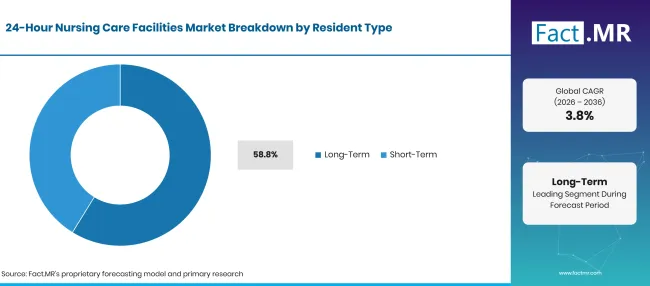
24 Hour Nursing Care Facilities Market Breakdown Resident Type | Source: Fact.MR
| Resident Type | Share (2026) |
|---|---|
| Long-Term (Leading segment) | 58.8% |
| Other segments combined | 41.2%* |
| Total | 100.0% |
Source: Fact.MR analysis. Updated Oct 23, 2026
People with advanced frailty or dementia rarely regain the ability to live alone, so a nursing home becomes their permanent residence. These long stays give operators predictable occupancy and steady daily billing. Short-term residents arrive from hospital for a defined recovery period. MedPAC reported that about 14,400 freestanding skilled nursing facilities furnished about 1.5 million Medicare-covered stays to 1.1 million fee-for-service beneficiaries in 2024 [4]. These patients turn over quickly and need more therapy hours per day than long-stay residents.
How does Payment Source shape demand?
Medicaid funds 43.7% of 2026 revenue.
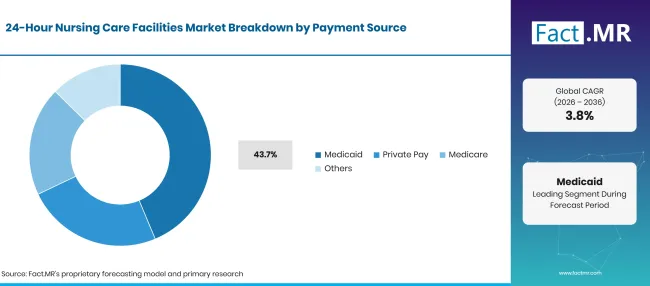
24 Hour Nursing Care Facilities Market Breakdown Payment Source | Source: Fact.MR
| Payment Source | Share (2026) |
|---|---|
| Medicaid (Leading segment) | 43.7% |
| Other segments combined | 56.3%* |
| Total | 100.0% |
Source: Fact.MR analysis. Updated Oct 23, 2026
Long-stay residents often spend down their assets within a year or two of admission and then rely on public coverage. MedPAC found that Medicaid paid for 64% of facility days in the median freestanding facility in 2024, while fee-for-service Medicare accounted for 13% of total facility revenue [4]. Rate setting by state agencies therefore drives margins for many homes. Private pay covers residents who fund care from savings, pensions or home sales, and it brings premium rates per day. Medicare pays for short post-acute stays that follow a qualifying hospital admission. Others include long-term care insurance, veterans’ benefits and national care insurance schemes outside the United States.
What supports Freestanding within Facility Type?
Freestanding homes generate 78.4% of 2026 revenue.
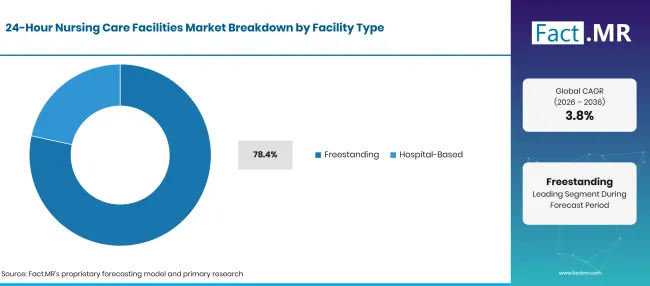
24 Hour Nursing Care Facilities Market Breakdown Facility Type | Source: Fact.MR
| Facility Type | Share (2026) |
|---|---|
| Freestanding (Leading segment) | 78.4% |
| Other segments combined | 21.6%* |
| Total | 100.0% |
Source: Fact.MR analysis. Updated Oct 23, 2026
Community nursing homes stand apart from hospital campuses and serve residents close to their families. Chains and local owners can open them in suburbs and small towns where land costs less than near a hospital. Many share sites with assisted living buildings, so residents can move to a higher level of care without changing address. Hospital-based units operate inside or attached to acute hospitals. They admit patients with complex medical needs straight from the ward and use the hospital’s pharmacy, imaging and specialist teams. Their number has fallen in several countries as hospitals focus beds on acute cases.
What is accelerating 24-Hour Nursing Care Facilities Market adoption, and what is holding it back?
Adoption will gain from a fast-growing population over 80, higher dementia prevalence and earlier hospital discharge. Staff shortages, public rate pressure and high building costs will limit how quickly new beds open.
Drivers Impact Analysis
| DRIVER | (~) % IMPACT ON CAGR | GEOGRAPHIC RELEVANCE | IMPACT TIMELINE |
|---|---|---|---|
| Growth in the population aged 80 and older | +1.3% | Global | Long term (>= 4 years) |
| Rising dementia prevalence and need for supervised care | +1.0% | Western Europe, East Asia, North America | Medium term (2-4 years) |
| Earlier hospital discharge into post-acute skilled nursing beds | +0.7% | North America, Western Europe | Short term (<= 2 years) |
| Public long-term care insurance and Medicaid coverage | +0.5% | North America, East Asia, Western Europe | Medium term (2-4 years) |
| Fewer family caregivers available for night care | +0.3% | Global | Long term (>= 4 years) |
Source: Fact.MR analysis. Updated Oct 23, 2026
Opportunity Impact Analysis
| OPPORTUNITY | (~) % IMPACT ON CAGR | GEOGRAPHIC RELEVANCE | IMPACT TIMELINE |
|---|---|---|---|
| Purpose-built dementia and memory care units | +0.8% | Western Europe, North America, East Asia | Medium term (2-4 years) |
| Formal nursing home capacity in emerging aged populations | +0.6% | Latin America, East Asia | Long term (>= 4 years) |
| Remote monitoring and fall detection in resident rooms | +0.4% | North America, Western Europe | Short term (<= 2 years) |
Source: Fact.MR analysis. Updated Oct 23, 2026
Restraints Impact Analysis
| RESTRAINT | (~) % IMPACT ON CAGR | GEOGRAPHIC RELEVANCE | IMPACT TIMELINE |
|---|---|---|---|
| Shortage of registered nurses and care aides | -0.8% | Global | Short term (<= 2 years) |
| Public reimbursement rates below cost of care | -0.6% | North America, Western Europe | Medium term (2-4 years) |
| Policy preference for home and community-based care | -0.4% | North America, Western Europe, East Asia | Long term (>= 4 years) |
Source: Fact.MR analysis. Updated Oct 23, 2026
Which countries are scaling the 24-Hour Nursing Care Facilities Market through 2036?
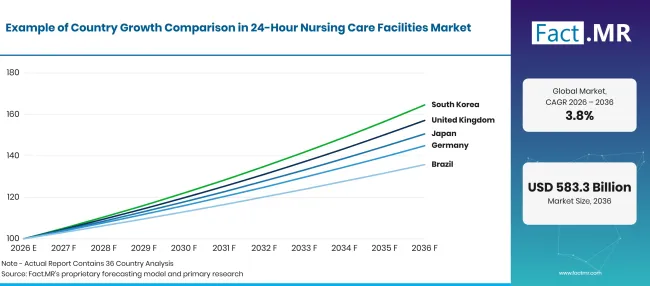
Factmr 24 Hour Nursing Care Facilities Market Growth Index | Source: Fact.MR
| Country | CAGR (2026 to 2036) |
|---|---|
| United Kingdom | 4.6% |
| Japan | 4.2% |
| Germany | 3.8% |
| Brazil | 3.1% |
| United States | 2.8% |
Source: Fact.MR analysis. Updated Oct 23, 2026
What supports United Kingdom adoption?
4.6% CAGR, driven by council-arranged nursing placements and a large self-funding resident base.
Care home funding in England draws on both councils and private payers. The Department of Health and Social Care reported that local authorities spent £2.6 billion on nursing care for clients aged 65 and over in 2024 to 2025, within gross adult social care spending of £29.4 billion [5]. Self-funders pay higher fees, which helps operators cover nurse wages and invest in dementia units.
How is Japan scaling demand?
4.2% CAGR, backed by near-full occupancy across public long-term care facilities.
Japan’s long-term care insurance funds three main facility types. The Ministry of Health, Labour and Welfare counted 8,621 welfare facilities for the elderly requiring long-term care as of October 2024, with capacity for 604,469 residents and a 94.5% utilization rate [6]. Waiting lists for these homes push providers to add beds and staff where local plans allow.
What supports Germany’s growth?
3.8% CAGR, reflecting higher spending on inpatient care and an expanding nursing workforce.
German care homes are absorbing higher costs as acuity rises. Destatis reported that health spending in inpatient and part-inpatient care facilities reached 48.2 billion euros in 2023, up 6.7% from the prior year [7]. Staff supply is improving as well, with 63,900 new nursing training contracts signed in 2025, an 8% increase [8].
How is Brazil developing demand?
3.1% CAGR, helped by a fast-growing older population and longer life spans.
Brazil’s ageing is moving faster than its supply of formal care homes. IBGE reported that the population aged 60 or older grew from 22 million to 34.1 million between 2012 and 2024 [9]. In its 2024 life tables, IBGE also found that a Brazilian aged 60 could expect to live another 22.6 years [10]. Long-stay institutions for older people are growing in large cities, where family carers are scarcer.
How does the United States perform?
2.8% CAGR, as a mature facility base expands mostly through rates and resident acuity.
American nursing homes serve an older population that keeps getting larger. The U.S. Census Bureau reported that the population aged 65 and older rose by 3.1% to 61.2 million in 2024, and grew by 13.0% from 2020 to 2024 [11]. Bed counts change slowly, so revenue gains come from higher acuity, therapy volumes and state Medicaid rate updates.
Who leads the 24-Hour Nursing Care Facilities Market?
Nursing home operators fall into three groups. U.S. post-acute chains such as The Ensign Group, PACS Group, Genesis HealthCare and Life Care Centers of America run large networks of skilled nursing centers through local affiliates, and they compete on short-stay rehabilitation and hospital referral ties.
Senior living groups such as Brookdale Senior Living add skilled nursing wings to campuses that also offer assisted and independent living. International operators focus on long-stay and dementia care under national funding rules. Extendicare opened Extendicare Beauclaire in Ottawa in spring 2026, a long-term care home for 320 residents and the fourth new home it has opened in Ontario since 2024 [12]. In October 2026, Clariane University welcomed a training division with seven institutes that prepare nearly 800 nurses, care assistants and other students each year [13]. Barchester Healthcare runs nursing homes across the United Kingdom. Nurse recruitment, dementia expertise and payer mix will separate stronger operators from the rest.
Which companies are the key providers?
Key companies include The Ensign Group, Inc.; PACS Group, Inc.; Genesis HealthCare; Life Care Centers of America; Brookdale Senior Living Inc.; Extendicare Inc.; Clariane SE; and Barchester Healthcare.
- The Ensign Group, Inc.
- PACS Group, Inc.
- Genesis HealthCare
- Life Care Centers of America
- Brookdale Senior Living Inc.
- Extendicare Inc.
- Clariane SE
- Barchester Healthcare
Bibliography
- [1] World Health Organization. (2025, October 1). Ageing and health.
- [2] World Health Organization. (2026, July 3). Dementia.
- [3] Centers for Medicare & Medicaid Services. (2025). National Health Expenditures 2024 Highlights.
- [4] Medicare Payment Advisory Commission (MedPAC). (2026, March 12). Chapter 7: Skilled nursing facility services (March 2026 Report).
- [5] Department of Health and Social Care. (2025, October 23). Adult social care finance report, England: 2024 to 2025.
- [6] Ministry of Health, Labour and Welfare, Japan. (2025, December 19).[Overview of the 2024 Survey of Institutions and Establishments for Long-term Care].
- [7] Statistisches Bundesamt (Destatis). (2025, May 15). Gesundheitsausgaben in Pflegeeinrichtungen im Jahr 2023 um 6,3 % gestiegen [Health expenditure in care facilities rose by 6.3% in 2023].
- [8] Statistisches Bundesamt (Destatis). (2026, July 2). Pflegeausbildung 2025: Zahl neuer Auszubildender zum dritten Mal in Folge gestiegen [Nursing training 2025: Number of new trainees rose for the third year in a row].
- [9] Instituto Brasileiro de Geografia e Estatística (IBGE). (2025, December 3). IBGE mostra que um a cada quatro idosos trabalhava em 2024 [IBGE shows that one in four older people worked in 2024].
- [10] Instituto Brasileiro de Geografia e Estatística (IBGE). (2025, November 28). Expectativa de vida chega a 76,6 anos em 2024 [Life expectancy reaches 76.6 years in 2024].
- [11] U.S. Census Bureau. (2025, June 26). Older Adults Outnumber Children in 11 States and Nearly Half of U.S. Counties.
- [12] Extendicare. (2026, July 9). Welcome home, Extendicare Beauclaire!.
- [13] Clariane. (2026, October 21). Clariane University and the Fondation Œuvre de la Croix Saint-Simon join forces to develop healthcare and social care training in Île-de-France.
This Report Answers
- What 24-hour nursing care facilities earn in total, split by service type, resident type, payment source and facility type.
- Why skilled nursing care, long-term residents, Medicaid funding and freestanding homes come first in their segments in 2026.
- How ageing, care funding and workforce supply differ across the United Kingdom, Japan, Germany, Brazil and the United States.
- Which post-acute chains, senior living groups and international operators run nursing homes, and how they compete for residents and staff.
- Where staffing gaps, reimbursement levels and home care policy limit new bed capacity.
What does the 24-Hour Nursing Care Facilities Market cover?
Nursing homes, skilled nursing facilities and care homes with nursing all fall within this market when licensed nurses are present around the clock. Revenue covers daily care, room and board, medication management and therapy delivered inside the facility.
All payer groups are counted, from public programs and national care insurance to private payers and insurers. Operators include for-profit chains, nonprofit groups and public bodies of every size.
What is included in the scope?
Long-stay nursing beds, short-stay post-acute beds, secured dementia units and hospice beds inside nursing homes are in scope. Rehabilitation therapy delivered by facility staff or contracted therapists on site is included.
Hospital-based skilled nursing units are counted at their nursing care revenue. Nursing wings within continuing care campuses are also included, as are related geriatric care services billed by the facility.
What is excluded from the scope?
Care delivered in private homes by visiting nurses or aides falls outside this market, including services covered under health caregiving for family carers. Independent living units without on-site nursing are excluded.
Equipment sales to facilities, such as beds, lifts and elder care products, are not counted. Mobility aids and assistive technology devices bought by residents are also left out.
How Was the Analysis Built?
The analysis draws on 120+ sources, 35+ company portfolios, 25+ countries, and more than 20 industry interviews.
- Primary Research: Primary research includes discussions with manufacturers, service providers, technology developers, distributors, end users, and subject-matter experts. These conversations examine purchasing priorities, product adoption, operational challenges, approval requirements, competitive positioning, and the factors that influence wider market acceptance.
- Desk Research: Desk research covers government statistics, regulatory publications, company filings, trade data, technical studies, industry associations, standards, public policy, and other authoritative sources. Every source used in the analysis is documented in the bibliography.
- Market Sizing and Forecasting: Market estimates combine historical performance, demand indicators, pricing and volume trends, segment shares, company participation, country-level growth, adoption patterns, investment activity, and barriers to market expansion.
- Data Validation and Update Cycle: Findings are validated by comparing primary interviews with public data, company activity, regulatory changes, trade patterns, and industry developments. Regular updates review new product launches, capacity changes, partnerships, approvals, and shifts in commercial adoption.
Segmentation
What is the report’s scope and coverage?
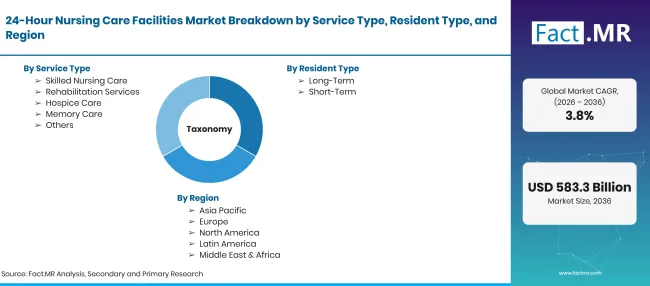
24 Hour Nursing Care Facilities Market Taxonomy | Source: Fact.MR
| Attribute | Details |
|---|---|
| Quantitative Units | USD billion in 2026 to USD billion by 2036 at CAGR |
| Market Definition | Residential facilities that provide licensed nursing care and personal care 24 hours a day to older, disabled or recovering residents. The scope covers revenue from all payers for care, accommodation and on-site therapy. |
| Service Type | Skilled Nursing Care; Rehabilitation Services; Hospice Care; Memory Care; Others |
| Resident Type | Long-Term; Short-Term |
| Payment Source | Medicaid; Private Pay; Medicare; Others |
| Facility Type | Freestanding; Hospital-Based |
| Regions Covered | North America; Latin America; Western Europe; Eastern Europe; East Asia; South Asia & Pacific; Middle East & Africa |
| Countries Covered | United Kingdom; Japan; Germany; Brazil; United States |
| Companies Profiled | The Ensign Group, Inc.; PACS Group, Inc.; Genesis HealthCare; Life Care Centers of America; Brookdale Senior Living Inc.; Extendicare Inc.; Clariane SE; Barchester Healthcare |
| Forecast Period | 2026 to 2036 |
| Approach | Hybrid top-down and bottom-up approach using population aged 65 and 80 and older; licensed nursing home beds and occupancy; average daily rates by payer; public long-term care spending by country; and operator portfolio review. |
Source: Fact.MR analysis. Updated Oct 23, 2026
How is the market segmented?
-
By Service Type
- Skilled Nursing Care
- Rehabilitation Services
- Hospice Care
- Memory Care
- Others
-
By Resident Type
- Long-Term
- Short-Term
-
By Payment Source
- Medicaid
- Private Pay
- Medicare
- Others
-
By Facility Type
- Freestanding
- Hospital-Based
-
By Region
- North America
- Latin America
- Western Europe
- Eastern Europe
- East Asia
- South Asia & Pacific
- Middle East & Africa
Frequently Asked Questions
How big is the 24-hour nursing care facilities market in 2026?
What is the CAGR of the 24-hour nursing care facilities market from 2026 to 2036?
Which service type leads the 24-hour nursing care facilities market?
Which resident type leads the 24-hour nursing care facilities market?
Which payment source leads the 24-hour nursing care facilities market?
Which facility type leads the 24-hour nursing care facilities market?
Which country will grow the most in the 24-hour nursing care facilities market?
Who are the main companies in the 24-hour nursing care facilities market?
Who worked on this report


Preview the report firsthand - request a free sample
Free SampleGet the brochure for pricing and purchase details
Download PDF