- Base Value(2025): 2410 Mn
- Forecast Value (2035): 3499 Mn
- CAGR (2035): 4.5%
Drip Coffee Machine Market Outlook 2025 to 2035
The global drip coffee machine market is expected to reach USD 3,499 million by 2035, up from USD 2,410 million in 2025. During the forecast period (2025 – 2035), the industry is projected to register at a CAGR of 3.8%.
The drip coffee machines market is expanding steadily, driven by the increasing popularity of coffee and the demand for convenient home brewing solutions. The integration of smart features and the continued growth of e-commerce are contributing to broader consumer adoption and overall market development.
Quick Stats for Drip Coffee Machine Market
- Industry Value(2025):USD 2,410 Million
- Projected Value (2035):USD 3,499 Million
- Forecast CAGR(2025 to 2035):3.8%
- Leading Segment(2025):Less than 10 cups (45% Market Share)
- Fastest Growing Country (2025-35):India (6.0% CAGR)
- Top Key Players:Krups GmbH, Koninklijke Philips N.V., De'Longhi Appliances s.r.l, BSH Hausgeräte GmbH, Melitta Group, BUNN-O-Matic Corporation, JURA Elektroapparate AG, Hamilton Beach Brands, Inc., Bravilor Bonamat B.V., and Spectrum Brand Holdings, Inc.
2025-to-2035.webp "Us Drip Coffee Machine Market Market Value(usd Million)2025 To 2035")
Us Drip Coffee Machine Market Market Value(usd Million)2025 To 2035 | Source: Fact.MR
What are the drivers of drip coffee machine market?
The shift toward convenient daily routines is contributing to the growing demand for drip coffee machines. It is primarily driven by the increases in the world coffee consumption by the younger and working population, and is expected to fuel the drip coffee machine market.
As coffee becomes a regular part of daily schedules, the popularity has increased in easy and faster modes of brewing coffee. Drip coffee machines are convenient and timesaving, which makes them suitable both at home and offices. There has been a trend of setting up coffee at home and this has especially increased after the pandemic, thereby supporting market growth.
Innovations in the field of technologies are the key market drivers. Characteristics such as programmable timers, auto-shut off, temperature settings, and intelligent connectivity, have helped drip coffee machines gain popularity among technology-savvy individuals.
The market is also being influenced by environmental concerns and the changing consumer interests. The e-commerce boom has increased consumer access to compare, review and buy drip coffee makers online, broadening market presence to manufacturers and retailers.
What are the regional trends of drip coffee machine market?
In North America, drip coffee machines market is well-established. The consumers prefer convenience, intelligent features and energy efficiency. In the U.S. and Canada in particular, the coffee culture is so vibrant leading to constant demand both at the residential level as well as workplace levels.
Europe is driven by preference for sustainability, design and high-quality products. Germany and the U.K. choose to use environment friendly machines whose filter can be reused. The trends of home brewing and specialty coffee act as contributing factors to the growth of the market.
The Asia-Pacific is experiencing rapid growth, driven by urbanization, increased incomes, and growing popularity of the western way of life. Key markets include China, Japan, and South Korea, where there is increasing interest in home coffee preparation.
What are the challenges and restraining factors of drip coffee machine market?
The market saturation in developed markets poses a challenge in the drip coffee machine market. High penetration in regions such as North America and Western Europe restricts additional sales. Moreover, the presence of the competition in the form of alternative brewing methods including pod machines, espresso equipment, and manual pour-over techniques may become an attraction point.
The premium and smart drip coffee machines also have high costs of entry in its initial stage which is a barrier particularly in the developing nations. Those with a small disposable income can afford cheaper or manual models. Moreover, long-term usage may not be encouraged by the cost of the maintenance as in the replacement of the filters and de-scaling.
Another limitation is the environmental aspect. Some of the machines that use disposable filters add to the problem of waste and as more eco-conscious consumers are concerned with energy use. The manufacturers are expected to focus on sustainability in order to stay relevant over time and to comply with increasingly stringent environmental regulations around the globe.
Country-Wise Outlook
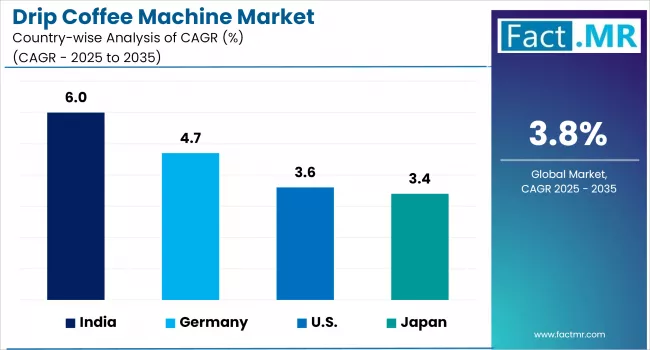
Drip Coffee Machine Market By Country | Source: Fact.MR
Smart Brewing and Sustainability Put Germany on the Drip Coffee Map
The coffee-drinking culture supports the presence of the drip coffee machine market in Germany, where sustainability and energy efficiency remain key considerations. Consumers are also purchasing more environment friendly design machines, descale warning, and filter system recycling.
The demand of energy efficient appliances is made by the EU regulations and laws of green labels. High-end models with their fine control over temperature settings and automation are gaining traction in the market.
Convenience and Customization Brew Growth in the U.S. Market
2025-to-2035.webp "Us Drip Coffee Machine Market Country Value(usd Million)2025 To 2035")
Us Drip Coffee Machine Market Country Value(usd Million)2025 To 2035 | Source: Fact.MR
The U.S. remains the leading consumer of drip coffee machines, driven by its fast-paced lifestyle and high demand of conveniences. Popular are single-serve drip version models with programmable time along with smart home integration. The market also benefits from the growing interest in gourmet coffee culture and the increased home brewing after the pandemic.
Market growth is facilitated by a combination of e-commerce, intensive promotion, and extensive availability of products in price ranges. The current interest in sustainability drives a demand in reusable filters and economical versions.
Precision, Compact Design, and Quality Define Japan’s Drip Coffee Demand
The Japanese drip coffee machine industry focuses on small size, noise-free and attention to beer quality. Due to the lack of kitchen space in urban regions, space-saving and slim-profile machines are on demand. Adjustable strength of a brew and fast dispensing of hot water is what the consumers find valuable in the programs.
Quality in terms of design, durability and hygiene are also key contributing factors to steady demand. Buying behavior has also been affected by environmental awareness, as there has been increased demand in reusable filters, low waste packaged products and energy efficient contents that comply with Japan sustainability objectives.
Country Wise Insights
| Country | CAGR (2025-35) |
|---|---|
| Germany | 4.7% |
| U.S. | 3.6% |
| Japan | 3.4% |
Source: Fact.MR analysis. Updated Aug 12, 2025
Category-Wise Analysis
Glass Carafes Brew Trust in Drip Coffee Machine Design
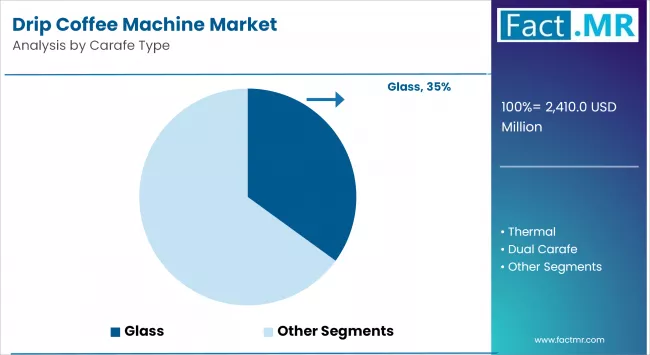
Drip Coffee Machine Market By Carafe Type | Source: Fact.MR
Glass carafes remain popular in the design of drip coffee machines, as they are visually appealing, affordable and easy to clean. Their transparency enables users to check the levels of brew and its freshness, and are thus preferred both at homes and at workplaces.
Although glass carafes with hot plates have a weaker capacity than thermal alternatives, they maintain suitable serving temperatures during short durations, ideal for immediate consumption.
With the growing preference for minimalism in kitchen furnishings and stylishness among counter appliances, the neat and elegant designs of glass carafe continue to gain popularity, supported by broad consumer familiarity and accessible pricing.
Compact Cup Sizes Brew Daily Convenience in the Drip Coffee Machine Market
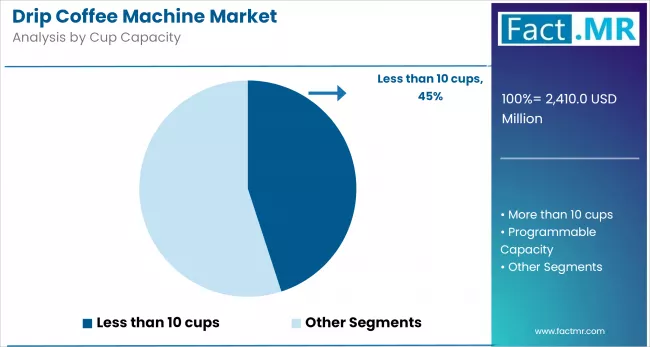
Drip Coffee Machine Market By Cup Capacity | Source: Fact.MR
Drip coffee machines with a capacity of less than 10 cups are primarily used in households, as their compact size, faster brewing time, and alignment with modern consumption habits appeal to both families and individuals. Such machines are well-suited for people who live in cities and want to have the convenience without losing the benefits of a quality brew.
Their price-performance ratio and the fact that they comfortably fit into counter-space makes them a preferred choice of apartment, dorms and home office. The increasing popularity of personalized coffee experiences and less wastage also indicate the popularity of small-capacity drip models.
Residential Use Brews Everyday Demand in the Drip Coffee Machine Market
Residential end use leads the drip coffee machine industry, supported by the increase in at-home consumption, particularly after the pandemic. Consumers are becoming more focused on being able to achieve convenience, affordability and customization, which means small, full-featured machines can be optimally utilized in a home environment.
As more individuals work remotely and seek cafe-like experiences at home, there is heightened demand in programmable settings, strength of brew control, and visually appealing kitchen-friendly design. The residential adoption is also promoted by its simple reachability brought about by e-commerce and the overall low prices available in the market.
Competitive Analysis
The drip coffee machines market is highly competitive, with numerous brands offering their products at varying prices. There is strong competition in terms of features, design, and technology. Firms aim to differentiate their products by enhancing intelligence, energy- efficiency, and customization capabilities.
The competitiveness of mid-range and entry-level divisions is particularly intense, as there are great number of regional and private-label brands competing via price tag and minimum functionality. These competitors often employ assertive pricing, using online retail channels to attract price sensitive consumers particularly in emerging markets.
The competitive factors are user convenience, innovation and sustainability. The brands specializing in environmentally-friendly materials, reusable filters, and small-size products are gaining advantage. The online reviews, influencer marketing and direct-to customer models are also becoming the key tools of attracting and maintaining customer attention in an oversaturated and dynamic market.
Key players in the market are Krups GmbH, Koninklijke Philips N.V., De'Longhi Appliances s.r.l, BSH Hausgeräte GmbH, Melitta Group, BUNN-O-Matic Corporation, JURA Elektroapparate AG, Hamilton Beach Brands, Inc., Bravilor Bonamat B.V., Spectrum Brand Holdings, Inc., and other players.
Recent Development
- In May, 2025, Ratio’s official blog published “Ten Years in: The Next Chapter of the Ratio Eight,” detailing the evolution to Series 2—highlighting material choices (matte polymer body, stainless hot-water path), improved durability, and manufacturing refinements without plastic water-contact surfaces.
- In May, 2025, Daily Coffee News (citing the company source) reports the rollout of the Ratio Eight Series 2, noting its upgraded brewing features and sustainability-focused design directly referencing Ratio’s announcement and linking to their official launch page.
Methodology and Industry Tracking Approach
The study conducted by Fact.MR on drip coffee machine market of 2025 has interviewed more than 2,700 respondents in 15 countries. To connect with any changing trends, over 70 local flavor specialists, such as appliance engineers, sustainability planners, and store planners, were interviewed in the month of October, 2025. Ideas that were aimed at enhancing the need of energy-conserving compact and recyclable appliances matched the urban ways of life that were current.
Growth in smart brewing technologies, Wi-Fi-based controls, and automated, maintenance-based alerts supported a strong market growth in the year July 2024- June 2025. These innovations enhanced the convenience of the user and stimulated adoption both in the residential and the commercial sectors.
Fact.MR analysts noticed that there was increased attention to sustainable manufacturing as well. Since 2018, brands have started to use sustainable materials, modular designs in order to make them reparable and the components with reduced power consumption need to meet new global environmental requirements as well as ensure advantages in the long run in terms of ensuring consumer confidence.
Fact.MR has provided detailed information about the price points of key manufacturers of Drip Coffee Machine Market positioned across regions, sales growth, production capacity, and speculative technological expansion, in the recently published report.
Segmentation
Segmentation of Drip coffee machine market
-
By Cup Capacity :
- Less than 10 cups
- More than 10 cups
- Programmable Capacity
-
By Carafe Type :
- Glass
- Thermal
- Dual Carafe
- Insulated Steel
- BPA-free Plastic
-
By End Use :
- Residential
- Commercial
- Quick Service Restaurants
- Cafés & Coffee Shops
-
By Body Type :
- Metal
- Plastic
- Stainless Steel
- Composite
- Glass-infused Polymer
-
By Region :
- North America
- Latin America
- Western Europe
- Eastern Europe
- East Asia
- South Asia & Pacific
- Middle East & Africa
Frequently Asked Questions
What was the global Drip coffee machine market size reported by Fact.MR for 2025?
Who are the major players operating in the drip coffee machine market?
What is the Estimated Valuation of the drip coffee machine market in 2035?
What value CAGR did the Drip coffee machine market exhibit over the last five years?
Who worked on this report


Preview the report firsthand - request a free sample
Free SampleGet the brochure for pricing and purchase details
Download PDF