- Base Value(2025): 1.6 Bn
- Estimated Value(2026): 1.7 Bn
- Forecast Value (2036): 3.7 Bn
- CAGR (2026 - 2036): 8.1%
Plasmapheresis Market Analysis and Forecast by Fact.MR
- The Plasmapheresis Market is expected to grow from USD 1.7 billion in 2026 to USD 3.7 billion by 2036, at a 8.1% CAGR.
- Driven by expanding therapeutic plasma exchange indications across neurological and autoimmune conditions, growing plasma collection volumes for immunoglobulin fractionation, and increasing adoption of automated apheresis systems with improved separation efficiency and donor comfort, with therapeutic plasmapheresis systems accounting for 48.3% share.
- Neurological disorder applications contributing 36.4% share as companies invest in next-generation centrifugation platforms, membrane filtration technology, and connected apheresis monitoring systems.
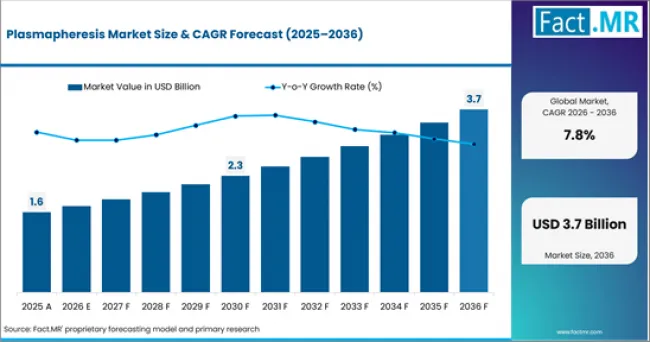
Plasmapheresis Market Value Analysis | Source: Fact.MR
Summary of Plasmapheresis Market
- Market Snapshot
- In 2025, the global Plasmapheresis Market was valued at approximately USD 1.6 billion.
- The market is estimated to reach USD 1.7 billion in 2026 and is projected to attain USD 3.7 billion by 2036.
- The plasmapheresis market is likely to expand at a CAGR of 8.1% during the forecast period.
- The market is anticipated to create an absolute dollar opportunity of USD 2 billion between 2026 and 2036.
- Therapeutic Plasmapheresis Systems account for 48.3% of product segment share in 2026.
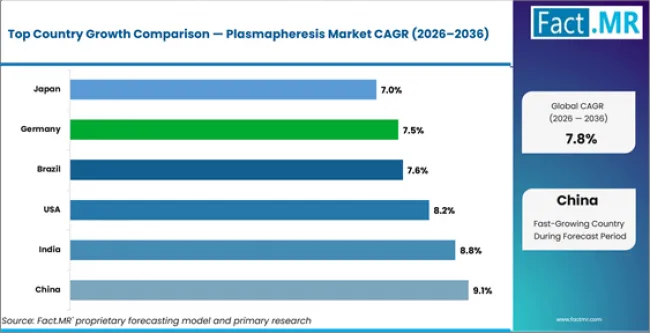
- China (9.1%) and India (8.8%) are the key growth markets during the forecast period.
- Demand and Growth Drivers
- Expanding therapeutic plasma exchange indications for autoimmune neurological conditions including Guillain-Barre syndrome, myasthenia gravis, and chronic inflammatory demyelinating polyneuropathy are driving procedure volume growth.
- Growing global demand for immunoglobulin products is driving plasma collection center expansion and donor apheresis system procurement.
- Automated apheresis technology advancement is improving plasma separation efficiency, donor comfort, and collection throughput.
- Increasing recognition of plasmapheresis as first-line therapy for several neurological and autoimmune conditions is expanding clinical adoption beyond specialty academic centers.
- Emerging market hospital infrastructure investment is creating new treatment access for conditions previously undiagnosed or untreated in resource-limited settings.
- Product and Segment View
- In the clinical application of plasma exchange equipment in hospital, the largest product share is therapeutic plasmapheresis systems at 48.3% in 2026.
- The technology segment is led by centrifugation technology with 44.1% share due to established clinical protocols and validated separation performance.
- Key segmentation includes:
- Product: Therapeutic Plasmapheresis Systems, Donor Plasmapheresis Systems, Plasma Filters, Replacement Fluids
- Application: Neurological Disorder Applications, Auto-immune Disease, Hematologic Disorders, Renal Disorders.
- Type of Procedure: Therapeutic Plasma Exchange, Donor Plasma Collection, Double Filtration Plasmapheresis
- These systems enable:
- Therapeutic plasma exchange for the removal of pathogenic autoantibodies and immune complexes in autoimmune and neurological diseases
- Efficient donor plasma collection for production of plasma-derived therapeutics and immunoglobulins
- Double filtration plasmapheresis:selective removal of pathogens with less albumin replacement
- Geography and Competitive Outlook
- China is leading with 9.1%, driven by expansion of hospital neurology and nephrology, growing plasma collection infrastructure and development of domestic apheresis devices.
- India is projected to grow at 8.8% CAGR, while the USA is projected to grow at 8.2%, supported by expanding therapeutic plasma exchange adoption and plasma collection infrastructure.
- Brazil at 7.6% is backed by growing public health expenditure towards advanced treatment modalities for neurological disorders.
- Key players are Terumo BCT, Fresenius Kabi, Haemonetics Corporation, Asahi Kasei Medical, and B. Braun.
- Analyst Opinion
- Shambhu Nath Jha, Principal Consultant at Fact.MR, says "The plasmapheresis market is growing on two parallel demand channels: therapeutic plasma exchange for treating neurological and autoimmune diseases, and donor plasmapheresis for collecting plasma used in immunoglobulin manufacturing. Terumo BCT leads through its Optia and Trima apheresis platform ecosystem, which serves both hospital therapeutic and donor collection applications. Haemonetics is repositioning toward apheresis technology after divesting its whole blood assets in 2025, while Fresenius Kabi competes through its integrated plasma collection center network and nephrology equipment portfolio."
Key Growth Drivers, Constraints, and Opportunities
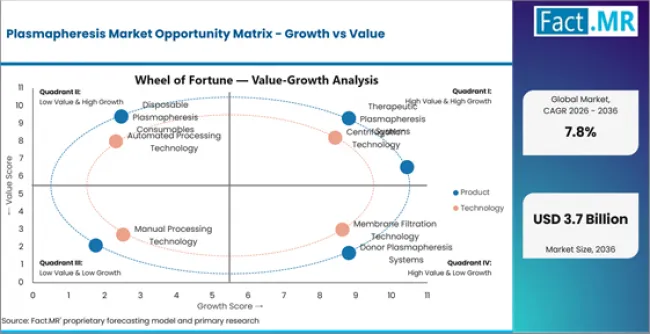
Plasmapheresis Market Opportunity Matrix Growth Vs Value | Source: Fact.MR
Key Factors Driving Growth
- The expansion of therapeutic plasma exchange indication to autoimmune neurological conditions is helping to support continued procedure volume growth across hospital neurology departments.
- The global immunoglobulin shortage has resulted in plasma collection centers expanding and procuring donor apheresis systems to increase the source plasma supply.
- Automated apheresis technology with improved collection efficiencies and donor comfort features is increasing per-procedure plasma yield and donor retention.
Key Market Constraints
- High capital cost of apheresis systems and ongoing disposable kit expenses create procurement barriers for resource-limited hospital settings.
- Trained apheresis nursing staff requirements limit procedure throughput and geographic availability of therapeutic plasma exchange services.
- Regulatory complexity for blood products and apheresis devices creates market access delays and compliance costs across jurisdictions.
Key Opportunity Areas
- Emerging market hospital neurology and nephrology investment is creating new therapeutic plasma exchange treatment access in regions with large undiagnosed patient populations.
- Connected apheresis monitoring systems with remote procedure oversight capabilities create potential for hub-and-spoke treatment delivery models.
- Double filtration plasmapheresis technology that selectively removes pathogenic proteins while conserving albumin addresses clinical limitations of conventional plasma exchange.
Segment-wise Analysis of the Plasmapheresis Market
- Therapeutic plasmapheresis systems will account for 48.3% of product share in the main clinical treatment application of apheresis equipment in 2026.
- Neurological disorder applications dominate, accounting for 36.4%, primarily due to therapeutic plasma exchange protocols for Guillain-Barre syndrome, myasthenia gravis and CIDP.
- End User Insights Hospitals accounted for 57.2% share owing to presence of institutional apheresis programs and infrastructure for specialist neurology/nephrology treatment.
By Product, Technology, Application, Procedure Type, End User And Region. For therapeutic systems, the clinical treatment demand is ahead. For donor systems, the plasma collection expansion is ahead. Therapeutic plasma exchange has 51.8% share of procedure type.
Which Product Segment Dominates the Plasmapheresis Market?
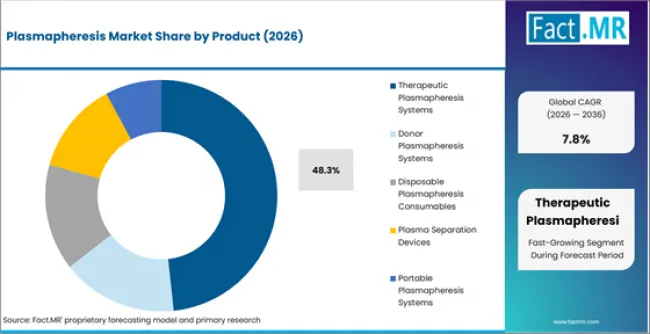
Plasmapheresis Market Analysis By Product | Source: Fact.MR
In 2026, therapeutic plasmapheresis systems will account for 48.3% of product segment value. This leadership is fueled by the increasing clinical indication base for therapeutic plasma exchange in neurologic, autoimmune and hematologic conditions and the high per-system capital value of automated apheresis platforms.
The second largest segment is donor plasmapheresis systems. The growth of plasma collection centers for immunoglobulin manufacturing drives system procurement. High frequency consumables such as plasma filters and replacement fluids generate recurring revenue for each procedure.
Which Application Segment Dominates the Plasmapheresis Market?
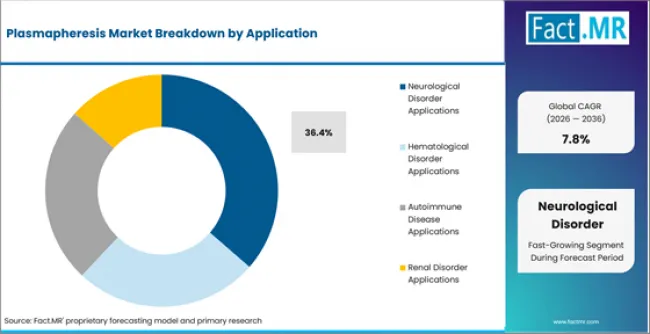
Plasmapheresis Market Analysis By Application | Source: Fact.MR
Neurological disorder applications account for 36.4% of application segment value in 2026. Guillain-Barre syndrome, myasthenia gravis, chronic inflammatory demyelinating polyneuropathy, and neuromyelitis optica spectrum disorder generate the highest therapeutic plasma exchange procedure volumes.
Autoimmune disease and hematological disorders represent the second and third-largest application areas. Thrombotic thrombocytopenic purpura, anti-GBM disease, and transplant-related antibody removal drive additional TPE procedure demand in hospital hematology and nephrology settings.
Which Product Trend is Shaping the Next Phase of Growth in the Plasmapheresis Market?
The major technology trend impacting delivery of plasmapheresis services is the monitoring systems for connected apheresis with real-time oversight of the procedure. Digital connectivity in modern apheresis platforms allows for remote clinical monitoring, standardization of procedure protocols, and quality data collection to support treatment optimization and regulatory compliance documentation.
This trend is reinforced by the treatment hub-and-spoke model, in which academic centers with specialist physicians can remotely supervise therapeutic plasma exchange procedures performed at community hospitals with trained nursing staff. Adding connected monitoring capabilities to apheresis platforms positions companies well to expand the geographic reach of TPE treatment beyond specialist centers.
Regional Outlook Across Key Markets
- China leads at 9.1% from hospital neurology expansion, plasma collection infrastructure development and domestic apheresis device manufacturing.
- Increasing adoption of therapeutic plasma exchange and increasing investment in the plasma collection industry are represented by India 8.8% and USA 8.2%.
- Brazil is supported by the growing public health investment in advanced treatment modalities for neurological conditions at 7.6%.
.webp "Top Country Growth Comparison Plasmapheresis Market Cagr (2026 2036)")
Top Country Growth Comparison Plasmapheresis Market Cagr (2026 2036) | Source: Fact.MR
CAGR Table
| Country | CAGR (%) |
|---|---|
| China | 9.1% |
| India | 8.8% |
| USA | 8.2% |
| Brazil | 7.6% |
| Germany | 7.5% |
| Japan | 7.0% |
Source: Fact.MR analysis. Updated Jun 17, 2026
Source: Fact.MR analysis, based on proprietary forecasting model and primary research.
Plasmapheresis Market Cagr Analysis By Country | Source: Fact.MR
China Plasmapheresis Demand Trends
The China Plasmapheresis Market is projected to grow at a CAGR of 9.1% through 2036. Hospital neurology and nephrology department expansion and centralized drug procurement are reshaping plasmapheresis treatment access. Domestic apheresis device development under self-sufficiency policies supports equipment cost reduction.
- Hospital expansion in Tier 2 and Tier 3 cities is broadening neurology specialist access for therapeutic plasma exchange procedures.
- Centralized procurement programs are standardizing apheresis equipment selection across hospital networks.
- Domestic apheresis device manufacturers are developing cost-competitive systems to reduce import dependency.
Plasmapheresis Growth Assessment in India
The India Plasmapheresis Market is projected to grow at a CAGR of 8.8% through 2036. Ayushman Bharat and private healthcare investment are expanding specialist treatment access. Cost-effectiveness requirements in public health programs shape apheresis equipment procurement and procedure pricing.
- Ayushman Bharat coverage expansion improves patient access to therapeutic plasma exchange for previously untreated autoimmune neurological conditions.
- Private hospital neurology investment in metropolitan centers creates premium treatment capacity for TPE procedures.
- Cost-effective apheresis system procurement through group purchasing organizations supports equipment adoption in resource-limited settings.
Plasmapheresis Demand Analysis in USA
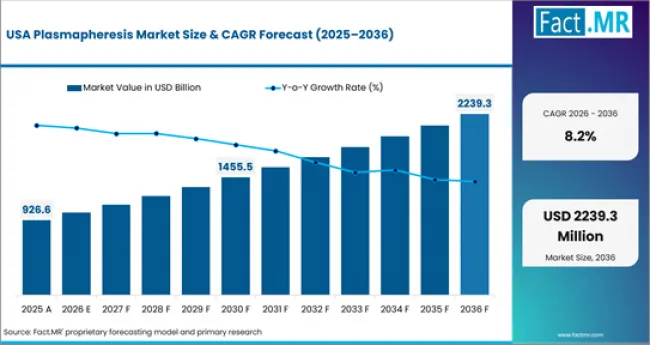
Plasmapheresis Market Country Value Analysis | Source: Fact.MR
The USA Plasmapheresis Market is projected to grow at a CAGR of 8.2% through 2036. FDA device clearance and insurance reimbursement frameworks shape apheresis equipment procurement and therapeutic procedure economics. Plasma collection industry expansion drives donor system demand.
- FDA device clearance pathways and insurance reimbursement for TPE procedures support sustained equipment and consumable procurement.
- Plasma collection center expansion driven by immunoglobulin manufacturing demand generates donor apheresis system procurement volume.
- Specialty pharmacy and hospital outpatient department settings are expanding TPE treatment access beyond inpatient neurology wards.
Brazil Plasmapheresis Market Growth Outlook
The Brazil Plasmapheresis Market is projected to grow at a CAGR of 7.6% through 2036. Public health system investment and ANVISA regulatory pathways shape therapeutic equipment procurement. Large consumer base and growing specialist healthcare access create demand for advanced neurological treatment modalities.
- ANVISA regulatory processes govern medical device approval and influence apheresis equipment market access timelines.
- SUS public health system investment in specialist neurology services supports TPE treatment access expansion.
- Local manufacturing incentives create potential for domestic apheresis consumable production to reduce import dependency.
Germany Plasmapheresis Market Growth Outlook
The Germany Plasmapheresis Market is projected to grow at a CAGR of 7.5% through 2036. EU MDR compliance and GKV reimbursement decisions shape apheresis equipment procurement. University hospital neurology departments operate established TPE programs with advanced treatment protocols.
- GKV reimbursement for therapeutic plasma exchange procedures supports sustained institutional equipment and consumable procurement.
- EU MDR compliance requirements for apheresis devices create regulatory barriers that favor established manufacturers with validated product portfolios.
- University hospital neurology programs operate the most advanced TPE treatment protocols with long-term patient outcome tracking.
Competitive Benchmarking and Company Positioning
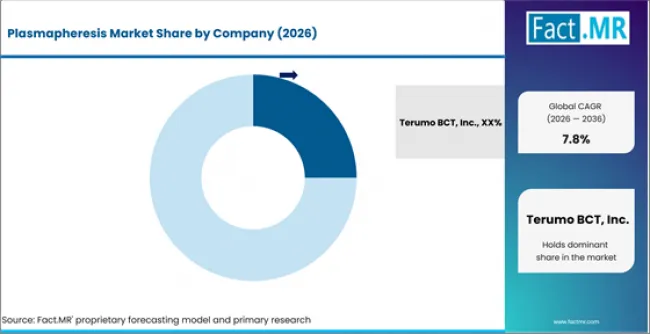
Plasmapheresis Market Analysis By Company | Source: Fact.MR
Plasmapheresis Market Analysis By Company
- Terumo BCT Inc. has the largest market share, at approximately 25.0%, with its Optia and Trima apheresis platform ecosystem that serves both hospital therapeutic and plasma collection center donor applications with validated separation technology.
- Fresenius Medical Care/Fresenius Kabi operates in a unique vertical integrated market position with an integrated portfolio of apheresis equipment, dialysis systems and plasma collection center operations.
- Haemonetics Corporation has divested the whole blood assets in January 2025 and is now focused on leadership in apheresis technology. Apheresis will be the company’s core business segment.
The competitive landscape is dominated by three major apheresis platform manufacturers: Terumo BCT, Fresenius, and Haemonetics. Terumo BCT is the market leader with dual therapeutic and donor platform capability. Fresenius competes vertically from equipment to plasma collection center operations.
Haemonetics’ strategic shift after the 2025 whole blood divestiture makes apheresis the company’s core growth platform. Haemonetics expanded its hospital portfolio with the acquisition of Vivasure Medical in January 2026. B. Asahi Kasei Medical Braun has a focus on membrane filtration and treatment-specific apheresis applications for specific regions and technologies.
Key Companies in the Plasmapheresis Market
- The leading companies are Terumo BCT, Inc., Fresenius Medical Care / Fresenius Kabi, Haemonetics Corporation, Asahi Kasei Medical Co., Ltd., B. Braun Melsungen AG, Kaneka Corporation, Medica S.p.A., Miltenyi Biotec, Nikkiso Co., Ltd., Therakos, Inc.
Recent Industry Developments
- Haemonetics Corporation - Whole Blood Asset Divestiture and Apheresis Focus (January 2025)
- Haemonetics completed the divestiture of its whole blood product portfolio to GVS for a transaction valued at up to USD 67.8 million, strategically repositioning the company to focus on its core apheresis technology platforms and hospital-based therapeutic solutions while streamlining its long-term growth strategy.
- Haemonetics Corporation - Vivasure Medical Acquisition (January 2026)
- Haemonetics acquired Vivasure Medical, a developer of large-bore vascular closure technologies, through a transaction comprising EUR 100 million in upfront consideration and up to EUR 85 million in milestone payments. The acquisition expanded the company’s hospital interventional technology portfolio by adding the PerQseal® Elite bioabsorbable vascular closure system.
Leading Companies Shaping the Plasmapheresis Market
- Terumo BCT, Inc.
- Fresenius Medical Care / Fresenius Kabi
- Haemonetics Corporation
- Asahi Kasei Medical Co., Ltd.
- B. Braun Melsungen AG
- Kaneka Corporation
- Medica S.p.A.
- Miltenyi Biotec
- Nikkiso Co., Ltd.
- Therakos, Inc.
Sources and Research References
- Haemonetics Corporation. (2025). Haemonetics completes divestiture of whole blood asset portfolio to GVS. Haemonetics Corporation.
- Haemonetics Corporation. (2026). Haemonetics acquires Vivasure Medical to expand vascular closure technologies portfolio. Haemonetics Corporation.
This bibliography is provided for reader reference and is not exhaustive. The full report contains the complete reference list and detailed citations.
Key Questions This Report Addresses
- What is the estimated size of the global Plasmapheresis Market in 2026, and how is it projected to grow through 2036?
- What incremental revenue opportunity is the Plasmapheresis Market expected to create between 2026 and 2036?
- Which product segment holds the largest share in 2026, and what clinical indication factors support therapeutic system leadership?
- How is the balance between therapeutic and donor plasmapheresis expected to shift as immunoglobulin demand grows?
- Which application segment is projected to generate the most incremental revenue through 2036?
- Which countries are projected to register the highest CAGR, and what healthcare investment factors accelerate growth?
- How do treatment access patterns in the U.S. compare with China and India in terms of TPE procedure availability?
- What capital cost and staffing constraints could limit plasmapheresis adoption in resource-limited settings?
- Who are the leading companies, and how are they differentiating through platform technology, consumable portfolios, and service networks?
- What recent divestitures and acquisitions in 2025 and 2026 are reshaping competitive positioning in the plasmapheresis market?
- Which technology or delivery model trend is driving the next phase of growth?
- How is connected apheresis monitoring changing the geographic reach of therapeutic plasma exchange services?
- What role are double filtration technology, membrane-based separation, and donor comfort improvements playing in reshaping market dynamics?
- What demand-side drivers sustain growth, and how do they vary between therapeutic treatment and donor collection applications?
Plasmapheresis Market Definition
The plasmapheresis market covers therapeutic and donor apheresis systems, disposable kits, replacement fluids, and associated consumables used for plasma exchange procedures in the treatment of neurological, autoimmune, hematological, and renal disorders across hospital, blood center, and specialty clinic settings.
Plasmapheresis Market Inclusions
- Global and regional market size and forecasts for 2026 to 2036 across product, technology, application, procedure type, end user, and region.
- Demand analysis based on therapeutic plasma exchange procedure volumes, plasma collection center count, immunoglobulin demand, and hospital nephrology/neurology capacity.
- Competitive landscape including apheresis system portfolios, disposable kit revenues, and plasma collection network strategies of leading companies.
Plasmapheresis Market Exclusions
- Hemodialysis equipment not designed for plasma separation or exchange procedures.
- Blood collection equipment for whole blood donation without apheresis separation capability.
- Plasma-derived therapeutic products (immunoglobulins, albumin, clotting factors) sold downstream of the collection process.
Plasmapheresis Market Research Methodology
- Methodology combines secondary research from transfusion medicine publications, plasma industry databases, and hospital equipment registries with primary validation.
- Market sizing covers 30+ countries with inputs including TPE procedure volumes, plasma collection center count, immunoglobulin consumption, and hospital neurology/nephrology capacity.
- Primary validation includes 18+ interviews across apheresis device manufacturers, blood center operators, hospital procurement managers, and transfusion medicine specialists.
Segmentation
Scope of Analysis
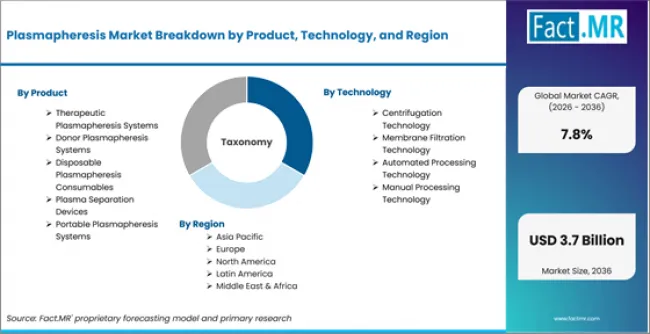
Plasmapheresis Market Breakdown By Product, Technology, And Region | Source: Fact.MR
| Parameter | Details |
|---|---|
| Quantitative Units | USD 1.7 billion to USD 3.7 billion, at a CAGR of 8.1% |
| Market Definition | The plasmapheresis market covers therapeutic and donor apheresis systems, disposable kits, replacement fluids, and associated consumables used for plasma exchange procedures in the treatment of neurological, autoimmune, hematological, and renal disorders across hospital, blood center, and specialty clinic settings. |
| Regions Covered | North America, Latin America, Europe, East Asia, South Asia and Pacific, Middle East and Africa |
| Countries Covered | China, India, USA, Brazil, Germany, Japan, 30 plus countries |
| Key Companies | Terumo BCT, Inc., Fresenius Medical Care / Fresenius Kabi, Haemonetics Corporation, Asahi Kasei Medical Co., Ltd., B. Braun Melsungen AG, Kaneka Corporation, Medica S.p.A., Miltenyi Biotec |
| Forecast Period | 2026 to 2036 |
| Approach | Hybrid demand-side and top-down methodology built on TPE procedure volumes, plasma collection center count, immunoglobulin consumption, hospital infrastructure, and primary interviews |
Source: Fact.MR analysis. Updated Jun 17, 2026
Plasmapheresis Market Segmentation
-
Plasmapheresis Market Segmented by Product:
- Therapeutic Plasmapheresis Systems
- Centrifugal Plasmapheresis Systems
- Autoimmune Disorder Applications
- Hospital Apheresis Products
- Membrane Filtration Plasmapheresis Systems
- Neurological Disorder Applications
- Critical Care Systems
- Centrifugal Plasmapheresis Systems
- Donor Plasmapheresis Systems
- Manual Plasma Collection Systems
- Blood Donation Applications
- Collection Center Products
- Automated Plasma Collection Systems
- High Volume Donation Applications
- Commercial Plasma Systems
- Manual Plasma Collection Systems
- Disposable Plasmapheresis Consumables
- Apheresis Tubing Sets
- Single Use Applications
- Infection Control Products
- Plasma Collection Kits
- Blood Processing Applications
- Clinical Consumable Systems
- Apheresis Tubing Sets
- Plasma Separation Devices
- Continuous Flow Separation Systems
- High Efficiency Applications
- Therapeutic Plasma Products
- Intermittent Flow Separation Systems
- Small Volume Applications
- Clinical Processing Systems
- Continuous Flow Separation Systems
- Portable Plasmapheresis Systems
- Compact Apheresis Devices
- Mobile Care Applications
- Emergency Treatment Products
- Bedside Plasma Exchange Systems
- Intensive Care Applications
- Point Of Care Systems
- Compact Apheresis Devices
- Therapeutic Plasmapheresis Systems
-
Plasmapheresis Market Segmented by Technology:
- Centrifugation Technology
- Continuous Flow Centrifugation
- Large Volume Plasma Applications
- Hospital Treatment Systems
- Intermittent Flow Centrifugation
- Low Volume Applications
- Clinical Care Products
- Continuous Flow Centrifugation
- Membrane Filtration Technology
- Hollow Fiber Filtration Systems
- Therapeutic Exchange Applications
- Blood Purification Products
- Selectivity Filtration Systems
- Precision Plasma Separation Applications
- Advanced Treatment Systems
- Hollow Fiber Filtration Systems
- Automated Processing Technology
- Sensor Integrated Systems
- Real Time Monitoring Applications
- Smart Apheresis Products
- Computer Controlled Processing
- High Accuracy Applications
- Digital Healthcare Systems
- Sensor Integrated Systems
- Manual Processing Technology
- Operator Controlled Systems
- Small Clinic Applications
- Basic Treatment Products
- Semi Automated Exchange Systems
- Cost Efficient Applications
- Clinical Care Systems
- Operator Controlled Systems
- Centrifugation Technology
-
Plasmapheresis Market Segmented by Application:
- Neurological Disorder Applications
- Guillain Barre Syndrome Treatment
- Critical Neurology Applications
- Therapeutic Exchange Products
- Myasthenia Gravis Management
- Autoimmune Neurology Applications
- Advanced Care Systems
- Guillain Barre Syndrome Treatment
- Hematological Disorder Applications
- Thrombotic Disorder Treatment
- Blood Purification Applications
- Clinical Hematology Products
- Sickle Cell Disease Applications
- Blood Component Exchange Systems
- Specialty Care Products
- Thrombotic Disorder Treatment
- Autoimmune Disease Applications
- Lupus Management Applications
- Immune Modulation Systems
- Therapeutic Plasma Products
- Rheumatoid Disorder Applications
- Inflammatory Disease Systems
- Clinical Treatment Products
- Lupus Management Applications
- Renal Disorder Applications
- Kidney Failure Support Applications
- Critical Care Systems
- Blood Filtration Products
- Antibody Removal Applications
- Transplant Support Systems
- Advanced Renal Care
- Kidney Failure Support Applications
- Neurological Disorder Applications
-
Plasmapheresis Market Segmented by Procedure Type:
- Therapeutic Plasma Exchange
- Total Plasma Replacement Systems
- Critical Care Applications
- Advanced Treatment Products
- Targeted Plasma Removal Systems
- Disease Specific Applications
- Precision Therapeutic Systems
- Total Plasma Replacement Systems
- Donor Plasma Collection
- Source Plasma Collection Systems
- Biopharmaceutical Applications
- Commercial Donation Products
- Voluntary Donation Systems
- Blood Bank Applications
- Collection Center Products
- Source Plasma Collection Systems
- Double Filtration Plasmapheresis
- Selective Component Removal Systems
- Autoimmune Applications
- Advanced Filtration Products
- Protein Fractionation Systems
- Specialized Treatment Applications
- Clinical Exchange Systems
- Selective Component Removal Systems
- Immunoadsorption Procedures
- Antibody Removal Systems
- Neurological Applications
- Immune Therapy Products
- Selective Adsorption Columns
- Precision Treatment Applications
- Advanced Therapeutic Systems
- Antibody Removal Systems
- Therapeutic Plasma Exchange
-
Plasmapheresis Market Segmented by End User:
- Hospitals
- Multispecialty Hospitals
- Critical Care Applications
- Apheresis Treatment Products
- Tertiary Care Centers
- Advanced Neurology Applications
- Specialized Care Systems
- Multispecialty Hospitals
- Blood Collection Centers
- Commercial Plasma Centers
- Source Plasma Applications
- Collection Processing Products
- Blood Bank Facilities
- Donation Applications
- Storage Management Systems
- Commercial Plasma Centers
- Specialty Clinics
- Neurology Clinics
- Autoimmune Disorder Applications
- Therapeutic Exchange Products
- Renal Care Clinics
- Kidney Disorder Applications
- Clinical Treatment Systems
- Neurology Clinics
- Research Institutes
- Clinical Research Centers
- Experimental Therapy Applications
- Investigational Apheresis Products
- Academic Medical Institutes
- Blood Research Applications
- Advanced Healthcare Systems
- Clinical Research Centers
- Hospitals
-
Plasmapheresis Market by Region:
- North America
- USA
- Canada
- Mexico
- Latin America
- Brazil
- Chile
- Rest of Latin America
- Western Europe
- Germany
- UK
- Italy
- Spain
- France
- Nordic
- BENELUX
- Rest of Western Europe
- Eastern Europe
- Russia
- Poland
- Hungary
- Balkan & Baltic
- Rest of Eastern Europe
- East Asia
- China
- Japan
- South Korea
- South Asia and Pacific
- India
- ASEAN
- Australia & New Zealand
- Rest of South Asia and Pacific
- Middle East & Africa
- Kingdom of Saudi Arabia
- Other GCC Countries
- Turkiye
- South Africa
- Other African Union
- Rest of Middle East & Africa
- North America
Frequently Asked Questions
How big is the plasmapheresis market in 2026?
What will be the size of the plasmapheresis market in 2036?
How much will the plasmapheresis market grow between 2026 and 2036?
What are the key products in the plasmapheresis market?
Which technology segment is expected to contribute a significant share in the plasmapheresis market in 2026?
Who worked on this report


Preview the report firsthand - request a free sample
Free SampleGet the brochure for pricing and purchase details
Download PDF