- Market Value (2025): USD 1.7 Bn
- Estimated Value (2026): USD 1.8 Bn
- Forecast Value (2036): USD 3.2 Bn
- CAGR (2026-2036): 6.0%
What is the Balayage Lightener Market forecast to be worth by 2036?
USD 1.8 billion in 2026 to USD 3.2 billion by 2036 at a 6.0% CAGR.
- The Balayage Lightener Market reached USD 1.7 billion in 2025.
- Demand is projected to increase from USD 1.8 billion in 2026 to USD 3.2 billion by 2036.
- The market is forecast to record a 6.0% CAGR from 2026 to 2036 as salons and home users select controlled systems.
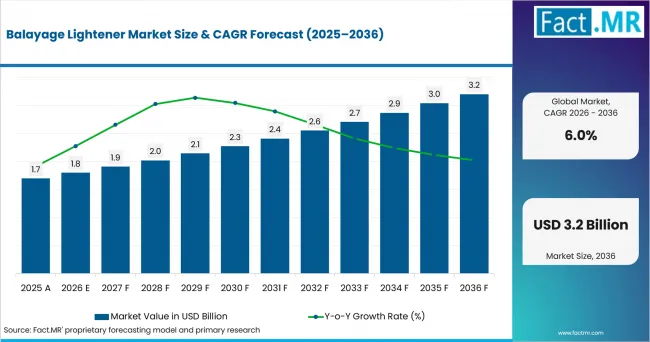
Balayage Lightener Market Value Analysis | Source: Fact.MR
What are the defining numbers behind Balayage Lightener Market growth?
USD 1.4 billion absolute opportunity is expected between 2026 and 2036.
- Demand Drivers in the Market
- Salon colourists need lighteners that stay in place during open-air painting, so clay formats gain value when stylists create blended ribbons without foil support.
- FDA reported 1,298,361 unique active cosmetic product listings under MoCRA as of June 30, 2026.
- Professional hair brands need products that fit salon traffic. L’Oréal reported in July 2026 that its Professional Products Division reached EUR 2,920.8 million in first-half 2026 sales.
- Home users need simpler selection guidance because lift timing and developer pairing vary by formula, hair condition and target result.
- Key Segments Analyzed
- By Product: Clay Lighteners are expected to hold 34.90% share in 2026 due to paste-like control in open-air balayage placement.
- By Hair Density: Thin is projected to account for 29.40% share in 2026 as fine-hair users need lighter formulas with controlled processing.
- By Lightening Power: Up To 6 Levels is anticipated to capture 36.80% share in 2026 because soft lift fits lived-in blonding and lower-damage routines.
- By Buyer Category: Households are estimated to represent 41.30% share in 2026 owing to do-it-yourself touch-ups and retail access to guided kits.
- By Sales Channel: Offline Sales Of Balayage Lighteners are forecast to hold 37.60% share in 2026 because shoppers value in-store colour advice and salon retail recommendations.
- Analyst Opinion at Fact.MR
- Shambhu Nath Jha, Principal Consultant at Fact.MR, states, “Balayage lightener buying is shaped by control beyond lift claims. The category is expected to expand as users move between salon services and home maintenance. Suppliers that combine lift claims and clear safety steps reduce misuse and returns.”
- Strategic Implications
- Brand teams should explain lift level, developer pairing and strand-test guidance so users can match processing to hair condition and target result.
- Salon distributors should package clay lighteners with education cards since freehand results depend on saturation, sectioning and drying behaviour.
- Retail chains should keep offline advice visible. Lightener selection carries higher error risk than shampoo or colour-depositing products.
- E-commerce teams should add patch-test, developer and strand-test guidance near the purchase button to reduce unsafe home use.
Germany is projected to record 6.6% CAGR through 2036, supported by premium salon services and regulated hair-colour use. Brazil follows at 6.0% as pharmacy, perfumery and cosmetics retail sales improve. The USA is anticipated to post 5.4% through salon employment and professional service demand. The U.K. reaches 4.9% as cosmetic-store sales recover, while Japan posts 4.3% through steady household spending and cautious salon demand.
How does the Balayage Lightener Market break down by segment?
Clay Lighteners lead Product at 34.90%; Households lead Buyer Category at 41.30%.
Which Product dominates?
Clay Lighteners are expected to hold 34.9% share in 2026.
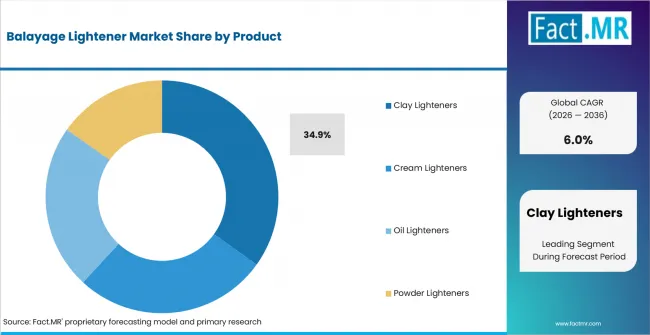
Balayage Lightener Market Analysis By Product | Source: Fact.MR
Clay Lighteners lead because thicker texture supports stable freehand placement. Ammonia-free clay products serve softer processing, while professional formulas suit wide-panel painting. Cream lighteners cover smoother mixing needs, and powder lighteners remain relevant for higher lift. Sunlights describes its kaolin-based Balayage Lightener as designed for balayage techniques.
What leads the Hair Density segment?
Thin holds 29.4% share in 2026.
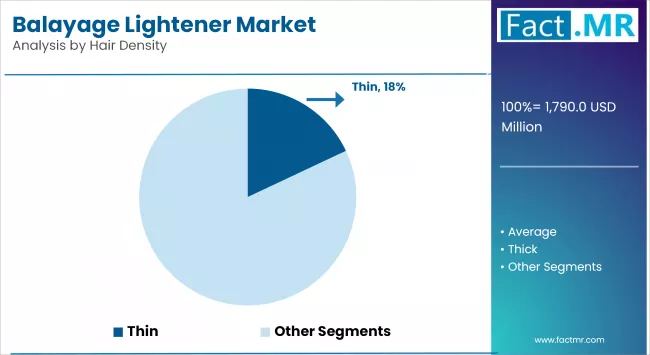
Balayage Lightener Market Analysis By Hair Density | Source: Fact.MR
Processing requirements vary by lightener formula, developer strength, target lift, application method and hair condition. Strand testing and manufacturer directions remain central across fine, average and coarse hair.
How does Lightening Power shape demand?
Up To 6 Levels leads with 36.8% share in 2026.
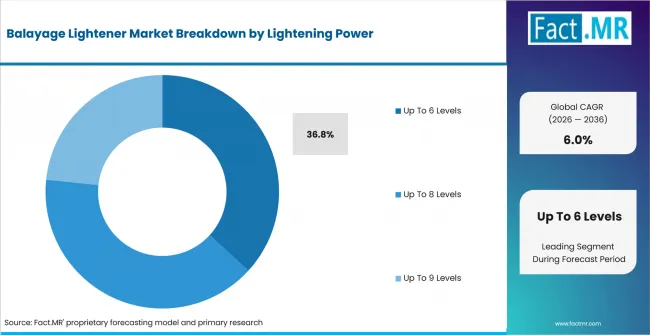
Balayage Lightener Market Analysis By Lightening Power | Source: Fact.MR
Up To 6 Levels leads because many balayage looks aim for soft contrast. Gentle Lightening and Controlled Lightening fit this use case. Up To 8 Levels serves medium lift, while Up To 9 Levels supports corrective salon work. Goldwell LightDimensions lists professional lighteners ranging from up to 6 levels of lift to up to 9+ levels, depending on the product.
What supports Households within Buyer Category?
Households are estimated to represent 41.3% share in 2026.
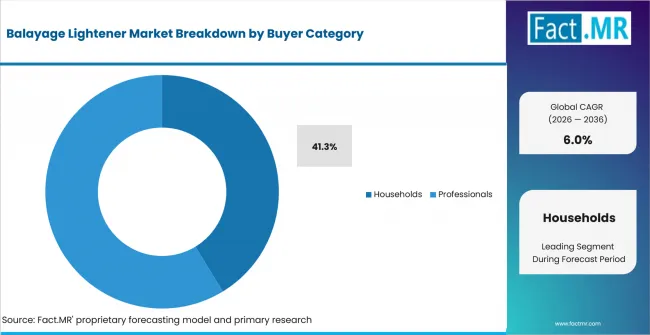
Balayage Lightener Market Analysis By Buyer Category | Source: Fact.MR
Households lead because home users buy lighteners for face-framing sections and salon-visit maintenance. Do It Yourself Users look for predictable lift and simple instructions. Personal Care Enthusiasts still need safety steps. The FDA listing count provides scale context for cosmetic product registration and listing.
What supports Offline Sales Of Balayage Lighteners?
Offline Sales Of Balayage Lighteners are forecast to hold 37.6% share in 2026.
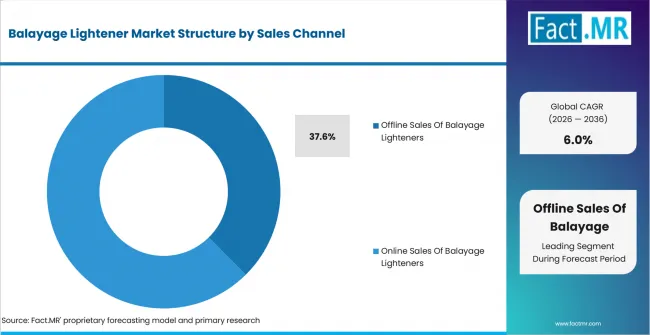
Balayage Lightener Market Analysis By Sales Channel | Source: Fact.MR
Offline Sales Of Balayage Lighteners lead because choice depends on hair history, developer strength and target lift. Cosmetic Stores and Franchised Outlets offer product advice. Hypermarkets and Departmental Stores add reach, while Multi Brand Outlets help compare formats. ONS retail-sales time-series data show that retail-sales volume for cosmetic and toilet articles in specialized stores was 14.0% higher year over year in May 2026.
What is accelerating Balayage Lightener Market adoption, and what is holding it back?
Controlled freehand lift drives it; safety and damage risk restrain it.
Drivers Impact Analysis
| Driver | (~) % Impact on CAGR | Geographic Relevance | Impact Timeline |
|---|---|---|---|
| Controlled open-air blonding formats | +0.8% | Global | Short term (<= 2 years) |
| Salon premium colour services | +0.6% | North America, Europe | Medium term (2-4 years) |
| Retail access for home users | +0.5% | Global | Short term (<= 2 years) |
| Hair-density specific formulas | +0.4% | Japan, Europe | Medium term (2-4 years) |
| Offline cosmetic-store advice | +0.3% | USA, U.K., Brazil | Long term (>= 4 years) |
Source: Fact.MR analysis. Updated Sep 1, 2026
- Controlled open-air blonding formats: Clay and cream systems help users paint sections without foil and can reduce rework risk. J Beverly Hills offers a kaolin clay Balayage Lightener designed for brush application, supporting the fit between product texture and freehand colouring techniques.
- Salon premium colour services: Balayage remains closely tied to professional salon expertise, stylist skill and service education. Continued activity in premium professional hair-colour services supports demand for specialized lightening products designed for controlled application and customized results.
- Retail access for home users: Cosmetic stores and e-commerce platforms improve household access to hair lighteners. Brands therefore benefit from clear guidance covering shade selection, expected lift, application and patch testing at the point of sale.
Opportunity Impact Analysis
| Opportunity | (~) % Impact on CAGR | Geographic Relevance | Impact Timeline |
|---|---|---|---|
| Ammonia-free clay lighteners | +0.6% | Global | Short term (<= 2 years) |
| Professional education kits | +0.5% | Europe, USA | Medium term (2-4 years) |
| E-commerce shade consultation | +0.4% | USA, Japan, U.K. | Medium term (2-4 years) |
| High-lift systems for corrective work | +0.3% | Global | Long term (>= 4 years) |
Source: Fact.MR analysis. Updated Sep 1, 2026
- Ammonia-free clay lighteners: Gentler positioning helps brands reach users concerned about odor and scalp comfort. L’Oréal Professionnel offers Blond Studio Clay as an ammonia-free lightener, showing how brands combine comfort-focused positioning with professional lightening performance.
- Professional education kits: Training cards, video guidance and strand-test workflows can turn a product sale into a broader service system. Salon distributors can support repeat purchasing when application outcomes remain consistent across different hair textures and conditions.
- E-commerce shade consultation: Online sales can improve when users receive guided product selection based on hair density, existing condition and desired lift. Clear application and returns guidance can also reduce unsuitable product selection before strong lighteners are used on damaged hair.
Restraints Impact Analysis
| Restraint | (~) % Impact on CAGR | Geographic Relevance | Impact Timeline |
|---|---|---|---|
| Hair damage and breakage risk | -0.5% | Global | Short term (<= 2 years) |
| Ingredient and labeling compliance | -0.4% | Europe, Brazil, U.K. | Medium term (2-4 years) |
| Professional-skill gap in home use | -0.3% | Global | Short term (<= 2 years) |
| Service-price pressure in salons | -0.2% | Germany, Japan, USA | Medium term (2-4 years) |
Source: Fact.MR analysis. Updated Sep 1, 2026
- Hair damage and breakage risk: Lighteners rely on chemical processes that alter the hair fiber. Concerns about uneven lift, dryness and breakage can delay purchasing decisions when users lack professional guidance or adequate product knowledge.
- Ingredient and labeling compliance: Hair colourants and cosmetic products are subject to ingredient restrictions, warning requirements and product-information obligations across many markets. These requirements increase the importance of accurate labeling, safety documentation and regulatory compliance for manufacturers and distributors.
- Professional-skill gap in home use: Balayage requires controlled sectioning, product placement and timing. Limited experience with these techniques can increase the risk of uneven results and corrective salon visits, reducing confidence in repeated home use.
Which countries are scaling the Balayage Lightener Market through 2036?
- The country comparison spans 2.3 percentage points across the forecast period.
- Germany remains 0.6 percentage point above Brazil through salon depth and personal-care spending.
- Brazil remains 0.6 percentage point above the USA as beauty retail and hair-care exports expand.
- The USA remains 0.5 percentage point above the U.K. through salon employment and cosmetic-product compliance depth.
- The U.K. remains 0.6 percentage point above Japan as cosmetic store value sales recover in 2026.
- Japan closes the displayed range through steady household spending and cautious salon demand for lower-lift systems.
Comparable CAGRs create different entry conditions due to salon density, retail access and product-safety rules. Full report coverage includes North America, Latin America, Western Europe, Eastern Europe, East Asia, South Asia & Pacific and Middle East & Africa.
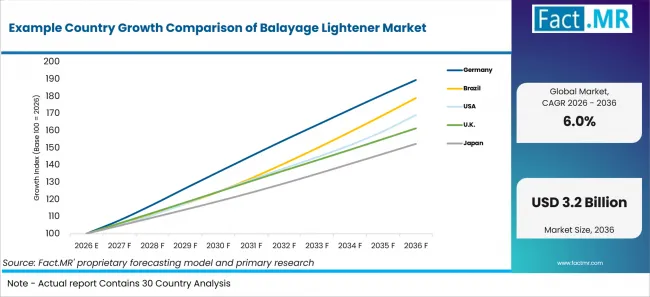
Example Country Growth Comparison Of Balayage Lightener Market | Source: Fact.MR
| Country | CAGR |
|---|---|
| Germany | 6.6% |
| Brazil | 6.0% |
| USA | 5.4% |
| U.K. | 4.9% |
| Japan | 4.3% |
Source: Fact.MR analysis. Updated Sep 1, 2026
What supports Germany adoption?
6.6% CAGR through 2036, driven by premium salon services and regulated hair-colour use.
Destatis reported in July 2026 that hairdresser and other personal-care service prices were 4.2% higher year over year in June 2026. Germany is projected to record 6.6% CAGR through 2036 as salon users balance premium blonding with service-price pressure. Clay and cream systems are expected to gain preference where colourists need predictable placement and fewer corrective visits.
How is Brazil scaling demand?
6.0% CAGR through 2036, driven by beauty retail depth and regulated cosmetics access.
Brazilian Finance Ministry data based on IBGE showed in August 2026 that pharmaceutical, medical, perfumery and cosmetics retail volume rose 6.2% year over year in June 2026. Brazil is expected to record 6.0% CAGR through 2036 as beauty retail remains active. Textured-hair diversity supports formulas that explain density, lift level and processing control clearly.
What supports USA adoption?
5.4% CAGR through 2036, driven by salon employment and cosmetic compliance depth.
BLS reported in May 2026 that employment of hairdressers, hairstylists, and cosmetologists was estimated at 305,710 in the United States in May 2025. This provides employment context for professional hair services. Professional salon demand and household access support balayage services, with clear patch-test and developer guidance remaining important for home use.
What supports the U.K. outlook?
4.9% CAGR through 2036, driven by cosmetic-store recovery and product-safety controls.
ONS retail-sales time-series data show that retail-sales volume for cosmetic and toilet articles in specialized stores was 14.0% higher year over year in May 2026. This provides cosmetic-store context.
How does Japan perform?
4.3% CAGR through 2036, driven by household spending and cautious salon demand.
The Statistics Bureau of Japan reported in February 2026 that average monthly consumption expenditure for two-or-more-person households reached 314,001 yen in 2025. This provides general household-consumption context.
Who leads the Balayage Lightener Market?
L’Oréal S.A. (L’Oréal Professionnel) and Henkel AG & Co. KGaA (Schwarzkopf Professional) lead direct salon coverage, while Kao Corporation (Goldwell) and Oligo Professionnel strengthen professional lightener depth.
L’Oréal S.A. (L’Oréal Professionnel) is active through L’Oréal Professionnel Blond Studio lighteners and professional colour systems. Henkel AG & Co. KGaA (Schwarzkopf Professional) participates through Schwarzkopf Professional BLONDME, including professional lighteners designed for high-lift blonde services. Kao Corporation (Goldwell) supports the market through Goldwell LightDimensions, which includes lighteners designed for balayage and other freehand methods.
Oligo Professionnel, J Beverly Hills, Sunlights Balayage, Inc. and Farouk Systems, Inc. (CHI) serve professional blonding through lightener ranges, clay-based systems and professional salon education. Product differentiation centers on lifting performance, application control, formula consistency and clearly defined usage instructions. Professional product portfolios also distinguish their offerings through developer recommendations, mixing ratios and processing guidance.
Which companies are the key providers?
Key companies include L’Oréal S.A. (L’Oréal Professionnel), Henkel AG & Co. KGaA (Schwarzkopf Professional), Kao Corporation (Goldwell), Oligo Professionnel, J Beverly Hills, Sunlights Balayage, Inc., and Farouk Systems, Inc. (CHI).
- L’Oréal S.A. (L’Oréal Professionnel)
- Henkel AG & Co. KGaA (Schwarzkopf Professional)
- Kao Corporation (Goldwell)
- Oligo Professionnel
- J Beverly Hills
- Sunlights Balayage, Inc.
- Farouk Systems, Inc. (CHI)
Bibliography
- U.S. Bureau of Labor Statistics. (2026, May 15). Occupational employment and wages—May 2025.
- Federal Statistical Office (Destatis). (2026, July 10). Inflation rate at +2.3% in June 2026.
- Instituto Brasileiro de Geografia e Estatística. (2026, August 13). Monthly Survey of Trade.
- L'Oréal Groupe. (2026, July 29). 2026 half-year results.
- Office for National Statistics. (2026, August 21). RSI: Retail of cosmetic and toilet articles (vol sa): All Business % [Time series].
- Office for Product Safety and Standards. (2026, August 5). OPSS delivery report 2025-2026.
- Statistics Bureau of Japan. (2026, February 6). 2025 yearly average.
This Report Answersg
- The report explains use across product format, buyer category, hair density, lightening power and sales channel.
- Segment analysis identifies clay lighteners and household buyers as the visible share leaders in 2026.
- Country analysis examines Germany, Brazil, the USA, the U.K. and Japan through retail, salon and regulatory evidence.
- Competitive analysis reviews active providers across salon clay, powder and high-lift lightener portfolios.
- Application analysis assesses how hair density, lift level and service setting influence purchase decisions.
- Primary interviews and official source review support the forecast.
What does the Balayage Lightener Market cover?
Clay, cream, oil and powder lighteners used for painted blonding and controlled lift.
The Balayage Lightener Market covers products used to lighten selected hair sections through painted or freehand application. It includes clay, cream, oil and powder formats for blended colour effects.
The assessment is narrower than wider hair colour because it focuses on lift products used for balayage effects. Toner, shampoo and permanent-colour products are covered only inside a lightening service or kit.
What is included in the scope?
Balayage lightener systems used in salons, households and beauty retail channels.
The scope includes professional and retail lighteners used for freehand blonding across clay, cream, oil and powder formats. Products are sold through cosmetic stores, franchised outlets, brand websites and e-commerce platforms. Adjacent coverage of hair color products, professional hair care products and hair dye products is relevant for adjacent category context, while the market boundary remains focused on lighteners used for balayage.
What is excluded from the scope?
General hair colour, toners and shampoos are outside the scope unless sold with a lightener.
The scope excludes ordinary permanent colour, semi-permanent colour, toner-only products and maintenance shampoos when sold outside a lifting system. Bleaching powders intended only for non-hair applications are also excluded.
Developer lotions are considered only when they are sold as part of a balayage lightening system. Salon education, tools and aftercare are discussed only when they explain product selection or safe use.
How Was the Analysis Built?
The analysis draws on 120+ sources, 35+ company portfolios, 25+ countries, and more than 20 industry interviews.
- Primary Research: Primary research includes discussions with manufacturers, service providers, technology developers, distributors, end users, and subject-matter experts. These conversations examine purchasing priorities, product adoption, operational challenges, approval requirements, competitive positioning, and the factors that influence wider market acceptance.
- Desk Research: Desk research covers government statistics, regulatory publications, company filings, trade data, technical studies, industry associations, standards, public policy, and other authoritative sources. Every source used in the analysis is documented in the bibliography.
- Market Sizing and Forecasting: Market estimates combine historical performance, demand indicators, pricing and volume trends, segment shares, company participation, country-level growth, adoption patterns, investment activity, and barriers to market expansion.
- Data Validation and Update Cycle: Findings are validated by comparing primary interviews with public data, company activity, regulatory changes, trade patterns, and industry developments. Regular updates review new product launches, capacity changes, partnerships, approvals, and shifts in commercial adoption.
Segmentation
What is the report’s scope and coverage?
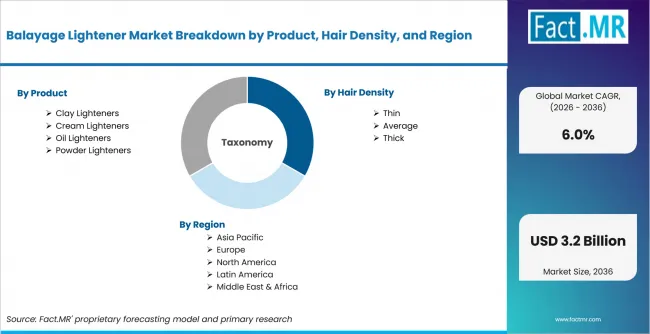
Balayage Lightener Market Breakdown By Product, Hair Density, And Region | Source: Fact.MR
| Attribute | Details |
|---|---|
| Quantitative Units | USD billion |
| Market Definition | Products used to lighten selected hair sections through freehand or painted balayage application. |
| Product | Clay Lighteners; Cream Lighteners; Oil Lighteners; Powder Lighteners |
| Hair Density | Thin; Average; Thick |
| Lightening Power | Up To 6 Levels; Up To 8 Levels; Up To 9 Levels |
| Buyer Category | Households; Professionals |
| Sales Channel | Offline Sales Of Balayage Lighteners; Online Sales Of Balayage Lighteners |
| Regions Covered | North America; Latin America; Western Europe; Eastern Europe; East Asia; South Asia & Pacific; Middle East & Africa |
| Countries Covered | Germany; Brazil; USA; U.K.; Japan |
| Companies Profiled | L’Oréal S.A. (L’Oréal Professionnel); Henkel AG & Co. KGaA (Schwarzkopf Professional); Kao Corporation (Goldwell); Oligo Professionnel; J Beverly Hills; Sunlights Balayage, Inc.; Farouk Systems, Inc. (CHI) |
| Forecast Period | 2026 to 2036 |
| Approach | Hybrid top-down and bottom-up approach using product format, retail channel, salon use, country growth and provider portfolio review. |
Source: Fact.MR analysis. Updated Sep 1, 2026
How is the market segmented?
-
By Product
- Clay Lighteners
- Ammonia Free Clay Lighteners
- Professional Clay Lighteners
- Cream Lighteners
- Standard Cream Lighteners
- High Performance Cream Lighteners
- Oil Lighteners
- Nourishing Oil Lighteners
- High Lift Oil Lighteners
- Powder Lighteners
- White Powder Lighteners
- Blue Powder Lighteners
- Clay Lighteners
-
By Hair Density
- Thin
- Fine Hair
- Low Volume Hair
- Average
- Medium Texture Hair
- Normal Volume Hair
- Thick
- High Density Hair
- Coarse Hair
- Thin
-
By Lightening Power
- Up To 6 Levels
- Gentle Lightening
- Controlled Lightening
- Up To 8 Levels
- Medium Lift Lightening
- Professional Lightening
- Up To 9 Levels
- High Lift Lightening
- Maximum Lift Systems
- Up To 6 Levels
-
By Buyer Category
- Households
- Do It Yourself Users
- Personal Care Enthusiasts
- Professionals
- Hair Salons
- Freelance Stylists
- Households
-
By Sales Channel
- Offline Sales Of Balayage Lighteners
- Cosmetic Stores
- Franchised Outlets
- Hypermarkets And Departmental Stores
- Multi Brand Outlets
- Online Sales Of Balayage Lighteners
- Company And Brand Websites
- E Commerce Platforms
- Offline Sales Of Balayage Lighteners
-
By Region
- North America
- Latin America
- Western Europe
- Eastern Europe
- East Asia
- South Asia & Pacific
- Middle East & Africa
Frequently Asked Questions
How big is the balayage lightener market in 2026?
What is the CAGR of the balayage lightener market from 2026 to 2036?
Which product leads the Balayage Lightener Market?
Which sales channel leads the Balayage Lightener Market?
Who are the leading companies in the Balayage Lightener Market?
Who worked on this report


Preview the report firsthand - request a free sample
Free SampleGet the brochure for pricing and purchase details
Download PDF