- Base Value(2025): 58.3 Bn
- Estimated Value(2025): 58.3 Bn
- Forecast Value (2035): 106.4 Bn
- CAGR (2025 - 2035): 6.2%
Medical Transcription Services Market Outlook 2025 to 2035
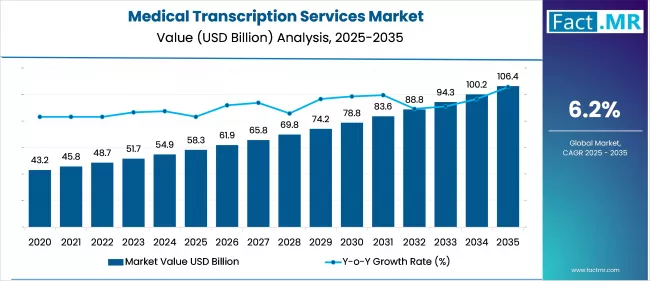
The global medical transcription services market is forecast to reach USD 106.4 billion by 2035, up from USD 58.3 billion in 2025. During the forecast period, the industry is projected to register at a CAGR of 6.2%.
The market for medical transcription services is expanding as a result of the growing demand for digital patient records and precise healthcare documentation. Adoption is being fueled by an increase in demand for transcription outsourcing to lessen administrative strain. The market is also being helped by the expansion of telemedicine and healthcare IT integration.
Quick Stats of Medical Transcription Services Market
- Medical Transcription Services Market Size (2025): USD 58.3 billion
- Projected Medical Transcription Services Market Size (2035): USD 106.4 billion
- Forecast CAGR of Medical Transcription Services Market (2025 to 2035): 6.2%
- Leading Service Type Segment of Medical Transcription Services Market: Consultation Reports
- Key Growth Regions of Medical Transcription Services Market: United States, China, Japan
- Key Players of the Medical Transcription Services Market: Acusis, Amberscript, Aquity Solutions, Caption First, Daily Transcription, Ditto Scribe, Eccellente Services Pvt. Ltd., Others
Medical Transcription Services Market Analysis Value 2025 To 2035 | Source: Fact.MR
| Metric | Value |
|---|---|
| Industry Size (2025E) | USD 58.3 billion |
| Industry Size (2035F) | USD 106.4 billion |
| CAGR (2025-2035) | 6.2% |
Source: Fact.MR analysis. Updated Aug 20, 2025
The medical transcription services business is expected to grow from USD 58.3 billion in 2025 to USD 106.4 billion in 2035, representing a 6.2% CAGR. Profit pools are shifting toward AI-powered platforms, real-time speech-to-text technologies, and EHR-integrated processes, while traditional BPO transcription is experiencing margin pressure. Regulatory frameworks like HIPAA and GDPR keep compliance-heavy niches profitable, while vendor consolidation benefits huge, multi-service providers.
Annual growth averages 6.2%, with projected values of ~USD 61.9 billion in 2026, ~USD 69.8 billion in 2028, and ~USD 78.8 billion by 2030. The advent of ambient scribing, specialty-specific workflows, and hybrid AI-human quality assurance models will help to drive demand growth throughout this time.
For high-value segments such as radiology and cardiology, competitive dynamics favor providers who provide secure integrations, quick turnaround times, and domain-specific accuracy.
From 2031, growth is consistent but is increasingly driven by telemedicine, home care documentation, and payer-driven structured data requirements. Manual transcribing volumes are likely to diminish, while automated CDI tools and analytics will grow.
Regulatory scrutiny of AI-generated material and evolving coding standards will drive up compliance costs, favoring certified suppliers with robust audit capabilities. Bargaining power will be concentrated among big provider groups and EHR vendors, with difference connected to measurable improvements in accuracy, clinical efficiency, and revenue cycle effect.
What are the Drivers of Medical Transcription Services Market?
Transcribing patient medical records is becoming more and more important, which is driving up demand for these services. Good documentation facilitates more accurate diagnosis, more effective treatment planning, and adherence to medical regulations. Because of this, clinics and hospitals are depending more and more on expert transcription services.
There is a greater need to turn audio conversations into written records as telemedicine and remote consultations grow in popularity. Healthcare professionals need accurate transcripts to guarantee continuity of care as more consultations take place virtually. The transcription market is growing rapidly as a result of this tendency.
Transcription services are being outsourced by healthcare organizations in an effort to cut expenses and administrative strains. Outsourcing ensures timely and accurate paperwork while allowing physicians to concentrate on patient care. The market's expansion is largely driven by this cost-effectiveness.
Accuracy and speed of transcription are increasing with the use of AI and speech recognition technologies. These tools help transcriptionists and increase the productivity of medical documentation workflows. By making services faster and more scalable, their adoption is propelling additional market growth.
What are the Regional Trends of Medical Transcription Services Market?
Due to its sophisticated healthcare system and stringent documentation laws, North America dominates the market for medical transcribing services. Transcription services are widely used in the US to guarantee legal compliance and enhance patient care. Additionally, the existence of significant service providers supports regional development.
The healthcare industry's growing digitization is fueling Europe's steady growth. The need for transcribing services is increased by nations like the UK and Germany that place a strong emphasis on accurate electronic health records. The industry is expanding due to the growing need for multilingual transcribing.
Asia-Pacific is becoming a rapidly increasing market as a result of expanding healthcare services and cost-effective outsourcing. India and the Philippines are important offshore transcribing hubs because of their highly qualified workforces and fluency in English. Increased spending on healthcare IT is speeding up expansion even more.
The region of the Middle East and Africa is expanding moderately as healthcare becomes more modernized. Digital health systems, including transcription services, are being invested in by countries such as South Africa and the United Arab Emirates. However, full-scale implementation is still constrained in a number of regions by infrastructure issues.
What are the Challenges and Restraining Factors of Medical Transcription Services Market?
The shortage of medical transcriptionists with professional training makes it difficult to meet the growing demand. Expertise and experience are necessary for transcribing complicated medical terms. Underqualified personnel cause inconsistent quality, which impacts accuracy. Delays and extra expenses for changes follow from this.
Ensuring data security and patient confidentiality is one of the main issues facing the medical transcription services industry. Managing private patient data puts providers at risk for noncompliance with laws such as HIPAA. Loss of client trust and legal repercussions could follow any data leak. Operating costs go up when systems are kept secure.
Traditional service models face threats from the increasing use of AI-powered transcription tools and speech recognition. These technologies make manual services less competitive by cutting costs and turnaround times. Providers who do not invest in tech integration risk becoming obsolete. This shift, however, necessitates financial and technological adjustment.
Different doctor accents, regional dialects, and low audio quality can all make transcribing difficult. Negligible medical mistakes might result from misinterpretations. Expert transcribers or expensive software are needed to overcome these obstacles. Both choices increase operational expenses and complexity.
Country-Wise Outlook
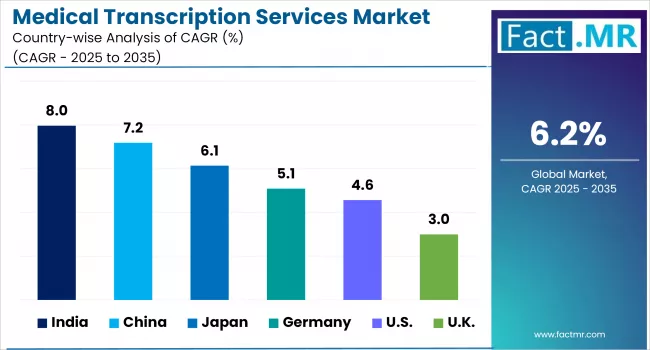
Medical Transcription Services Market Analysis By Country | Source: Fact.MR
| Countries | CAGR (2025 to 2035) |
|---|---|
| United States | 4.6% |
| China | 7.2% |
| Japan | 6.1% |
Source: Fact.MR analysis. Updated Aug 20, 2025
United States Medical Transcription Services Market Sees Growth Driven by Increasing Adoption of Electronic Health Records (EHRs)
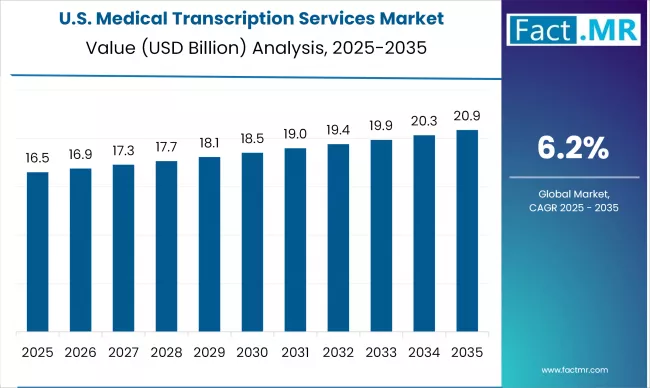
US Medical Transcription Services Market Analysis Value 2025 To 2035 | Source: Fact.MR
The growing use of Electronic Health Records (EHRs) is driving the growth of the U.S. industry. In order to comply with insurance and regulatory regulations, healthcare providers mostly depend on timely and correct paperwork. As a result, there is a steady need for transcribing services in clinics and hospitals. Accuracy and efficiency are being further improved through integration with cutting-edge AI techniques.
The necessity for regular medical visits is being fueled by the aging population and an increase in chronic sickness cases. Comprehensive clinical notes are taken at each patient visit, and these notes need to be transcribed. Clear communication between interdisciplinary teams is ensured by transcription. This continuous need fuels market expansion.
Professional documentation is required by the U.S. healthcare system's stringent adherence to HIPAA and other regulatory criteria. To stay out of trouble with the law and enhance patient results, accurate transcription is necessary. Service providers are spending money on skilled workers and safe platforms. The demand for services is driven by this emphasis on security and quality.
The environment of transcription is changing due in large part to technological advancement. Cloud integration, AI-powered solutions, and voice recognition software are all becoming more and more popular. These developments improve accessibility for medical providers and shorten turnaround times. Hospitals and outside suppliers are increasing their investments in transcribing services as a result.
China’s Healthcare Sector is Rapidly Modernizing, Leading to a Surge in Digital Health Records
Digital health records are proliferating as a result of China's healthcare system's quick modernization. Transcription services are being used more and more by clinics and hospitals to digitize patient data. This change improves patient care and data management efficiency. The need for transcribing services is steadily increasing due to the trend.
Opportunities for transcribing services are being created by the increasing number of hospitals, particularly in urban areas. Structured medical documentation is becoming more and more necessary as both public and commercial healthcare facilities grow. Support is necessary for doctors and experts to handle their large patient loads. The use of contracted transcribing services rises as a result.
Industry expansion is being supported by government programs that foster healthcare digitization, such as the "Healthy China 2030" strategy. The integration of healthcare IT and electronic medical records are encouraged by these rules. Better record-keeping is made possible by medical transcribing services, which supports these objectives. The market is therefore receiving a lot of policy support.
Additionally, China is seeing developments in AI-powered transcription tools and speech recognition. Businesses are spending money on specialized AI models that can speak regional languages and Mandarin. These techniques lower expenses while increasing the accuracy of transcription. This advancement in technology is promoting wider adoption of transcribing services in clinics and hospitals.
Japan Medical Transcription Services Demand is Driven by Need for Healthcare Services and Proper Medical Documentation
The need for healthcare services and proper medical documentation is rising as a result of Japan's aging population. Hospitals have a lot of paperwork because elderly patients need medical care frequently. Healthcare professionals can handle this administrative burden with the use of medical transcription services. With changes in the population, this demand is anticipated to increase gradually.
The necessity for expert transcription is increased by the nation's emphasis on accuracy and compliance in healthcare. For the sake of insurance claims and regulations, accurate patient records are essential. Standardized and comprehensive medical notes are guaranteed by transcription services. This is in line with Japan's stringent medical quality control requirements.
The market is growing because of technological developments in voice-to-text software designed specifically for the Japanese language. The accuracy and speed of transcription have increased as a result of the incorporation of AI and NLP tools into healthcare procedures. These technologies are particularly useful in hectic healthcare settings. Consequently, a growing number of healthcare facilities are implementing digital transcribing services.
The need for transcription services is also being fueled by Japan's growing use of telemedicine. For continuity of care, trustworthy documentation is necessary for remote consultations. Across digital platforms, medical transcription aids in the preservation of transparent and safe patient records. The incorporation of transcription into contemporary healthcare delivery paradigms is supported by this tendency.
Category-wise Analysis
Demand for Consultation Report Transcription Services is Growing
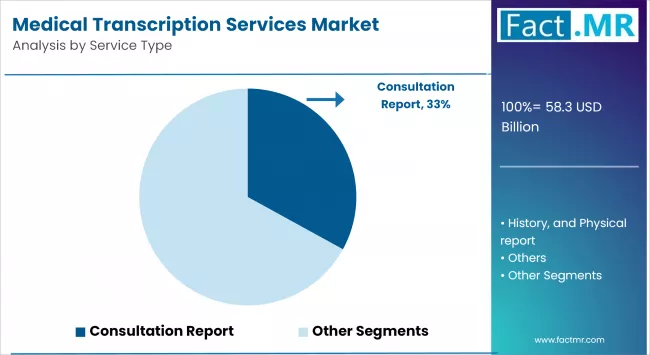
Medical Transcription Services Market Analysis By Service Type | Source: Fact.MR
As the necessity for precise, thorough communication among specialists increases, so does the demand for consultation report transcription services. Because accurate patient data transmission has a direct impact on treatment outcomes, these reports are crucial in multispecialty settings. With the growing reliance of healthcare providers on digital tools, transcription services guarantee accurate and timely documentation. Clinics and hospitals looking to cut back on clerical work and streamline processes are driving the market's expansion.
Quicker consult note exchange has been made possible by integration with EHR systems, which has increased demand even more. Due to the growing complexity of patient cases, comprehensive consult reports are now required, which is fueling the segment's continuous expansion.
Transcription of history and physical (H&P) records is essential for initial diagnosis and treatment planning since these reports are essential for baseline patient evaluation. H&P transcription is becoming more and more in demand due to an increase in hospital admissions and outpatient visits worldwide. The need for these reports to be complete, on time, and in accordance with medical standards makes using expert transcription services necessary.
By outsourcing transcribing, medical facilities want to reduce human entry as electronic documentation becomes increasingly common. This demand is exacerbated by the increasing requirement for consistent, unambiguous documentation for insurance verification and audits. Diagnostic centers, clinics, and hospital chains are driving the market's consistent expansion.
Outsourced Medical Transcription is Gaining Traction
The popularity of outsourcing medical transcription can be attributed to its affordability, scalability, and capacity to provide superior documentation services. In order to acquire specialized expertise, lower labor expenses, and lessen internal operational constraints, healthcare providers favor outsourcing. Hospitals and clinics find it more cost-effective to hire outside transcribing vendors when patient volumes increase.
The market is growing internationally, particularly in the United States, the United Kingdom, and India, where there is a large supply of qualified transcriptionists. Critical report response times are shortened by outsourcing, which also enables round-the-clock assistance. AI-assisted transcribing tools and technological interaction with healthcare systems have increased the appeal of outsourcing as a solution.
The demand for offshore transcribing services is high because of the financial benefits and the availability of highly qualified medical personnel in nations like the Philippines and India. Lower labor costs, multilingual assistance, and compliance with international healthcare documentation requirements are all provided by these companies. Hospitals with staffing difficulties in North America and Europe are especially interested in offshore services.
Concerns over data protection and compliance have been lessened by developments in secure cloud-based systems, which has increased confidence in foreign suppliers. The expansion of this approach is aided by the worldwide drive for cost-effective healthcare operations. With the increasing demand for high-volume, high-accuracy documentation, offshore services are essential to the growth of the market.
Competitive Analysis
The market for medical transcription services is extremely competitive, with many national and international players. MModal, Acusis, Nuance Communications, iMedX, and TransTech Medical Solutions are a few of the important businesses. These competitors compete based on criteria such precision, speed of response, cost, adherence to data privacy laws (such as HIPAA), and compatibility with electronic health record (EHR) systems.
The increasing use of speech recognition and artificial intelligence (AI) has made competition even more fierce, with many businesses investing in AI-powered transcription software to increase productivity and lessen reliance on humans.
Additionally, major firms are adding analytics-enabled documentation, voice-to-text conversion, and real-time transcription to their list of services. Securing long-term contracts is being accomplished through strategic alliances with clinics, hospitals, and insurance providers. Offshoring and outsourcing have also emerged as crucial cost-cutting tactics, influencing competitiveness between local suppliers and foreign vendors in nations like the Philippines and India.
Smaller and mid-sized businesses are trying to set themselves apart by concentrating on specialized markets such transcribing services for cardiology, radiology, and orthopedics.
Large companies are using their global reach and technology infrastructure to control high-volume accounts in the meantime. With mergers and acquisitions allowing businesses to grow operations and provide end-to-end documentation solutions, the market is generally consolidating, which is boosting competitiveness and innovation in the industry.
Key players in the market are Acusis, Amberscript, Aquity Solutions, Caption First, Daily Transcription, Ditto Scribe, Eccellente Services Pvt. Ltd., EHR Transcriptions, GoTranscript, InSync Healthcare Solutions, Med-Scribe, MTBC, SmartMD, Voxtab, World Wide Dictation, and Other Key Players.
Recent Development
- In September 2023, the first enterprise-level fully automated AI medical scribe in healthcare, DeepScribe, revealed its Customization Studio, a collection of tools and workflow choices that enable physicians to modify its AI scribe to fit their complex workflows.
- In August 2023, Leading AI medical practice innovator SOAP Health has established a strategic alliance with Dolbey and Company, Inc. Dolbey's cutting-edge voice recognition technology, Fusion Narrate powered by nVoq, and SOAP Health's proficiency in utilizing AI for medical interactions are combined in this partnership.
Segmentation
Segmentation of Medical Transcription Services Market
-
By Service Type :
- Consultation Report
- History, and Physical report
- Operative Note or Report
- Discharge Summary
- Others
-
By Mode of Procurement :
- OutSource
- OffSource
- Both
-
By Region :
- North America
- Latin America
- Western Europe
- Eastern Europe
- East Asia
- South Asia & Pacific
- Middle East & Africa
Frequently Asked Questions
What is the Global Medical Transcription Services Market size in 2025?
Who are the Major Players Operating in the Medical Transcription Services Market?
What is the Estimated Valuation of the Medical Transcription Services Market by 2035?
At what CAGR is the Medical Transcription Services Market slated to grow during the study period?
Who worked on this report


Preview the report firsthand - request a free sample
Free SampleGet the brochure for pricing and purchase details
Download PDF