Forestry Machinery Market Size, Share, Growth and Forecast (2026 - 2036)
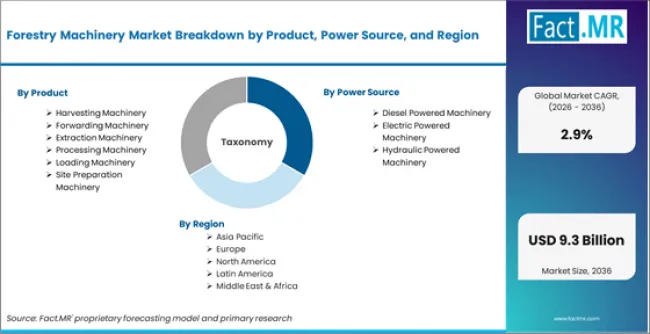
Forestry Machinery Market is segmented by Product (Harvesting Machinery, Forwarding Machinery, Extraction Machinery, Processing Machinery, Loading Machinery, Site Preparation Machinery), Power Source (Diesel Powered Machinery, Electric Powered Machinery, Hydraulic Powered Machinery), Operation Mode (Manual Machinery, Semi Automatic Machinery, Fully Automatic Machinery), and Region, with forecasts covering the period from 2026 to 2036.
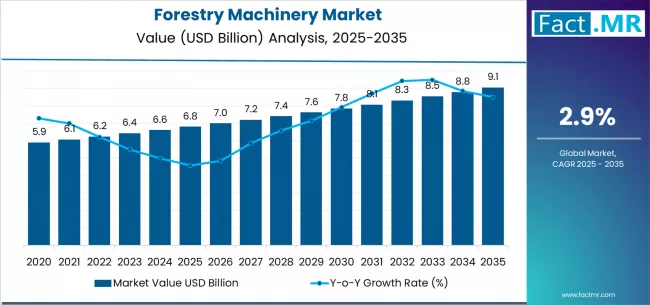
According to Fact.MR estimates, the global forestry machinery Market was valued at USD 6.8 billion in 2025. The market is projected to reach USD 7.0 billion in 2026 and is expected to grow to USD 9.3 billion by 2036, expanding at a CAGR of 2.9%. Harvesting Machinery is anticipated to account for 28.6% of the product segment in 2026, while Diesel Powered Machinery is expected to remain the leading application with around 52.4% share.
Forestry Machinery Market Analysis and Forecast by Fact.MR
- The global forestry machinery market is estimated at USD 6.997 billion in 2026 and is forecast to expand at a CAGR of 2.9% to reach USD 9.313 billion by 2036.
- Forestry machinery encompasses harvesters, feller bunchers, forwarders, skidders, chippers, and delimbers used in logging, land clearing, and forest management operations.
- Diesel-powered systems dominate the installed base, while battery-electric and hybrid powertrains are under development for emissions reduction and noise compliance in environmentally sensitive forest zones.
- Mechanization rates continue to increase in emerging timber markets, while mature markets focus on fleet replacement, operator productivity, and precision forestry technology integration.
Summary of the Forestry Machinery Market
- Market Snapshot
- In 2025, the global Forestry Machinery Market was valued at approximately USD 6.8 billion.
- The market is estimated to reach USD 6.997 billion in 2026 and is projected to attain USD 9.313 billion by 2036.
- The forestry machinery market is likely to expand at a CAGR of 2.9% during the forecast period.
- The market is anticipated to create an absolute dollar opportunity of USD 2.316 billion between 2026 and 2036.
- Forestry Companies accounts for 42.1% of end-use segment share in 2026.
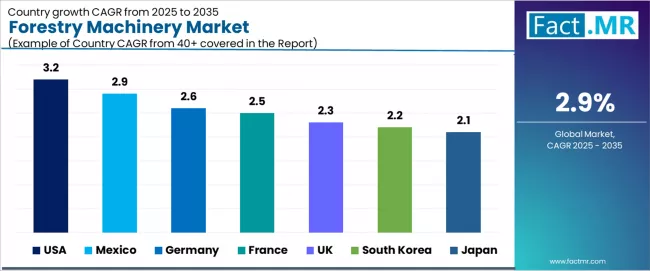
- USA (3.2%) and Mexico (2.9%) are the key growth markets during the forecast period.
- Demand and Growth Drivers
- Rising global timber demand from construction, packaging, and biomass energy sectors is supporting logging activity levels that sustain equipment procurement and fleet replacement cycles across major forestry regions.
- Labor shortages in forestry operations, particularly across Nordic countries, North America, and Japan, are accelerating mechanization investment as operators seek to maintain harvesting productivity with fewer skilled workers.
- Sustainable forest management certification requirements are increasing demand for precision forestry technology that improves harvesting accuracy, reduces site damage, and enables compliance with FSC and PEFC standards.
- Biomass energy feedstock demand, driven by renewable energy mandates and industrial decarbonization, is expanding the market for chipping, forwarding, and land-clearing equipment used in biomass supply chains.
- Fleet replacement cycles in mature forestry markets are generating sustained procurement as operators upgrade aging diesel fleets with lower-emission, higher-productivity equipment featuring advanced control systems and telematics.
- Product and Segment View
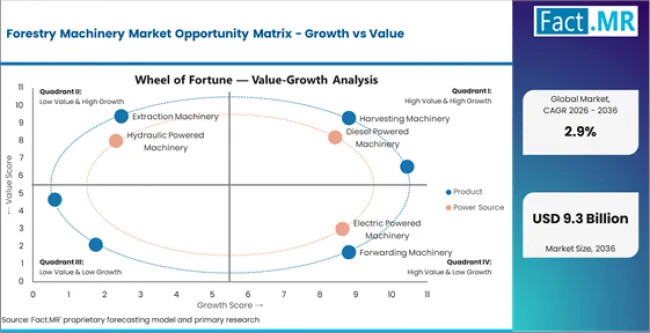
- Harvesting machinery accounts for 28.6% of the product segment in 2026, supported by sustained timber demand and ongoing mechanization of cut-to-length harvesting operations.
- Diesel-powered machinery represents 52.4% of the power source segment in 2026, reflecting the continued dominance of heavy-duty diesel engines in remote forest environments where refueling infrastructure is limited.
- Logging and timber harvesting holds 39.8% of the application segment, with clear cutting and selective logging operations generating the majority of equipment procurement.
- Key segmentation includes:
- Product: Harvesting Machinery, Harvesters, Feller Bunchers, Forwarding Machinery, Forwarders, Skidders
- Power Source: Diesel Powered Machinery, Electric Powered Machinery, Hybrid Electric Systems
- Operation Mode: Manual Machinery, Semi Automatic Machinery, Fully Automatic Systems
- Application: Logging and Timber Harvesting, Land Clearing, Forest Management
- End Use: Forestry Companies, Government and Public Sector, Rental and Leasing
- These systems enable:
- Mechanized harvesting, forwarding, and processing of timber in cut-to-length and full-tree logging operations across diverse terrain and forest types
- Precision forestry operations that use GPS-guided controls, harvester measurement systems, and onboard computers for optimized cutting patterns and log inventory tracking
- Land clearing and site preparation for infrastructure, agricultural conversion, and forest regeneration using dedicated clearing and mulching equipment
- Geography and Competitive Outlook
- North America leads by value, with the U.S. accounting for USD 2.503 billion in 2026, supported by strong softwood and hardwood harvesting activity, fleet replacement cycles, and biomass feedstock demand.
- Europe shows moderate growth, with Germany (2.6%) and France (2.5%) supported by sustainable forestry mandates, precision forestry technology adoption, and fleet modernization across private and state forest operations.
- Mexico (2.9%) is the second-fastest-growing market, driven by expanding land clearing for infrastructure and agricultural development, combined with growing mechanization in commercial forestry operations.
- Key companies active in the market include Komatsu Forestry, John Deere, Ponsse, Tigercat, Valmet, Rottne.
- Analyst Opinion
- Shambhu Nath Jha, Principal Consultant at Fact.MR, says 'The forestry machinery market is shaped by two concurrent pressures: the need to maintain harvesting productivity with fewer workers, and the need to meet tightening environmental standards in forest operations. Precision forestry technology that optimizes cut-to-length harvesting while minimizing soil compaction and residual stand damage is becoming a procurement specification rather than an option. Electrification remains in early stages due to the remote operating environment, but hybrid powertrains and battery-electric concepts are advancing, particularly in Nordic markets where noise and emission restrictions in sensitive forest zones are tightening.'
Key Growth Drivers, Constraints, and Opportunities
Key Factors Driving Growth
- Global timber demand from mass timber construction, sustainable packaging, and biomass energy applications is supporting harvesting activity levels that sustain equipment procurement cycles, particularly in North America, Scandinavia, and South America.
- Labor shortages in forestry operations are compelling operators to invest in higher-capacity mechanized systems, operator-assist technology, and semi-automated harvesting functions that maintain productivity with reduced crew sizes.
- Sustainable forest management certification under FSC and PEFC standards is driving adoption of precision forestry technology that reduces environmental impact, improves log quality measurement, and supports traceability from stump to mill.
Key Market Constraints
- High equipment capital costs exceeding USD 500,000 for fully equipped harvesters and forwarders create procurement barriers for smaller forestry operators and contract loggers, particularly in markets with limited fleet financing access.
- Environmental restrictions on harvesting seasons, protected forest zones, and soil compaction limits constrain operational windows and reduce annual equipment utilization rates in ecologically sensitive regions.
- Supply chain lead times for specialized forestry equipment, driven by custom configuration requirements and limited manufacturing capacity, extend delivery timelines to 6 to 12 months for new orders.
Key Opportunity Areas
- Mass timber construction growth is increasing demand for structural-grade softwood logs that require precision harvesting and sorting capabilities, creating procurement demand for harvester systems with advanced measurement and grade-classification technology.
- Battery-electric and hybrid powertrain development for forestry machinery is creating a future equipment replacement cycle, with early-mover manufacturers positioning for regulatory-driven procurement shifts in Nordic and European markets.
- Forest restoration and reforestation programs funded by climate commitments are expanding the market for site preparation, planting, and forest management equipment beyond traditional logging and timber harvesting applications.
Segment-wise Analysis of the Forestry Machinery Market
- Harvesting machinery holds 28.6% of the product segment in 2026, reflecting the central role of harvesters and feller bunchers in mechanized logging operations across cut-to-length and full-tree systems.
- Forestry companies represent 42.1% of end-use demand in 2026, with industrial logging firms and commercial timber producers accounting for the majority of new equipment procurement.
- Manual and operator-controlled machinery holds 33.7% of the operation mode segment, with assisted controls and partial automation gaining share as manufacturers integrate precision forestry features.
The forestry machinery market is segmented by product type, power source, operation mode, application, end use, and region. By product type, the market covers harvesting machinery, forwarding machinery, and land clearing equipment. By end use, coverage includes forestry companies, government forest agencies, and equipment rental and leasing operations. Harvesting machinery leads by value because of higher unit prices and central importance in mechanized timber operations, while forwarding equipment holds the second-largest share supported by growing demand for efficient log transport from stump to roadside.
Which Product Segment Dominates the Forestry Machinery Market?
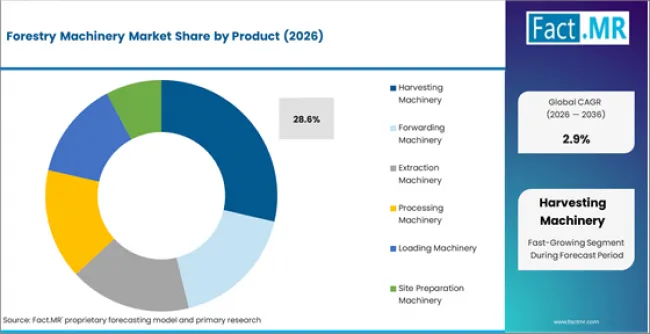
Harvesting machinery accounts for 28.6% of the product segment in 2026. Leadership reflects the higher unit values and mission-critical role of harvesters and feller bunchers in mechanized logging operations. Demand is concentrated in cut-to-length harvesting systems used across Nordic countries, Central Europe, and increasingly in North American softwood operations, where single-grip harvesters process standing trees into measured logs at the stump.
Forwarding machinery holds the second-largest product share, with forwarders transporting cut logs from the harvesting site to roadside landing areas. The harvester-forwarder combination is the standard mechanized logging system in Nordic forestry and is gaining adoption in other regions as operators shift from full-tree to cut-to-length methods for environmental compliance and log quality reasons.
Which End-Use Segment Dominates the Forestry Machinery Market?
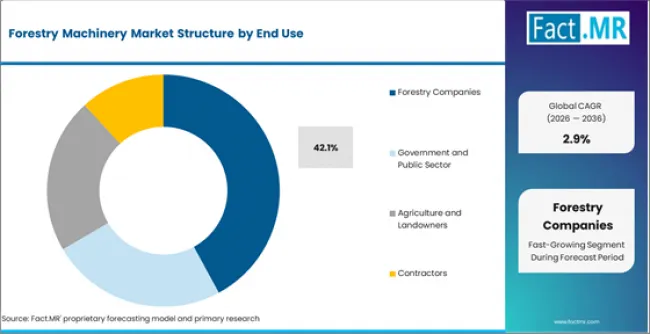
Forestry companies are expected to lead the end-use segment with a 42.1% share of market value in 2026. Industrial logging firms and commercial timber producers account for the majority of new equipment procurement, with fleet size and replacement timing driven by harvesting contract volumes, timber market conditions, and equipment lifecycle economics.
Government and public-sector forest agencies represent the second-largest end-use category, with state forest departments, national parks services, and municipal forestry bodies procuring equipment for fire prevention, habitat management, and sustainable timber harvesting on public lands.
Which Product Trend is Shaping the Next Phase of Growth in the Forestry Machinery Market?
Electrification and hybrid powertrain development represent the most significant technology shift in the forestry machinery market. Komatsu Forest established a dedicated electrification design department in 2025 targeting 50% CO2 emission reduction from its products by 2030, and Ponsse has demonstrated its EV1 electric forwarder concept. While full electrification faces challenges from remote operating environments and limited charging infrastructure, hybrid systems that reduce fuel consumption by 20 to 30 percent are closer to commercial viability.
The electrification push is driven by tightening emission regulations in European forestry operations, noise restrictions in urban-adjacent forests, and operator demand for reduced vibration and improved cabin environment. Manufacturers investing in electric and hybrid capability now are positioning for a fleet replacement cycle that is expected to accelerate in the late 2020s as regulatory thresholds tighten and battery technology improves for heavy-duty mobile applications.
Regional Outlook Across Key Markets
.webp)
- The United States leads growth at 3.2%, supported by strong softwood harvesting activity in the Southeast and Pacific Northwest, biomass feedstock demand, and fleet replacement procurement from aging equipment fleets.
- Mexico (2.9%) reflects expanding land clearing for infrastructure development and growing mechanization in commercial forestry and plantation management operations.
- Europe shows steady growth, with Germany (2.6%) and France (2.5%) supported by sustainable forestry mandates, precision harvesting technology adoption, and biomass energy supply requirements.
CAGR Table
| Country | CAGR (%) |
|---|---|
| USA | 3.2% |
| Mexico | 2.9% |
| Germany | 2.6% |
| France | 2.5% |
| UK | 2.3% |
| South Korea | 2.2% |
| Japan | 2.1% |
Source: Fact MR (FMR) analysis, based on proprietary forecasting model and primary research.
Market Outlook for Forestry Machinery in the United States
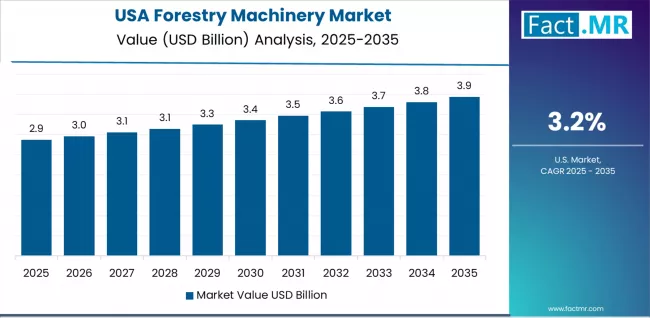
Reshoring investment in wood-based construction materials and growing biomass energy feedstock demand are expanding timber harvesting volumes across the Southeast and Pacific Northwest. Federal and state forest management budgets support fire prevention and restoration equipment procurement, while private forestry companies are upgrading to precision harvesting systems with advanced measurement and GPS-guided controls.
- Mass timber construction growth is increasing demand for structural-grade softwood that requires precision harvesting and log-quality sorting capabilities.
- USDA Forest Service restoration programs and wildfire prevention initiatives are generating public-sector equipment procurement for forest management and fuels reduction.
Forestry Machinery Demand Trends in Mexico
Infrastructure development clearing and growing commercial plantation forestry are the primary demand drivers in Mexico at 2.9% CAGR. National highway construction, industrial site preparation, and expanding agricultural frontiers are generating procurement for land clearing and mulching equipment.
- National infrastructure programs are funding land clearing equipment procurement for highway, rail, and industrial development projects.
- Commercial eucalyptus and pine plantation expansion is driving mechanization investment in harvesting and forwarding equipment.
Germany Forestry Machinery Market Demand Analysis
DIN certification standards and EU sustainable forestry regulations shape procurement specifications in Germany at 2.6% CAGR. State forest agencies and private forest owners are investing in precision harvesting technology and lower-emission equipment that meets tightening environmental requirements for operations in protected and ecologically sensitive forest zones.
- EU deforestation regulation compliance is increasing demand for traceability-enabled harvesting systems with GPS-based log tracking capabilities.
- Energiewende biomass targets are supporting wood chip and pellet supply chain equipment procurement for renewable energy feedstock.
United Kingdom Forestry Machinery Growth Outlook
The UK market is projected to grow at 2.3% CAGR through 2036. Government reforestation commitments and expanding biomass energy programs are supporting equipment demand for forest management, harvesting, and site preparation operations across Scotland, Wales, and northern England.
- Government tree-planting targets under national climate commitments are generating demand for site preparation and planting equipment.
- Biomass supply chain requirements for power generation and industrial heating are sustaining procurement of chipping and forwarding machinery.
Japan Forestry Machinery Opportunity Outlook
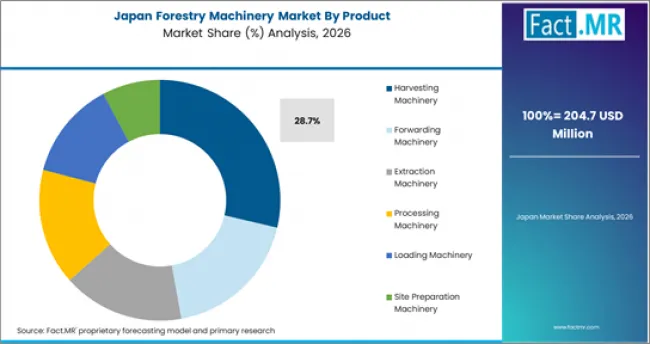
Aging forestry workforce and strict JIS compliance requirements shape demand in Japan at 2.1% CAGR. Labor shortage mitigation through mechanization is the primary adoption driver, with compact harvesting equipment designed for steep-slope operations in Japanese mountain forests.
- Labor shortage pressures are accelerating mechanization investment in compact, steep-slope-capable harvesting and forwarding systems.
- National forest revitalization policy supports equipment procurement for thinning, restoration, and timber supply chain improvement.
Competitive Benchmarking and Company Positioning
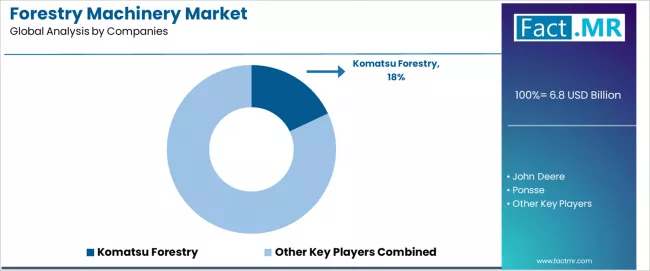
Forestry Machinery Market Analysis By Company
- Komatsu Forestry, John Deere, and Ponsse hold commanding positions through specialized forestry equipment portfolios, extensive dealer and service networks, and technology leadership in precision harvesting and operator-assist systems.
- Tigercat, Rottne, and Eco Log compete through application-specific designs, regional market depth, and specialized capabilities in demanding terrain and operating conditions where customization requirements differentiate from standard equipment.
- Precision forestry technology integration, including GPS-guided controls, harvester measurement systems, and fleet telematics, is creating competitive separation between manufacturers with strong digital capability and those offering primarily mechanical equipment.
The competitive landscape is moderately concentrated, with Komatsu Forestry holding approximately 18.0% market share through its global product portfolio, advanced harvester technology, and established dealer networks across Nordic, North American, and South American forestry markets.
John Deere competes through its agricultural machinery dealer network and broad equipment range, while Ponsse differentiates through Finnish-engineered precision harvesting systems favored in Nordic and Central European cut-to-length operations. Tigercat holds strong positions in full-tree logging operations across North America and South America.
Strategic priorities include electrification and hybrid powertrain development, precision forestry technology integration, aftermarket service network expansion, and fleet management platform deployment that enables remote monitoring, predictive maintenance, and operational productivity optimization.
Key Companies in the Forestry Machinery Market
- Komatsu Forestry, John Deere, Ponsse, Tigercat are among the leading players in the forestry machinery market globally, supported by strong brand visibility, broad service portfolios, and growing positions in managed energy solutions.
- Valmet, Rottne, Koller, Eco Log hold established positions across specific service segments, end-use categories, and regional markets, supported by specialized capabilities and established commercial relationships.
- Krpan, Kesla continue to compete through focused offerings, technology partnerships, and regional service networks.
Recent Industry Developments
- Komatsu Forest, Acquisition, Malwa Forest AB (April 2026)
- Komatsu Forest completed the acquisition of Swedish forestry machine manufacturer Malwa Forest AB, expanding its product portfolio with compact forestry machines suited for smaller-scale and thinning operations. The acquisition strengthens Komatsu's position in the Nordic forestry market and adds smaller machine capabilities that complement its existing harvester and forwarder lines.
- Komatsu Forest, Technology Investment, Electrification Design Department (2025)
- Komatsu Forest established a dedicated electrification design department targeting 50% CO2 emission reduction from its forest machinery by 2030. The initiative positions Komatsu at the forefront of forestry equipment electrification, addressing growing demand for lower-emission operations in environmentally regulated forest zones.
- Caterpillar, Product Launch, FM528 Forestry Machine (February 2025)
- Caterpillar launched the FM528 General Forestry and Log Loader, designed for demanding mill-yard and forestry applications. The launch expands Caterpillar's forestry product line with a multi-function platform that addresses both forestry and material handling requirements in timber processing operations.
Leading Companies Shaping the Forestry Machinery Market
- Komatsu Forestry
- John Deere
- Ponsse
- Tigercat
- Valmet
- Rottne
- Koller
- Eco Log
- Krpan
- Kesla
Sources and Research References
- Komatsu Forest. Malwa Forest acquisition, electrification program, and product portfolio updates.
- Ponsse. EV1 electric forwarder concept and precision forestry technology developments.
- Caterpillar. FM528 forestry machine launch and forestry equipment product updates.
- Food and Agriculture Organization (FAO). Global timber production and forest area statistics.
- U.S. Forest Service. Timber harvest volumes and forest management program data.
- Primary interviews with forestry equipment manufacturers, dealers, forestry companies, government agencies, and logging contractors.
- This bibliography is provided for reader reference and is not exhaustive. The full report contains the complete reference list and detailed citations.
Key Questions This Report Addresses
- What is the current and future size of the Forestry Machinery Market?
- How fast is the Forestry Machinery Market expected to grow between 2026 and 2036?
- Which product type is likely to lead the market by 2026?
- Which end-use segment is expected to account for the highest demand by 2026?
- What factors are driving demand for forestry machinery globally?
- How is electrification influencing the next generation of forestry equipment?
- Why is the USA the leading growth market?
- How are sustainable forestry mandates supporting technology adoption?
- Which countries are projected to show the fastest growth through 2036?
- Who are the key companies active in the Forestry Machinery Market?
- How does Fact.MR estimate and validate the market forecast?
Forestry Machinery Market Definition
The forestry machinery market covers powered equipment used in logging, timber harvesting, forwarding, land clearing, and forest management operations, including harvesters, feller bunchers, forwarders, skidders, chippers, delimbers, and associated attachments.
Forestry Machinery Market Inclusions
- The scope covers global and regional market size and forecasts for 2026 to 2036 across product type, power source, operation mode, application, end use, and region.
- It includes regional demand analysis across major geographies, based on factors such as timber harvesting volumes, forest area, mechanization rates, environmental regulations, and biomass energy demand.
- The report includes pricing analysis across harvester, forwarder, and feller buncher categories, including lifecycle costs, operating expenses, and fleet financing structures.
- It covers technology trends, market drivers and constraints, and the competitive landscape, including product portfolios, dealer networks, service capabilities, and technology partnerships of leading manufacturers.
Forestry Machinery Market Exclusions
- The scope excludes agricultural tractors adapted for occasional forestry use, sawmill processing equipment, wood pellet manufacturing machinery, and paper mill machinery that operates downstream of timber harvesting.
- It excludes handheld chainsaws, portable chippers below commercial scale, and forestry hand tools without powered mechanisms.
- The report excludes forest fire suppression equipment, tree planting machines for silviculture-only operations, and aerial surveying drones used for forest inventory without direct connection to harvesting equipment.
Forestry Machinery Market Research Methodology
- The methodology combines secondary research, primary interviews, and forecast modelling.
- It draws on 100+ secondary sources and benchmarks 45+ company product portfolios.
- Market sizing covers 30+ countries through a demand-side model, supported by top-down validation.
- Key inputs include timber harvesting volumes, forest area data, mechanization rates, equipment fleet age, and biomass feedstock procurement trends.
- The model cross-checks demand with manufacturer shipment data, dealer inventory, pricing trends, and fleet financing activity.
- Primary validation includes 20+ interviews across equipment manufacturers, dealers, forestry companies, government forest agencies, and logging contractors.
- Final estimates go through shipment-reconciliation, fleet-age analysis, and sensitivity testing.
Scope of Analysis

| Parameter | Details |
|---|---|
| Quantitative Units | USD 6.997 billion to USD 9.313 billion, at a CAGR of 2.9% |
| Market Definition | The forestry machinery market covers powered equipment for logging, timber harvesting, forwarding, land clearing, and forest management, including harvesters, feller bunchers, forwarders, skidders, chippers, and related machinery. |
| Regions Covered | North America, Latin America, Europe, East Asia, South Asia and Pacific, Middle East and Africa |
| Countries Covered | USA, Mexico, Germany, France, UK, South Korea, Japan, 30 plus countries |
| Key Companies | Komatsu Forestry, John Deere, Ponsse, Tigercat, Valmet, Rottne, Koller, Eco Log, Krpan, Kesla |
| Forecast Period | 2026 to 2036 |
| Approach | Hybrid demand-side and top-down methodology built on timber harvesting volumes, forest area data, mechanization rates, fleet age profiles, manufacturer shipments, and primary interviews across manufacturers, dealers, forestry companies, and government forest agencies |
Forestry Machinery Market Segmentation
-
Forestry Machinery Market Segmented by Product:
- Harvesting Machinery
- Harvesters
- Feller Bunchers
- Stroke Delimbers
- Forwarding Machinery
- Forwarders
- Log Forwarding Trailers
- Extraction Machinery
- Skidder Machines
- Cable Skidders
- Grapple Skidders
- Processing Machinery
- Log Processors
- Delimbers
- Chippers
- Loading Machinery
- Log Loaders
- Grapple Loaders
- Knuckleboom Loaders
- Site Preparation Machinery
- Forest Mulchers
- Stump Grinders
- Brush Cutters
- Harvesting Machinery
-
Forestry Machinery Market Segmented by Power Source:
- Diesel Powered Machinery
- Heavy Duty Diesel Engines
- Low Emission Diesel Systems
- Electric Powered Machinery
- Battery Electric Forestry Equipment
- Hybrid Electric Systems
- Hydraulic Powered Machinery
- Hydraulic Drive Systems
- Integrated Hydraulic Units
- Diesel Powered Machinery
-
Forestry Machinery Market Segmented by Operation Mode:
- Manual Machinery
- Operator Controlled Equipment
- Semi Mechanized Tools
- Semi Automatic Machinery
- Assisted Control Systems
- Partially Automated Operations
- Fully Automatic Machinery
- Autonomous Forestry Equipment
- Remote Controlled Machinery
- Manual Machinery
-
Forestry Machinery Market Segmented by Application:
- Logging and Timber Harvesting
- Clear Cutting Operations
- Selective Logging
- Land Clearing
- Agricultural Land Conversion
- Infrastructure Development Clearing
- Forest Management
- Thinning Operations
- Forest Restoration
- Biomass Collection
- Wood Chip Production
- Bioenergy Feedstock Collection
- Logging and Timber Harvesting
-
Forestry Machinery Market Segmented by End Use:
- Forestry Companies
- Industrial Logging Firms
- Commercial Timber Producers
- Government and Public Sector
- Forest Departments
- Municipal Forestry Bodies
- Agriculture and Landowners
- Private Landowners
- Farm Forestry Operators
- Contractors
- Forestry Service Contractors
- Equipment Leasing Companies
- Forestry Companies
-
Forestry Machinery Market by Region:
- North America
- USA
- Canada
- Mexico
- Latin America
- Brazil
- Chile
- Rest of Latin America
- Western Europe
- Germany
- UK
- Italy
- Spain
- France
- Nordic
- BENELUX
- Rest of Western Europe
- Eastern Europe
- Russia
- Poland
- Hungary
- Balkan & Baltic
- Rest of Eastern Europe
- East Asia
- China
- Japan
- South Korea
- South Asia and Pacific
- India
- ASEAN
- Australia & New Zealand
- Rest of South Asia and Pacific
- Middle East & Africa
- Kingdom of Saudi Arabia
- Other GCC Countries
- Turkiye
- South Africa
- Other African Union
- Rest of Middle East & Africa
- North America
- Frequently Asked Questions -
How big is the forestry machinery market in 2026?
The global forestry machinery market is estimated to be valued at USD 7.0 billion in 2026.
What will be the size of forestry machinery market in 2036?
The market size for the forestry machinery market is projected to reach USD 9.3 billion by 2036.
How much will be the forestry machinery market growth between 2026 and 2036?
The forestry machinery market is expected to grow at a 2.9% CAGR between 2026 and 2036.
What are the key product types in the forestry machinery market?
The key product types in forestry machinery market are harvesting machinery, _harvesters, _feller bunchers, _stroke delimbers, forwarding machinery, _forwarders, _log forwarding trailers, extraction machinery, _skidder machines, _cable skidders, _grapple skidders, processing machinery, _log processors, _delimbers, _chippers, loading machinery, _log loaders, _grapple loaders, _knuckleboom loaders, site preparation machinery, _forest mulchers, _stump grinders and _brush cutters.
Which power source segment is expected to contribute significant share in the forestry machinery market in 2026?
In terms of power source, diesel powered machinery segment is expected to command 52.4% share in the forestry machinery market in 2026.
Table of Content
- Executive Summary
- Global Market Outlook
- Demand to side Trends
- Supply to side Trends
- Technology Roadmap Analysis
- Analysis and Recommendations
- Market Overview
- Market Coverage / Taxonomy
- Market Definition / Scope / Limitations
- Research Methodology
- Chapter Orientation
- Analytical Lens and Working Hypotheses
- Market Structure, Signals, and Trend Drivers
- Benchmarking and Cross-market Comparability
- Market Sizing, Forecasting, and Opportunity Mapping
- Research Design and Evidence Framework
- Desk Research Programme (Secondary Evidence)
- Company Annual and Sustainability Reports
- Peer-reviewed Journals and Academic Literature
- Corporate Websites, Product Literature, and Technical Notes
- Earnings Decks and Investor Briefings
- Statutory Filings and Regulatory Disclosures
- Technical White Papers and Standards Notes
- Trade Journals, Industry Magazines, and Analyst Briefs
- Conference Proceedings, Webinars, and Seminar Materials
- Government Statistics Portals and Public Data Releases
- Press Releases and Reputable Media Coverage
- Specialist Newsletters and Curated Briefings
- Sector Databases and Reference Repositories
- Fact.MR Internal Proprietary Databases and Historical Market Datasets
- Subscription Datasets and Paid Sources
- Social Channels, Communities, and Digital Listening Inputs
- Additional Desk Sources
- Expert Input and Fieldwork (Primary Evidence)
- Primary Modes
- Qualitative Interviews and Expert Elicitation
- Quantitative Surveys and Structured Data Capture
- Blended Approach
- Why Primary Evidence is Used
- Field Techniques
- Interviews
- Surveys
- Focus Groups
- Observational and In-context Research
- Social and Community Interactions
- Stakeholder Universe Engaged
- C-suite Leaders
- Board Members
- Presidents and Vice Presidents
- R&D and Innovation Heads
- Technical Specialists
- Domain Subject-matter Experts
- Scientists
- Physicians and Other Healthcare Professionals
- Governance, Ethics, and Data Stewardship
- Research Ethics
- Data Integrity and Handling
- Primary Modes
- Tooling, Models, and Reference Databases
- Desk Research Programme (Secondary Evidence)
- Data Engineering and Model Build
- Data Acquisition and Ingestion
- Cleaning, Normalisation, and Verification
- Synthesis, Triangulation, and Analysis
- Quality Assurance and Audit Trail
- Market Background
- Market Dynamics
- Drivers
- Restraints
- Opportunity
- Trends
- Scenario Forecast
- Demand in Optimistic Scenario
- Demand in Likely Scenario
- Demand in Conservative Scenario
- Opportunity Map Analysis
- Product Life Cycle Analysis
- Supply Chain Analysis
- Investment Feasibility Matrix
- Value Chain Analysis
- PESTLE and Porter’s Analysis
- Regulatory Landscape
- Regional Parent Market Outlook
- Production and Consumption Statistics
- Import and Export Statistics
- Market Dynamics
- Global Market Analysis 2021 to 2025 and Forecast, 2026 to 2036
- Historical Market Size Value (USD Million) Analysis, 2021 to 2025
- Current and Future Market Size Value (USD Million) Projections, 2026 to 2036
- Y to o to Y Growth Trend Analysis
- Absolute $ Opportunity Analysis
- Global Market Pricing Analysis 2021 to 2025 and Forecast 2026 to 2036
- Global Market Analysis 2021 to 2025 and Forecast 2026 to 2036, By Product
- Introduction / Key Findings
- Historical Market Size Value (USD Million) Analysis By Product, 2021 to 2025
- Current and Future Market Size Value (USD Million) Analysis and Forecast By Product, 2026 to 2036
- Harvesting Machinery
- Harvesters
- Feller Bunchers
- Stroke Delimbers
- Forwarding Machinery
- Forwarders
- Log Forwarding Trailers
- Extraction Machinery
- Skidder Machines
- Cable Skidders
- Grapple Skidders
- Processing Machinery
- Log Processors
- Delimbers
- Chippers
- Loading Machinery
- Log Loaders
- Grapple Loaders
- Knuckleboom Loaders
- Site Preparation Machinery
- Forest Mulchers
- Stump Grinders
- Brush Cutters
- Harvesting Machinery
- Y to o to Y Growth Trend Analysis By Product, 2021 to 2025
- Absolute $ Opportunity Analysis By Product, 2026 to 2036
- Global Market Analysis 2021 to 2025 and Forecast 2026 to 2036, By Power Source
- Introduction / Key Findings
- Historical Market Size Value (USD Million) Analysis By Power Source, 2021 to 2025
- Current and Future Market Size Value (USD Million) Analysis and Forecast By Power Source, 2026 to 2036
- Diesel Powered Machinery
- Heavy Duty Diesel Engines
- Low Emission Diesel Systems
- Electric Powered Machinery
- Battery Electric Forestry Equipment
- Hybrid Electric Systems
- Hydraulic Powered Machinery
- Hydraulic Drive Systems
- Integrated Hydraulic Value (USD Million)s
- Diesel Powered Machinery
- Y to o to Y Growth Trend Analysis By Power Source, 2021 to 2025
- Absolute $ Opportunity Analysis By Power Source, 2026 to 2036
- Global Market Analysis 2021 to 2025 and Forecast 2026 to 2036, By Operation Mode
- Introduction / Key Findings
- Historical Market Size Value (USD Million) Analysis By Operation Mode, 2021 to 2025
- Current and Future Market Size Value (USD Million) Analysis and Forecast By Operation Mode, 2026 to 2036
- Manual Machinery
- Operator Controlled Equipment
- Semi Mechanized Tools
- Semi Automatic Machinery
- Assisted Control Systems
- Partially Automated Operations
- Fully Automatic Machinery
- Autonomous Forestry Equipment
- Remote Controlled Machinery
- Manual Machinery
- Y to o to Y Growth Trend Analysis By Operation Mode, 2021 to 2025
- Absolute $ Opportunity Analysis By Operation Mode, 2026 to 2036
- Global Market Analysis 2021 to 2025 and Forecast 2026 to 2036, By Application
- Introduction / Key Findings
- Historical Market Size Value (USD Million) Analysis By Application, 2021 to 2025
- Current and Future Market Size Value (USD Million) Analysis and Forecast By Application, 2026 to 2036
- Logging and Timber Harvesting
- Clear Cutting Operations
- Selective Logging
- Land Clearing
- Agricultural Land Conversion
- Infrastructure Development Clearing
- Forest Management
- Thinning Operations
- Forest Restoration
- Biomass Collection
- Wood Chip Production
- Bioenergy Feedstock Collection
- Logging and Timber Harvesting
- Y to o to Y Growth Trend Analysis By Application, 2021 to 2025
- Absolute $ Opportunity Analysis By Application, 2026 to 2036
- Global Market Analysis 2021 to 2025 and Forecast 2026 to 2036, By End Use
- Introduction / Key Findings
- Historical Market Size Value (USD Million) Analysis By End Use, 2021 to 2025
- Current and Future Market Size Value (USD Million) Analysis and Forecast By End Use, 2026 to 2036
- Forestry Companies
- Industrial Logging Firms
- Commercial Timber Producers
- Government and Public Sector
- Forest Departments
- Municipal Forestry Bodies
- Agriculture and Landowners
- Private Landowners
- Farm Forestry Operators
- Contractors
- Forestry Service Contractors
- Equipment Leasing Companies
- Forestry Companies
- Y to o to Y Growth Trend Analysis By End Use, 2021 to 2025
- Absolute $ Opportunity Analysis By End Use, 2026 to 2036
- Global Market Analysis 2021 to 2025 and Forecast 2026 to 2036, By Region
- Introduction
- Historical Market Size Value (USD Million) Analysis By Region, 2021 to 2025
- Current Market Size Value (USD Million) Analysis and Forecast By Region, 2026 to 2036
- North America
- Latin America
- Western Europe
- Eastern Europe
- East Asia
- South Asia and Pacific
- Middle East & Africa
- Market Attractiveness Analysis By Region
- North America Market Analysis 2021 to 2025 and Forecast 2026 to 2036, By Country
- Historical Market Size Value (USD Million) Trend Analysis By Market Taxonomy, 2021 to 2025
- Market Size Value (USD Million) Forecast By Market Taxonomy, 2026 to 2036
- By Country
- USA
- Canada
- Mexico
- By Product
- By Power Source
- By Operation Mode
- By Application
- By End Use
- By Country
- Market Attractiveness Analysis
- By Country
- By Product
- By Power Source
- By Operation Mode
- By Application
- By End Use
- Key Takeaways
- Latin America Market Analysis 2021 to 2025 and Forecast 2026 to 2036, By Country
- Historical Market Size Value (USD Million) Trend Analysis By Market Taxonomy, 2021 to 2025
- Market Size Value (USD Million) Forecast By Market Taxonomy, 2026 to 2036
- By Country
- Brazil
- Chile
- Rest of Latin America
- By Product
- By Power Source
- By Operation Mode
- By Application
- By End Use
- By Country
- Market Attractiveness Analysis
- By Country
- By Product
- By Power Source
- By Operation Mode
- By Application
- By End Use
- Key Takeaways
- Western Europe Market Analysis 2021 to 2025 and Forecast 2026 to 2036, By Country
- Historical Market Size Value (USD Million) Trend Analysis By Market Taxonomy, 2021 to 2025
- Market Size Value (USD Million) Forecast By Market Taxonomy, 2026 to 2036
- By Country
- Germany
- UK
- Italy
- Spain
- France
- Nordic
- BENELUX
- Rest of Western Europe
- By Product
- By Power Source
- By Operation Mode
- By Application
- By End Use
- By Country
- Market Attractiveness Analysis
- By Country
- By Product
- By Power Source
- By Operation Mode
- By Application
- By End Use
- Key Takeaways
- Eastern Europe Market Analysis 2021 to 2025 and Forecast 2026 to 2036, By Country
- Historical Market Size Value (USD Million) Trend Analysis By Market Taxonomy, 2021 to 2025
- Market Size Value (USD Million) Forecast By Market Taxonomy, 2026 to 2036
- By Country
- Russia
- Poland
- Hungary
- Balkan & Baltic
- Rest of Eastern Europe
- By Product
- By Power Source
- By Operation Mode
- By Application
- By End Use
- By Country
- Market Attractiveness Analysis
- By Country
- By Product
- By Power Source
- By Operation Mode
- By Application
- By End Use
- Key Takeaways
- East Asia Market Analysis 2021 to 2025 and Forecast 2026 to 2036, By Country
- Historical Market Size Value (USD Million) Trend Analysis By Market Taxonomy, 2021 to 2025
- Market Size Value (USD Million) Forecast By Market Taxonomy, 2026 to 2036
- By Country
- China
- Japan
- South Korea
- By Product
- By Power Source
- By Operation Mode
- By Application
- By End Use
- By Country
- Market Attractiveness Analysis
- By Country
- By Product
- By Power Source
- By Operation Mode
- By Application
- By End Use
- Key Takeaways
- South Asia and Pacific Market Analysis 2021 to 2025 and Forecast 2026 to 2036, By Country
- Historical Market Size Value (USD Million) Trend Analysis By Market Taxonomy, 2021 to 2025
- Market Size Value (USD Million) Forecast By Market Taxonomy, 2026 to 2036
- By Country
- India
- ASEAN
- Australia & New Zealand
- Rest of South Asia and Pacific
- By Product
- By Power Source
- By Operation Mode
- By Application
- By End Use
- By Country
- Market Attractiveness Analysis
- By Country
- By Product
- By Power Source
- By Operation Mode
- By Application
- By End Use
- Key Takeaways
- Middle East & Africa Market Analysis 2021 to 2025 and Forecast 2026 to 2036, By Country
- Historical Market Size Value (USD Million) Trend Analysis By Market Taxonomy, 2021 to 2025
- Market Size Value (USD Million) Forecast By Market Taxonomy, 2026 to 2036
- By Country
- Kingdom of Saudi Arabia
- Other GCC Countries
- Turkiye
- South Africa
- Other African Union
- Rest of Middle East & Africa
- By Product
- By Power Source
- By Operation Mode
- By Application
- By End Use
- By Country
- Market Attractiveness Analysis
- By Country
- By Product
- By Power Source
- By Operation Mode
- By Application
- By End Use
- Key Takeaways
- Key Countries Market Analysis
- USA
- Pricing Analysis
- Market Share Analysis, 2025
- By Product
- By Power Source
- By Operation Mode
- By Application
- By End Use
- Canada
- Pricing Analysis
- Market Share Analysis, 2025
- By Product
- By Power Source
- By Operation Mode
- By Application
- By End Use
- Mexico
- Pricing Analysis
- Market Share Analysis, 2025
- By Product
- By Power Source
- By Operation Mode
- By Application
- By End Use
- Brazil
- Pricing Analysis
- Market Share Analysis, 2025
- By Product
- By Power Source
- By Operation Mode
- By Application
- By End Use
- Chile
- Pricing Analysis
- Market Share Analysis, 2025
- By Product
- By Power Source
- By Operation Mode
- By Application
- By End Use
- Germany
- Pricing Analysis
- Market Share Analysis, 2025
- By Product
- By Power Source
- By Operation Mode
- By Application
- By End Use
- UK
- Pricing Analysis
- Market Share Analysis, 2025
- By Product
- By Power Source
- By Operation Mode
- By Application
- By End Use
- Italy
- Pricing Analysis
- Market Share Analysis, 2025
- By Product
- By Power Source
- By Operation Mode
- By Application
- By End Use
- Spain
- Pricing Analysis
- Market Share Analysis, 2025
- By Product
- By Power Source
- By Operation Mode
- By Application
- By End Use
- France
- Pricing Analysis
- Market Share Analysis, 2025
- By Product
- By Power Source
- By Operation Mode
- By Application
- By End Use
- India
- Pricing Analysis
- Market Share Analysis, 2025
- By Product
- By Power Source
- By Operation Mode
- By Application
- By End Use
- ASEAN
- Pricing Analysis
- Market Share Analysis, 2025
- By Product
- By Power Source
- By Operation Mode
- By Application
- By End Use
- Australia & New Zealand
- Pricing Analysis
- Market Share Analysis, 2025
- By Product
- By Power Source
- By Operation Mode
- By Application
- By End Use
- China
- Pricing Analysis
- Market Share Analysis, 2025
- By Product
- By Power Source
- By Operation Mode
- By Application
- By End Use
- Japan
- Pricing Analysis
- Market Share Analysis, 2025
- By Product
- By Power Source
- By Operation Mode
- By Application
- By End Use
- South Korea
- Pricing Analysis
- Market Share Analysis, 2025
- By Product
- By Power Source
- By Operation Mode
- By Application
- By End Use
- Russia
- Pricing Analysis
- Market Share Analysis, 2025
- By Product
- By Power Source
- By Operation Mode
- By Application
- By End Use
- Poland
- Pricing Analysis
- Market Share Analysis, 2025
- By Product
- By Power Source
- By Operation Mode
- By Application
- By End Use
- Hungary
- Pricing Analysis
- Market Share Analysis, 2025
- By Product
- By Power Source
- By Operation Mode
- By Application
- By End Use
- Kingdom of Saudi Arabia
- Pricing Analysis
- Market Share Analysis, 2025
- By Product
- By Power Source
- By Operation Mode
- By Application
- By End Use
- Turkiye
- Pricing Analysis
- Market Share Analysis, 2025
- By Product
- By Power Source
- By Operation Mode
- By Application
- By End Use
- South Africa
- Pricing Analysis
- Market Share Analysis, 2025
- By Product
- By Power Source
- By Operation Mode
- By Application
- By End Use
- USA
- Market Structure Analysis
- Competition Dashboard
- Competition Benchmarking
- Market Share Analysis of Top Players
- By Regional
- By Product
- By Power Source
- By Operation Mode
- By Application
- By End Use
- Competition Analysis
- Competition Deep Dive
- Komatsu Forestry
- Overview
- Product Portfolio
- Profitability by Market Segments (Product/Age /Sales Channel/Region)
- Sales Footprint
- Strategy Overview
- Marketing Strategy
- Product Strategy
- Channel Strategy
- John Deere
- Ponsse
- Tigercat
- Valmet
- Rottne
- Koller
- Eco Log
- Krpan
- Kesla
- Komatsu Forestry
- Competition Deep Dive
- Assumptions & Acronyms Used
List Of Table
- Table 1: Global Market Value (USD Million) Forecast by Region, 2021 to 2036
- Table 2: Global Market Value (USD Million) Forecast by Product, 2021 to 2036
- Table 3: Global Market Value (USD Million) Forecast by Power Source, 2021 to 2036
- Table 4: Global Market Value (USD Million) Forecast by Operation Mode, 2021 to 2036
- Table 5: Global Market Value (USD Million) Forecast by Application, 2021 to 2036
- Table 6: Global Market Value (USD Million) Forecast by End Use, 2021 to 2036
- Table 7: North America Market Value (USD Million) Forecast by Country, 2021 to 2036
- Table 8: North America Market Value (USD Million) Forecast by Product, 2021 to 2036
- Table 9: North America Market Value (USD Million) Forecast by Power Source, 2021 to 2036
- Table 10: North America Market Value (USD Million) Forecast by Operation Mode, 2021 to 2036
- Table 11: North America Market Value (USD Million) Forecast by Application, 2021 to 2036
- Table 12: North America Market Value (USD Million) Forecast by End Use, 2021 to 2036
- Table 13: Latin America Market Value (USD Million) Forecast by Country, 2021 to 2036
- Table 14: Latin America Market Value (USD Million) Forecast by Product, 2021 to 2036
- Table 15: Latin America Market Value (USD Million) Forecast by Power Source, 2021 to 2036
- Table 16: Latin America Market Value (USD Million) Forecast by Operation Mode, 2021 to 2036
- Table 17: Latin America Market Value (USD Million) Forecast by Application, 2021 to 2036
- Table 18: Latin America Market Value (USD Million) Forecast by End Use, 2021 to 2036
- Table 19: Western Europe Market Value (USD Million) Forecast by Country, 2021 to 2036
- Table 20: Western Europe Market Value (USD Million) Forecast by Product, 2021 to 2036
- Table 21: Western Europe Market Value (USD Million) Forecast by Power Source, 2021 to 2036
- Table 22: Western Europe Market Value (USD Million) Forecast by Operation Mode, 2021 to 2036
- Table 23: Western Europe Market Value (USD Million) Forecast by Application, 2021 to 2036
- Table 24: Western Europe Market Value (USD Million) Forecast by End Use, 2021 to 2036
- Table 25: Eastern Europe Market Value (USD Million) Forecast by Country, 2021 to 2036
- Table 26: Eastern Europe Market Value (USD Million) Forecast by Product, 2021 to 2036
- Table 27: Eastern Europe Market Value (USD Million) Forecast by Power Source, 2021 to 2036
- Table 28: Eastern Europe Market Value (USD Million) Forecast by Operation Mode, 2021 to 2036
- Table 29: Eastern Europe Market Value (USD Million) Forecast by Application, 2021 to 2036
- Table 30: Eastern Europe Market Value (USD Million) Forecast by End Use, 2021 to 2036
- Table 31: East Asia Market Value (USD Million) Forecast by Country, 2021 to 2036
- Table 32: East Asia Market Value (USD Million) Forecast by Product, 2021 to 2036
- Table 33: East Asia Market Value (USD Million) Forecast by Power Source, 2021 to 2036
- Table 34: East Asia Market Value (USD Million) Forecast by Operation Mode, 2021 to 2036
- Table 35: East Asia Market Value (USD Million) Forecast by Application, 2021 to 2036
- Table 36: East Asia Market Value (USD Million) Forecast by End Use, 2021 to 2036
- Table 37: South Asia and Pacific Market Value (USD Million) Forecast by Country, 2021 to 2036
- Table 38: South Asia and Pacific Market Value (USD Million) Forecast by Product, 2021 to 2036
- Table 39: South Asia and Pacific Market Value (USD Million) Forecast by Power Source, 2021 to 2036
- Table 40: South Asia and Pacific Market Value (USD Million) Forecast by Operation Mode, 2021 to 2036
- Table 41: South Asia and Pacific Market Value (USD Million) Forecast by Application, 2021 to 2036
- Table 42: South Asia and Pacific Market Value (USD Million) Forecast by End Use, 2021 to 2036
- Table 43: Middle East & Africa Market Value (USD Million) Forecast by Country, 2021 to 2036
- Table 44: Middle East & Africa Market Value (USD Million) Forecast by Product, 2021 to 2036
- Table 45: Middle East & Africa Market Value (USD Million) Forecast by Power Source, 2021 to 2036
- Table 46: Middle East & Africa Market Value (USD Million) Forecast by Operation Mode, 2021 to 2036
- Table 47: Middle East & Africa Market Value (USD Million) Forecast by Application, 2021 to 2036
- Table 48: Middle East & Africa Market Value (USD Million) Forecast by End Use, 2021 to 2036
List Of Figures
- Figure 1: Global Market Pricing Analysis
- Figure 2: Global Market Value (USD Million) Forecast 2021 to 2036
- Figure 3: Global Market Value Share and BPS Analysis by Product, 2026 and 2036
- Figure 4: Global Market Y-o-Y Growth Comparison by Product, 2026 to 2036
- Figure 5: Global Market Attractiveness Analysis by Product
- Figure 6: Global Market Value Share and BPS Analysis by Power Source, 2026 and 2036
- Figure 7: Global Market Y-o-Y Growth Comparison by Power Source, 2026 to 2036
- Figure 8: Global Market Attractiveness Analysis by Power Source
- Figure 9: Global Market Value Share and BPS Analysis by Operation Mode, 2026 and 2036
- Figure 10: Global Market Y-o-Y Growth Comparison by Operation Mode, 2026 to 2036
- Figure 11: Global Market Attractiveness Analysis by Operation Mode
- Figure 12: Global Market Value Share and BPS Analysis by Application, 2026 and 2036
- Figure 13: Global Market Y-o-Y Growth Comparison by Application, 2026 to 2036
- Figure 14: Global Market Attractiveness Analysis by Application
- Figure 15: Global Market Value Share and BPS Analysis by End Use, 2026 and 2036
- Figure 16: Global Market Y-o-Y Growth Comparison by End Use, 2026 to 2036
- Figure 17: Global Market Attractiveness Analysis by End Use
- Figure 18: Global Market Value (USD Million) Share and BPS Analysis by Region, 2026 and 2036
- Figure 19: Global Market Y-o-Y Growth Comparison by Region, 2026 to 2036
- Figure 20: Global Market Attractiveness Analysis by Region
- Figure 21: North America Market Incremental Dollar Opportunity, 2026 to 2036
- Figure 22: Latin America Market Incremental Dollar Opportunity, 2026 to 2036
- Figure 23: Western Europe Market Incremental Dollar Opportunity, 2026 to 2036
- Figure 24: Eastern Europe Market Incremental Dollar Opportunity, 2026 to 2036
- Figure 25: East Asia Market Incremental Dollar Opportunity, 2026 to 2036
- Figure 26: South Asia and Pacific Market Incremental Dollar Opportunity, 2026 to 2036
- Figure 27: Middle East & Africa Market Incremental Dollar Opportunity, 2026 to 2036
- Figure 28: North America Market Value Share and BPS Analysis by Country, 2026 and 2036
- Figure 29: North America Market Value Share and BPS Analysis by Product, 2026 and 2036
- Figure 30: North America Market Y-o-Y Growth Comparison by Product, 2026 to 2036
- Figure 31: North America Market Attractiveness Analysis by Product
- Figure 32: North America Market Value Share and BPS Analysis by Power Source, 2026 and 2036
- Figure 33: North America Market Y-o-Y Growth Comparison by Power Source, 2026 to 2036
- Figure 34: North America Market Attractiveness Analysis by Power Source
- Figure 35: North America Market Value Share and BPS Analysis by Operation Mode, 2026 and 2036
- Figure 36: North America Market Y-o-Y Growth Comparison by Operation Mode, 2026 to 2036
- Figure 37: North America Market Attractiveness Analysis by Operation Mode
- Figure 38: North America Market Value Share and BPS Analysis by Application, 2026 and 2036
- Figure 39: North America Market Y-o-Y Growth Comparison by Application, 2026 to 2036
- Figure 40: North America Market Attractiveness Analysis by Application
- Figure 41: North America Market Value Share and BPS Analysis by End Use, 2026 and 2036
- Figure 42: North America Market Y-o-Y Growth Comparison by End Use, 2026 to 2036
- Figure 43: North America Market Attractiveness Analysis by End Use
- Figure 44: Latin America Market Value Share and BPS Analysis by Country, 2026 and 2036
- Figure 45: Latin America Market Value Share and BPS Analysis by Product, 2026 and 2036
- Figure 46: Latin America Market Y-o-Y Growth Comparison by Product, 2026 to 2036
- Figure 47: Latin America Market Attractiveness Analysis by Product
- Figure 48: Latin America Market Value Share and BPS Analysis by Power Source, 2026 and 2036
- Figure 49: Latin America Market Y-o-Y Growth Comparison by Power Source, 2026 to 2036
- Figure 50: Latin America Market Attractiveness Analysis by Power Source
- Figure 51: Latin America Market Value Share and BPS Analysis by Operation Mode, 2026 and 2036
- Figure 52: Latin America Market Y-o-Y Growth Comparison by Operation Mode, 2026 to 2036
- Figure 53: Latin America Market Attractiveness Analysis by Operation Mode
- Figure 54: Latin America Market Value Share and BPS Analysis by Application, 2026 and 2036
- Figure 55: Latin America Market Y-o-Y Growth Comparison by Application, 2026 to 2036
- Figure 56: Latin America Market Attractiveness Analysis by Application
- Figure 57: Latin America Market Value Share and BPS Analysis by End Use, 2026 and 2036
- Figure 58: Latin America Market Y-o-Y Growth Comparison by End Use, 2026 to 2036
- Figure 59: Latin America Market Attractiveness Analysis by End Use
- Figure 60: Western Europe Market Value Share and BPS Analysis by Country, 2026 and 2036
- Figure 61: Western Europe Market Value Share and BPS Analysis by Product, 2026 and 2036
- Figure 62: Western Europe Market Y-o-Y Growth Comparison by Product, 2026 to 2036
- Figure 63: Western Europe Market Attractiveness Analysis by Product
- Figure 64: Western Europe Market Value Share and BPS Analysis by Power Source, 2026 and 2036
- Figure 65: Western Europe Market Y-o-Y Growth Comparison by Power Source, 2026 to 2036
- Figure 66: Western Europe Market Attractiveness Analysis by Power Source
- Figure 67: Western Europe Market Value Share and BPS Analysis by Operation Mode, 2026 and 2036
- Figure 68: Western Europe Market Y-o-Y Growth Comparison by Operation Mode, 2026 to 2036
- Figure 69: Western Europe Market Attractiveness Analysis by Operation Mode
- Figure 70: Western Europe Market Value Share and BPS Analysis by Application, 2026 and 2036
- Figure 71: Western Europe Market Y-o-Y Growth Comparison by Application, 2026 to 2036
- Figure 72: Western Europe Market Attractiveness Analysis by Application
- Figure 73: Western Europe Market Value Share and BPS Analysis by End Use, 2026 and 2036
- Figure 74: Western Europe Market Y-o-Y Growth Comparison by End Use, 2026 to 2036
- Figure 75: Western Europe Market Attractiveness Analysis by End Use
- Figure 76: Eastern Europe Market Value Share and BPS Analysis by Country, 2026 and 2036
- Figure 77: Eastern Europe Market Value Share and BPS Analysis by Product, 2026 and 2036
- Figure 78: Eastern Europe Market Y-o-Y Growth Comparison by Product, 2026 to 2036
- Figure 79: Eastern Europe Market Attractiveness Analysis by Product
- Figure 80: Eastern Europe Market Value Share and BPS Analysis by Power Source, 2026 and 2036
- Figure 81: Eastern Europe Market Y-o-Y Growth Comparison by Power Source, 2026 to 2036
- Figure 82: Eastern Europe Market Attractiveness Analysis by Power Source
- Figure 83: Eastern Europe Market Value Share and BPS Analysis by Operation Mode, 2026 and 2036
- Figure 84: Eastern Europe Market Y-o-Y Growth Comparison by Operation Mode, 2026 to 2036
- Figure 85: Eastern Europe Market Attractiveness Analysis by Operation Mode
- Figure 86: Eastern Europe Market Value Share and BPS Analysis by Application, 2026 and 2036
- Figure 87: Eastern Europe Market Y-o-Y Growth Comparison by Application, 2026 to 2036
- Figure 88: Eastern Europe Market Attractiveness Analysis by Application
- Figure 89: Eastern Europe Market Value Share and BPS Analysis by End Use, 2026 and 2036
- Figure 90: Eastern Europe Market Y-o-Y Growth Comparison by End Use, 2026 to 2036
- Figure 91: Eastern Europe Market Attractiveness Analysis by End Use
- Figure 92: East Asia Market Value Share and BPS Analysis by Country, 2026 and 2036
- Figure 93: East Asia Market Value Share and BPS Analysis by Product, 2026 and 2036
- Figure 94: East Asia Market Y-o-Y Growth Comparison by Product, 2026 to 2036
- Figure 95: East Asia Market Attractiveness Analysis by Product
- Figure 96: East Asia Market Value Share and BPS Analysis by Power Source, 2026 and 2036
- Figure 97: East Asia Market Y-o-Y Growth Comparison by Power Source, 2026 to 2036
- Figure 98: East Asia Market Attractiveness Analysis by Power Source
- Figure 99: East Asia Market Value Share and BPS Analysis by Operation Mode, 2026 and 2036
- Figure 100: East Asia Market Y-o-Y Growth Comparison by Operation Mode, 2026 to 2036
- Figure 101: East Asia Market Attractiveness Analysis by Operation Mode
- Figure 102: East Asia Market Value Share and BPS Analysis by Application, 2026 and 2036
- Figure 103: East Asia Market Y-o-Y Growth Comparison by Application, 2026 to 2036
- Figure 104: East Asia Market Attractiveness Analysis by Application
- Figure 105: East Asia Market Value Share and BPS Analysis by End Use, 2026 and 2036
- Figure 106: East Asia Market Y-o-Y Growth Comparison by End Use, 2026 to 2036
- Figure 107: East Asia Market Attractiveness Analysis by End Use
- Figure 108: South Asia and Pacific Market Value Share and BPS Analysis by Country, 2026 and 2036
- Figure 109: South Asia and Pacific Market Value Share and BPS Analysis by Product, 2026 and 2036
- Figure 110: South Asia and Pacific Market Y-o-Y Growth Comparison by Product, 2026 to 2036
- Figure 111: South Asia and Pacific Market Attractiveness Analysis by Product
- Figure 112: South Asia and Pacific Market Value Share and BPS Analysis by Power Source, 2026 and 2036
- Figure 113: South Asia and Pacific Market Y-o-Y Growth Comparison by Power Source, 2026 to 2036
- Figure 114: South Asia and Pacific Market Attractiveness Analysis by Power Source
- Figure 115: South Asia and Pacific Market Value Share and BPS Analysis by Operation Mode, 2026 and 2036
- Figure 116: South Asia and Pacific Market Y-o-Y Growth Comparison by Operation Mode, 2026 to 2036
- Figure 117: South Asia and Pacific Market Attractiveness Analysis by Operation Mode
- Figure 118: South Asia and Pacific Market Value Share and BPS Analysis by Application, 2026 and 2036
- Figure 119: South Asia and Pacific Market Y-o-Y Growth Comparison by Application, 2026 to 2036
- Figure 120: South Asia and Pacific Market Attractiveness Analysis by Application
- Figure 121: South Asia and Pacific Market Value Share and BPS Analysis by End Use, 2026 and 2036
- Figure 122: South Asia and Pacific Market Y-o-Y Growth Comparison by End Use, 2026 to 2036
- Figure 123: South Asia and Pacific Market Attractiveness Analysis by End Use
- Figure 124: Middle East & Africa Market Value Share and BPS Analysis by Country, 2026 and 2036
- Figure 125: Middle East & Africa Market Value Share and BPS Analysis by Product, 2026 and 2036
- Figure 126: Middle East & Africa Market Y-o-Y Growth Comparison by Product, 2026 to 2036
- Figure 127: Middle East & Africa Market Attractiveness Analysis by Product
- Figure 128: Middle East & Africa Market Value Share and BPS Analysis by Power Source, 2026 and 2036
- Figure 129: Middle East & Africa Market Y-o-Y Growth Comparison by Power Source, 2026 to 2036
- Figure 130: Middle East & Africa Market Attractiveness Analysis by Power Source
- Figure 131: Middle East & Africa Market Value Share and BPS Analysis by Operation Mode, 2026 and 2036
- Figure 132: Middle East & Africa Market Y-o-Y Growth Comparison by Operation Mode, 2026 to 2036
- Figure 133: Middle East & Africa Market Attractiveness Analysis by Operation Mode
- Figure 134: Middle East & Africa Market Value Share and BPS Analysis by Application, 2026 and 2036
- Figure 135: Middle East & Africa Market Y-o-Y Growth Comparison by Application, 2026 to 2036
- Figure 136: Middle East & Africa Market Attractiveness Analysis by Application
- Figure 137: Middle East & Africa Market Value Share and BPS Analysis by End Use, 2026 and 2036
- Figure 138: Middle East & Africa Market Y-o-Y Growth Comparison by End Use, 2026 to 2036
- Figure 139: Middle East & Africa Market Attractiveness Analysis by End Use
- Figure 140: Global Market - Tier Structure Analysis
- Figure 141: Global Market - Company Share Analysis