- Base Value(2025): 780.0 Mn
- Estimated Value(2026): 811.2 Mn
- Forecast Value (2036): 1200.8 Mn
- CAGR (2026 - 2036): 4.0%
Forestry Mulcher Rental Market Analysis and Forecast by Fact.MR
- The global forestry mulcher rental market is estimated at USD 811.2 million in 2026 and is forecast to expand at a CAGR of 4.0% to reach USD 1,200.8 million by 2036.
- Forestry mulcher rental covers the provision of carrier-mounted and self-propelled vegetation mulching equipment for land clearing, forestry management, right-of-way maintenance, fire mitigation, agricultural land preparation, and site development operations.
- The rental fleet includes skid steer-mounted mulchers, excavator-mounted mulcher heads, dedicated mulching tractors, and remote-controlled tracked carriers equipped with drum or disc cutting systems.
- FAE Bite Limiter rotor technology and Fecon Fusion smart control systems represent the latest product advancements entering rental fleets.
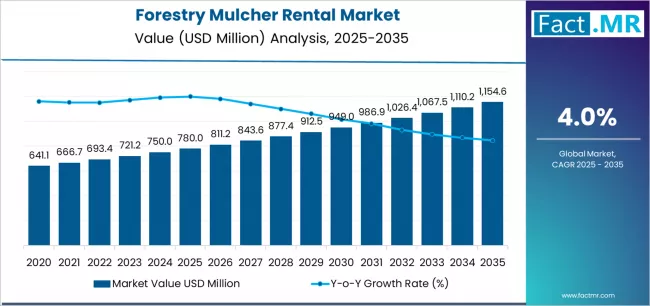
Forestry Mulcher Rental Market Market Value Analysis | Source: Fact.MR
Summary of Forestry Mulcher Rental Market
- Market Snapshot
- In 2025, the global Forestry Mulcher Rental Market was valued at approximately USD 780 million.
- The market is estimated to reach USD 811.2 million in 2026 and is projected to attain USD 1,200.8 million by 2036.
- The forestry mulcher rental market is likely to expand at a CAGR of 4.0% during the forecast period.
- The market is anticipated to create an absolute dollar opportunity of USD 389.6 million between 2026 and 2036.
- Short-term rental accounts for 37.1% of rental duration segment share in 2026.
- India (4.5%) and the USA (4.0%) are the key growth markets during the forecast period.
- Demand and Growth Drivers
- Wildfire prevention and fuel load reduction programs are generating expanding procurement pipelines for mulcher rental as government agencies and private landowners shift from prescribed burns to mechanical vegetation management for firebreak creation and forest floor fuel reduction.
- Utility right-of-way clearance mandates for power transmission, pipeline, and telecommunications corridors create recurring rental demand for mulchers deployed on vegetation management schedules dictated by regulatory compliance timelines.
- Agricultural land preparation, including brush clearing, pasture reclamation, and orchard site development, generates seasonal rental demand for skid steer and tractor-mounted mulcher systems.
- Residential and commercial land development projects requiring initial site clearing of trees, brush, and undergrowth before grading and construction are creating a growing rental channel from general contractors and land development firms.
- Remote-controlled mulching carriers are expanding the addressable application scope into steep-slope vegetation management, hazardous terrain clearance, and environmentally sensitive areas where conventional carrier access is restricted.
- Product and Segment View
- Skid steer forestry mulcher rental accounts for 34.8% of the product segment in 2026, supported by versatility, compact size, and broad carrier compatibility across land clearing, right-of-way maintenance, and residential site preparation applications.
- Forestry land management represents 31.6% of the application segment in 2026, with fuel load reduction, selective thinning, and sustainable forestry management programs generating the most concentrated rental demand.
- Forestry companies constitute 33.9% of end-use demand in 2026, with timber management operators, conservation agencies, and sustainable forestry contractors as the primary rental procurement channel.
- Key segmentation includes:
- Product Type: Skid Steer Forestry Mulcher Rental, Excavator Forestry Mulcher Rental, Tractor Forestry Mulcher Rental, Dedicated Mulching Tractor Rental, Remote-Controlled Mulcher Carrier Rental
- Application: Forestry Land Management, Right-of-Way Clearance, Agricultural Land Preparation, Site Development, Fire Mitigation
- These systems enable:
- Single-pass vegetation clearing that mulches trees, brush, and undergrowth into ground-level biomass without separate cutting, hauling, and disposal operations
- Utility corridor and pipeline right-of-way maintenance through scheduled mulching cycles that maintain vegetation clearance per regulatory specifications
- Firebreak creation and forest floor fuel load reduction for wildfire prevention programs managed by government agencies and private landowners
- Geography and Competitive Outlook
- North America holds the largest market share, driven by wildfire prevention spending in western states, utility right-of-way maintenance mandates, and high rental adoption among land clearing and forestry contractors.
- Asia Pacific is growing as organized forestry management and agricultural land preparation services adopt mechanical mulching methods over manual and chemical alternatives.
- Latin America sustains demand through agricultural land clearing, pasture management, and forestry plantation preparation, with Brazil at 3.7% reflecting expanding mechanized land management adoption.
- India (4.5%), USA (4.0%), and Canada (3.8%) are the fastest-growing markets, while South Korea (3.4%) and Germany (3.3%) maintain demand through institutional forestry and environmental management programs.
- Key players include FAE, Fecon, Prinoth, AHWI, Tigercat, Bobcat, Vermeer, Seppi M, Loftness, Rayco, Bandit, and Sunbelt Rentals.
- Analyst Opinion
- Shambhu Nath Jha, Principal Consultant at Fact.MR, says 'The forestry mulcher rental market is gaining structural momentum from the convergence of wildfire mitigation spending, utility right-of-way compliance, and agricultural mechanization. Fire prevention programs are the fastest-growing demand channel as federal and state agencies in the U.S. and Australia shift budgets from reactive firefighting to proactive fuel load reduction through mechanical mulching. FAE and Fecon dominate the OEM supply side with rotor technology and smart control systems that improve mulching efficiency and reduce carrier strain. Rental is the natural access model because most contractors treat mulching as a seasonal or project-specific capability rather than a permanent fleet investment.'
Key Growth Drivers, Constraints, and Opportunities
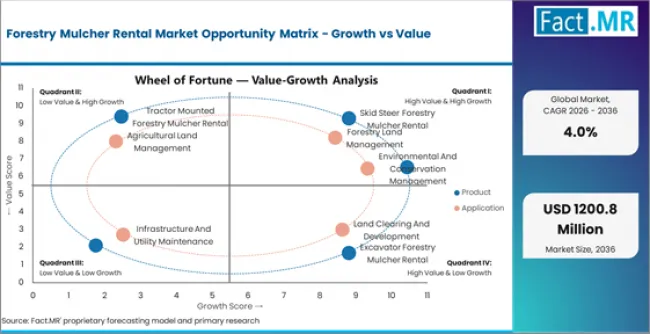
Forestry Mulcher Rental Market Opportunity Matrix Growth Vs Value | Source: Fact.MR
Key Factors Driving Growth
- Federal and state wildfire prevention budgets in the U.S. and Australia are increasing allocations for mechanical fuel load reduction through mulching programs that clear forest floor vegetation and create defensible space around communities and infrastructure.
- Utility companies managing power transmission and pipeline corridors on regulatory maintenance schedules create recurring, contract-driven rental demand for mulchers deployed on annual vegetation clearance cycles.
- Agricultural land conversion from brush and scrubland to productive pasture, orchard, and cropland generates seasonal rental demand for high-capacity mulchers capable of single-pass clearing.
Key Market Constraints
- Seasonal demand concentration in spring and autumn clearing windows creates fleet utilization pressure, with mulcher rental assets sitting idle during winter and high-fire-risk summer months when field operations are restricted.
- High carrier compatibility requirements limit mulcher attachment interchangeability across different skid steer and excavator brands, reducing fleet flexibility for rental operators managing diverse carrier inventories.
- Operator skill requirements for efficient mulching without carrier damage or rotor wear limit adoption among general contractors unfamiliar with mulcher-specific operating techniques.
Key Opportunity Areas
- Remote-controlled mulching carriers such as FAE RCU and Prinoth tracked platforms are opening new rental demand in steep-slope vegetation management, environmentally sensitive wetland clearance, and hazardous terrain applications.
- Post-wildfire rehabilitation mulching, including ash and debris processing for soil stabilization after fire events, is creating an emerging counter-cyclical demand channel that improves annual fleet utilization for rental operators.
- Smart control systems such as Fecon Fusion electronic motor control are reducing rotor and carrier stress, extending rental asset life and improving per-rental profitability for operators managing mulcher fleets.
Segment-wise Analysis of the Forestry Mulcher Rental Market
- Skid steer forestry mulcher rental holds 34.8% of the product segment in 2026, driven by compact carrier versatility, lower rental rates, and broad applicability across land clearing, right-of-way maintenance, and residential site preparation.
- Forestry land management represents 31.6% of the application segment in 2026, with selective thinning, fuel load reduction, and sustainable forestry programs generating the most concentrated institutional rental demand.
- Mechanical forestry mulching technology accounts for 29.4% of the technology segment in 2026, reflecting the dominance of drum-style rotor systems in standard-capacity mulcher rental configurations.
The market is segmented by product type, application, end use, technology, rental duration, and region. Skid steer mulchers lead by rental transaction volume. Excavator-mounted mulchers generate higher per-rental revenue on large-diameter clearing assignments. Short-term and project-based rental dominate due to the seasonal and assignment-specific nature of mulching operations.
Which Product Segment Dominates the Forestry Mulcher Rental Market?
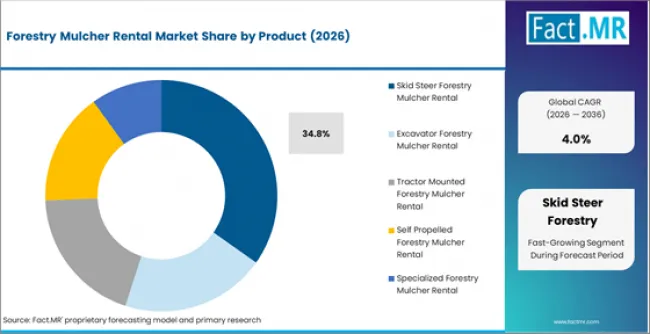
Forestry Mulcher Rental Market Analysis By Product | Source: Fact.MR
Skid steer forestry mulcher rental is estimated to account for 34.8% of product segment value in 2026. Skid steer-mounted mulcher heads generate the highest rental transaction volume due to their compact size, lower daily rental rate, and broad carrier compatibility with standard skid steer and compact track loader platforms. Demand spans residential land clearing, right-of-way maintenance, small-acreage agricultural clearing, and fire mitigation perimeter work where access constraints favor compact carrier platforms.
Excavator-mounted mulcher rental generates higher per-unit revenue for large-diameter tree and heavy brush clearing assignments where the reach and lifting capability of excavator carriers enables efficient processing of material beyond skid steer capacity. Dedicated mulching tractors and remote-controlled carriers serve the premium rental tier for large-acreage forestry management and steep-slope applications.
Which Application Segment Dominates the Forestry Mulcher Rental Market?
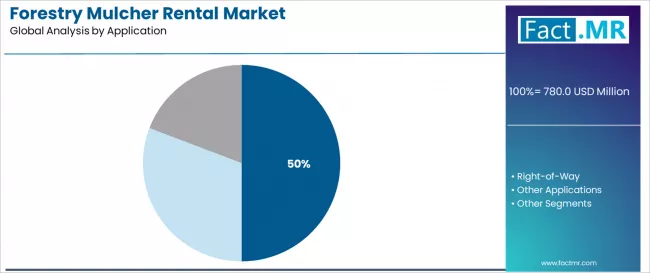
Forestry Mulcher Rental Market Analysis By Application | Source: Fact.MR
Forestry land management is expected to lead the application segment with 31.6% share in 2026. Demand is generated by fuel load reduction programs, selective thinning for forest health, sustainable timber management site preparation, and conservation area vegetation control. Government forestry agencies and private timber management companies are the primary institutional buyers, with procurement often structured as contract-based seasonal rental aligned with annual clearing schedules.
Right-of-way clearance follows as the second-largest application, driven by utility company vegetation management mandates for power transmission, pipeline, and telecommunications corridors. Agricultural land preparation and site development sustain parallel demand streams for seasonal and project-specific mulcher rental.
Which Product Trend is Shaping the Next Phase of Growth in the Forestry Mulcher Rental Market?
Remote-controlled tracked mulching carriers are the fastest-growing product category in the forestry mulcher rental market. FAE introduced the RCU45, an ultra-compact tracked carrier designed for professional vegetation management, alongside the PML/RCU swinging hammer mulcher head. These platforms enable mulching operations on steep slopes, in environmentally sensitive zones, and on hazardous terrain where conventional carrier access is restricted or operator safety requirements prohibit direct machine operation.
The rental appeal of remote-controlled carriers is strengthened by their expanding compatibility with third-party attachments. FAE released the SAE universal attachment plate for the RCU75, enabling integration with standard skid steer-mount equipment from other manufacturers. Fecon demonstrated its FTX150-2 mulching tractor with fire mitigation packaging in southern California wildfire zones during 2025, showcasing the convergence of dedicated mulching platforms with fire prevention applications. Rental operators stocking remote-controlled and fire-package-equipped mulchers are capturing premium daily rates in government-funded fire mitigation and utility clearance contracts.
Regional Outlook Across Key Markets
- India leads growth at 4.5%, driven by expanding mechanized agricultural land preparation, growing adoption of mulching for plantation site development, and increasing institutional demand for vegetation management in forestry and conservation programs.
- The U.S. at 4.0% sustains the largest absolute demand, supported by wildfire prevention spending, utility right-of-way mandates, and high rental adoption among land clearing contractors in the Southeast, Pacific Northwest, and mountain West regions.
- Canada at 3.8% reflects expanding wildfire mitigation programs, pipeline right-of-way maintenance, and forestry management demand across western provinces.
- Brazil at 3.7% sustains demand through agricultural land clearing for pasture and plantation development, with growing mechanized mulching adoption replacing manual clearing methods.
.webp "Top Country Growth Comparison Forestry Mulcher Rental Market Cagr (2026 2036)")
Top Country Growth Comparison Forestry Mulcher Rental Market Cagr (2026 2036) | Source: Fact.MR
| Country | CAGR (%) |
|---|---|
| India | 4.5% |
| USA | 4.0% |
| Canada | 3.8% |
| Brazil | 3.7% |
| South Korea | 3.4% |
| Germany | 3.3% |
| Japan | 3.0% |
Source: Fact.MR analysis. Updated Jun 3, 2026
Source: Fact MR (FMR) analysis, based on proprietary forecasting model and primary research.
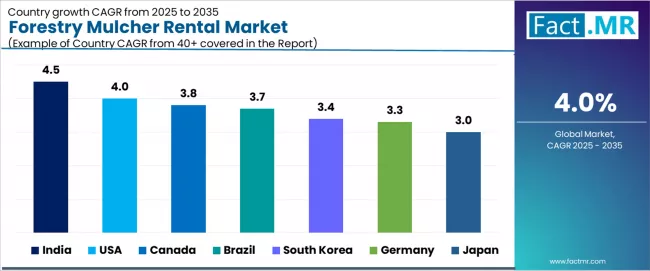
Forestry Mulcher Rental Market Cagr Analysis By Country | Source: Fact.MR
Forestry Mulcher Rental Demand Trends in India
Expanding mechanized agriculture and plantation development in southern and northeastern states are generating growing demand for mulcher rental as an alternative to manual brush clearing. National forestry management programs and conservation area vegetation control are adding institutional procurement channels, while PLI scheme-linked agricultural infrastructure development supports wider adoption of rental-accessed mulching equipment among organized farming cooperatives.
- Plantation development and mechanized agricultural land preparation are creating a growing rental demand channel for tractor-mounted forestry mulchers.
- National forestry and conservation programs add institutional procurement for vegetation management mulcher rental.
Market Outlook for Forestry Mulcher Rental in the United States
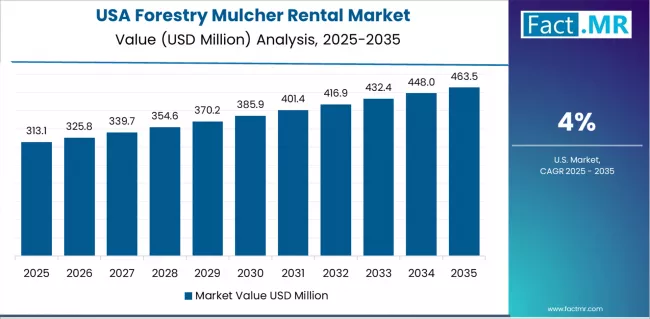
Forestry Mulcher Rental Market Country Value Analysis | Source: Fact.MR
Federal wildfire prevention spending and state-level fuel load reduction programs are the fastest-growing demand channels. USDA Forest Service and state agency contracts for defensible space creation and forest floor fuel reduction specify mechanical mulching as the preferred method. Utility right-of-way clearance mandates across power, gas, and telecom corridors sustain recurring rental procurement on annual vegetation management schedules. Sunbelt Rentals and regional equipment providers serve the primary rental access channels.
- Federal and state wildfire prevention contracts for mechanical fuel load reduction drive expanding mulcher rental procurement on government-funded timelines.
- Utility right-of-way clearance mandates create recurring annual rental demand cycles for skid steer and excavator-mounted mulcher systems.
Canada Forestry Mulcher Rental Demand Trends
The Canada Forestry Mulcher Rental Market is projected to grow at a CAGR of 3.8% through 2036. Wildfire mitigation programs across British Columbia, Alberta, and Ontario are expanding mechanical mulching specifications for fuel load management. Pipeline right-of-way maintenance across oil and gas corridors in western Canada sustains institutional rental procurement for excavator-mounted mulcher heads capable of processing large-diameter vegetation.
- Provincial wildfire mitigation programs in British Columbia and Alberta generate expanding contract-based mulcher rental demand.
- Oil and gas pipeline right-of-way maintenance sustains recurring excavator-mounted mulcher rental across western Canada.
Brazil Forestry Mulcher Rental Market Growth Assessment
Agricultural land conversion from brush and scrubland to productive pasture and plantation creates the primary demand channel. National infrastructure programs and expanding mechanized farming adoption are reducing reliance on manual and burn-based clearing methods. Import dependency for advanced mulcher systems with Bite Limiter or smart control technology creates cost premiums that favor rental access over equipment purchase for mid-size agricultural operators.
- Agricultural land conversion for pasture and plantation development generates seasonal mulcher rental demand across central and northern regions.
- Import cost premiums for advanced mulcher technology drive preference for rental access over capital purchase among mid-size operators.
Germany Forestry Mulcher Rental Market Positioning
The Germany Forestry Mulcher Rental Market is projected to grow at a CAGR of 3.3% through 2036. Institutional forestry management programs, energy corridor vegetation maintenance, and conservation area management sustain the primary demand channels. EU environmental compliance requirements for mechanical vegetation management over chemical alternatives support mulcher specification in government-tendered forestry and land management contracts.
- Institutional forestry management and conservation programs create structured, contract-based mulcher rental demand.
- EU environmental compliance favoring mechanical over chemical vegetation management methods supports mulcher rental specification.
Competitive Benchmarking and Company Positioning
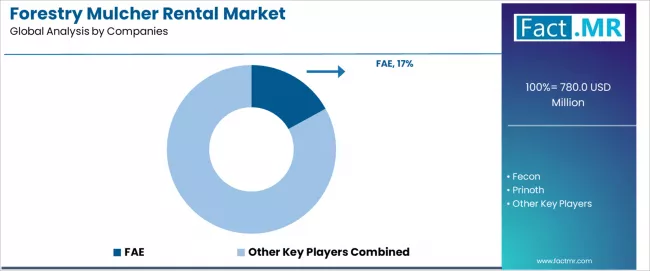
Forestry Mulcher Rental Market Analysis By Company | Source: Fact.MR
Forestry Mulcher Rental Market Analysis By Company
- FAE holds the strongest OEM position through its Bite Limiter rotor technology, broadest carrier compatibility range from 2-ton mini-excavators to 40-ton machines, and dedicated remote-controlled carrier platforms for professional vegetation management.
- Fecon competes through Fusion smart control technology, dedicated mulching tractor platforms including the FTX150-2, and fire mitigation packaging that positions its products for government wildfire prevention contracts.
- Rental platform access through Sunbelt Rentals, regional equipment providers, and dealer-linked rental channels determines market penetration, with mulcher rental demand concentrated at platforms that also stock compatible carrier machines.
The competitive landscape combines specialized mulcher OEMs with carrier manufacturers and rental platforms. FAE holds an estimated 17% market share in mulcher attachment manufacturing, supported by the widest carrier compatibility range and Bite Limiter rotor technology that reduces material blow-back and improves mulching efficiency. Fecon competes through integrated mulching tractor platforms and Fusion electronic motor control that reduces rotor and carrier stress.
Strategic priorities include expanding remote-controlled carrier product lines, developing fire mitigation-specific rental packages, deepening compatibility with third-party carrier platforms, and building rental fleet partnerships with major equipment rental operators.
Key Companies in the Forestry Mulcher Rental Market
- FAE, Fecon, and Prinoth lead the forestry mulcher market through specialized product portfolios, proprietary rotor and control technologies, and growing rental fleet integration with major equipment platforms.
- AHWI, Tigercat, Vermeer, Seppi M, Loftness, Rayco, and Bandit compete through carrier-specific mulcher head product lines and regional dealer networks.
- Bobcat, Sunbelt Rentals, and regional equipment rental providers serve the fleet access layer, with competition shaped by carrier and attachment inventory depth.
Recent Industry Developments
- FAE, UMM/S/EX Mulcher for 40-Ton Excavators (June 2025): FAE launched the UMM/S/EX, its most powerful mulcher for excavators, extending compatibility to vehicles up to 40 tons and opening new application capability for heavy-duty forestry and land clearing assignments. The launch strengthens FAE's position in the high-capacity rental segment.
- FAE, RCU45 Remote-Controlled Tracked Carrier (2025): FAE introduced the RCU45, an ultra-compact remote-controlled tracked carrier for professional vegetation management, alongside the PML/RCU swinging hammer mulcher head. The platform expands rental fleet options for steep-slope and hazardous terrain applications.
- Fecon, FTX150-2 Fire Package Demonstration (July 2025): Fecon demonstrated its FTX150-2 mulching tractor with fire mitigation packaging in Tonner Canyon, Los Angeles County, showcasing firebreak creation capability for wildfire prevention. The demonstration supports positioning of Fecon platforms in government-funded fire prevention rental contracts.
- Fecon, Stone Crusher Series Launch (2025): Fecon introduced the SC7620 and SC6220 Stone Crusher models for skid steers and compact track loaders, equipped with Fusion smart control. The launch expands Fecon's product portfolio beyond mulching into complementary land reclamation equipment.
Leading Companies Shaping the Forestry Mulcher Rental Market
- FAE
- Fecon
- Prinoth
- AHWI
- Tigercat
- Bobcat
- Vermeer
- Seppi M
- Loftness
- Rayco
Sources and Research References
- FAE Group S.p.A. Mulcher product launches, RCU carrier updates, and technology documentation.
- Fecon LLC. FTX mulching tractor, Fusion control system, and stone crusher product data.
- USDA Forest Service. Wildfire prevention spending and mechanical fuel reduction program data.
- Natural Resources Canada. Forest management and wildfire mitigation program data.
- Primary interviews with mulcher OEMs, rental platforms, forestry contractors, utility companies, and fire mitigation agencies.
This bibliography is provided for reader reference and is not exhaustive. The full report contains the complete reference list and detailed citations.
Key Questions This Report Addresses
- What is the current and projected size of the Forestry Mulcher Rental Market through 2036?
- Which product type generates the highest rental demand by transaction volume in 2026?
- What wildfire prevention and land management factors are driving mulcher rental growth?
- How are remote-controlled carriers influencing the forestry mulcher rental market?
- Which countries are projected to show the fastest growth through 2036?
- How do utility right-of-way mandates create recurring rental demand?
- Who are the key OEMs and rental platforms in the Forestry Mulcher Rental Market?
- How does Fact.MR estimate and validate the forestry mulcher rental market forecast?
Forestry Mulcher Rental Market Definition
The forestry mulcher rental market covers the provision of carrier-mounted and self-propelled vegetation mulching equipment on rental or lease agreements for land clearing, forestry management, right-of-way maintenance, fire mitigation, agricultural land preparation, and site development operations.
Forestry Mulcher Rental Market Inclusions
- The scope covers global and regional market size and forecasts for 2026 to 2036 across product type, application, end use, technology, rental duration, and region.
- It includes rental demand analysis based on wildfire prevention spending, utility right-of-way maintenance schedules, agricultural clearing activity, and land development permit volumes.
- The report includes rental rate benchmarking across mulcher types, carrier configurations, and deployment durations.
Forestry Mulcher Rental Market Exclusions
- The scope excludes forestry mulchers sold for permanent ownership, chainsaw and manual clearing tools, and chemical vegetation management products.
- It excludes tree harvesters, feller bunchers, and wood chippers operating outside the mulching equipment classification.
- The report excludes biomass processing equipment sold independently of mulcher rental and carrier-only rental without mulcher attachment specification.
Forestry Mulcher Rental Market Research Methodology
- The methodology combines secondary research, primary interviews, and forecast modelling tied to forestry management and land clearing activity cycles.
- It draws on 90+ secondary sources including wildfire agency budgets, utility maintenance databases, and agricultural clearing permits.
- Market sizing covers 30+ countries through a demand-side model validated against forestry expenditure and land clearing activity data.
- Primary validation includes 20+ interviews across mulcher OEMs, rental platforms, forestry contractors, utility companies, and fire mitigation agencies.
Segmentation
Scope of Analysis
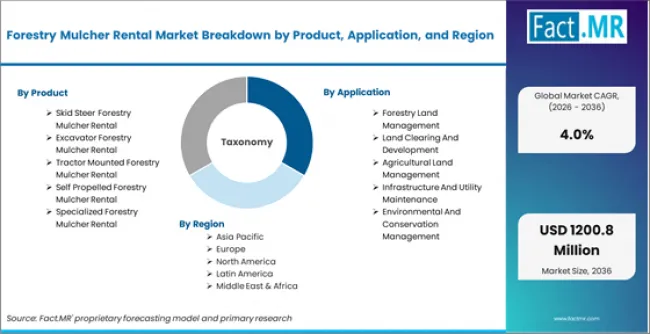
Forestry Mulcher Rental Market Breakdown By Product, Application, And Region | Source: Fact.MR
| Parameter | Details |
|---|---|
| Quantitative Units | USD 811.2 million to USD 1,200.8 million, at a CAGR of 4.0% |
| Market Definition | The Forestry Mulcher Rental Market covers the provision of carrier-mounted and self-propelled vegetation mulching equipment on rental agreements for land clearing, forestry management, right-of-way maintenance, fire mitigation, agricultural land preparation, and site development. |
| Regions Covered | North America, Latin America, Europe, East Asia, South Asia and Pacific, Middle East and Africa |
| Countries Covered | India, USA, Canada, Brazil, South Korea, Germany, Japan, 30 plus countries |
| Key Companies | FAE, Fecon, Prinoth, AHWI, Tigercat, Bobcat, Vermeer, Seppi M, Loftness, Rayco, Bandit, Sunbelt Rentals |
| Forecast Period | 2026 to 2036 |
| Approach | Hybrid demand-side and top-down methodology built on wildfire prevention budgets, utility right-of-way maintenance data, agricultural clearing activity, forestry expenditure, and primary interviews across OEMs, rental platforms, and forestry contractors. |
Source: Fact.MR analysis. Updated Jun 3, 2026
Forestry Mulcher Rental Market Segmentation
-
Forestry Mulcher Rental Market Segmented by Product:
- Skid Steer Forestry Mulcher Rental
- Standard Skid Steer Forestry Mulcher Rental
- Residential Land Clearing Rental
- Small Scale Vegetation Removal Rental
- Heavy Duty Skid Steer Forestry Mulcher Rental
- Commercial Land Development Clearing Rental
- Dense Vegetation Removal Rental
- Standard Skid Steer Forestry Mulcher Rental
- Excavator Forestry Mulcher Rental
- High Reach Excavator Forestry Mulcher Rental
- Roadside Vegetation Management Rental
- Utility Corridor Clearing Rental
- Fixed Boom Excavator Mulcher Rental
- Forest Floor Clearing Rental
- Industrial Land Preparation Rental
- High Reach Excavator Forestry Mulcher Rental
- Tractor Mounted Forestry Mulcher Rental
- PTO Driven Forestry Mulcher Rental
- Agricultural Land Clearing Rental
- Rural Vegetation Management Rental
- Hydraulic Tractor Mulcher Rental
- Large Scale Farm Land Clearing Rental
- Estate Land Maintenance Rental
- PTO Driven Forestry Mulcher Rental
- Self Propelled Forestry Mulcher Rental
- Tracked Forestry Mulcher Rental
- Forestry Road Maintenance Rental
- Wildfire Prevention Vegetation Clearing Rental
- Wheeled Forestry Mulcher Rental
- Commercial Plantation Maintenance Rental
- Municipal Green Belt Management Rental
- Tracked Forestry Mulcher Rental
- Specialized Forestry Mulcher Rental
- Heavy Duty Rock Forestry Mulcher Rental
- Mining Site Land Clearing Rental
- Rough Terrain Vegetation Removal Rental
- Low Impact Forestry Mulcher Rental
- Environmental Sensitive Area Clearing Rental
- Protected Land Vegetation Management Rental
- Heavy Duty Rock Forestry Mulcher Rental
- Skid Steer Forestry Mulcher Rental
-
Forestry Mulcher Rental Market Segmented by Application:
- Forestry Land Management
- Commercial Forestry Operations
- Timber Harvest Site Clearing Rental
- Logging Residue Processing Rental
- Forest Maintenance Operations
- Forest Trail Maintenance Rental
- Selective Vegetation Management Rental
- Commercial Forestry Operations
- Land Clearing And Development
- Construction Land Clearing
- Infrastructure Site Preparation Rental
- Road Expansion Vegetation Removal Rental
- Real Estate Development Clearing
- Commercial Plot Preparation Rental
- Residential Land Development Rental
- Construction Land Clearing
- Agricultural Land Management
- Farm Land Clearing
- Crop Land Preparation Rental
- Field Boundary Clearing Rental
- Ranch And Estate Management
- Large Property Vegetation Control Rental
- Pasture Maintenance Rental
- Farm Land Clearing
- Infrastructure And Utility Maintenance
- Roadside Vegetation Control
- Highway Corridor Maintenance Rental
- Railway Track Vegetation Removal Rental
- Power Line Maintenance
- Transmission Corridor Clearing Rental
- Substation Perimeter Vegetation Control Rental
- Roadside Vegetation Control
- Environmental And Conservation Management
- Wildfire Prevention Management
- Fuel Load Reduction Clearing Rental
- Firebreak Creation Rental
- Park And Protected Area Maintenance
- Eco Sensitive Land Management Rental
- Government Conservation Projects Rental
- Wildfire Prevention Management
- Forestry Land Management
-
Forestry Mulcher Rental Market Segmented by End Use:
- Forestry Companies
- Timber Production Companies
- Logging Contractors
- Forest Management Operators
- Pulp And Paper Companies
- Raw Material Supply Operations
- Sustainable Forestry Operators
- Timber Production Companies
- Construction Companies
- Infrastructure Construction Companies
- Road Development Contractors
- Utility Corridor Contractors
- Real Estate Development Companies
- Land Development Contractors
- Commercial Property Developers
- Infrastructure Construction Companies
- Agricultural Sector
- Commercial Farming Operations
- Large Scale Farm Maintenance Contractors
- Agricultural Land Developers
- Ranch And Estate Operators
- Private Land Management Contractors
- Large Property Maintenance Operators
- Commercial Farming Operations
- Municipal Authorities
- Forest Departments
- Public Land Management Agencies
- Reforestation Project Authorities
- Municipal Maintenance Departments
- Urban Green Belt Management Teams
- Public Infrastructure Maintenance Teams
- Forest Departments
- Environmental And Conservation Agencies
- Wildlife Protection Agencies
- Forest Conservation Authorities
- Protected Area Management Bodies
- Disaster Management Agencies
- Wildfire Prevention Teams
- Emergency Land Clearing Units
- Wildlife Protection Agencies
- Forestry Companies
-
Forestry Mulcher Rental Market Segmented by Technology:
- Mechanical Forestry Mulching Technology
- Drum Mulching Systems
- High Density Vegetation Processing Rental
- Large Scale Land Clearing Rental
- Disc Mulching Systems
- Precision Vegetation Removal Rental
- Selective Clearing Rental
- Drum Mulching Systems
- Power Source
- Diesel Powered Forestry Mulcher Rental
- Heavy Duty Land Clearing Rental
- Remote Site Forestry Operations Rental
- Hydraulic Powered Forestry Mulcher Rental
- High Torque Vegetation Removal Rental
- Dense Forest Clearing Rental
- Diesel Powered Forestry Mulcher Rental
- Mobility Configuration
- Tracked Forestry Mulcher Rental
- Rough Terrain Land Clearing Rental
- Slope Vegetation Removal Rental
- Wheeled Forestry Mulcher Rental
- Flat Terrain Vegetation Management Rental
- Urban Edge Land Clearing Rental
- Tracked Forestry Mulcher Rental
- Mounting System
- Skid Steer Mounted Mulcher Rental
- Compact Site Clearing Rental
- Residential Vegetation Removal Rental
- Excavator Mounted Mulcher Rental
- High Reach Vegetation Clearing Rental
- Infrastructure Corridor Maintenance Rental
- Skid Steer Mounted Mulcher Rental
- Mechanical Forestry Mulching Technology
-
Forestry Mulcher Rental Market Segmented by Rental Duration:
- Short Term Rental
- Daily Rental
- Emergency Land Clearing Rental
- Storm Damage Vegetation Removal Rental
- Weekly Rental
- Seasonal Forestry Maintenance Rental
- Project Based Clearing Rental
- Daily Rental
- Long Term Rental
- Monthly Rental
- Large Scale Forestry Operations Rental
- Infrastructure Corridor Maintenance Rental
- Project Based Rental
- Reforestation Land Management Rental
- Long Duration Land Development Rental
- Monthly Rental
- Short Term Rental
-
Forestry Mulcher Rental Market by Region:
- North America
- USA
- Canada
- Mexico
- Latin America
- Brazil
- Chile
- Rest of Latin America
- Western Europe
- Germany
- UK
- Italy
- Spain
- France
- Nordic
- BENELUX
- Rest of Western Europe
- Eastern Europe
- Russia
- Poland
- Hungary
- Balkan & Baltic
- Rest of Eastern Europe
- East Asia
- China
- Japan
- South Korea
- South Asia and Pacific
- India
- ASEAN
- Australia & New Zealand
- Rest of South Asia and Pacific
- Middle East & Africa
- Kingdom of Saudi Arabia
- Other GCC Countries
- Turkiye
- South Africa
- Other African Union
- Rest of Middle East & Africa
- North America
Frequently Asked Questions
How big is the forestry mulcher rental market in 2026?
What will be the size of forestry mulcher rental market in 2036?
How much will be the forestry mulcher rental market growth between 2026 and 2036?
What are the key product types in the forestry mulcher rental market?
Which application segment is expected to contribute significant share in the forestry mulcher rental market in 2026?
Who worked on this report


Preview the report firsthand - request a free sample
Free SampleGet the brochure for pricing and purchase details
Download PDF