3D Printing Gases Market Size, Share, Growth and Forecast (2026 - 2036)
The 3D Printing Gases Market is segmented by Gas Type, by Process, by Supply Mode, by Application, and by End-use Industry and region. Forecast for 2026 to 2036.
Fact.MR states that 3D printing gases demand is moving toward controlled metal additive manufacturing environments. Manufacturers need inert atmospheres that protect powders and parts during printing. Gas suppliers need delivery models that match lab-scale printing and production-scale additive manufacturing.
3D Printing Gases Market Size, Market Forecast and Outlook by Fact.MR
- The 3D printing gases market was valued at USD 64.8 million in 2025.
- Demand is expected to increase from USD 70.2 million in 2026 to USD 156.5 million by 2036.
- The market is forecast to record 8.3% CAGR during 2026 to 2036 as metal additive manufacturing users tighten control over oxygen, moisture, and powder-handling conditions.
Metric Details
| Metric | Details |
|---|---|
| Industry Size 2026 | USD 70.2 million |
| Industry Value 2036 | USD 156.5 million |
| CAGR 2026 to 2036 | 8.3% |
Summary of 3D Printing Gases Market
- Demand Drivers in the Market
- Print Quality: Metal AM users need inert gases to reduce oxidation and improve part consistency.
- Powder Production: Metal powder makers use argon and nitrogen during gas atomization.
- Process Control: Industrial printers need atmosphere monitoring to manage oxygen and moisture during builds.
- Key Segments Analyzed
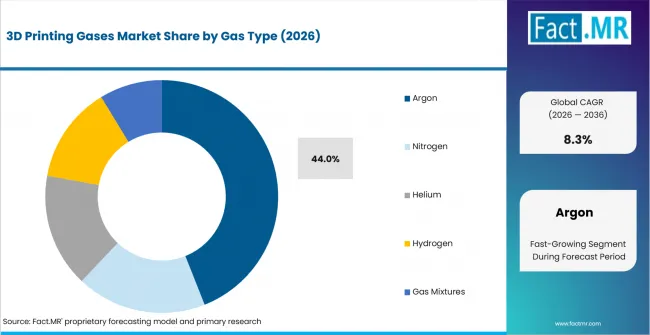
- By Gas Type: Argon is expected to hold 44.0% share in 2026 because reactive metal printing and powder atomization need high inertness.
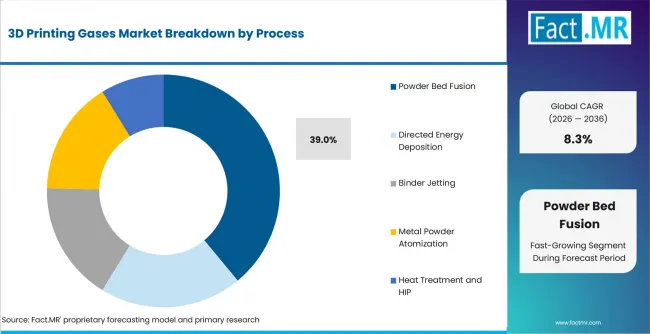
- By Process: Powder bed fusion is likely to account for 39.0% share in 2026 because metal AM users rely on controlled chamber atmospheres.
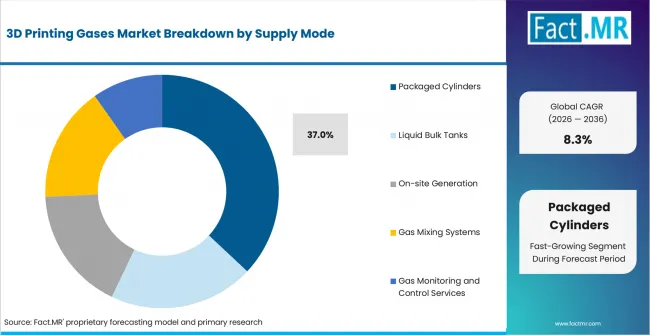
- By Supply Mode: Packaged cylinders are projected to hold 37.0% share in 2026 because small and mid-scale AM users need flexible gas delivery.
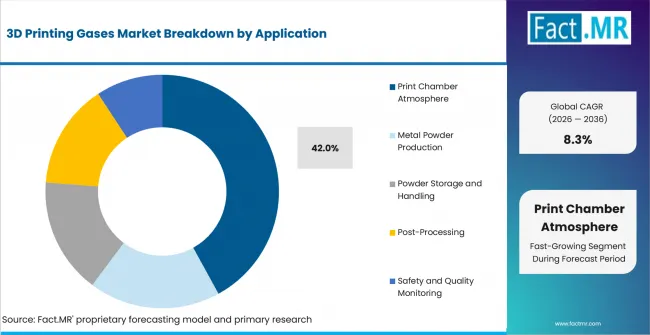
- By Application: Print chamber atmosphere leads as inert gas control protects the melt pool and powder surface. The segment is anticipated to capture 42.0% share in 2026.
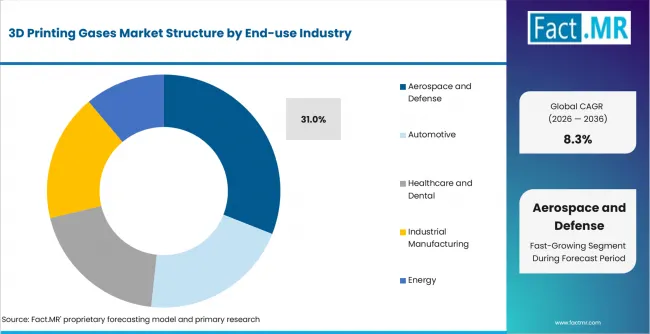
- By End-use Industry: Aerospace and defense are expected to hold 31.0% share in 2026 because certified metal AM parts need tighter process control.
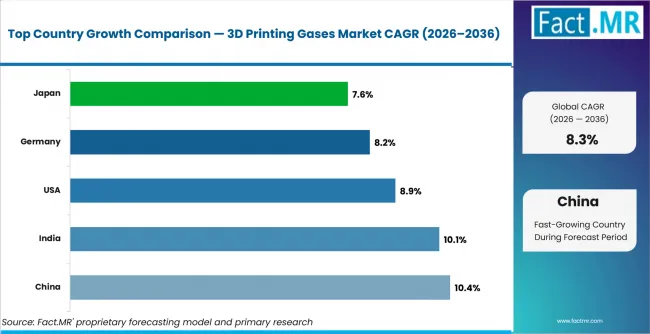
- By Geography: China is projected to record 10.4% CAGR through 2036 as metal additive manufacturing capacity and powder production expand.
- Analyst Opinion at Fact.MR
- Shambhunath Jha, Principal Consultant at Fact.MR, states, “3D printing gases are becoming a quality-control input rather than a utility item. We see users asking for stable gas purity and repeatable chamber conditions. Suppliers that combine gas supply with application support will gain better access to production AM users.”
- Strategic Implications
- Purity Control: Gas suppliers need reliable argon and nitrogen supply for metal AM users.
- Chamber Monitoring: Printer operators should manage oxygen and dew point during production builds.
- Supply Planning: AM service bureaus need gas delivery models that match build frequency and printer count.
3D printing gases demand is becoming more process focused. Metal printing users need argon and nitrogen to protect the melt pool and powder surface during printing. Gas suppliers also support powder atomization and post-processing. Air Liquide stated in 2024 that gas atomization for additive manufacturing metal powders uses significant amounts of argon and nitrogen. [1]
China is projected to record 10.4% CAGR by 2036 as metal additive manufacturing capacity and powder production expand. India is likely to post 10.1% CAGR as aerospace and medical device printing activity grows. The United States is expected to register 8.9% CAGR by 2036 as aerospace and healthcare users deepen production use. Germany is forecast to advance at 8.2% CAGR because industrial AM and automotive tooling support demand. Japan is set to record 7.6% CAGR because precision manufacturing and medical printing sustain gas use.
Segmental Analysis
3D Printing Gases Market Analysis by Gas Type

Argon is anticipated to hold 44.0% share in 2026 because reactive metal printing and powder atomization need high inertness. A 2025 Additive Manufacturing study compared argon and helium as environment gases in laser powder bed fusion, supporting the role of controlled gas selection in melt pool behavior and part quality [2]. Titanium and aluminum workflows need stronger protection from oxygen exposure. Nickel alloy printing also benefits from stable chamber conditions. Nitrogen supports stainless steel and selected powder bed processes. Helium helps applications that need different heat transfer behavior. Hydrogen is used in selected reducing atmospheres and post-processing. Gas mixtures support process tuning and quality control.
- Argon Shielding: Argon protects reactive metals during printing and powder production.
- Nitrogen Use: Nitrogen supports selected alloys and lower-cost inerting needs.
- Helium Support: Helium serves specialized processes that need different thermal behavior.
3D Printing Gases Market Analysis by Process

Powder bed fusion leads because metal AM users rely on controlled chamber atmospheres. Laser-based metal printing needs a stable gas environment to limit oxidation and maintain part quality. The segment is likely to account for 39.0% share in 2026 because most production metal AM programs use chamber-based systems. Directed energy deposition uses shielding gas around the melt zone. Binder jetting needs gases during sintering and heat treatment. Metal powder atomization uses argon or nitrogen to form spherical powders for printing.
- Chamber Control: Powder bed fusion needs inert gas to protect powder and melt pools.
- Melt Protection: Directed energy deposition uses shielding gas around the build zone.
- Powder Creation: Gas atomization uses high-pressure gas to create metal powder feedstock.
3D Printing Gases Market Analysis by Supply Mode

Packaged cylinders are projected to hold 37.0% share in 2026 because small and mid-scale AM users need flexible gas delivery. Research labs and service bureaus often start with cylinders before moving to larger systems. Liquid bulk tanks become more relevant when printer fleets and powder atomization volumes rise. On-site generation suits nitrogen-heavy users with regular consumption. Gas mixing systems support process tuning. Gas monitoring and control services help users document chamber conditions. Supply mode selection depends on print volume and process sensitivity.
- Cylinder Flexibility: Packaged cylinders help smaller AM users manage variable build schedules.
- Bulk Demand: Liquid tanks support facilities with multiple printers and higher gas use.
- Site Control: On-site generation supports users with steady nitrogen demand.
3D Printing Gases Market Analysis by Application

Print chamber atmosphere leads as inert gas control protects the melt pool and powder surface. A 2024 peer-reviewed review in Materials identifies atmosphere control, cover gas, and process control as important factors in laser powder bed fusion, making it a close source for this segment [3]. Metal AM users need controlled oxygen and moisture levels during builds. The segment is anticipated to capture 42.0% share in 2026 because chamber conditions affect part repeatability. Metal powder production follows because gas atomization depends on high-pressure argon or nitrogen. Powder storage and handling need inerting to limit oxidation. Post-processing uses gases for sintering and heat treatment. Safety and monitoring systems support compliance and process documentation.
- Build Protection: Print chamber gas limits oxygen exposure during metal printing.
- Powder Quality: Metal powder production uses gas atomization to shape printable powders.
- Storage Safety: Powder handling gases help protect sensitive powders from moisture and oxidation.
3D Printing Gases Market Analysis by End-use Industry

Aerospace and defense are expected to hold 31.0% share in 2026 because certified metal AM parts need tighter process control. Aircraft and defense components require repeatable mechanical properties and documented production conditions. Automotive users apply gases in tooling and selected metal parts. Healthcare and dental users need controlled printing for implants and dental frameworks. Industrial manufacturing uses AM gases for tooling and spare parts. Energy users apply printed parts in turbines and repair workflows. End-use adoption depends on qualification burden and part risk.
- Aerospace Control: Aerospace users need documented gas conditions for qualified metal parts.
- Medical Precision: Healthcare and dental users need stable print quality for patient-specific parts.
- Industrial Parts: Manufacturers use AM gases for tools and selected spare components.
3D Printing Gases Market Drivers, Restraints, and Opportunities

Metal additive manufacturing quality needs are the main drivers for 3D printing gases demand. NIST reported in 2024 that process variation creates challenges for industrial acceptance of metal AM, with qualification and certification of fabricated components requiring stronger in-process monitoring and control [4]. Controlled build conditions matter for part acceptance. Gas suppliers gain value when they support purity, delivery reliability, and chamber control.
Cost and process knowledge can restrain demand. High-purity argon and helium can raise operating cost for small AM users. Poor gas selection may create oxidation, discoloration, or weak part quality. Some polymer printing applications do not need controlled gas environments. Gas safety training is also needed because inert gases can create asphyxiation risks in enclosed production areas.
Opportunities in the 3D Printing Gases Market
- Oxygen Control: Suppliers can offer chamber monitoring and purge optimization for metal AM users.
- Powder Atomization: Gas firms can support metal powder producers with argon and nitrogen supply.
- On-site Nitrogen: Gas suppliers can serve high-volume users that need stable nitrogen availability.
Regional Analysis
Based on regional analysis, the 3D printing gases market is segmented into North America, Latin America, Europe, East Asia, South Asia and Pacific, and Middle East and Africa.
.webp)
Country CAGR 2026 to 2036
| Country | CAGR |
|---|---|
| China | 10.4% |
| India | 10.1% |
| United States | 8.9% |
| Germany | 8.2% |
| Japan | 7.6% |

East Asia 3D Printing Gases Market Analysis

East Asia demand comes from metal powder production and industrial additive manufacturing. China leads regional demand because manufacturing capacity and metal AM equipment use are expanding. Japan has steady gas demand from precision manufacturing and medical printing applications. Local gas infrastructure and printer supplier access support adoption across production environments.
- China: China is projected to record 10.4% CAGR through 2036 as metal additive manufacturing capacity and powder production expand. Industrial users need argon and nitrogen for powder bed fusion and gas atomization. Automotive, aerospace, and medical device printing create demand for controlled atmospheres. Domestic gas supply can support wider AM use across industrial clusters.
- Japan: Japan has a mature precision manufacturing base and steady additive manufacturing demand. Medical and automotive users apply metal AM for selected parts. The country is set to post 7.6% CAGR through 2036 as production users move from prototypes to qualified applications. Gas purity and documentation matter because Japanese manufacturers value repeatability.
North America 3D Printing Gases Market Analysis

North America demand is led by the United States because aerospace, defense, and medical AM users have deep qualification needs. Metal AM users require gas supply that supports repeatable builds and documentation. Air Products stated in 2025 that it provides nitrogen and hydrogen along with gas handling equipment and technology. [5]
- United States: The United States is forecast to register 8.9% CAGR during 2026 to 2036 as aerospace, defense, and healthcare users deepen production AM use. Aircraft component makers need stable chamber atmospheres for qualified metal parts. Medical implant and dental labs use gases for controlled printing and post-processing. Service bureaus need reliable packaged and bulk supply.
South Asia and Europe 3D Printing Gases Market Analysis

South Asia has faster headroom because industrial AM adoption is expanding from research labs into manufacturing clusters. India leads this group as aerospace and medical device printing activity grows. Europe has steady demand because additive manufacturing is linked to automotive and precision engineering. Germany benefits from advanced machine tool and industrial gas infrastructure.
- India: India is likely to post 10.1% CAGR through 2036 as aerospace and medical device printing activity grows. Additive manufacturing users need argon and nitrogen for metal printing and powder handling. Space and healthcare applications support early production use. Cost sensitivity may keep some users on packaged cylinders before bulk systems. Local gas availability and application support will decide adoption outside major industrial cities. Suppliers with training support can improve conversion.
- Germany: Germany industrial AM base supports steady 3D printing gas demand. This supports 8.2% CAGR through 2036 as automotive and aerospace users adopt metal printing. Powder bed fusion users need argon and nitrogen to control build chambers. Binder jetting and heat treatment create additional gas needs. German users value process documentation and repeatable results. Gas suppliers with atmosphere monitoring and bulk delivery capability can defend stronger accounts.
Competitive Aligners for Market Suppliers

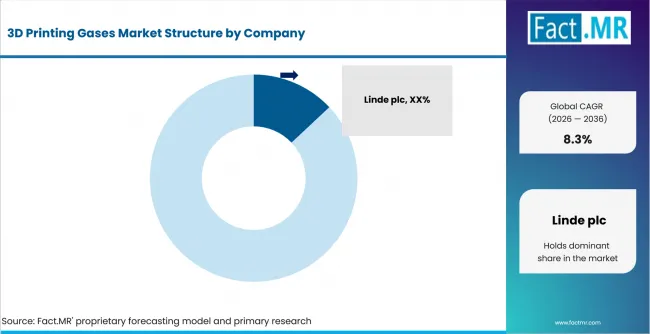
The 3D printing gases market is led by industrial gas companies with additive manufacturing support. Linde plc offers process gases and gas mixture support for AM users. Air Liquide S.A. serves applications from powder production to post processing. Air Products and Chemicals Inc. supports powder metallurgy and additive manufacturing through industrial gas supply.
Messer Group GmbH and Nippon Sanso Holdings Corporation add regional supply strength. Packaged gases and bulk delivery help users manage different production volumes. EIGA’s 2026 classification guide notes that nitrogen and argon and helium can act as asphyxiants in high concentrations. Safety training and gas monitoring will become more important as AM sites scale production.
Through 2036, supplier selection will depend on purity control and process support. AM users need more than cylinders and bulk tanks. They need purge advice and chamber control guidance. Gas suppliers with AM specialists and dependable delivery networks will be better placed.
Key Companies in 3D Printing Gases Market
- Linde plc
- Air Liquide S.A.
- Air Products and Chemicals, Inc.
- Messer Group GmbH
- Nippon Sanso Holdings Corporation
Bibliography
- [1] Air Liquide. (2024, March 27). 3D printing, a multi-layered success story. Air Liquide.
- [2] Ren, Z., Clark, S. J., Gao, L., Fezzaa, K., & Sun, T. (2025, July). A mechanistic study on environment gas in laser powder bed fusion. Additive Manufacturing, 109, Article 104886.
- [3] Brown, B., Lough, C., Wilson, D., Newkirk, J., & Liou, F. (2024, November). Atmosphere effects in laser powder bed fusion: A review. Materials, 17(22), Article 5549.
- [4] Donmez, A., Fox, J., Kim, F., Lane, B., Praniewicz, M., Tondare, V., Weaver, J., & Witherell, P. (2024, September). In-process monitoring and non-destructive evaluation for metal additive manufacturing processes. National Institute of Standards and Technology.
- [5] Air Products and Chemicals, Inc. (2025, June 13). Air Products to showcase industrial gas solutions at the PowderMet2025 International Conference. Air Products and Chemicals, Inc.
This Report Addresses
- Strategic intelligence on 3D printing gases demand across gas type, process, supply mode, application, and end-use industry.
- Forecast mapping from USD 70.2 million in 2026 to USD 156.5 million by 2036.
- Segment analysis covering argon, powder bed fusion, packaged cylinders, print chamber atmosphere, and aerospace and defense.
- Regional outlook covering China, India, the United States, Germany, and Japan.
- Competitive analysis of Linde plc, Air Liquide S.A., Air Products and Chemicals, Inc., Messer Group GmbH, Nippon Sanso Holdings Corporation.
- Product assessment covering argon, nitrogen, helium, hydrogen, and gas mixtures.
- Process assessment covering powder bed fusion, directed energy deposition, binder jetting, metal powder atomization, and heat treatment.
- Primary interviews, supplier checks, official source review, and additive manufacturing workflow validation support the forecast.
3D Printing Gases Market Definition
The 3D printing gases market covers industrial and specialty gases used in additive manufacturing processes. It includes argon and gas mixtures used for print chambers and post-processing. The market differs from general industrial gas demand because gas purity and atmosphere control directly affect printed part quality.
3D Printing Gases Market Inclusions
The scope includes gases used in metal additive manufacturing and heat treatment. It includes packaged cylinders and controlled gas mixing systems. Monitoring and atmosphere-control services are included when supplied with 3D printing gas programs.
3D Printing Gases Market Exclusions
The scope excludes gases used only for conventional welding or cutting when no additive manufacturing process is involved. General laboratory gases are excluded unless used in 3D printing workflows. Polymer 3D printing without gas control is outside scope. Equipment-only sales are excluded unless bundled with gas supply or atmosphere-control services.
3D Printing Gases Market Research Methodology
- Primary Research
- Primary research includes interviews with additive manufacturing production managers and metal powder suppliers. It includes input from gas application specialists and aerospace AM qualification engineers.
- Desk Research
- Desk research reviews gas supplier product pages and additive manufacturing process standards. It covers powder bed fusion guidance and metal powder production references.
- Market-Sizing and Forecasting
- Forecasting uses gas type demand and process use. Supply mode movement and end-use industry adoption support future market assessment.
- Data Validation and Update Cycle
- Forecasts are validated through gas supplier checks and AM user feedback. Printer installation signals and metal powder production activity help confirm demand direction.
Scope of the Report

| Attribute | Details |
|---|---|
| Quantitative Units | USD 70.2 million in 2026 to USD 156.5 million by 2036 at 8.3% CAGR |
| Market Definition | Industrial and specialty gases used in additive manufacturing processes |
| Gas Type | Argon, Nitrogen, Helium, Hydrogen, Gas Mixtures |
| Process | Powder Bed Fusion, Directed Energy Deposition, Binder Jetting, Metal Powder Atomization, Heat Treatment and HIP |
| Supply Mode | Packaged Cylinders, Liquid Bulk Tanks, On-site Generation, Gas Mixing Systems, Gas Monitoring and Control Services |
| Application | Print Chamber Atmosphere, Metal Powder Production, Powder Storage and Handling, Post-Processing, Safety and Quality Monitoring |
| End-use Industry | Aerospace and Defense, Automotive, Healthcare and Dental, Industrial Manufacturing, Energy |
| Regions Covered | North America, Latin America, Europe, East Asia, South Asia and Pacific, Middle East and Africa |
| Countries Covered | China, India, United States, Germany, Japan |
| Key Companies Profiled | Linde plc, Air Liquide S.A., Air Products and Chemicals, Inc., Messer Group GmbH, Nippon Sanso Holdings Corporation |
| Forecast Period | 2026 to 2036 |
| Approach | Hybrid top-down and bottom-up approach using gas type demand, process use, supply mode movement, application demand, end-use industry adoption, and regional validation |
3D Printing Gases Market Analysis by Segments
-
By Gas Type:
- Argon
- Nitrogen
- Helium
- Hydrogen
- Gas Mixtures
-
By Process:
- Powder Bed Fusion
- Directed Energy Deposition
- Binder Jetting
- Metal Powder Atomization
- Heat Treatment and HIP
-
By Supply Mode:
- Packaged Cylinders
- Liquid Bulk Tanks
- On-site Generation
- Gas Mixing Systems
- Gas Monitoring and Control Services
-
By Application:
- Print Chamber Atmosphere
- Metal Powder Production
- Powder Storage and Handling
- Post-Processing
- Safety and Quality Monitoring
-
By End-use Industry:
- Aerospace and Defense
- Automotive
- Healthcare and Dental
- Industrial Manufacturing
- Energy
-
Region:
- North America
- United States
- Canada
- Europe
- Germany
- United Kingdom
- France
- Italy
- Spain
- Asia Pacific
- China
- Japan
- South Korea
- Taiwan
- Singapore
- Latin America
- Brazil
- Mexico
- Argentina
- Middle East & Africa
- GCC Countries
- South Africa
- Israel
- North America
- Frequently Asked Questions -
What is the 3D Printing Gases Market size in 2026?
The 3D printing gases market is estimated to reach USD 70.2 million in 2026.
What will the 3D Printing Gases Market be worth by 2036?
The 3D printing gases market is projected to reach USD 156.5 million by 2036 as production AM programs use more controlled atmospheres.
What CAGR is projected for the 3D Printing Gases Market?
The 3D printing gases market is forecast to record 8.3% CAGR during 2026 to 2036.
Which gas type leads the 3D Printing Gases Market?
Argon leads with 44.0% share in 2026 because reactive metal printing and powder atomization need high inertness.
Which country expands faster in the 3D Printing Gases Market?
China is projected to record 10.4% CAGR through 2036 as metal additive manufacturing capacity and powder production expand.
How does India perform in the 3D Printing Gases Market?
India is likely to post 10.1% CAGR through 2036 as aerospace and medical device printing activity grows.
How does the United States perform in the 3D Printing Gases Market?
The United States is forecast to register 8.9% CAGR as aerospace, defense, and healthcare users deepen production AM use.
What is the primary driver in the 3D Printing Gases Market?
The primary driver is process control. Metal AM users need stable inert gases to protect powder and printed parts.
What is the main restraint in the 3D Printing Gases Market?
The main restraint is operating cost. High-purity argon and helium can raise the cost of production AM.
Why is argon important in the 3D Printing Gases Market?
Argon is important because it protects reactive metals during printing and powder atomization.
Why is atmosphere monitoring important in this market?
Atmosphere monitoring is important because oxygen and moisture changes can affect printed part quality.
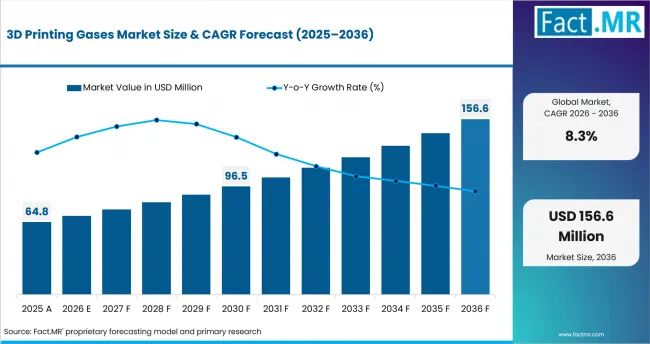
Table of Content
- Executive Summary
- Global Market Outlook
- Demand to side Trends
- Supply to side Trends
- Technology Roadmap Analysis
- Analysis and Recommendations
- Market Overview
- Market Coverage / Taxonomy
- Market Definition / Scope / Limitations
- Research Methodology
- Chapter Orientation
- Analytical Lens and Working Hypotheses
- Market Structure, Signals, and Trend Drivers
- Benchmarking and Cross-market Comparability
- Market Sizing, Forecasting, and Opportunity Mapping
- Research Design and Evidence Framework
- Desk Research Programme (Secondary Evidence)
- Company Annual and Sustainability Reports
- Peer-reviewed Journals and Academic Literature
- Corporate Websites, Product Literature, and Technical Notes
- Earnings Decks and Investor Briefings
- Statutory Filings and Regulatory Disclosures
- Technical White Papers and Standards Notes
- Trade Journals, Industry Magazines, and Analyst Briefs
- Conference Proceedings, Webinars, and Seminar Materials
- Government Statistics Portals and Public Data Releases
- Press Releases and Reputable Media Coverage
- Specialist Newsletters and Curated Briefings
- Sector Databases and Reference Repositories
- Fact.MR Internal Proprietary Databases and Historical Market Datasets
- Subscription Datasets and Paid Sources
- Social Channels, Communities, and Digital Listening Inputs
- Additional Desk Sources
- Expert Input and Fieldwork (Primary Evidence)
- Primary Modes
- Qualitative Interviews and Expert Elicitation
- Quantitative Surveys and Structured Data Capture
- Blended Approach
- Why Primary Evidence is Used
- Field Techniques
- Interviews
- Surveys
- Focus Groups
- Observational and In-context Research
- Social and Community Interactions
- Stakeholder Universe Engaged
- C-suite Leaders
- Board Members
- Presidents and Vice Presidents
- R&D and Innovation Heads
- Technical Specialists
- Domain Subject-matter Experts
- Scientists
- Physicians and Other Healthcare Professionals
- Governance, Ethics, and Data Stewardship
- Research Ethics
- Data Integrity and Handling
- Primary Modes
- Tooling, Models, and Reference Databases
- Desk Research Programme (Secondary Evidence)
- Data Engineering and Model Build
- Data Acquisition and Ingestion
- Cleaning, Normalisation, and Verification
- Synthesis, Triangulation, and Analysis
- Quality Assurance and Audit Trail
- Market Background
- Market Dynamics
- Drivers
- Restraints
- Opportunity
- Trends
- Scenario Forecast
- Demand in Optimistic Scenario
- Demand in Likely Scenario
- Demand in Conservative Scenario
- Opportunity Map Analysis
- Product Life Cycle Analysis
- Supply Chain Analysis
- Investment Feasibility Matrix
- Value Chain Analysis
- PESTLE and Porter’s Analysis
- Regulatory Landscape
- Regional Parent Market Outlook
- Production and Consumption Statistics
- Import and Export Statistics
- Market Dynamics
- Global Market Analysis 2021 to 2025 and Forecast, 2026 to 2036
- Historical Market Size Value (USD Million) Analysis, 2021 to 2025
- Current and Future Market Size Value (USD Million) Projections, 2026 to 2036
- Y to o to Y Growth Trend Analysis
- Absolute $ Opportunity Analysis
- Global Market Pricing Analysis 2021 to 2025 and Forecast 2026 to 2036
- Global Market Analysis 2021 to 2025 and Forecast 2026 to 2036, By Material Type
- Introduction / Key Findings
- Historical Market Size Value (USD Million) Analysis By Material Type , 2021 to 2025
- Current and Future Market Size Value (USD Million) Analysis and Forecast By Material Type , 2026 to 2036
- Metal Powders
- Polymer Powders
- Ceramic Powders
- Metal Powders
- Y to o to Y Growth Trend Analysis By Material Type , 2021 to 2025
- Absolute $ Opportunity Analysis By Material Type , 2026 to 2036
- Global Market Analysis 2021 to 2025 and Forecast 2026 to 2036, By Application
- Introduction / Key Findings
- Historical Market Size Value (USD Million) Analysis By Application, 2021 to 2025
- Current and Future Market Size Value (USD Million) Analysis and Forecast By Application, 2026 to 2036
- Industrial manufacturing
- Aerospace
- Automotive & Transportation
- Healthcare
- Industrial manufacturing
- Y to o to Y Growth Trend Analysis By Application, 2021 to 2025
- Absolute $ Opportunity Analysis By Application, 2026 to 2036
- Global Market Analysis 2021 to 2025 and Forecast 2026 to 2036, By Printing Technology
- Introduction / Key Findings
- Historical Market Size Value (USD Million) Analysis By Printing Technology, 2021 to 2025
- Current and Future Market Size Value (USD Million) Analysis and Forecast By Printing Technology, 2026 to 2036
- Selective Laser Sintering (SLS)
- Direct Metal Laser Sintering (DMLS)
- Electron Beam Melting (EBM)
- Binder Jetting
- Multi Jet Fusion (MJF)
- Selective Laser Sintering (SLS)
- Y to o to Y Growth Trend Analysis By Printing Technology, 2021 to 2025
- Absolute $ Opportunity Analysis By Printing Technology, 2026 to 2036
- Global Market Analysis 2021 to 2025 and Forecast 2026 to 2036, By Particle Size
- Introduction / Key Findings
- Historical Market Size Value (USD Million) Analysis By Particle Size, 2021 to 2025
- Current and Future Market Size Value (USD Million) Analysis and Forecast By Particle Size, 2026 to 2036
- Fine Powders (20–60 Microns)
- Medium Powders (60–100 Microns)
- Coarse Powders (>100 Microns)
- Fine Powders (20–60 Microns)
- Y to o to Y Growth Trend Analysis By Particle Size, 2021 to 2025
- Absolute $ Opportunity Analysis By Particle Size, 2026 to 2036
- Global Market Analysis 2021 to 2025 and Forecast 2026 to 2036, By End-use Industry
- Introduction / Key Findings
- Historical Market Size Value (USD Million) Analysis By End-use Industry, 2021 to 2025
- Current and Future Market Size Value (USD Million) Analysis and Forecast By End-use Industry, 2026 to 2036
- Manufacturing & Industrial Equipment
- Aerospace & Defense
- Healthcare & Medical Devices
- Automotive
- Consumer Products
- Manufacturing & Industrial Equipment
- Y to o to Y Growth Trend Analysis By End-use Industry, 2021 to 2025
- Absolute $ Opportunity Analysis By End-use Industry, 2026 to 2036
- Global Market Analysis 2021 to 2025 and Forecast 2026 to 2036, By Region
- Introduction
- Historical Market Size Value (USD Million) Analysis By Region, 2021 to 2025
- Current Market Size Value (USD Million) Analysis and Forecast By Region, 2026 to 2036
- North America
- Latin America
- Western Europe
- Eastern Europe
- East Asia
- South Asia and Pacific
- Middle East & Africa
- Market Attractiveness Analysis By Region
- North America Market Analysis 2021 to 2025 and Forecast 2026 to 2036, By Country
- Historical Market Size Value (USD Million) Trend Analysis By Market Taxonomy, 2021 to 2025
- Market Size Value (USD Million) Forecast By Market Taxonomy, 2026 to 2036
- By Country
- USA
- Canada
- Mexico
- By Material Type
- By Application
- By Printing Technology
- By Particle Size
- By End-use Industry
- By Country
- Market Attractiveness Analysis
- By Country
- By Material Type
- By Application
- By Printing Technology
- By Particle Size
- By End-use Industry
- Key Takeaways
- Latin America Market Analysis 2021 to 2025 and Forecast 2026 to 2036, By Country
- Historical Market Size Value (USD Million) Trend Analysis By Market Taxonomy, 2021 to 2025
- Market Size Value (USD Million) Forecast By Market Taxonomy, 2026 to 2036
- By Country
- Brazil
- Chile
- Rest of Latin America
- By Material Type
- By Application
- By Printing Technology
- By Particle Size
- By End-use Industry
- By Country
- Market Attractiveness Analysis
- By Country
- By Material Type
- By Application
- By Printing Technology
- By Particle Size
- By End-use Industry
- Key Takeaways
- Western Europe Market Analysis 2021 to 2025 and Forecast 2026 to 2036, By Country
- Historical Market Size Value (USD Million) Trend Analysis By Market Taxonomy, 2021 to 2025
- Market Size Value (USD Million) Forecast By Market Taxonomy, 2026 to 2036
- By Country
- Germany
- UK
- Italy
- Spain
- France
- Nordic
- BENELUX
- Rest of Western Europe
- By Material Type
- By Application
- By Printing Technology
- By Particle Size
- By End-use Industry
- By Country
- Market Attractiveness Analysis
- By Country
- By Material Type
- By Application
- By Printing Technology
- By Particle Size
- By End-use Industry
- Key Takeaways
- Eastern Europe Market Analysis 2021 to 2025 and Forecast 2026 to 2036, By Country
- Historical Market Size Value (USD Million) Trend Analysis By Market Taxonomy, 2021 to 2025
- Market Size Value (USD Million) Forecast By Market Taxonomy, 2026 to 2036
- By Country
- Russia
- Poland
- Hungary
- Balkan & Baltic
- Rest of Eastern Europe
- By Material Type
- By Application
- By Printing Technology
- By Particle Size
- By End-use Industry
- By Country
- Market Attractiveness Analysis
- By Country
- By Material Type
- By Application
- By Printing Technology
- By Particle Size
- By End-use Industry
- Key Takeaways
- East Asia Market Analysis 2021 to 2025 and Forecast 2026 to 2036, By Country
- Historical Market Size Value (USD Million) Trend Analysis By Market Taxonomy, 2021 to 2025
- Market Size Value (USD Million) Forecast By Market Taxonomy, 2026 to 2036
- By Country
- China
- Japan
- South Korea
- By Material Type
- By Application
- By Printing Technology
- By Particle Size
- By End-use Industry
- By Country
- Market Attractiveness Analysis
- By Country
- By Material Type
- By Application
- By Printing Technology
- By Particle Size
- By End-use Industry
- Key Takeaways
- South Asia and Pacific Market Analysis 2021 to 2025 and Forecast 2026 to 2036, By Country
- Historical Market Size Value (USD Million) Trend Analysis By Market Taxonomy, 2021 to 2025
- Market Size Value (USD Million) Forecast By Market Taxonomy, 2026 to 2036
- By Country
- India
- ASEAN
- Australia & New Zealand
- Rest of South Asia and Pacific
- By Material Type
- By Application
- By Printing Technology
- By Particle Size
- By End-use Industry
- By Country
- Market Attractiveness Analysis
- By Country
- By Material Type
- By Application
- By Printing Technology
- By Particle Size
- By End-use Industry
- Key Takeaways
- Middle East & Africa Market Analysis 2021 to 2025 and Forecast 2026 to 2036, By Country
- Historical Market Size Value (USD Million) Trend Analysis By Market Taxonomy, 2021 to 2025
- Market Size Value (USD Million) Forecast By Market Taxonomy, 2026 to 2036
- By Country
- Kingdom of Saudi Arabia
- Other GCC Countries
- Turkiye
- South Africa
- Other African Union
- Rest of Middle East & Africa
- By Material Type
- By Application
- By Printing Technology
- By Particle Size
- By End-use Industry
- By Country
- Market Attractiveness Analysis
- By Country
- By Material Type
- By Application
- By Printing Technology
- By Particle Size
- By End-use Industry
- Key Takeaways
- Key Countries Market Analysis
- USA
- Pricing Analysis
- Market Share Analysis, 2025
- By Material Type
- By Application
- By Printing Technology
- By Particle Size
- By End-use Industry
- Canada
- Pricing Analysis
- Market Share Analysis, 2025
- By Material Type
- By Application
- By Printing Technology
- By Particle Size
- By End-use Industry
- Mexico
- Pricing Analysis
- Market Share Analysis, 2025
- By Material Type
- By Application
- By Printing Technology
- By Particle Size
- By End-use Industry
- Brazil
- Pricing Analysis
- Market Share Analysis, 2025
- By Material Type
- By Application
- By Printing Technology
- By Particle Size
- By End-use Industry
- Chile
- Pricing Analysis
- Market Share Analysis, 2025
- By Material Type
- By Application
- By Printing Technology
- By Particle Size
- By End-use Industry
- Germany
- Pricing Analysis
- Market Share Analysis, 2025
- By Material Type
- By Application
- By Printing Technology
- By Particle Size
- By End-use Industry
- UK
- Pricing Analysis
- Market Share Analysis, 2025
- By Material Type
- By Application
- By Printing Technology
- By Particle Size
- By End-use Industry
- Italy
- Pricing Analysis
- Market Share Analysis, 2025
- By Material Type
- By Application
- By Printing Technology
- By Particle Size
- By End-use Industry
- Spain
- Pricing Analysis
- Market Share Analysis, 2025
- By Material Type
- By Application
- By Printing Technology
- By Particle Size
- By End-use Industry
- France
- Pricing Analysis
- Market Share Analysis, 2025
- By Material Type
- By Application
- By Printing Technology
- By Particle Size
- By End-use Industry
- India
- Pricing Analysis
- Market Share Analysis, 2025
- By Material Type
- By Application
- By Printing Technology
- By Particle Size
- By End-use Industry
- ASEAN
- Pricing Analysis
- Market Share Analysis, 2025
- By Material Type
- By Application
- By Printing Technology
- By Particle Size
- By End-use Industry
- Australia & New Zealand
- Pricing Analysis
- Market Share Analysis, 2025
- By Material Type
- By Application
- By Printing Technology
- By Particle Size
- By End-use Industry
- China
- Pricing Analysis
- Market Share Analysis, 2025
- By Material Type
- By Application
- By Printing Technology
- By Particle Size
- By End-use Industry
- Japan
- Pricing Analysis
- Market Share Analysis, 2025
- By Material Type
- By Application
- By Printing Technology
- By Particle Size
- By End-use Industry
- South Korea
- Pricing Analysis
- Market Share Analysis, 2025
- By Material Type
- By Application
- By Printing Technology
- By Particle Size
- By End-use Industry
- Russia
- Pricing Analysis
- Market Share Analysis, 2025
- By Material Type
- By Application
- By Printing Technology
- By Particle Size
- By End-use Industry
- Poland
- Pricing Analysis
- Market Share Analysis, 2025
- By Material Type
- By Application
- By Printing Technology
- By Particle Size
- By End-use Industry
- Hungary
- Pricing Analysis
- Market Share Analysis, 2025
- By Material Type
- By Application
- By Printing Technology
- By Particle Size
- By End-use Industry
- Kingdom of Saudi Arabia
- Pricing Analysis
- Market Share Analysis, 2025
- By Material Type
- By Application
- By Printing Technology
- By Particle Size
- By End-use Industry
- Turkiye
- Pricing Analysis
- Market Share Analysis, 2025
- By Material Type
- By Application
- By Printing Technology
- By Particle Size
- By End-use Industry
- South Africa
- Pricing Analysis
- Market Share Analysis, 2025
- By Material Type
- By Application
- By Printing Technology
- By Particle Size
- By End-use Industry
- USA
- Market Structure Analysis
- Competition Dashboard
- Competition Benchmarking
- Market Share Analysis of Top Players
- By Regional
- By Material Type
- By Application
- By Printing Technology
- By Particle Size
- By End-use Industry
- Competition Analysis
- Competition Deep Dive
- EOS GmbH
- Overview
- Product Portfolio
- Profitability by Market Segments (Product/Age /Sales Channel/Region)
- Sales Footprint
- Strategy Overview
- Marketing Strategy
- Product Strategy
- Channel Strategy
- Sandvik AB
- Carpenter Technology Corporation
- Höganäs AB
- GKN Powder Metallurgy
- EOS GmbH
- Competition Deep Dive
- Assumptions & Acronyms Used
List Of Table
- Table 1: Global Market Value (USD Million) Forecast by Region, 2021 to 2036
- Table 2: Global Market Value (USD Million) Forecast by Material Type, 2021 to 2036
- Table 3: Global Market Value (USD Million) Forecast by Application, 2021 to 2036
- Table 4: Global Market Value (USD Million) Forecast by Printing Technology, 2021 to 2036
- Table 5: Global Market Value (USD Million) Forecast by Particle Size, 2021 to 2036
- Table 6: Global Market Value (USD Million) Forecast by End-use Industry, 2021 to 2036
- Table 7: North America Market Value (USD Million) Forecast by Country, 2021 to 2036
- Table 8: North America Market Value (USD Million) Forecast by Material Type, 2021 to 2036
- Table 9: North America Market Value (USD Million) Forecast by Application, 2021 to 2036
- Table 10: North America Market Value (USD Million) Forecast by Printing Technology, 2021 to 2036
- Table 11: North America Market Value (USD Million) Forecast by Particle Size, 2021 to 2036
- Table 12: North America Market Value (USD Million) Forecast by End-use Industry, 2021 to 2036
- Table 13: Latin America Market Value (USD Million) Forecast by Country, 2021 to 2036
- Table 14: Latin America Market Value (USD Million) Forecast by Material Type, 2021 to 2036
- Table 15: Latin America Market Value (USD Million) Forecast by Application, 2021 to 2036
- Table 16: Latin America Market Value (USD Million) Forecast by Printing Technology, 2021 to 2036
- Table 17: Latin America Market Value (USD Million) Forecast by Particle Size, 2021 to 2036
- Table 18: Latin America Market Value (USD Million) Forecast by End-use Industry, 2021 to 2036
- Table 19: Western Europe Market Value (USD Million) Forecast by Country, 2021 to 2036
- Table 20: Western Europe Market Value (USD Million) Forecast by Material Type, 2021 to 2036
- Table 21: Western Europe Market Value (USD Million) Forecast by Application, 2021 to 2036
- Table 22: Western Europe Market Value (USD Million) Forecast by Printing Technology, 2021 to 2036
- Table 23: Western Europe Market Value (USD Million) Forecast by Particle Size, 2021 to 2036
- Table 24: Western Europe Market Value (USD Million) Forecast by End-use Industry, 2021 to 2036
- Table 25: Eastern Europe Market Value (USD Million) Forecast by Country, 2021 to 2036
- Table 26: Eastern Europe Market Value (USD Million) Forecast by Material Type, 2021 to 2036
- Table 27: Eastern Europe Market Value (USD Million) Forecast by Application, 2021 to 2036
- Table 28: Eastern Europe Market Value (USD Million) Forecast by Printing Technology, 2021 to 2036
- Table 29: Eastern Europe Market Value (USD Million) Forecast by Particle Size, 2021 to 2036
- Table 30: Eastern Europe Market Value (USD Million) Forecast by End-use Industry, 2021 to 2036
- Table 31: East Asia Market Value (USD Million) Forecast by Country, 2021 to 2036
- Table 32: East Asia Market Value (USD Million) Forecast by Material Type, 2021 to 2036
- Table 33: East Asia Market Value (USD Million) Forecast by Application, 2021 to 2036
- Table 34: East Asia Market Value (USD Million) Forecast by Printing Technology, 2021 to 2036
- Table 35: East Asia Market Value (USD Million) Forecast by Particle Size, 2021 to 2036
- Table 36: East Asia Market Value (USD Million) Forecast by End-use Industry, 2021 to 2036
- Table 37: South Asia and Pacific Market Value (USD Million) Forecast by Country, 2021 to 2036
- Table 38: South Asia and Pacific Market Value (USD Million) Forecast by Material Type, 2021 to 2036
- Table 39: South Asia and Pacific Market Value (USD Million) Forecast by Application, 2021 to 2036
- Table 40: South Asia and Pacific Market Value (USD Million) Forecast by Printing Technology, 2021 to 2036
- Table 41: South Asia and Pacific Market Value (USD Million) Forecast by Particle Size, 2021 to 2036
- Table 42: South Asia and Pacific Market Value (USD Million) Forecast by End-use Industry, 2021 to 2036
- Table 43: Middle East & Africa Market Value (USD Million) Forecast by Country, 2021 to 2036
- Table 44: Middle East & Africa Market Value (USD Million) Forecast by Material Type, 2021 to 2036
- Table 45: Middle East & Africa Market Value (USD Million) Forecast by Application, 2021 to 2036
- Table 46: Middle East & Africa Market Value (USD Million) Forecast by Printing Technology, 2021 to 2036
- Table 47: Middle East & Africa Market Value (USD Million) Forecast by Particle Size, 2021 to 2036
- Table 48: Middle East & Africa Market Value (USD Million) Forecast by End-use Industry, 2021 to 2036
List Of Figures
- Figure 1: Global Market Pricing Analysis
- Figure 2: Global Market Value (USD Million) Forecast 2021-2036
- Figure 3: Global Market Value Share and BPS Analysis by Material Type, 2026 and 2036
- Figure 4: Global Market Y-o-Y Growth Comparison by Material Type, 2026 to 2036
- Figure 5: Global Market Attractiveness Analysis by Material Type
- Figure 6: Global Market Value Share and BPS Analysis by Application, 2026 and 2036
- Figure 7: Global Market Y-o-Y Growth Comparison by Application, 2026 to 2036
- Figure 8: Global Market Attractiveness Analysis by Application
- Figure 9: Global Market Value Share and BPS Analysis by Printing Technology, 2026 and 2036
- Figure 10: Global Market Y-o-Y Growth Comparison by Printing Technology, 2026 to 2036
- Figure 11: Global Market Attractiveness Analysis by Printing Technology
- Figure 12: Global Market Value Share and BPS Analysis by Particle Size, 2026 and 2036
- Figure 13: Global Market Y-o-Y Growth Comparison by Particle Size, 2026 to 2036
- Figure 14: Global Market Attractiveness Analysis by Particle Size
- Figure 15: Global Market Value Share and BPS Analysis by End-use Industry, 2026 and 2036
- Figure 16: Global Market Y-o-Y Growth Comparison by End-use Industry, 2026 to 2036
- Figure 17: Global Market Attractiveness Analysis by End-use Industry
- Figure 18: Global Market Value (USD Million) Share and BPS Analysis by Region, 2026 and 2036
- Figure 19: Global Market Y-o-Y Growth Comparison by Region, 2026 to 2036
- Figure 20: Global Market Attractiveness Analysis by Region
- Figure 21: North America Market Incremental Dollar Opportunity, 2026 to 2036
- Figure 22: Latin America Market Incremental Dollar Opportunity, 2026 to 2036
- Figure 23: Western Europe Market Incremental Dollar Opportunity, 2026 to 2036
- Figure 24: Eastern Europe Market Incremental Dollar Opportunity, 2026 to 2036
- Figure 25: East Asia Market Incremental Dollar Opportunity, 2026 to 2036
- Figure 26: South Asia and Pacific Market Incremental Dollar Opportunity, 2026 to 2036
- Figure 27: Middle East & Africa Market Incremental Dollar Opportunity, 2026 to 2036
- Figure 28: North America Market Value Share and BPS Analysis by Country, 2026 and 2036
- Figure 29: North America Market Value Share and BPS Analysis by Material Type, 2026 and 2036
- Figure 30: North America Market Y-o-Y Growth Comparison by Material Type, 2026 to 2036
- Figure 31: North America Market Attractiveness Analysis by Material Type
- Figure 32: North America Market Value Share and BPS Analysis by Application, 2026 and 2036
- Figure 33: North America Market Y-o-Y Growth Comparison by Application, 2026 to 2036
- Figure 34: North America Market Attractiveness Analysis by Application
- Figure 35: North America Market Value Share and BPS Analysis by Printing Technology, 2026 and 2036
- Figure 36: North America Market Y-o-Y Growth Comparison by Printing Technology, 2026 to 2036
- Figure 37: North America Market Attractiveness Analysis by Printing Technology
- Figure 38: North America Market Value Share and BPS Analysis by Particle Size, 2026 and 2036
- Figure 39: North America Market Y-o-Y Growth Comparison by Particle Size, 2026 to 2036
- Figure 40: North America Market Attractiveness Analysis by Particle Size
- Figure 41: North America Market Value Share and BPS Analysis by End-use Industry, 2026 and 2036
- Figure 42: North America Market Y-o-Y Growth Comparison by End-use Industry, 2026 to 2036
- Figure 43: North America Market Attractiveness Analysis by End-use Industry
- Figure 44: Latin America Market Value Share and BPS Analysis by Country, 2026 and 2036
- Figure 45: Latin America Market Value Share and BPS Analysis by Material Type, 2026 and 2036
- Figure 46: Latin America Market Y-o-Y Growth Comparison by Material Type, 2026 to 2036
- Figure 47: Latin America Market Attractiveness Analysis by Material Type
- Figure 48: Latin America Market Value Share and BPS Analysis by Application, 2026 and 2036
- Figure 49: Latin America Market Y-o-Y Growth Comparison by Application, 2026 to 2036
- Figure 50: Latin America Market Attractiveness Analysis by Application
- Figure 51: Latin America Market Value Share and BPS Analysis by Printing Technology, 2026 and 2036
- Figure 52: Latin America Market Y-o-Y Growth Comparison by Printing Technology, 2026 to 2036
- Figure 53: Latin America Market Attractiveness Analysis by Printing Technology
- Figure 54: Latin America Market Value Share and BPS Analysis by Particle Size, 2026 and 2036
- Figure 55: Latin America Market Y-o-Y Growth Comparison by Particle Size, 2026 to 2036
- Figure 56: Latin America Market Attractiveness Analysis by Particle Size
- Figure 57: Latin America Market Value Share and BPS Analysis by End-use Industry, 2026 and 2036
- Figure 58: Latin America Market Y-o-Y Growth Comparison by End-use Industry, 2026 to 2036
- Figure 59: Latin America Market Attractiveness Analysis by End-use Industry
- Figure 60: Western Europe Market Value Share and BPS Analysis by Country, 2026 and 2036
- Figure 61: Western Europe Market Value Share and BPS Analysis by Material Type, 2026 and 2036
- Figure 62: Western Europe Market Y-o-Y Growth Comparison by Material Type, 2026 to 2036
- Figure 63: Western Europe Market Attractiveness Analysis by Material Type
- Figure 64: Western Europe Market Value Share and BPS Analysis by Application, 2026 and 2036
- Figure 65: Western Europe Market Y-o-Y Growth Comparison by Application, 2026 to 2036
- Figure 66: Western Europe Market Attractiveness Analysis by Application
- Figure 67: Western Europe Market Value Share and BPS Analysis by Printing Technology, 2026 and 2036
- Figure 68: Western Europe Market Y-o-Y Growth Comparison by Printing Technology, 2026 to 2036
- Figure 69: Western Europe Market Attractiveness Analysis by Printing Technology
- Figure 70: Western Europe Market Value Share and BPS Analysis by Particle Size, 2026 and 2036
- Figure 71: Western Europe Market Y-o-Y Growth Comparison by Particle Size, 2026 to 2036
- Figure 72: Western Europe Market Attractiveness Analysis by Particle Size
- Figure 73: Western Europe Market Value Share and BPS Analysis by End-use Industry, 2026 and 2036
- Figure 74: Western Europe Market Y-o-Y Growth Comparison by End-use Industry, 2026 to 2036
- Figure 75: Western Europe Market Attractiveness Analysis by End-use Industry
- Figure 76: Eastern Europe Market Value Share and BPS Analysis by Country, 2026 and 2036
- Figure 77: Eastern Europe Market Value Share and BPS Analysis by Material Type, 2026 and 2036
- Figure 78: Eastern Europe Market Y-o-Y Growth Comparison by Material Type, 2026 to 2036
- Figure 79: Eastern Europe Market Attractiveness Analysis by Material Type
- Figure 80: Eastern Europe Market Value Share and BPS Analysis by Application, 2026 and 2036
- Figure 81: Eastern Europe Market Y-o-Y Growth Comparison by Application, 2026 to 2036
- Figure 82: Eastern Europe Market Attractiveness Analysis by Application
- Figure 83: Eastern Europe Market Value Share and BPS Analysis by Printing Technology, 2026 and 2036
- Figure 84: Eastern Europe Market Y-o-Y Growth Comparison by Printing Technology, 2026 to 2036
- Figure 85: Eastern Europe Market Attractiveness Analysis by Printing Technology
- Figure 86: Eastern Europe Market Value Share and BPS Analysis by Particle Size, 2026 and 2036
- Figure 87: Eastern Europe Market Y-o-Y Growth Comparison by Particle Size, 2026 to 2036
- Figure 88: Eastern Europe Market Attractiveness Analysis by Particle Size
- Figure 89: Eastern Europe Market Value Share and BPS Analysis by End-use Industry, 2026 and 2036
- Figure 90: Eastern Europe Market Y-o-Y Growth Comparison by End-use Industry, 2026 to 2036
- Figure 91: Eastern Europe Market Attractiveness Analysis by End-use Industry
- Figure 92: East Asia Market Value Share and BPS Analysis by Country, 2026 and 2036
- Figure 93: East Asia Market Value Share and BPS Analysis by Material Type, 2026 and 2036
- Figure 94: East Asia Market Y-o-Y Growth Comparison by Material Type, 2026 to 2036
- Figure 95: East Asia Market Attractiveness Analysis by Material Type
- Figure 96: East Asia Market Value Share and BPS Analysis by Application, 2026 and 2036
- Figure 97: East Asia Market Y-o-Y Growth Comparison by Application, 2026 to 2036
- Figure 98: East Asia Market Attractiveness Analysis by Application
- Figure 99: East Asia Market Value Share and BPS Analysis by Printing Technology, 2026 and 2036
- Figure 100: East Asia Market Y-o-Y Growth Comparison by Printing Technology, 2026 to 2036
- Figure 101: East Asia Market Attractiveness Analysis by Printing Technology
- Figure 102: East Asia Market Value Share and BPS Analysis by Particle Size, 2026 and 2036
- Figure 103: East Asia Market Y-o-Y Growth Comparison by Particle Size, 2026 to 2036
- Figure 104: East Asia Market Attractiveness Analysis by Particle Size
- Figure 105: East Asia Market Value Share and BPS Analysis by End-use Industry, 2026 and 2036
- Figure 106: East Asia Market Y-o-Y Growth Comparison by End-use Industry, 2026 to 2036
- Figure 107: East Asia Market Attractiveness Analysis by End-use Industry
- Figure 108: South Asia and Pacific Market Value Share and BPS Analysis by Country, 2026 and 2036
- Figure 109: South Asia and Pacific Market Value Share and BPS Analysis by Material Type, 2026 and 2036
- Figure 110: South Asia and Pacific Market Y-o-Y Growth Comparison by Material Type, 2026 to 2036
- Figure 111: South Asia and Pacific Market Attractiveness Analysis by Material Type
- Figure 112: South Asia and Pacific Market Value Share and BPS Analysis by Application, 2026 and 2036
- Figure 113: South Asia and Pacific Market Y-o-Y Growth Comparison by Application, 2026 to 2036
- Figure 114: South Asia and Pacific Market Attractiveness Analysis by Application
- Figure 115: South Asia and Pacific Market Value Share and BPS Analysis by Printing Technology, 2026 and 2036
- Figure 116: South Asia and Pacific Market Y-o-Y Growth Comparison by Printing Technology, 2026 to 2036
- Figure 117: South Asia and Pacific Market Attractiveness Analysis by Printing Technology
- Figure 118: South Asia and Pacific Market Value Share and BPS Analysis by Particle Size, 2026 and 2036
- Figure 119: South Asia and Pacific Market Y-o-Y Growth Comparison by Particle Size, 2026 to 2036
- Figure 120: South Asia and Pacific Market Attractiveness Analysis by Particle Size
- Figure 121: South Asia and Pacific Market Value Share and BPS Analysis by End-use Industry, 2026 and 2036
- Figure 122: South Asia and Pacific Market Y-o-Y Growth Comparison by End-use Industry, 2026 to 2036
- Figure 123: South Asia and Pacific Market Attractiveness Analysis by End-use Industry
- Figure 124: Middle East & Africa Market Value Share and BPS Analysis by Country, 2026 and 2036
- Figure 125: Middle East & Africa Market Value Share and BPS Analysis by Material Type, 2026 and 2036
- Figure 126: Middle East & Africa Market Y-o-Y Growth Comparison by Material Type, 2026 to 2036
- Figure 127: Middle East & Africa Market Attractiveness Analysis by Material Type
- Figure 128: Middle East & Africa Market Value Share and BPS Analysis by Application, 2026 and 2036
- Figure 129: Middle East & Africa Market Y-o-Y Growth Comparison by Application, 2026 to 2036
- Figure 130: Middle East & Africa Market Attractiveness Analysis by Application
- Figure 131: Middle East & Africa Market Value Share and BPS Analysis by Printing Technology, 2026 and 2036
- Figure 132: Middle East & Africa Market Y-o-Y Growth Comparison by Printing Technology, 2026 to 2036
- Figure 133: Middle East & Africa Market Attractiveness Analysis by Printing Technology
- Figure 134: Middle East & Africa Market Value Share and BPS Analysis by Particle Size, 2026 and 2036
- Figure 135: Middle East & Africa Market Y-o-Y Growth Comparison by Particle Size, 2026 to 2036
- Figure 136: Middle East & Africa Market Attractiveness Analysis by Particle Size
- Figure 137: Middle East & Africa Market Value Share and BPS Analysis by End-use Industry, 2026 and 2036
- Figure 138: Middle East & Africa Market Y-o-Y Growth Comparison by End-use Industry, 2026 to 2036
- Figure 139: Middle East & Africa Market Attractiveness Analysis by End-use Industry
- Figure 140: Global Market - Tier Structure Analysis
- Figure 141: Global Market - Company Share Analysis