Memory Foam Market (2026 - 2036)
Memory Foam Market is segmented by Density (Standard density, Ultra-High Density), Type (Traditional, Gel-Infused, Plant-Based), Application (Pillows and Mattresses, Insoles, Padding, Transportation, Others), and Region. Forecast for 2026 to 2036.
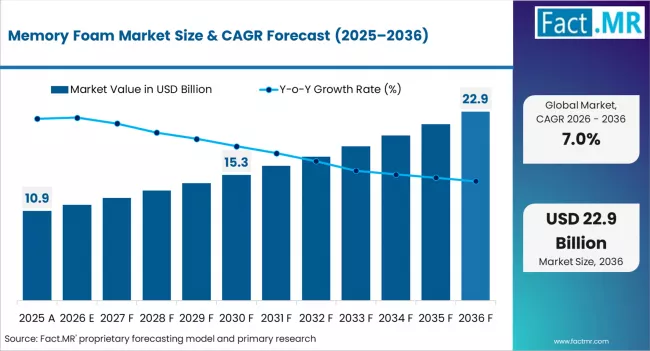
Fact.MR opines the memory foam market was valued at USD 10.90 billion in 2025. Sales are expected to reach USD 11.66 billion in 2026 and USD 22.94 billion by 2036. Standard density is poised to lead by Density with 60.0% share in 2026. Traditional is estimated to command by Type in 2026.
Memory Foam Market Size, Market Forecast and Outlook By Fact.MR
The memory foam market was valued at USD 10.90 billion in 2025, projected to reach USD 11.66 billion in 2026, and is forecast to expand to USD 22.94 billion by 2036 at a 7.0% CAGR. where gel-infused and plant-based formulations are capturing margin from traditional petrochemical memory foam as consumers prioritize thermal regulation and material origin transparency.
The absolute dollar expansion between 2026 and 2036 amounts to approximately USD 11.28 billion. Growth is sustained by mattress replacement cycles in mature markets, urbanization-driven bedding demand in India and China, and expanding non-bedding applications in automotive seating, medical cushioning, and footwear insoles. Raw material cost for methylene diphenyl diisocyanate (MDI) and polyols, the two primary chemical inputs, acts as the margin constraint governing manufacturer profitability.
Mattress procurement teams at major hospitality chains are revising their replacement cycle specifications to mandate gel-infused memory foam layers that address the heat retention complaints driving guest dissatisfaction scores. Suppliers unable to demonstrate certified thermal conductivity improvements over traditional viscoelastic foam face exclusion from 2026 to 2028 hotel refurbishment tenders.
All major regional markets reflect differentiated growth parameters. China sets the pace at 6.6% CAGR. India registers at 6.0% CAGR. USA registers at 5.8% CAGR. UK registers at 5.7% CAGR. Germany registers at 4.8% CAGR.
Memory Foam Market Key Takeaways
| Metric | Details |
|---|---|
| Industry Size (2026) | USD 11.66 billion |
| Industry Value (2036) | USD 22.94 billion |
| CAGR (2026 to 2036) | 7.0% |
Memory Foam Market Definition
Memory foam is a viscoelastic polyurethane material that deforms under pressure and body heat to conform to applied loads, then slowly recovers its original shape when the load is removed. It is manufactured by reacting polyols with diisocyanates in the presence of blowing agents and additives that control density, firmness, and thermal response. Primary commercial applications include mattresses, pillows, furniture cushioning, automotive seating, medical support surfaces, and footwear insoles.
Memory Foam Market Inclusions
Market scope covers global and regional revenue for memory foam across standard density and ultra-high density classifications, traditional, gel-infused, and plant-based types, and applications including pillows and mattresses, insoles, padding, transportation, and others. The forecast period spans 2026 to 2036.
Memory Foam Market Exclusions
The scope excludes latex foam, spring mattress cores, and non-viscoelastic polyurethane foam products. Finished branded mattress and pillow products are excluded unless the valuation pertains specifically to memory foam material content. Industrial acoustic and vibration dampening foams not classified as viscoelastic memory foam fall outside the boundary.
Memory Foam Market Research Methodology
- Primary Research: Analysts engaged with procurement specialists, process engineers, and supply chain directors across producing and consuming regions to map the specific decision criteria triggering purchasing and specification changes.
- Desk Research: Data collection aggregated regulatory filings, trade body publications, standards body documentation, and company disclosures relevant to the product category.
- Market-Sizing and Forecasting: Baseline values derive from a bottom-up aggregation of production volumes and trade flows, applying region-specific demand curves to project adoption velocity through 2036.
- Data Validation and Update Cycle: Projections are tested against publicly reported industry expenditure guidance and cross-referenced with primary interview data to ensure internal consistency.
Summary of Memory Foam Market
- Memory Foam Market Definition
- Memory foam is a viscoelastic polyurethane material that deforms under pressure and body heat to conform to applied loads, then slowly recovers its original shape when the load is removed. It is manufactured by reacting polyols with diisocyanates in the presence of blowing agents and additives that control density, firmness, and thermal response.
- Demand Drivers in the Market
- Mattress replacement cycles: The International Sleep Products Association (ISPA) reports average mattress replacement intervals of 8 to 10 years in the United States.
- Urbanization and bedding demand in India: India's National Housing Bank estimates 10 million new urban housing units are needed annually through 2030.
- Automotive seating comfort specification: Automotive OEMs including Hyundai Motor and Toyota Motor Corporation specify memory foam seat cushion inserts in mid-range and premium vehicle lines as a comfort differentiator.
- Key Segments Analyzed in the Fact.MR Report
- Standard density density: 60.0% share in 2026.
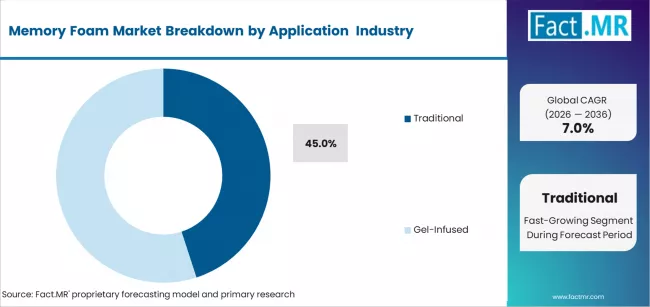
- Traditional type: 45.0% share in 2026.
- China: 6.6% compound growth through 2036.
- Analyst Opinion at Fact.MR
- The central shift in this market involves product composition. Traditional petroleum-based memory foam faces consumer pushback on two fronts: heat retention during sleep and environmental concerns about petrochemical content. Gel-infused memory foam addresses the thermal issue by incorporating phase-change material or gel beads that absorb and dissipate body heat. Plant-based memory foam replaces a portion of petroleum polyols with soy or castor oil-derived polyols, reducing petrochemical content by 15% to 30%.
- Strategic Implications / Executive Takeaways
- Procurement teams must establish multi-year supply agreements with qualified producers to secure allocation ahead of anticipated demand increases.
- Product development resources should prioritize formulations that meet tightening regulatory specifications in key import markets.
- Regional expansion strategies must account for divergent growth rates and regulatory environments across major consuming nations.
Segmental Analysis
Memory Foam Market Analysis by Density
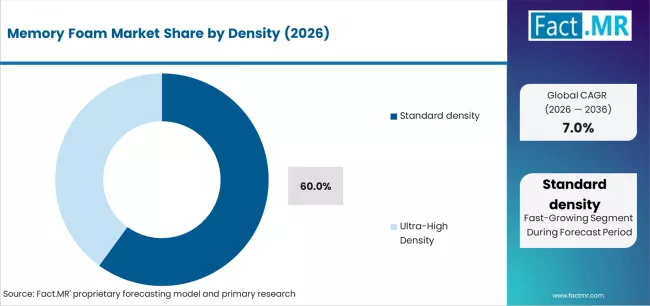
Based on Fact.MR's memory foam market report, consumption of Standard Density memory foam is estimated to hold 60.0% share in 2026. Standard density (40 to 60 kg/m3) memory foam dominates because it delivers the pressure-relieving comfort profile consumers expect at price points accessible to mass-market mattress and pillow manufacturing.
- Cost-performance balance: Standard density memory foam requires approximately 15% to 20% less MDI and polyol input per cubic meter than ultra-high density variants, directly reducing manufacturing cost. FXI and Future Foam operate continuous pour lines optimized for standard density output, achieving production economics that ultra-high density specialty runs cannot match [1].
- Consumer preference alignment: Consumer mattress reviews aggregated by Sleep Foundation and similar independent testing organizations consistently rate medium-firm (standard density) memory foam as the preferred firmness for combination sleepers. This preference pattern sustains standard density specification in approximately 70% of retail mattress SKUs containing memory foam layers [2].
- Direct-to-consumer format: Compressed and rolled mattress shipping (bed-in-a-box) requires foam that recovers its specified dimensions within 72 hours of unboxing. Standard density memory foam achieves this recovery timeline reliably, whereas ultra-high density variants require longer decompression periods that increase customer complaint rates during the initial ownership period [3].
Memory Foam Market Analysis by Application
As per Fact.MR's analysis, Pillows and Mattresses account for 60.0% of memory foam consumption in 2026. This dominance reflects the bedding industry's structural reliance on viscoelastic foam as the primary comfort and pressure-relief material across every retail price tier from budget to luxury.
- Hospitality sector demand: Major hotel chains including Marriott International (with its proprietary mattress specifications) and Hilton Worldwide procure memory foam mattresses in bulk replacement cycles spanning 50,000 to 100,000 units per procurement event. These institutional purchasing programs provide foam manufacturers with predictable, high-volume demand [4].
- E-commerce mattress growth: Online mattress sales in the United States exceeded USD 7 billion in 2024 according to Furniture Today industry estimates. Memory foam's compressibility enables the bed-in-a-box shipping format that underpins the entire direct-to-consumer mattress segment, making foam specification inseparable from the e-commerce distribution model [5].
- Medical and therapeutic applications: Hospital bed overlay mattresses and wheelchair cushions specified under Medicare HCPCS codes E0184 and E0277 require pressure-redistribution surfaces. Memory foam qualifies under these medical device classifications, creating a healthcare procurement channel independent of consumer retail cycles [6].
Memory Foam Market Drivers, Restraints, and Opportunities
Fact.MR analysis indicates the memory foam market's current valuation reflects mature penetration in North American and European bedding markets combined with accelerating adoption across Asian consumer markets. The material was originally developed by NASA in the 1960s for seat cushion applications and entered consumer bedding markets in the 1990s. FXI (formerly Foamex International) and Innocor, Inc. are among the largest North American producers.
The central shift in this market involves product composition. Traditional petroleum-based memory foam faces consumer pushback on two fronts: heat retention during sleep and environmental concerns about petrochemical content. Gel-infused memory foam addresses the thermal issue by incorporating phase-change material or gel beads that absorb and dissipate body heat. Plant-based memory foam replaces a portion of petroleum polyols with soy or castor oil-derived polyols, reducing petrochemical content by 15% to 30%. Both variants command 10% to 20% price premiums over traditional formulations, creating a margin expansion opportunity for manufacturers willing to invest in reformulation.
Opportunities in the Memory Foam Market
- Mattress replacement cycles: The International Sleep Products Association (ISPA) reports average mattress replacement intervals of 8 to 10 years in the United States. With the first wave of direct-to-consumer memory foam mattress purchases (Casper, Tuft & Needle, Purple) occurring between 2014 and 2018, a major replacement cycle is entering its active phase during the 2026 to 2028 period.
- Urbanization and bedding demand in India: India's National Housing Bank estimates 10 million new urban housing units are needed annually through 2030. Each furnished unit represents a new mattress purchase occasion. Indian manufacturers including Sheela Foam (Sleepwell brand) and Kurlon Enterprise have expanded memory foam production capacity to meet this structural demand increase.
- Automotive seating comfort specification: Automotive OEMs including Hyundai Motor and Toyota Motor Corporation specify memory foam seat cushion inserts in mid-range and premium vehicle lines as a comfort differentiator. Global light vehicle production exceeding 85 million units annually creates a secondary demand channel for specialty-grade viscoelastic foam with specific compression set and durability requirements.
Memory Foam Market Restraints
One of the factors that potentially restrain the sales of the global memory foam market include the high price of the product. Memory foam mattresses are considered to be luxury and lavish products that are consumed majorly by the high-earning population of the society. Furthermore, the durability of the memory foam is less. In other words, memory foam loses its ability to recover its shape and size with time.
Memory Foam Market Trends
As the number of players in the production of consumer goods is increasing, the number of manufacturers in the memory foam market is growing at a significant rate. Furthermore, the intensity of competition among the players of the global memory foam market is significantly high. Continuous efforts by memory foam manufacturers are being channeled towards improved prototypes of the product consisting of superior properties at an affordable price.
Memory Foam Market Segmentation
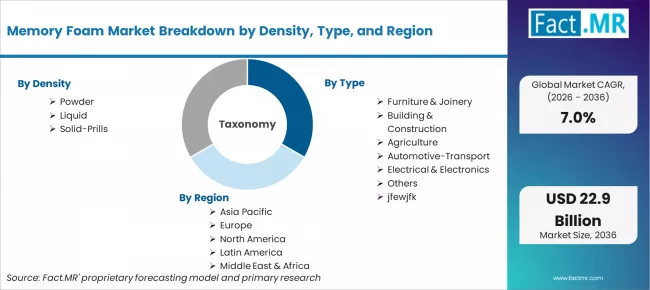
The global memory foam market has been segmented into different segments based on density, types, and applications of memory foam.
On the basis of density, the global memory foam market is be segmented as:
- Standard density (5 to 6 pounds per cubic foot)
- Ultra-High Density (18 to 30 pounds per cubic foot)
On the basis of type, the global memory foam market is be segmented as:
- Traditional
- Gel-Infused
- Plant-Based
On the basis of applications, the global memory foam market is be segmented as:
- Insoles
- Pillows and Mattresses
- Padding
- Transportation
- Others
Memory Foam Market Participants
Some of the market key Memory Foam market participants identified across the value chain of global Memory Foam market that include manufacturers operating at national or international levels and suppliers are as follows:
- Foam Factory, Inc.
- Innocor, Inc.
- FXI
- Future Foam
- Sinomax USA Inc.
- Adetex Foam Group
- Suzhou Isante Home Co., Ltd.
- Adams Foam
- Elite Comfort Solutions
- Pittsburgh Plastics Manufacturing Inc.
- Pinnacle Products International LLC
Memory Foam Market Regional Outlook
.webp)
The consumption of memory foam for the production of consumer goods is expected to be prominent in developed regions such as North America and Europe. Economic development in countries such as China, India and Brazil is expected to result in moderate volumes of consumption of memory foam in regions such as East Asia, South Asia and Latin America. Lesser but considerable amount of consumption of memory foam is expected to be in regions such as Oceania and Middle East and Africa.
The research report presents a comprehensive assessment of the market and contains thoughtful insights, facts, historical data, and statistically supported and industry-validated market data. Report also contains projections using a suitable set of assumptions and methodologies. The Memory Foam research report provides analysis and information according to market segments such as density, type, and application.
The report covers exhaustive analysis on
- Market Segments
- Market Dynamics
- Market Size
- Supply & Demand
- Current Trends/Issues/Challenges
- Competition & Companies involved
- Technology
- Value Chain
Report Highlights
- Detailed overview of parent market
- Changing market dynamics in the industry
- In-depth market segmentation
- Historical, current, and projected market size in terms of volume and value
- Recent industry trends and developments
- Competitive landscape
- Strategies of key players and products offered
- Market potential and niche segments, geographical regions exhibiting promising growth
- A neutral perspective on market performance
- Must-have information for market players to sustain and enhance their market footprint
NOTE - All statements of fact, opinion, or analysis expressed in reports are those of the respective analysts. They do not necessarily reflect formal positions or views of the company.
Bibliography
- International Sleep Products Association (ISPA). (2024). Mattress industry trends report: Replacement cycles and consumer preferences. ISPA.
- Sleep Foundation. (2024). Best memory foam mattresses: Independent testing and consumer review analysis. Sleep Foundation.
- Furniture Today. (2024). Annual consumer buying trends: Online mattress sales market sizing. Furniture Today.
- National Housing Bank, India. (2024). Urban housing demand assessment: Annual report. NHB.
- Centers for Medicare & Medicaid Services (CMS). (2024). HCPCS Level II code set: Durable medical equipment classifications. CMS.
- Sheela Foam Ltd. (2024). Annual report 2024: Production capacity expansion and product portfolio. Sheela Foam.
This bibliography is provided for reader reference. The full Fact.MR report contains the complete reference list with primary research documentation.
This Report Addresses
- Market sizing and quantitative forecast metrics detailing the precise expenditure dedicated to memory foam across major industrial sectors through 2036.
- Segmentation analysis mapping the adoption patterns of specific density categories and evaluating the technical and economic factors driving segment share distribution.
- Regional deployment intelligence comparing growth trajectories across Asia Pacific, North America, Europe, Latin America, and Middle East and Africa.
- Regulatory compliance assessment analyzing how evolving standards and policies affect product specifications and market access in key consuming regions.
- Competitive posture evaluation tracking the positioning of leading producers and the structural factors determining competitive advantage.
- Capital investment strategic guidance defining the procurement and capacity planning considerations for industry participants.
- Supply chain risk analysis identifying the specific feedstock, logistics, and regulatory variables that constrain market expansion.
- Custom data delivery formats encompassing interactive dashboards, raw Excel datasets, and PDF narrative reports.
Scope of the Report

| Metric | Value |
|---|---|
| Quantitative Units | USD 11.66 billion to USD 22.94 billion, at a CAGR of 7.0% |
| Market Definition | Memory foam is a viscoelastic polyurethane material that deforms under pressure and body heat to conform to applied loads, then slowly recovers its original shape when the load is removed. It is manufactured by reacting polyols with diisocyanates in the presence of blowing agents and additives that control density, firmness, and thermal response. |
| Density Segmentation | Standard density, Ultra-High Density |
| Type Segmentation | Traditional, Gel-Infused, Plant-Based |
| Application Segmentation | Pillows and Mattresses, Insoles, Padding, Transportation, Others |
| Regions Covered | North America, Latin America, Europe, East Asia, South Asia, Oceania, Middle East & Africa |
| Countries Covered | China, India, USA, UK, Germany, and 40 plus countries |
| Key Companies Profiled | FXI, Innocor, Inc., Foam Factory, Inc., Future Foam, Sinomax USA Inc., Adetex Foam Group, Suzhou Isante Home Co., Ltd., Adams Foam, Elite Comfort Solutions, Pittsburgh Plastics Manufacturing Inc., Pinnacle Products International LLC |
| Forecast Period | 2026 to 2036 |
| Approach | Hybrid top-down and bottom-up methodology reconciling production, trade, and consumption data with primary research validation. |
Table of Content
- Executive Summary
- Global Market Outlook
- Demand to side Trends
- Supply to side Trends
- Technology Roadmap Analysis
- Analysis and Recommendations
- Market Overview
- Market Coverage / Taxonomy
- Market Definition / Scope / Limitations
- Research Methodology
- Chapter Orientation
- Analytical Lens and Working Hypotheses
- Market Structure, Signals, and Trend Drivers
- Benchmarking and Cross-market Comparability
- Market Sizing, Forecasting, and Opportunity Mapping
- Research Design and Evidence Framework
- Desk Research Programme (Secondary Evidence)
- Company Annual and Sustainability Reports
- Peer-reviewed Journals and Academic Literature
- Corporate Websites, Product Literature, and Technical Notes
- Earnings Decks and Investor Briefings
- Statutory Filings and Regulatory Disclosures
- Technical White Papers and Standards Notes
- Trade Journals, Industry Magazines, and Analyst Briefs
- Conference Proceedings, Webinars, and Seminar Materials
- Government Statistics Portals and Public Data Releases
- Press Releases and Reputable Media Coverage
- Specialist Newsletters and Curated Briefings
- Sector Databases and Reference Repositories
- Fact.MR Internal Proprietary Databases and Historical Market Datasets
- Subscription Datasets and Paid Sources
- Social Channels, Communities, and Digital Listening Inputs
- Additional Desk Sources
- Expert Input and Fieldwork (Primary Evidence)
- Primary Modes
- Qualitative Interviews and Expert Elicitation
- Quantitative Surveys and Structured Data Capture
- Blended Approach
- Why Primary Evidence is Used
- Field Techniques
- Interviews
- Surveys
- Focus Groups
- Observational and In-context Research
- Social and Community Interactions
- Stakeholder Universe Engaged
- C-suite Leaders
- Board Members
- Presidents and Vice Presidents
- R&D and Innovation Heads
- Technical Specialists
- Domain Subject-matter Experts
- Scientists
- Physicians and Other Healthcare Professionals
- Governance, Ethics, and Data Stewardship
- Research Ethics
- Data Integrity and Handling
- Primary Modes
- Tooling, Models, and Reference Databases
- Desk Research Programme (Secondary Evidence)
- Data Engineering and Model Build
- Data Acquisition and Ingestion
- Cleaning, Normalisation, and Verification
- Synthesis, Triangulation, and Analysis
- Quality Assurance and Audit Trail
- Market Background
- Market Dynamics
- Drivers
- Restraints
- Opportunity
- Trends
- Scenario Forecast
- Demand in Optimistic Scenario
- Demand in Likely Scenario
- Demand in Conservative Scenario
- Opportunity Map Analysis
- Product Life Cycle Analysis
- Supply Chain Analysis
- Investment Feasibility Matrix
- Value Chain Analysis
- PESTLE and Porter’s Analysis
- Regulatory Landscape
- Regional Parent Market Outlook
- Production and Consumption Statistics
- Import and Export Statistics
- Market Dynamics
- Global Market Analysis 2021 to 2025 and Forecast, 2026 to 2036
- Historical Market Size Value (USD Million) Analysis, 2021 to 2025
- Current and Future Market Size Value (USD Million) Projections, 2026 to 2036
- Y to o to Y Growth Trend Analysis
- Absolute $ Opportunity Analysis
- Global Market Pricing Analysis 2021 to 2025 and Forecast 2026 to 2036
- Global Market Analysis 2021 to 2025 and Forecast 2026 to 2036, By Density
- Introduction / Key Findings
- Historical Market Size Value (USD Million) Analysis By Density, 2021 to 2025
- Current and Future Market Size Value (USD Million) Analysis and Forecast By Density, 2026 to 2036
- Standard density
- Ultra-High Density
- Standard density
- Y to o to Y Growth Trend Analysis By Density, 2021 to 2025
- Absolute $ Opportunity Analysis By Density, 2026 to 2036
- Global Market Analysis 2021 to 2025 and Forecast 2026 to 2036, By Type
- Introduction / Key Findings
- Historical Market Size Value (USD Million) Analysis By Type, 2021 to 2025
- Current and Future Market Size Value (USD Million) Analysis and Forecast By Type, 2026 to 2036
- Traditional
- Gel-Infused
- Plant-Based
- Traditional
- Y to o to Y Growth Trend Analysis By Type, 2021 to 2025
- Absolute $ Opportunity Analysis By Type, 2026 to 2036
- Global Market Analysis 2021 to 2025 and Forecast 2026 to 2036, By Application
- Introduction / Key Findings
- Historical Market Size Value (USD Million) Analysis By Application, 2021 to 2025
- Current and Future Market Size Value (USD Million) Analysis and Forecast By Application, 2026 to 2036
- Pillows and Mattresses
- Insoles
- Padding
- Transportation
- Others
- Pillows and Mattresses
- Y to o to Y Growth Trend Analysis By Application, 2021 to 2025
- Absolute $ Opportunity Analysis By Application, 2026 to 2036
- Global Market Analysis 2021 to 2025 and Forecast 2026 to 2036, By Region
- Introduction
- Historical Market Size Value (USD Million) Analysis By Region, 2021 to 2025
- Current Market Size Value (USD Million) Analysis and Forecast By Region, 2026 to 2036
- North America
- Latin America
- Western Europe
- Eastern Europe
- East Asia
- South Asia and Pacific
- Middle East & Africa
- Market Attractiveness Analysis By Region
- North America Market Analysis 2021 to 2025 and Forecast 2026 to 2036, By Country
- Historical Market Size Value (USD Million) Trend Analysis By Market Taxonomy, 2021 to 2025
- Market Size Value (USD Million) Forecast By Market Taxonomy, 2026 to 2036
- By Country
- USA
- Canada
- Mexico
- By Density
- By Type
- By Application
- By Country
- Market Attractiveness Analysis
- By Country
- By Density
- By Type
- By Application
- Key Takeaways
- Latin America Market Analysis 2021 to 2025 and Forecast 2026 to 2036, By Country
- Historical Market Size Value (USD Million) Trend Analysis By Market Taxonomy, 2021 to 2025
- Market Size Value (USD Million) Forecast By Market Taxonomy, 2026 to 2036
- By Country
- Brazil
- Chile
- Rest of Latin America
- By Density
- By Type
- By Application
- By Country
- Market Attractiveness Analysis
- By Country
- By Density
- By Type
- By Application
- Key Takeaways
- Western Europe Market Analysis 2021 to 2025 and Forecast 2026 to 2036, By Country
- Historical Market Size Value (USD Million) Trend Analysis By Market Taxonomy, 2021 to 2025
- Market Size Value (USD Million) Forecast By Market Taxonomy, 2026 to 2036
- By Country
- Germany
- UK
- Italy
- Spain
- France
- Nordic
- BENELUX
- Rest of Western Europe
- By Density
- By Type
- By Application
- By Country
- Market Attractiveness Analysis
- By Country
- By Density
- By Type
- By Application
- Key Takeaways
- Eastern Europe Market Analysis 2021 to 2025 and Forecast 2026 to 2036, By Country
- Historical Market Size Value (USD Million) Trend Analysis By Market Taxonomy, 2021 to 2025
- Market Size Value (USD Million) Forecast By Market Taxonomy, 2026 to 2036
- By Country
- Russia
- Poland
- Hungary
- Balkan & Baltic
- Rest of Eastern Europe
- By Density
- By Type
- By Application
- By Country
- Market Attractiveness Analysis
- By Country
- By Density
- By Type
- By Application
- Key Takeaways
- East Asia Market Analysis 2021 to 2025 and Forecast 2026 to 2036, By Country
- Historical Market Size Value (USD Million) Trend Analysis By Market Taxonomy, 2021 to 2025
- Market Size Value (USD Million) Forecast By Market Taxonomy, 2026 to 2036
- By Country
- China
- Japan
- South Korea
- By Density
- By Type
- By Application
- By Country
- Market Attractiveness Analysis
- By Country
- By Density
- By Type
- By Application
- Key Takeaways
- South Asia and Pacific Market Analysis 2021 to 2025 and Forecast 2026 to 2036, By Country
- Historical Market Size Value (USD Million) Trend Analysis By Market Taxonomy, 2021 to 2025
- Market Size Value (USD Million) Forecast By Market Taxonomy, 2026 to 2036
- By Country
- India
- ASEAN
- Australia & New Zealand
- Rest of South Asia and Pacific
- By Density
- By Type
- By Application
- By Country
- Market Attractiveness Analysis
- By Country
- By Density
- By Type
- By Application
- Key Takeaways
- Middle East & Africa Market Analysis 2021 to 2025 and Forecast 2026 to 2036, By Country
- Historical Market Size Value (USD Million) Trend Analysis By Market Taxonomy, 2021 to 2025
- Market Size Value (USD Million) Forecast By Market Taxonomy, 2026 to 2036
- By Country
- Kingdom of Saudi Arabia
- Other GCC Countries
- Turkiye
- South Africa
- Other African Union
- Rest of Middle East & Africa
- By Density
- By Type
- By Application
- By Country
- Market Attractiveness Analysis
- By Country
- By Density
- By Type
- By Application
- Key Takeaways
- Key Countries Market Analysis
- USA
- Pricing Analysis
- Market Share Analysis, 2025
- By Density
- By Type
- By Application
- Canada
- Pricing Analysis
- Market Share Analysis, 2025
- By Density
- By Type
- By Application
- Mexico
- Pricing Analysis
- Market Share Analysis, 2025
- By Density
- By Type
- By Application
- Brazil
- Pricing Analysis
- Market Share Analysis, 2025
- By Density
- By Type
- By Application
- Chile
- Pricing Analysis
- Market Share Analysis, 2025
- By Density
- By Type
- By Application
- Germany
- Pricing Analysis
- Market Share Analysis, 2025
- By Density
- By Type
- By Application
- UK
- Pricing Analysis
- Market Share Analysis, 2025
- By Density
- By Type
- By Application
- Italy
- Pricing Analysis
- Market Share Analysis, 2025
- By Density
- By Type
- By Application
- Spain
- Pricing Analysis
- Market Share Analysis, 2025
- By Density
- By Type
- By Application
- France
- Pricing Analysis
- Market Share Analysis, 2025
- By Density
- By Type
- By Application
- India
- Pricing Analysis
- Market Share Analysis, 2025
- By Density
- By Type
- By Application
- ASEAN
- Pricing Analysis
- Market Share Analysis, 2025
- By Density
- By Type
- By Application
- Australia & New Zealand
- Pricing Analysis
- Market Share Analysis, 2025
- By Density
- By Type
- By Application
- China
- Pricing Analysis
- Market Share Analysis, 2025
- By Density
- By Type
- By Application
- Japan
- Pricing Analysis
- Market Share Analysis, 2025
- By Density
- By Type
- By Application
- South Korea
- Pricing Analysis
- Market Share Analysis, 2025
- By Density
- By Type
- By Application
- Russia
- Pricing Analysis
- Market Share Analysis, 2025
- By Density
- By Type
- By Application
- Poland
- Pricing Analysis
- Market Share Analysis, 2025
- By Density
- By Type
- By Application
- Hungary
- Pricing Analysis
- Market Share Analysis, 2025
- By Density
- By Type
- By Application
- Kingdom of Saudi Arabia
- Pricing Analysis
- Market Share Analysis, 2025
- By Density
- By Type
- By Application
- Turkiye
- Pricing Analysis
- Market Share Analysis, 2025
- By Density
- By Type
- By Application
- South Africa
- Pricing Analysis
- Market Share Analysis, 2025
- By Density
- By Type
- By Application
- USA
- Market Structure Analysis
- Competition Dashboard
- Competition Benchmarking
- Market Share Analysis of Top Players
- By Regional
- By Density
- By Type
- By Application
- Competition Analysis
- Competition Deep Dive
- FXI
- Overview
- Product Portfolio
- Profitability by Market Segments (Product/Age /Sales Channel/Region)
- Sales Footprint
- Strategy Overview
- Marketing Strategy
- Product Strategy
- Channel Strategy
- Innocor, Inc.
- Foam Factory, Inc.
- Future Foam
- Sinomax USA Inc.
- Adetex Foam Group
- Suzhou Isante Home Co., Ltd.
- Adams Foam
- Elite Comfort Solutions
- Pittsburgh Plastics Manufacturing Inc.
- Pinnacle Products International LLC
- FXI
- Competition Deep Dive
- Assumptions & Acronyms Used
List Of Table
- Table 1: Global Market Value (USD Million) Forecast by Region, 2021 to 2036
- Table 2: Global Market Value (USD Million) Forecast by Density, 2021 to 2036
- Table 3: Global Market Value (USD Million) Forecast by Type, 2021 to 2036
- Table 4: Global Market Value (USD Million) Forecast by Application, 2021 to 2036
- Table 5: North America Market Value (USD Million) Forecast by Country, 2021 to 2036
- Table 6: North America Market Value (USD Million) Forecast by Density, 2021 to 2036
- Table 7: North America Market Value (USD Million) Forecast by Type, 2021 to 2036
- Table 8: North America Market Value (USD Million) Forecast by Application, 2021 to 2036
- Table 9: Latin America Market Value (USD Million) Forecast by Country, 2021 to 2036
- Table 10: Latin America Market Value (USD Million) Forecast by Density, 2021 to 2036
- Table 11: Latin America Market Value (USD Million) Forecast by Type, 2021 to 2036
- Table 12: Latin America Market Value (USD Million) Forecast by Application, 2021 to 2036
- Table 13: Western Europe Market Value (USD Million) Forecast by Country, 2021 to 2036
- Table 14: Western Europe Market Value (USD Million) Forecast by Density, 2021 to 2036
- Table 15: Western Europe Market Value (USD Million) Forecast by Type, 2021 to 2036
- Table 16: Western Europe Market Value (USD Million) Forecast by Application, 2021 to 2036
- Table 17: Eastern Europe Market Value (USD Million) Forecast by Country, 2021 to 2036
- Table 18: Eastern Europe Market Value (USD Million) Forecast by Density, 2021 to 2036
- Table 19: Eastern Europe Market Value (USD Million) Forecast by Type, 2021 to 2036
- Table 20: Eastern Europe Market Value (USD Million) Forecast by Application, 2021 to 2036
- Table 21: East Asia Market Value (USD Million) Forecast by Country, 2021 to 2036
- Table 22: East Asia Market Value (USD Million) Forecast by Density, 2021 to 2036
- Table 23: East Asia Market Value (USD Million) Forecast by Type, 2021 to 2036
- Table 24: East Asia Market Value (USD Million) Forecast by Application, 2021 to 2036
- Table 25: South Asia and Pacific Market Value (USD Million) Forecast by Country, 2021 to 2036
- Table 26: South Asia and Pacific Market Value (USD Million) Forecast by Density, 2021 to 2036
- Table 27: South Asia and Pacific Market Value (USD Million) Forecast by Type, 2021 to 2036
- Table 28: South Asia and Pacific Market Value (USD Million) Forecast by Application, 2021 to 2036
- Table 29: Middle East & Africa Market Value (USD Million) Forecast by Country, 2021 to 2036
- Table 30: Middle East & Africa Market Value (USD Million) Forecast by Density, 2021 to 2036
- Table 31: Middle East & Africa Market Value (USD Million) Forecast by Type, 2021 to 2036
- Table 32: Middle East & Africa Market Value (USD Million) Forecast by Application, 2021 to 2036
List Of Figures
- Figure 1: Global Market Pricing Analysis
- Figure 2: Global Market Value (USD Million) Forecast 2021 to 2036
- Figure 3: Global Market Value Share and BPS Analysis by Density, 2026 and 2036
- Figure 4: Global Market Y-o-Y Growth Comparison by Density, 2026 to 2036
- Figure 5: Global Market Attractiveness Analysis by Density
- Figure 6: Global Market Value Share and BPS Analysis by Type, 2026 and 2036
- Figure 7: Global Market Y-o-Y Growth Comparison by Type, 2026 to 2036
- Figure 8: Global Market Attractiveness Analysis by Type
- Figure 9: Global Market Value Share and BPS Analysis by Application, 2026 and 2036
- Figure 10: Global Market Y-o-Y Growth Comparison by Application, 2026 to 2036
- Figure 11: Global Market Attractiveness Analysis by Application
- Figure 12: Global Market Value (USD Million) Share and BPS Analysis by Region, 2026 and 2036
- Figure 13: Global Market Y-o-Y Growth Comparison by Region, 2026 to 2036
- Figure 14: Global Market Attractiveness Analysis by Region
- Figure 15: North America Market Incremental Dollar Opportunity, 2026 to 2036
- Figure 16: Latin America Market Incremental Dollar Opportunity, 2026 to 2036
- Figure 17: Western Europe Market Incremental Dollar Opportunity, 2026 to 2036
- Figure 18: Eastern Europe Market Incremental Dollar Opportunity, 2026 to 2036
- Figure 19: East Asia Market Incremental Dollar Opportunity, 2026 to 2036
- Figure 20: South Asia and Pacific Market Incremental Dollar Opportunity, 2026 to 2036
- Figure 21: Middle East & Africa Market Incremental Dollar Opportunity, 2026 to 2036
- Figure 22: North America Market Value Share and BPS Analysis by Country, 2026 and 2036
- Figure 23: North America Market Value Share and BPS Analysis by Density, 2026 and 2036
- Figure 24: North America Market Y-o-Y Growth Comparison by Density, 2026 to 2036
- Figure 25: North America Market Attractiveness Analysis by Density
- Figure 26: North America Market Value Share and BPS Analysis by Type, 2026 and 2036
- Figure 27: North America Market Y-o-Y Growth Comparison by Type, 2026 to 2036
- Figure 28: North America Market Attractiveness Analysis by Type
- Figure 29: North America Market Value Share and BPS Analysis by Application, 2026 and 2036
- Figure 30: North America Market Y-o-Y Growth Comparison by Application, 2026 to 2036
- Figure 31: North America Market Attractiveness Analysis by Application
- Figure 32: Latin America Market Value Share and BPS Analysis by Country, 2026 and 2036
- Figure 33: Latin America Market Value Share and BPS Analysis by Density, 2026 and 2036
- Figure 34: Latin America Market Y-o-Y Growth Comparison by Density, 2026 to 2036
- Figure 35: Latin America Market Attractiveness Analysis by Density
- Figure 36: Latin America Market Value Share and BPS Analysis by Type, 2026 and 2036
- Figure 37: Latin America Market Y-o-Y Growth Comparison by Type, 2026 to 2036
- Figure 38: Latin America Market Attractiveness Analysis by Type
- Figure 39: Latin America Market Value Share and BPS Analysis by Application, 2026 and 2036
- Figure 40: Latin America Market Y-o-Y Growth Comparison by Application, 2026 to 2036
- Figure 41: Latin America Market Attractiveness Analysis by Application
- Figure 42: Western Europe Market Value Share and BPS Analysis by Country, 2026 and 2036
- Figure 43: Western Europe Market Value Share and BPS Analysis by Density, 2026 and 2036
- Figure 44: Western Europe Market Y-o-Y Growth Comparison by Density, 2026 to 2036
- Figure 45: Western Europe Market Attractiveness Analysis by Density
- Figure 46: Western Europe Market Value Share and BPS Analysis by Type, 2026 and 2036
- Figure 47: Western Europe Market Y-o-Y Growth Comparison by Type, 2026 to 2036
- Figure 48: Western Europe Market Attractiveness Analysis by Type
- Figure 49: Western Europe Market Value Share and BPS Analysis by Application, 2026 and 2036
- Figure 50: Western Europe Market Y-o-Y Growth Comparison by Application, 2026 to 2036
- Figure 51: Western Europe Market Attractiveness Analysis by Application
- Figure 52: Eastern Europe Market Value Share and BPS Analysis by Country, 2026 and 2036
- Figure 53: Eastern Europe Market Value Share and BPS Analysis by Density, 2026 and 2036
- Figure 54: Eastern Europe Market Y-o-Y Growth Comparison by Density, 2026 to 2036
- Figure 55: Eastern Europe Market Attractiveness Analysis by Density
- Figure 56: Eastern Europe Market Value Share and BPS Analysis by Type, 2026 and 2036
- Figure 57: Eastern Europe Market Y-o-Y Growth Comparison by Type, 2026 to 2036
- Figure 58: Eastern Europe Market Attractiveness Analysis by Type
- Figure 59: Eastern Europe Market Value Share and BPS Analysis by Application, 2026 and 2036
- Figure 60: Eastern Europe Market Y-o-Y Growth Comparison by Application, 2026 to 2036
- Figure 61: Eastern Europe Market Attractiveness Analysis by Application
- Figure 62: East Asia Market Value Share and BPS Analysis by Country, 2026 and 2036
- Figure 63: East Asia Market Value Share and BPS Analysis by Density, 2026 and 2036
- Figure 64: East Asia Market Y-o-Y Growth Comparison by Density, 2026 to 2036
- Figure 65: East Asia Market Attractiveness Analysis by Density
- Figure 66: East Asia Market Value Share and BPS Analysis by Type, 2026 and 2036
- Figure 67: East Asia Market Y-o-Y Growth Comparison by Type, 2026 to 2036
- Figure 68: East Asia Market Attractiveness Analysis by Type
- Figure 69: East Asia Market Value Share and BPS Analysis by Application, 2026 and 2036
- Figure 70: East Asia Market Y-o-Y Growth Comparison by Application, 2026 to 2036
- Figure 71: East Asia Market Attractiveness Analysis by Application
- Figure 72: South Asia and Pacific Market Value Share and BPS Analysis by Country, 2026 and 2036
- Figure 73: South Asia and Pacific Market Value Share and BPS Analysis by Density, 2026 and 2036
- Figure 74: South Asia and Pacific Market Y-o-Y Growth Comparison by Density, 2026 to 2036
- Figure 75: South Asia and Pacific Market Attractiveness Analysis by Density
- Figure 76: South Asia and Pacific Market Value Share and BPS Analysis by Type, 2026 and 2036
- Figure 77: South Asia and Pacific Market Y-o-Y Growth Comparison by Type, 2026 to 2036
- Figure 78: South Asia and Pacific Market Attractiveness Analysis by Type
- Figure 79: South Asia and Pacific Market Value Share and BPS Analysis by Application, 2026 and 2036
- Figure 80: South Asia and Pacific Market Y-o-Y Growth Comparison by Application, 2026 to 2036
- Figure 81: South Asia and Pacific Market Attractiveness Analysis by Application
- Figure 82: Middle East & Africa Market Value Share and BPS Analysis by Country, 2026 and 2036
- Figure 83: Middle East & Africa Market Value Share and BPS Analysis by Density, 2026 and 2036
- Figure 84: Middle East & Africa Market Y-o-Y Growth Comparison by Density, 2026 to 2036
- Figure 85: Middle East & Africa Market Attractiveness Analysis by Density
- Figure 86: Middle East & Africa Market Value Share and BPS Analysis by Type, 2026 and 2036
- Figure 87: Middle East & Africa Market Y-o-Y Growth Comparison by Type, 2026 to 2036
- Figure 88: Middle East & Africa Market Attractiveness Analysis by Type
- Figure 89: Middle East & Africa Market Value Share and BPS Analysis by Application, 2026 and 2036
- Figure 90: Middle East & Africa Market Y-o-Y Growth Comparison by Application, 2026 to 2036
- Figure 91: Middle East & Africa Market Attractiveness Analysis by Application
- Figure 92: Global Market - Tier Structure Analysis
- Figure 93: Global Market - Company Share Analysis
- Frequently Asked Questions -
How large is the demand for Memory Foam in the global market in 2026?
Demand for Memory Foam in the global market is estimated to be valued at USD 11.66 billion in 2026.
What will be the market size of Memory Foam in the global market by 2036?
Market size for Memory Foam is projected to reach USD 22.94 billion by 2036.
What is the expected demand growth for Memory Foam in the global market between 2026 and 2036?
Demand for Memory Foam is expected to grow at a CAGR of 7.0% between 2026 and 2036.
Which Density is poised to lead global sales by 2026?
Standard density accounts for 60.0% share in 2026.
How is the Type segment structured in this report?
Traditional holds a 45.0% share in 2026 within the Type segment.
What is the growth outlook for China in this report?
China is projected to grow at a CAGR of 6.6% during 2026 to 2036.
What is Memory Foam and what is it mainly used for?
Memory foam is a viscoelastic polyurethane material that deforms under pressure and body heat to conform to applied loads, then slowly recovers its original shape when the load is removed. It is manufactured by reacting polyols with diisocyanates in the presence of blowing agents and additives that control density, firmness, and thermal response.
How does Fact.MR build and validate the Memory Foam forecast?
Forecasting models apply a hybrid top-down and bottom-up methodology starting with production and trade data, and cross-validate projections against primary research findings and quarterly industry data releases.