- Market Value (2025): USD 1.7 Bn
- Estimated Value (2026): USD 1.8 Bn
- Forecast Value (2036): USD 3.5 Bn
- CAGR (2026-2036): 6.9%
What is the Flexible Bio-Foams Market forecast to be worth by 2036?
USD 3.5 billion by 2036 at a 6.9% CAGR.
- The Flexible Bio-Foams Market reached approximately USD 1.7 billion in 2025.
- Demand is projected to increase from USD 1.8 billion in 2026 to USD 3.5 billion by 2036.
- The market is projected to expand at a 6.9% CAGR from 2026 to 2036.
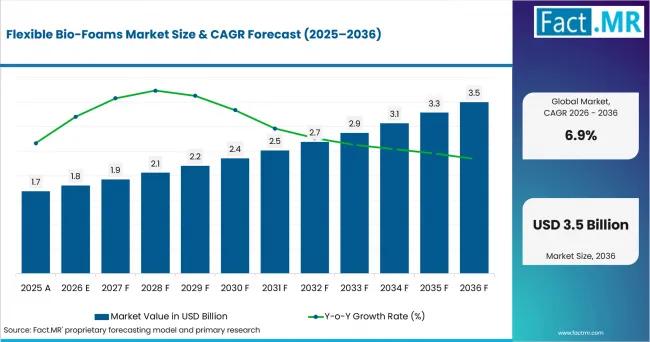
Flexible Bio Foams Market Value Analysis | Source: Fact.MR
What are the defining numbers behind Flexible Bio-Foams Market growth?
An absolute opportunity of USD 1.7 billion is expected between 2026 and 2036.
- Demand Drivers in the Market
- Furniture and bedding demand is benefiting from renewable-content foam systems that can be processed on existing polyurethane equipment. BASF introduced biomass-balance flexible polyurethane systems for North American furniture applications in 2025 and expanded biomass-balance polyether polyols for sleep products in 2026, allowing manufacturers to raise renewable feedstock content without major process changes.
- Automotive seating is another important use case because foam must retain cushioning performance, durability and low weight. Woodbridge supplies bio-based polyurethane foam for seating systems, headrests, headliners and other interior components, showing that renewable-content formulations can meet established vehicle specifications.
- Packaging rules are increasing pressure to reduce fossil-material use and improve recovery. The EU Packaging and Packaging Waste Regulation began applying in August 2026, Brazil introduced a national reverse-logistics system for plastic packaging in October 2025, and the UK is linking producer fees to recyclability. These changes encourage packaging suppliers to consider renewable cushioning materials with clearer recovery pathways.
- Public procurement is also supporting wider use of biobased materials. The USDA BioPreferred Program includes biodegradable foams and foam intermediates among its product categories, giving institutional buyers a defined framework for identifying and purchasing biobased products.
- Foam development is moving beyond conventional vegetable-oil polyols. U.S. Department of Energy research has explored algae-derived polyurethane precursors, while commercial suppliers are introducing bio-circular, mass-balanced and recycled-content polyols. This gives manufacturers more ways to increase renewable content while maintaining compression recovery, comfort and processing stability.
- Key Segments Analyzed
- Polyurethane Bio-Foams account for 48.5% of Product in 2026. Bio-based polyether and polyester routes allow manufacturers to lower fossil feedstock use while retaining the resilience and comfort needed in mattresses, furniture and vehicle seating.
- Plant Oil Based raw materials represent 56.2% of Raw Material in 2026. Soybean, castor and palm-derived intermediates can be converted into polyols that work within established polyurethane chemistry and are commercially available at broader scale than many protein or cellulose alternatives.
- Furniture And Bedding hold 35.8% of Application in 2026. Mattresses and cushions consume substantial volumes of flexible foam, giving manufacturers a practical route to introduce renewable-content materials without redesigning the finished product.
- Residential accounts for 32.7% of End Use in 2026. Mattresses, upholstered furniture, toppers and other comfort products create recurring replacement demand and give brands a direct way to incorporate renewable-content or natural foam materials.
- Medium Density Foam represents 44.6% of Density in 2026. It offers a workable balance between cushioning, durability, material use and cost across bedding, furniture, automotive interiors and protective applications.
- Bio Polyol Technology holds 53.1% of Technology in 2026. Partially and fully bio-based polyols can be introduced into familiar polyurethane production systems with less disruption than switching to entirely different foam chemistries.
- Direct Sales account for 61.4% of Distribution Channel in 2026. Large converters and OEM-linked buyers often need formulation support, consistent batches, certification documents and dependable long-term supply when qualifying renewable-content foam.
- Analyst Opinion at Fact.MR
- Shambhu Nath Jha, Principal Consultant, Fact.MR ~ "Flexible bio-foams are moving from a material-substitution story to a qualification story. Buyers still need compression recovery, comfort, durability and cycle-time consistency, so renewable content has to enter without upsetting the performance envelope of the finished cushion, mattress, seat or protective pack. The strongest suppliers will be those that can prove feedstock provenance and carbon benefits while giving converters a formulation that behaves like the material already running on their lines."
- Strategic Implications
- Flexible polyurethane suppliers should position renewable-content grades as drop-in performance materials rather than as sustainability add-ons. The broader foam market shows that polyurethane remains central to furniture, automotive and industrial cushioning, so bio-foam adoption depends on matching established resilience, density and process-control expectations.
- Packaging-focused producers need to distinguish biobased content from biodegradability and compostability. The European Commission makes that distinction explicit, and buyers comparing renewable cushioning with the bioplastics market will increasingly ask for a defined end-of-life route rather than a broad environmental claim.
- Foam converters should also secure more than one renewable feedstock pathway. Vegetable-oil polyols can support polyurethane scale, while natural latex, cellulose, starch and protein systems serve different performance and disposal profiles. Multi-feedstock capability reduces dependence on one crop, one certification route or one regional supply chain.
- Supplier development should focus on application qualification data. Mattress makers care about comfort retention and emissions, vehicle programs require durability and interior performance, packaging users focus on shock protection and disposal, and healthcare buyers require controlled material behavior. A single sustainability claim will not satisfy all four buying processes.
How does the Flexible Bio-Foams Market break down by segment?
The Flexible Bio-Foams Market is segmented by Product, Raw Material, Application, End Use, Density, Technology and Distribution Channel.
Why do Polyurethane Bio-Foams lead Product with 48.5% share in 2026?
Polyurethane Bio-Foams hold a 48.5% share of Product in 2026.
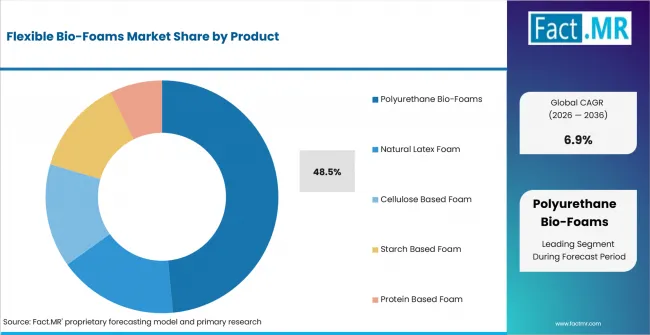
Flexible Bio Foams Market Analysis By Product | Source: Fact.MR
Flexible polyurethane already has a mature production base in mattresses, upholstered furniture, vehicle seating and specialty cushioning. Replacing a portion of fossil-derived polyol or assigning renewable feedstock through certified mass-balance routes lets manufacturers reduce fossil input while preserving familiar mixing, metering, curing and cutting operations. BASF states that its biomass-balance flexible foam systems retain the properties and processing behavior of conventional equivalents.
The segment also benefits from a wide formulation range. Bio-based polyether polyurethane can be tuned for resilient or viscoelastic comfort, while bio-based polyester routes support applications that need different mechanical or chemical behavior. Huntsman lists bio-based and renewable-resource claims within flexible polyurethane foam systems used in furniture, bedding and transportation.
Why does Plant Oil Based lead Raw Material with 56.2% share in 2026?
Plant Oil Based raw materials hold a 56.2% share of Raw Material in 2026.
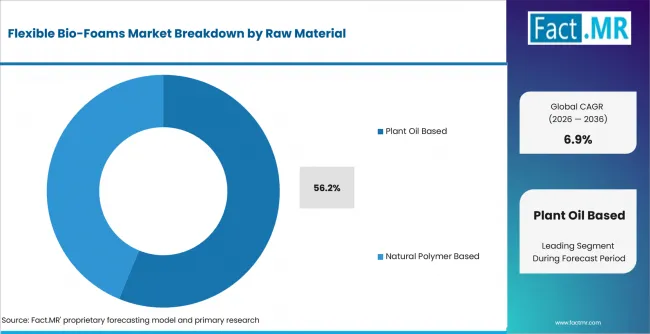
Flexible Bio Foams Market Analysis By Raw Material | Source: Fact.MR
Vegetable oils provide chemically useful hydroxyl-bearing or convertible feedstocks for polyol production, allowing renewable carbon to enter polyurethane chemistry without changing the full foam manufacturing platform. Soybean oil is widely used where supply scale matters, castor oil offers naturally high hydroxyl functionality, and palm-derived routes support additional formulation flexibility.
Commercial adoption is helped by the ability to blend renewable and conventional feedstocks to reach required performance. Woodbridge reports bio-polyol substitution across multiple automotive interior foam applications, demonstrating why plant-derived polyols are used as a controlled formulation input rather than requiring an all-or-nothing switch to a different foam family.
Why does Furniture And Bedding lead Application with 35.8% share in 2026?
Furniture And Bedding hold a 35.8% share of Application in 2026.
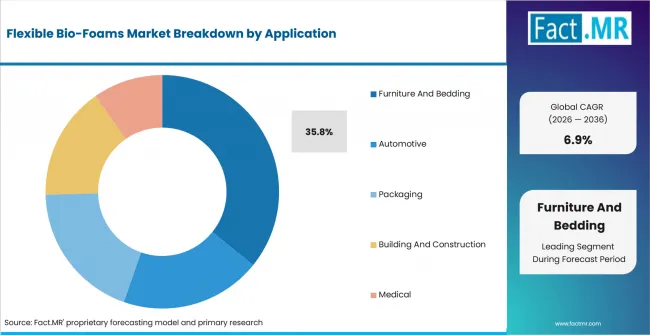
Flexible Bio Foams Market Analysis By Application | Source: Fact.MR
Mattresses and upholstered furniture use large volumes of flexible foam in comfort layers, cushions, headrests and support structures. These products also provide room to market renewable-content materials directly to brands and consumers, making the application an early qualification route for bio-polyol polyurethane and natural latex alternatives.
Commercial activity is already visible. BASF has introduced biomass-balance flexible polyurethane systems specifically for furniture seating, Covestro supplies renewable-attributed polyurethane inputs for mattress foam, and Dow uses chemically recycled mattress foam to produce polyol for new flexible foam. Together, these routes show how bedding can absorb renewable and circular feedstocks while retaining established comfort specifications.
Why does Residential lead End Use with 32.7% share in 2026?
Residential holds a 32.7% share of End Use in 2026.
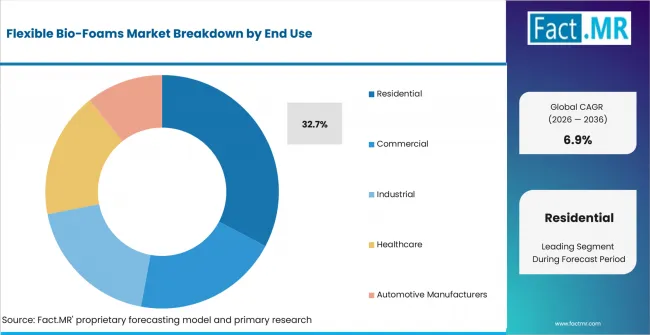
Flexible Bio Foams Market Analysis By End Use | Source: Fact.MR
Household mattresses, sofas, chairs, toppers and cushions create a broad installed base with recurring replacement cycles. Residential buyers can encounter bio-based content as a product attribute at the point of purchase, which gives bedding and furniture brands a reason to qualify renewable-content foam even when the manufacturing process remains similar to conventional flexible foam.
Residential demand also accommodates multiple foam families. Polyurethane can deliver memory, resilience and molded comfort, natural latex serves premium and elastic cushioning positions, and cellulose or starch-based foams can be used in selected protective or support applications. This diversity makes household products a practical testing ground for new feedstocks before suppliers extend them into tighter industrial specifications.
Why does Medium Density Foam lead Density with 44.6% share in 2026?
Medium Density Foam holds a 44.6% share of Density in 2026.
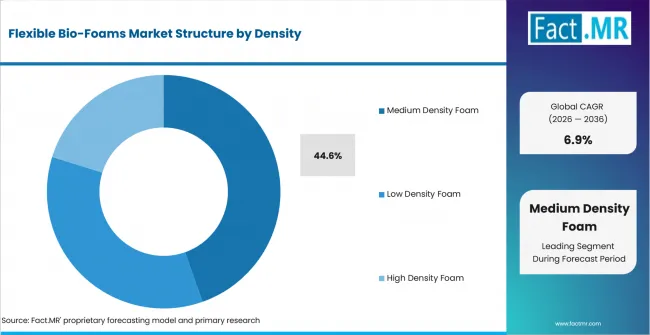
Flexible Bio Foams Market Analysis By Density | Source: Fact.MR
Medium-density grades provide the balance most general-purpose cushioning applications need: enough cellular structure for load support and durability without the material consumption of high-density premium grades. That balance is useful in mattresses, furniture cushions, automotive trim, protective inserts and acoustic components.
For bio-based formulations, medium density also reduces qualification risk. Producers can introduce renewable polyols or natural feedstocks while staying within familiar comfort and compression ranges, then adjust cell structure, additives and cure conditions to recover the target resilience. This makes medium-density formulations an efficient bridge between sustainability targets and established product specifications.
Why does Bio Polyol Technology lead Technology with 53.1% share in 2026?
Bio Polyol Technology holds a 53.1% share of Technology in 2026.
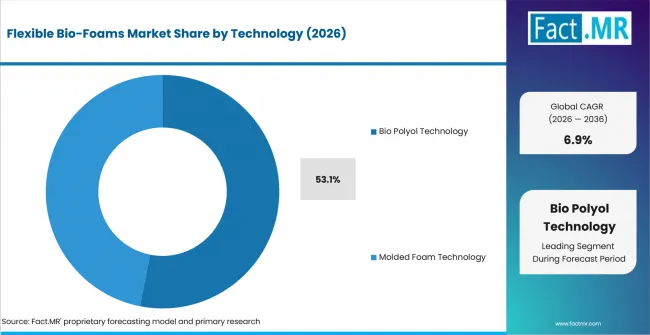
Flexible Bio Foams Market Analysis By Technology | Source: Fact.MR
Polyols are one of the two major reactive components in polyurethane chemistry, so substituting renewable or bio-circular content at the polyol stage gives formulators a direct route to lower fossil feedstock use. BASF began commercial North American production of biomass-balance polyether polyols in 2026 for sleep products and automotive applications, emphasizing that they can be used without reformulation or process changes.
The technology is also flexible in how quickly a converter moves. Partially bio-based foam can introduce a controlled renewable share while maintaining tight mechanical properties, while more aggressive formulations can raise renewable content when the application allows it. That staged pathway helps producers manage cost, certification and performance risk during qualification.
Why do Direct Sales lead Distribution Channel with 61.4% share in 2026?
Direct Sales hold a 61.4% share of Distribution Channel in 2026.
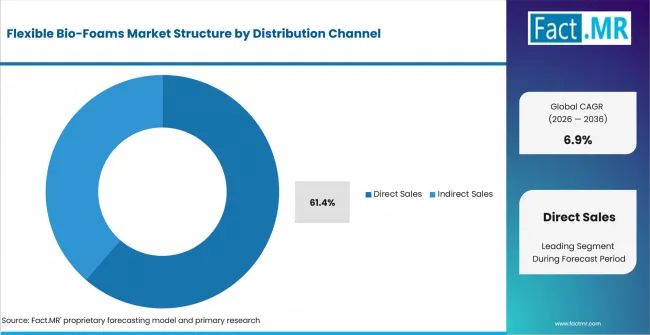
Flexible Bio Foams Market Analysis By Distribution Channel | Source: Fact.MR
Large bedding manufacturers, foam slabstock producers, automotive suppliers and specialty packaging converters typically qualify a specific formulation rather than buy an interchangeable commodity. Direct supplier relationships are therefore valuable for density tuning, catalyst packages, renewable-content documentation, emissions requirements, color, compression behavior and plant-to-plant consistency.
Long-term supply contracts also matter because renewable feedstocks can introduce crop, certification and chain-of-custody considerations that differ from conventional petrochemical sourcing. Direct engagement allows suppliers and converters to coordinate certified input allocation, technical service and change-control procedures before a modified foam enters production.
What is accelerating Flexible Bio-Foams Market adoption, and what is holding it back?
Adoption is being accelerated by renewable-content furniture programs, automotive seating qualification, packaging waste rules and the availability of drop-in bio-polyol chemistry. Vehicle cushioning creates a particularly important qualification path because the automotive seat value chain already buys flexible foam against demanding comfort, fatigue and interior-performance specifications.
Protective packaging is another growth route as producers compare starch, cellulose and renewable polyurethane cushioning against conventional fossil foams. The shift overlaps with the biodegradable packaging where disposal pathways and material claims increasingly influence specification decisions. Healthcare cushioning and bedding provide a smaller but technically demanding outlet. The medical foam uses flexible materials in patient support, cushioning and protective applications, creating an opportunity for bio-based grades that can meet hygiene, durability and comfort requirements. Constraints remain material-specific. Renewable feedstocks can carry higher cost or supply variability, and natural materials may require additional control of odor, moisture, allergen or aging behavior. The European Commission also cautions that biobased plastics are not automatically biodegradable or compostable, so suppliers must avoid end-of-life claims that exceed the actual material standard or collection system.
Drivers Impact Analysis
| Factor | (~) % Impact on CAGR | Geographic Relevance | Impact Timeline |
|---|---|---|---|
| Renewable-content conversion in furniture and bedding foam | +0.90% | Germany, USA, UK, Brazil, Japan | 2026-2036 |
| Bio-polyol adoption in automotive seating and interiors | +0.70% | Germany, Brazil, USA, UK, Japan | 2026-2036 |
| Packaging redesign toward lower fossil input and clearer recovery routes | +0.55% | Europe, UK, Brazil, USA, Japan | 2026-2036 |
Source: Fact.MR analysis. Updated Aug 31, 2026
Opportunity Impact Analysis
| Factor | (~) % Impact on CAGR | Geographic Relevance | Impact Timeline |
|---|---|---|---|
| Drop-in mass-balance polyols and isocyanates for existing foam lines | +0.50% | Germany, USA, UK, Japan, Brazil | 2026-2035 |
| Higher bio-polyol substitution in molded automotive and comfort foams | +0.40% | USA, Germany, Brazil, Japan | 2027-2036 |
| Circular polyols from end-of-life flexible polyurethane foam | +0.35% | Europe, USA, Japan | 2027-2036 |
Source: Fact.MR analysis. Updated Aug 31, 2026
Restraints Impact Analysis
| Factor | (~) % Impact on CAGR | Geographic Relevance | Impact Timeline |
|---|---|---|---|
| Renewable feedstock premium and certification cost | -0.45% | Global | 2026-2036 |
| Mismatch between biobased claims and actual end-of-life infrastructure | -0.35% | Europe, UK, USA, Japan | 2026-2036 |
| Natural-feedstock variability and application qualification burden | -0.30% | Automotive, bedding, medical and industrial markets | 2026-2035 |
Source: Fact.MR analysis. Updated Aug 31, 2026
Which countries are scaling the Flexible Bio-Foams Market through 2036?
- Germany’s automotive and polyurethane manufacturing base supports demand for renewable-content flexible foams in seating, furniture and protective applications. European packaging rules are also encouraging buyers to evaluate formulations with lower fossil feedstock use.
- Brazil is seeing stronger recovery requirements for plastic packaging while renewable polyurethane inputs are already being used in mattress production. This supports bio-based cushioning demand across household, transport and packaging applications.
- In the USA, federal recognition of biobased products is being matched by commercial launches of biomass-balance polyurethane systems and polyether polyols. These materials give furniture, bedding and automotive manufacturers a more practical route to increase renewable content within established foam production.
- UK demand is influenced by packaging EPR requirements, recyclability reporting and continued automotive production. Suppliers that can document renewable content and end-of-life performance have a clearer route into procurement programs.
- Japan’s polyurethane and plastics industries provide an established manufacturing base for renewable foam materials. Policy support for biomass materials is also encouraging suppliers to improve performance, broaden applications and reduce costs.
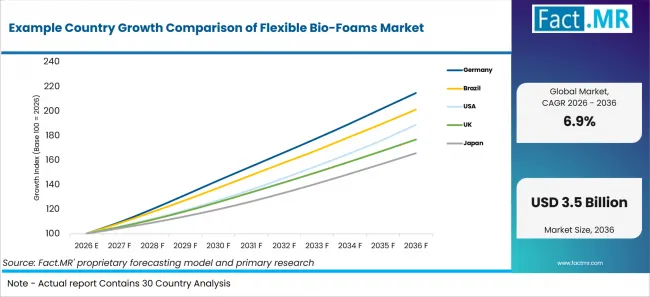
Example Country Growth Comparison Of Flexible Bio Foams Market | Source: Fact.MR
Country CAGR (2026-2036)
| Country | CAGR (2026-2036) |
|---|---|
| Germany | 7.9% |
| Brazil | 7.3% |
| USA | 6.6% |
| UK | 5.9% |
| Japan | 5.2% |
Source: Fact.MR analysis. Updated Aug 31, 2026
What is driving Germany's growth through 2036?
The Germany Flexible Bio-Foams Market is projected to grow at a 7.9% CAGR from 2026 to 2036.
Germany produced about 4.15 million passenger cars in 2025 according to VDA. Flexible polyurethane is used in seating, headrests and interior cushioning, so vehicle programs create a large qualification base for renewable-content foam systems that can meet compression, durability and interior performance targets.
The supply side is also supportive. Covestro manufactures renewable-attributed TDI and mass-balanced polyether polyols in Germany for flexible foam applications. At the same time, EU packaging rules that began applying in August 2026 are increasing pressure to reduce waste and improve recoverability, creating additional interest in renewable cushioning and protective foam options where the end-of-life route is credible.
What is driving Brazil's growth through 2036?
The Brazil Flexible Bio-Foams Market is projected to grow at a 7.3% CAGR from 2026 to 2036.
Brazil established a federal reverse-logistics system for plastic packaging in October 2025, requiring manufacturers, importers, distributors and retailers to participate in recovery systems and encouraging inputs with lower environmental impact, greater recyclability and recycled content. Protective foam suppliers therefore face stronger incentives to reduce fossil material use and design clearer recovery pathways.
Furniture and bedding provide a second route. Covestro documents the use of certified renewable-attributed TDI by Brazilian mattress producer Orbhes without changes to existing formulations or processing. That drop-in model lowers the technical barrier for domestic converters that want a renewable-content product while retaining familiar comfort and manufacturing performance.
What is driving USA's growth through 2036?
The USA Flexible Bio-Foams Market is projected to grow at a 6.6% CAGR from 2026 to 2036.
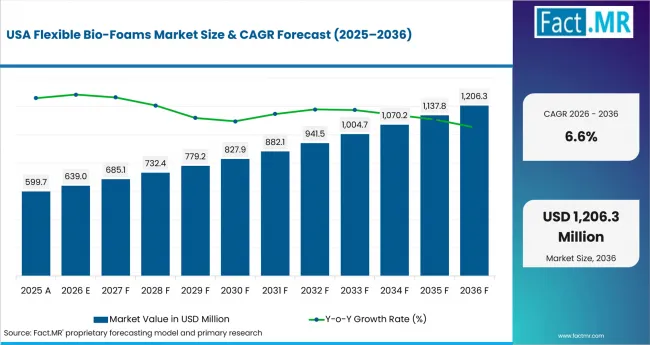
Flexible Bio Foams Market Country Value Analysis | Source: Fact.MR
The USDA BioPreferred Program gives federal purchasers and suppliers a defined framework for biobased products and explicitly lists biodegradable foams and foam intermediates among its product categories. This helps standardize how renewable-content products are identified in institutional procurement rather than relying only on unverified marketing claims.
Commercial capacity is expanding at the same time. BASF launched biomass-balance flexible polyurethane systems for North American furniture in 2025 and began commercial production of biomass-balance polyether polyols in Louisiana in 2026 for sleep products, automotive and other polyurethane uses. These drop-in materials make it easier for converters to raise renewable feedstock content without replacing existing foam equipment.
What is driving UK's growth through 2036?
The UK Flexible Bio-Foams Market is projected to grow at a 5.9% CAGR from 2026 to 2036.
PackUK requires large producers to assess household-packaging recyclability under the EPR framework, and fee modulation makes less recyclable formats more expensive to place on the market. Protective foam and temperature-sensitive packaging suppliers therefore have a stronger reason to document material composition, recovery routes and any renewable-content advantage.
Automotive manufacturing remains another demand base. SMMT reported 717,371 cars produced in the UK in 2025. Seating and interior programs use flexible foam under tightly controlled specifications, giving bio-polyol and renewable-attributed foam suppliers an opportunity when they can match conventional performance and provide traceable sustainability documentation.
What is driving Japan's growth through 2036?
The Japan Flexible Bio-Foams Market is projected to grow at a 5.2% CAGR from 2026 to 2036.
Japan is pursuing broader adoption of biomass materials through its resource-circulation strategy. METI identifies higher functionality, wider applications and lower cost for biomass materials as policy priorities and retains a goal of introducing about 2 million tonnes of bioplastics by 2030. Although bioplastics and bio-foams are not identical categories, the policy direction expands the supplier, certification and procurement ecosystem for renewable polymer feedstocks.
Japan also maintains an established polyurethane and plastics production base. METI production surveys cover polyurethane foam, plastic products, chemicals and transport equipment, supporting a domestic manufacturing environment in which renewable polyols, natural foams and lightweight cushioning can be qualified for furniture, transport, packaging and medical uses.
Who Leads the Flexible Bio-Foams Market?
Key players in the Flexible Bio-Foams Market include BASF SE, Covestro AG, Huntsman Corporation, Woodbridge Foam Corporation, Recticel NV, Dow Inc. and Rogers Corporation.
Competition is shaped by access to renewable feedstocks, formulation capability, application support and the ability to meet qualification requirements in furniture, bedding and automotive uses. BASF and Covestro are developing mass-balance polyurethane inputs, while Huntsman offers flexible foam systems with bio-based and renewable-resource attributes.
Woodbridge supplies bio-based foam for automotive interiors, and Dow has commercialized recycled-content polyol for new flexible foam production. Rogers added a polyurethane foam containing renewable bio-based and post-industrial recycled content in 2026. These product strategies show how suppliers are competing through material sourcing, performance consistency and easier integration into existing foam-processing systems.
Which companies are the key providers?
BASF SE, Covestro AG, Huntsman Corporation, Woodbridge Foam Corporation, Recticel NV, Dow Inc. and Rogers Corporation are the key providers included in the assessment.
- BASF SE
- Covestro AG
- Huntsman Corporation
- Woodbridge Foam Corporation
- Recticel NV
- Dow Inc.
- Rogers Corporation
Bibliography
- U.S. Department of Agriculture. (2026). BioPreferred Product Categories. USDA BioPreferred Program.
- U.S. Department of Energy. (2021). Production of High-Performance Biodegradable Polyurethane Products Made from Algae Precursors. Bioenergy Technologies Office.
- European Commission. (2026). New EU Rules on Packaging Enter into Application. Directorate-General for Environment.
- European Commission. (2022). Policy Framework on Biobased, Biodegradable and Compostable Plastics. Directorate-General for Environment.
- German Environment Agency. (2026). Packaging Waste in Germany. Umweltbundesamt.
- Verband der Automobilindustrie. (2026). Passenger Car Production in 2025. VDA.
- Presidency of the Republic of Brazil. (2025). Decree No. 12,688 Establishing Reverse Logistics for Plastic Packaging. Government of Brazil.
- BASF SE. (2025). Biomass Balance Flexible Polyurethane Foam Systems for the North American Furniture Industry. BASF Performance Materials.
- BASF SE. (2026). Biomass Balance Polyether Polyol Portfolio for Sleep Products, Automotive and CASE Industries. BASF.
- Covestro AG. (2025). Polyurethane Foams with Attributed Renewable Certified Materials for Mattresses. Covestro.
- Woodbridge. (2026). Bio-Based Foam for Automotive Interior Applications. Woodbridge.
- Huntsman Corporation. (2026). RUBIFLEX Flexible Polyurethane Foam Systems. Huntsman.
- Dow Inc. (2026). RENUVA FF 60 Polyol for Flexible Polyurethane Foam. Dow.
- Rogers Corporation. (2026). PORON ReSource30 Polyurethane Foam. Rogers Corporation.
- PackUK and Department for Environment, Food & Rural Affairs. (2026). Recyclability Assessment Methodology 2027. UK Government.
- Society of Motor Manufacturers and Traders. (2026). UK Car Manufacturing and Production Data. SMMT.
- Ministry of Economy, Trade and Industry. (2024). Resource Circulation-Related Industries. Government of Japan.
- Ministry of Economy, Trade and Industry. (2026). Current Survey of Production. Government of Japan.
- Recticel NV. (2023). Completion of the Divestment of Engineered Foams Activities to Carpenter. Recticel Group.
This Report Answers
- How large is the Flexible Bio-Foams Market in 2026 and what value is projected for 2036?
- Why do polyurethane bio-foams, plant-oil raw materials, furniture and bedding, residential use, medium-density foam, bio-polyol technology and direct sales lead their respective segments?
- How are renewable feedstocks, automotive seating, furniture programs and packaging circularity changing flexible foam specifications?
- What country-specific mechanisms support growth in Germany, Brazil, USA, UK and Japan?
- Which companies compete in flexible bio-foams and what capabilities influence supplier qualification?
What does the Flexible Bio-Foams Market cover?
The Flexible Bio-Foams Market covers revenue from flexible cellular foam materials sold with renewable, biological, bio-circular or qualifying biobased feedstock content as a material feature of the commercial product. Product coverage includes bio-polyol polyurethane foam, natural latex foam, cellulose-based foam, starch-based foam and protein-based foam used in furniture and bedding, automotive, packaging, building and construction, and medical applications.
The assessment covers Product, Raw Material, Application, End Use, Density, Technology and Distribution Channel across Germany, Brazil, USA, UK and Japan, with global market sizing for 2026 to 2036.
What is included in the scope?
Included revenue covers flexible foams sold as finished slabstock, molded foam, cushioning material, flexible cellular sheet or application-ready foam where renewable feedstock content, natural polymer content or certified renewable attribution is part of the product specification. Plant-oil polyols, natural latex, cellulose, starch and protein feedstock routes are included when they are converted into the commercial foam product.
Furniture cushions, mattresses, vehicle seating and interiors, protective and temperature-sensitive packaging, flexible acoustic or insulation applications, medical cushions and healthcare bedding are included. Direct producer sales and indirect distribution are counted when the transaction represents commercial flexible bio-foam revenue.
What is excluded from the scope?
Conventional fossil-derived flexible foam with no renewable or biological feedstock claim is excluded. Rigid polyurethane insulation boards, rigid structural foams, expanded polystyrene, polyethylene foams, loose-fill products and finished furniture, mattresses, vehicle seats or medical devices are excluded when their value cannot be separated from the foam material itself.
Bio-based feedstock does not automatically qualify a product as biodegradable or compostable. Composting, biodegradation, recycling and renewable-carbon claims are treated as separate attributes, and the market does not include unsupported environmental claims or pre-commercial formulations without validated commercial revenue.
How Was the Analysis Built?
The analysis combines flexible foam demand by product chemistry with raw-material route, application, end-use purchasing, density class, processing technology and distribution structure. Furniture and bedding, automotive, packaging, construction, medical and residential demand are evaluated separately before being reconciled into the global forecast.
- Primary Research: Interviews with polyol and polyurethane system suppliers, foam converters, mattress and furniture producers, automotive seating suppliers, packaging converters, healthcare-product manufacturers, distributors and procurement teams are used to test renewable-content premiums, density mix, substitution limits, qualification cycles and contract structure.
- Desk Research: The review covers biobased procurement programs, packaging regulation, plastics and foam production statistics, vehicle manufacturing data, renewable-feedstock policy and first-party documentation on bio-polyol, mass-balance, natural and circular flexible foam technologies.
- Market Sizing and Forecasting: Estimates combine foam volume, average selling value, renewable-content penetration, application intensity, density mix, bio-polyol substitution, country manufacturing activity and replacement demand. Forecast assumptions are cross-checked against downstream furniture, bedding, automotive and packaging activity together with supplier commercialization milestones.
Segmentation
What is the report's scope and coverage?
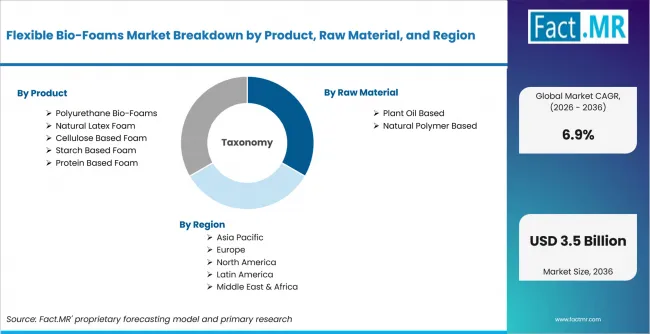
Flexible Bio Foams Market Breakdown By Product, Raw Material, And Region | Source: Fact.MR
| Scope Item | Coverage |
|---|---|
| Quantitative Units | USD billion |
| Market Definition | Flexible cellular foam materials sold with renewable, biological, bio-circular or qualifying biobased feedstock content across cushioning, interiors, packaging, acoustic, medical and related applications. |
| Segments Covered | Product, Raw Material, Application, End Use, Density, Technology and Distribution Channel |
| Regions Covered | North America, Latin America, Europe, East Asia, South Asia and Pacific, Middle East and Africa |
| Countries Covered | Germany, Brazil, USA, UK and Japan |
| Key Companies Profiled | BASF SE; Covestro AG; Huntsman Corporation; Woodbridge Foam Corporation; Recticel NV; Dow Inc.; Rogers Corporation |
| Forecast Period | 2026-2036 |
| Base Year | 2025 |
| Market Value, 2026 | USD 1.8 billion |
| Market Value, 2036 | USD 3.5 billion |
| CAGR, 2026-2036 | 6.9% |
| Absolute Opportunity | USD 1.7 billion |
| Approach | Hybrid bottom-up and top-down modelling using foam chemistry, renewable feedstock penetration, application demand, density mix, country manufacturing activity and primary validation |
Source: Fact.MR analysis. Updated Aug 31, 2026
How is the market segmented?
-
By Product:
- Polyurethane Bio-Foams
- Bio Based Polyether Polyurethane Foam
- Bio Based Polyester Polyurethane Foam
- Natural Latex Foam
- Dunlop Process Foam
- Talalay Process Foam
- Cellulose Based Foam
- Regenerated Cellulose Foam
- Microfibrillated Cellulose Foam
- Starch Based Foam
- Corn Starch Foam
- Potato Starch Foam
- Protein Based Foam
- Soy Protein Foam
- Gelatin Protein Foam
- Polyurethane Bio-Foams
-
By Raw Material:
- Plant Oil Based
- Soybean Oil
- Castor Oil
- Palm Oil
- Natural Polymer Based
- Cellulose
- Starch
- Protein
- Plant Oil Based
-
By Application:
- Furniture And Bedding
- Mattresses
- Furniture Cushions
- Automotive
- Seating Systems
- Interior Components
- Packaging
- Protective Packaging
- Temperature Sensitive Packaging
- Building And Construction
- Insulation Systems
- Acoustic Applications
- Medical
- Medical Cushions
- Healthcare Bedding
- Furniture And Bedding
-
By End Use:
- Residential
- Commercial
- Industrial
- Healthcare
- Automotive Manufacturers
-
By Density:
- Medium Density Foam
- General Purpose Foam
- Performance Foam
- Low Density Foam
- Ultra Lightweight Foam
- Standard Lightweight Foam
- High Density Foam
- High Resilience Foam
- Premium Performance Foam
- Medium Density Foam
-
By Technology:
- Bio Polyol Technology
- Partially Bio Based Foam
- Fully Bio Based Foam
- Molded Foam Technology
- Slabstock Foam Technology
- Foam In Place Technology
- Bio Polyol Technology
-
By Distribution Channel:
- Direct Sales
- Long Term Supply Contracts
- Customized Product Supply
- Indirect Sales
- Distributors
- Specialty Retailers
- Direct Sales
-
By Region
- North America
- Latin America
- Western Europe
- Eastern Europe
- East Asia
- South Asia and Pacific
- Middle East & Africa
Frequently Asked Questions
What is the Flexible Bio-Foams Market value in 2026?
At what CAGR is the market projected to grow?
What will the market be worth by 2036?
Which Product leads the market?
Which Raw Material leads the market?
Which Application leads the market?
Which End Use leads the market?
Which Density leads the market?
Which Technology leads the market?
Which Distribution Channel leads the market?
Which companies are included in the market assessment?
Who worked on this report


Preview the report firsthand - request a free sample
Free SampleGet the brochure for pricing and purchase details
Download PDF