- Base Value(2025): 1.5 Bn
- Estimated Value(2025): 1.5 Bn
- Forecast Value (2035): 2.5 Bn
- CAGR (2025 - 2035): 5.3%
Isophorone Market Forecast and Outlook 2025 to 2035
The global isophorone market is projected to grow from USD 1.51 billion in 2025 to approximately USD 2.54 billion by 2035, expanding at a compound annual growth rate (CAGR) of 5.3% between 2025 and 2035. The market is positioned for steady expansion, driven by consistent adhesives industry growth, expanding paints and coatings applications, and increasing utilization as chemical intermediate across polyurethane resin manufacturers, specialty coating formulators, and printing ink producers globally.
Quick Stats on Isophorone Market
- Isophorone Market Value (2025): USD 1.51 billion
- Isophorone Market Forecast Value (2035): USD 2.54 billion
- Isophorone Market Forecast CAGR (2025 to 2035): 5.3%
- Leading Application in Isophorone Market: Adhesives (35.7%)
- Key Growth Regions in Isophorone Market: Asia Pacific, North America, and Europe
- Key Players in Isophorone Market: Arkema Group, Evonik Industries, BASF SE, Covestro AG, CHAIN FONG, Jiangsu Huanxin High Tech Materials, Prasol Chemicals Pvt Ltd., SI Group Inc., Krasiklal, Dhalop Chemicals
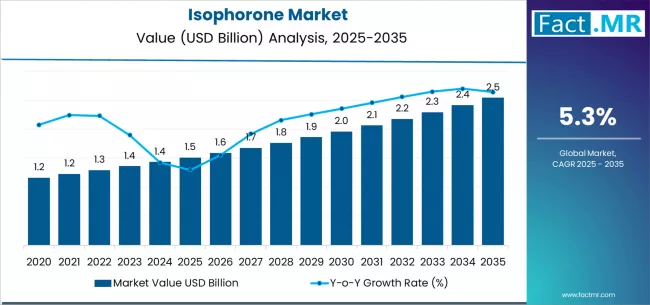
Isophorone Market Market Value Analysis | Source: Fact.MR
The market demonstrates stable fundamentals supported by established applications in solvent formulations, chemical manufacturers' focus on high-purity intermediate optimization, and sustained recognition of isophorone as an essential building block in achieving enhanced resin performance, coating durability, and adhesive bonding characteristics within established chemical manufacturing architectures across diverse industrial applications.
Market growth is underpinned by continuing demand in downstream industries, particularly adhesive formulations and protective coating systems, which utilize isophorone's favorable solvent characteristics, chemical reactivity, and compatibility with polyurethane chemistry prevalent in contemporary industrial applications.
Chemical manufacturers and formulators maintain utilization of isophorone solutions that provide proven performance in established applications, processing reliability, and cost-effective production economics while serving well-established market requirements and application-specific formulation needs across global industrial chemical markets.
The combination of construction activity supporting adhesives and coatings demand in developed markets, automotive refinishing requirements in established economies, and industrial maintenance coating programs in manufacturing sectors creates sustained demand supporting isophorone producers and specialty chemical suppliers.
Established isophorone applications incorporating proven formulation chemistry, validated manufacturing processes, and standardized product specifications maintain consistent industrial utilization, application reliability, and supply chain stability across chemical manufacturing operations.
The market's trajectory reflects the chemical industry's continuing reliance on established intermediate chemistry for polyurethane systems, the sustained role of solvent-based formulations in specialized coating applications, and the ongoing utilization of proven chemical building blocks supporting diverse downstream manufacturing.
Construction activity patterns and industrial coating requirement networks maintain established consumption frameworks supporting steady demand growth, while chemical industry infrastructure provides reliable production capacity and established distribution connectivity across global isophorone supply chain operations.
Between 2020 and 2025, the isophorone market expanded from USD 1.11 billion to USD 1.51 billion, demonstrating steady foundational growth supported by consistent industrial chemical demand, sustained construction activity supporting adhesives consumption, and continuing coating industry requirements across automotive refinishing and industrial maintenance applications. This growth phase maintained established supply infrastructure, sustained chemical intermediate production, and preserved reliable distribution networks supporting global chemical manufacturing operations.
From 2025 to 2030, the market is projected to continue steady expansion, reaching USD 1.96 billion, representing continued utilization as established chemical applications maintain consistent demand patterns and as construction activity sustains adhesives and coatings consumption across major industrial markets. This period will be characterized by stable production capacity utilization, continuing downstream application demand, and sustained chemical intermediate requirements across established industrial segments.
From 2030 to 2035, the market is forecast to reach USD 2.54 billion, supported by ongoing industrial chemical consumption, continuing construction and automotive aftermarket activity, and sustained utilization in established formulation chemistry across adhesives, coatings, and specialty chemical applications. The continuing adoption of polyurethane-based systems, maintenance of industrial coating programs, and sustained chemical intermediate requirements will support steady demand for isophorone with established production infrastructure and proven supply chain integration functionality.
Isophorone Market Key Takeaways
| Metric | Value |
|---|---|
| Estimated Value (2025E) | USD 1.51 billion |
| Forecast Value (2035F) | USD 2.54 billion |
| Forecast CAGR (2025 to 2035) | 5.3% |
Source: Fact.MR analysis. Updated Dec 1, 2025
Why is the Isophorone Market Growing?
Market expansion is being supported by the consistent demand from adhesives and coatings industries and the corresponding utilization of isophorone as established chemical intermediate in industrial formulation applications across global chemical operations. Chemical manufacturers maintain focus on proven intermediate materials that support reliable formulation performance, established processing characteristics, and cost-effective production economics while meeting continuing industrial requirements.
The established utility of isophorone in various chemical applications makes it a continuing component of industrial chemical supply strategies and formulation integration programs. The sustained emphasis on construction activity and industrial coating requirements maintains demand for chemical products incorporating isophorone that serve established performance specifications and application requirements for industrial uses.
Chemical industry utilization of reliable, proven intermediate materials that support consistent formulation outcomes maintains opportunities for established chemical intermediates and proven industrial materials. The continuing importance of industrial chemical applications and established formulation protocols supports ongoing utilization of isophorone across different industrial categories and chemical systems requiring proven intermediate chemistry.
Opportunity Pathways - Isophorone Market
The isophorone market represents a steady growth opportunity, expanding from USD 1.51 billion in 2025 to USD 2.54 billion by 2035 at a 5.3% CAGR. As chemical manufacturers maintain established formulation systems, proven intermediate utilization, and cost-effective production in industrial chemical architectures, isophorone materials continue serving as reliable chemical intermediates enabling consistent adhesive performance, proven coating formulations, and established solvent characteristics across polyurethane adhesive platforms and specialty coating applications.
The combination of construction activity continuation, automotive refinishing demand sustainability, established coating application requirements, and proven chemical formulation systems maintains steady demand momentum. Established adhesive formulations utilizing proven isophorone chemistry, continuing paints and coatings applications balancing performance with established economics, and specialized variants for printing ink applications will maintain market volumes, while sustained industrial activity in established manufacturing markets and continuing construction programs support baseline demand. Chemical industry reliance on proven intermediates and established formulation systems provides structural support.
- Pathway A - Adhesives Application Leadership: Leading with 35.7% market share, adhesives applications drive primary demand through polyurethane adhesive formulations requiring established chemical intermediates for proven bonding systems. Established adhesive formulations utilizing isophorone chemistry for polyurethane resin synthesis maintain steady consumption from adhesive manufacturers requiring proven performance characteristics and established cost economics. Expected revenue pool: USD 0.54-0.91 billion.
- Pathway B - Paints & Coatings Application Strength: Commanding 28.4% market share through established utilization in coating formulations and proven solvent characteristics, paints and coatings applications serve industrial maintenance and automotive refinishing requirements. This application addresses both protective coating needs and refinishing market demands, making it an important category for chemical suppliers and coating manufacturers. Opportunity: USD 0.43-0.72 billion.
- Pathway C - Asian Market Development: India (7.1% CAGR) and China (6.2% CAGR) show growth through construction expansion, coatings market development, and industrial chemical consumption increases. Market development in high-activity construction markets, established chemical production presence, and growing downstream application demand support isophorone consumption in major chemical production regions. Geographic development upside: USD 0.31-0.56 billion.
- Pathway D - North American Regional Position: North American markets maintain significant share serving established adhesives demand and coating industry requirements for construction and industrial applications. Established chemical production infrastructure supporting consistent intermediate supply, mature application markets, and proven distribution networks maintain baseline consumption from chemical manufacturers and formulation companies. Regional demand potential: USD 0.61-1.02 billion.
- Pathway E - Established Production & Supply Chain Management: Companies maintaining reliable production capacity, consistent product quality, and established distribution systems support steady market position through proven supply reliability. Production capabilities delivering standardized product specifications and reliable availability maintain customer relationships supporting continuing demand. Production value: USD 0.24-0.41 billion.
- Pathway F - Application Technical Support & Formulation Services: Chemical suppliers providing technical support services, formulation assistance, and application expertise create service differentiation in industrial markets utilizing established chemistry. Companies offering technical resources, formulation guidance, and application support maintain customer relationships with formulation-focused manufacturers. Technical service value: USD 0.20-0.33 billion.
- Pathway G - Specialty Applications & Niche Markets: Beyond primary adhesives and coatings uses, isophorone in printing inks, artificial leather production, and specialty chemical applications represent continuing niche demand. Companies serving specialized applications, maintaining technical expertise, and supporting niche industrial requirements capture incremental volumes while serving diverse customer needs. Specialty opportunity: USD 0.17-0.28 billion.
Segmental Analysis
The market is segmented by application and region. By application, the market is divided into adhesives, paints & coatings, printing inks, artificial leather, agrochemicals, composites, and others. Regionally, the market is divided into North America, Europe, Asia Pacific, Central & South America, and Middle East & Africa.
How do Adhesives Drive Application Leadership?
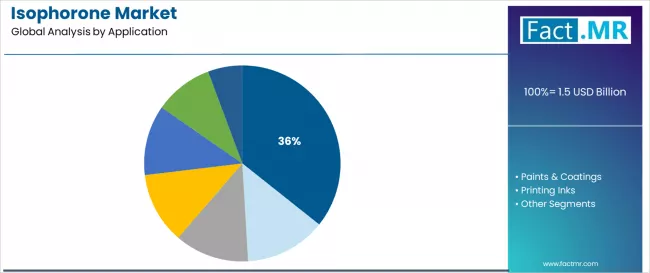
Isophorone Market Analysis By Application | Source: Fact.MR
The adhesives application is projected to account for 35.7% of the isophorone market in 2025, establishing its position as the leading end-use segment. Chemical manufacturers and adhesive formulators recognize that isophorone utilization in polyurethane adhesive systems, serving as chemical intermediate for isophorone diisocyanate production and as reactive diluent in formulations, represents the largest established application due to proven chemistry and widespread adoption.
This application addresses both polyurethane chemistry requirements and formulation needs while providing established performance in construction, automotive, and industrial bonding applications. This segment represents the foundation of primary isophorone consumption for adhesive intermediate production and formulation applications, as it serves the most commercially significant and technically established end-use in the isophorone value chain.
Application performance standards and extensive formulation experience continue supporting isophorone utilization in adhesive systems among chemical manufacturers and adhesive producers. With established polyurethane adhesive markets and continuing construction activity supporting adhesive demand, isophorone consumption in adhesives applications maintains its central position in overall market demand across industrial chemical utilization.
Why do Paints & Coatings Command Significant Market Share?
Paints & coatings application is projected to represent 28.4% of isophorone demand in 2025, underscoring its role as a major application category supporting market consumption. Chemical formulators recognize that isophorone serves multiple functions in coating systems, including solvent applications, chemical intermediate roles, and formulation components, providing capabilities that support diverse coating requirements across industrial maintenance, automotive refinishing, and protective coating applications.
Coatings utilizing isophorone chemistry offer established formulation characteristics supporting industrial coating performance. The segment reflects the continuing nature of industrial coating demand requiring chemical materials supporting proven formulation performance, application reliability, and established cost-effectiveness, alongside sustained recognition that isophorone provides useful characteristics in coating formulation chemistry.
Coating manufacturers maintain utilization of established chemical intermediates supporting proven coating performance and application characteristics. As industrial coating markets continue and automotive refinishing demand persists, isophorone utilization in paints and coatings applications will maintain significant importance supporting chemical consumption within established coating industry operations.
What Drives Printing Inks Application Segment?
The printing inks application segment accounts for notable isophorone consumption in 2025, serving as established segment within the overall application mix. Chemical suppliers and ink manufacturers recognize that isophorone utilization in printing ink formulations, particularly for specialty inks and coating systems, provides proven solvent characteristics and chemical properties supporting ink performance requirements.
This application addresses specific formulation needs where isophorone characteristics provide performance advantages in specialized ink applications. The segment represents continuing utilization in specialty printing applications and coating-ink hybrid products, supported by established formulation practices and proven application performance.
Printing ink manufacturers maintain isophorone utilization where its specific properties provide formulation benefits and application advantages. As specialty printing applications continue and ink formulation requirements persist, isophorone consumption in printing inks will maintain its role within the diversified application portfolio supporting overall market demand.
What are the Drivers, Restraints, and Key Trends of the Isophorone Market?
The isophorone market maintains steady development supported by established industrial chemical applications and continuing demand from downstream industries utilizing proven intermediate chemistry.
The market experiences considerations including environmental regulations affecting solvent applications in certain jurisdictions, competition from alternative chemical intermediates in some formulation systems, and sensitivity to construction activity cycles affecting adhesives and coatings demand patterns. Continuing industrial chemical utilization and established application requirements influence market stability and demand patterns.
Construction Activity and Adhesives-Coatings Demand Correlation
The continuing pattern of construction activity in major markets maintains demand for adhesives and coatings applications utilizing isophorone chemistry in formulation systems. Chemical manufacturers supply established industrial applications, including polyurethane adhesive intermediates and coating formulation components that serve construction-related demand supporting reliable consumption patterns.
Isophorone utilization benefits from established position in proven formulation chemistry supporting construction materials and industrial adhesives while maintaining economic competitiveness for established high-volume applications.
Industrial Chemical Supply Chain and Production Economics
Established chemical manufacturing operations maintain production of isophorone through proven chemical processes, integrated production facilities, and established supply chain networks supporting consistent product availability.
Chemical production systems provide reliable supply supporting downstream formulation industries, enable efficient distribution to established customer bases, and maintain cost-effective production economics throughout industrial chemical supply chains. Established production infrastructure supports consistent availability and reliable quality supporting continuing industrial utilization across diverse application requirements.
Analysis of the Isophorone Market by Key Countries
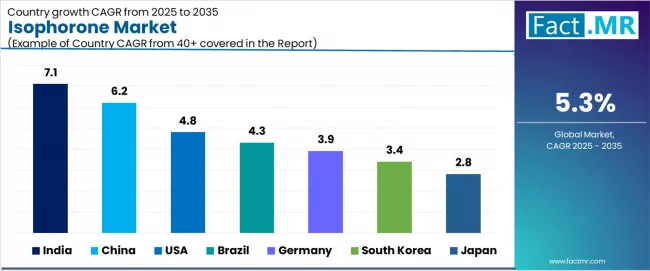
Isophorone Market Cagr Analysis By Country | Source: Fact.MR
| Country | CAGR (2025-2035) |
|---|---|
| India | 7.1% |
| China | 6.2% |
| usa | 4.8% |
| Brazil | 4.3% |
| South Korea | 3.4% |
| Germany | 3.9% |
| Japan | 2.8% |
Source: Fact.MR analysis. Updated Dec 1, 2025
The isophorone market demonstrates varied growth globally, with India leading at a 7.1% CAGR through 2035, driven by fastest-growing coatings market development, expanding construction activity, and increasing industrial chemical consumption across developing manufacturing sectors. China follows at 6.2%, supported by large coatings industry base, printing inks demand, and polyurethane intermediates requirements.
The USA records 4.8% growth, benefiting from strong adhesives and coatings demand and continuing construction sector activity. Brazil demonstrates 4.3% growth, emphasizing construction expansion and automotive aftermarket development.
Germany shows 3.9% growth, representing automotive paints applications and engineered materials utilization. South Korea records 3.4% growth with electronics adhesives and specialty coatings demand, while Japan shows 2.8% growth, representing mature but stable adhesives market and established industrial chemical consumption.
How Does India Demonstrate Strong Market Potential with Coatings Market Growth?
The isophorone market in India is projected to exhibit strong growth with a CAGR of 7.1% through 2035, driven by fastest-growing coatings market in Asia Pacific region and expanding construction activity supporting adhesives and coatings demand across developing infrastructure and manufacturing sectors. The country's rapid construction expansion and growing industrial base are creating increased opportunities for chemical consumption across both architectural coatings and industrial adhesive applications. Chemical suppliers and downstream manufacturers maintain growing presence serving expanding industrial chemical requirements and developing construction material markets throughout India's major industrial and urban centers.
The Indian construction and manufacturing sector expansion supports growing chemical consumption across diverse industrial applications. This market development, combined with the country's expanding middle-class housing demand and industrial facility construction, creates growing demand environment supporting chemical intermediate consumption. Indian chemical markets increasingly utilize established industrial materials for construction and manufacturing applications, with isophorone representing proven intermediate chemistry supporting downstream product requirements.
- Construction sector expansion and coatings market growth supporting increased chemical intermediate demand across architectural and industrial applications
- Growing adhesives utilization in construction materials and industrial assembly operations supporting chemical consumption nationwide
- Manufacturing facility expansion and industrial coating requirements increasing utilization of chemical intermediates across production sectors
- Chemical industry development and formulation capability enhancement supporting market growth and industrial chemical adoption
What Makes China Demonstrate Market Development with Large Industry Base?
The isophorone market in China is expanding at a CAGR of 6.2%, supported by large coatings industry base, printing inks demand, and polyurethane intermediates requirements across the country's extensive chemical manufacturing infrastructure. The country's substantial chemical production capacity and large downstream industries maintain significant consumption supporting chemical intermediate demand in both export-oriented and domestic market applications. Chemical producers and downstream manufacturers maintain comprehensive production supporting ongoing consumption and established industrial utilization throughout China's major chemical manufacturing regions.
China's chemical sector maintains substantial production and consumption patterns supporting established industrial chemical markets. The country's large-scale manufacturing base supports chemical intermediate utilization across diverse downstream applications including coatings, adhesives, and specialty chemicals. This industrial foundation maintains significant consumption supporting ongoing market demand and established supply infrastructure.
- Large coatings industry and adhesives manufacturing base maintaining substantial chemical intermediate consumption across industrial applications
- Printing inks production and specialty chemical manufacturing supporting diverse isophorone utilization across chemical sectors
- Construction activity continuation and industrial coating requirements sustaining chemical demand across manufacturing operations
- Chemical production infrastructure and downstream industry presence supporting steady consumption patterns and market stability
Why Does USA Maintain Strong Adhesives and Coatings Demand?
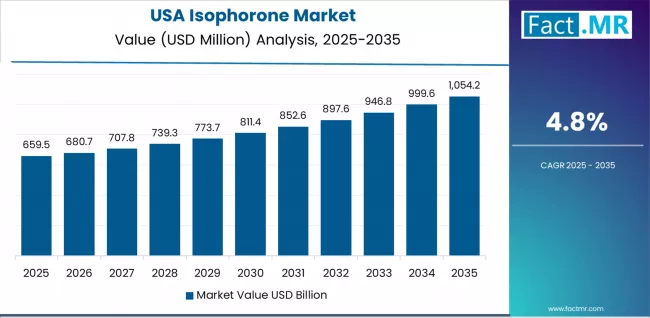
Isophorone Market Country Value Analysis | Source: Fact.MR
The isophorone market in USA is projected to exhibit moderate growth with a CAGR of 4.8% through 2035, driven by strong adhesives and coatings demand and construction sector activity. The country's established chemical industry and mature downstream markets maintain consistent consumption supporting chemical intermediate utilization across automotive refinishing, industrial maintenance coatings, and construction adhesives applications. American chemical producers maintain established supply serving continuing industrial requirements and proven application demand.
The USA market benefits from established construction activity patterns and mature industrial chemical consumption supporting steady demand for intermediate materials. This market foundation maintains consistent utilization as construction programs continue and industrial coating requirements persist across established application sectors.
Strategic Market Considerations:
- Construction activity and adhesives demand maintaining steady consumption with focus on established applications and proven formulation systems
- Automotive refinishing and industrial coatings supporting continued utilization across mature market applications
- Chemical production infrastructure and established supply networks maintaining reliable availability and market stability
- Industrial chemical consumption patterns supporting baseline demand across established downstream applications
How Does Germany Maintain Automotive and Industrial Applications?
Germany's established chemical market demonstrates steady isophorone utilization supporting a 3.9% CAGR through 2035. The country's automotive industry and engineered materials sector maintain demand for chemical intermediates supporting coating systems and specialty chemical applications. German chemical producers serve established industrial requirements through proven production infrastructure and technical expertise supporting downstream formulation industries.
Market patterns reflect established industrial chemical consumption supporting automotive coatings, industrial adhesives, and specialty material applications important to German manufacturing sectors. Established chemical industry infrastructure and technical formulation expertise maintain steady consumption supporting proven industrial applications.
Strategic Market Considerations:
- Automotive coatings and industrial materials applications maintaining established consumption patterns across manufacturing sectors
- Chemical production excellence and formulation expertise supporting steady utilization in proven applications
- Industrial chemical infrastructure maintaining reliable supply supporting downstream manufacturing requirements
- Established application markets and proven formulation systems supporting continuing demand across industrial segments
What Drives Japan Market Stability with Mature Applications?
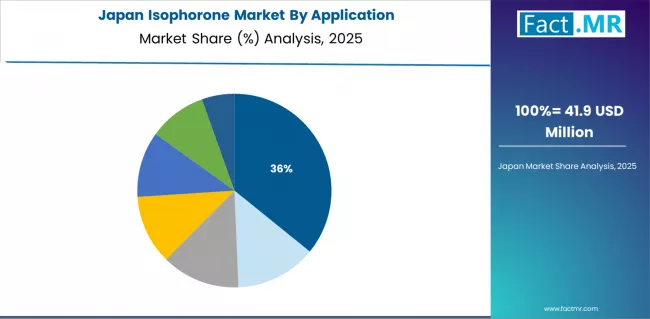
Isophorone Market Japan Market Share Analysis By Application | Source: Fact.MR
Japan's mature chemical market demonstrates stable isophorone consumption with a 2.8% CAGR through 2035, representing established industrial chemical utilization across adhesives and specialty chemical applications. The country's mature industrial base and established chemical consumption patterns maintain steady demand supporting continuing utilization in proven applications. Japanese chemical producers maintain established production serving domestic industrial requirements and proven market applications.
Market dynamics reflect mature industrial chemical consumption maintaining steady utilization patterns across established application sectors. Stable industrial activity and continuing manufacturing operations support baseline chemical demand maintaining established consumption levels.
Strategic Market Considerations:
- Mature adhesives market and established industrial applications maintaining stable consumption across proven end-uses
- Industrial chemical utilization patterns supporting continuing demand through established market applications
- Chemical production infrastructure maintaining reliable supply across mature market segments
- Established application requirements and proven formulation systems supporting baseline consumption levels
How Does South Korea Demonstrate Specialty Applications Growth?
South Korea's chemical market shows moderate growth with a 3.4% CAGR through 2035 driven by electronics adhesives and specialty coatings applications. The country's electronics manufacturing sector and industrial coating requirements create demand for chemical intermediates supporting specialized adhesive formulations and coating systems. Korean chemical producers serve established industrial applications through proven supply infrastructure.
The South Korean market benefits from electronics industry presence and industrial manufacturing activity supporting chemical consumption across specialized applications. This maintains steady demand as electronics production continues and industrial coating requirements persist.
Strategic Market Considerations:
- Electronics adhesives and specialty coatings applications supporting steady consumption across manufacturing sectors
- Industrial chemical requirements maintaining established utilization patterns across proven applications
- Chemical supply infrastructure supporting reliable availability for industrial manufacturing operations
- Manufacturing activity patterns supporting baseline demand across established industrial segments
Why Does Brazil Show Construction-Driven Growth?
The isophorone market in Brazil is projected to grow at a CAGR of 4.3% through 2035, driven by construction sector expansion and automotive aftermarket growth. The country's developing construction activity and automotive refinishing market create opportunities for chemical consumption supporting coatings and adhesives applications. Brazilian chemical suppliers serve growing industrial requirements through developing distribution infrastructure.
The Brazilian market benefits from construction sector development and automotive aftermarket activity supporting growing chemical consumption. This creates expanding demand as construction programs develop and industrial chemical utilization increases.
Strategic Market Considerations:
- Construction expansion and automotive aftermarket growth supporting increasing chemical consumption across industrial applications
- Coatings and adhesives demand driving chemical intermediate utilization across developing market segments
- Infrastructure development supporting steady market growth as industrial activity expands
- Industrial chemical consumption increasing with construction sector development and manufacturing activity growth
Europe Market Split by Country
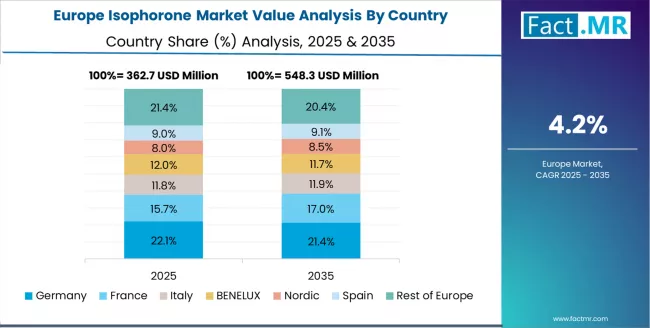
Isophorone Market Europe Country Market Share Analysis, 2025 & 2035 | Source: Fact.MR
The isophorone market in Europe is projected to grow from USD 0.39 billion in 2025 to USD 0.60 billion by 2035, registering a CAGR of 4.4% over the forecast period. Germany is expected to maintain its leadership position with a 32.8% market share in 2025, remaining at 32.6% by 2035, supported by its automotive coatings industry, comprehensive chemical production infrastructure, and established downstream manufacturing operations throughout major industrial regions.
France follows with a 21.4% share in 2025, projected to reach 21.8% by 2035, driven by chemical production capabilities, coatings industry presence, and established industrial chemical consumption serving domestic and European markets. The United Kingdom holds a 16.2% share in 2025, expected to remain at 16.4% by 2035, supported by chemical industry presence and industrial applications.
Italy commands a 13.8% share in 2025, projected to reach 13.6% by 2035, while Spain accounts for 9.6% in 2025, expected to reach 9.4% by 2035. The Rest of Europe region, including Nordic countries with chemical industry presence, Eastern European developing markets, and smaller Western European industrial markets, is anticipated to hold 6.2% in 2025, declining slightly to 6.2% by 2035, reflecting market stability across established European chemical consumption patterns and industrial application requirements.
Competitive Landscape of the Isophorone Market
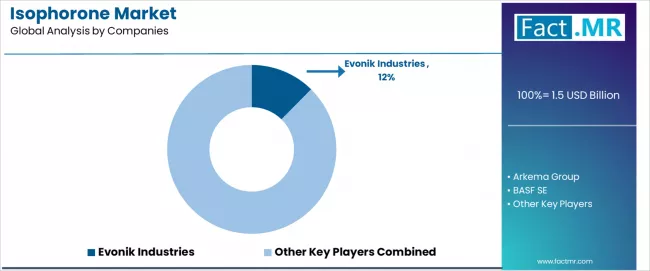
Isophorone Market Analysis By Company | Source: Fact.MR
The isophorone market is characterized by established competition among major chemical producers, integrated chemical companies, and regional specialty chemical manufacturers focused on delivering consistent quality, reliable supply, and cost-competitive chemical intermediate products.
Companies maintain production capacity, supply chain reliability, strategic customer relationships, and technical support capabilities to deliver effective, economical, and consistent chemical intermediate solutions meeting established industrial requirements and customer specifications. Production efficiency optimization, quality consistency maintenance, and customer relationship management are central to maintaining market position and customer retention.
Evonik Industries leads the market with a 12.4% market share, offering comprehensive isophorone production with focus on integrated chemical manufacturing and established customer supply relationships for industrial applications. Arkema Group provides chemical intermediate production with emphasis on specialty chemicals portfolio and technical support across global industrial markets.
BASF SE focuses on integrated chemical production operations and broad chemical portfolio serving international manufacturing customers. Covestro AG delivers polyurethane raw materials and chemical intermediates supporting downstream polymer applications. CHAIN FONG operates chemical production facilities serving Asian markets with established manufacturing presence.
Jiangsu Huanxin High Tech Materials provides chemical intermediate production emphasizing Chinese market supply and regional customer service. Prasol Chemicals Pvt Ltd. specializes in chemical manufacturing serving regional markets with established production capabilities.
SI Group Inc. delivers specialty chemical products including intermediate materials for diverse industrial applications. Krasiklal and Dhalop Chemicals focus on regional chemical production and distribution serving established industrial customers and maintaining supply relationships through reliable production and customer service strategies.
Key Players in the Isophorone Market
- Arkema Group
- Evonik Industries
- BASF SE
- Covestro AG
- CHAIN FONG
- Jiangsu Huanxin High Tech Materials
- Prasol Chemicals Pvt Ltd.
- SI Group Inc.
- Krasiklal
- Dhalop Chemicals
Segmentation
Scope of the Report
| Items | Values |
|---|---|
| Quantitative Units (2025) | USD 1.51 Billion |
| Application | Adhesives, Paints & Coatings, Printing Inks, Artificial Leather, Agrochemicals, Composites, Others |
| Regions Covered | North America, Europe, Asia Pacific, Central & South America, Middle East & Africa |
| Countries Covered | usa, Germany, UK, Japan, India, China, South Korea, Brazil and 40+ countries |
| Key Companies Profiled | Arkema Group, Evonik Industries, BASF SE, Covestro AG, CHAIN FONG, Jiangsu Huanxin High Tech Materials, Prasol Chemicals Pvt Ltd., SI Group Inc., Krasiklal, Dhalop Chemicals |
| Additional Attributes | Dollar sales by application, regional demand trends, competitive landscape, industrial customer preferences for chemical intermediate suppliers, integration with downstream formulation systems, production technology standards, supply chain reliability assessment, and cost-effectiveness optimization capabilities |
Source: Fact.MR analysis. Updated Dec 1, 2025
Isophorone Market by Segments
-
Application :
- Adhesives
- Paints & Coatings
- Printing Inks
- Artificial Leather
- Agrochemicals
- Composites
- Others
-
Region :
-
North America
- United States
- Canada
- Mexico
-
Europe
- Germany
- France
- United Kingdom
- Italy
- Spain
- Nordic
- BENELUX
- Rest of Europe
-
Asia Pacific
- China
- India
- Japan
- South Korea
- ASEAN
- Australia & New Zealand
- Rest of Asia Pacific
-
Central & South America
- Brazil
- Argentina
- Chile
- Rest of Central & South America
-
Middle East & Africa
- Kingdom of Saudi Arabia
- Other GCC Countries
- Turkey
- South Africa
- Other African Countries
- Rest of Middle East & Africa
-
Frequently Asked Questions
How big is the isophorone market in 2025?
What will be the size of isophorone market in 2035?
How much will be the isophorone market growth between 2025 and 2035?
What are the key product types in the isophorone market?
Which segment to contribute significant share in the isophorone market in 2025?
Who worked on this report


Preview the report firsthand - request a free sample
Free SampleGet the brochure for pricing and purchase details
Download PDF