The Active Oxygen Scavenger Labels Market is analyzed across its key product, application and end-use segments, with the study covering market dynamics, regional trends and demand outlook, forecast 2026 to 2036.
By Fact.MR Chemical & Materials DeskFact-checked under the Fact.MR editorial processUpdated
11 min read
Active Oxygen Scavenger Labels Market Forecast and Outlook 2026 to 2036
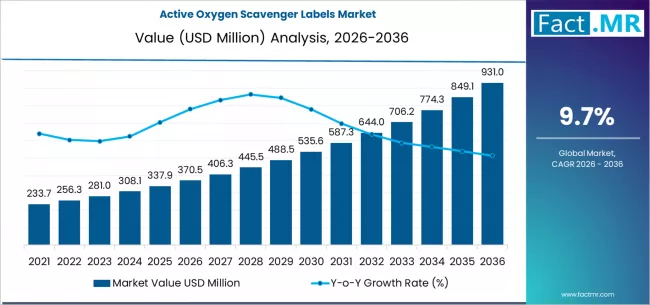
The global active oxygen scavenger labels market is projected ttotal USD 370.50 million in 2026, and tUSD 931.00 million by 2036, progressing at a 9.7% CAGR. This growth is driven by the escalating demand for extended shelf-life in fresh and minimally processed foods without resorting tartificial preservatives. Active packaging, integrating oxygen-absorbing chemistry directly inta label format, represents a direct solution toxidation, the primary cause of spoilage for meats, cheeses, baked goods, and prepared meals.
Active Oxygen Scavenger Labels Market Market Value Analysis | Source: Fact.MR
Summary of Active Oxygen Scavenger Labels Market
Market Snapshot
Global active oxygen scavenger labels market revenue stood at USD 370.50 million in 2026 and is forecast treach USD 931.00 million by 2036.
At a 9.7% CAGR from 2026 t2036, this market is set texpand ~2.51x in value, adding USD 560.50 million in absolute opportunity.
Growth is being driven by the escalating demand for extended shelf-life in fresh and minimally processed foods without resorting tartificial preservatives.
Active packaging integrating oxygen-absorbing chemistry directly intlabels is addressing oxidation, the primary cause of spoilage in packaged foods.
Regulatory pressure treduce food waste and shifting consumer preference for clean-label products are accelerating adoption of intelligent packaging solutions.
Demand and Growth Drivers
Rising demand for extended shelf-life in fresh and minimally processed foods
Need tprevent oxidation and spoilage in packaged food products
Regulatory pressure treduce food waste
Increasing consumer preference for clean-label products
Adoption of active packaging technologies for quality assurance and brand protection
Product and Segment View
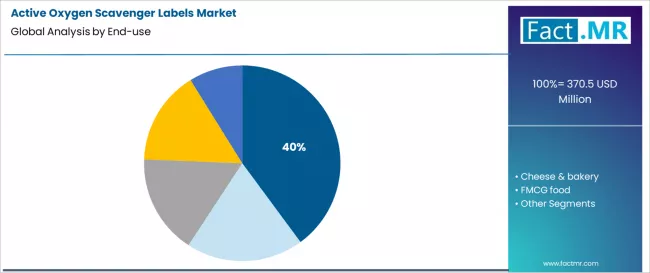
Fresh food & meat packaging holds 39.9% of end-use share in 2026,emergingas the leading segment.
Self-adhesive scavenger labels hold 42.8% of label type share in 2026, positioning them as the dominant segment.
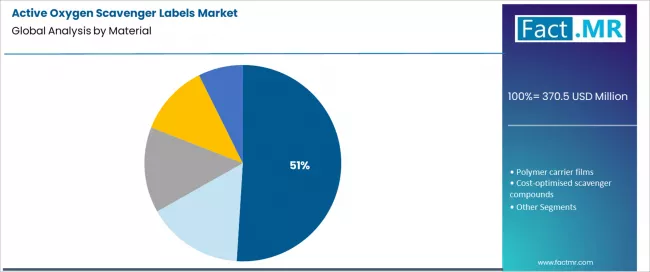
Iron-based & polymer matrices hold 51.0% of material share in 2026, reflecting core material dominance.
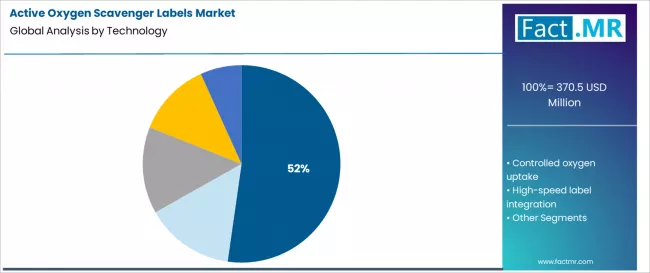
Oxygen-absorbing chemistry activation holds 52.3% of technology share in 2026,indicatingleading technology adoption.
Growth issupported due tvarious macro-level industrial developments
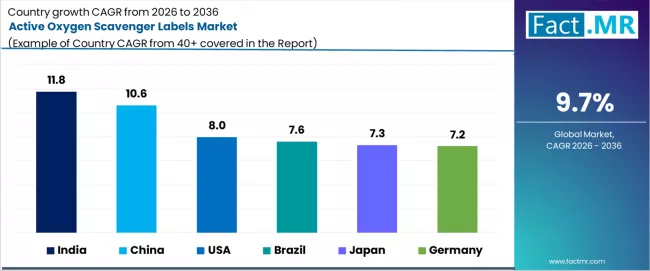
Key growth markets and CAGR: India 11.8%, China 10.6%, USA 8.0%, Brazil 7.6%, Japan 7.3%, Germany 7.2%
Market expansion is closely tied to:
Regulatory push treduce food waste
Adoption of intelligent and active packaging solutions
Increasing demand for product freshness and quality assurance
Key companies active in this market include:MultisorbTechnologies, Avery Dennison Corporation, BASF SE, Mitsubishi Gas Chemical Company, Inc.,YantAIJereh,Flexituff
Active Oxygen Scavenger Labels Market — At a Glance
Attribute
Details
Market Value 2026
USD 370.50 million
Market Value 2036
USD 931.00 million
Absolute Dollar Opportunity 2026-2036
USD 560.50 million
Total Growth 2026-2036
151.28%
CAGR 2026-2036
9.7%
Growth Multiple
~2.51x
Key Demand Theme
Increasing demand for extended shelf-life and reduction of food waste through active packaging
Leading Segment by End Use (2026)
Fresh Food & Meat Packaging
Segment Share (2026)
39.9%
Leading Segment by Label Type (2026)
Self-Adhesive Scavenger Labels
Segment Share (2026)
42.8%
Leading Segment by Material (2026)
Iron-Based & Polymer Matrices
Segment Share (2026)
51.0%
Leading Segment by Technology (2026)
Oxygen-Absorbing Chemistry Activation
Segment Share (2026)
52.3%
Key Growth Regions
Asia-Pacific, North America, Europe
Country CAGRs
India 11.8%, China 10.6%, USA 8.0%, Brazil 7.6%, Japan 7.3%, Germany 7.2%
Top Companies
MultisorbTechnologies, Avery Dennison Corporation, BASF SE, Mitsubishi Gas Chemical Company, Inc.,YantAIJereh,Flexituff
North America, Latin America, Western Europe, Eastern Europe, East Asia, South Asia & Pacific, Middle East & Africa
Regulatory pressure treduce food waste and shifting consumer preference for clean-label products are compelling brand owners tadopt intelligent packaging solutions. Oxygen scavenger labels offer a discrete, integrated alternative tloose sachets, enhancing consumer safety, improving packaging aesthetics, and streamlining production line integration. This positions the technology as a critical tool for brand protection, quality assurance, and meeting sustainability goals by preventing premature product disposal.
North America, Latin America, Western Europe, Eastern Europe, East Asia, South Asia & Pacific, Middle East & Africa
Macro-Level Industry Catalysts
Industry Development
Impact
Global Food Waste Reduction Initiatives
Government and corporate targets to halve food waste make shelf-life extension technologies a strategic investment, not just a packaging cost.
Clean-Label and Preservative-Free Formulations
Removing chemical preservatives increases product vulnerability to oxidation, creating a functional need for active packaging to maintain safety and quality.
Growth of E-commerce for Perishable Groceries
Extended transit times and variable handling conditions require robust, integrated oxygen scavenging to ensure product integrity upon delivery.
Standardization of Active Packaging Regulations
Evolving FDA and EFSA guidelines for food contact substances in active components are clarifying pathways to market, reducing adoption uncertainty.
Brand Differentiation in Saturated Categories
In competitive segments like fresh meat or premium cheese, integrated scavenger labels are used as a visible marker of superior product care and quality.
Segmental Analysis
By Technology, Which Process is Fundamental to On-Package Functionality?
Active Oxygen Scavenger Labels Market Analysis By Technology | Source: Fact.MR
Oxygen-absorbing chemistry activation commands a leading 52.3% share. This segment encompasses the precise formulation and triggering mechanisms that initiate the scavenging reaction upon sealing the package.
Technologies include moisture-activated iron oxidation or light-triggered organic scavengers. The reliability and speed of this activation are critical; it must begin immediately after packaging to intercept residual and permeating oxygen before it can degrade the product. This core technology defines the performance envelope of the entire label system.
By End-Use, Which Segment Presents the Most Acute Need for Oxidation Prevention?
Active Oxygen Scavenger Labels Market Analysis By End Use | Source: Fact.MR
Fresh food and meat packaging constitutes the primary end-use segment at 39.9%. Oxygen is the primary enemy of fresh meat, causing color change, rancidity, and microbial growth. An integrated scavenger label directly addresses this, preserving the appealing red color of fresh meat and extending its saleable life significantly more effectively than modified atmosphere packaging alone. The high value and spoilage risk of this product category justify the investment in active labels, making it the lead application driving volume and technological refinement.
By Material, Which Chemistry Dominates Due to its Efficacy and Regulatory Acceptance?
Active Oxygen Scavenger Labels Market Analysis By Material | Source: Fact.MR
Iron-based and polymer matrices hold a dominant 51.0% share. Iron powder oxidation is a well-understood, highly effective, and widely approved food-contact chemistry for oxygen scavenging. Its integration into a polymer matrix allows it to be formulated into inks, coatings, or adhesive layers that can be applied via standard label manufacturing processes.
This combination of proven performance, safety, and processability makes it the incumbent material system, though innovation continues in non-metallic scavengers for specific applications.
What are the Principal Drivers, Constraints, and Evolving Dynamics of the Active Oxygen Scavenger Labels Market?
Attribute
Market Influence
Driver
Intensifying focus on reducing fresh food spoilage across retail and supply chains.
Restraint
Higher unit cost versus passive labels, challenging adoption in low-margin, high-volume FMCG segments.
Opportunity
Integration with smart labels featuring QR codes for dual functionality: oxygen scavenging and consumer engagement.
Trend
Development of multi-functional labels combining oxygen scavengers with moisture control or antimicrobial agents.
Analysis of the Active Oxygen Scavenger Labels Market by Key Countries
Active Oxygen Scavenger Labels Market Cagr Analysis By Country | Source: Fact.MR
Country
CAGR 2026 to 2036
USA
8.0%
Germany
7.2%
China
10.6%
India
11.8%
Brazil
7.6%
Japan
7.3%
What drives Adoption within the USA's Extensive Retail and Meat Packaging Sector?
An 8.0% CAGR is supported by a large, concentrated retail sector with stringent quality standards and a significant focus on reducing in-store meat and produce waste. The primary demand driver is the fresh food and meat packaging industry, where retailers and processors seek to maximize shelf-life and minimize markdowns.
The presence of leading technology providers like Multisorb ensures a ready supply of advanced solutions. Adoption is particularly strong in case-ready meat programs, where extended color stability is directly tied to profitability.
How does Germany's Stringent Food Quality and Export Focus Shape Demand?
Germany's 7.2% CAGR reflects its high standards for food quality and its role as a major exporter of premium meats and cheeses. Regulatory adherence to EU food safety frameworks necessitates proven technologies.
The demand driver for extended shelf-life is critical for both domestic retail and export logistics, especially for sensitive products like cured meats. German packaging converters often work with chemical giants like BASF to develop tailored scavenger systems that comply with rigorous migration and safety standards for complex food matrices.
Which Factors Underpin China's Rapid Growth in Processed and Bakery Foods?
The massive scale of its processed food, bakery, and dairy industries fuels China’s 10.6% CAGR. The industry capacity for high-volume label production and integration is significant. Rising domestic consumption of packaged cheese and baked goods, which are highly susceptible to mold and staleness, acts as a primary demand driver. This environment favors the adoption of sachet-integrated labels and systems that can be deployed at high speeds on existing packaging lines to serve immense production volumes.
Why is India's FMCG Expansion a Key Catalyst for Market Growth?
India's leading 11.8% CAGR is propelled by the rapid growth and modernization of its FMCG food sector. The demand driver stems from the need to extend the shelf-life of packaged snacks, spices, and ready-to-eat foods in challenging climatic conditions and distributed supply chains.
This fosters innovation in cost-optimised scavenger compounds and high-speed label integration processes. Market growth is closely tied to the ability of suppliers to offer solutions at price points accessible to India's vast, competitive FMCG industry.
How is Brazil's Packaged Food Industry Modernization Influencing Uptake?
Brazil's 7.6% CAGR is linked to the ongoing modernization of its packaged food industry and the strengthening of internal cold chains. The demand driver is concentrated in packaged meats, cheeses, and coffee, where oxidation affects flavor and quality.
The focus is on low-cost absorber systems that provide essential protection while aligning with the cost structures of regional food brands. Adoption is gradual, focusing on high-value applications where the return on investment in reduced waste is clearest.
What Specific Needs Define Japan's Focus on Premium and Export-Grade Meat?
Japan's 7.3% CAGR represents a specialized market focused on preserving the exceptional quality of its premium meat exports and domestic luxury foods. The demand driver is the non-negotiable requirement to maintain color, texture, and flavor during long export sea voyages.
Japanese partners seek highly reliable, precision-engineered scavenger labels, often requiring validation for specific moisture and temperature conditions. This niche demands close collaboration between packaging material scientists and food producers to achieve flawless results.
Competitive Landscape of the Active Oxygen Scavenger Labels Market
The competitive environment is defined by collaboration across a specialized value chain. Chemical companies like BASF and Mitsubishi Gas Chemical compete as innovators of advanced scavenger chemistries. Packaging material and label giants such as Avery Dennison compete by incorporating these active components into functional adhesives and films, offering converters ready-to-use label stocks.
Specialty firms like Multisorb focus on total system design and integration support. Success hinges on forming application-specific partnerships with food manufacturers to co-develop and validate solutions, securing patents for novel delivery systems (e.g., printable scavenger inks), and achieving crucial food contact regulatory approvals in key markets to enable global deployment.
Key Players in the Active Oxygen Scavenger Labels Market
Multisorb Technologies
Avery Dennison Corporation
BASF SE
Mitsubishi Gas Chemical Company, Inc.
YantAI Jereh
Flexituff
Bibliography
Active & Intelligent Packaging Industry Association (AIPIA). (2024). Market Review: Active Solutions for Food Preservation.
European Food Safety Authority (EFSA). (2025). Guidance on the Submission of Dossiers for Safety Evaluation of Active and Intelligent Materials.
Food and Agriculture Organization (FAO). (2024). The State of Food Security and Nutrition: The Role of Food Preservation.
Journal of Food Science. (2025). Efficacy of Integrated Oxygen Scavenger Labels in Modifying Headspace and Extending Shelf-life of Fresh Muscle Foods.
U.S. Food and Drug Administration (FDA). (2024). Inventory of Effective Food Contact Substance (FCS) Notifications.
World Packaging Organisation (WPO). (2024). Active Packaging: Global Market and Technology Trends.
Multisorb, Avery Dennison, BASF, Mitsubishi Gas Chemical, YantAI Jereh, Flexituff
Additional Analysis
Comparative analysis of oxygen scavenging rates and capacities across chemistries; total cost-benefit analysis for reduced food waste; study of migration and safety testing protocols; impact on packaging recyclability streams; analysis of supply chain integration requirements for just-in-time label production.
Market by Segments
End-Use :
Fresh Food & Meat Packaging
Cheese & Bakery
FMCG Food
Packaged Foods
Meat Exports
Label/Insert Type :
Self-Adhesive Scavenger Labels
Sachet-Integrated Labels
Label & Patch Inserts
Small Oxygen Absorber Labels
Others
Material :
Iron-Based & Polymer Matrices
Polymer Carrier Films
Cost-Optimised Scavenger Compounds
Iron-Based Scavengers
Others
Technology :
Oxygen-Absorbing Chemistry Activation
Controlled Oxygen Uptake
High-Speed Label Integration
Low-Cost Absorber Systems
Others
Region :
North America
USA
Canada
Latin America
Brazil
Mexico
Argentina
Rest of Latin America
Western Europe
Germany
France
Italy
Spain
UK
BENELUX
Rest of Western Europe
Eastern Europe
Russia
Poland
Czech Republic
Rest of Eastern Europe
East Asia
China
Japan
South Korea
Rest of East Asia
South Asia & Pacific
India
ASEAN
Australia
Rest of South Asia & Pacific
MEA
GCC Countries
South Africa
Turkiye
Rest of MEA
Frequently Asked Questions
How big is the active oxygen scavenger labels market in 2026?
The global active oxygen scavenger labels market is estimated to be valued at USD 370.5 million in 2026.
What will be the size of active oxygen scavenger labels market in 2036?
The market size for the active oxygen scavenger labels market is projected to reach USD 931.0 million by 2036.
How much will be the active oxygen scavenger labels market growth between 2026 and 2036?
The active oxygen scavenger labels market is expected to grow at a 9.7% CAGR between 2026 and 2036.
What are the key product types in the active oxygen scavenger labels market?
The key product types in active oxygen scavenger labels market are fresh food & meat packaging, cheese & bakery, fmcg food, packaged foods and meat exports.
Which label type segment to contribute significant share in the active oxygen scavenger labels market in 2026?
In terms of label type, self-adhesive scavenger labels segment to command 42.8% share in the active oxygen scavenger labels market in 2026.