- Market Value (2025): USD 167.1 Mn
- Estimated Value (2026): USD 174.0 Mn
- Forecast Value (2036): USD 259.0 Mn
- CAGR (2026-2036): 4.1%
What is the Reactive Binder Pigments Market forecast to be worth by 2036?
USD 174.0 million in 2026 to USD 259.0 million by 2036, at 4.1% CAGR.
- The USD 167.1 million valuation in 2025 reflects a developed specialty market serving formulators that cannot treat pigment and binder selection as separate decisions.
- Revenue is projected to rise from USD 174.0 million in 2026 to USD 259.0 million in 2036 as coatings, inks, adhesives, and construction-chemical producers tighten compatibility requirements.
- The 4.1% CAGR rests on recurring formulation work around faster wetting, stable let-down, lower flocculation, and resistance after the binder has cured.
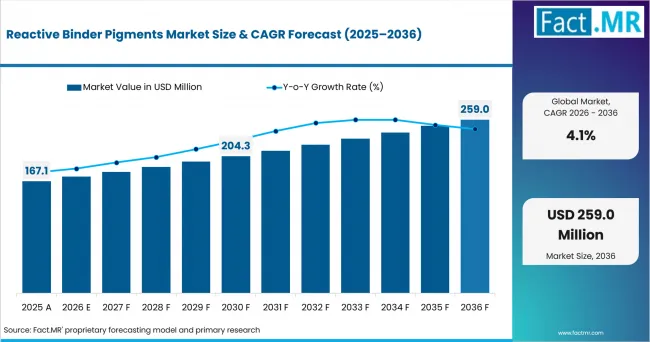
Reactive Binder Pigments Market Value Analysis | Source: Fact.MR
What are the defining numbers behind Reactive Binder Pigments Market growth?
USD 85.0 million absolute opportunity by 2036, led by Acrylic binders and Industrial coatings within their respective segments.
- Demand Drivers in the Market
- Industrial coating formulators need pigments that disperse predictably without weakening adhesion, gloss, or chemical resistance in the finished film.
- Waterborne systems create demand for preparations that wet efficiently while preserving storage stability under a narrower additive window.
- Ink and adhesive producers are buying more application-ready formats when avoided milling time and batch corrections outweigh the premium over dry powder.
- Resin producers increasingly use pigment compatibility as part of technical-service packages built around acrylic, polyurethane, epoxy, and hybrid platforms.
- Key Segments Analyzed
- By Binder Chemistry: The 2026 Binder Chemistry segment is defined by Acrylic binders since acrylic platforms span waterborne and solvent-borne coatings with broad pigment requirements.
- By Application: Application demand in 2026 clusters around Industrial coatings more than around any other category. Film appearance and protection must survive demanding substrates and service conditions.
- By Pigment Format: Equipped formulators want concentrated color and freedom to choose their own milling package. As a result the largest 2026 Pigment Format position goes to Binder-compatible powder.
- By Performance Need: The 2026 Performance Need field is led by Binder wetting since poor initial wetting prevents later dispersion and color development from stabilizing.
- By Buyer Type: No Buyer Type category matches the 2026 performance of Coating formulators. They manage the widest combination of resin families, substrates, and finish requirements.
- Analyst Opinion at Fact.MR
- Shambhu Nath Jha, Senior Analyst at Fact.MR, states, "A reactive-binder pigment wins on what happens after it enters the resin, not on dry-powder color alone. Commercial success will depend on showing formulators how wetting, dispersion stability, and cured-film properties behave in the exact chemistry they intend to sell."
- Strategic Implications
- Pigment manufacturers should organize technical data by binder chemistry and cure route so buyers can screen grades before a full mill-base trial.
- Coating companies can cut reformulation risk by testing color development, viscosity drift, gloss, and chemical resistance in a single approval sequence.
- Resin suppliers have an opening to qualify matched pigment packages that make a new binder easier for customers to adopt.
- Specialty distributors need small-lot sampling and formulation records because local technical support can matter as much as nominal pigment price.
Official supplier portfolios already bridge pigment and resin decisions: DIC lists processed pigments for waterborne coatings, and Sudarshan publishes formulations across polyurethane, epoxy, alkyd, and acrylic systems. This product architecture supports a market defined by verified binder compatibility rather than an assumption of universal chemical reactivity.
United States 5.1% CAGR. China 6.1% CAGR. Germany 4.8% CAGR. Japan 4.9% CAGR. South Korea 5.3% CAGR.
How does the Reactive Binder Pigments Market break down by segment?
The leading segments are Acrylic binders by Binder Chemistry and Industrial coatings by Application.
Why do acrylic binders anchor the largest compatibility pool?
In 2026, the leading position goes to Acrylic binders because acrylic platforms span waterborne and solvent-borne coatings with broad pigment requirements.
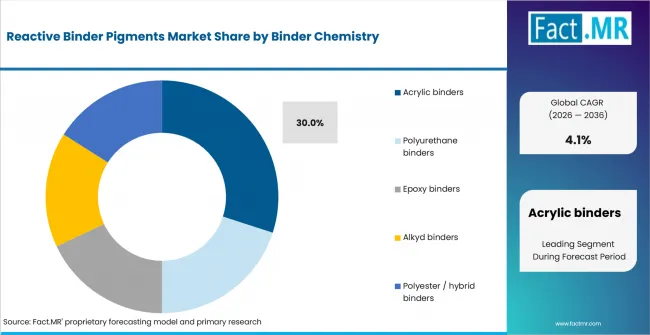
Reactive Binder Pigments Market Analysis By Binder Chemistry | Source: Fact.MR
Acrylic binders lead demand, ahead of polyurethane binders and epoxy binders. Their reach across architectural, industrial, and specialty finishes creates many opportunities for grades that wet cleanly and remain stable during let-down. Polyurethane and epoxy systems impose different cure and resistance demands, so their pigment approvals tend to be narrower and more formulation-specific.
What makes industrial coatings the leading application?
The 2026 leader is Industrial coatings as film appearance and protection must survive demanding substrates and service conditions.
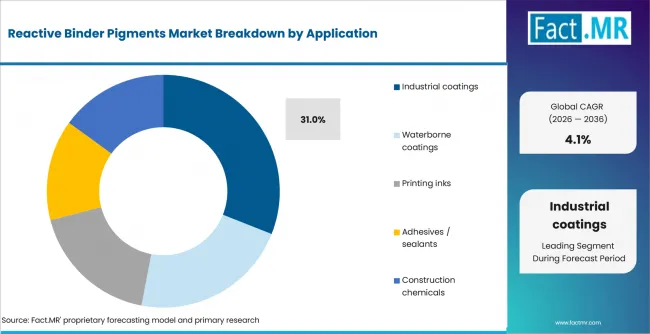
Reactive Binder Pigments Market Analysis By Application | Source: Fact.MR
Industrial coatings lead the market, while waterborne coatings follow. A pigment that causes flocculation, gloss loss, or poor film integrity can compromise both appearance and protective performance, which raises the value of binder-specific evidence. Printing inks emphasize flow and color development, whereas adhesives and sealants place more weight on cohesion, cure, and bond-line behavior.
Why does binder-compatible powder retain the largest format share?
Binder-compatible powder ranks first in 2026 because equipped formulators want concentrated color and freedom to choose their own milling package.
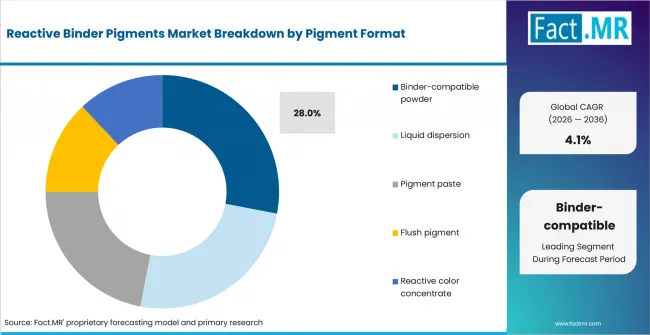
Reactive Binder Pigments Market Analysis By Pigment Format | Source: Fact.MR
Binder-compatible powder leads, followed closely by liquid dispersion and pigment paste. Powder suits producers with established dispersion assets and gives them control over resin, solvent, and additive selection. Liquid dispersions and pastes move more of the compatibility work upstream, which can shorten batch preparation but requires confidence in the reported carrier.
Why is binder wetting the first performance gate?
For Performance Need, the top 2026 position is Binder wetting since poor initial wetting prevents later dispersion and color development from stabilizing.
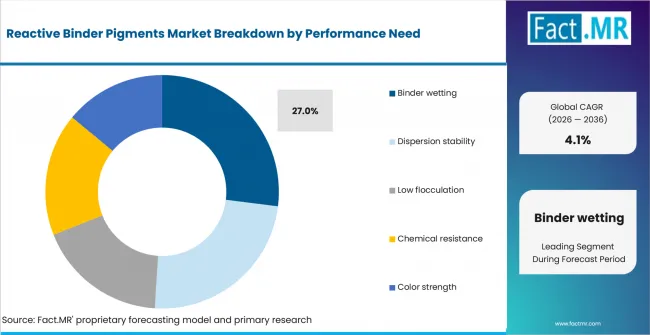
Reactive Binder Pigments Market Analysis By Performance Need | Source: Fact.MR
Binder wetting leads performance demand, just ahead of dispersion stability. Rapid incorporation has limited value if particles later reagglomerate, so buyers examine both the early mill-base response and the stored formulation. Low flocculation, chemical resistance, and color strength then determine whether the selected grade remains viable through application and cure.
Why do coating formulators account for the largest buyer group?
The leading 2026 position belongs to Coating formulators because they manage the widest combination of resin families, substrates, and finish requirements.
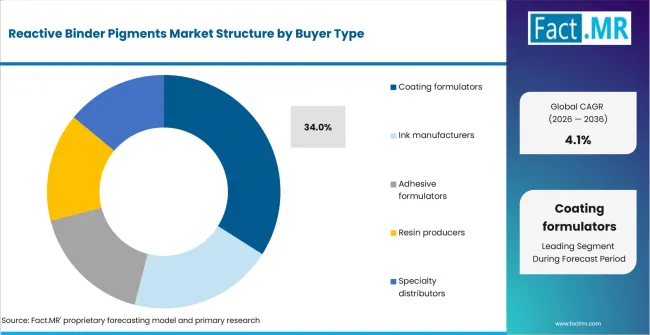
Reactive Binder Pigments Market Analysis By Buyer Type | Source: Fact.MR
Coating formulators lead the buyer base, well ahead of ink manufacturers. They must balance color with adhesion, gloss, weathering, corrosion protection, and chemical exposure, making compatibility failures expensive to correct late in development. Adhesive formulators and resin producers buy against different performance screens, while specialty distributors extend application support to customers without large internal laboratories.
What is accelerating Reactive Binder Pigments Market adoption, and what is holding it back?
The leading accelerator is the need to remove pigment-binder incompatibility before scale-up or customer qualification. The central restraint is that proof from one resin platform rarely transfers without additional work to another.
Drivers Impact Analysis
| DRIVER | (~) % IMPACT ON CAGR | GEOGRAPHIC RELEVANCE | IMPACT TIMELINE |
|---|---|---|---|
| Waterborne formulation conversion | +0.6% | Europe, North America, Japan, and South Korea | Long term (>= 4 years) |
| Industrial film performance | +0.5% | Global | Medium term (2-4 years) |
| Shorter dispersion cycles | +0.5% | United States, Germany, and South Korea | Short term (<= 2 years) |
| Resin-pigment co-qualification | +0.4% | Japan, Germany, and United States | Medium term (2-4 years) |
| Application technical service | +0.3% | Asia Pacific and emerging manufacturing markets | Long term (>= 4 years) |
Source: Fact.MR analysis. Updated Jul 20, 2026
- Waterborne formulation conversion: Waterborne coatings make wetting and storage stability visible because the formulator has less latitude to hide poor compatibility with strong solvent packages. Prepared pigments and acrylic-supported dispersions can reduce that friction when their carrier matches the final resin.
- Industrial film performance: Industrial customers approve color and protection together. Pigments that preserve gloss, adhesion, and chemical resistance across the cure cycle are more likely to remain specified through repeat production.
- Shorter dispersion cycles: Pre-dispersions and compatible pastes can remove a milling step or reduce correction additions for plants with limited color capacity. The economic argument strengthens when faster changeovers release equipment for higher-value batches.
Opportunity Impact Analysis
| OPPORTUNITY | (~) % IMPACT ON CAGR | GEOGRAPHIC RELEVANCE | IMPACT TIMELINE |
|---|---|---|---|
| Binder-matched dispersion families | +0.3% | Global | Medium term (2-4 years) |
| Low-flocculation concentrates | +0.3% | Europe, Japan, South Korea, and United States | Long term (>= 4 years) |
| Distributor formulation labs | +0.2% | Southeast Asia | Short term (<= 2 years) |
| Construction-chemical coloration | +0.2% | United States, Germany, and Italy | Medium term (2-4 years) |
Source: Fact.MR analysis. Updated Jul 20, 2026
- Binder-matched dispersion families: Separate acrylic, polyurethane, and epoxy-compatible dispersion ranges would let formulators start closer to a viable recipe. Clear limits on cross-compatibility would make the offer more credible than a universal-use claim.
- Low-flocculation concentrates: High-performance finishes need shade and gloss to remain stable after storage and application. Concentrates supported by flocculation and rheology data can earn a premium in appearance-sensitive coating and ink systems.
- Distributor formulation labs: Regional distributors can screen pigments in locally common resins before a customer commits plant time. That service is particularly valuable for small batches and multi-supplier formulation portfolios.
Restraints Impact Analysis
| RESTRAINT | (~) % IMPACT ON CAGR | GEOGRAPHIC RELEVANCE | IMPACT TIMELINE |
|---|---|---|---|
| Resin-specific test burden | -0.3% | Global | Short term (<= 2 years) |
| Carrier incompatibility | -0.2% | Global | Medium term (2-4 years) |
| Scale-up variability | -0.2% | Asia Pacific, Europe, and North America | Medium term (2-4 years) |
| Ambiguous product terminology | -0.1% | Global | Long term (>= 4 years) |
Source: Fact.MR analysis. Updated Jul 20, 2026
- Resin-specific test burden: A positive result in one acrylic or epoxy grade does not establish compatibility across the whole chemistry family. Repeated testing lengthens substitution cycles and favors incumbent pigments with extensive formulation history.
- Carrier incompatibility: A liquid dispersion can simplify incorporation yet introduce a resin, surfactant, or solvent that conflicts with the customer's system. Buyers therefore examine the full preparation rather than just the pigment it contains.
- Scale-up variability: Laboratory wetting and dispersion results can shift with mill energy, order of addition, temperature, and batch size. Suppliers must support plant trials before customers will accept a formulation-critical change.
How does reactive binder pigment demand map by country?
United States 5.1% CAGR. Germany 4.8% CAGR. Japan 4.9% CAGR. South Korea 5.3% CAGR.
Regional analysis covers country chapters on United States, China, Germany, Japan, and South Korea. Analysis on more than 30 countries is included in the full report.
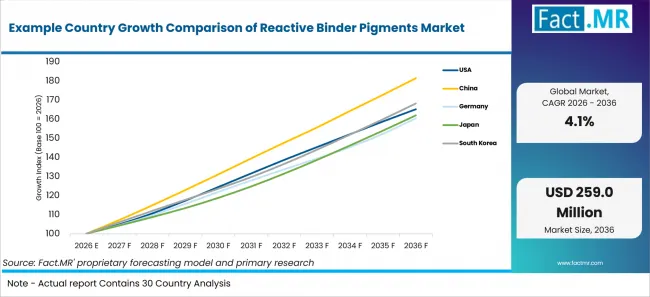
Example Country Growth Comparison Of Reactive Binder Pigments Market | Source: Fact.MR
| COUNTRY | CAGR |
|---|---|
| United States | 5.1% |
| Germany | 4.8% |
| Japan | 4.9% |
| South Korea | 5.3% |
Source: Fact.MR analysis. Updated Jul 20, 2026
How is the United States market likely to develop?
A 5.1% CAGR is projected for United States during 2026-2036.
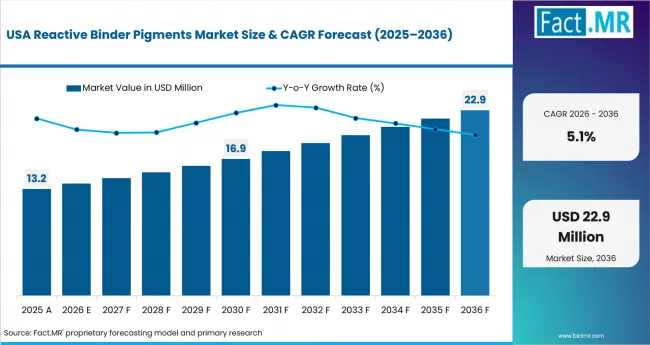
Reactive Binder Pigments Market Country Value Analysis | Source: Fact.MR
Binder pigment approvals in the United States move through the same technical files that coatings and ink formulators already keep for EPA chemical reporting, so a new grade is judged as much on its paper trail as on its wet-out behavior. A large, standardized manufacturing base means one successful qualification at a major coatings producer can carry weight with smaller regional formulators sourcing the same resin platforms.
For reactive binder pigments, the country mechanism reaches binder compatibility, dispersion stability, and conversion to waterborne or lower-emission coating systems.
Because acrylic and waterborne coatings dominate US production, suppliers that can show flocculation and gloss-retention data in those specific resin families tend to clear technical review faster than those offering only general-purpose compatibility claims.
How is the Germany market likely to develop?
A 4.8% CAGR is projected for Germany during 2026-2036.
German buyers fold pigment approval into the same REACH substance-tracking discipline that governs the rest of their raw-material list, which makes traceability as much a purchasing criterion as dispersion performance. A production base weighted toward precision coatings and industrial finishes leaves little tolerance for batch-to-batch shade drift once a grade is locked into a qualified formulation.
For reactive binder pigments, the country mechanism reaches binder compatibility, dispersion stability, and conversion to waterborne or lower-emission coating systems.
Formulators here are also more likely to specify polyurethane and epoxy binder chemistries than the global average, so pigment suppliers without resin-specific compatibility data for those systems face a narrower opening than in more acrylic-dominated markets.
How is the Japan market likely to develop?
A 4.9% CAGR is projected for Japan during 2026-2036.
Japanese coating and ink producers tend to run long-standing, tightly controlled formulations, so a pigment change is treated as a production-line risk to be minimized rather than a routine substitution. Chemical-management and consumer-safety review adds a documentation step that most global suppliers already anticipate, but the bigger hurdle is usually proving that a new grade will not require any adjustment elsewhere in an established process.
For reactive binder pigments, the country mechanism reaches binder compatibility, dispersion stability, and conversion to waterborne or lower-emission coating systems.
Local technical support therefore carries outsized weight relative to price: suppliers able to run compatibility trials with the customer's own resin batch, rather than a generic reference formulation, are better positioned to displace an incumbent grade.
How is the South Korea market likely to develop?
A 5.3% CAGR is projected for South Korea during 2026-2036.
South Korea's coatings and ink sector is heavily export-oriented, so pigment suppliers are often qualifying against the specification standards of the buyer's overseas customers as much as domestic rules. Fast product cycles common in electronics-adjacent and automotive-supply coatings leave little room for a compatibility issue to surface late in a qualification run.
For reactive binder pigments, the country mechanism reaches binder compatibility, dispersion stability, and conversion to waterborne or lower-emission coating systems.
That combination favors pigment formats -- pastes and dispersions in particular -- that shorten the supplier's own qualification timeline, since a faster internal approval directly protects the customer's ability to hit export delivery windows.
Who leads the Reactive Binder Pigments Market?
Sudarshan Chemical, DIC, Lanxess, and Chromaflo Technologies compete by linking pigment portfolios to practical resin and formulation support.
Product form is a major competitive lever. DIC and Lanxess show how processed pigments and pre-dispersions can remove work from the customer's plant, while Sudarshan's formulation pages demonstrate the value of evidence across polyurethane, epoxy, alkyd, and acrylic systems.
Which companies are the key providers?
The company set includes Chromaflo Technologies, Sudarshan Chemical, DIC, and Lanxess.
- Sudarshan Chemical
- Chromaflo Technologies
- DIC
- Lanxess
The five names above frame the comparison, and the complete study covers more than 30 companies in pigment preparations and binder-compatible color.
Bibliography
- EPA coatings resources.
- BASF dispersions portfolio.
- ECHA REACH registration.
- [US-1] U.S. Environmental Protection Agency. Chemicals under TSCA.
- [US-2] U.S. Census Bureau. Manufacturing.
- [DE-1] European Chemicals Agency. REACH restriction.
- [DE-2] Federal Statistical Office of Germany. Manufacturing statistics.
- [JP-1] Ministry of Economy, Trade and Industry. Chemical management.
- [KR-1] Ministry of Environment. Korea environmental policy.
- [KR-2] Statistics Korea. Industry statistics.
This Report Addresses
- The report explains how wetting, flocculation, and cured-film behavior shape reactive binder pigment selection.
- It reviews United States, China, Germany, Japan, and South Korea, within coverage that reaches more than 30 countries.
- Competition coverage benchmarks Chromaflo Technologies, Sudarshan Chemical, DIC, and Lanxess.
- Product analysis separates powders, liquid dispersions, pastes, flush pigments, and reactive color concentrates.
- Application assessment spans industrial and waterborne coatings, printing inks, adhesives and sealants, and construction chemicals.
- Forecast evidence connects market value with binder chemistry, buyer type, technical-service intensity, and qualification timing.
What does the Reactive Binder Pigments Market cover?
Pigments and prepared colorants sold on demonstrated compatibility with acrylic, polyurethane, epoxy, alkyd, or polyester and hybrid binders.
The report measures the colorant value entering industrial coatings, waterborne coatings, printing inks, adhesives and sealants, and construction chemicals. It retains the source taxonomy across binder chemistry, application, pigment format, performance need, and buyer type.
The geographic scope reaches more than 30 countries, led by the United States and Europe, with 30+ suppliers reviewed; revenue is forecast in USD million for 2026-2036.
What is included in the scope?
Included products range from compatible dry powders to carrier-supported pastes and dispersions.
The product boundary includes grades positioned for binder wetting, dispersion stability, low flocculation, chemical resistance, or color strength. Surface treatment, resin support, and preparation format are considered where they form part of the sold pigment product.
Buyer coverage includes coating and adhesive formulators, ink manufacturers, resin producers, and specialty distributors purchasing within the source-defined applications.
What is excluded from the scope?
The value of complete downstream formulations and unsupported claims of chemical reactivity are outside the market.
Finished coatings, inks, adhesives, sealants, and construction products are not counted at their full sales value. Generic pigments without a binder-compatibility proposition and colorants used outside the reported application taxonomy are excluded.
How Was the Analysis Built?
The analysis draws on 120+ sources, 35+ company portfolios, 25+ countries, and more than 20 industry interviews.
- Primary Research: Primary research includes discussions with manufacturers, service providers, technology developers, distributors, end users, procurement teams, and subject-matter experts. These conversations examine purchasing priorities, product adoption, operational challenges, approval requirements, competitive positioning, and the factors that influence wider market acceptance.
- Desk Research: Desk research covers government statistics, regulatory publications, company filings, trade data, technical studies, industry associations, standards, public policy, and other authoritative sources. Every source used in the analysis is documented in the bibliography.
- Market Sizing and Forecasting: Market estimates combine historical performance, demand indicators, pricing and volume trends, segment shares, company participation, country-level growth, adoption patterns, investment activity, and barriers to market expansion.
- Data Validation and Update Cycle: Findings are validated by comparing primary interviews with public data, company activity, regulatory changes, trade patterns, and industry developments. Regular updates review new product launches, capacity changes, partnerships, approvals, procurement trends, and shifts in commercial adoption.
Segmentation
What is the report's scope and coverage?
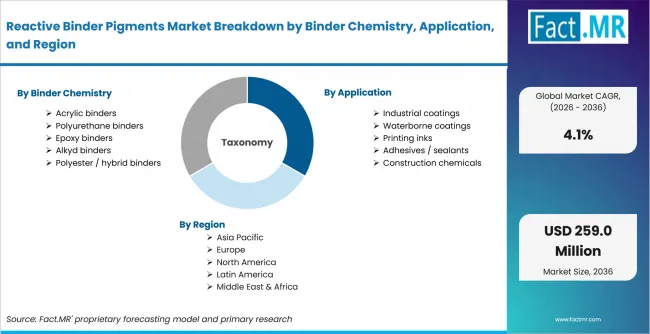
Reactive Binder Pigments Market Breakdown By Binder Chemistry, Application, And Region | Source: Fact.MR
| ATTRIBUTE | DETAILS |
|---|---|
| Quantitative Units | USD Million in 2026 to USD Million by 2036 at CAGR |
| Market Definition | The market covers pigment powders and prepared colorants engineered and validated to wet, disperse, and perform compatibly in specified binder systems used for coatings, inks, adhesives, sealants, and construction chemicals. |
| Binder Chemistry | Acrylic binders; Polyurethane binders; Epoxy binders; Alkyd binders; Polyester / hybrid binders |
| Application | Industrial coatings; Waterborne coatings; Printing inks; Adhesives / sealants; Construction chemicals |
| Pigment Format | Binder-compatible powder; Liquid dispersion; Pigment paste; Flush pigment; Reactive color concentrate |
| Performance Need | Binder wetting; Dispersion stability; Low flocculation; Chemical resistance; Color strength |
| Buyer Type | Coating formulators; Ink manufacturers; Adhesive formulators; Resin producers; Specialty distributors |
| Regions Covered | North America; Europe; Asia Pacific |
| Countries Covered | United States; Germany; Japan; South Korea (analysis extends to 30+ countries) |
| Key Companies Profiled | Lanxess; Sudarshan Chemical; DIC
Chromaflo Technologies |
| Forecast Period | 2026 to 2036 |
| Approach |
Demand is evaluated using binder-compatible pigment shipment volumes by format, resin-chemistry adoption rates, formulation-grade dispersion output, buyer qualification cycle length, and supplier pricing across pigment formats. |
Source: Fact.MR analysis. Updated Jul 20, 2026
How is the market segmented?
-
By Binder Chemistry:
- Acrylic binders
- Polyurethane binders
- Epoxy binders
- Alkyd binders
- Polyester / hybrid binders
-
By Application:
- Industrial coatings
- Waterborne coatings
- Printing inks
- Adhesives / sealants
- Construction chemicals
-
By Pigment Format:
- Binder-compatible powder
- Liquid dispersion
- Pigment paste
- Flush pigment
- Reactive color concentrate
-
By Performance Need:
- Binder wetting
- Dispersion stability
- Low flocculation
- Chemical resistance
- Color strength
-
By Buyer Type:
- Coating formulators
- Ink manufacturers
- Adhesive formulators
- Resin producers
- Specialty distributors
-
By Region:
- North America
- United States
- Europe
- Germany
- Asia Pacific
- China
- Japan
- South Korea
- South Asia
- India
- Latin America
- Brazil
- Middle East and Africa
- Morocco
- Saudi Arabia
- Russia
- United Arab Emirates
- Italy
- United Kingdom
- North America
Frequently Asked Questions
What is the Reactive Binder Pigments Market forecast for 2036?
Which binder chemistry leads demand?
Which application has the largest share?
What is the leading pigment format?
Which performance need ranks first?
What is the main adoption barrier?
Who worked on this report


Preview the report firsthand - request a free sample
Free SampleGet the brochure for pricing and purchase details
Download PDF