- Market Value (2025): USD 95.9 Mn
- Estimated Value (2026): USD 101.0 Mn
- Forecast Value (2036): USD 170.0 Mn
- CAGR (2026-2036): 5.3%
What is the Reactive Resin Pigments Market forecast to be worth by 2036?
USD 101.0 million in 2026 to USD 170.0 million by 2036, at 5.3% CAGR.
- The market was valued at approximately USD 95.9 million in 2025, reflecting established pigment demand in epoxy, polyester, polyurethane, acrylic, and hybrid resin systems.
- Revenue is projected to move from USD 101.0 million in 2026 to USD 170.0 million by 2036 as colored coatings, composites, castings, gelcoats, adhesives, and sealants require more application-specific pigment packages.
- A 5.3% CAGR is supported by the need for stable cure behavior, durable color in chemically exposed parts, and supply forms that reduce dispersion work without introducing an incompatible carrier.
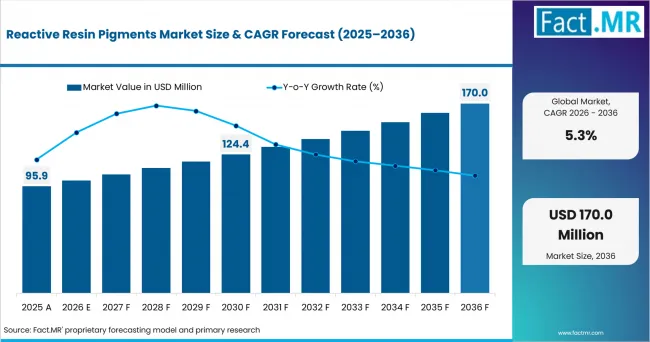
Reactive Resin Pigments Market Value Analysis | Source: Fact.MR
What are the defining numbers behind Reactive Resin Pigments Market growth?
USD 69.0 million absolute opportunity by 2036, led by Epoxy resins and Industrial coatings within their respective segments.
- Demand Drivers in the Market
- Epoxy and unsaturated polyester formulators need pigments that disperse before cure and remain visually uniform after crosslinking.
- Industrial coatings create demand for color that withstands chemical contact, heat, weather, and film-building conditions.
- Composite and casting producers value pastes or dispersions that lower dust and shorten incorporation without weakening mechanical or cure performance.
- Customers increasingly qualify the pigment inside the complete resin, hardener, filler, and additive package because individual raw-material results do not predict the cured article.
- Key Segments Analyzed
- By Resin System: Few Resin System categories rival Epoxy resins in 2026. They span protective coatings, castings, adhesives, composites, and electrically or chemically demanding parts.
- By Application: Within Application the 2026 lead goes to Industrial coatings because cured films must hold color through heat, chemical contact, and weather exposure.
- By Pigment Type: Among 2026 Pigment Type categories none matches High-performance pigments. Demanding heat, weather, and chemical requirements justify their premium.
- By Performance Need: Few Performance Need categories rival the 2026 position held by Reactive system stability since an otherwise attractive pigment fails if it changes cure, separates, or becomes incompatible before the part is made.
- By Supply Form: In the Supply Form field first place for 2026 goes to Powder pigment because it gives experienced formulators maximum freedom over resin, carrier, loading, and dispersion method.
- Analyst Opinion at Fact.MR
- Shambhu Nath Jha, Senior Analyst at Fact.MR, states, "Reactive-resin color is a systems problem hidden inside a pigment purchase. Suppliers gain credibility when they show what the colorant does to pot life, cure, viscosity, surface, and long-term resistance as well as the initial shade."
- Strategic Implications
- Pigment makers should organize compatibility data by resin and curing route, with clear limits on the carrier used in pastes and liquid concentrates.
- Coating formulators need to compare shade after full cure because exotherm, film thickness, and binder yellowing can change the visible result.
- Composite manufacturers should test colorant influence on wet-out and laminate quality before shifting from powder to a convenient dispersion.
- Distributors can improve sample conversion by collecting the customer's resin, hardener, filler loading, cure schedule, and final exposure conditions at the start.
DIC's 2026 PAINTINDIA program placed acrylic, epoxy, and polyester coating resins beside organic, inorganic, and effect pigments and pigment preparations. That combined presentation reflects the practical direction of the market: pigment selection is increasingly discussed with the host resin and required coating performance in view.
How does the Reactive Resin Pigments Market break down by segment?
The leading segments are Epoxy resins by Resin System and Industrial coatings by Application.
Why are epoxy resins the largest resin-system base?
In 2026, the leading position goes to Epoxy resins because they span protective coatings, castings, adhesives, composites, and electrically or chemically demanding parts.
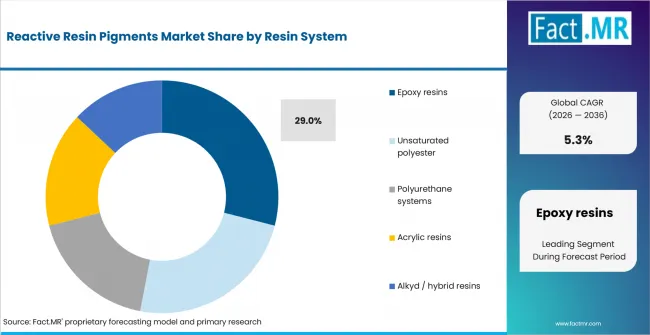
Reactive Resin Pigments Market Analysis By Resin System | Source: Fact.MR
Epoxy resins lead resin-system demand and combine broad use with exacting cure and resistance requirements. Unsaturated polyester follows, with a strong connection to composites and gelcoats where wet-out and surface finish matter. Polyurethane systems and acrylic resins introduce different polarity, reactivity, and weathering conditions, preventing one dispersion from serving every system equally.
How do composites shape reactive-pigment requirements?
Composites rank second in 2026 to industrial coatings, because color must integrate with fiber wet-out, filled resin flow, and the cured structure.
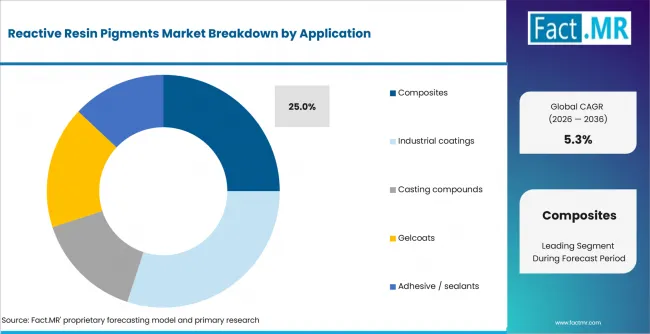
Reactive Resin Pigments Market Analysis By Application | Source: Fact.MR
Composites hold a meaningful share of application demand and require colorants that do not disrupt impregnation or cure. Industrial coatings are larger, placing greater weight on film appearance and exposure resistance. Gelcoats and casting compounds often use thicker sections, where exotherm and opacity can alter final color.
Where do organic azo pigments fit in the type mix?
Organic azo pigments rank just behind high-performance pigments in 2026, because they provide practical shade breadth and cost for many general reactive-resin colors.
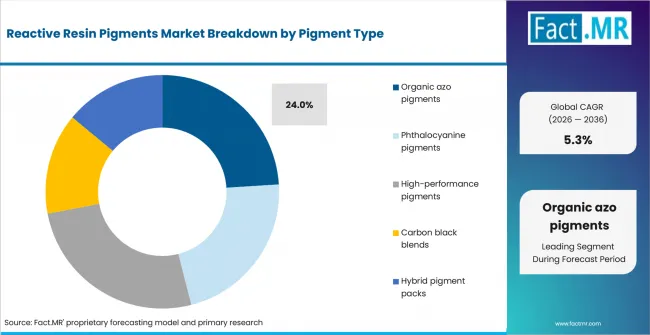
Reactive Resin Pigments Market Analysis By Pigment Type | Source: Fact.MR
Organic azo pigments hold a solid share of pigment-type demand and provide an accessible route to red, orange, and yellow shades. High-performance pigments are slightly larger, reflecting applications that need stronger heat, weather, or chemical durability. Phthalocyanine pigments follow, while carbon black blends and hybrid pigment packs contribute for dark shades or balanced performance.
Why does reactive-system stability rank first?
For Performance Need, the top 2026 position is Reactive system stability because an otherwise attractive pigment fails if it changes cure, separates, or becomes incompatible before the part is made.
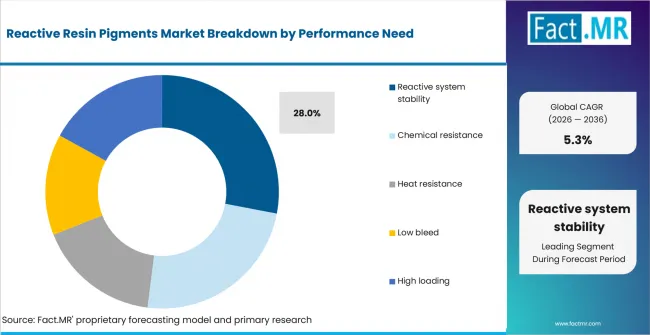
Reactive Resin Pigments Market Analysis By Performance Need | Source: Fact.MR
Reactive system stability leads and captures the central requirement that color must coexist with resin and hardener. Chemical resistance follows, tying the pigment to the service environment of the cured article. Heat resistance and high loading pose different challenges: one protects shade under temperature while the other preserves processability at deeper color.
Why does powder pigment remain the leading form?
The leading 2026 position belongs to Powder pigment because it gives experienced formulators maximum freedom over resin, carrier, loading, and dispersion method.
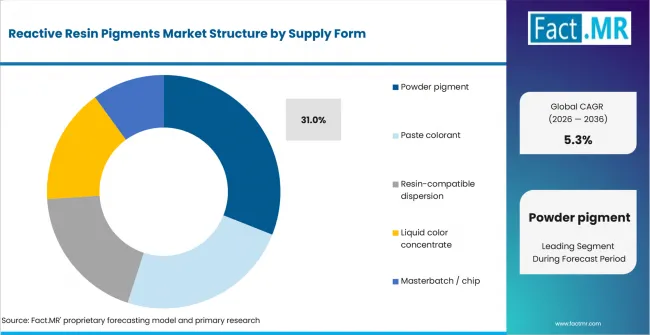
Reactive Resin Pigments Market Analysis By Supply Form | Source: Fact.MR
Powder pigment leads supply-form demand and avoids introducing a supplier-selected vehicle. Paste colorant follows, offering easier dosing where its carrier is compatible with the cure system. Resin-compatible dispersion and liquid color concentrate reduce processing work, yet every convenience claim depends on stability in the customer's exact formulation.
What is accelerating Reactive Resin Pigments Market adoption, and what is holding it back?
The main accelerator is the need to combine durable, designed color with the structural and protective functions of cured resins. Adoption slows when colorant qualification must be repeated across resin, hardener, filler, cure schedule, and end-use exposure.
Drivers Impact Analysis
| DRIVER | (~) % IMPACT ON CAGR | GEOGRAPHIC RELEVANCE | IMPACT TIMELINE |
|---|---|---|---|
| Durable industrial finishes | +0.8% | United States, Germany, and the United Kingdom | Medium term (2-4 years) |
| Composite coloration | +0.7% | Asia Pacific and North America | Long term (>= 4 years) |
| Application-ready dispersions | +0.6% | Japan and South Korea | Short term (<= 2 years) |
| Chemical-resistance targets | +0.5% | Global industrial markets | Medium term (2-4 years) |
| Resin-system diversification | +0.4% | Global | Long term (>= 4 years) |
Source: Fact.MR analysis. Updated Jul 20, 2026
- Durable industrial finishes: Industrial coatings are the largest application. Their performance demands support pigments that retain shade while the cured film faces heat, chemicals, or weather.
- Composite coloration: Color can be built into composite parts, gelcoats, and casting resins rather than applied later. This creates pigment demand but adds wet-out, cure, and thickness variables to approval.
- Application-ready dispersions: Resin-compatible dispersions can simplify dosing and reduce powder handling. Buyers will adopt them when carrier identity, pigment content, and cure neutrality are demonstrated.
Opportunity Impact Analysis
| OPPORTUNITY | (~) % IMPACT ON CAGR | GEOGRAPHIC RELEVANCE | IMPACT TIMELINE |
|---|---|---|---|
| Cure-neutral color packages | +0.4% | United States, Germany, and Japan | Medium term (2-4 years) |
| Epoxy dispersion libraries | +0.4% | South Korea and Japan | Short term (<= 2 years) |
| High-performance shade conversion | +0.3% | Europe and North America | Long term (>= 4 years) |
| Low-dust composite colors | +0.3% | Asia Pacific | Medium term (2-4 years) |
Source: Fact.MR analysis. Updated Jul 20, 2026
- Cure-neutral color packages: Suppliers can differentiate with evidence that a colorant does not materially change pot life, cure completion, or film properties in defined systems. This is more persuasive than an unsupported statement of resin compatibility.
- Epoxy dispersion libraries: Epoxy resins lead the system mix. Dispersions matched to common epoxy and hardener families can shorten customer screening while preserving room for custom shade work.
- High-performance shade conversion: High-performance pigments already lead type demand. Converting vulnerable classical shades to more durable chemistries can serve outdoor, chemical, and heat-exposed programs.
Restraints Impact Analysis
| RESTRAINT | (~) % IMPACT ON CAGR | GEOGRAPHIC RELEVANCE | IMPACT TIMELINE |
|---|---|---|---|
| Cure interference | -0.4% | Global reactive-resin plants | Short term (<= 2 years) |
| Resin-specific compatibility | -0.3% | Global | Medium term (2-4 years) |
| Cured-shade drift | -0.2% | Coatings and casting applications | Short term (<= 2 years) |
| Dispersion-cost burden | -0.2% | Small and mid-sized formulators | Long term (>= 4 years) |
Source: Fact.MR analysis. Updated Jul 20, 2026
- Cure interference: Pigment surfaces, moisture, impurities, or dispersion carriers can alter a reactive formulation. Even small changes may appear as tack, incomplete cure, reduced hardness, or shortened working time.
- Resin-specific compatibility: A stable epoxy paste may separate in polyurethane or behave differently in unsaturated polyester. Requalification limits the economies of a universal color range.
- Cured-shade drift: Exotherm, binder color, film thickness, and cure temperature can shift hue or opacity. Wet drawdowns may therefore give false confidence.
Which countries frame reactive resin pigment demand?
United States 5.3% CAGR, Germany 5.0% CAGR, Japan 5.1% CAGR, South Korea 5.5% CAGR.
Regional analysis covers country chapters on United States, China, Germany, Japan, and South Korea. Analysis on more than 30 countries is included in the full report.
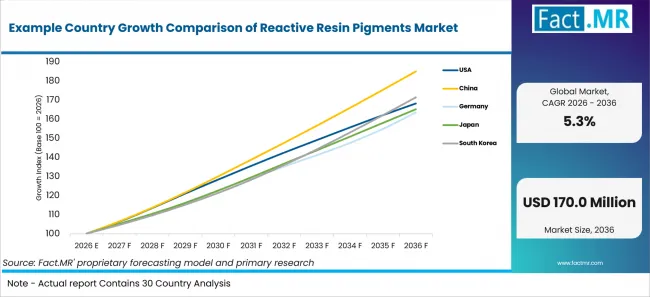
Example Country Growth Comparison Of Reactive Resin Pigments Market | Source: Fact.MR
| COUNTRY | CAGR |
|---|---|
| United States | 5.3% |
| Germany | 5.0% |
| Japan | 5.1% |
| South Korea | 5.5% |
Source: Fact.MR analysis. Updated Jul 20, 2026
How is the United States market likely to develop?
A 5.3% CAGR is projected for United States during 2026-2036.
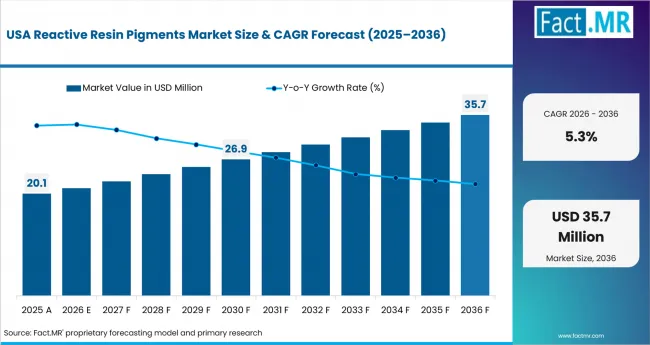
Reactive Resin Pigments Market Country Value Analysis | Source: Fact.MR
US formulators of epoxy and polyester resin systems typically hold pigment suppliers to the same documentation standard they already apply to hardeners and other reactive raw materials, so EPA chemical reporting and cure-compatibility data tend to move through review together rather than as separate steps. A manufacturing base weighted toward industrial coatings and composites means a pigment that interferes with cure or pot life can affect production lines running continuous, high-volume batches.
For reactive resin pigments, buyers assess pigment wetting, cure compatibility, and resistance performance in durable resin finishes.
Because epoxy systems dominate US reactive-resin pigment demand, suppliers with cure-neutrality data specific to common epoxy-hardener pairs tend to clear technical qualification faster than those relying on generic resin-compatibility claims.
How is the Germany market likely to develop?
A 5.0% CAGR is projected for Germany during 2026-2036.
German buyers combine REACH substance tracking with some of the most demanding cure-performance specifications in industrial coatings and composite manufacturing, so a pigment's effect on pot life and cure completion is scrutinized alongside its regulatory file rather than after it. The country's strength in technical composites and gelcoat production adds wet-out and exotherm behavior to the qualification list well beyond a simple shade check.
For reactive resin pigments, buyers assess pigment wetting, cure compatibility, and resistance performance in durable resin finishes.
Formulators here are also more likely to run full-cure-cycle color checks rather than accept a wet drawdown as sufficient evidence, since exotherm and binder yellowing are well understood to shift the finished shade in thicker cast and composite sections.
How is the Japan market likely to develop?
A 5.1% CAGR is projected for Japan during 2026-2036.
Japanese producers of epoxy and polyurethane resin systems tend to run established, tightly controlled formulations for extended production periods, so a pigment substitution is evaluated as a risk to an already-optimized cure process rather than a routine color change. Chemical-management guidance adds a documentation layer, but the more consequential barrier is usually proving the new grade will not shift pot life or cure completion in a formulation that has not changed in years.
For reactive resin pigments, buyers assess pigment wetting, cure compatibility, and resistance performance in durable resin finishes.
Suppliers able to run trials in the customer's specific hardener and filler package -- rather than a generic epoxy reference system -- are better placed to displace an incumbent pigment here than those offering only broad resin-family compatibility claims.
How is the South Korea market likely to develop?
A 5.5% CAGR is projected for South Korea during 2026-2036.
South Korea's reactive-resin pigment demand is closely tied to export-oriented composite and coatings manufacturing, so qualification often has to satisfy both domestic regulatory expectations and the specification standards of overseas customers simultaneously. Short product cycles common in electronics and automotive-supply composites leave limited room for a cure-interference issue to surface late in a production run.
For reactive resin pigments, buyers assess pigment wetting, cure compatibility, and resistance performance in durable resin finishes.
That combination favors resin-compatible dispersions and liquid concentrates that shorten a supplier's own qualification timeline, since faster internal approval helps customers hold export delivery schedules.
Who leads the Reactive Resin Pigments Market?
Sudarshan Chemical, DIC, and Venator compete across reactive-resin colors with different combinations of pigment breadth, preparations, and application support.
Sudarshan Chemical is named as the leading positions in the market evidence, followed by DIC. Sudarshan presents high-performance pigments and preparations for demanding coatings, while DIC's current materials connect pigment proposals with acrylic, epoxy, and polyester resins; the practical advantage lies in system-level formulation evidence.
Venator is also named in the source structure. Their positions can be strengthened through responsive custom shades and disciplined raw-material documentation, but each project still depends on cure and compatibility testing in the customer's complete resin package.
Which companies are the key providers?
The company set includes Sudarshan Chemical, DIC, and Venator.
- Sudarshan Chemical
- DIC
- Venator
These five names lead the chapter, while the full report reviews more than 30 companies in resin-compatible pigments and preparations.
Bibliography
- U.S. EPA technical resources on chemical substances used in reactive-resin coatings and composite manufacturing.
- BASF technical literature on performance polymers and reactive-resin systems.
- ECHA REACH registration dossiers relevant to reactive-resin pigment substances.
- [US-1] U.S. Environmental Protection Agency. Chemicals under TSCA.
- [US-2] U.S. Census Bureau. Manufacturing.
- [DE-1] European Chemicals Agency. REACH restriction.
- [DE-2] Federal Statistical Office of Germany. Manufacturing statistics.
- [JP-1] Ministry of Economy, Trade and Industry. Chemical management.
This Report Addresses
- It establishes the 2025 reference and the quantified path from 2026 to 2036.
- It reviews United States, China, Germany, Japan, and South Korea, within coverage that reaches more than 30 countries.
- It examines Sudarshan Chemical, DIC, and Venator within the recorded market shares.
- It distinguishes classical pigments, high-performance chemistries, carbon black blends, and hybrid packs across five delivery forms.
- It maps color demand through composites, industrial coatings, casting compounds, gelcoats, adhesives, and sealants.
- It tests the forecast against cure stability, chemical and heat resistance, bleed, loading, dispersion effort, and resin compatibility.
What does the Reactive Resin Pigments Market cover?
The report isolates pigment revenue where the colorant is incorporated before or during cure of a reactive resin.
Resin system, application, pigment type, performance need, supply form, country, and competition are assessed together.
The commercial review includes dispersion, carrier choice, pot life, cure, exotherm, film or part appearance, and long-term resistance.
What is included in the scope?
A pigment sale is included when it is intended for a chemically curing resin system in the source taxonomy.
Powder and prepared colorant value is counted at the pigment-supplier level after adjustment for resin or carrier content.
Both decorative and performance-driven color uses remain in scope when the reactive-resin application can be identified.
What is excluded from the scope?
Host resin and finished-article value are separated from the colorant market.
Resins, hardeners, reinforcement, fillers, solvents, cure equipment, coatings, adhesives, and molded or cast products are not counted.
Thermoplastic masterbatch unrelated to reactive systems, soluble dyes, and color services without attributable pigment revenue are removed.
How Was the Analysis Built?
The analysis draws on 120+ sources, 35+ company portfolios, 25+ countries, and more than 20 industry interviews.
- Primary Research: Primary research includes discussions with manufacturers, service providers, technology developers, distributors, end users, procurement teams, and subject-matter experts. These conversations examine purchasing priorities, product adoption, operational challenges, approval requirements, competitive positioning, and the factors that influence wider market acceptance.
- Desk Research: Desk research covers government statistics, regulatory publications, company filings, trade data, technical studies, industry associations, standards, public policy, and other authoritative sources. Every source used in the analysis is documented in the bibliography.
- Market Sizing and Forecasting: Market estimates combine historical performance, demand indicators, pricing and volume trends, segment shares, company participation, country-level growth, adoption patterns, investment activity, and barriers to market expansion.
- Data Validation and Update Cycle: Findings are validated by comparing primary interviews with public data, company activity, regulatory changes, trade patterns, and industry developments. Regular updates review new product launches, capacity changes, partnerships, approvals, procurement trends, and shifts in commercial adoption.
Segmentation
What is the report's scope and coverage?
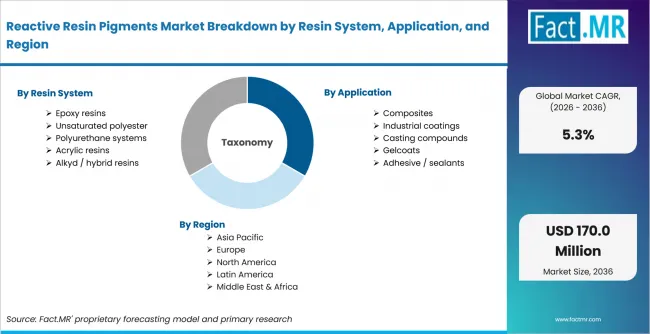
Reactive Resin Pigments Market Breakdown By Resin System, Application, And Region | Source: Fact.MR
| ATTRIBUTE | DETAILS |
|---|---|
| Quantitative Units | USD Million in 2026 to USD Million by 2036 at CAGR |
| Market Definition | Reactive resin pigments are pigment powders, pastes, dispersions, concentrates, and chips sold to color resin systems that cure by chemical reaction into coatings, composites, castings, gelcoats, adhesives, or sealants. |
| Resin System | Epoxy resins; Unsaturated polyester; Polyurethane systems; Acrylic resins; Alkyd / hybrid resins |
| Application | Composites; Industrial coatings; Casting compounds; Gelcoats; Adhesive / sealants |
| Pigment Type | Organic azo pigments; Phthalocyanine pigments; High-performance pigments; Carbon black blends; Hybrid pigment packs |
| Performance Need | Reactive system stability; Chemical resistance; Heat resistance; Low bleed; High loading |
| Supply Form | Powder pigment; Paste colorant; Resin-compatible dispersion; Liquid color concentrate; Masterbatch / chip |
| Regions Covered | North America; Europe; Asia Pacific |
| Countries Covered | United States; Germany; Japan; South Korea (analysis extends to 30+ countries) |
| Key Companies Profiled | Sudarshan Chemical; DIC; Venator |
| Forecast Period | 2026 to 2036 |
| Approach |
Demand is evaluated using resin-system-specific pigment shipment volumes, supply-form adoption rates (powder, paste, dispersion, concentrate), cure-compatibility-driven qualification cycles, pigment-type pricing differentials, and buyer purchasing patterns. |
Source: Fact.MR analysis. Updated Jul 20, 2026
How is the market segmented?
-
By Resin System
- Epoxy resins
- Unsaturated polyester
- Polyurethane systems
- Acrylic resins
- Alkyd / hybrid resins
-
By Application
- Composites
- Industrial coatings
- Casting compounds
- Gelcoats
- Adhesive / sealants
-
By Pigment Type
- Organic azo pigments
- Phthalocyanine pigments
- High-performance pigments
- Carbon black blends
- Hybrid pigment packs
-
By Performance Need
- Reactive system stability
- Chemical resistance
- Heat resistance
- Low bleed
- High loading
-
By Supply Form
- Powder pigment
- Paste colorant
- Resin-compatible dispersion
- Liquid color concentrate
- Masterbatch / chip
-
By Region
- North America
- United States
- Europe
- Germany
- Asia Pacific
- China
- Japan
- South Korea
- South Asia
- India
- Latin America
- Brazil
- Middle East and Africa
- Morocco
- Saudi Arabia
- Russia
- United Arab Emirates
- Italy
- United Kingdom
- North America
Frequently Asked Questions
What is the reactive resin pigments market forecast?
Which resin system holds the largest share?
Which use category accounts for the greatest share?
Which pigment type is largest?
What performance requirement ranks first?
Which delivery form leads?
Who are the named reactive-resin pigment suppliers?
Who worked on this report


Preview the report firsthand - request a free sample
Free SampleGet the brochure for pricing and purchase details
Download PDF