- Market Value (2025): USD 491.6 Mn
- Estimated Value (2026): USD 527.1 Mn
- Forecast Value (2036): USD 1,059.4 Mn
- CAGR (2026-2036): 7.2%
What is the Acute Intermittent Porphyria Market forecast to be worth by 2036?
USD 527.1 million in 2026 to USD 1,059.4 million by 2036 at a 7.2% CAGR.
- As per Fact.MR analysis, the Acute Intermittent Porphyria Market reached USD 491.6 million in 2025
- Demand is projected to increase from USD 527.1 million in 2026 to USD 1,059.4 million by 2036.
- The market is forecast to record 7.2% CAGR from 2026 to 2036.
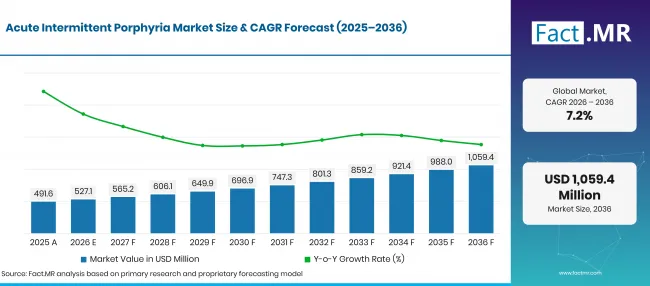
Acute Intermittent Porphyria Market Forecast Global | Source: Fact.MR
What are the defining numbers behind Acute Intermittent Porphyria Market growth?
An absolute opportunity of USD 532.3 million is expected between 2026 and 2036.
- Demand Drivers in the Market
- Targeted therapies are transforming the treatment model for acute hepatic porphyria. RNA interference (RNAi) therapy shifts care from the management of individual attacks to their prevention, which generates recurring treatment demand among patients who experience frequent attacks.
- Diagnostic delay remains a significant unmet need. Abdominal pain, neuropathy, and psychiatric symptoms can resemble those of many other conditions, so greater clinician awareness and broader use of biochemical testing increase the number of confirmed cases entering treatment.
- Genetic testing is expanding the identified patient population. The condition follows an autosomal dominant inheritance pattern, and many carriers never develop symptoms. Confirmation of HMBS gene variants and screening of family members help identify individuals who require counseling and guidance on trigger avoidance.
- Intravenous hemin continues to anchor hospital-based attack management. Its established role in treating severe acute attacks sustains demand for inpatient therapy and underscores the need for reliable supply and appropriately trained clinical teams.
- Key Segments Analyzed
- Medications are expected to account for 48.3% of the market in 2026 by treatment type, as they support acute attack management, attack prevention, and symptom control across the broadest range of patients and care settings.
- By diagnosis type, blood tests are projected to hold a 55.0% share in 2026. Routine blood work is typically ordered at first presentation to assess liver function and electrolyte balance, and it also directs further biochemical testing.
- Among end users, hospitals are anticipated to capture a 50.0% share in 2026, since acute attacks usually require inpatient care, including intravenous therapy, pain control, and clinical monitoring.
- Analyst Opinion at Fact.MR
- Shambhu Nath Jha, Principal Consultant at Fact.MR, observes, "Acute intermittent porphyria is a rare disease, yet its commercial potential will depend on how quickly patients are identified and how effectively attacks are prevented. Earlier diagnosis will bring more patients into specialist care, while targeted therapy will continue to reshape recurring attack management. Stakeholders are advised to strengthen diagnostic capabilities and invest in prevention-focused treatment models to capture long-term growth."
- Strategic Implications
- Therapy developers are encouraged to generate real-world evidence on attack frequency, hospital admissions, and quality of life, as payers weigh the cost of long-term treatment against the burden of repeated acute care.
- Diagnostic providers are advised to standardize testing pathways that combine urine biochemical testing with blood work and genetic confirmation, since faster and more consistent results shorten the time to a correct diagnosis.
- Hospitals and specialty clinics need to maintain clear attack-management protocols and ensure reliable access to intravenous hemin. They are also urged to establish links with centers of expertise to support patients who experience recurrent attacks.
- Companies across the care pathway are recommended to support patient registries and clinician education in emergency and primary care settings, where the condition is most often overlooked.
Mexico is set to record the fastest growth at a CAGR of 9.0%, backed by wider diagnostic access and heightened awareness of rare diseases. South Korea ranks second at 8.1%, supported by sophisticated hospital infrastructure and dedicated rare-disease programs. The USA follows at 7.8%, benefiting from a mature orphan drug framework and ready availability of targeted therapy. The Netherlands registers 6.8%, reflecting its depth of specialist expertise and organized rare-disease care pathways. Canada advances at 6.1%, while Germany grows at a steadier 5.3%, in line with the maturity of its existing market.
How does the Acute Intermittent Porphyria Market break down by segment?
Medications are projected to lead Treatment Type at 48.3% share in 2026; while Blood Tests lead Diagnosis Type at 55.0% share, and Hospitals lead End-User at 50.0% share.
Which Treatment Type dominates?
Medications are expected to hold 48.3% share in 2026.
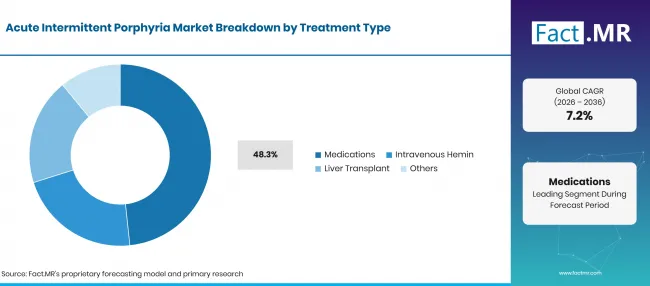
Acute Intermittent Porphyria Market Breakdown Treatment Type | Source: Fact.MR
Medications hold the leading position because they cover the entire course of the disease. They are used to treat acute attacks, to prevent recurrence, and to manage symptoms such as pain, nausea, and autonomic disturbances. Targeted RNA interference therapy has broadened the pharmacological options beyond attack treatment alone and enables sustained management for patients who experience recurrent attacks.
Intravenous hemin remains the established therapy for severe acute attacks and forms a core component of hospital protocols, while liver transplant is reserved for rare cases of severe, recurrent attacks that do not respond to other interventions. As both options are used in narrower clinical circumstances, medications account for the larger share of overall treatment spending.
How does Diagnosis Type shape demand?
Blood Tests are anticipated to lead with 55.0% share in 2026.
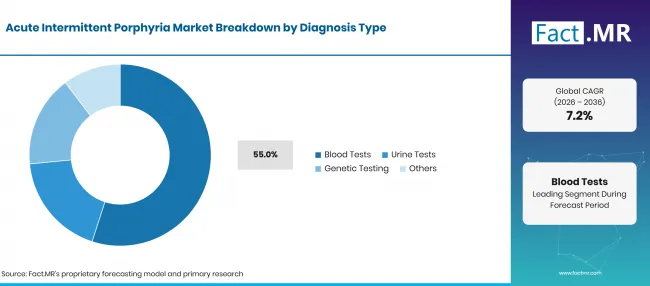
Acute Intermittent Porphyria Market Breakdown Diagnosis Type | Source: Fact.MR
Blood tests lead the segment because they are typically among the first investigations requested when a patient presents with unexplained abdominal pain, neurological symptoms, or changes in behavior. They help gauge liver function and electrolyte balance, assist in ruling out other conditions, and guide the choice to proceed with more specific biochemical and genetic testing.
Urine tests continue to play a critical role because elevated porphobilinogen and delta-aminolevulinic acid levels during an attack confirm the diagnosis. Genetic testing pinpoints the causative HMBS variant and makes it possible to screen relatives. This matters because many carriers never develop symptoms, yet they may still face the risk of an acute attack.
What supports Hospitals within End-User?
Hospitals are estimated to represent 50.0% share in 2026.
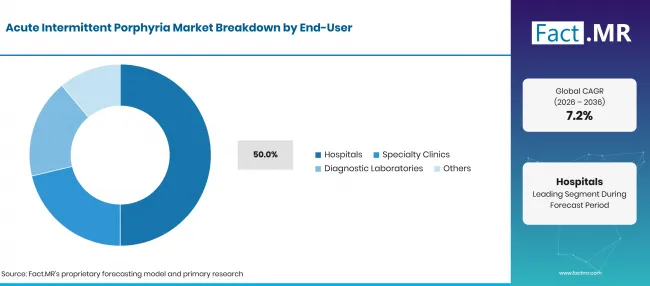
Acute Intermittent Porphyria Market Breakdown End User | Source: Fact.MR
Hospitals lead the segment because acute attacks typically require inpatient care. Patients may need intravenous hemin, glucose, analgesia, correction of electrolyte imbalances, and close monitoring of neurological and respiratory function. Emergency departments and in-house laboratories are also the settings in which the condition is most often first suspected.
Specialty clinics support long-term management, prevention, and follow-up care, while diagnostic laboratories deliver biochemical and genetic testing. Hospitals nonetheless remain the primary point of purchase, as they bring together acute care, inpatient pharmacy services, and testing capacity within a single setting.
What is accelerating Acute Intermittent Porphyria Market adoption, and what is holding it back?
Demand is expected to rise through targeted therapy availability and wider genetic testing. Growth may be limited by high treatment costs, diagnostic delays and limited access to specialists.
Drivers Impact Analysis
| DRIVER | (~) % IMPACT ON CAGR | GEOGRAPHIC RELEVANCE | IMPACT TIMELINE |
|---|---|---|---|
| Increasing availability of targeted therapies for attack prevention | +2.4% | North America, Europe, East Asia | Short term (<= 2 years) |
| Wider adoption of genetic testing and family screening | +1.8% | Global | Medium term (2-4 years) |
| Heightened clinician awareness and earlier diagnosis | +1.4% | Global | Medium term (2-4 years) |
| Orphan drug incentives and supportive rare-disease policies | +1.0% | North America, Europe, East Asia | Long term (>= 4 years) |
Opportunity Impact Analysis
| OPPORTUNITY | (~) % IMPACT ON CAGR | GEOGRAPHIC RELEVANCE | IMPACT TIMELINE |
|---|---|---|---|
| Broadening of diagnostic access across emerging healthcare markets | +1.3% | Latin America, East Asia | Medium term (2-4 years) |
| Deployment of rapid biochemical testing in emergency and hospital settings | +1.0% | Global | Long term (>= 4 years) |
| Patient registries and real-world evidence strengthening reimbursement cases | +0.7% | Europe, North America | Short term (<= 2 years) |
Restraints Impact Analysis
| RESTRAINT | (~) % IMPACT ON CAGR | GEOGRAPHIC RELEVANCE | IMPACT TIMELINE |
|---|---|---|---|
| High cost of targeted therapy and reimbursement barriers | -0.9% | Global | Short term (<= 2 years) |
| Low disease prevalence and diagnostic delays arising from symptom overlap | -0.8% | Global | Medium term (2-4 years) |
| Shortage of specialist centers and trained clinicians beyond major hospitals | -0.6% | Global | Long term (>= 4 years) |
Which countries are scaling the Acute Intermittent Porphyria Market through 2036?
- The country comparison spans a range of 3.7 percentage points and forms three distinct growth bands across the forecast period.
- Mexico leads, holding a 0.9 percentage point advantage over South Korea, supported by expanding diagnostic access and growing awareness of rare diseases.
- South Korea stays 0.3 percentage point ahead of the USA, as advanced hospital infrastructure and dedicated rare-disease support widen patient access.
- The USA maintains a 1.0 percentage point lead over the Netherlands, underpinned by a well-established orphan drug framework and ready access to targeted therapy.
- The Netherlands holds a 0.7 percentage point advantage over Canada, reflecting deep specialist expertise and structured rare-disease care.
- Canada remains 0.8 percentage point above Germany, as expanding public-system access is partly offset by reimbursement hurdles that slow the adoption of higher-cost therapies.
- Germany closes the displayed range as a mature market, with well-established diagnosis and treatment pathways.
Equivalent CAGRs can create different entry conditions due to diagnostic capacity, reimbursement pathways, specialist availability and healthcare infrastructure. Full report coverage includes North America, Latin America, Western Europe, Eastern Europe, East Asia, South Asia & Pacific, Middle East & Africa.
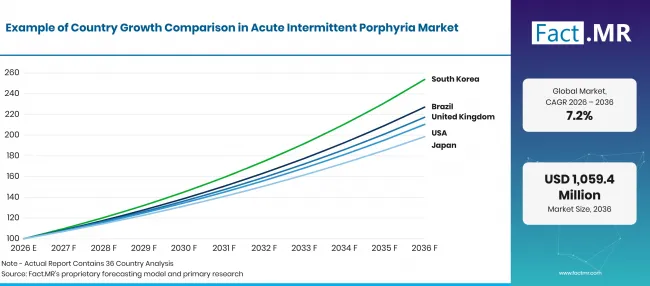
Factmr Acute Intermittent Porphyria Market Growth Index | Source: Fact.MR
| Country | CAGR (2026-2036) |
|---|---|
| United States | 7.8% |
| Mexico | 9.0% |
| South Korea | 8.1% |
| Netherlands | 6.8% |
| Canada | 6.1% |
| Germany | 5.3% |
What supports USA adoption?
7.8% CAGR, supported by an established orphan drug framework and access to targeted therapy.
The United States benefits from a well-developed orphan drug framework, and the first RNA interference therapy for acute hepatic porphyria secured FDA approval in 2019. Academic hospitals, specialty centers, and insurance channels give patients with recurrent attacks access to long-term, higher-cost treatment, sustaining demand across medications, intravenous hemin, and diagnostic testing.
How is Mexico scaling demand?
9.0% CAGR, driven by expanding diagnostic access and rising rare-disease awareness.
Mexico posts the fastest growth among the countries compared, as diagnostic capacity and clinician awareness build from a lower base. Broader biochemical and genetic testing in private and larger public hospitals enables more confirmed diagnoses, which in turn lifts demand for intravenous hemin and newer maintenance therapies.
How is South Korea developing demand?
8.1% CAGR, supported by advanced hospital infrastructure and rare-disease support.
South Korea pairs high-capacity tertiary hospitals with national health insurance and dedicated rare-disease programs. Robust laboratory and genetic testing capabilities facilitate diagnostic confirmation and improve patient access to treatment.
What supports the Netherlands' growth?
6.8% CAGR, backed by specialist expertise and structured rare-disease care.
The Netherlands draws on specialist porphyria expertise within academic hospitals and well-organized care pathways that promote early referral, accurate diagnosis, and consistent treatment. As these systems are already well structured, growth remains steady rather than rapid.
How is Canada scaling demand?
6.1% CAGR, supported by public-system access and provincial reimbursement pathways.
Canada's public health system covers hospital-based care for acute attacks, whereas access to higher-cost maintenance therapies depends on drug review and provincial reimbursement decisions. Specialist care is also concentrated in large urban centers, which influences how quickly patients reach targeted treatment.
What is supporting Germany's adoption?
5.3% CAGR, reflecting a mature market with well-established care pathways.
Germany records the lowest CAGR in the comparison because its diagnosis and treatment pathways are already well established, limiting the gain from identifying new patients. Comprehensive statutory health insurance and a dense network of hospitals and laboratories sustain stable demand, although growth moderates from an already developed base.
Who leads the Acute Intermittent Porphyria Market?
Alnylam Pharmaceuticals leads the market with an estimated 11% share, anchored by Givlaari (givosiran), an RNA interference therapy that has shifted treatment from managing individual attacks toward preventing them.
Recordati Rare Diseases supplies Panhematin (hemin for injection), a long-established therapy that keeps the company closely aligned with hospital-based attack management.
Pfizer, AbbVie, Hoffmann-La Roche, Novartis, Sanofi, Takeda, and GSK are diversified global healthcare companies whose portfolio breadth, hospital relationships, and research capabilities influence the wider competitive and partnership landscape.
Competition therefore centers on attack prevention, speed of diagnosis, and hospital access, supported by evidence of reduced attack frequency, fewer hospital admissions, and reimbursement support.
Which companies are the key providers?
Key companies include Alnylam Pharmaceuticals; Recordati Rare Diseases; Pfizer; AbbVie; Hoffmann-La Roche; Novartis; Sanofi; Takeda; and GSK.
- Alnylam Pharmaceuticals
- Recordati Rare Diseases
- Pfizer
- AbbVie
- Hoffmann-La Roche
- Novartis
- Sanofi
- Takeda
- GSK
Bibliography
- Balwani, M., Sardh, E., Ventura, P., et al. (2020). Phase 3 trial of RNAi therapeutic givosiran for acute intermittent porphyria. New England Journal of Medicine, 382, 2289-2301.
https://www.nejm.org/doi/full/10.1056/NEJMoa1913147 - Bissell, D. M., Anderson, K. E., & Bonkovsky, H. L. (2017). Porphyria. New England Journal of Medicine, 377, 862-872.
https://www.nejm.org/doi/full/10.1056/NEJMra1608634 - Wang, B., Bonkovsky, H. L., Lim, J. K., & Balwani, M. (2023). AGA clinical practice update on diagnosis and management of acute hepatic porphyrias: Expert review. Gastroenterology, 164(3), 484-491.
I'm not certain of the exact DOI, so I haven't given a direct link. Searching the title on PubMed (https://pubmed.ncbi.nlm.nih.gov) or the journal site (https://www.gastrojournal.org) should find it quickly. - U.S. Food and Drug Administration. (2019, November 20). FDA approves first treatment for inherited rare disease.
https://www.fda.gov/news-events/press-announcements/fda-approves-first-treatment-inherited-rare-disease - European Medicines Agency. (2020). Givlaari (givosiran): European public assessment report.
https://www.ema.europa.eu/en/medicines/human/EPAR/givlaari
This Report Answers
- The report explains where acute intermittent porphyria treatments and diagnostic tests are used across treatment type, diagnosis type and end-user setting.
- Segment analysis identifies the leading subsegments and the clinical reasons providers prioritize them.
- Country analysis examines the listed markets and the healthcare infrastructure, reimbursement and policy mechanisms supporting diagnosis and treatment.
- Competitive analysis reviews current providers across targeted therapy, intravenous hemin and the wider rare-disease portfolio.
- Application analysis assesses how diagnostic delay, attack frequency and hospital admissions influence treatment and testing decisions.
What does the Acute Intermittent Porphyria Market cover?
The Acute Intermittent Porphyria Market encompasses the diagnosis and treatment of acute intermittent porphyria, a rare inherited metabolic disorder caused by reduced activity of the enzyme porphobilinogen deaminase. This deficiency results in an accumulation of porphyrin precursors and can trigger acute neurovisceral attacks, marked by severe abdominal pain, nerve damage, and psychiatric symptoms.
The assessment spans medications, intravenous hemin, and liver transplant as treatment options, along with blood, urine, and genetic testing as diagnostic approaches. Demand is evaluated across hospitals, specialty clinics, and diagnostic laboratories.
What is included in the scope?
The scope incorporates prescription medications used to treat or prevent acute intermittent porphyria attacks and to manage related symptoms, intravenous hemin therapy, and liver transplant procedures performed for the condition.
It also covers blood, urine, and genetic tests used to detect, confirm, and monitor acute intermittent porphyria across hospitals, specialty clinics, and diagnostic laboratories.
What is excluded from the scope?
The scope omits treatments and diagnostics intended solely for other forms of porphyria, including cutaneous and erythropoietic porphyrias. Investigational therapies that have yet to reach commercial availability are also excluded.
General laboratory equipment and general pain-management products are not considered unless they are specific to acute intermittent porphyria care.
How Was the Analysis Built?
The analysis is based on more than 120 sources, 35 company portfolios, 25 countries, and over 20 industry interviews.
- Primary Research: Primary research is conducted through direct engagement with manufacturers, service providers, technology developers, distributors, end users, and subject-matter experts. These engagements assess buying priorities, product uptake, operational constraints, regulatory approval requirements, competitive standing, and the drivers of wider market acceptance.
- Desk Research: Desk research is built on government statistics, regulatory publications, company filings, trade data, technical studies, industry associations, standards, public policy, and other credible references. Each source consulted is recorded in the bibliography.
- Market Sizing and Forecasting: Market estimates are derived by combining historical performance, demand indicators, pricing and volume trends, segment shares, company participation, country-level growth, adoption patterns, investment activity, and barriers to market expansion.
- Data Validation and Update Cycle: Findings are verified by reconciling primary interview insights with public data, company activity, regulatory changes, trade patterns, and industry developments. Scheduled reviews incorporate new product launches, capacity changes, partnerships, approvals, and shifts in commercial adoption.
What is the report’s scope and coverage?
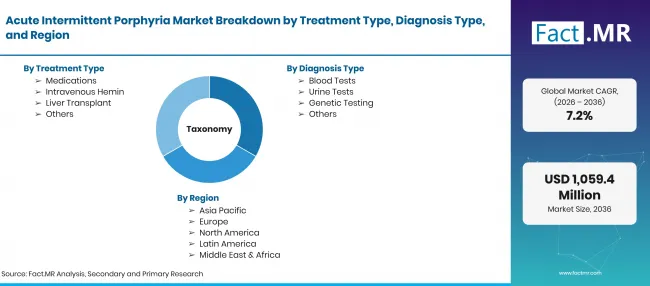
Acute Intermittent Porphyria Market Taxonomy | Source: Fact.MR
| Attribute | Details |
|---|---|
| Quantitative Units | USD Million |
| Market Definition | Therapies, procedures and diagnostic tests used to detect, treat and manage acute intermittent porphyria, including medications, intravenous hemin, liver transplant, and blood, urine and genetic testing delivered through hospitals, specialty clinics and diagnostic laboratories. |
| Treatment Type | Medications; Intravenous Hemin; Liver Transplant |
| Diagnosis Type | Blood Tests; Urine Tests; Genetic Testing |
| End-User | Hospitals; Specialty Clinics; Diagnostic Laboratories |
| Regions Covered | North America; Latin America; Western Europe; Eastern Europe; East Asia; South Asia & Pacific; Middle East & Africa |
| Countries Covered | United States; Mexico; South Korea; Netherlands; Canada; Germany |
| Key Companies Profiled | Alnylam Pharmaceuticals; Recordati Rare Diseases; Pfizer; AbbVie; Hoffmann-La Roche; Novartis; Sanofi; Takeda; GSK |
| Forecast Period | 2026 to 2036 |
| Approach | Hybrid top-down and bottom-up approach using the diagnosed patient population; treatment and test volumes; treatment mix; pricing and reimbursement; country adoption; and provider portfolio review. |
How is the market segmented?
-
By Treatment Type:
- Medications
- Intravenous Hemin
- Liver Transplant
-
By Diagnosis Type:
- Blood Tests
- Urine Tests
- Genetic Testing
-
By End-User:
- Hospitals
- Specialty Clinics
- Diagnostic Laboratories
-
By Region:
- North America
- Latin America
- Western Europe
- Eastern Europe
- East Asia
- South Asia & Pacific
- Middle East & Africa