- Market Value (2025): USD 3.1 Bn
- Estimated Value (2026): USD 3.4 Bn
- Forecast Value (2036): USD 9.5 Bn
- CAGR (2026-2036): 10.8%
What is the Recyclable Paper Barrier Technologies Market forecast to be worth by 2036?
USD 3.3950 billion in 2026 to USD 9.4675 billion by 2036 at a 10.8% CAGR.
- As per Fact.MR analysis, the Recyclable Paper Barrier Technologies Market reached USD 3.1 billion in 2025.
- Demand is expected to increase from USD 3.4 billion in 2026 to USD 9.5 billion by 2036.
- The market is forecast to record a 10.8% CAGR from 2026 to 2036.
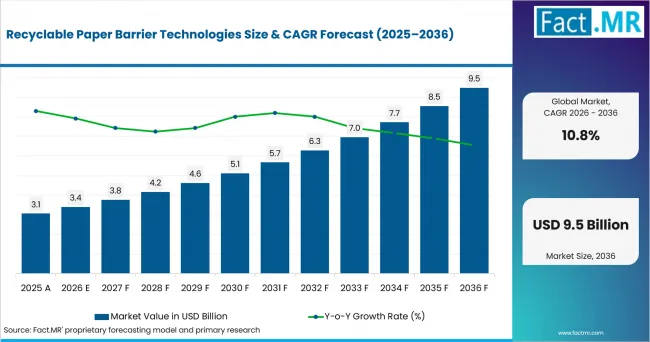
Recyclable Paper Barrier Technologies Value Analysis | Source: Fact.MR
What are the defining numbers behind Recyclable Paper Barrier Technologies Market growth?
USD 6.0 billion absolute opportunity by 2036, led by aqueous polymer dispersion, paper substrates and moisture / vapor protection.
- Demand Drivers in the Market
- Food packaging companies need coatings that protect paper from hot liquids and grease while keeping it recyclable.
- Paper and board makers need coatings that work on existing machines. This helps reduce testing costs and keep production running smoothly.
- In April 2025, China’s State Council announced 15 new express-delivery rules that support degradable and reusable packaging [4]. These rules increase demand for paper packaging with moisture and grease protection.
- Flexible packaging companies need better protection from oxygen and moisture. This helps paper packs protect dry foods and other products during storage.
- Key Segments Analyzed
- By Barrier Chemistry: Aqueous polymer dispersion is expected to hold a 34.0% share in 2026 because these water-based coatings work well on paper-coating lines and provide a thin protective layer.
- By Barrier Function: Moisture / vapor is expected to account for 31.0% share in 2026 because paper packaging needs protection from moisture during storage.
- By Substrate: Paper is expected to capture 36.0% share in 2026 because it is used for wraps, pouches, liners, and coated sheets.
- By Use: Hot food packs are estimated to represent 29.0% share in 2026 because they need protection from heat and grease.
- Analyst Opinion at Fact.MR
- Shambhu Nath Jha, Principal Consultant at Fact.MR, states, “Packaging companies check protection, recycling, drying, and food safety when choosing coatings. Suppliers with clear use details and recycling test results are more likely to get repeat orders.”
- Strategic Implications
- Coating suppliers should give clear instructions for using coatings on common paper types. In February 2025, the European Commission reported that the Packaging and Packaging Waste Regulation had entered into force [2]. The rules increase the need for clear recycling and material records.
- Paper mills should test coatings after folding and heat exposure to make sure they work on the finished pack.
- Food brands should check recycling and food safety rules early when designing the pack. This helps them choose the right materials.
- Packaging companies should check coating use and drying energy during testing. This helps control production speed and cost.
China is expected to grow at 12.4% CAGR through 2036 due to high parcel volumes and packaging rules. The USA and France follow at 10.9% each, while Germany is expected to grow at 10.7%. Japan records 9.6% as paper recycling programs affect packaging material choices.
How does the Recyclable Paper Barrier Technologies Market break down by segment?
Aqueous polymer dispersion leads Barrier Chemistry at 34.0%; paper leads Substrate at 36.0%.
Which Barrier Chemistry dominates?
Aqueous polymer dispersion is expected to hold 34.0% share in 2026.
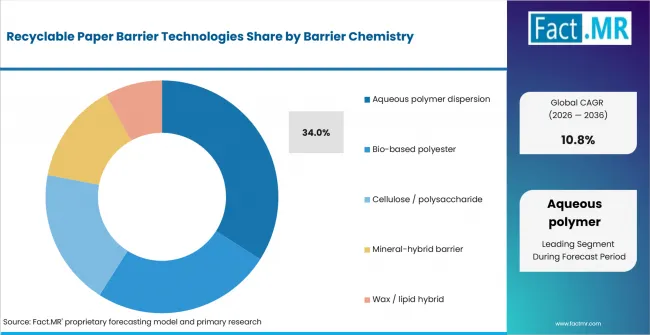
Recyclable Paper Barrier Technologies Analysis By Barrier Chemistry | Source: Fact.MR
Aqueous polymer dispersions are expected to lead because they give paper a thin protective coating and work with existing coating machines. Bio-based polyester and cellulose coatings meet different packaging needs, while mineral and wax coatings provide specific types of protection.
What leads the Barrier Function segment?
Moisture / vapor is expected to account for 31.0% share in 2026.
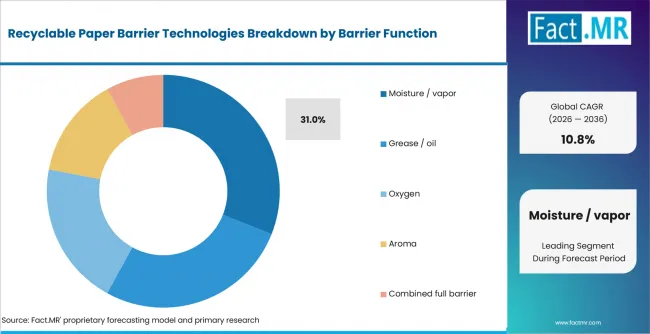
Recyclable Paper Barrier Technologies Analysis By Barrier Function | Source: Fact.MR
Moisture protection is important because paper can become weak in humid conditions. Grease barriers protect takeaway food packs, while oxygen and smell barriers protect dry foods during storage. Waterproof coatings for paper and paperboard packaging also help keep paper packs strong and dry.
How does Substrate shape demand?
Paper is expected to capture 36.0% share in 2026.
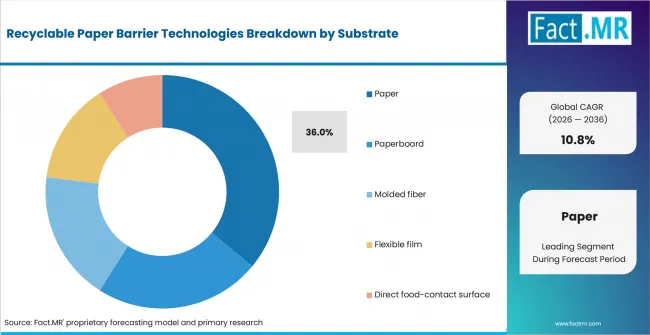
Recyclable Paper Barrier Technologies Analysis By Substrate | Source: Fact.MR
Paper is expected to capture 36.0% share in 2026. It remains widely used for sheets, wraps, and coated packaging. Paperboard supports strong cartons, while molded fiber is used for shaped packs. Coatings help improve protection and surface performance across applications.
Where is use demand concentrated?
Hot food packs are estimated to represent 29.0% share in 2026.
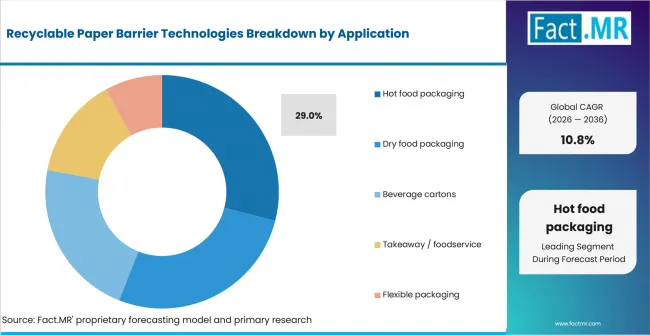
Recyclable Paper Barrier Technologies Analysis By Application | Source: Fact.MR
Hot food packaging needs protection from heat and grease to keep the pack strong. Dry food packs need protection from moisture and smell, while beverage cartons need liquid protection and good sealing. Sustainable food packaging must protect the product and support recycling.
What is accelerating Recyclable Paper Barrier Technologies Market adoption, and what is holding it back?
Packaging recycling rules increase demand, while approval costs and coating limits can slow growth.
Drivers Impact Analysis
| DRIVER | (~) % IMPACT ON CAGR | GEOGRAPHIC RELEVANCE | IMPACT TIMELINE |
|---|---|---|---|
| Packaging rules favoring recyclable structures | +1.7% | Europe, North America | Medium term (2-4 years) |
| PFAS replacement in food-contact paper | +1.4% | North America, Europe | Short term (<= 2 years) |
| Hot-food and takeaway barrier needs | +1.2% | Global | Short term (<= 2 years) |
| Water-based coating compatibility | +0.9% | Global | Medium term (2-4 years) |
| High-barrier paper for dry foods | +0.7% | Europe, East Asia | Long term (>= 4 years) |
Source: Fact.MR analysis. Updated Oct 6, 2026
Opportunity Impact Analysis
| OPPORTUNITY | (~) % IMPACT ON CAGR | GEOGRAPHIC RELEVANCE | IMPACT TIMELINE |
|---|---|---|---|
| Aroma and oxygen barriers for dry foods | +1.1% | Europe, North America, East Asia | Medium term (2-4 years) |
| Barrier-treated molded fiber | +0.9% | North America, East Asia | Medium term (2-4 years) |
| Bio-based coating chemistry | +0.7% | Europe, Japan | Long term (>= 4 years) |
| Direct coating on converting lines | +0.6% | Global | Short term (<= 2 years) |
Source: Fact.MR analysis. Updated Oct 6, 2026
Restraints Impact Analysis
| RESTRAINT | (~) % IMPACT ON CAGR | GEOGRAPHIC RELEVANCE | IMPACT TIMELINE |
|---|---|---|---|
| Recyclability qualification across paper grades | -0.8% | Global | Short term (<= 2 years) |
| Barrier loss at folds and seals | -0.6% | Global | Medium term (2-4 years) |
| Drying energy and coat-weight cost | -0.5% | Europe, East Asia | Medium term (2-4 years) |
| Food-contact approval complexity | -0.4% | North America, Europe | Long term (>= 4 years) |
Source: Fact.MR analysis. Updated Oct 6, 2026
Which countries are scaling the Recyclable Paper Barrier Technologies Market through 2036?
- China remains 1.5 percentage points above the USA through the forecast period as parcel packaging and input rules support paper-based formats.
- The USA and France both record 10.9% CAGR, although food-contact reformulation has a larger role in the U.S. outlook.
- France remains 0.2 percentage point above Germany as EU pack rules keep recyclable design and recovery results in focus.
- Germany remains 1.1 percentage points above Japan as its current paper collection system supports repeated testing of recyclable barrier packs.
- Japan closes the displayed range at 9.6% CAGR as recycling programs support paper and molded-fiber packaging work.
Comparable CAGRs can still create different entry needs. Food-contact rules and paper-recovery systems influence approval time, while coating-line capability shapes the cost of moving from trials to full output. Full coverage spans North America, Latin America, Western Europe, Eastern Europe, East Asia, South Asia & Pacific, Middle East & Africa.
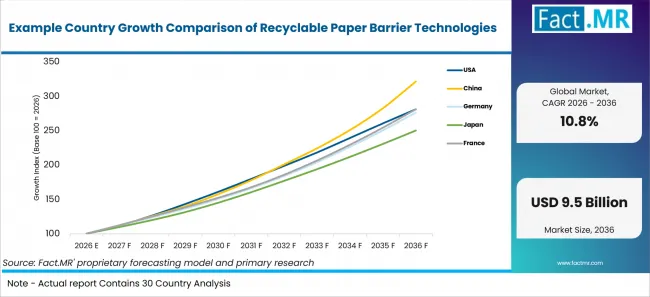
Example Country Growth Comparison Of Recyclable Paper Barrier Technologies | Source: Fact.MR
| Country | CAGR (2026-2036) |
|---|---|
| China | 12.4% |
| USA | 10.9% |
| France | 10.9% |
| Germany | 10.7% |
| Japan | 9.6% |
Source: Fact.MR analysis. Updated Oct 6, 2026
How is China developing demand?
12.4% CAGR, supported by parcel volumes and recyclable delivery-pack rules.
China’s large delivery network increases the use of coated paper for mailers and food delivery packs. In May 2026, the State Post Bureau reported that express-delivery volume reached 198.95 billion items in 2025 [3]. More deliveries increase demand for paper packaging that can handle moisture and regular handling at a reasonable cost.
What supports USA adoption?
10.9% CAGR, shaped by food-contact reformulation and grease-resistant paper packs.
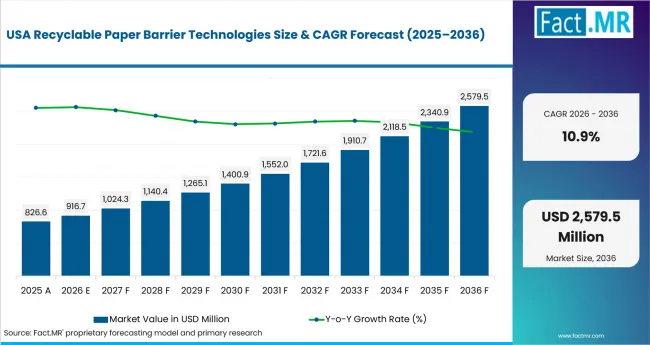
Recyclable Paper Barrier Technologies Country Value Analysis | Source: Fact.MR
U.S. foodservice and takeaway packaging needs paper coatings that protect against grease. In January 2025, the U.S. Food and Drug Administration reported that 35 PFAS-related food-contact notifications were no longer effective [1]. These notifications covered grease-proofing uses for paper and paperboard.
How is France developing demand?
10.9% CAGR, reinforced by circular-pack rules and demand for recyclable food formats.
France is expected to use more paper packaging that protects food and supports recycling. In October 2025, Eurostat reported that France recycled 25.7% of its plastic packaging waste in 2023 [6]. This keeps recycling and material choice important when brands compare paper with other packaging for takeaway and dry foods.
How is Germany developing demand?
10.7% CAGR, supported by current collection systems and detailed recycling checks.
Germany’s paper recycling system keeps recycling tests important for new barrier coatings. Packaging companies check the amount of coating and how well the paper folds before using it for cartons or food packs. Demand is higher for coatings that protect against moisture and grease and work well during production.
How is Japan developing demand?
9.6% CAGR, led by recycling programs and lower-plastic pack design.
Japan is expected to use more paper and molded-fiber packaging as brands reduce plastic use and support recycling. In March 2026, the Ministry of the Environment reported that municipalities collected 81,757 tonnes of paper packaging separately in fiscal 2024 [5]. This supports the use of coatings that protect food while keeping the paper suitable for recycling.
Who leads the Recyclable Paper Barrier Technologies Market?
Solenis supplies coatings for paper and board that protect against oil, grease, liquids, and moisture. Buyers of paper barrier coatings compare protection, recycling, and use on existing machines.
BASF supplies coatings for paper and paperboard used in food packaging. Its ecovio® 70 PS14H6 is used for food-contact paper and supports home-compostable packaging. It is also used in areas linked with compostable food service coatings.
Mondi supplies FunctionalBarrier Paper Ultimate for paper packaging. In August 2025, Mondi said it was increasing production at its Solec plant in Poland after a €16 million investment. The paper protects against oxygen, moisture, and grease and is designed for recycling.
Archroma, Michelman, and Dow supply water-based coatings for paper packaging. These coatings protect against moisture, water, oil, and grease.
Which companies are the key providers?
Key companies include Solenis; Michelman; BASF; Archroma; Dow; and Mondi.
- Solenis
- Michelman
- BASF
- Archroma
- Dow
- Mondi
Bibliography
- [1] U.S. Food and Drug Administration. (2025, January 3). FDA determines authorization for 35 food contact notifications related to PFAS are no longer effective.
- [2] European Commission, Directorate-General for Environment. (2025, February 11). New rules enter into force for a more sustainable and competitive packaging economy.
- [3] State Post Bureau of the People’s Republic of China. (2026, May 22). 2025 [2025 postal industry development statistical bulletin].
- [4] Xinhua. (2025, April 18). China unveils new regulations on express delivery sector. The State Council of the People’s Republic of China.
- [5] Ministry of the Environment, Government of Japan. (2026, March 31). [Results of municipal separate collection under the Containers and Packaging Recycling Act for fiscal 2024].
- [6] Eurostat. (2025, October 22). Plastic packaging waste in the EU: 35.3 kg per person.
- [7] Solenis. (2025, August 13). Solenis to showcase sustainable paper and packaging solutions at FACHPACK 2025 and PACK EXPO Las Vegas 2025.
- [8] Mondi. (2025, August 14). Mondi ramps up FunctionalBarrier Paper Ultimate to meet growing demand for sustainable high-barrier paper-based packaging.
This Report Answers
- The report explains the market across barrier chemistry, barrier function, substrate and use while region remains the regional coverage dimension.
- Segment review identifies the leading subsegments and explains the operating reasons pack makers select them for recyclable paper-based packaging.
- Country review reviews China, USA, France, Germany and Japan together with regulation, collection systems and converting needs that affect approval.
- Competitive review reviews Solenis, Michelman, BASF, Archroma, Dow and Mondi across coating chemistry, paper work and use support.
What does the Recyclable Paper Barrier Technologies Market cover?
The Recyclable Paper Barrier Technologies Market covers functional barrier systems for paper-based packaging that needs protection from moisture, water vapor, grease, oil, oxygen or aroma. It includes aqueous dispersions, bio-based polyester systems, cellulose or polysaccharide coatings, mineral-hybrid barriers and wax or lipid hybrids used in paper-rich recyclable formats. The boundary overlaps with next-generation paper and fiber-based packaging when a functional coating is part of the package design.
The review covers paper, paperboard, molded fiber, flexible packs and direct food-contact surfaces. uses include hot food, dry food, beverage cartons, takeaway or foodservice packs and flexible packaging. The market boundary centers on barrier system used within paper-rich packs designed for practical recovery.
What is included in the scope?
The scope includes barrier chemistry sold for coating paper and board before or during package conversion. It covers aqueous coating, printing, spray and related converting routes when the main purpose is barrier protection. Food-contact grades are included where coatings protect against liquids, grease, oxygen, aroma or water vapor and support finished-pack results.
What is excluded from the scope?
The scope excludes uncoated paper, standard printing inks used only for graphics and standalone plastic films. Structural adhesives and conventional extrusion layers fall outside the boundary when they serve a separate role from recyclable paper-barrier system. Finished-package revenue is excluded when barrier revenue is inseparable from the complete package value.
How Was the Analysis Built?
The analysis draws on 120+ sources, 35+ company portfolios, 25+ countries, and more than 20 industry interviews.
- Primary Research: Primary research includes discussions with manufacturers, service providers, technology developers, distributors, end users, and subject-matter experts. These conversations examine purchasing priorities, product adoption, operational challenges, approval requirements, competitive positioning, and the factors that influence wider market acceptance.
- Desk Research: Desk research covers government statistics, regulatory publications, company filings, trade data, technical studies, industry associations, standards, public policy, and other authoritative sources. Every source used in the analysis is documented in the bibliography.
- Market Sizing and Forecasting: Market estimates combine historical performance, demand indicators, pricing and volume trends, segment shares, company participation, country-level growth, adoption patterns, investment activity, and barriers to market expansion.
- Data Validation and Update Cycle: Findings are validated by comparing primary interviews with public data, company activity, regulatory changes, trade patterns, and industry developments. Regular updates review new product launches, capacity changes, partnerships, approvals, and shifts in commercial adoption.
Segmentation
What is the report’s scope and coverage?
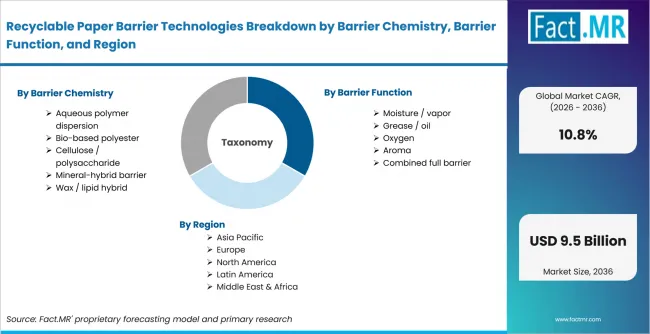
Recyclable Paper Barrier Technologies Breakdown By Barrier Chemistry, Barrier Function, And Region | Source: Fact.MR
| Attribute | Details |
|---|---|
| Quantitative Units | USD billion in 2026 to USD billion by 2036 at a CAGR |
| Market Definition | Barrier technologies applied to paper, paperboard, molded fiber and paper-rich flexible structures to provide moisture, grease, oxygen, aroma or combined protection while retaining a recyclable paper-based design. |
| Barrier Chemistry | Aqueous polymer dispersion; Bio-based polyester; Cellulose / polysaccharide; Mineral-hybrid barrier; Wax / lipid hybrid |
| Barrier Function | Moisture / vapor; Grease / oil; Oxygen; Aroma; Combined full barrier |
| Substrate | Paper; Paperboard; Molded fiber; Flexible film; Direct food-contact surface |
| Application | Hot food packaging; Dry food packaging; Beverage cartons; Takeaway / foodservice; Flexible packaging |
| Regions Covered | North America; Latin America; Western Europe; Eastern Europe; East Asia; South Asia & Pacific; Middle East & Africa |
| Countries Covered | USA; China; Germany; Japan; France |
| Key Companies Profiled | Solenis; Michelman; BASF; Archroma; Dow; Mondi |
| Forecast Period | 2026 to 2036 |
| Approach | Hybrid top-down and bottom-up approach using packaging application volumes, paper and board use, coating intensity, barrier-function mix, country conditions and provider portfolio review. |
Source: Fact.MR analysis. Updated Oct 6, 2026
How is the market segmented?
-
By Barrier Chemistry
- Aqueous polymer dispersion
- Bio-based polyester
- Cellulose / polysaccharide
- Mineral-hybrid barrier
- Wax / lipid hybrid
-
By Barrier Function
- Moisture / vapor
- Grease / oil
- Oxygen
- Aroma
- Combined full barrier
-
By Substrate
- Paper
- Paperboard
- Molded fiber
- Flexible film
- Direct food-contact surface
-
By Application
- Hot food packaging
- Dry food packaging
- Beverage cartons
- Takeaway / foodservice
- Flexible packaging
-
By Region
- North America
- Latin America
- Western Europe
- Eastern Europe
- East Asia
- South Asia & Pacific
- Middle East & Africa
Frequently Asked Questions
How big is the recyclable paper barrier technologies market in 2026?
What is the CAGR of the recyclable paper barrier technologies market from 2026 to 2036?
Which barrier chemistry leads the market?
Which substrate leads the market?
Which companies are active in the market?
Who worked on this report


Preview the report firsthand - request a free sample
Free SampleGet the brochure for pricing and purchase details
Download PDF