Adhesion Barrier Market Size, Share, Growth and Forecast (2026 - 2036)

The Adhesion Barrier Market is segmented by Product Type (Natural Adhesion Barriers and Synthetic Adhesion Barriers), Form (Liquid, Gel, and Film), Application (Abdominal Surgeries, Gynecological Surgeries, Orthopedic Surgeries, Cardiovascular Surgeries, Reconstructive Surgeries, and Urological Surgeries), End User (Hospitals, Ambulatory Surgical Centers, and Specialty Clinics), Distribution Channel (Direct Sales, Medical Distributors, and Online Purchase Platforms) and Region. Forecast for 2026 to 2036.

Adhesion Barrier Market Forecast and Outlook By FACT MR

  • In 2025, the adhesion barrier market was valued at USD 3.2 billion. Based on Fact.MR analysis, demand for adhesion barriers is estimated to grow to USD 3.3 billion in 2026 and USD 4.3 billion by 2036. Fact.MR projects a CAGR of 2.7% during the forecast period.
  • The market is projected to create approximately USD 1.0 billion in additional revenue between 2026 and 2036. Steady surgical procedure volumes across abdominal and pelvic interventions support demand.
  • Greater focus on complication reduction is also helping adoption. Product cost and limited use in some surgical settings can slow market expansion.
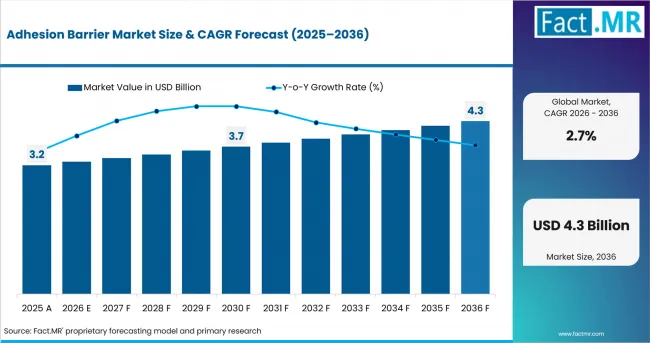
Adhesion Barrier Market Value Analysis

Summary of Adhesion Barrier Market

  • Demand Drivers
    • Rising abdominal and pelvic surgery volumes are supporting adhesion barrier demand in hospitals. Higher procedure activity increases the need for products that help reduce post-operative tissue adhesion.
    • Greater focus on complication reduction is supporting wider use of adhesion prevention products. Surgeons are using preventive measures to improve recovery outcomes.
    • Expansion of minimally invasive surgery is supporting advanced barrier formulations. Gel and film products suit precision-focused surgical techniques.
  • Key Segments Analyzed
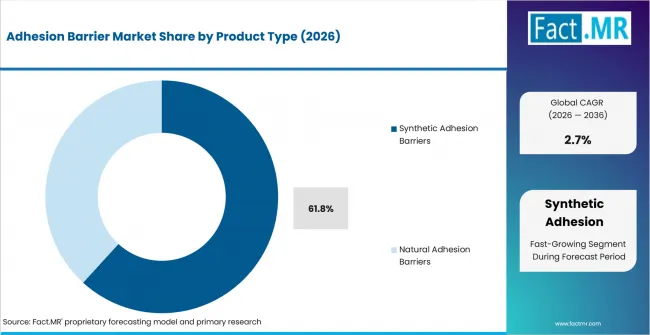
    • By Product Type: Synthetic adhesion barriers account for 61.8% share in 2026 due to consistent clinical performance.
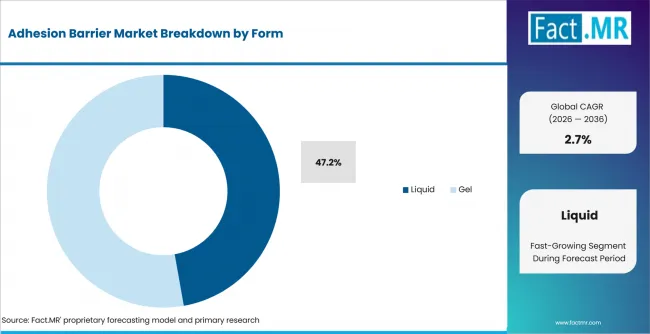
    • By Form: Film products contribute 47.2% share in 2026 supported by precise placement during surgery.
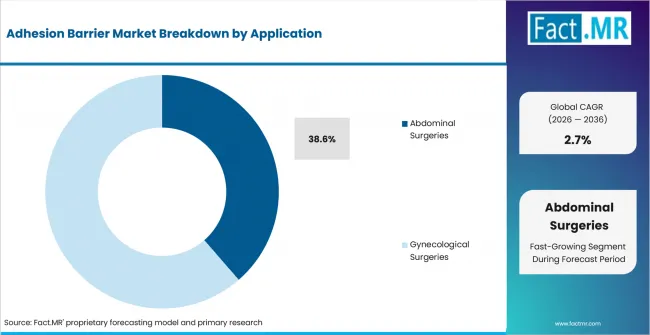
    • By Application: Abdominal surgeries represent 38.6% share due to elevated adhesion formation risk.
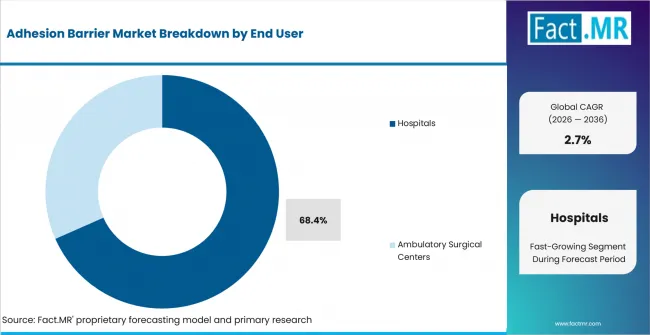
    • By End User: Hospitals contribute 68.4% share in 2026 supported by higher procedure volumes.
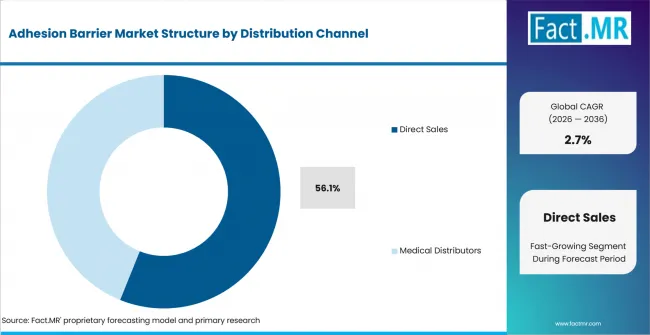
    • By Distribution Channel: Direct sales account for 56.1% share due to established hospital supply agreements.
    • By Geography: China is projected to record 3.8% CAGR by 2036 supported by surgical infrastructure expansion.
  • Analyst Opinion at Fact.MR
    • Shambhu Nath Jha, Principal Consultant at Fact.MR opines, “Market expansion will be influenced by procedural efficiency targets and post-operative outcome improvement. Clinical evidence and surgeon adoption will shape commercial performance.”
  • Strategic Implications
    • Manufacturers should improve surgeon education programs on adhesion prevention. Clear awareness of clinical benefits can support wider use in abdominal and gynecological procedures.
    • Healthcare facilities should review complication reduction benefits in high-risk procedures. Fewer adhesion-related interventions can improve long-term treatment efficiency.
    • Distributors should expand coverage across ambulatory surgical centers and specialty care networks. Better product availability can support adoption beyond large hospitals.
Metric Value
Estimated Value in 2026 USD 3.3 billion
Forecast Value in 2036 USD 4.3 billion
Forecast CAGR (2026 to 2036) 2.7%

China is expected to record 3.8% CAGR supported by hospital capacity expansion. India is forecast to grow at 3.5% CAGR driven by increasing surgical access. South Korea is projected to expand at 3.2% CAGR due to advanced surgical care adoption. The United States is estimated to witness 2.8% CAGR supported by established adhesion prevention practices. Germany is likely to register 2.6% CAGR due to procedural volume growth and healthcare quality initiatives.

Segmental Analysis

Adhesion Barrier Market Analysis by Product Type
Adhesion Barrier Market Analysis By Product Type

Synthetic adhesion barriers are estimated to hold 61.8% share in 2026. These products offer predictable handling characteristics and longer storage stability. Hospitals often select synthetic materials because they deliver standard performance across many surgical procedures. FzioMed announced it would showcase its Dynavisc® adhesion barrier gel at the Federation of European Societies for the Surgery of the Hand (FESSH) Congress. The company highlighted the product for reducing adhesions after tendon and peripheral nerve surgeries. [1]

  • Material Consistency: Synthetic formulations maintain uniform product properties. Surgical teams value reliability during complex procedures.
  • Storage Advantage: Extended shelf life reduces inventory management concerns. Healthcare facilities benefit from lower product wastage.
  • Procedure Coverage: Synthetic barriers are utilized across multiple specialties. Wider clinical applicability supports demand concentration.

Adhesion Barrier Market Analysis by Form
Adhesion Barrier Market Analysis By Form

Film adhesion barriers are projected to account for 47.2% share in 2026. Their structure allows direct placement over surgical sites. Surgeons often prefer film formats in procedures that need clear tissue separation during healing. TYBR Health announced that the U.S. FDA granted 510(k) clearance for the B3 GEL™ System, a bioresorbable flowable gel barrier designed to temporarily separate tissues during healing following tendon and skeletal muscle surgeries. The company stated that the gel helps protect healing tissue planes and preserve mobility, addressing postoperative adhesion formation. [3]

  • Placement Control: Films remain positioned at the intended location. This characteristic supports procedural precision.
  • Established Practice: Clinical familiarity strengthens acceptance among experienced surgical teams. Adoption benefits from routine use patterns.
  • Recovery Support: Physical separation of tissue surfaces assists post-operative healing. Demand reflects practical surgical utility.

Adhesion Barrier Market Analysis by Application
Adhesion Barrier Market Analysis By Application

Abdominal surgeries are expected to contribute 38.6% share in 2026. Adhesion formation risk is comparatively high in these procedures. Clinical protocols are adding preventive measures to reduce secondary interventions. Fziomed announced positive results from a Level I randomized clinical study published in Spine, showing that Oxiplex® Absorbable Gel improved pain and neurological outcomes after lumbar spine surgery. The study evaluated 134 patients and supported the clinical effectiveness of the company's adhesion barrier technology [2]

  • Procedure Volume: General surgery departments perform large numbers of abdominal operations. Utilization follows procedure activity.
  • Complication Reduction: Prevention strategies focus on limiting tissue attachment after surgery. Product demand reflects this objective.
  • Economic Benefit: Lower rates of corrective surgery improve healthcare resource allocation. Hospitals assess barriers within broader outcome programs.

Adhesion Barrier Market Analysis by End User
Adhesion Barrier Market Analysis By End User

Hospitals are estimated to generate 68.4% share in 2026. Most complex surgical procedures take place in hospital operating rooms. Access to surgical specialists supports product use.

  • Advanced Facilities: Major hospitals perform higher-acuity procedures. Demand aligns with treatment complexity.
  • Specialist Presence: Multidisciplinary surgical specialists influence product selection. Clinical expertise supports adoption.
  • Volume Concentration: Large institutions manage substantial procedure counts. Utilization reflects operating room activity.

Adhesion Barrier Market Analysis by Distribution Channel
Adhesion Barrier Market Analysis By Distribution Channel

Direct sales are projected to represent 56.1% share in 2026. Manufacturers work directly with healthcare institutions through dedicated sales networks. Long-term supply relationships guide channel selection. ARC Medical Inc. presented positive clinical safety and efficacy data for IPCOAT, its novel liquid surgical adhesion barrier, at the AAGL Global Congress 2025. The company reported successful GLAD-01 clinical trial results and announced initiation of further clinical studies in gynecologic endometriosis surgery patients. IPCOAT is specifically being developed as a surgical adhesion barrier device. [5]

  • Contract Stability: Direct agreements improve supply continuity. Hospitals value dependable product availability.
  • Technical Support: Manufacturers provide training and clinical guidance. Service quality influences purchasing decisions.
  • Commercial Relationships: Established supplier networks support repeat ordering activity. Distribution efficiency strengthens channel preference.

Drivers, Restraints, and Opportunities
Adhesion Barrier Market Opportunity Matrix Growth Vs Value

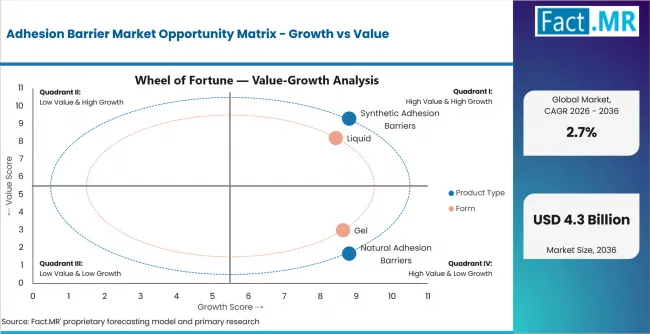
The adhesion barrier market is driven by steady surgical procedure demand. Use is concentrated in surgeries with elevated adhesion risk. Market value reflects clinical efforts to lower reoperation rates and improve recovery outcomes. Fziomed announced it would showcase its Oxiplex/IU® and Oxiplex/AP® adhesion barrier gels at the European Society for Gynecological Endoscopy (ESGE) Congress in Marseille, France. The products are designed to reduce postoperative adhesions following intrauterine and abdominal/pelvic surgeries, supporting the company's expansion and commercialization efforts in the adhesion barrier market. [4]

Surgeons are giving more attention to preventive products during initial procedures. Healthcare facilities are reviewing long-term treatment costs linked to adhesion-related complications. Premium products command higher pricing due to documented clinical benefits and procedure-specific applications.

  • Procedure Expansion: Abdominal and pelvic surgical volumes are rising across developing healthcare systems. Wider access to elective procedures supports adhesion barrier use in operating rooms.
  • Cost Sensitivity: Budget limits restrict product adoption across mid-sized hospitals. Facilities often prioritize essential surgical consumables before preventive products.
  • Clinical Awareness: Growing publication of post-surgical adhesion outcomes is improving surgeon familiarity. Expanded training activity creates opportunities across specialty surgical disciplines.

Regional Analysis

The adhesion barrier market is assessed across North America, Europe, Asia Pacific, Latin America, and the Middle East & Africa. The study evaluates surgical procedure demand, healthcare expenditure, operating room utilization, and adoption of adhesion prevention products across major healthcare systems.

Top Country Growth Comparison Adhesion Barrier Market Cagr (2026 2036)

Country CAGR (2026 to 2036)
China 3.8%
India 3.5%
South Korea 3.2%
United States 2.8%
Germany 2.6%

Source: Fact.MR analysis based on proprietary forecasting model and primary research.
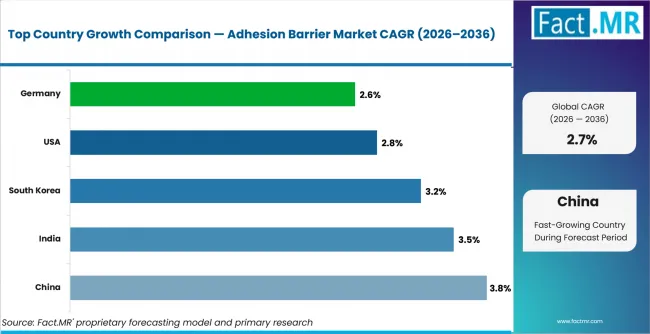
Adhesion Barrier Market Cagr Analysis By Country

Asia Pacific Adhesion Barrier Market Analysis
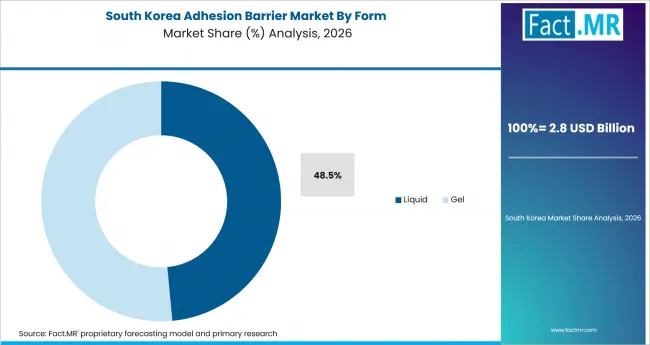
Adhesion Barrier Market South Korea Market Share Analysis By Form

Asia Pacific presents steady opportunities for adhesion barrier manufacturers. Surgical access is improving across major economies. Healthcare investment is increasing the use of advanced surgical consumables.

  • China: China is projected to rise at 3.8% CAGR by 2036 as large public hospitals perform more surgical procedures. Access to advanced surgical care is expanding across provincial healthcare systems. Greater emphasis on reducing post-operative complications is encouraging wider use of adhesion prevention products during abdominal and gynecological procedures. Healthcare infrastructure investment and rising treatment quality standards are contributing to steady market expansion.
  • India: Demand for adhesion barriers in India is projected to rise at 3.5% CAGR. Private hospital expansion and wider access to laparoscopic surgery support product use. Growth reflects increasing awareness of post-operative outcome management among surgical specialists.
  • South Korea: South Korea is expected to advance at 3.2% CAGR by 2036. High surgical standards support the use of products that improve recovery outcomes. Demand is supported by advanced healthcare infrastructure and strict procedural quality benchmarks.

North America Adhesion Barrier Market Analysis
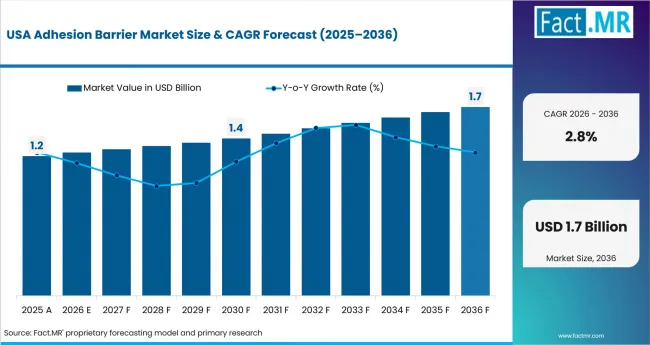
Adhesion Barrier Market Country Value Analysis

North America is an established market for adhesion prevention products. Clinical evidence and surgeon familiarity support product adoption. Demand is concentrated in high-value surgical procedures.

  • United States: Demand for adhesion barriers in the United States is estimated to expand at 2.8% CAGR through 2036. Utilization benefits from established clinical protocols in gynecological and abdominal surgery. Growth is supported by hospital focus on reducing readmissions linked to post-surgical complications.

Europe Adhesion Barrier Market Analysis
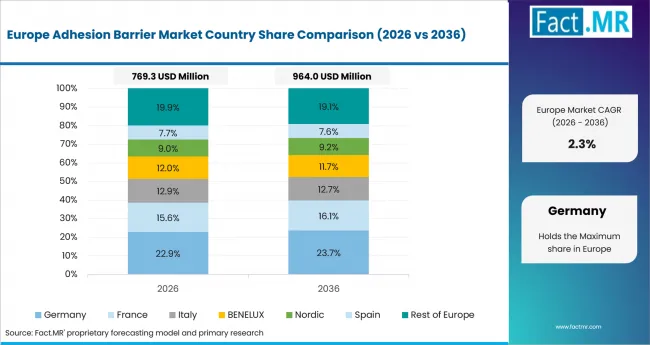
Adhesion Barrier Market Europe Country Market Share Analysis, 2026 & 2036

Europe benefits from structured healthcare delivery and high surgical quality standards. Hospitals focus on better outcomes and procedural efficiency. Adoption reflects clinical evaluation of long-term treatment benefits.

  • Germany: Germany is anticipated to register 2.6% CAGR during the forecast period. Hospital networks place emphasis on reducing secondary interventions following surgery. Demand is supported by procedure volumes and established reimbursement systems for advanced surgical care.

Competitive Aligners for Market Players
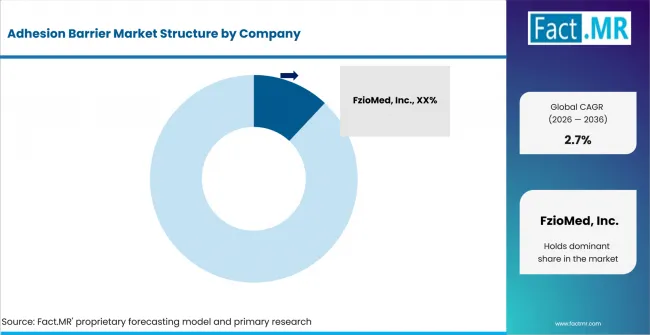
Adhesion Barrier Market Analysis By Company

The adhesion barrier market has a concentrated competitive structure led by multinational medical technology suppliers. Product effectiveness and surgeon acceptance influence commercial positioning. Clinical evidence remains a major differentiating factor across healthcare institutions.

Manufacturers with established surgical portfolios benefit from long-standing relationships with hospitals and surgical centers. Distribution reach improves access to operating rooms across developed healthcare markets. Product familiarity supports repeat purchasing.

Healthcare institutions evaluate adhesion barriers based on handling characteristics and documented clinical outcomes. Cost considerations influence purchasing decisions in price-sensitive markets. Commercial success is linked to surgeon education programs and procedure-specific product positioning. Product innovation focuses on improved biocompatibility and simplified application methods. Suppliers seek differentiation through clinical data and specialty procedure expertise. Market competition centers on performance validation rather than volume expansion alone.

Key Players

  • FzioMed, Inc.
  • Terumo Corporation
  • ARC Medical Inc.
  • Baxter International Inc.
  • Integra LifeSciences Holdings Corporation

Bibliography

  • [1] FzioMed, Inc. (2025). FzioMed, Inc. to highlight its adhesion barrier gel product solutions at the 2025 IFSSH and IFSHT Triennial Global Hand Congress.
  • [2] FzioMed, Inc. (2026). FzioMed announces clinical results from Level I study evaluating Oxiplex absorbable gel for spine surgery.
  • [3] Tybr Health. (2025). Tybr Health announces FDA 510(k) clearance for B3 Gel System, a flowable bio-gel to protect healing tissue and preserve function.
  • [4] FzioMed, Inc. (2024). FzioMed, Inc. to highlight its adhesion barrier product solutions at the European Society for Gynecological Endoscopy (ESGE) Congress. PR Newswire.
  • [5] ARC Medical, Inc. (2025). ARC presents positive data at AAGL 2025. ARC Medical, Inc.

This Report Addresses

  • Analysis of adhesion barrier demand across abdominal, gynecological, orthopedic, cardiovascular, reconstructive, and urological surgical procedures.
  • Market forecast from USD 3.3 billion in 2026 to USD 4.3 billion by 2036 at 2.7% CAGR.
  • Opportunity assessment across synthetic and natural adhesion barrier product segments.
  • Segment forecasts covering product type, form, application, end user, and distribution channel demand.
  • Competitive assessment of adhesion barrier manufacturers and surgical product suppliers.
  • Evaluation of surgical procedure trends and healthcare investment activity.
  • Country-level analysis across China, India, South Korea, the United States, and Germany.
  • Report delivery through PDF and Excel formats supported by primary interviews and healthcare industry analysis.

Adhesion Barrier Market Definition

The adhesion barrier market covers products used during surgery to reduce formation of internal adhesions after tissue trauma. These products act as temporary physical barriers between tissue surfaces during healing. Adhesion barriers are available as films, gels, and liquid formulations. They are commonly used in abdominal, gynecological, cardiovascular, orthopedic, and urological procedures. Their primary purpose is reducing post-surgical complications linked to tissue attachment and scar formation.

Adhesion Barrier Market Inclusions

The study covers global and regional forecasts from 2026 to 2036 by product type, form, application, end user, and distribution channel. It includes adhesion prevention products used across surgical settings. The report evaluates procedure volumes, adoption trends, healthcare investment, and regional demand patterns.

Adhesion Barrier Market Exclusions

The study excludes surgical instruments, wound closure products, hemostatic agents, and general post-operative care materials. It omits products not intended for adhesion prevention. Pharmaceutical therapies unrelated to surgical adhesion management are excluded from market estimates.

Adhesion Barrier Market Research Methodology

  • Primary Research
    • Interviews were conducted with surgeons, hospital purchasing departments, specialty clinic administrators, distributors, and adhesion barrier manufacturers.
  • Desk Research
    • Analysis included company disclosures, regulatory publications, healthcare databases, surgical procedure statistics, and clinical literature published during 2024 and 2025.
  • Market-Sizing and Forecasting
    • Hybrid top-down and bottom-up model using procedure volumes, product utilization rates, pricing benchmarks, and healthcare expenditure trends.
  • Data Validation and Update Cycle
    • Forecast was validated through surgeon interviews, distributor feedback, company disclosures, and healthcare utilization assessments.

Scope of Report

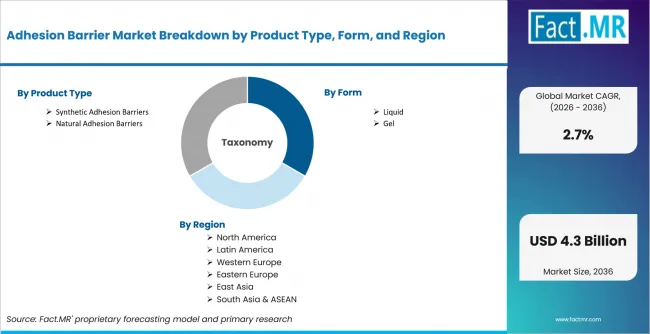
Adhesion Barrier Market Breakdown By Product Type, Form, And Region

Attribute Details
Quantitative Units USD 3.3 billion (2026) to USD 4.3 billion (2036) at a CAGR of 2.7%
Market Definition Covers products used to reduce post-surgical adhesion formation.
Product Type Segmentation Natural Adhesion Barriers, Synthetic Adhesion Barriers
Form Segmentation Liquid, Gel, Film
Application Segmentation Abdominal Surgeries, Gynecological Surgeries, Orthopedic Surgeries, Cardiovascular Surgeries, Reconstructive Surgeries, Urological Surgeries
End User Segmentation Hospitals, Ambulatory Surgical Centers, Specialty Clinics
Distribution Channel Segmentation Direct Sales, Medical Distributors, Online Purchase Platforms
Regions Covered North America, Europe, Asia Pacific, Latin America, Middle East & Africa
Countries Covered China, India, South Korea, United States, Germany
Key Companies Profiled FzioMed, Inc., Terumo Corporation, ARC Medical Inc., Baxter International Inc., Integra LifeSciences Holdings Corporation
Forecast Period 2026 to 2036
Approach Hybrid top-down and bottom-up model using procedure and utilization analysis.

Adhesion Barrier Market by Segment

  • By Product Type:

    • Natural Adhesion Barriers
    • Synthetic Adhesion Barriers
  • By Form:

    • Liquid
    • Gel
    • Film
  • By Application:

    • Abdominal Surgeries
    • Gynecological Surgeries
    • Orthopedic Surgeries
    • Cardiovascular Surgeries
    • Reconstructive Surgeries
    • Urological Surgeries
  • By End User:

    • Hospitals
    • Ambulatory Surgical Centers
    • Specialty Clinics
  • By Distribution Channel:

    • Direct Sales
    • Medical Distributors
    • Online Purchase Platforms
  • By Region:

    • North America
      • United States
      • Canada
      • Mexico
    • Latin America
      • Brazil
      • Argentina
      • Rest of Latin America
    • Europe
      • Germany
      • United Kingdom
      • France
      • Italy
      • Rest of Europe
    • Asia Pacific
      • China
      • India
      • Japan
      • South Korea
      • ASEAN
    • Middle East & Africa
      • UAE
      • Saudi Arabia
      • South Africa
      • Rest of Middle East & Africa

- Frequently Asked Questions -

How large is the global adhesion barrier market in 2025?

The global adhesion barrier market was valued at USD 3.2 billion in 2025 based on Fact.MR industry analysis.

What will the adhesion barrier market size be in 2026?

Based on Fact.MR analysis, demand for adhesion barriers is estimated to reach USD 3.3 billion in 2026.

What is the projected adhesion barrier market size by 2036?

The market is projected to reach USD 4.3 billion by 2036 supported by steady surgical procedure demand and increasing focus on post-operative complication reduction.

What is the expected CAGR for the adhesion barrier market from 2026 to 2036?

Fact.MR projects the global adhesion barrier market to expand at a CAGR of 2.7% during the forecast period.

Which product type segment is poised to lead market demand?

Synthetic adhesion barriers lead with 61.8% share in 2026 due to product consistency, longer shelf life, and wider surgical applicability.

Which application segment contributes the leading demand?

Abdominal surgeries contribute 38.6% share in 2026 supported by elevated adhesion formation risk and increasing adoption of preventive surgical measures.

Which country records stronger growth across the assessment period?

China is projected to expand at 3.8% CAGR through 2036 supported by growing surgical procedure volumes and improving healthcare infrastructure.

Table of Content

  1. Executive Summary
    • Global Market Outlook
    • Demand to side Trends
    • Supply to side Trends
    • Technology Roadmap Analysis
    • Analysis and Recommendations
  2. Market Overview
    • Market Coverage / Taxonomy
    • Market Definition / Scope / Limitations
  3. Research Methodology
    • Chapter Orientation
    • Analytical Lens and Working Hypotheses
      • Market Structure, Signals, and Trend Drivers
      • Benchmarking and Cross-market Comparability
      • Market Sizing, Forecasting, and Opportunity Mapping
    • Research Design and Evidence Framework
      • Desk Research Programme (Secondary Evidence)
        • Company Annual and Sustainability Reports
        • Peer-reviewed Journals and Academic Literature
        • Corporate Websites, Product Literature, and Technical Notes
        • Earnings Decks and Investor Briefings
        • Statutory Filings and Regulatory Disclosures
        • Technical White Papers and Standards Notes
        • Trade Journals, Industry Magazines, and Analyst Briefs
        • Conference Proceedings, Webinars, and Seminar Materials
        • Government Statistics Portals and Public Data Releases
        • Press Releases and Reputable Media Coverage
        • Specialist Newsletters and Curated Briefings
        • Sector Databases and Reference Repositories
        • Fact.MR Internal Proprietary Databases and Historical Market Datasets
        • Subscription Datasets and Paid Sources
        • Social Channels, Communities, and Digital Listening Inputs
        • Additional Desk Sources
      • Expert Input and Fieldwork (Primary Evidence)
        • Primary Modes
          • Qualitative Interviews and Expert Elicitation
          • Quantitative Surveys and Structured Data Capture
          • Blended Approach
        • Why Primary Evidence is Used
        • Field Techniques
          • Interviews
          • Surveys
          • Focus Groups
          • Observational and In-context Research
          • Social and Community Interactions
        • Stakeholder Universe Engaged
          • C-suite Leaders
          • Board Members
          • Presidents and Vice Presidents
          • R&D and Innovation Heads
          • Technical Specialists
          • Domain Subject-matter Experts
          • Scientists
          • Physicians and Other Healthcare Professionals
        • Governance, Ethics, and Data Stewardship
          • Research Ethics
          • Data Integrity and Handling
      • Tooling, Models, and Reference Databases
    • Data Engineering and Model Build
      • Data Acquisition and Ingestion
      • Cleaning, Normalisation, and Verification
      • Synthesis, Triangulation, and Analysis
    • Quality Assurance and Audit Trail
  4. Market Background
    • Market Dynamics
      • Drivers
      • Restraints
      • Opportunity
      • Trends
    • Scenario Forecast
      • Demand in Optimistic Scenario
      • Demand in Likely Scenario
      • Demand in Conservative Scenario
    • Opportunity Map Analysis
    • Product Life Cycle Analysis
    • Supply Chain Analysis
    • Investment Feasibility Matrix
    • Value Chain Analysis
    • PESTLE and Porter’s Analysis
    • Regulatory Landscape
    • Regional Parent Market Outlook
    • Production and Consumption Statistics
    • Import and Export Statistics
  5. Global Market Analysis 2021 to 2025 and Forecast, 2026 to 2036
    • Historical Market Size Value (USD Million) Analysis, 2021 to 2025
    • Current and Future Market Size Value (USD Million) Projections, 2026 to 2036
      • Y to o to Y Growth Trend Analysis
      • Absolute $ Opportunity Analysis
  6. Global Market Pricing Analysis 2021 to 2025 and Forecast 2026 to 2036
  7. Global Market Analysis 2021 to 2025 and Forecast 2026 to 2036, By Product
    • Introduction / Key Findings
    • Historical Market Size Value (USD Million) Analysis By Product , 2021 to 2025
    • Current and Future Market Size Value (USD Million) Analysis and Forecast By Product , 2026 to 2036
      • Industrial Hot Melt
      • Adhesive Controllers
      • Cold Glue Applicators
    • Y to o to Y Growth Trend Analysis By Product , 2021 to 2025
    • Absolute $ Opportunity Analysis By Product , 2026 to 2036
  8. Global Market Analysis 2021 to 2025 and Forecast 2026 to 2036, By Application
    • Introduction / Key Findings
    • Historical Market Size Value (USD Million) Analysis By Application, 2021 to 2025
    • Current and Future Market Size Value (USD Million) Analysis and Forecast By Application, 2026 to 2036
      • Packaging
      • Construction
      • Lamination
    • Y to o to Y Growth Trend Analysis By Application, 2021 to 2025
    • Absolute $ Opportunity Analysis By Application, 2026 to 2036
  9. Global Market Analysis 2021 to 2025 and Forecast 2026 to 2036, By End-use Industry
    • Introduction / Key Findings
    • Historical Market Size Value (USD Million) Analysis By End-use Industry, 2021 to 2025
    • Current and Future Market Size Value (USD Million) Analysis and Forecast By End-use Industry, 2026 to 2036
      • Food & Beverage
      • Consumer Goods
      • Automotive
    • Y to o to Y Growth Trend Analysis By End-use Industry, 2021 to 2025
    • Absolute $ Opportunity Analysis By End-use Industry, 2026 to 2036
  10. Global Market Analysis 2021 to 2025 and Forecast 2026 to 2036, By Automation Level
    • Introduction / Key Findings
    • Historical Market Size Value (USD Million) Analysis By Automation Level, 2021 to 2025
    • Current and Future Market Size Value (USD Million) Analysis and Forecast By Automation Level, 2026 to 2036
      • Fully Automatic Systems
      • Manual Systems
      • Semi-Automatic Systems
    • Y to o to Y Growth Trend Analysis By Automation Level, 2021 to 2025
    • Absolute $ Opportunity Analysis By Automation Level, 2026 to 2036
  11. Global Market Analysis 2021 to 2025 and Forecast 2026 to 2036, By Distribution Channel
    • Introduction / Key Findings
    • Historical Market Size Value (USD Million) Analysis By Distribution Channel, 2021 to 2025
    • Current and Future Market Size Value (USD Million) Analysis and Forecast By Distribution Channel, 2026 to 2036
      • Direct Sales
      • Distributors
      • Online Sales
    • Y to o to Y Growth Trend Analysis By Distribution Channel, 2021 to 2025
    • Absolute $ Opportunity Analysis By Distribution Channel, 2026 to 2036
  12. Global Market Analysis 2021 to 2025 and Forecast 2026 to 2036, By Region
    • Introduction
    • Historical Market Size Value (USD Million) Analysis By Region, 2021 to 2025
    • Current Market Size Value (USD Million) Analysis and Forecast By Region, 2026 to 2036
      • North America
      • Latin America
      • Western Europe
      • Eastern Europe
      • East Asia
      • South Asia and Pacific
      • Middle East & Africa
    • Market Attractiveness Analysis By Region
  13. North America Market Analysis 2021 to 2025 and Forecast 2026 to 2036, By Country
    • Historical Market Size Value (USD Million) Trend Analysis By Market Taxonomy, 2021 to 2025
    • Market Size Value (USD Million) Forecast By Market Taxonomy, 2026 to 2036
      • By Country
        • USA
        • Canada
        • Mexico
      • By Product
      • By Application
      • By End-use Industry
      • By Automation Level
      • By Distribution Channel
    • Market Attractiveness Analysis
      • By Country
      • By Product
      • By Application
      • By End-use Industry
      • By Automation Level
      • By Distribution Channel
    • Key Takeaways
  14. Latin America Market Analysis 2021 to 2025 and Forecast 2026 to 2036, By Country
    • Historical Market Size Value (USD Million) Trend Analysis By Market Taxonomy, 2021 to 2025
    • Market Size Value (USD Million) Forecast By Market Taxonomy, 2026 to 2036
      • By Country
        • Brazil
        • Chile
        • Rest of Latin America
      • By Product
      • By Application
      • By End-use Industry
      • By Automation Level
      • By Distribution Channel
    • Market Attractiveness Analysis
      • By Country
      • By Product
      • By Application
      • By End-use Industry
      • By Automation Level
      • By Distribution Channel
    • Key Takeaways
  15. Western Europe Market Analysis 2021 to 2025 and Forecast 2026 to 2036, By Country
    • Historical Market Size Value (USD Million) Trend Analysis By Market Taxonomy, 2021 to 2025
    • Market Size Value (USD Million) Forecast By Market Taxonomy, 2026 to 2036
      • By Country
        • Germany
        • UK
        • Italy
        • Spain
        • France
        • Nordic
        • BENELUX
        • Rest of Western Europe
      • By Product
      • By Application
      • By End-use Industry
      • By Automation Level
      • By Distribution Channel
    • Market Attractiveness Analysis
      • By Country
      • By Product
      • By Application
      • By End-use Industry
      • By Automation Level
      • By Distribution Channel
    • Key Takeaways
  16. Eastern Europe Market Analysis 2021 to 2025 and Forecast 2026 to 2036, By Country
    • Historical Market Size Value (USD Million) Trend Analysis By Market Taxonomy, 2021 to 2025
    • Market Size Value (USD Million) Forecast By Market Taxonomy, 2026 to 2036
      • By Country
        • Russia
        • Poland
        • Hungary
        • Balkan & Baltic
        • Rest of Eastern Europe
      • By Product
      • By Application
      • By End-use Industry
      • By Automation Level
      • By Distribution Channel
    • Market Attractiveness Analysis
      • By Country
      • By Product
      • By Application
      • By End-use Industry
      • By Automation Level
      • By Distribution Channel
    • Key Takeaways
  17. East Asia Market Analysis 2021 to 2025 and Forecast 2026 to 2036, By Country
    • Historical Market Size Value (USD Million) Trend Analysis By Market Taxonomy, 2021 to 2025
    • Market Size Value (USD Million) Forecast By Market Taxonomy, 2026 to 2036
      • By Country
        • China
        • Japan
        • South Korea
      • By Product
      • By Application
      • By End-use Industry
      • By Automation Level
      • By Distribution Channel
    • Market Attractiveness Analysis
      • By Country
      • By Product
      • By Application
      • By End-use Industry
      • By Automation Level
      • By Distribution Channel
    • Key Takeaways
  18. South Asia and Pacific Market Analysis 2021 to 2025 and Forecast 2026 to 2036, By Country
    • Historical Market Size Value (USD Million) Trend Analysis By Market Taxonomy, 2021 to 2025
    • Market Size Value (USD Million) Forecast By Market Taxonomy, 2026 to 2036
      • By Country
        • India
        • ASEAN
        • Australia & New Zealand
        • Rest of South Asia and Pacific
      • By Product
      • By Application
      • By End-use Industry
      • By Automation Level
      • By Distribution Channel
    • Market Attractiveness Analysis
      • By Country
      • By Product
      • By Application
      • By End-use Industry
      • By Automation Level
      • By Distribution Channel
    • Key Takeaways
  19. Middle East & Africa Market Analysis 2021 to 2025 and Forecast 2026 to 2036, By Country
    • Historical Market Size Value (USD Million) Trend Analysis By Market Taxonomy, 2021 to 2025
    • Market Size Value (USD Million) Forecast By Market Taxonomy, 2026 to 2036
      • By Country
        • Kingdom of Saudi Arabia
        • Other GCC Countries
        • Turkiye
        • South Africa
        • Other African Union
        • Rest of Middle East & Africa
      • By Product
      • By Application
      • By End-use Industry
      • By Automation Level
      • By Distribution Channel
    • Market Attractiveness Analysis
      • By Country
      • By Product
      • By Application
      • By End-use Industry
      • By Automation Level
      • By Distribution Channel
    • Key Takeaways
  20. Key Countries Market Analysis
    • USA
      • Pricing Analysis
      • Market Share Analysis, 2025
        • By Product
        • By Application
        • By End-use Industry
        • By Automation Level
        • By Distribution Channel
    • Canada
      • Pricing Analysis
      • Market Share Analysis, 2025
        • By Product
        • By Application
        • By End-use Industry
        • By Automation Level
        • By Distribution Channel
    • Mexico
      • Pricing Analysis
      • Market Share Analysis, 2025
        • By Product
        • By Application
        • By End-use Industry
        • By Automation Level
        • By Distribution Channel
    • Brazil
      • Pricing Analysis
      • Market Share Analysis, 2025
        • By Product
        • By Application
        • By End-use Industry
        • By Automation Level
        • By Distribution Channel
    • Chile
      • Pricing Analysis
      • Market Share Analysis, 2025
        • By Product
        • By Application
        • By End-use Industry
        • By Automation Level
        • By Distribution Channel
    • Germany
      • Pricing Analysis
      • Market Share Analysis, 2025
        • By Product
        • By Application
        • By End-use Industry
        • By Automation Level
        • By Distribution Channel
    • UK
      • Pricing Analysis
      • Market Share Analysis, 2025
        • By Product
        • By Application
        • By End-use Industry
        • By Automation Level
        • By Distribution Channel
    • Italy
      • Pricing Analysis
      • Market Share Analysis, 2025
        • By Product
        • By Application
        • By End-use Industry
        • By Automation Level
        • By Distribution Channel
    • Spain
      • Pricing Analysis
      • Market Share Analysis, 2025
        • By Product
        • By Application
        • By End-use Industry
        • By Automation Level
        • By Distribution Channel
    • France
      • Pricing Analysis
      • Market Share Analysis, 2025
        • By Product
        • By Application
        • By End-use Industry
        • By Automation Level
        • By Distribution Channel
    • India
      • Pricing Analysis
      • Market Share Analysis, 2025
        • By Product
        • By Application
        • By End-use Industry
        • By Automation Level
        • By Distribution Channel
    • ASEAN
      • Pricing Analysis
      • Market Share Analysis, 2025
        • By Product
        • By Application
        • By End-use Industry
        • By Automation Level
        • By Distribution Channel
    • Australia & New Zealand
      • Pricing Analysis
      • Market Share Analysis, 2025
        • By Product
        • By Application
        • By End-use Industry
        • By Automation Level
        • By Distribution Channel
    • China
      • Pricing Analysis
      • Market Share Analysis, 2025
        • By Product
        • By Application
        • By End-use Industry
        • By Automation Level
        • By Distribution Channel
    • Japan
      • Pricing Analysis
      • Market Share Analysis, 2025
        • By Product
        • By Application
        • By End-use Industry
        • By Automation Level
        • By Distribution Channel
    • South Korea
      • Pricing Analysis
      • Market Share Analysis, 2025
        • By Product
        • By Application
        • By End-use Industry
        • By Automation Level
        • By Distribution Channel
    • Russia
      • Pricing Analysis
      • Market Share Analysis, 2025
        • By Product
        • By Application
        • By End-use Industry
        • By Automation Level
        • By Distribution Channel
    • Poland
      • Pricing Analysis
      • Market Share Analysis, 2025
        • By Product
        • By Application
        • By End-use Industry
        • By Automation Level
        • By Distribution Channel
    • Hungary
      • Pricing Analysis
      • Market Share Analysis, 2025
        • By Product
        • By Application
        • By End-use Industry
        • By Automation Level
        • By Distribution Channel
    • Kingdom of Saudi Arabia
      • Pricing Analysis
      • Market Share Analysis, 2025
        • By Product
        • By Application
        • By End-use Industry
        • By Automation Level
        • By Distribution Channel
    • Turkiye
      • Pricing Analysis
      • Market Share Analysis, 2025
        • By Product
        • By Application
        • By End-use Industry
        • By Automation Level
        • By Distribution Channel
    • South Africa
      • Pricing Analysis
      • Market Share Analysis, 2025
        • By Product
        • By Application
        • By End-use Industry
        • By Automation Level
        • By Distribution Channel
  21. Market Structure Analysis
    • Competition Dashboard
    • Competition Benchmarking
    • Market Share Analysis of Top Players
      • By Regional
      • By Product
      • By Application
      • By End-use Industry
      • By Automation Level
      • By Distribution Channel
  22. Competition Analysis
    • Competition Deep Dive
      • Robatech
        • Overview
        • Product Portfolio
        • Profitability by Market Segments (Product/Age /Sales Channel/Region)
        • Sales Footprint
        • Strategy Overview
          • Marketing Strategy
          • Product Strategy
          • Channel Strategy
      • Glue Machinery Corporation
      • Gluefast Company
      • Nordson Corporation
      • Adhesive & Equipment, Inc.
  23. Assumptions & Acronyms Used

List Of Table

  • Table 1: Global Market Value (USD Million) Forecast by Region, 2021 to 2036
  • Table 2: Global Market Value (USD Million) Forecast by Product , 2021 to 2036
  • Table 3: Global Market Value (USD Million) Forecast by Application, 2021 to 2036
  • Table 4: Global Market Value (USD Million) Forecast by End-use Industry, 2021 to 2036
  • Table 5: Global Market Value (USD Million) Forecast by Automation Level, 2021 to 2036
  • Table 6: Global Market Value (USD Million) Forecast by Distribution Channel, 2021 to 2036
  • Table 7: North America Market Value (USD Million) Forecast by Country, 2021 to 2036
  • Table 8: North America Market Value (USD Million) Forecast by Product , 2021 to 2036
  • Table 9: North America Market Value (USD Million) Forecast by Application, 2021 to 2036
  • Table 10: North America Market Value (USD Million) Forecast by End-use Industry, 2021 to 2036
  • Table 11: North America Market Value (USD Million) Forecast by Automation Level, 2021 to 2036
  • Table 12: North America Market Value (USD Million) Forecast by Distribution Channel, 2021 to 2036
  • Table 13: Latin America Market Value (USD Million) Forecast by Country, 2021 to 2036
  • Table 14: Latin America Market Value (USD Million) Forecast by Product , 2021 to 2036
  • Table 15: Latin America Market Value (USD Million) Forecast by Application, 2021 to 2036
  • Table 16: Latin America Market Value (USD Million) Forecast by End-use Industry, 2021 to 2036
  • Table 17: Latin America Market Value (USD Million) Forecast by Automation Level, 2021 to 2036
  • Table 18: Latin America Market Value (USD Million) Forecast by Distribution Channel, 2021 to 2036
  • Table 19: Western Europe Market Value (USD Million) Forecast by Country, 2021 to 2036
  • Table 20: Western Europe Market Value (USD Million) Forecast by Product , 2021 to 2036
  • Table 21: Western Europe Market Value (USD Million) Forecast by Application, 2021 to 2036
  • Table 22: Western Europe Market Value (USD Million) Forecast by End-use Industry, 2021 to 2036
  • Table 23: Western Europe Market Value (USD Million) Forecast by Automation Level, 2021 to 2036
  • Table 24: Western Europe Market Value (USD Million) Forecast by Distribution Channel, 2021 to 2036
  • Table 25: Eastern Europe Market Value (USD Million) Forecast by Country, 2021 to 2036
  • Table 26: Eastern Europe Market Value (USD Million) Forecast by Product , 2021 to 2036
  • Table 27: Eastern Europe Market Value (USD Million) Forecast by Application, 2021 to 2036
  • Table 28: Eastern Europe Market Value (USD Million) Forecast by End-use Industry, 2021 to 2036
  • Table 29: Eastern Europe Market Value (USD Million) Forecast by Automation Level, 2021 to 2036
  • Table 30: Eastern Europe Market Value (USD Million) Forecast by Distribution Channel, 2021 to 2036
  • Table 31: East Asia Market Value (USD Million) Forecast by Country, 2021 to 2036
  • Table 32: East Asia Market Value (USD Million) Forecast by Product , 2021 to 2036
  • Table 33: East Asia Market Value (USD Million) Forecast by Application, 2021 to 2036
  • Table 34: East Asia Market Value (USD Million) Forecast by End-use Industry, 2021 to 2036
  • Table 35: East Asia Market Value (USD Million) Forecast by Automation Level, 2021 to 2036
  • Table 36: East Asia Market Value (USD Million) Forecast by Distribution Channel, 2021 to 2036
  • Table 37: South Asia and Pacific Market Value (USD Million) Forecast by Country, 2021 to 2036
  • Table 38: South Asia and Pacific Market Value (USD Million) Forecast by Product , 2021 to 2036
  • Table 39: South Asia and Pacific Market Value (USD Million) Forecast by Application, 2021 to 2036
  • Table 40: South Asia and Pacific Market Value (USD Million) Forecast by End-use Industry, 2021 to 2036
  • Table 41: South Asia and Pacific Market Value (USD Million) Forecast by Automation Level, 2021 to 2036
  • Table 42: South Asia and Pacific Market Value (USD Million) Forecast by Distribution Channel, 2021 to 2036
  • Table 43: Middle East & Africa Market Value (USD Million) Forecast by Country, 2021 to 2036
  • Table 44: Middle East & Africa Market Value (USD Million) Forecast by Product , 2021 to 2036
  • Table 45: Middle East & Africa Market Value (USD Million) Forecast by Application, 2021 to 2036
  • Table 46: Middle East & Africa Market Value (USD Million) Forecast by End-use Industry, 2021 to 2036
  • Table 47: Middle East & Africa Market Value (USD Million) Forecast by Automation Level, 2021 to 2036
  • Table 48: Middle East & Africa Market Value (USD Million) Forecast by Distribution Channel, 2021 to 2036

List Of Figures

  • Figure 1: Global Market Pricing Analysis
  • Figure 2: Global Market Value (USD Million) Forecast 2021-2036
  • Figure 3: Global Market Value Share and BPS Analysis by Product, 2026 and 2036
  • Figure 4: Global Market Y-o-Y Growth Comparison by Product,2026 to 2036
  • Figure 5: Global Market Attractiveness Analysis by Product
  • Figure 6: Global Market Value Share and BPS Analysis by Application, 2026 and 2036
  • Figure 7: Global Market Y-o-Y Growth Comparison by Application,2026 to 2036
  • Figure 8: Global Market Attractiveness Analysis by Application
  • Figure 9: Global Market Value Share and BPS Analysis by End-use Industry, 2026 and 2036
  • Figure 10: Global Market Y-o-Y Growth Comparison by End-use Industry,2026 to 2036
  • Figure 11: Global Market Attractiveness Analysis by End-use Industry
  • Figure 12: Global Market Value Share and BPS Analysis by Automation Level, 2026 and 2036
  • Figure 13: Global Market Y-o-Y Growth Comparison by Automation Level,2026 to 2036
  • Figure 14: Global Market Attractiveness Analysis by Automation Level
  • Figure 15: Global Market Value Share and BPS Analysis by Distribution Channel, 2026 and 2036
  • Figure 16: Global Market Y-o-Y Growth Comparison by Distribution Channel,2026 to 2036
  • Figure 17: Global Market Attractiveness Analysis by Distribution Channel
  • Figure 18: Global Market Value (USD Million) Share and BPS Analysis by Region, 2026 and 2036
  • Figure 19: Global Market Y-o-Y Growth Comparison by Region,2026 to 2036
  • Figure 20: Global Market Attractiveness Analysis by Region
  • Figure 21: North America Market Incremental Dollar Opportunity,2026 to 2036
  • Figure 22: Latin America Market Incremental Dollar Opportunity,2026 to 2036
  • Figure 23: Western Europe Market Incremental Dollar Opportunity,2026 to 2036
  • Figure 24: Eastern Europe Market Incremental Dollar Opportunity,2026 to 2036
  • Figure 25: East Asia Market Incremental Dollar Opportunity,2026 to 2036
  • Figure 26: South Asia and Pacific Market Incremental Dollar Opportunity,2026 to 2036
  • Figure 27: Middle East & Africa Market Incremental Dollar Opportunity,2026 to 2036
  • Figure 28: North America Market Value Share and BPS Analysis by Country, 2026 and 2036
  • Figure 29: North America Market Value Share and BPS Analysis by Product, 2026 and 2036
  • Figure 30: North America Market Y-o-Y Growth Comparison by Product,2026 to 2036
  • Figure 31: North America Market Attractiveness Analysis by Product
  • Figure 32: North America Market Value Share and BPS Analysis by Application, 2026 and 2036
  • Figure 33: North America Market Y-o-Y Growth Comparison by Application,2026 to 2036
  • Figure 34: North America Market Attractiveness Analysis by Application
  • Figure 35: North America Market Value Share and BPS Analysis by End-use Industry, 2026 and 2036
  • Figure 36: North America Market Y-o-Y Growth Comparison by End-use Industry,2026 to 2036
  • Figure 37: North America Market Attractiveness Analysis by End-use Industry
  • Figure 38: North America Market Value Share and BPS Analysis by Automation Level, 2026 and 2036
  • Figure 39: North America Market Y-o-Y Growth Comparison by Automation Level,2026 to 2036
  • Figure 40: North America Market Attractiveness Analysis by Automation Level
  • Figure 41: North America Market Value Share and BPS Analysis by Distribution Channel, 2026 and 2036
  • Figure 42: North America Market Y-o-Y Growth Comparison by Distribution Channel,2026 to 2036
  • Figure 43: North America Market Attractiveness Analysis by Distribution Channel
  • Figure 44: Latin America Market Value Share and BPS Analysis by Country, 2026 and 2036
  • Figure 45: Latin America Market Value Share and BPS Analysis by Product, 2026 and 2036
  • Figure 46: Latin America Market Y-o-Y Growth Comparison by Product,2026 to 2036
  • Figure 47: Latin America Market Attractiveness Analysis by Product
  • Figure 48: Latin America Market Value Share and BPS Analysis by Application, 2026 and 2036
  • Figure 49: Latin America Market Y-o-Y Growth Comparison by Application,2026 to 2036
  • Figure 50: Latin America Market Attractiveness Analysis by Application
  • Figure 51: Latin America Market Value Share and BPS Analysis by End-use Industry, 2026 and 2036
  • Figure 52: Latin America Market Y-o-Y Growth Comparison by End-use Industry,2026 to 2036
  • Figure 53: Latin America Market Attractiveness Analysis by End-use Industry
  • Figure 54: Latin America Market Value Share and BPS Analysis by Automation Level, 2026 and 2036
  • Figure 55: Latin America Market Y-o-Y Growth Comparison by Automation Level,2026 to 2036
  • Figure 56: Latin America Market Attractiveness Analysis by Automation Level
  • Figure 57: Latin America Market Value Share and BPS Analysis by Distribution Channel, 2026 and 2036
  • Figure 58: Latin America Market Y-o-Y Growth Comparison by Distribution Channel,2026 to 2036
  • Figure 59: Latin America Market Attractiveness Analysis by Distribution Channel
  • Figure 60: Western Europe Market Value Share and BPS Analysis by Country, 2026 and 2036
  • Figure 61: Western Europe Market Value Share and BPS Analysis by Product, 2026 and 2036
  • Figure 62: Western Europe Market Y-o-Y Growth Comparison by Product,2026 to 2036
  • Figure 63: Western Europe Market Attractiveness Analysis by Product
  • Figure 64: Western Europe Market Value Share and BPS Analysis by Application, 2026 and 2036
  • Figure 65: Western Europe Market Y-o-Y Growth Comparison by Application,2026 to 2036
  • Figure 66: Western Europe Market Attractiveness Analysis by Application
  • Figure 67: Western Europe Market Value Share and BPS Analysis by End-use Industry, 2026 and 2036
  • Figure 68: Western Europe Market Y-o-Y Growth Comparison by End-use Industry,2026 to 2036
  • Figure 69: Western Europe Market Attractiveness Analysis by End-use Industry
  • Figure 70: Western Europe Market Value Share and BPS Analysis by Automation Level, 2026 and 2036
  • Figure 71: Western Europe Market Y-o-Y Growth Comparison by Automation Level,2026 to 2036
  • Figure 72: Western Europe Market Attractiveness Analysis by Automation Level
  • Figure 73: Western Europe Market Value Share and BPS Analysis by Distribution Channel, 2026 and 2036
  • Figure 74: Western Europe Market Y-o-Y Growth Comparison by Distribution Channel,2026 to 2036
  • Figure 75: Western Europe Market Attractiveness Analysis by Distribution Channel
  • Figure 76: Eastern Europe Market Value Share and BPS Analysis by Country, 2026 and 2036
  • Figure 77: Eastern Europe Market Value Share and BPS Analysis by Product, 2026 and 2036
  • Figure 78: Eastern Europe Market Y-o-Y Growth Comparison by Product,2026 to 2036
  • Figure 79: Eastern Europe Market Attractiveness Analysis by Product
  • Figure 80: Eastern Europe Market Value Share and BPS Analysis by Application, 2026 and 2036
  • Figure 81: Eastern Europe Market Y-o-Y Growth Comparison by Application,2026 to 2036
  • Figure 82: Eastern Europe Market Attractiveness Analysis by Application
  • Figure 83: Eastern Europe Market Value Share and BPS Analysis by End-use Industry, 2026 and 2036
  • Figure 84: Eastern Europe Market Y-o-Y Growth Comparison by End-use Industry,2026 to 2036
  • Figure 85: Eastern Europe Market Attractiveness Analysis by End-use Industry
  • Figure 86: Eastern Europe Market Value Share and BPS Analysis by Automation Level, 2026 and 2036
  • Figure 87: Eastern Europe Market Y-o-Y Growth Comparison by Automation Level,2026 to 2036
  • Figure 88: Eastern Europe Market Attractiveness Analysis by Automation Level
  • Figure 89: Eastern Europe Market Value Share and BPS Analysis by Distribution Channel, 2026 and 2036
  • Figure 90: Eastern Europe Market Y-o-Y Growth Comparison by Distribution Channel,2026 to 2036
  • Figure 91: Eastern Europe Market Attractiveness Analysis by Distribution Channel
  • Figure 92: East Asia Market Value Share and BPS Analysis by Country, 2026 and 2036
  • Figure 93: East Asia Market Value Share and BPS Analysis by Product, 2026 and 2036
  • Figure 94: East Asia Market Y-o-Y Growth Comparison by Product,2026 to 2036
  • Figure 95: East Asia Market Attractiveness Analysis by Product
  • Figure 96: East Asia Market Value Share and BPS Analysis by Application, 2026 and 2036
  • Figure 97: East Asia Market Y-o-Y Growth Comparison by Application,2026 to 2036
  • Figure 98: East Asia Market Attractiveness Analysis by Application
  • Figure 99: East Asia Market Value Share and BPS Analysis by End-use Industry, 2026 and 2036
  • Figure 100: East Asia Market Y-o-Y Growth Comparison by End-use Industry,2026 to 2036
  • Figure 101: East Asia Market Attractiveness Analysis by End-use Industry
  • Figure 102: East Asia Market Value Share and BPS Analysis by Automation Level, 2026 and 2036
  • Figure 103: East Asia Market Y-o-Y Growth Comparison by Automation Level,2026 to 2036
  • Figure 104: East Asia Market Attractiveness Analysis by Automation Level
  • Figure 105: East Asia Market Value Share and BPS Analysis by Distribution Channel, 2026 and 2036
  • Figure 106: East Asia Market Y-o-Y Growth Comparison by Distribution Channel,2026 to 2036
  • Figure 107: East Asia Market Attractiveness Analysis by Distribution Channel
  • Figure 108: South Asia and Pacific Market Value Share and BPS Analysis by Country, 2026 and 2036
  • Figure 109: South Asia and Pacific Market Value Share and BPS Analysis by Product, 2026 and 2036
  • Figure 110: South Asia and Pacific Market Y-o-Y Growth Comparison by Product,2026 to 2036
  • Figure 111: South Asia and Pacific Market Attractiveness Analysis by Product
  • Figure 112: South Asia and Pacific Market Value Share and BPS Analysis by Application, 2026 and 2036
  • Figure 113: South Asia and Pacific Market Y-o-Y Growth Comparison by Application,2026 to 2036
  • Figure 114: South Asia and Pacific Market Attractiveness Analysis by Application
  • Figure 115: South Asia and Pacific Market Value Share and BPS Analysis by End-use Industry, 2026 and 2036
  • Figure 116: South Asia and Pacific Market Y-o-Y Growth Comparison by End-use Industry,2026 to 2036
  • Figure 117: South Asia and Pacific Market Attractiveness Analysis by End-use Industry
  • Figure 118: South Asia and Pacific Market Value Share and BPS Analysis by Automation Level, 2026 and 2036
  • Figure 119: South Asia and Pacific Market Y-o-Y Growth Comparison by Automation Level,2026 to 2036
  • Figure 120: South Asia and Pacific Market Attractiveness Analysis by Automation Level
  • Figure 121: South Asia and Pacific Market Value Share and BPS Analysis by Distribution Channel, 2026 and 2036
  • Figure 122: South Asia and Pacific Market Y-o-Y Growth Comparison by Distribution Channel,2026 to 2036
  • Figure 123: South Asia and Pacific Market Attractiveness Analysis by Distribution Channel
  • Figure 124: Middle East & Africa Market Value Share and BPS Analysis by Country, 2026 and 2036
  • Figure 125: Middle East & Africa Market Value Share and BPS Analysis by Product, 2026 and 2036
  • Figure 126: Middle East & Africa Market Y-o-Y Growth Comparison by Product,2026 to 2036
  • Figure 127: Middle East & Africa Market Attractiveness Analysis by Product
  • Figure 128: Middle East & Africa Market Value Share and BPS Analysis by Application, 2026 and 2036
  • Figure 129: Middle East & Africa Market Y-o-Y Growth Comparison by Application,2026 to 2036
  • Figure 130: Middle East & Africa Market Attractiveness Analysis by Application
  • Figure 131: Middle East & Africa Market Value Share and BPS Analysis by End-use Industry, 2026 and 2036
  • Figure 132: Middle East & Africa Market Y-o-Y Growth Comparison by End-use Industry,2026 to 2036
  • Figure 133: Middle East & Africa Market Attractiveness Analysis by End-use Industry
  • Figure 134: Middle East & Africa Market Value Share and BPS Analysis by Automation Level, 2026 and 2036
  • Figure 135: Middle East & Africa Market Y-o-Y Growth Comparison by Automation Level,2026 to 2036
  • Figure 136: Middle East & Africa Market Attractiveness Analysis by Automation Level
  • Figure 137: Middle East & Africa Market Value Share and BPS Analysis by Distribution Channel, 2026 and 2036
  • Figure 138: Middle East & Africa Market Y-o-Y Growth Comparison by Distribution Channel,2026 to 2036
  • Figure 139: Middle East & Africa Market Attractiveness Analysis by Distribution Channel
  • Figure 140: Global Market - Tier Structure Analysis
  • Figure 141: Global Market - Company Share Analysis

Adhesion Barrier Market

About The Report

down arrow