- Market Value (2025): USD 409.0 Mn
- Estimated Value (2026): USD 438.4 Mn
- Forecast Value (2036): USD 878.7 Mn
- CAGR (2026-2036): 7.2%
What is the No Sting Barrier Market forecast to be worth by 2036?
USD 438.4 million in 2026 and USD 878.7 million by 2036 at a 7.2% CAGR.
- The No Sting Barrier Market reached approximately USD 409.0 million in 2025.
- Demand is projected to increase from USD 438.4 million in 2026 to USD 878.7 million by 2036.
- The market is forecast to expand at a 7.2% CAGR from 2026 to 2036.
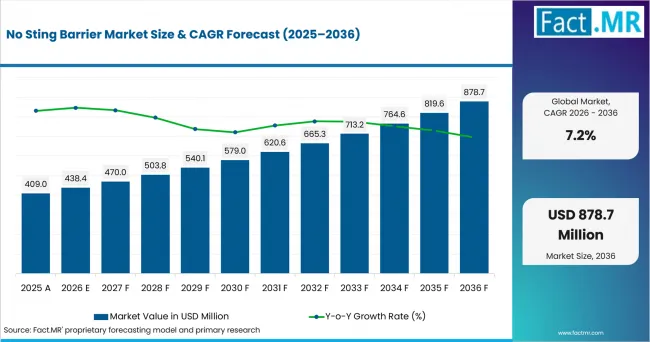
No Sting Barrier Market Value Analysis | Source: Fact.MR
What are the defining numbers behind No Sting Barrier Market growth?
An absolute opportunity of USD 440.3 million is expected between 2026 and 2036. Growth is supported by protocol-based prevention of moisture-associated skin damage, recurring ostomy and wound-care use, long-term care demand and barrier formats designed for low-irritation application.
- Demand Drivers in the Market
- Moisture-associated skin damage creates recurring demand for protectants. NICE recommends considering a barrier preparation for adults at high risk of moisture lesions or incontinence-associated dermatitis, linking barrier use directly to preventive skin assessment.
- Clinical pathways distinguish creams, films and stronger protectants by the severity of skin damage. NHS pathways use durable barrier cream for prevention or mild damage and no sting barrier film where skin breakdown is more established, supporting product selection by clinical need rather than one universal barrier format.
- Incontinence-associated dermatitis remains clinically material. A 2026 systematic review and meta-analysis reported a pooled prevalence of 14.2% among low-risk-of-bias prevalence studies in adults with incontinence, with higher incidence in intensive-care settings.
- Medical adhesive-related skin injury extends demand beyond continence care. A 2024 international consensus update addresses prevention and management of skin injury associated with adhesive medical devices, supporting skin-protection strategies around repeated dressing and device removal.
- Ostomy care creates repeat skin-protection demand because peristomal skin is exposed to effluent and adhesive removal. Medicare covers medically necessary ostomy supplies for eligible beneficiaries, while Brazilian public ostomy services provide collection equipment and protective adjuncts and address peristomal complications.
- The category is adjacent to the broader skin barrier market, but no sting products are differentiated by clinically oriented formulations and delivery formats designed to reduce irritation during protective use.
- Key Segments Analyzed
- Barrier Films account for 42.7% of Product in 2026. Their thin protective layer can be used around wound dressings, ostomy appliances and moisture-exposed skin without the bulk of heavier topical barriers.
- Wound Care represents 36.9% of Application in 2026 as periwound skin is repeatedly exposed to exudate, cleansing and adhesive removal during chronic and acute wound management.
- Hospitals hold 44.8% of End Use in 2026. Operating rooms, intensive-care units and inpatient wound or ostomy teams create multiple high-acuity workflows for barrier products within one institution.
- Spray accounts for 31.6% of Form in 2026 because it can cover wider or irregular areas with limited skin contact, which is useful when direct rubbing is undesirable.
- Silicone Based represents 53.1% of Ingredient in 2026. Silicone formulations support sting-free, fast-drying protection and are established in products intended for repeated ostomy or adhesive-related skin care.
- Direct Sales account for 58.4% of Distribution Channel in 2026 as hospitals and institutional care buyers commonly purchase recurring skin-protection products through procurement contracts and clinical supply agreements.
- Analyst Opinion at Fact.MR
- Shambhu Nath Jha, Senior Consultant, Fact.MR
- “No sting barrier products are increasingly being selected through structured skin-care pathways rather than as optional add-ons. Hospitals want films, creams and sprays that dry quickly, work with dressings or ostomy appliances and can be applied consistently by nursing teams. Home-care users need the same protection in practical formats with clear reapplication guidance. Product compatibility and ease of use will remain central to repeat purchasing through 2036.”
- Strategic Implications
- Prioritize alcohol-free barrier films and sprays for care pathways involving moisture-associated skin damage and repeated adhesive exposure.
- Develop instructions around dressing and ostomy compatibility because excessive or inappropriate layering can shorten appliance wear time or interfere with adhesion.
- Build institutional supply programs around hospitals, long-term care centers and home-health providers where barrier use can be embedded in recurring skin-care protocols.
- Offer several delivery formats around compatible formulations so facilities can use sprays for wider areas, wipes for portable application and creams for prevention or mild damage.
- Support procurement with training that distinguishes prevention, moderate skin damage and severe skin breakdown instead of treating all barrier products as interchangeable.
How does the No Sting Barrier Market break down by segment?
The market is segmented by Product, Application, End Use, Form, Ingredient and Distribution Channel.
Why do Barrier Films lead Product?
Barrier Films account for a 42.7% share of Product in 2026.
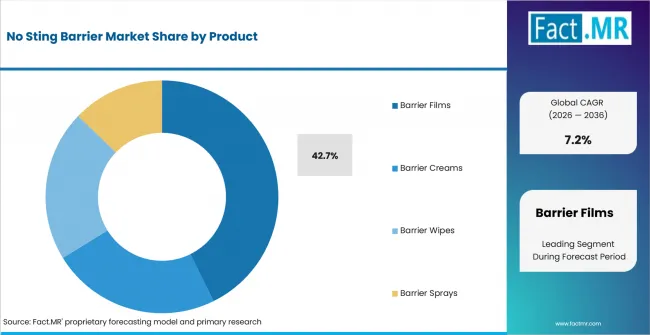
No Sting Barrier Market Analysis By Product | Source: Fact.MR
Films create a lightweight protective interface between vulnerable skin and external irritants. They are suited to wound edges, peristomal skin and areas exposed to urine, feces or adhesive removal because they dry into a thin layer rather than remaining as a thick topical coating.
Clinical pathways distinguish no sting film from durable barrier cream according to the severity and location of skin damage. Film use also overlaps with stoma care because peristomal protection is often applied alongside pouching systems, seals and related accessories.
Why does Wound Care lead Application?
Wound Care accounts for a 36.9% share of Application in 2026.
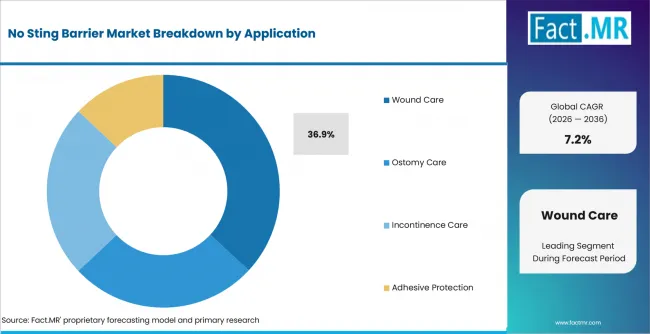
No Sting Barrier Market Analysis By Application | Source: Fact.MR
Skin around acute and chronic wounds can be exposed to drainage, repeated cleansing and frequent adhesive changes. A barrier reduces direct contact between vulnerable skin and these irritants while allowing the primary dressing to perform its clinical function.
The demand mechanism is closely related to active wound care because advanced wound management can increase the number of dressing, fixation and periwound-skin interactions that require protection.
Why do Hospitals lead End Use?
Hospitals account for a 44.8% share of End Use in 2026.
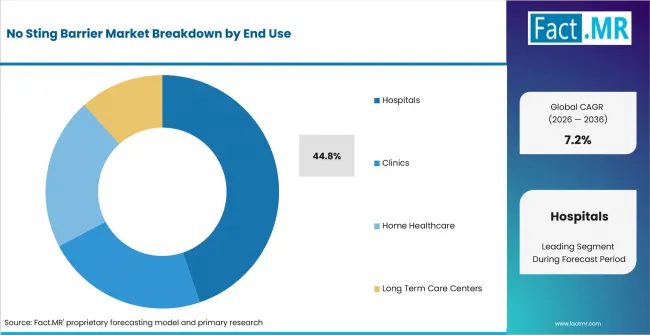
No Sting Barrier Market Analysis By End Use | Source: Fact.MR
Hospitals combine wound care, ostomy services, surgery and intensive-care demand. A single institution can use barrier products in operating rooms, critical-care units, inpatient wound teams and discharge planning, creating a broader consumption base than a single-purpose clinic.
Hospital protocols also favor products with clear application frequency and compatibility instructions. This supports formulary standardization across departments and allows nursing education to be coordinated around a smaller number of approved products.
Why does Spray lead Form?
Spray accounts for a 31.6% share of Form in 2026.
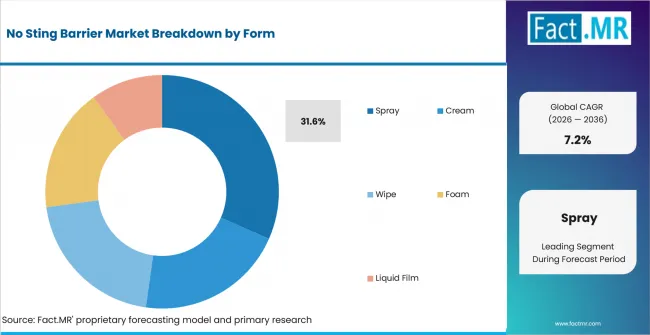
No Sting Barrier Market Analysis By Form | Source: Fact.MR
Sprays can be applied without rubbing an already irritated area and can cover larger or irregular surfaces efficiently. They are practical around ostomy sites, wound edges and moisture-exposed skin when direct contact with a wipe or cream is less desirable.
Current commercial products from Solventum, Smith+Nephew, Safe n' Simple, Coloplast and Welland Medical confirm continuing use of spray delivery. Supplier differentiation therefore depends on application control, drying speed and residue rather than the container alone.
Why does Silicone Based lead Ingredient?
Silicone Based accounts for a 53.1% share of Ingredient in 2026.
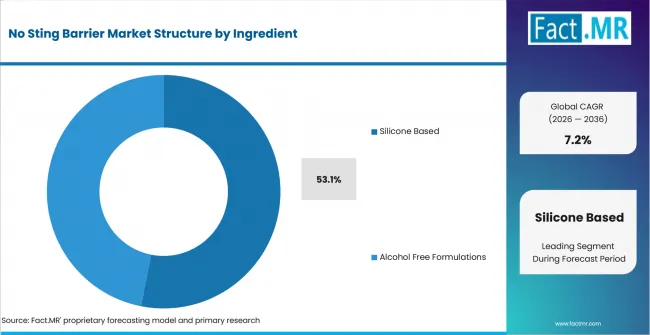
No Sting Barrier Market Analysis By Ingredient | Source: Fact.MR
Silicone-based barriers are used where buyers want sting-free application, rapid drying and compatibility with repeated ostomy or adhesive-related skin care. Convatec markets a 100% silicone blend for its Sensi-Care barrier wipes, while Coloplast identifies its Brava Skin Barrier as silicone based.
Formulation choice also connects with medical adhesives because a skin-protection layer must limit irritation without undermining the fixation performance of adjacent dressings, tapes or ostomy appliances.
Why do Direct Sales lead Distribution Channel?
Direct Sales account for a 58.4% share of Distribution Channel in 2026.
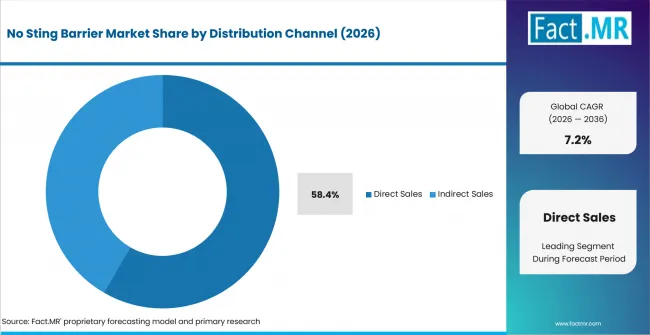
No Sting Barrier Market Analysis By Distribution Channel | Source: Fact.MR
Hospitals, care systems and institutional buyers purchase recurring wound, continence and ostomy supplies through procurement contracts or clinical supply agreements. Direct relationships support formulary standardization, training, price negotiation and replenishment across multiple wards or facilities.
Home and long-term care demand also intersects with incontinence care because skin-protection products are frequently used alongside absorbent products and continence-management routines.
What is accelerating No Sting Barrier Market adoption, and what is holding it back?
Adoption is supported by moisture-associated skin-damage pathways, recurring ostomy care, wound dressing changes and preference for alcohol-free application. Growth is moderated by formulary substitution, price pressure, incorrect application that can affect dressing or pouch adhesion, and the need for staff to match the barrier product to the severity of skin damage.
Drivers Impact Analysis
| Factor | (~) % Impact on CAGR | Geographic Relevance | Impact Timeline |
|---|---|---|---|
| Moisture-associated skin damage protocols | +1.4% | Global | Short term (<= 2 years) |
| Ostomy and peristomal skin protection | +1.2% | USA, Brazil, Germany and UK | Short term (<= 2 years) |
| Repeated wound dressing and adhesive use | +0.9% | Global | Medium term (2-4 years) |
| Expansion of long-term and home care | +0.7% | Germany, USA and Japan | Long term (>= 4 years) |
Source: Fact.MR analysis. Updated Sep 3, 2026
Opportunity Impact Analysis
| Factor | (~) % Impact on CAGR | Geographic Relevance | Impact Timeline |
|---|---|---|---|
| Alcohol-free silicone films and sprays | +0.8% | Global | Medium term (2-4 years) |
| Hospital protocol and procurement standardization | +0.7% | Germany, USA and UK | Medium term (2-4 years) |
| Home-care wipes and portable formats | +0.6% | USA, Japan and Germany | Medium term (2-4 years) |
| Public ostomy-care supply expansion | +0.5% | Brazil and other public health systems | Long term (>= 4 years) |
Source: Fact.MR analysis. Updated Sep 3, 2026
Restraints Impact Analysis
| Factor | (~) % Impact on CAGR | Geographic Relevance | Impact Timeline |
|---|---|---|---|
| Formulary substitution and price pressure | -0.6% | Global | Short term (<= 2 years) |
| Reduced dressing or pouch adhesion when misapplied | -0.5% | Global | Short term (<= 2 years) |
| Preference for lower-cost conventional barrier creams | -0.4% | Brazil and cost-sensitive markets | Medium term (2-4 years) |
| Need for staff assessment and product-specific training | -0.3% | Hospitals and long-term care | Long term (>= 4 years) |
Source: Fact.MR analysis. Updated Sep 3, 2026
Which countries are scaling the No Sting Barrier Market through 2036?
- Germany: Population aging is expanding home and long-term care demand. Destatis reported 5.69 million people in need of long-term care in 2023, with 86% receiving care at home, creating a substantial base for continence and skin-protection routines.
- Brazil: Public ostomy services provide collection equipment and protective adjuncts and are expected to address peristomal skin complications. This care pathway supports recurring use of skin barriers in referral and community services.
- USA: Medicare covers medically necessary ostomy supplies, while nursing homes and home-health agencies create a broad institutional base where continence, wound and skin-integrity management are routine care requirements.
- UK: NHS pathways and formularies explicitly include no sting barrier films and barrier creams for moisture-associated and incontinence-associated skin damage, supporting protocol-based procurement.
- Japan: A large older population sustains long-term care demand, while facility-care guidance includes assessment of pressure-ulcer risk and excretion status, supporting preventive skin-protection routines.
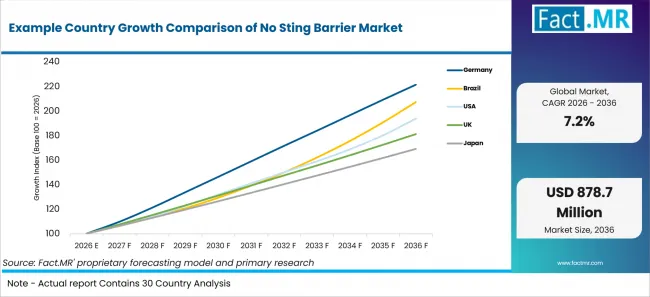
Example Country Growth Comparison Of No Sting Barrier Market | Source: Fact.MR
Country CAGR (2026-2036)
| Country | CAGR (2026-2036) |
|---|---|
| Germany | 8.3% |
| Brazil | 7.6% |
| USA | 6.8% |
| UK | 6.1% |
| Japan | 5.4% |
Source: Fact.MR analysis. Updated Sep 3, 2026
What is driving Germany's growth through 2036?
Germany is forecast to expand at an 8.3% CAGR from 2026 to 2036.
Long-term care is the main structural demand mechanism. Destatis reported 5.69 million people in need of long-term care in 2023 and stated that 86% were cared for at home. Care dependency also rises with age, increasing exposure to incontinence, immobility and fragile-skin management.
This supports institutional and home-care purchasing of barrier creams, films and wipes. Products that fit repeated cleansing and continence routines without affecting absorbent products or adhesive devices are better suited to recurring use.
What is driving Brazil's growth through 2036?
Brazil is forecast to expand at a 7.6% CAGR from 2026 to 2036.
Brazilian public health services for people with stomas include self-care education, assessment of peristomal skin, prevention of complications and provision of collection equipment and protective adjuncts. Skin barriers are therefore part of an organized care pathway rather than only discretionary retail purchases.
Suppliers serving public procurement need products that can be taught and used consistently across colostomy, ileostomy and urostomy care, with practical pack sizes and clear application instructions.
What is driving USA's growth through 2036?
The USA is forecast to expand at a 6.8% CAGR from 2026 to 2036.
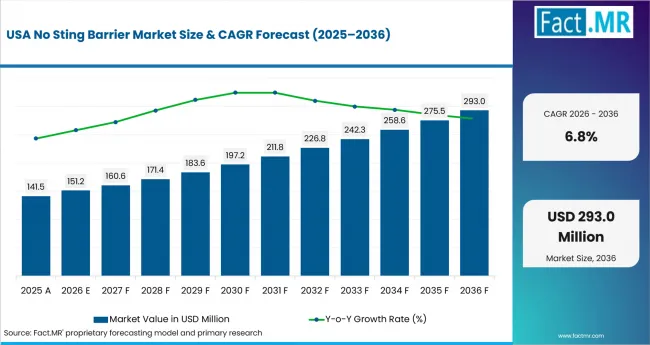
No Sting Barrier Market Country Value Analysis | Source: Fact.MR
Medicare Part B covers medically necessary ostomy supplies for eligible beneficiaries after colostomy, ileostomy or urinary ostomy. CMS provider listings also show a broad network of nursing homes and home-health agencies where skin integrity, continence and wound care are recurring clinical concerns.
Barrier demand is supported by ostomy care, incontinence management, wound dressing changes and protection from medical adhesive removal. Institutional supply remains important because facilities can standardize products and coordinate staff training.
What is driving UK's growth through 2036?
The UK is forecast to expand at a 6.1% CAGR from 2026 to 2036.
NHS guidance provides a defined route for barrier use. NICE recommends barrier preparations for adults at high risk of moisture lesions or incontinence-associated dermatitis, while NHS pathways differentiate durable barrier cream from no sting barrier film according to the severity of skin damage.
This protocol structure supports formulary purchasing and repeat use by community nursing, care homes and hospitals. It also increases the value of clear reapplication intervals, compatibility guidance and staff training.
What is driving Japan's growth through 2036?
Japan is forecast to expand at a 5.4% CAGR from 2026 to 2036.
Japan had approximately 36.2 million people aged 65 and above in the August 2026 population estimate, including about 21.5 million aged 75 and above. The size of this older population sustains demand for continence support, pressure-injury prevention and skin protection across home and facility care.
Long-term care guidance includes structured assessment and care planning for pressure ulcers and excretion status in facility services. This supports recurring skin-protection use where moisture exposure, immobility or repeated care procedures increase skin risk.
Who Leads the No Sting Barrier Market?
Key players in the No Sting Barrier Market include Solventum, Smith+Nephew, Safe n' Simple LLC, Convatec, Medline Industries, LP, CliniMed Ltd., Welland Medical Ltd., Coloplast A/S and Hollister Incorporated.
Competition is shaped by barrier durability, sting-free application, drying speed, compatibility with dressings and ostomy appliances, and the availability of formats suited to different care settings. Buyers also compare reapplication guidance, product residue and the level of clinical education available during formulary adoption.
Solventum markets 3M Cavilon No Sting Barrier Film in spray, wipe and wand formats following the 2024 spin-off of 3M Health Care. Smith+Nephew supplies NO-STING SKIN-PREP across spray, swab and wipe formats. Safe n' Simple offers no-sting films, sprays and wands, while Medline supplies SurePrep no-sting and rapid-dry skin protectants for wound and moisture protection.
Ostomy-focused suppliers add further competition. Convatec markets Sensi-Care silicone barrier wipes, Coloplast offers Brava barrier spray and wipes, Hollister supplies Adapt no sting skin protective wipes, Welland Medical supplies WBF barrier film in spray and wipe formats, and CliniMed supplies LBF barrier film and protective barrier creams.
Which companies are the key providers?
Key providers include Solventum, Smith+Nephew, Safe n' Simple LLC, Convatec, Medline Industries, LP, CliniMed Ltd., Welland Medical Ltd., Coloplast A/S and Hollister Incorporated.
- Solventum
- Smith+Nephew
- Safe n' Simple LLC
- Convatec
- Medline Industries, LP
- CliniMed Ltd.
- Welland Medical Ltd.
- Coloplast A/S
- Hollister Incorporated
Bibliography
- National Institute for Health and Care Excellence. (2014, current guidance). Pressure ulcers: prevention and management, CG179. NICE.
- Medway Community Healthcare. (2025). Moisture Associated Skin Damage Pathway and Incontinence Skin Care Pathway. NHS.
- Bath and North East Somerset, Swindon and Wiltshire Formulary. (2026). Barrier Preparations and MASD/IAD Skin Care Pathway. NHS.
- NHS Lanarkshire. (2022, next review 2026). Barrier Preparations for Excoriation and Moisture Related Skin Damage. NHS Scotland.
- Barton, A., et al. (2024). Medical Adhesive-Related Skin Injury at 10 Years: An Updated Consensus. Journal of Wound, Ostomy and Continence Nursing.
- Ohde, N., Tafesh, A., Pittelkow, M.-M., & Kottner, J. (2026). Global Prevalence and Incidence of Incontinence-Associated Dermatitis in Adults: A Systematic Review and Meta-Analysis. Journal of Advanced Nursing.
- National Institute for Health and Care Research. (2026). Prevention and treatment of incontinence-associated dermatitis through optimising care: PREVENT-IAD Synopsis. NIHR.
- Statistisches Bundesamt. (2025). More People in Need of Long-Term Care. Federal Statistical Office of Germany.
- Statistisches Bundesamt. (2026). Long-Term Care and Demographic Change Data. Federal Statistical Office of Germany.
- Ministerio da Saude. (2022). Specialized Care Services for People with Stomas and Protective Adjuncts. Government of Brazil.
- Centers for Medicare & Medicaid Services. (2026). Ostomy Supplies Coverage. Medicare.
- Centers for Medicare & Medicaid Services. (2026). Provider Information: Active Nursing Homes. CMS Provider Data Catalog.
- Centers for Medicare & Medicaid Services. (2026). Home Health Care Agencies. CMS Provider Data Catalog.
- Statistics Bureau of Japan. (2026). Population Estimates, August 2026. Government of Japan.
- Ministry of Health, Labour and Welfare. (2024). Long-Term Care Fee Revision Guidance. Government of Japan.
- Solventum. (2026). 3M Cavilon No Sting Barrier Film. Solventum.
- 3M Company. (2024). 3M Completes Spin-off of Solventum. 3M Company.
- Smith+Nephew. (2026). SECURA Skin Care Range and NO-STING SKIN-PREP Skin Protectant. Smith+Nephew.
- Safe n' Simple LLC. (2026). No-Sting Skin Barrier Film and Spray. Safe n' Simple.
- Convatec. (2026). Sensi-Care Sting Free Skin Barrier Wipes. Convatec.
- Medline Industries, LP. (2026). SurePrep No-Sting Skin Protectants. Medline.
- CliniMed Ltd. (2026). LBF Skin Barrier Film and CliniShield Advance Protective Barrier Cream. CliniMed.
- Welland Medical Ltd. (2026). WBF Barrier Film Spray. Welland Medical.
- Coloplast A/S. (2026). Brava Skin Barrier Spray. Coloplast.
- Hollister Incorporated. (2026). Adapt No Sting Skin Protective Wipes. Hollister.
This Report Answers
- What is the No Sting Barrier Market value in 2026 and what value is forecast for 2036?
- Why do Barrier Films hold the leading Product share in 2026?
- Why does Wound Care lead Application demand?
- Why are Hospitals the leading End Use setting?
- Why does Spray lead Form?
- Why do Silicone Based formulations lead Ingredient?
- Why do Direct Sales lead Distribution Channel?
- How do Germany, Brazil, USA, UK and Japan differ in projected growth?
- What demand comes from incontinence-associated skin damage, wound care and ostomy care?
- Which companies currently supply no sting skin-protection products?
What does the No Sting Barrier Market cover?
The No Sting Barrier Market covers commercial revenue from barrier films, creams, wipes and sprays used to protect skin from moisture, bodily fluids, wound exudate, adhesives and repeated cleansing. Revenue includes products sold for wound care, ostomy care, incontinence care and adhesive protection in hospitals, clinics, home healthcare and long-term care settings.
The market counts the skin-protection product itself and does not include the downstream value of wound dressings, ostomy appliances, continence products or clinical services unless the barrier product is sold as a separately identifiable item.
What is included in the scope?
Included products are Barrier Films, Barrier Creams, Barrier Wipes and Barrier Sprays. Applications include Wound Care, Ostomy Care, Incontinence Care and Adhesive Protection, while End Use includes Hospitals, Clinics, Home Healthcare and Long Term Care Centers.
Form includes Spray, Cream, Wipe, Foam and Liquid Film. Ingredient includes Silicone Based, Dimethicone, Acrylate Terpolymer, Alcohol Free Formulations, Hypoallergenic Formulations and Preservative Free Formulations. Distribution Channel includes Direct Sales and Indirect Sales through hospital procurement, clinical supply agreements, medical distributors, retail pharmacies and online retail.
What is excluded from the scope?
The scope excludes wound dressings, ostomy pouches, continence pads and medical adhesives when sold without a qualifying skin-protection product. General cosmetic moisturizers, therapeutic wound agents and unrelated skin-care products are also outside the market.
Adhesive-removal products are excluded unless they are sold as part of a skin-protection system that meets the market definition. General disinfectants, cleansers and antiseptics are outside scope when their primary commercial function is cleansing or antimicrobial treatment rather than barrier protection.
How Was the Analysis Built?
The analysis uses a hybrid top-down and bottom-up framework anchored to barrier-product consumption, care-setting demand and the defined segment structure.
- Primary Research: Interviews with wound-care nurses, ostomy nurses, continence teams, hospital procurement teams, distributors, home-health providers and manufacturers examine application frequency, format preference, compatibility requirements, training needs and procurement behavior.
- Desk Research: The review covers clinical guidelines, NHS formularies, government long-term-care and ostomy policies, public reimbursement information, peer-reviewed skin-integrity research and current company product documentation.
- Market Sizing and Forecasting: Estimates combine patient and care-setting demand with product use frequency, format mix, institutional purchasing, replacement or reapplication cycles, pricing and country-level care structures.
- Data Validation and Update Cycle: Findings are cross-checked against current clinical pathways, government care data, reimbursement rules and active product portfolios. Updates account for formulary practice, product ownership, distribution models and changes in wound, ostomy and continence care.
Segmentation
What is the report's scope and coverage?
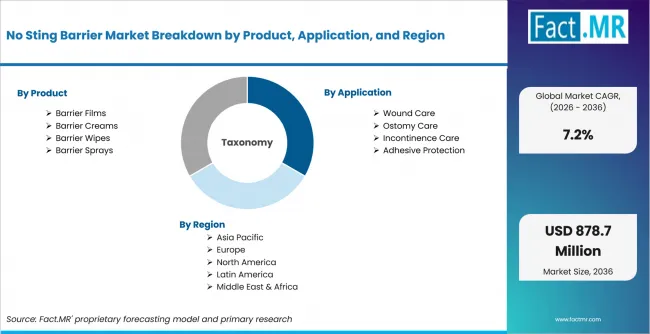
No Sting Barrier Market Breakdown By Product, Application, And Region | Source: Fact.MR
| Attribute | Details |
|---|---|
| Quantitative Units | USD million |
| Market Definition | No sting barrier films, creams, wipes and sprays used to protect skin from moisture, bodily fluids, adhesives and related irritation |
| Segments Covered | Product; Application; End Use; Form; Ingredient; Distribution Channel |
| Regions Covered | North America; Latin America; Europe; East Asia; South Asia and Pacific; Middle East and Africa |
| Countries Covered | Germany; Brazil; USA; UK; Japan |
| Key Companies Profiled | Solventum; Smith+Nephew; Safe n' Simple LLC; Convatec; Medline Industries, LP; CliniMed Ltd.; Welland Medical Ltd.; Coloplast A/S; Hollister Incorporated |
| Forecast Period | 2026 to 2036 |
| Base Year | 2025 |
| Market Value, 2026 | USD 438.4 million |
| Market Value, 2036 | USD 878.7 million |
| CAGR, 2026-2036 | 7.2% |
| Absolute Opportunity | USD 440.3 million |
| Approach | Hybrid top-down and bottom-up approach using care-setting demand, application frequency, format mix, institutional purchasing, reapplication cycles and pricing |
Source: Fact.MR analysis. Updated Sep 3, 2026
How is the market segmented?
-
By Product
- Barrier Films
- Silicone Based Barrier Films
- Acrylic Based Barrier Films
- Polymer Based Barrier Films
- Barrier Creams
- Moisturizing Barrier Creams
- Protective Barrier Creams
- Barrier Wipes
- Pre Moistened Wipes
- Dry Barrier Wipes
- Barrier Sprays
- Aerosol Sprays
- Pump Sprays
- Barrier Films
-
By Application
- Wound Care
- Chronic Wounds
- Acute Wounds
- Ostomy Care
- Colostomy Care
- Ileostomy Care
- Urostomy Care
- Incontinence Care
- Adult Incontinence
- Pediatric Incontinence
- Adhesive Protection
- Medical Adhesive Application
- Device Related Protection
- Wound Care
-
By End Use
- Hospitals
- Operating Rooms
- Intensive Care Units
- Clinics
- Wound Care Clinics
- Outpatient Clinics
- Home Healthcare
- Elderly Care
- Chronic Care
- Long Term Care Centers
- Nursing Homes
- Rehabilitation Centers
- Hospitals
-
By Form
- Spray
- Cream
- Wipe
- Foam
- Liquid Film
-
By Ingredient
- Silicone Based
- Dimethicone
- Acrylate Terpolymer
- Alcohol Free Formulations
- Hypoallergenic Formulations
- Preservative Free Formulations
- Silicone Based
-
By Distribution Channel
- Direct Sales
- Hospital Procurement
- Clinical Supply Agreements
- Indirect Sales
- Medical Distributors
- Retail Pharmacies
- Online Retail
- Direct Sales
Frequently Asked Questions
What is the No Sting Barrier Market value in 2026?
At what CAGR is the No Sting Barrier Market projected to grow?
What is the projected No Sting Barrier Market value by 2036?
Which Product segment leads the No Sting Barrier Market?
Which Application segment leads the No Sting Barrier Market?
Which End Use segment leads the No Sting Barrier Market?
Which Form leads the No Sting Barrier Market?
Which Ingredient segment leads the No Sting Barrier Market?
Which Distribution Channel leads the No Sting Barrier Market?
What CAGR is projected for Germany?
What is a major demand driver for no sting barriers?
What is a major restraint on the No Sting Barrier Market?
Who are the key companies in the No Sting Barrier Market?
Who worked on this report


Preview the report firsthand - request a free sample
Free SampleGet the brochure for pricing and purchase details
Download PDF