- Market Value (2025): USD 2.85 Bn
- Estimated Value (2026): USD 3.63 Bn
- Forecast Value (2036): USD 41.2 Bn
- CAGR (2026-2036): 27.5%
What is the AI in Social Media Market forecast to be worth by 2036?
USD 3.63 billion in 2026 to USD 41.2 billion by 2036 at a 27.5% CAGR.
- At USD 2.85 billion in 2025, the AI in social media market drew most of its revenue from ad targeting, creative generation and audience analytics sold to brands.
- Spending will grow from USD 3.63 billion in 2026 to USD 41.2 billion in 2036 as generative video, AI agents and automated campaign tools move into everyday marketing work.
- Social AI tools will expand at a 27.5% CAGR between 2026 and 2036, because each new platform feature turns into a paid layer for advertisers and agencies.
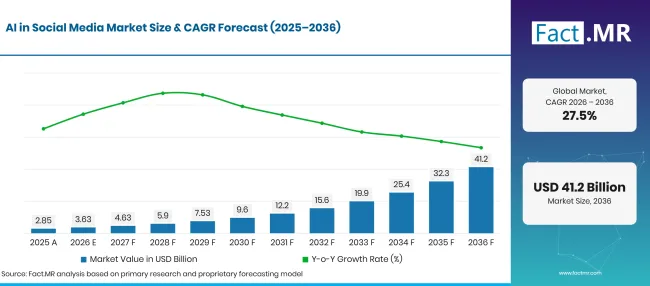
Ai In Social Media Market Forecast Global | Source: Fact.MR
| Year | Basis | Market Value (USD billion) |
|---|---|---|
| 2025 | Actual | 2.85 |
| 2026 | Estimate | 3.6 |
| 2036 | Forecast | 41.2 |
| CAGR 2026 to 2036 | Forecast period | 27.5% |
Source: Fact.MR analysis. Updated Oct 22, 2026
What are the defining numbers behind AI in Social Media Market growth?
Between 2026 and 2036, the market will add USD 37.6 billion in fresh revenue.
- Demand Drivers in the Market
- Social media audience growth widens the pool that AI systems can target and measure. The International Telecommunication Union reported in 2025 that almost three-quarters of the world’s population was online, while 2.2 billion people remained offline [1]. Each new user adds feed, ad and messaging activity that platforms sort with machine learning.
- AI use inside companies is moving from trials to routine work. Eurostat reported that 20.0% of EU enterprises with 10 or more employees used AI technologies in 2025, up from 13.5% in 2024 [2]. Marketing teams are often the first to test these tools, since social content needs constant volume.
- Generative creative tools cut the cost of producing ad variations. Brands can now test dozens of images, captions and short videos per campaign without a full studio shoot, and the platforms reward fresh creative with lower delivery costs.
- Automated campaign setup lowers the skill needed to run paid social.
- Customer service on messaging apps is shifting to AI assistants. Brands use bots to answer order and return questions outside office hours.
- Key Segments Analyzed
- By Component: Software will represent 62.4% of 2026 revenue, since brands license platforms for scheduling, listening and creative generation on a subscription basis.
- By Application: Advertising will capture 31.8% of spending in 2026, as ad targeting and bidding models are tied most closely to measurable sales results for marketers.
- By Deployment Mode: Cloud will account for 74.8% of 2026 demand, given that social data, model updates and platform APIs all live online.
- By Enterprise Size: Large Enterprises will hold 68.3% of 2026 sales through multi-brand, multi-country social programs that need governance and analytics.
- By End-User: Retail will command 28.4% of the 2026 market, driven by shoppable posts, catalog ads and high volumes of product creative.
- Analyst Opinion at Fact.MR
- Shambhu Nath Jha, Principal Consultant at Fact.MR, states, “Brands no longer ask whether to use AI on social channels; they ask how much of the campaign it should run. Platforms that own the audience data will keep pulling budgets into their built-in tools. Independent software vendors will win where they help a brand manage many channels, prove results and keep content safe.”
- Strategic Implications
- Social platforms should give advertisers clear controls over what generative tools change in an ad, since brand teams will not hand over creative without review rights.
- Marketing software vendors should build connectors to every major platform’s AI features and offer cross-channel reporting that the platforms do not provide on their own.
- Retail and consumer brands should feed clean product catalogs and first-party data into ad systems, because model quality depends on the inputs it receives.
- Agencies should retrain staff from manual bid and audience work toward creative direction, testing design and AI output review.
Germany will grow at 32.3% CAGR as one in four German establishments already works with generative AI. The United Kingdom follows at 30.8%, where a broad base of AI-using businesses supports paid social investment. Brazil will post 25.6% with very high social network use among internet users. Japan will expand at 22.8% as generative AI use catches up from a low start. The United States will advance at 21.4% from a mature ad market where large firms already use AI widely.
How does the AI in Social Media Market break down by segment?
Software will lead Component at 62.4%; Advertising will lead Application at 31.8%; Cloud will lead Deployment Mode at 74.8%; Large Enterprises will lead Enterprise Size at 68.3%; Retail will lead End-User at 28.4%.
Which Component dominates?
Software takes 62.4% of 2026 revenue.
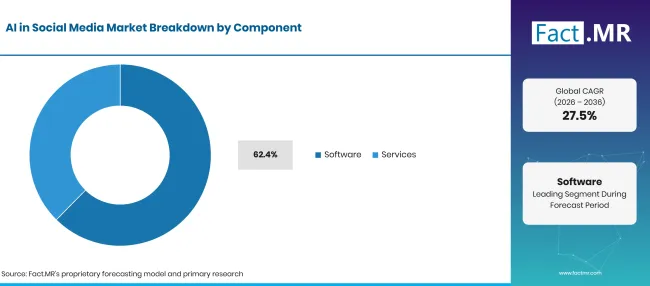
Ai In Social Media Market Breakdown Component | Source: Fact.MR
| Component | Share (2026) |
|---|---|
| Software (Leading segment) | 62.4% |
| Other segments combined | 37.6%* |
| Total | 100.0% |
Source: Fact.MR analysis. Updated Oct 22, 2026
Social media managers work inside dashboards every day, so the tool itself is what they budget for. Licensed platforms bundle post scheduling, social listening, creative generation and reporting under one seat-based fee. Many draw on natural language processing to read comments, tag sentiment and surface trending topics. Services cover setup, model tuning, content operations and managed campaigns. Agencies sell these hours to brands that lack in-house data staff.
What leads the Application segment?
Advertising represents 31.8% of 2026 spending.
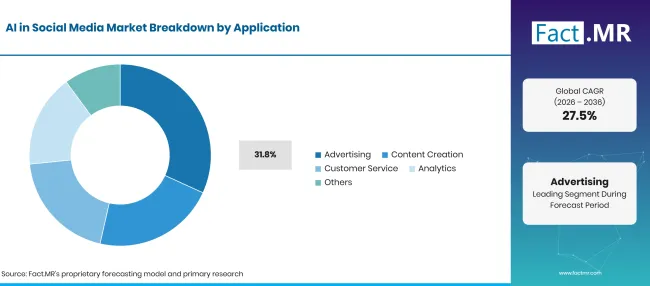
Ai In Social Media Market Breakdown Application | Source: Fact.MR
| Application | Share (2026) |
|---|---|
| Advertising (Leading segment) | 31.8% |
| Other segments combined | 68.2%* |
| Total | 100.0% |
Source: Fact.MR analysis. Updated Oct 22, 2026
Paid social is where AI spending links most directly to revenue, since every bid and audience choice can be tied to a click or sale. Platforms train models on conversion signals and sell the outcome through automated campaign products, much like programmatic advertising on the open web. Eurostat reported that 34.7% of EU enterprises using AI in 2025 applied it to marketing or sales [3]. Content creation tools generate copy, images and short video for organic and paid posts. Customer service relies on chat assistants, often built on intelligent virtual assistant technology, while analytics tools track reach, sentiment and campaign return.
How does Deployment Mode shape demand?
Cloud makes up 74.8% of 2026 demand.
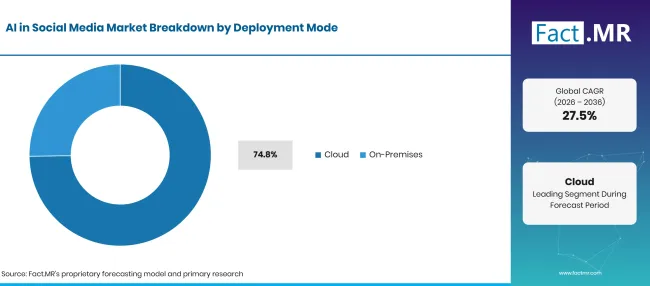
Ai In Social Media Market Breakdown Deployment Mode | Source: Fact.MR
| Deployment Mode | Share (2026) |
|---|---|
| Cloud (Leading segment) | 74.8% |
| Other segments combined | 25.2%* |
| Total | 100.0% |
Source: Fact.MR analysis. Updated Oct 22, 2026
Social platforms expose their data and ad functions through online APIs, which favors tools hosted in the cloud. Buyers also avoid managing servers for workloads that spike around holiday sales. On-premises deployment remains in banks, insurers and healthcare groups that must keep customer messages and identity data inside their own systems. These buyers often run listening and archiving tools locally while still buying ads through the platforms.
What supports Large Enterprises within Enterprise Size?
Large Enterprises account for 68.3% of 2026 sales.
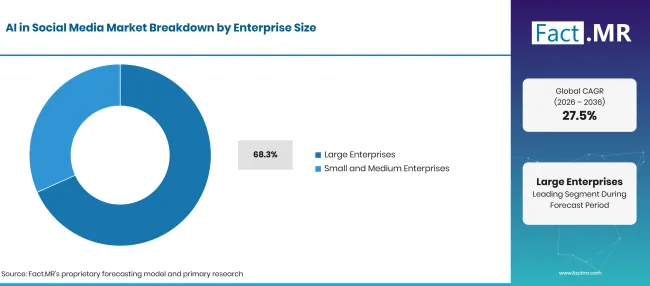
Ai In Social Media Market Breakdown Enterprise Size | Source: Fact.MR
| Enterprise Size | Share (2026) |
|---|---|
| Large Enterprises (Leading segment) | 68.3% |
| Other segments combined | 31.7%* |
| Total | 100.0% |
Source: Fact.MR analysis. Updated Oct 22, 2026
Global brands run dozens of accounts across regions and languages, and they need approval workflows, brand safety filters and audit trails. Eurostat reported that 55.0% of large EU enterprises used AI in 2025, against 17.0% of small enterprises [3]. Small and medium enterprises buy AI mostly through the self-serve tools inside each social platform. Automated campaign builders and AI caption writers let a two-person team run paid social, and marketing automation suites offer bundled plans at lower price points.
Why does Retail take first place in End-User?
Retail holds 28.4% of the 2026 market.
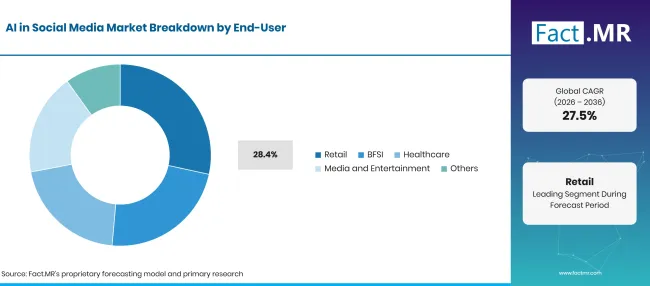
Ai In Social Media Market Breakdown End User | Source: Fact.MR
| End-User | Share (2026) |
|---|---|
| Retail (Leading segment) | 28.4% |
| Other segments combined | 71.6%* |
| Total | 100.0% |
Source: Fact.MR analysis. Updated Oct 22, 2026
Shoppers discover products in feeds and short videos, then buy through catalog ads and shoppable posts. Retailers need thousands of product images and captions refreshed each season, which suits generative tools. Many link social campaigns to AI in retail systems for pricing and stock planning. The U.S. Census Bureau reported in May 2026 that about 14% of retail trade firms used AI, well below the information sector [4]. That gap leaves room for growth among store chains and online sellers. BFSI firms use AI for compliant messaging and fraud alerts, healthcare groups for patient outreach, and media and entertainment companies for clip editing and fan engagement.
What is accelerating AI in Social Media Market adoption, and what is holding it back?
Adoption will speed up as platforms build generative creative, automated bidding and AI agents into their ad managers. Ad transparency rules, data protection limits and brand safety concerns will slow how far advertisers let AI act without review.
Drivers Impact Analysis
| DRIVER | (~) % IMPACT ON CAGR | GEOGRAPHIC RELEVANCE | IMPACT TIMELINE |
|---|---|---|---|
| Automated campaign tools built into social ad managers | +3.4% | North America, Western Europe, East Asia | Short term (<= 2 years) |
| Generative image and video tools for ad creative | +3.0% | Global | Short term (<= 2 years) |
| AI chat assistants for customer service on messaging apps | +2.2% | Latin America, South Asia & Pacific | Medium term (2-4 years) |
| Social listening and sentiment analytics for brand teams | +1.6% | Western Europe, North America | Medium term (2-4 years) |
Source: Fact.MR analysis. Updated Oct 22, 2026
Opportunity Impact Analysis
| OPPORTUNITY | (~) % IMPACT ON CAGR | GEOGRAPHIC RELEVANCE | IMPACT TIMELINE |
|---|---|---|---|
| AI agents that plan and run full social campaigns | +1.4% | North America, Western Europe | Long term (>= 4 years) |
| Self-serve AI ad tools for small and medium enterprises | +1.2% | Latin America, South Asia & Pacific | Medium term (2-4 years) |
| Multilingual content generation for cross-border brands | +0.9% | Western Europe, East Asia | Medium term (2-4 years) |
Source: Fact.MR analysis. Updated Oct 22, 2026
Restraints Impact Analysis
| RESTRAINT | (~) % IMPACT ON CAGR | GEOGRAPHIC RELEVANCE | IMPACT TIMELINE |
|---|---|---|---|
| Ad transparency and platform accountability rules | -0.9% | Western Europe | Short term (<= 2 years) |
| Data protection limits on targeting and personal data use | -0.8% | Western Europe, North America | Medium term (2-4 years) |
| Brand safety concerns over unreviewed AI content | -0.6% | Global | Short term (<= 2 years) |
Source: Fact.MR analysis. Updated Oct 22, 2026
Which countries are scaling the AI in Social Media Market through 2036?
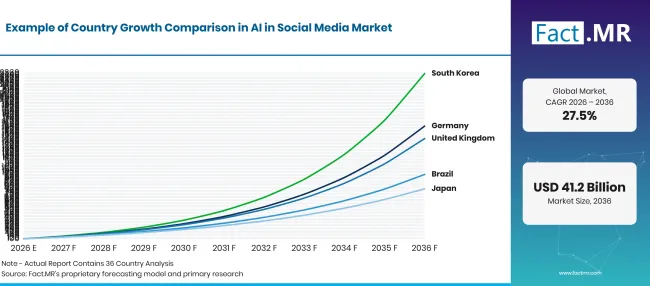
Ai In Social Media Market Growth Index | Source: Fact.MR
| Country | CAGR (2026 to 2036) |
|---|---|
| Germany | 32.3% |
| United Kingdom | 30.8% |
| Brazil | 25.6% |
| Japan | 22.8% |
| United States | 21.4% |
Source: Fact.MR analysis. Updated Oct 22, 2026
What supports Germany’s adoption?
32.3% CAGR, driven by quick generative AI take-up across German establishments.
AI in social media in Germany draws on a business base that moved fast on generative tools. The Institute for Employment Research (IAB) reported that just under 25% of German establishments used generative AI in 2025, and 59% of establishments in information and communications did so [5]. Media groups, retailers and carmakers use these tools for social content in several languages. EU ad transparency rules shape how campaigns are disclosed.
How is the United Kingdom scaling demand?
30.8% CAGR, backed by a large share of AI-using businesses.
UK demand for social media AI tools comes from a market where firms already work with AI. The Office for National Statistics reported that about 35% of businesses with 10 or more employees used at least one AI technology in June 2026 [6]. In the information and communication industry, the share reached 58% [6].
What supports Brazil’s growth?
25.6% CAGR, helped by heavy social network use among internet users.
Social media marketing in Brazil runs on a very large online audience. IBGE reported that 90.5% of people aged 10 or older used the internet in 2025, about 168.7 million people [7]. Of these users, 84.9% used the internet for social networks [7]. Brands sell through messaging apps and short video, which lifts demand for chat assistants and creative tools in Portuguese.
How is Japan developing demand?
22.8% CAGR, reflecting a fast rise in personal generative AI use.
Generative AI in Japan started from a low base but is gaining users. The Ministry of Internal Affairs and Communications reported that 26.7% of people in Japan had used generative AI in its 2024 survey, up from 9.1% a year earlier [8]. LINE use reached 94.9% in 2024 [9]. Brands run official accounts and chat services on the app, which supports AI customer service.
How does the United States perform?
21.4% CAGR, as large firms extend AI already in place.
AI social media marketing in the United States grows from a large, mature base. The Census Bureau reported that 19.8% of U.S. firms used AI in the period ending May 3, 2026, and the information sector reached 39.7% [4]. Firms with at least 250 employees reported a rate of 37% [4].
Who leads the AI in Social Media Market?
Competition splits into three groups. Platform owners such as Meta Platforms, Google (YouTube), ByteDance (TikTok), Snap, Pinterest, LinkedIn and Tencent build AI into feeds and ad managers and sell it through ad spend. Meta introduced Muse for Small Business in September 2026, an AI tool that connects to Meta ad accounts to review results and draft campaigns [10].
Snap launched Sponsored AI Lenses in April 2025, an ad format built on its own generative AI [11]. TikTok announced image-to-video and text-to-video tools for Symphony Creative Studio in June 2025 [12]. Google announced Asset Studio and generative video extension tools for Google Ads in May 2025 [13]. Pinterest sells its Performance+ suite for automated campaigns, while Tencent offers intelligent ad delivery across Weixin and QQ. Salesforce competes as an independent software layer, adding AI recommendations to social analytics in Marketing Cloud. Control of audience data, creative quality and proof of sales results will separate winners in this field.
Which companies are the key providers?
Key companies include Meta Platforms, Inc.; Google LLC; ByteDance Ltd. (TikTok); Snap Inc.; Pinterest, Inc.; LinkedIn (Microsoft); Tencent Holdings Limited; and Salesforce, Inc.
- Meta Platforms, Inc.
- Google LLC
- ByteDance Ltd. (TikTok)
- Snap Inc.
- Pinterest, Inc.
- LinkedIn (Microsoft)
- Tencent Holdings Limited
- Salesforce, Inc.
How is the market segmented?
-
By Component
- Software
- Services
-
By Application
- Advertising
- Content Creation
- Customer Service
- Analytics
- Others
-
By Deployment Mode
- Cloud
- On-Premises
-
By Enterprise Size
- Large Enterprises
- Small and Medium Enterprises
-
By End-User
- Retail
- BFSI
- Healthcare
- Media and Entertainment
- Others
-
By Region
- North America
- Latin America
- Western Europe
- Eastern Europe
- East Asia
- South Asia & Pacific
- Middle East & Africa
Bibliography
- [1] International Telecommunication Union. (2025, November 17). Measuring digital development: Facts and Figures 2025.
- [2] Eurostat. (2025, December 11). 20% of EU enterprises use AI technologies.
- [3] Eurostat. (2025, December). Use of artificial intelligence in enterprises.
- [4] U.S. Census Bureau. (2026, May 26). Large Firms With at Least 20 Employees Biggest AI Users.
- [5] Institut für Arbeitsmarkt- und Berufsforschung (IAB). (2026, May 5). Jeder vierte Betrieb nutzt mittlerweile generative KI [One in four establishments now uses generative AI] (IAB-Kurzbericht 8/2026).
- [6] Office for National Statistics. (2026, July 20). Artificial intelligence in UK businesses: 2023 to 2026.
- [7] Instituto Brasileiro de Geografia e Estatística (IBGE). (2026, July). Acesso à Internet e à televisão e posse de telefone móvel celular para uso pessoal 2025 [Internet and television access and mobile phone ownership for personal use 2025].
- [8] Ministry of Internal Affairs and Communications, Japan. (2025, July).[2025 White Paper on Information and Communications: Current state of AI use by individuals].
- [9] Ministry of Internal Affairs and Communications, Japan. (2025, July).SNS [2025 White Paper on Information and Communications: Communication tools and SNS].
- [10] Meta Platforms, Inc. (2026, September 29). The Future Is for Everyone: Muse for Small Business.
- [11] Snap Inc. (2025, April 8). Introducing Sponsored AI Lenses.
- [12] TikTok. (2025, June 16). Creativity at Scale: Meet our latest Symphony Generative AI Tools.
- [13] Google. (2025, May 21). Google Marketing Live 2025: Your roundup of announcements.
- [14] European Commission. (2025, December 5). Commission accepts TikTok’s commitments on advertising transparency under the Digital Services Act.
This Report Answers
- How large is AI spending on social channels in 2026, and what will it be worth by 2036?
- Which component, application, deployment mode, enterprise size and end-user lead, and why?
- Where do Germany, the United Kingdom, Brazil, Japan and the United States stand on growth, and what drives each?
- How do platform owners and independent software vendors compete for AI marketing budgets?
- Which rules on ad transparency and data use will shape how far AI can act on its own?
What does the AI in Social Media Market cover?
AI social media software and services form the core of this assessment. It counts tools that generate posts and ads, target and bid on paid placements, answer customer messages, and measure reach and sentiment across social networks.
Value is tracked by component, application, deployment mode, enterprise size and end-user. Both stand-alone vendors and AI features sold inside platform ad products are counted, so long as a buyer pays for the AI function.
What is included in the scope?
Social listening, sentiment analysis, AI creative generation, automated campaign tools and chat assistants deployed on social and messaging apps are in scope. Tools from audience intelligence platforms count when they draw on social data.
Implementation, training, model tuning and managed campaign services tied to these tools are included. So are on-premises archiving and listening systems used by regulated industries.
What is excluded from the scope?
Media spend paid to platforms for ad placement is excluded; only the AI tool or feature value is counted. General productivity assistants not used for social channels fall outside the boundary.
Content moderation run by platforms for their own policy compliance is excluded, as is hardware such as servers and chips. The European Commission accepted TikTok commitments in December 2025 to show full ad content and targeting data in its ad repository within 24 hours [14], and such compliance work by platforms is likewise not counted as market revenue.
How Was the Analysis Built?
The analysis draws on 120+ sources, 35+ company portfolios, 25+ countries, and more than 20 industry interviews.
- Primary Research: Primary research includes discussions with manufacturers, service providers, technology developers, distributors, end users, and subject-matter experts. These conversations examine purchasing priorities, product adoption, operational challenges, approval requirements, competitive positioning, and the factors that influence wider market acceptance.
- Desk Research: Desk research covers government statistics, regulatory publications, company filings, trade data, technical studies, industry associations, standards, public policy, and other authoritative sources. Every source used in the analysis is documented in the bibliography.
- Market Sizing and Forecasting: Market estimates combine historical performance, demand indicators, pricing and volume trends, segment shares, company participation, country-level growth, adoption patterns, investment activity, and barriers to market expansion.
- Data Validation and Update Cycle: Findings are validated by comparing primary interviews with public data, company activity, regulatory changes, trade patterns, and industry developments. Regular updates review new product launches, capacity changes, partnerships, approvals, and shifts in commercial adoption.
Segmentation
What is the report’s scope and coverage?
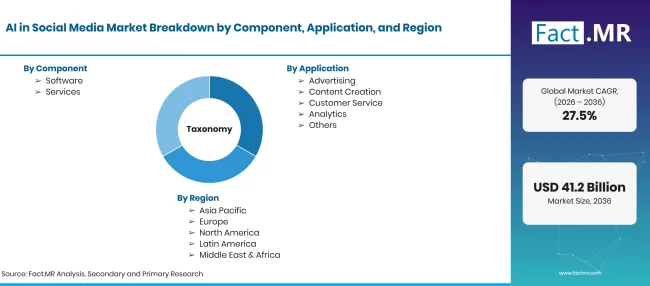
Ai In Social Media Market Taxonomy | Source: Fact.MR
| Attribute | Details |
|---|---|
| Quantitative Units | USD billion in 2026 to USD billion by 2036 at CAGR |
| Market Definition | Software and services that apply artificial intelligence to social media advertising, content creation, customer service and analytics. Revenue covers tools sold to brands, agencies and public bodies, and AI features sold through platform ad products. |
| Component | Software; Services |
| Application | Advertising; Content Creation; Customer Service; Analytics; Others |
| Deployment Mode | Cloud; On-Premises |
| Enterprise Size | Large Enterprises; Small and Medium Enterprises |
| End-User | Retail; BFSI; Healthcare; Media and Entertainment; Others |
| Regions Covered | North America; Latin America; Western Europe; Eastern Europe; East Asia; South Asia & Pacific; Middle East & Africa |
| Countries Covered | Germany; United Kingdom; Brazil; Japan; United States |
| Companies Profiled | Meta Platforms, Inc.; Google LLC; ByteDance Ltd. (TikTok); Snap Inc.; Pinterest, Inc.; LinkedIn (Microsoft); Tencent Holdings Limited; Salesforce, Inc. |
| Forecast Period | 2026 to 2036 |
| Approach | Hybrid top-down and bottom-up model built from social ad spend, AI feature uptake by platform, software seat pricing and enterprise AI adoption rates by country. |
Source: Fact.MR analysis. Updated Oct 22, 2026
Frequently Asked Questions
How big is the AI in social media market in 2026?
What is the CAGR of the AI in social media market from 2026 to 2036?
Which component leads the AI in social media market?
Which application leads the AI in social media market?
Which deployment mode leads the AI in social media market?
Which enterprise size leads the AI in social media market?
Which end-user leads the AI in social media market?
Which country will grow the most in the AI in social media market?
Who are the main companies in the AI in social media market?
Who worked on this report


Preview the report firsthand - request a free sample
Free SampleGet the brochure for pricing and purchase details
Download PDF