- Base Value(2025): 26.0 Bn
- Estimated Value(2026): 32.1 Bn
- Forecast Value (2036): 262.8 Bn
- CAGR (2026 - 2036): 23.4%
Natural Language Processing Market Forecast By Fact.MR
In 2025, the natural language processing market was valued at USD 26.0 billion. Based on Fact MR analysis, demand for natural language processing solutions is estimated to grow to USD 32.1 billion in 2026 and USD 262.8 billion by 2036. FMR projects a CAGR of 23.4% during the forecast period.
The absolute dollar growth from 2026 to 2036 is USD 230.7 billion. This magnitude of expansion reflects a transformational shift in enterprise software and digital service infrastructure. Natural language processing capabilities are being integrated across customer service automation, enterprise knowledge management, financial analytics, and digital assistants. Large language models, speech recognition systems, and automated text analysis platforms are expanding the operational role of language based computing across industries. Adoption continues across banking, healthcare, retail, telecommunications, and government information systems. Structural constraints remain present in the form of high computational infrastructure costs, the need for large training datasets, regulatory scrutiny around data privacy, and ongoing concerns related to algorithmic bias and model reliability.
South Korea records the fastest expansion with a projected CAGR of 12.7%, supported by strong adoption of AI driven digital services and large scale telecommunications infrastructure. The United States follows with a CAGR of 12.5%, driven by major investments in artificial intelligence platforms and enterprise software ecosystems. The United Kingdom shows a CAGR of 12.1% as financial services and technology firms expand language based analytics and automation tools. Japan records a CAGR of 11.9%, reflecting steady integration of language processing systems within robotics, consumer electronics, and enterprise information systems. Mature technology markets such as the United States, Japan, and the United Kingdom generate a growing share of replacement and upgrade demand as organizations transition from rule based language tools to advanced machine learning driven platforms. High infrastructure costs and evolving data governance regulations act as structural constraints in these established markets.
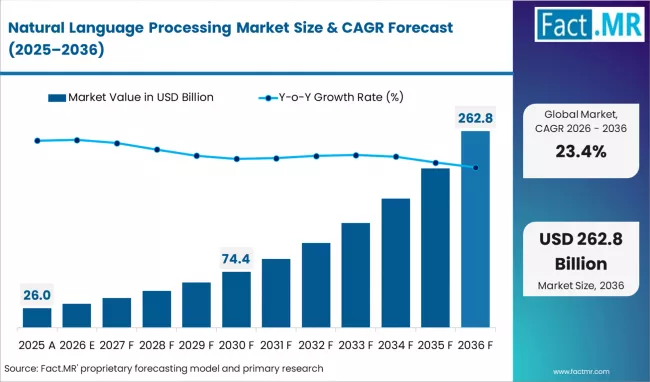
Natural Language Processing Market Market Value Analysis | Source: Fact.MR
Natural Language Processing Market
| Metric | Details |
|---|---|
| Industry Size (2026E) | USD 32.1 billion |
| Industry Value (2036F) | USD 262.8 billion |
| CAGR (2026 to 2036) | 23.4% |
Source: Fact.MR analysis. Updated Mar 16, 2026
Natural Language Processing Market Definition
The Natural Language Processing Market covers software technologies that enable computers to understand, interpret, and generate human language. Natural language processing systems analyze written or spoken text to extract meaning, identify patterns, and automate language related tasks. These tools support functions such as text analysis, speech recognition, language translation, sentiment analysis, and conversational interfaces. NLP technology is widely used in customer service platforms, digital assistants, search engines, and enterprise data analysis systems. Its primary function is to allow machines to process human language efficiently for communication, automation, and information analysis across digital applications.
Market Inclusions
This report covers global and regional market sizes for natural language processing solutions with forecast analysis for the study period. The market is segmented by product type including text analytics software, speech recognition systems, and language generation tools. Application segments include customer service automation, virtual assistants, enterprise analytics, and language translation services. End users include information technology companies, financial institutions, healthcare organizations, and telecommunications providers. The report also examines pricing models, deployment structures, and selected trade flow analysis across major technology markets.
Market Exclusions
The report excludes general artificial intelligence software that does not process human language data. Image recognition systems, computer vision platforms, and robotics control software are outside the defined scope. The analysis does not include hardware infrastructure such as servers, processors, or data center equipment used to run NLP applications. Standalone translation devices and consumer electronics products that embed language software are also excluded, as the study focuses strictly on natural language processing software and platforms.
Research Methodology
- Primary Research: Interviews were conducted with software developers, enterprise technology managers, data scientists, and solution providers involved in NLP implementation.
- Desk Research: Public information was gathered from technology industry publications, company reports, government statistics, and digital technology databases.
- Market-Sizing and Forecasting: A hybrid model combining bottom up software revenue analysis with top down demand assessment across industries was used.
- Data Validation and Update Cycle: Findings were cross verified through multiple industry sources and expert reviews, with periodic updates conducted as new market information becomes available.
Summary of the Natural Language Processing Market
- Market Definition
- The market comprises software technologies that enable computers to analyze, interpret, and generate human language across digital systems. These platforms process written or spoken text to extract meaning, automate communication tasks, and support decision making in enterprise and consumer applications.
- Demand Drivers
- Expansion of enterprise automation systems that process large volumes of text and voice data generated through digital communication platforms.
- Increasing deployment of conversational interfaces such as chatbots, digital assistants, and automated customer support systems.
- Growth in data analytics applications that analyze unstructured textual information including emails, documents, and customer feedback.
- Adoption of language processing tools across banking, healthcare, retail, telecommunications, and government information systems.
- Expansion of enterprise automation systems that process large volumes of text and voice data generated through digital communication platforms.
- Key Segments Analyzed
- Service: Integration services account for about 40% share due to the need to connect language processing platforms with enterprise software systems and databases.
- Technology: Text analytics represents about 28% share supported by applications in sentiment analysis, document processing, and social media monitoring.
- Application: Sentiment analysis, automatic summarization, and risk detection represent major application areas for enterprise language processing systems.
- Geography: South Korea records the fastest expansion supported by strong telecommunications infrastructure and adoption of artificial intelligence services.
- Analyst Opinion at Fact MR
- Shambhu Nath Jha, Principal Consultant, Fact MR, opines, "In this updated edition of the Natural Language Processing Market report, industry participants will observe that language processing technologies are becoming central to enterprise software and digital service infrastructure. Organizations increasingly rely on automated language analysis to process growing volumes of text and voice data generated through digital platforms. Vendors that provide scalable language models and integrate them with cloud computing platforms and enterprise applications will maintain competitive advantages."
- Strategic Implications or Executive Takeaways
- Expand development of advanced language models capable of processing multilingual and domain specific data.
- Strengthen integration capabilities with enterprise applications, customer service platforms, and analytics environments.
- Invest in infrastructure optimization to manage computational requirements associated with large language models.
- Develop compliance frameworks addressing data privacy regulations and ethical concerns associated with automated language processing.
- Methodology
- Primary interviews conducted with software developers, enterprise technology managers, data scientists, and NLP solution providers.
- Desk research based on technology industry publications, company reports, government statistics, and digital technology databases.
- Market sizing developed through a hybrid approach combining bottom up software revenue analysis and top down demand assessment across industry sectors.
- Findings validated through multiple industry data sources and expert consultation following Fact MR internal modeling standards.
Segmental Analysis
Natural Language Processing Market Analysis by Service
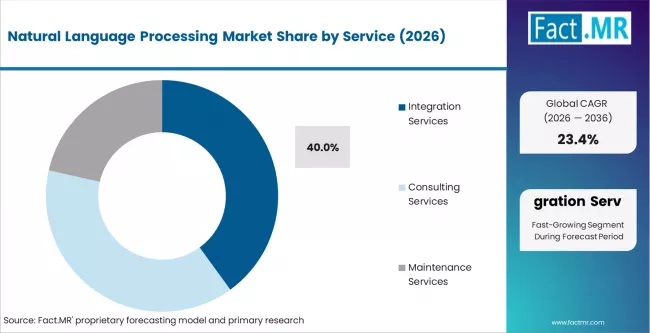
Natural Language Processing Market Analysis By Service | Source: Fact.MR
- Market Overview: Integration services are projected to account for around 40% share of the natural language processing market by 2026. Organizations adopting natural language processing solutions often require system integration to connect NLP platforms with existing enterprise applications, databases, and analytics systems. Integration services support the deployment of language processing tools within customer service platforms, enterprise resource planning systems, and data analytics environments. Businesses across banking, healthcare, retail, and telecommunications continue to integrate NLP capabilities into operational workflows to automate document processing, chatbot systems, and voice enabled interfaces. The complexity of enterprise IT environments increases reliance on integration services during NLP solution deployment.
- Demand Drivers:
- Enterprise System Integration: NLP solutions are integrated with enterprise applications such as customer service platforms, knowledge management systems, and analytics tools to enable automated language processing capabilities.
- Operational Workflow Automation: Organizations deploy NLP technologies within internal systems to process documents, analyze customer communications, and automate support services.
- Cross Platform Compatibility: Integration services ensure that NLP tools function across multiple enterprise software platforms and data environments used by large organizations.
Natural Language Processing Market Analysis by Technology
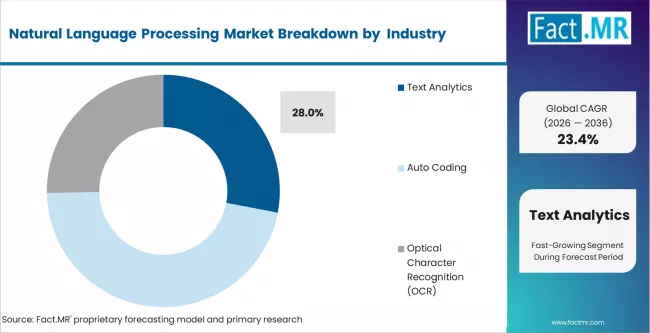
Natural Language Processing Market Analysis By Technology | Source: Fact.MR
- Market Overview: Text analytics is expected to represent approximately 28% share of the natural language processing market in 2026. Text analytics technologies analyze large volumes of unstructured textual data to extract insights, detect patterns, and support decision making processes. These solutions are widely used in applications such as sentiment analysis, document classification, fraud detection, and social media monitoring. Organizations across industries deploy text analytics tools to process customer feedback, financial documents, medical records, and online content. Increasing volumes of digital text generated through online platforms and enterprise communication systems continue to drive adoption of text analytics technologies.
- Demand Drivers:
- Growth of Unstructured Data: Businesses generate large volumes of text data through emails, documents, customer reviews, and social media interactions that require automated analysis.
- Customer Sentiment Monitoring: Organizations use text analytics tools to analyze customer feedback and social media conversations to understand public sentiment.
- Document Processing Applications: Text analytics solutions support automated classification and extraction of information from contracts, reports, and operational documents.
Natural Language Processing Market Drivers, Restraints, and Opportunities
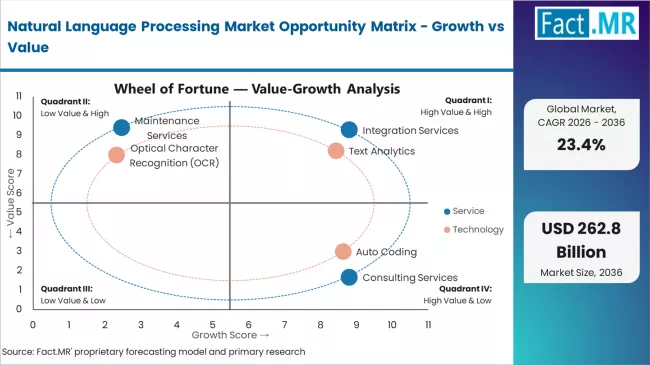
Natural Language Processing Market Opportunity Matrix Growth Vs Value | Source: Fact.MR
Fact MR analysis indicates that the natural language processing market developed from early computational linguistics research used in search engines, machine translation, and text analytics systems. Initial commercial applications focused on rule-based language processing tools used for document classification and information retrieval across enterprise data systems. The current market valuation reflects the integration of machine learning models that enable automated speech recognition, conversational interfaces, and large-scale language data analysis across digital platforms. Demand persists because organizations increasingly rely on automated language processing to manage growing volumes of text and voice data generated through digital communication systems.
A structural transition is underway as traditional rule-based NLP tools decline in relevance while machine learning driven language models become central to enterprise software architecture. Basic text processing tools remain widely used in legacy enterprise environments where implementation costs limit rapid platform upgrades. Advanced NLP systems based on neural networks require high computing resources, specialized datasets, and model training infrastructure, resulting in higher deployment costs per system. Even with slower adoption among smaller organizations, the pricing associated with enterprise-scale language platforms drives sustained market value growth.
- Conversational AI Systems: Businesses deploy NLP models in chatbots, virtual assistants, and automated customer support platforms to process large volumes of conversational interactions.
- Data Privacy Regulation: Legal frameworks such as the European Union General Data Protection Regulation (GDPR) and the California Consumer Privacy Act (CCPA) influence how language data is collected and processed within NLP systems.
- North America Technology Ecosystem: The United States hosts major cloud computing providers and AI research centers that drive large-scale development and deployment of natural language processing technologies.
Regional Analysis
The market analysis covers key global regions, including North America, Western Europe, and East Asia. It is segmented geographically, with specific market dynamics for each region. The full report provides a detailed market attractiveness analysis.
.webp "Top Country Growth Comparison Natural Language Processing Market Cagr (2026 2036)")
Top Country Growth Comparison Natural Language Processing Market Cagr (2026 2036) | Source: Fact.MR
| Country | CAGR (2026-2036) |
|---|---|
| USA | 12.5% |
| United Kingdom | 12.1% |
| Japan | 11.9% |
| South Korea | 12.7% |
Source: Fact.MR analysis. Updated Mar 16, 2026
Source: Fact MR (FMR) analysis, based on proprietary forecasting model and primary research
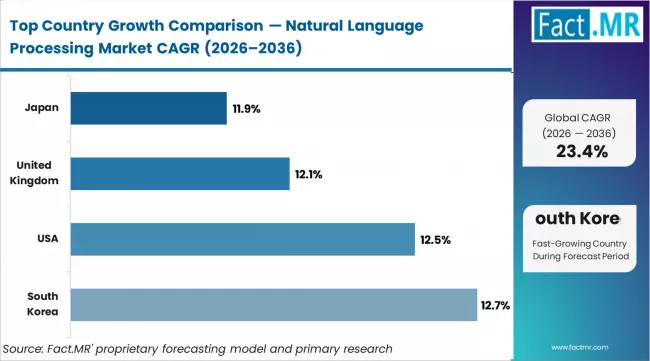
Natural Language Processing Market Cagr Analysis By Country | Source: Fact.MR
North America
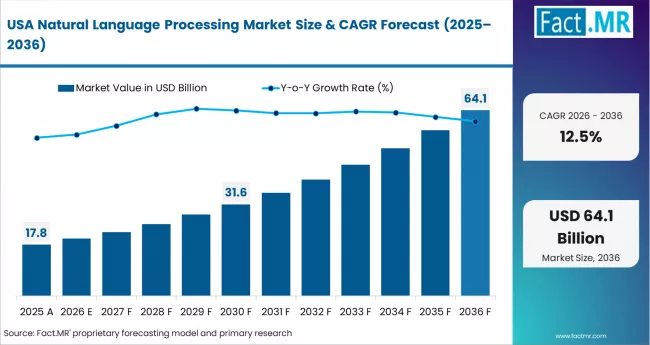
Natural Language Processing Market Country Value Analysis | Source: Fact.MR
The USA represents a major market supported by enterprise AI adoption, cloud computing infrastructure, and deployment of conversational AI platforms. Key companies include Microsoft, Google, and IBM.
- USA: Demand for natural language processing solutions in the U.S. is projected to rise at 12.5% CAGR through 2036. Growth is supported by artificial intelligence initiatives promoted by the National Science Foundation (05-2025) and expansion of NLP platforms by Microsoft (09-2025).
Western Europe
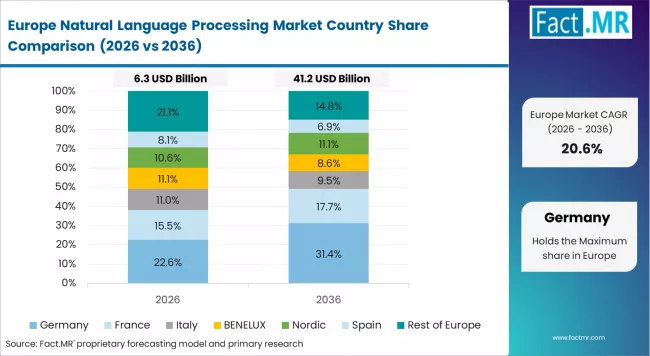
Natural Language Processing Market Europe Country Market Share Analysis, 2026 & 2036 | Source: Fact.MR
The United Kingdom is a key market supported by AI research programs, enterprise digital transformation, and adoption of language analytics platforms.
- United Kingdom: Demand for natural language processing solutions in the UK is projected to rise at 12.1% CAGR through 2036. Growth is supported by AI innovation programs promoted by the Department for Science, Innovation and Technology (03-2025) and expansion of NLP software platforms by Google (07-2025).
East Asia
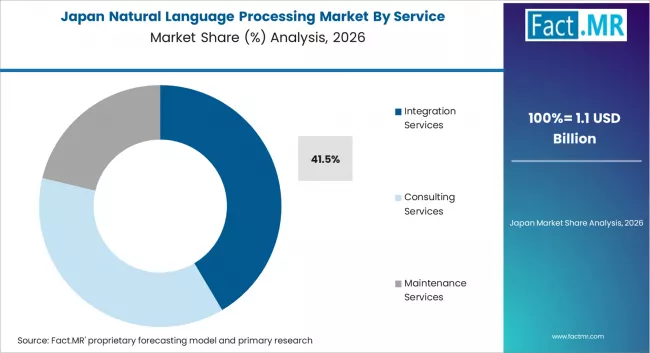
Natural Language Processing Market Japan Market Share Analysis By Service | Source: Fact.MR
Japan and South Korea represent major markets supported by AI research investment, robotics development, and digital service platforms.
- Japan: Demand for natural language processing solutions in Japan is projected to rise at 11.9% CAGR through 2036. Growth is supported by AI technology programs promoted by the Ministry of Economy, Trade and Industry (04-2025) and deployment of language processing systems by NTT Corporation (08-2025).
- South Korea: Demand for natural language processing solutions in South Korea is projected to rise at 12.7% CAGR through 2036. Growth is supported by national AI development initiatives promoted by the Ministry of Science and ICT (03-2025) and expansion of NLP technologies by Samsung Electronics (07-2025).
Fact MR's analysis of the natural language processing market in North America, Western Europe, and East Asia consists of country-wise assessments that include the USA, the United Kingdom, Japan, and South Korea. Readers can find detailed trends, regulatory updates, and company-specific investments shaping market growth in these countries.
Competitive Structure and Buyer Dynamics in the Natural Language Processing Market
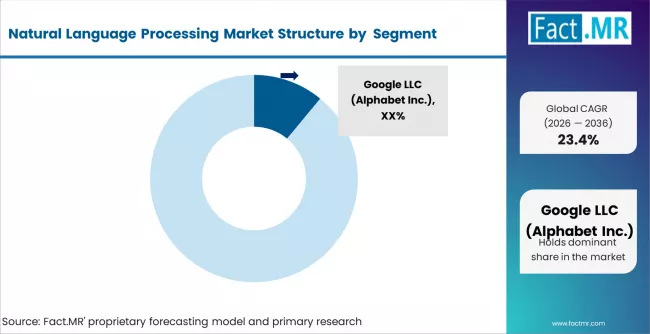
Natural Language Processing Market Analysis By Company | Source: Fact.MR
The competitive structure of the Natural Language Processing Market is moderately concentrated, with large technology firms holding significant influence over platform development and deployment infrastructure. Major companies including Google LLC (Alphabet Inc.), Microsoft Corporation, Amazon.com, Inc., International Business Machines Corporation, and Meta Platforms, Inc. control substantial portions of the market through cloud based artificial intelligence platforms and integrated software ecosystems. These organizations provide large scale language models, developer tools, and application programming interfaces used in enterprise software, digital assistants, search engines, and automated customer support systems. Specialized participants such as OpenAI, L.L.C., Hugging Face, Inc., Cohere Inc., SAP SE, and Nuance Communications, Inc. contribute through model development, enterprise language processing solutions, and domain specific applications. Competition is primarily driven by model performance, computational efficiency, multilingual capability, and integration with enterprise software environments. Cloud infrastructure access, developer ecosystems, and large training datasets also play central roles in shaping competitive positioning across the market.
Several companies maintain structural advantages through control of large scale computing infrastructure and extensive data resources required for training advanced language models. Firms such as Google LLC, Microsoft Corporation, Amazon.com, Inc., and Meta Platforms, Inc. operate global cloud computing platforms that support large model training and deployment capabilities. OpenAI, L.L.C. and Cohere Inc. maintain expertise in large language model research and model optimization techniques. Nuance Communications, Inc. and SAP SE provide specialized enterprise language processing solutions integrated with healthcare, business software, and enterprise workflows. Enterprise customers commonly adopt multi vendor strategies to reduce reliance on a single technology provider and maintain flexibility in model deployment. Procurement decisions frequently evaluate performance benchmarks, data security requirements, and long term platform support. This purchasing behavior moderates vendor pricing leverage, although providers with proprietary models, large computing resources, and integrated cloud platforms maintain strong negotiating positions.
Key Players of the Natural Language Processing Market
- Google LLC (Alphabet Inc.)
- Microsoft Corporation
- International Business Machines Corporation
- Amazon.com, Inc.
- OpenAI, L.L.C.
- Meta Platforms, Inc.
- SAP SE
- Nuance Communications, Inc.
- Hugging Face, Inc.
- Cohere Inc.
Report Scope
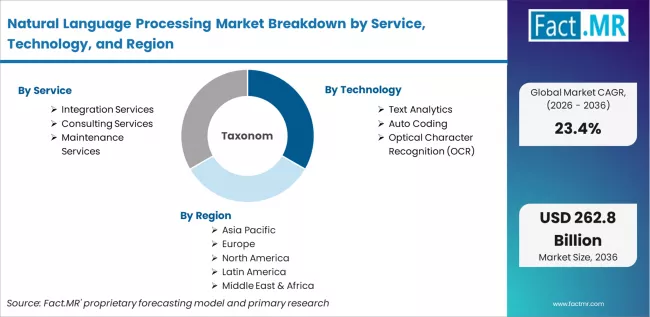
Natural Language Processing Market Breakdown By Service, Technology, And Region | Source: Fact.MR
| Metric | Value |
|---|---|
| Quantitative Units | USD 32.1 billion (2026) to USD 262.8 billion (2036), at a CAGR of 23.4% |
| Market Definition | The natural language processing market includes development, deployment, and integration of software technologies that enable machines to analyze, interpret, and generate human language across enterprise, consumer, and public sector applications. |
| Technology | Auto Coding, Text Analytics, Optical Character Recognition (OCR), Interactive Voice Response, Pattern & Image Recognition, Speech Analytics |
| Type | Rule-based, Statistical, Hybrid Models |
| Service | Integration Services, Consulting Services, Maintenance Services |
| Deployment Model | On-premise Models, On-demand Deployment Models |
| Application Coverage | Sentiment Analysis, Data Extraction, Risk and Threat Detection, Automatic Summarization, Content Management, Language Scoring, Others (Portfolio Monitoring, HR and Recruiting, Branding and Advertising) |
| Vertical Coverage | Healthcare Sector, Public Sector, Retail Sector, Media & Entertainment, Manufacturing, Other Sectors |
| Key Companies Profiled | Google LLC, Microsoft Corporation, International Business Machines Corporation, Amazon.com, Inc., OpenAI, L.L.C., Meta Platforms, Inc., SAP SE, Nuance Communications, Inc., Hugging Face, Inc., Cohere Inc. |
| Forecast Period | 2026 to 2036 |
| Approach | Hybrid top-down and bottom-up market modeling validated through interviews with AI technology providers and enterprise adopters, supported by cloud platform revenue analysis, AI model deployment trends, and enterprise adoption benchmarking. |
Source: Fact.MR analysis. Updated Mar 16, 2026
Bibliographies
- [1] National Science Foundation. (2025). Artificial intelligence initiatives.
- [2] Department for Science, Innovation and Technology, UK. (2025). AI innovation programs.
- [3] Ministry of Economy, Trade and Industry, Japan. (2025). AI technology programs.
- [4] Ministry of Science and ICT, South Korea. (2025). National AI development initiatives.
- [5] Microsoft Corporation. (2025). NLP platforms expansion.
- [6] Google. (2025). NLP software platforms.
- [7] NTT Corporation. (2025). Language processing systems deployment.
- [8] Samsung Electronics. (2025). NLP technologies expansion.
- [9] European Union. (2023). General Data Protection Regulation (GDPR).
This Report Addresses
- Market size estimation and revenue forecasts for the Natural Language Processing Market from 2026 to 2036, supported by enterprise software adoption benchmarks and artificial intelligence platform deployment indicators.
- Growth opportunity mapping across text analytics, optical character recognition, speech analytics, interactive voice response systems, and automated language processing technologies used in enterprise and digital service environments.
- Segment and regional revenue forecasts covering sentiment analysis, data extraction, risk detection, automatic summarization, and content management applications across healthcare, retail, public sector, media, and manufacturing industries.
- Competition strategy assessment including large language model development capability, cloud platform integration, and enterprise software ecosystem benchmarking among leading artificial intelligence providers.
- Regulatory and compliance impact analysis covering data privacy frameworks such as the General Data Protection Regulation and the California Consumer Privacy Act affecting language data processing systems.
- Market report delivery in PDF, Excel, PPT, and interactive dashboard formats designed for enterprise technology planning, artificial intelligence investment assessment, and digital transformation strategy development.
- Supply chain vulnerability assessments identifying cloud computing infrastructure concentration, large model training resource dependencies, and regional artificial intelligence development capacity risks affecting natural language processing deployment.
Segmentation
Natural Language Processing Market Key Segments
-
Technology :
- Auto Coding
- Text Analytics
- Optical Character Recognition (OCR)
- Interactive Voice Response
- Pattern and Image Recognition
- Speech Analytics
-
Type :
- Rule Based Models
- Statistical Models
- Hybrid Models
-
Service :
- Integration Services
- Consulting Services
- Maintenance Services
- Integration Services
-
Deployment Model :
- On Premises
- On Demand
-
Application :
- Sentiment Analysis
- Data Extraction
- Risk and Threat Detection
- Automatic Summarization
- Content Management
- Language Scoring
- Others
- Portfolio Monitoring
- HR and Recruiting
- Branding and Advertising
-
Vertical :
- Healthcare
- Public Sector
- Retail
- Media and Entertainment
- Manufacturing
- Other Sectors
-
Region :
- North America
- USA
- Canada
- Mexico
- Europe
- Germany
- UK
- France
- Italy
- Spain
- Nordic Countries
- BENELUX
- Rest of Europe
- Asia Pacific
- China
- Japan
- South Korea
- India
- Australia
- Rest of Asia Pacific
- Latin America
- Brazil
- Argentina
- Rest of Latin America
- Middle East and Africa
- Kingdom of Saudi Arabia
- United Arab Emirates
- South Africa
- Rest of Middle East and Africa
- Other Regions
- Oceania
- Central Asia
- Other Markets
- North America
Frequently Asked Questions
How large is the demand for Natural Language Processing in the global market in 2026?
What will be the market size of Natural Language Processing in the global market by 2036?
What is the expected demand growth for Natural Language Processing in the global market between 2026 and 2036?
Which Service Segment is poised to lead global demand by 2026?
Which Company is Identified as a Leading Participant in the Natural Language Processing Market?
What is Driving Natural Language Processing Demand in the United States?
What is the United States Growth Outlook in this Report?
What Factors Support Natural Language Processing Adoption in the United Kingdom?
What is the United Kingdom Growth Outlook in this Report?
Why is Japan an Important Market for Natural Language Processing Technologies?
What is the Japan Growth Outlook in this Report?
Why is South Korea Considered a Key Market for Natural Language Processing Solutions?
What is the South Korea Growth Outlook in this Report?
What is Natural Language Processing and What is It Mainly Used For?
What does Natural Language Processing Market Mean in this Report?
What is Included in the Scope of this Natural Language Processing Market Report?
What is Excluded from the Scope of this Report?
What does Market Forecast Mean on this Page?
How is the Natural Language Processing Market Forecast Developed in this Report?
Who worked on this report


Preview the report firsthand - request a free sample
Free SampleGet the brochure for pricing and purchase details
Download PDF