Air Care Chemicals Market (2026 - 2036)

Air Care Chemicals Market Size and Share Forecast Outlook 2026 to 2036

Core Findings

    Air Care Chemicals Market Size and Share Forecast Outlook 2026 to 2036

    Global revenues for air care chemicals market are expected to increase from USD 5.4 billion in 2026 to around USD 8.5 billion by 2036, reflecting a CAGR of 4.6% during the forecast period. Growth is driven by urbanization, rising indoor air quality awareness, and consumer preference for pleasant and personalized living environments.

    Summary of Air Care Chemicals Market - Key Takeaways

    • The market includes aerosol sprays, plug-in devices, gel-based fresheners, automatic dispensers, HVAC treatment chemicals, and odor neutralizers used across residential homes, offices, hospitality venues, commercial buildings, and automotive interiors to improve ambient air quality and manage odors.
    • The defined scope covers revenue generated by product type, formulation approach (fragrance-based, enzyme-based, chemical neutralization, bio-based systems), end-use sector, delivery format, and regional demand across North America, Europe, Asia Pacific, Latin America, and the Middle East & Africa, excluding industrial air purification equipment and non-chemical ventilation systems.
    • The air care chemicals market is projected to grow at a CAGR of 4.6% from 2026 to 2036, expanding from USD 5.4 billion in 2026 to approximately USD 8.5 billion by 2036, based on Fact.MR forecasting driven by urbanization, rising indoor air quality awareness, sustainability mandates, and growing consumer preference for personalized home environments.
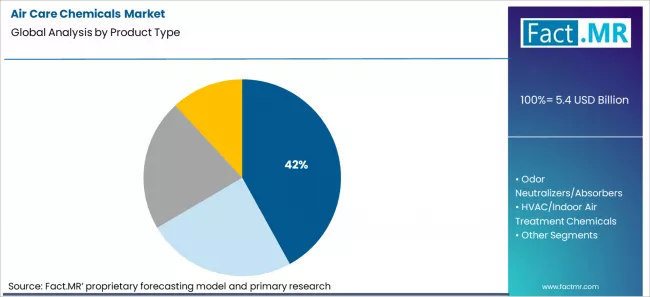
    • Air freshener formulations lead the product segment with a 42% share in 2026, supported by strong demand for instant odor masking, convenience formats, and premium fragrance collections.
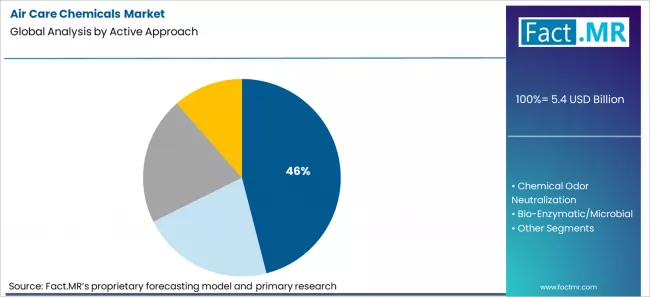
    • The fragrance-based approach dominates with a 46% share, reflecting widespread consumer familiarity, affordability, and ongoing innovation in long-lasting and essential oil-based scent technologies.
    • China records the fastest growth at 5.6% CAGR, supported by rapid urbanization and sustainability-driven reformulation, while Brazil and the United States also show strong momentum due to climate-related odor control needs and increasing demand for eco-friendly products.
    • Competition is led by major players such as Reckitt, Procter & Gamble, SC Johnson, Unilever, Henkel, Church & Dwight, Clorox, and Kao Corporation, with differentiation centered on fragrance innovation, sustainable packaging, refill systems, smart-home integration, and premium wellness-oriented positioning.
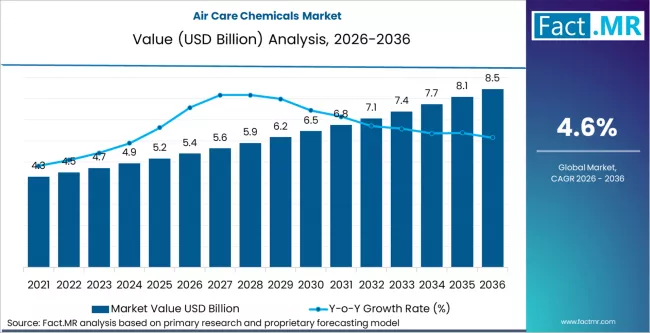
    Air Care Chemicals Market Market Value Analysis

    Sustainability is becoming central to innovation. Manufacturers are shifting toward recyclable packaging, refill systems, and bio-based ingredients. Smart home integration is also reshaping the category, with connected diffusers and automated dispensing systems gaining traction in premium households and commercial spaces.

    As Jon Moeller, Chairman, President, and CEO of Procter & Gamble (P&G), stated in the company’s 2025/2026 strategic outlook, the focus remains on “a focused product portfolio of daily use categories where performance drives brand choice” and leading constructive disruption across innovation and digitalization. This reflects how major players are investing in performance-driven fragrances, sustainable packaging, and digital-enabled air care solutions to meet evolving consumer expectations.

    Air Care Chemicals Market

    Metric Value
    Estimated Value in (2026) USD 5.4 billion
    Forecast Value in (2036) USD 8.5 billion
    Forecast CAGR (2026 to 2036) 4.6%

    Category 

    Category Segments
    Product Type Air Freshener Formulations, Odor Neutralizers/Absorbers, HVAC/Indoor Air Treatment Chemicals, Other Air Care Chemicals
    Active Approach Fragrance-Based, Chemical Odor Neutralization, Bio- Enzymatic/Microbial, Other Approaches
    End Use Sector Residential, Commercial Buildings, Hospitality & Foodservice, Other Sectors
    Delivery Format Aerosol/Spray, Liquid/Continuous Release, Gel/Solid, Other Formats
    Region North America; Europe; Asia Pacific; Latin America; Middle East & Africa

    Segmental Analysis

    What factors are driving air freshener formulations to maintain a 42.0% market share?
    Air Care Chemicals Market Analysis By Product Type

    Air freshener formulations continue to lead because consumers want fast and noticeable odor control. Aerosol sprays, plug-ins, automatic dispensers, and trigger sprays offer instant freshness in homes, offices, hotels, and cars. People value convenience and quick results. Brands are improving longevity so scents last longer without frequent reapplication. There is also growing demand for natural ingredients, which has pushed companies to use botanical extracts and reduce volatile organic compounds. Premium collections with layered and seasonal fragrances further strengthen this segment’s appeal.

    Why does the fragrance-based approach dominate with a 46.0% market share?
    Air Care Chemicals Market Analysis By Active Approach

    The fragrance-based approach remains dominant because it is familiar, simple, and effective. Consumers trust traditional scenting solutions that use aromatic molecules to create a pleasant environment. These products are widely available and cost-effective. Manufacturers continue enhancing them with essential oils and longer-lasting release technologies. Premium lines offer sophisticated scent profiles and limited-edition collections, attracting consumers who see fragrance as part of personal lifestyle expression. This balance of affordability, variety, and proven performance keeps the segment ahead.

    Market Drivers

    • Urbanization plays a major role. As more people live in apartments and densely populated cities, managing indoor odors becomes important. Limited ventilation and close living spaces increase demand for air treatment products. Commercial buildings also require ongoing air quality maintenance. Growing middle-class populations in emerging cities are spending more on home comfort products, including air care. Sustainability is another key driver. Regulations and consumer expectations are pushing brands to reduce VOC content and shift toward bio-based ingredients. The EU Green Deal and similar policies are influencing reformulation. Companies are replacing traditional propellants with compressed air or nitrogen systems. Refillable packaging and concentrated formats are also gaining popularity as part of circular economy efforts.
    • Market Restraints VOC regulations limit how strong or long-lasting fragrances can be. Compliance adds cost and complexity. Health concerns about synthetic fragrances are increasing, especially among families with children or individuals with respiratory sensitivities. Reformulating products to meet safety standards can sometimes reduce fragrance intensity or performance. This may affect customer satisfaction.
    • Market Trends Smart home integration is changing the way air care products are used. Connected plug-in devices can be controlled through smartphones. Some systems adjust automatically based on occupancy or air quality sensors. In commercial buildings, centralized control systems help manage multiple dispensers efficiently. Wellness positioning is also growing. Air care products are now marketed for relaxation, focus, and mood improvement. Brands promote essential oil blends with aromatherapy benefits. Packaging and branding emphasize health and wellbeing. Consumers increasingly see air care as part of a broader lifestyle focused on comfort, cleanliness, and emotional balance.

    Air Care Chemicals Market Analysis by Country
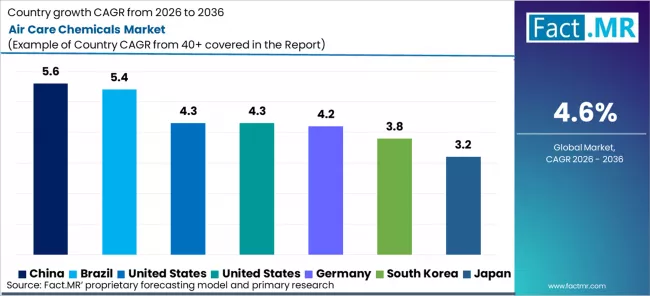
    Air Care Chemicals Market Cagr Analysis By Country

    Country CAGR (2026 to 2036)
    China 5.6%
    Brazil 5.4%
    United States 4.3%
    United Kingdom 4.3%
    Germany 4.2%
    South Korea 3.8%
    Japan 3.2%

    Why is China emerging as the fastest-growing air care chemicals market?

    China is expanding at a 5.6 percent CAGR, supported by powerful structural shifts. Rapid urbanization continues to concentrate millions of people in high-rise apartments where ventilation can be limited. This increases everyday demand for indoor odor control. At the same time, stricter government regulations on volatile organic compounds are pushing manufacturers toward water-based and low-emission formulations. A rising middle class is also trading up from basic aerosols to premium gel-based and plug-in systems that offer longer-lasting fragrance. E-commerce plays a major role, with online platforms accounting for a large share of sales and enabling subscription models for refills. Companies are aligning closely with China’s Dual Carbon goals, investing in greener packaging and plant-based ingredients to remain competitive.

    What is enabling Brazil’s rapid rise in the air care chemicals market?

    Brazil is growing at a 5.4 percent CAGR, supported by urbanization and a rising middle class. Warm and humid conditions create constant odor control needs, keeping demand steady throughout the year. Retail expansion and stronger local manufacturing reduce product costs and improve accessibility. Consumers are gradually shifting from basic sprays to more premium and long-lasting fragrance solutions. A young population profile also provides strong long-term growth potential.

    What is supporting steady expansion of the United States air care chemicals market through 2036?

    The United States market is growing at a 4.3 percent CAGR as sustainability and wellness reshape buying decisions. In late 2025, SC Johnson and its Glade brand introduced a 2030 sustainability agenda focused on cutting virgin plastic use. This move encouraged wider adoption of refill systems, concentrated liquids, and bio-based propellants. Major retailers such as Walmart and Target are also pushing suppliers to meet stricter packaging standards. More households now look for eco-friendly labels when choosing air care products. Natural fragrance lines are growing faster than traditional synthetic options. Companies are investing heavily in plant-based ingredients and recyclable packaging to stay competitive.

    What is fueling growth in the United Kingdom air care chemicals market?

    The United Kingdom is advancing at a 4.3 percent CAGR, driven by lifestyle and regulatory changes. More time spent at home has increased interest in creating pleasant and personalized indoor environments. Corporate restructuring among leading brands has shifted attention toward premium and smart-diffusion technologies. Sustainability regulations requiring higher recycled content in packaging are accelerating innovation. Consumers are increasingly drawn to luxury and designer-inspired fragrances, particularly in urban centers. Retailers are also prioritizing environmentally responsible product lines, reinforcing steady market momentum.

    How is Germany strengthening its position in the air care chemicals market?

    Germany is growing at a 4.2 percent CAGR, backed by strong environmental awareness and policy enforcement. National and EU climate targets are encouraging manufacturers to replace fossil-based inputs with bio-based and biodegradable ingredients. Large retail chains demand strict sustainability compliance from suppliers. German consumers show high trust in certified natural products, supporting premium positioning. Innovation is shifting toward enzyme-based odor neutralizers and low-impact production processes. Export opportunities within the EU single market further support growth.

    What factors are shaping Japan’s air care chemicals market growth?

    Japan is progressing at a 3.2 percent CAGR, shaped by demographic and cultural dynamics. A rapidly aging population prefers gentle, hypoallergenic, and low-intensity fragrances that do not irritate sensitive respiratory systems. Compact urban housing increases demand for subtle, continuous-release scent systems rather than strong sprays. Safety testing and dermatological validation are key selling points. Consumers value purity, reliability, and minimal residue. Convenience store distribution channels ensure wide household penetration, while premium positioning emphasizes quality over volume.

    How is South Korea driving wellness-led air care market development?

    South Korea is expanding at a 3.8 percent CAGR as consumers increasingly connect fragrance with mental well-being. Aromatherapy-inspired products are popular in both homes and vehicles. High urban density and long commuting times increase interest in personal space enhancement. Online beauty and wellness platforms strongly influence purchasing behavior. Essential oil-based plug-ins and premium layered fragrances are gaining popularity.

    Competitive Landscape for Air Care Chemicals Market
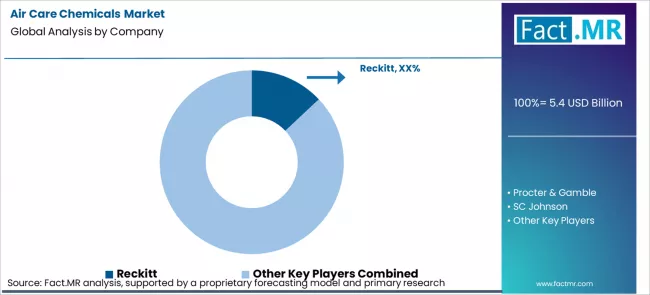
    Air Care Chemicals Market Analysis By Company

    The Air Care Chemicals market is led by well-established multinational companies that benefit from global distribution networks, recognizable brands, and strong R&D investment. These companies compete not only on fragrance quality but also on innovation, sustainability, and delivery technology.

    Reckitt Benckiser holds a strong global presence through its Air Wick portfolio, offering aerosols, plug-ins, and continuous-release systems across supermarkets and mass retail chains. Procter & Gamble positions Febreze as more than just an air freshener, extending it into fabric refreshers, automotive products, and odor-elimination sprays. SC Johnson continues to strengthen its Glade brand, particularly in North America, with a growing focus on natural fragrance ingredients and recyclable packaging formats. Unilever participates selectively, leveraging brand extensions and regional distribution strength. Henkel balances both consumer and professional segments, especially in Europe.

    Church & Dwight competes with Arm & Hammer, using its baking soda heritage to emphasize odor absorption rather than simple fragrance masking. Clorox focuses primarily on the U.S. market with odor-elimination positioning tied to hygiene credibility. In Asia-Pacific, Kao stands out with hypoallergenic and microbiome-friendly innovations tailored to sensitive consumers.

    Professional players such as SC Johnson Professional and Ecolab concentrate on commercial facilities, offering automated dispensers, bulk refills, and regulatory-compliant systems for hospitality and healthcare clients. Competition increasingly centers on sustainability credentials, smart-home compatibility, refill systems, and premium scent experiences. At the same time, private-label brands are expanding in value-driven retail channels, adding pricing pressure to the market.

    Recent Developments

    • In 2025, Reckitt launched a new range of biodegradable plug-in refills under its Fresh Earth line, featuring essential oils and 100% recyclable packaging designed for eco-conscious consumers. This expansion strengthens its position in the sustainable air care segment.
    • In 2025, Godrej launched the aer matic Royal automatic air freshener in India, offering a premium rose-gold finish and customizable spray intervals with a “Warm Vanilla” fragrance aimed at seasonal home fragrance demand.

    Key Players in Air Care Chemicals Market

    • Reckitt
    • Procter & Gamble
    • SC Johnson
    • Unilever
    • Henkel
    • Church & Dwight
    • Clorox
    • Kao Corporation
    • S.C. Johnson Professional
    • Ecolab

    Bibliography

    • Reckitt Benckiser Group. 2025. Air Wick sustainable plug-in refill expansion and biodegradable fragrance initiatives. Corporate press releases and sustainability updates.
    • Procter & Gamble Co. 2025-2026. Febreze and home fragrance portfolio innovation aligned with integrated growth and digitalization strategy. Company annual reports and strategic outlook publications.
    • SC Johnson. 2025. Glade 2030 Sustainability Agenda and recyclable packaging transition initiatives. Official sustainability reports and product documentation.
    • Henkel AG & Co. KGaA. 2026. Bio-based and biodegradable air care formulation developments aligned with EU Green Deal objectives. Corporate environmental disclosures and innovation briefs.
    • Kao Corporation. 2025-2026. Microbiome-friendly and hypoallergenic air care technologies for Asia-Pacific markets. Technical application guides and company publications.
    • European Commission. 2023. European Green Deal and volatile organic compound (VOC) regulatory framework impacting consumer air care products. Official EU policy documentation.
    • UK Health and Safety Executive (HSE). 2025. Regulatory guidance on VOC thresholds and respiratory irritants in consumer chemical products. Official HSE publications.

    Scope of Report

    Items Values
    Quantitative Units (2026) USD 5.4 Billion
    Product Type Air Freshener Formulations, Odor Neutralizers/Absorbers, VAC/Indoor Air Treatment Chemicals, Other Air Care Chemicals
    Active Approach Fragrance-Based, Chemical Odor Neutralization, Bio- Enzymatic/Microbial, Other Approaches
    End Use Sector Residential, Commercial Buildings, Hospitality & Foodservice, Other Sectors
    Delivery Format Aerosol/Spray, Liquid/Continuous Release, Gel/Solid, Other Formats
    Regions Covered North America, Europe, Asia Pacific, Latin America, Middle East & Africa
    Countries Covered U.S., Canada, Germany, Italy, UK, France, Japan, China, Brazil, South Korea, Australia, and other countries
    Key Companies Profiled Reckitt, Procter & Gamble, SC Johnson, Unilever, Henkel, Church & Dwight, Clorox, Kao Corporation, S.C. Johnson Professional, Ecolab
    Additional Attributes Dollar revenue in the air care chemicals market is segmented by product type (aerosols, plug-ins, gels, automatic dispensers, automotive), formulation approach (fragrance-based, enzyme-based, activated carbon, bio-based), end use (residential, commercial, hospitality, automotive, institutional), distribution channel (retail, e-commerce, professional supply), and region (North America, Europe, Asia Pacific, Latin America, Middle East & Africa).

    Air Care Chemicals Market by Segments

    • Product Type :

      • Air Freshener Formulations
      • Odor Neutralizers/Absorbers
      • HVAC/Indoor Air Treatment Chemicals
      • Other Air Care Chemicals
    • Active Approach :

      • Fragrance-Based
      • Chemical Odor Neutralization
      • Bio-Enzymatic/Microbial
      • Other Approaches
    • End use :

      • Residential
      • Commercial Buildings
      • Hospitality & Foodservice
      • Other Sectors
    • Delivery Format :

      • Aerosol/Spray
      • Liquid/Continuous Release
      • Gel/Solid
      • Other Formats
    • Region :

      • Asia Pacific
        • China
        • India
        • Japan
        • South Korea
        • Australia
        • Rest of Asia Pacific
      • North America
        • United States
        • Canada
        • Mexico
      • Europe
        • Germany
        • France
        • UK
        • Italy
        • Spain
        • Rest of Europe
      • Latin America
        • Brazil
        • Argentina
        • Chile

    Table of Content

    1. Executive Summary
      • Global Market Outlook
      • Demand to side Trends
      • Supply to side Trends
      • Technology Roadmap Analysis
      • Analysis and Recommendations
    2. Market Overview
      • Market Coverage / Taxonomy
      • Market Definition / Scope / Limitations
    3. Research Methodology
      • Chapter Orientation
      • Analytical Lens and Working Hypotheses
        • Market Structure, Signals, and Trend Drivers
        • Benchmarking and Cross-market Comparability
        • Market Sizing, Forecasting, and Opportunity Mapping
      • Research Design and Evidence Framework
        • Desk Research Programme (Secondary Evidence)
          • Company Annual and Sustainability Reports
          • Peer-reviewed Journals and Academic Literature
          • Corporate Websites, Product Literature, and Technical Notes
          • Earnings Decks and Investor Briefings
          • Statutory Filings and Regulatory Disclosures
          • Technical White Papers and Standards Notes
          • Trade Journals, Industry Magazines, and Analyst Briefs
          • Conference Proceedings, Webinars, and Seminar Materials
          • Government Statistics Portals and Public Data Releases
          • Press Releases and Reputable Media Coverage
          • Specialist Newsletters and Curated Briefings
          • Sector Databases and Reference Repositories
          • FMR Internal Proprietary Databases and Historical Market Datasets
          • Subscription Datasets and Paid Sources
          • Social Channels, Communities, and Digital Listening Inputs
          • Additional Desk Sources
        • Expert Input and Fieldwork (Primary Evidence)
          • Primary Modes
            • Qualitative Interviews and Expert Elicitation
            • Quantitative Surveys and Structured Data Capture
            • Blended Approach
          • Why Primary Evidence is Used
          • Field Techniques
            • Interviews
            • Surveys
            • Focus Groups
            • Observational and In-context Research
            • Social and Community Interactions
          • Stakeholder Universe Engaged
            • C-suite Leaders
            • Board Members
            • Presidents and Vice Presidents
            • R&D and Innovation Heads
            • Technical Specialists
            • Domain Subject-matter Experts
            • Scientists
            • Physicians and Other Healthcare Professionals
          • Governance, Ethics, and Data Stewardship
            • Research Ethics
            • Data Integrity and Handling
        • Tooling, Models, and Reference Databases
      • Data Engineering and Model Build
        • Data Acquisition and Ingestion
        • Cleaning, Normalisation, and Verification
        • Synthesis, Triangulation, and Analysis
      • Quality Assurance and Audit Trail
    4. Market Background
      • Market Dynamics
        • Drivers
        • Restraints
        • Opportunity
        • Trends
      • Scenario Forecast
        • Demand in Optimistic Scenario
        • Demand in Likely Scenario
        • Demand in Conservative Scenario
      • Opportunity Map Analysis
      • Product Life Cycle Analysis
      • Supply Chain Analysis
      • Investment Feasibility Matrix
      • Value Chain Analysis
      • PESTLE and Porter’s Analysis
      • Regulatory Landscape
      • Regional Parent Market Outlook
      • Production and Consumption Statistics
      • Import and Export Statistics
    5. Global Market Analysis 2021 to 2025 and Forecast, 2026 to 2036
      • Historical Market Size Value (USD Million) Analysis, 2021 to 2025
      • Current and Future Market Size Value (USD Million) Projections, 2026 to 2036
        • Y to o to Y Growth Trend Analysis
        • Absolute $ Opportunity Analysis
    6. Global Market Pricing Analysis 2021 to 2025 and Forecast 2026 to 2036
    7. Global Market Analysis 2021 to 2025 and Forecast 2026 to 2036, By Product Type
      • Introduction / Key Findings
      • Historical Market Size Value (USD Million) Analysis By Product Type, 2021 to 2025
      • Current and Future Market Size Value (USD Million) Analysis and Forecast By Product Type, 2026 to 2036
        • Air Freshener Formulations
        • Odor Neutralizers/Absorbers
        • HVAC/Indoor Air Treatment Chemicals
        • Other Air Care Chemicals
      • Y to o to Y Growth Trend Analysis By Product Type, 2021 to 2025
      • Absolute $ Opportunity Analysis By Product Type, 2026 to 2036
    8. Global Market Analysis 2021 to 2025 and Forecast 2026 to 2036, By Active Approach
      • Introduction / Key Findings
      • Historical Market Size Value (USD Million) Analysis By Active Approach, 2021 to 2025
      • Current and Future Market Size Value (USD Million) Analysis and Forecast By Active Approach, 2026 to 2036
        • Fragrance-Based
        • Chemical Odor Neutralization
        • Bio-Enzymatic/Microbial
        • Other Approaches
      • Y to o to Y Growth Trend Analysis By Active Approach, 2021 to 2025
      • Absolute $ Opportunity Analysis By Active Approach, 2026 to 2036
    9. Global Market Analysis 2021 to 2025 and Forecast 2026 to 2036, By Region
      • Introduction
      • Historical Market Size Value (USD Million) Analysis By Region, 2021 to 2025
      • Current Market Size Value (USD Million) Analysis and Forecast By Region, 2026 to 2036
        • North America
        • Latin America
        • Western Europe
        • Eastern Europe
        • East Asia
        • South Asia and Pacific
        • Middle East & Africa
      • Market Attractiveness Analysis By Region
    10. North America Market Analysis 2021 to 2025 and Forecast 2026 to 2036, By Country
      • Historical Market Size Value (USD Million) Trend Analysis By Market Taxonomy, 2021 to 2025
      • Market Size Value (USD Million) Forecast By Market Taxonomy, 2026 to 2036
        • By Country
          • USA
          • Canada
          • Mexico
        • By Product Type
        • By Active Approach
      • Market Attractiveness Analysis
        • By Country
        • By Product Type
        • By Active Approach
      • Key Takeaways
    11. Latin America Market Analysis 2021 to 2025 and Forecast 2026 to 2036, By Country
      • Historical Market Size Value (USD Million) Trend Analysis By Market Taxonomy, 2021 to 2025
      • Market Size Value (USD Million) Forecast By Market Taxonomy, 2026 to 2036
        • By Country
          • Brazil
          • Chile
          • Rest of Latin America
        • By Product Type
        • By Active Approach
      • Market Attractiveness Analysis
        • By Country
        • By Product Type
        • By Active Approach
      • Key Takeaways
    12. Western Europe Market Analysis 2021 to 2025 and Forecast 2026 to 2036, By Country
      • Historical Market Size Value (USD Million) Trend Analysis By Market Taxonomy, 2021 to 2025
      • Market Size Value (USD Million) Forecast By Market Taxonomy, 2026 to 2036
        • By Country
          • Germany
          • UK
          • Italy
          • Spain
          • France
          • Nordic
          • BENELUX
          • Rest of Western Europe
        • By Product Type
        • By Active Approach
      • Market Attractiveness Analysis
        • By Country
        • By Product Type
        • By Active Approach
      • Key Takeaways
    13. Eastern Europe Market Analysis 2021 to 2025 and Forecast 2026 to 2036, By Country
      • Historical Market Size Value (USD Million) Trend Analysis By Market Taxonomy, 2021 to 2025
      • Market Size Value (USD Million) Forecast By Market Taxonomy, 2026 to 2036
        • By Country
          • Russia
          • Poland
          • Hungary
          • Balkan & Baltic
          • Rest of Eastern Europe
        • By Product Type
        • By Active Approach
      • Market Attractiveness Analysis
        • By Country
        • By Product Type
        • By Active Approach
      • Key Takeaways
    14. East Asia Market Analysis 2021 to 2025 and Forecast 2026 to 2036, By Country
      • Historical Market Size Value (USD Million) Trend Analysis By Market Taxonomy, 2021 to 2025
      • Market Size Value (USD Million) Forecast By Market Taxonomy, 2026 to 2036
        • By Country
          • China
          • Japan
          • South Korea
        • By Product Type
        • By Active Approach
      • Market Attractiveness Analysis
        • By Country
        • By Product Type
        • By Active Approach
      • Key Takeaways
    15. South Asia and Pacific Market Analysis 2021 to 2025 and Forecast 2026 to 2036, By Country
      • Historical Market Size Value (USD Million) Trend Analysis By Market Taxonomy, 2021 to 2025
      • Market Size Value (USD Million) Forecast By Market Taxonomy, 2026 to 2036
        • By Country
          • India
          • ASEAN
          • Australia & New Zealand
          • Rest of South Asia and Pacific
        • By Product Type
        • By Active Approach
      • Market Attractiveness Analysis
        • By Country
        • By Product Type
        • By Active Approach
      • Key Takeaways
    16. Middle East & Africa Market Analysis 2021 to 2025 and Forecast 2026 to 2036, By Country
      • Historical Market Size Value (USD Million) Trend Analysis By Market Taxonomy, 2021 to 2025
      • Market Size Value (USD Million) Forecast By Market Taxonomy, 2026 to 2036
        • By Country
          • Kingdom of Saudi Arabia
          • Other GCC Countries
          • Turkiye
          • South Africa
          • Other African Union
          • Rest of Middle East & Africa
        • By Product Type
        • By Active Approach
      • Market Attractiveness Analysis
        • By Country
        • By Product Type
        • By Active Approach
      • Key Takeaways
    17. Key Countries Market Analysis
      • USA
        • Pricing Analysis
        • Market Share Analysis, 2025
          • By Product Type
          • By Active Approach
      • Canada
        • Pricing Analysis
        • Market Share Analysis, 2025
          • By Product Type
          • By Active Approach
      • Mexico
        • Pricing Analysis
        • Market Share Analysis, 2025
          • By Product Type
          • By Active Approach
      • Brazil
        • Pricing Analysis
        • Market Share Analysis, 2025
          • By Product Type
          • By Active Approach
      • Chile
        • Pricing Analysis
        • Market Share Analysis, 2025
          • By Product Type
          • By Active Approach
      • Germany
        • Pricing Analysis
        • Market Share Analysis, 2025
          • By Product Type
          • By Active Approach
      • UK
        • Pricing Analysis
        • Market Share Analysis, 2025
          • By Product Type
          • By Active Approach
      • Italy
        • Pricing Analysis
        • Market Share Analysis, 2025
          • By Product Type
          • By Active Approach
      • Spain
        • Pricing Analysis
        • Market Share Analysis, 2025
          • By Product Type
          • By Active Approach
      • France
        • Pricing Analysis
        • Market Share Analysis, 2025
          • By Product Type
          • By Active Approach
      • India
        • Pricing Analysis
        • Market Share Analysis, 2025
          • By Product Type
          • By Active Approach
      • ASEAN
        • Pricing Analysis
        • Market Share Analysis, 2025
          • By Product Type
          • By Active Approach
      • Australia & New Zealand
        • Pricing Analysis
        • Market Share Analysis, 2025
          • By Product Type
          • By Active Approach
      • China
        • Pricing Analysis
        • Market Share Analysis, 2025
          • By Product Type
          • By Active Approach
      • Japan
        • Pricing Analysis
        • Market Share Analysis, 2025
          • By Product Type
          • By Active Approach
      • South Korea
        • Pricing Analysis
        • Market Share Analysis, 2025
          • By Product Type
          • By Active Approach
      • Russia
        • Pricing Analysis
        • Market Share Analysis, 2025
          • By Product Type
          • By Active Approach
      • Poland
        • Pricing Analysis
        • Market Share Analysis, 2025
          • By Product Type
          • By Active Approach
      • Hungary
        • Pricing Analysis
        • Market Share Analysis, 2025
          • By Product Type
          • By Active Approach
      • Kingdom of Saudi Arabia
        • Pricing Analysis
        • Market Share Analysis, 2025
          • By Product Type
          • By Active Approach
      • Turkiye
        • Pricing Analysis
        • Market Share Analysis, 2025
          • By Product Type
          • By Active Approach
      • South Africa
        • Pricing Analysis
        • Market Share Analysis, 2025
          • By Product Type
          • By Active Approach
    18. Market Structure Analysis
      • Competition Dashboard
      • Competition Benchmarking
      • Market Share Analysis of Top Players
        • By Regional
        • By Product Type
        • By Active Approach
    19. Competition Analysis
      • Competition Deep Dive
        • Reckitt
          • Overview
          • Product Portfolio
          • Profitability by Market Segments (Product/Age /Sales Channel/Region)
          • Sales Footprint
          • Strategy Overview
            • Marketing Strategy
            • Product Strategy
            • Channel Strategy
        • Procter & Gamble
        • SC Johnson
        • Unilever
        • Henkel
        • Church & Dwight
        • Clorox
        • Kao Corporation
        • S.C. Johnson Professional
        • Ecolab
    20. Assumptions & Acronyms Used

    List Of Table

    • Table 1: Global Market Value (USD Million) Forecast by Region, 2021 to 2036
    • Table 2: Global Market Value (USD Million) Forecast by Product Type, 2021 to 2036
    • Table 3: Global Market Value (USD Million) Forecast by Active Approach, 2021 to 2036
    • Table 4: North America Market Value (USD Million) Forecast by Country, 2021 to 2036
    • Table 5: North America Market Value (USD Million) Forecast by Product Type, 2021 to 2036
    • Table 6: North America Market Value (USD Million) Forecast by Active Approach, 2021 to 2036
    • Table 7: Latin America Market Value (USD Million) Forecast by Country, 2021 to 2036
    • Table 8: Latin America Market Value (USD Million) Forecast by Product Type, 2021 to 2036
    • Table 9: Latin America Market Value (USD Million) Forecast by Active Approach, 2021 to 2036
    • Table 10: Western Europe Market Value (USD Million) Forecast by Country, 2021 to 2036
    • Table 11: Western Europe Market Value (USD Million) Forecast by Product Type, 2021 to 2036
    • Table 12: Western Europe Market Value (USD Million) Forecast by Active Approach, 2021 to 2036
    • Table 13: Eastern Europe Market Value (USD Million) Forecast by Country, 2021 to 2036
    • Table 14: Eastern Europe Market Value (USD Million) Forecast by Product Type, 2021 to 2036
    • Table 15: Eastern Europe Market Value (USD Million) Forecast by Active Approach, 2021 to 2036
    • Table 16: East Asia Market Value (USD Million) Forecast by Country, 2021 to 2036
    • Table 17: East Asia Market Value (USD Million) Forecast by Product Type, 2021 to 2036
    • Table 18: East Asia Market Value (USD Million) Forecast by Active Approach, 2021 to 2036
    • Table 19: South Asia and Pacific Market Value (USD Million) Forecast by Country, 2021 to 2036
    • Table 20: South Asia and Pacific Market Value (USD Million) Forecast by Product Type, 2021 to 2036
    • Table 21: South Asia and Pacific Market Value (USD Million) Forecast by Active Approach, 2021 to 2036
    • Table 22: Middle East & Africa Market Value (USD Million) Forecast by Country, 2021 to 2036
    • Table 23: Middle East & Africa Market Value (USD Million) Forecast by Product Type, 2021 to 2036
    • Table 24: Middle East & Africa Market Value (USD Million) Forecast by Active Approach, 2021 to 2036

    List Of Figures

    • Figure 1: Global Market Pricing Analysis
    • Figure 2: Global Market Value (USD Million) Forecast 2021 to 2036
    • Figure 3: Global Market Value Share and BPS Analysis by Product Type, 2026 and 2036
    • Figure 4: Global Market Y to o to Y Growth Comparison by Product Type, 2026 to 2036
    • Figure 5: Global Market Attractiveness Analysis by Product Type
    • Figure 6: Global Market Value Share and BPS Analysis by Active Approach, 2026 and 2036
    • Figure 7: Global Market Y to o to Y Growth Comparison by Active Approach, 2026 to 2036
    • Figure 8: Global Market Attractiveness Analysis by Active Approach
    • Figure 9: Global Market Value (USD Million) Share and BPS Analysis by Region, 2026 and 2036
    • Figure 10: Global Market Y to o to Y Growth Comparison by Region, 2026 to 2036
    • Figure 11: Global Market Attractiveness Analysis by Region
    • Figure 12: North America Market Incremental Dollar Opportunity, 2026 to 2036
    • Figure 13: Latin America Market Incremental Dollar Opportunity, 2026 to 2036
    • Figure 14: Western Europe Market Incremental Dollar Opportunity, 2026 to 2036
    • Figure 15: Eastern Europe Market Incremental Dollar Opportunity, 2026 to 2036
    • Figure 16: East Asia Market Incremental Dollar Opportunity, 2026 to 2036
    • Figure 17: South Asia and Pacific Market Incremental Dollar Opportunity, 2026 to 2036
    • Figure 18: Middle East & Africa Market Incremental Dollar Opportunity, 2026 to 2036
    • Figure 19: North America Market Value Share and BPS Analysis by Country, 2026 and 2036
    • Figure 20: North America Market Value Share and BPS Analysis by Product Type, 2026 and 2036
    • Figure 21: North America Market Y to o to Y Growth Comparison by Product Type, 2026 to 2036
    • Figure 22: North America Market Attractiveness Analysis by Product Type
    • Figure 23: North America Market Value Share and BPS Analysis by Active Approach, 2026 and 2036
    • Figure 24: North America Market Y to o to Y Growth Comparison by Active Approach, 2026 to 2036
    • Figure 25: North America Market Attractiveness Analysis by Active Approach
    • Figure 26: Latin America Market Value Share and BPS Analysis by Country, 2026 and 2036
    • Figure 27: Latin America Market Value Share and BPS Analysis by Product Type, 2026 and 2036
    • Figure 28: Latin America Market Y to o to Y Growth Comparison by Product Type, 2026 to 2036
    • Figure 29: Latin America Market Attractiveness Analysis by Product Type
    • Figure 30: Latin America Market Value Share and BPS Analysis by Active Approach, 2026 and 2036
    • Figure 31: Latin America Market Y to o to Y Growth Comparison by Active Approach, 2026 to 2036
    • Figure 32: Latin America Market Attractiveness Analysis by Active Approach
    • Figure 33: Western Europe Market Value Share and BPS Analysis by Country, 2026 and 2036
    • Figure 34: Western Europe Market Value Share and BPS Analysis by Product Type, 2026 and 2036
    • Figure 35: Western Europe Market Y to o to Y Growth Comparison by Product Type, 2026 to 2036
    • Figure 36: Western Europe Market Attractiveness Analysis by Product Type
    • Figure 37: Western Europe Market Value Share and BPS Analysis by Active Approach, 2026 and 2036
    • Figure 38: Western Europe Market Y to o to Y Growth Comparison by Active Approach, 2026 to 2036
    • Figure 39: Western Europe Market Attractiveness Analysis by Active Approach
    • Figure 40: Eastern Europe Market Value Share and BPS Analysis by Country, 2026 and 2036
    • Figure 41: Eastern Europe Market Value Share and BPS Analysis by Product Type, 2026 and 2036
    • Figure 42: Eastern Europe Market Y to o to Y Growth Comparison by Product Type, 2026 to 2036
    • Figure 43: Eastern Europe Market Attractiveness Analysis by Product Type
    • Figure 44: Eastern Europe Market Value Share and BPS Analysis by Active Approach, 2026 and 2036
    • Figure 45: Eastern Europe Market Y to o to Y Growth Comparison by Active Approach, 2026 to 2036
    • Figure 46: Eastern Europe Market Attractiveness Analysis by Active Approach
    • Figure 47: East Asia Market Value Share and BPS Analysis by Country, 2026 and 2036
    • Figure 48: East Asia Market Value Share and BPS Analysis by Product Type, 2026 and 2036
    • Figure 49: East Asia Market Y to o to Y Growth Comparison by Product Type, 2026 to 2036
    • Figure 50: East Asia Market Attractiveness Analysis by Product Type
    • Figure 51: East Asia Market Value Share and BPS Analysis by Active Approach, 2026 and 2036
    • Figure 52: East Asia Market Y to o to Y Growth Comparison by Active Approach, 2026 to 2036
    • Figure 53: East Asia Market Attractiveness Analysis by Active Approach
    • Figure 54: South Asia and Pacific Market Value Share and BPS Analysis by Country, 2026 and 2036
    • Figure 55: South Asia and Pacific Market Value Share and BPS Analysis by Product Type, 2026 and 2036
    • Figure 56: South Asia and Pacific Market Y to o to Y Growth Comparison by Product Type, 2026 to 2036
    • Figure 57: South Asia and Pacific Market Attractiveness Analysis by Product Type
    • Figure 58: South Asia and Pacific Market Value Share and BPS Analysis by Active Approach, 2026 and 2036
    • Figure 59: South Asia and Pacific Market Y to o to Y Growth Comparison by Active Approach, 2026 to 2036
    • Figure 60: South Asia and Pacific Market Attractiveness Analysis by Active Approach
    • Figure 61: Middle East & Africa Market Value Share and BPS Analysis by Country, 2026 and 2036
    • Figure 62: Middle East & Africa Market Value Share and BPS Analysis by Product Type, 2026 and 2036
    • Figure 63: Middle East & Africa Market Y to o to Y Growth Comparison by Product Type, 2026 to 2036
    • Figure 64: Middle East & Africa Market Attractiveness Analysis by Product Type
    • Figure 65: Middle East & Africa Market Value Share and BPS Analysis by Active Approach, 2026 and 2036
    • Figure 66: Middle East & Africa Market Y to o to Y Growth Comparison by Active Approach, 2026 to 2036
    • Figure 67: Middle East & Africa Market Attractiveness Analysis by Active Approach
    • Figure 68: Global Market - Tier Structure Analysis
    • Figure 69: Global Market - Company Share Analysis

    - Frequently Asked Questions -

    How big is the air care chemicals market in 2026?

    The global air care chemicals market is estimated to be valued at USD 5.4 billion in 2026.

    What will be the size of air care chemicals market in 2036?

    The market size for the air care chemicals market is projected to reach USD 8.5 billion by 2036.

    How much will be the air care chemicals market growth between 2026 and 2036?

    The air care chemicals market is expected to grow at a 4.6% CAGR between 2026 and 2036.

    What are the key product types in the air care chemicals market?

    The key product types in air care chemicals market are air freshener formulations, odor neutralizers/absorbers, hvac/indoor air treatment chemicals and other air care chemicals.

    Which active approach segment to contribute significant share in the air care chemicals market in 2026?

    In terms of active approach, fragrance-based segment to command 46.0% share in the air care chemicals market in 2026.

    Air Care Chemicals Market