- Base Value(2025): 4.1 Bn
- Estimated Value(2026): 4.4 Bn
- Forecast Value (2036): 7.9 Bn
- CAGR (2026 - 2036): 6.0%
Odor Control and Air Care Chemicals for Commercial Interiors Market Forecast and Outlook By Fact.MR
- The odor control and air care chemicals for commercial interiors market was valued at USD 4.1 billion in 2025.
- According to Fact.MR, demand is projected to reach USD 4.4 billion in 2026 and expand to USD 7.9 billion by 2036, reflecting a CAGR of 6.0% during the forecast period.
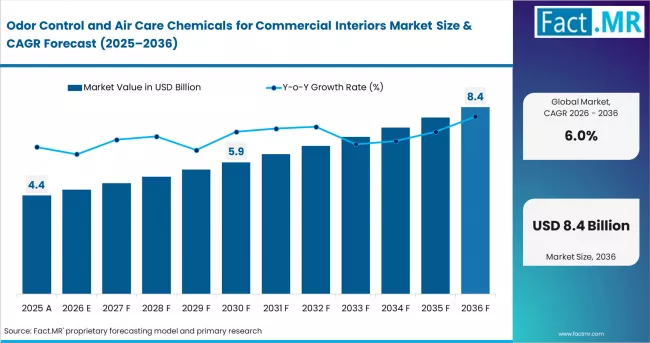
Odor Control And Air Care Chemicals For Commercial Interiors Market Market Value Analysis | Source: Fact.MR
| Metric | Value |
|---|---|
| Estimated Value in 2026 | USD 4.4 billion |
| Forecast Value in 2036 | USD 7.9 billion |
| Forecast CAGR (2026 to 2036) | 6.0% |
Source: Fact.MR analysis. Updated May 13, 2026
Summary of Odor Control and Air Care Chemicals for Commercial Interiors Market
- Market Definition
- The market includes chemical odor-control and air-care products used in occupied commercial interiors to manage malodors while supporting indoor environmental quality.
- Demand Drivers
- Indoor air quality frameworks increasingly favor source control and lower-emission maintenance products, which supports demand for more selective and less intrusive odor-control chemistry.
- Workplace odor complaints and fragrance sensitivity concerns support lower-burden air-care formats in offices, institutional buildings, and public interiors.
- Commercial suppliers continue to market odor control as a critical part of facility perception, especially in restrooms, corridors, hospitality interiors, and shared public spaces. [4]
- Key Segments Analyzed
- By Product Type: Liquid odor neutralizers are estimated to lead with approximately 33% share in 2026, supported by broad compatibility across restrooms, touchpoint areas, and spot-treatment applications.
- By Application: Metered dispensing programs are expected to hold approximately 31% share in 2026, driven by repeat refill demand and controlled output in public interiors.
- By End Use Setting: Commercial office buildings are projected to account for approximately 27% share in 2026, supported by high occupant density and recurring indoor-environment management.
- By Geography: India leads growth at 7.1% CAGR through 2036, supported by commercial-infrastructure expansion.
These share values are model-based estimates rather than figures directly published in the cited sources.
- Analyst Opinion at FACT.MR
- Shambhu Nath Jha, Senior Analyst at Fact.MR, opines, “CXOs should read this market as an indoor-environment and odor-management category rather than a fragrance niche. Buyers are not only paying for a pleasant scent. They are paying for chemistry that manages malodor without creating a bigger air-quality burden.”
This is a modeled analyst view, not a quoted external statement.
- Shambhu Nath Jha, Senior Analyst at Fact.MR, opines, “CXOs should read this market as an indoor-environment and odor-management category rather than a fragrance niche. Buyers are not only paying for a pleasant scent. They are paying for chemistry that manages malodor without creating a bigger air-quality burden.”
- Strategic Implications
- Invest in odor-control formats that neutralize or suppress malodor with lower residual scent burden.
- Build technical sales capability around IAQ, source control, and occupant tolerance rather than fragrance intensity.
- Position metered, bio-enzymatic, and targeted odor-elimination programs where facilities want predictable odor control without over-scenting occupied interiors.
These implications are inferred from the cited IAQ and supplier materials. [5]
The market is expected to generate an absolute opportunity of USD 3.5 billion between 2026 and 2036, supported by recurring facility maintenance demand and broader adoption across commercial environments. Growth is being driven by higher cleaning frequency in commercial interiors, increased sensitivity to indoor air quality, and rising expectations for odor control in restrooms, lobbies, corridors, and shared spaces. Guidance from ASHRAE emphasizes source reduction and the use of lower-emission maintenance products, reinforcing the shift toward more controlled air-care strategies. At the same time, supplier positioning continues to highlight odor control as a key factor in facility perception and user comfort. Market estimates are based on recurring service demand, institutional procurement patterns, and consumption across high-traffic commercial spaces rather than a single published market-size dataset. [1]
India is projected to lead with a CAGR of 7.1% through 2036, driven by commercial real estate expansion, outsourced facility management, and rising organized retail and office density. China follows at 6.7%, supported by large urban commercial interiors and stronger managed-cleaning adoption. The United States is expected to grow at 6.1%, underpinned by mature jan-san procurement and stronger IAQ awareness. Brazil records 5.8%, backed by commercial-facility formalization. Mexico grows at 5.5%, supported by hospitality and retail growth.
Segmental Analysis
Odor Control and Air Care Chemicals for Commercial Interiors Market Analysis by Product Type
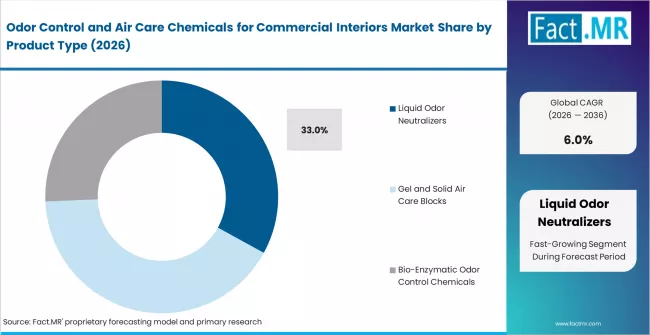
Odor Control And Air Care Chemicals For Commercial Interiors Market Analysis By Product Type | Source: Fact.MR
Based on Fact.MR’s analysis, liquid odor neutralizers are estimated to hold 33% share in 2026. They lead because they offer broad-use flexibility across restrooms, trash rooms, public corridors, soft-surface spot treatment, and general malodor response in occupied buildings. Metered aerosol refills remain highly relevant because automated dispensing provides predictable coverage in public facilities, while bio-enzymatic odor eliminators are commercially important where buyers want chemistry positioned around odor-source breakdown rather than fragrance masking.
- Liquid neutralizers lead because they fit both routine and spot-response odor control across many facility types.
- Metered air-care refills remain attractive where buildings want continuous output and predictable service cycles.
- Bio-enzymatic formats gain traction where facilities prefer odor elimination logic over stronger fragrance overlay.
Odor Control and Air Care Chemicals for Commercial Interiors Market Analysis by Application
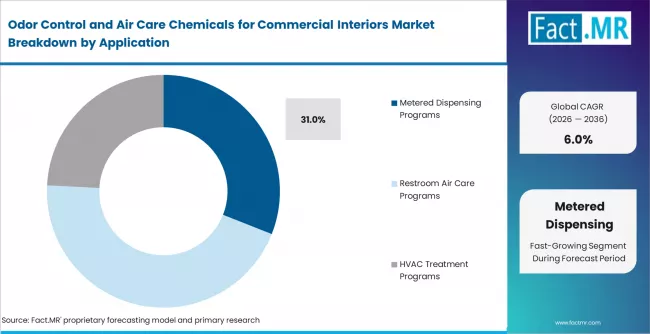
Odor Control And Air Care Chemicals For Commercial Interiors Market Analysis By Application | Source: Fact.MR
Metered dispensing programs are expected to hold approximately 31% share in 2026. This segment leads because public restrooms, common areas, and managed commercial interiors often rely on automatic dispensing to maintain consistent odor control with less labor intervention. Manual spray programs remain important for spot treatment and event-driven odor issues, while HVAC treatment programs are relevant in larger interiors where odor distribution is tied to ducted airflow. These application shares are model-based estimates inferred from supplier program logic and recurring refill demand.
- Metered systems lead because they create repeatable odor-control output in shared spaces.
- Manual sprays remain relevant where odor events are irregular and localized.
- HVAC treatment programs matter more in larger buildings where odor distribution and return-air issues are building-wide.
Odor Control and Air Care Chemicals for Commercial Interiors Market Analysis by End Use Setting
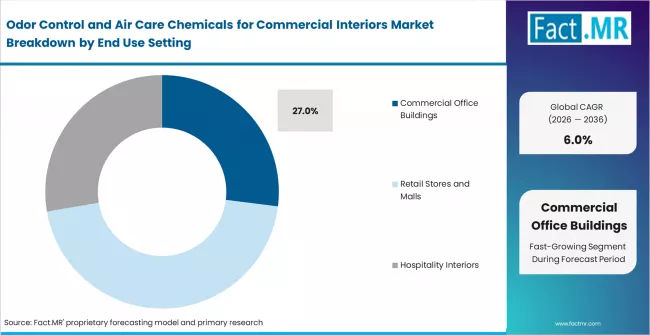
Odor Control And Air Care Chemicals For Commercial Interiors Market Analysis By End Use Setting | Source: Fact.MR
Commercial office buildings are projected to account for approximately 27% share in 2026, as they combine high occupant density, shared restrooms, recurring odor complaints, and stronger indoor-air expectations than many other interior categories. Retail stores and malls remain highly relevant where shopper experience matters, while hospitality interiors create strong demand where guest perception is directly linked to environment quality. These end-use shares are model-based estimates built from commercial interior management logic rather than from a published end-use table.
- Offices lead because shared occupancy and employee comfort keep odor complaints more visible.
- Retail settings matter where scent and odor perception affect customer experience.
- Hospitality interiors remain attractive where guest impression and restroom standards influence brand perception.
Drivers, Restraints, and Opportunities
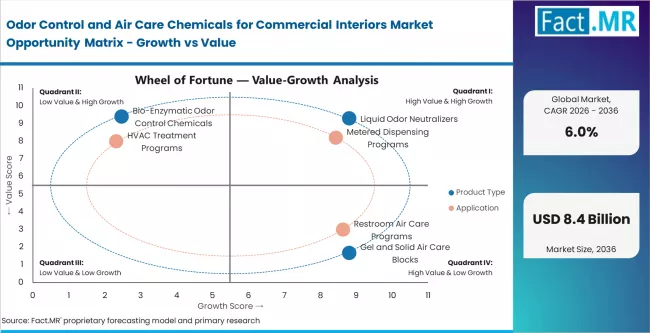
Odor Control And Air Care Chemicals For Commercial Interiors Market Opportunity Matrix Growth Vs Value | Source: Fact.MR
Fact.MR analysts observe that the market is being shaped by the need to manage odors in occupied interiors without worsening the indoor-air burden. Structural demand is anchored in the fact that malodors affect user perception, yet IAQ guidance increasingly favors source control and lower-emission maintenance products. That gives commercial odor-control chemistry a strong operating role, though the category is shifting away from simply masking odors with stronger fragrance.
The main restraint is fragrance sensitivity and perception conflict. NIOSH materials show that air fresheners and room deodorizers can irritate sensitive individuals, while workplace IEQ reports note fragrance-related employee complaints in some office environments [6]. Another challenge is user perception. Facilities often want a “clean-smelling” result, yet lower-odor products may be less immediately noticeable than heavily fragranced alternatives. This means suppliers need to prove odor-control performance without relying on scent intensity alone.
- Lower-scent odor neutralizers remain the clearest opportunity where IAQ and occupant tolerance matter most.
- Metered and route-sertviced programs create stronger value than ad hoc spray use where consistency and compliance matter.
- Bio-enzymatic and source-control chemistry offers higher-value opportunity where buyers want odor elimination rather than stronger masking fragrance.
Regional Analysis
The market is assessed across North America, Europe, Asia Pacific, Latin America, and Middle East and Africa, covering 40+ countries with demand profiles shaped by commercial-building density, restroom and shared-space service frequency, facility-management maturity, and IAQ sensitivity. The country growth rates below are model-based estimates.
.webp "Top Country Growth Comparison Odor Control And Air Care Chemicals For Commercial Interiors Market Cagr (2026 2036)")
Top Country Growth Comparison Odor Control And Air Care Chemicals For Commercial Interiors Market Cagr (2026 2036) | Source: Fact.MR
| Country | CAGR (2026 to 2036) |
|---|---|
| India | 7.1% |
| China | 6.7% |
| United States | 6.1% |
| Brazil | 5.8% |
| Mexico | 5.5% |
Source: Fact.MR analysis. Updated May 13, 2026
North America Odor Control and Air Care Chemicals for Commercial Interiors Market Analysis
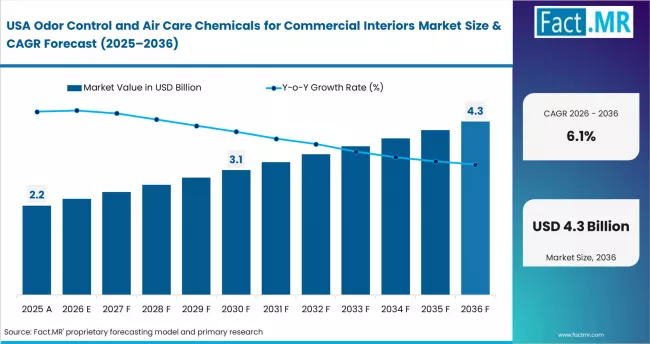
Odor Control And Air Care Chemicals For Commercial Interiors Market Country Value Analysis | Source: Fact.MR
North America remains an important commercial region because it combines mature jan-san channels, high commercial interior density, and stronger awareness of workplace air-quality burden. EPA and NIOSH materials give the region a clearer reference point for lower-emission and less intrusive product selection. Demand is strongest where facility managers already view odor control through both user-experience and IAQ lenses.
- United States: Mature facility-service procurement and stronger IAQ awareness support U.S. demand. The market in the United States is projected to expand at a CAGR of 6.1% through 2036.
- Mexico: Commercial-facility formalization and recurring restroom and shared-space odor-control demand create practical commercial fit. Sales in Mexico are likely to rise at 5.5% CAGR during the forecast period.
Asia Pacific and Latin America Odor Control and Air Care Chemicals for Commercial Interiors Market Analysis
Asia Pacific and Latin America offer the strongest long-term expansion potential because commercial real estate, organized retail, hospitality interiors, and outsourced facility management are rising across major urban centers. Demand is likely to strengthen where operators move from simple room fragrance toward managed odor-control programs that fit public and office environments. These regional growth views are model-based estimates built from commercial-infrastructure expansion and facility-care formalization.
- India: Commercial infrastructure expansion and the growing shift toward outsourced facility management continue to support demand across India. The market is projected to grow at a CAGR of 7.1% through 2036, driven by rising office spaces, retail complexes, and institutional facilities. Adoption is strengthening as businesses prioritize standardized cleaning practices, operational efficiency, and compliance in high-traffic environments.
- Brazil: Formalization of commercial facilities and increasing demand for institutional cleaning services support expansion in Brazil. Demand is expected to rise at a CAGR of 5.8% through 2036, with growth visible across corporate offices, retail environments, and public infrastructure. Operators are adopting more structured cleaning systems to improve service consistency and hygiene standards.
- China: Large urban commercial interiors and increasing adoption of managed-cleaning services continue to support growth across China. The market is projected to grow at a CAGR of 6.7% through 2036, driven by high-density commercial development and rising expectations around facility maintenance. Adoption is particularly strong in malls, office complexes, and transport hubs where efficiency and cleanliness are critical.
Competitive Aligners for Market Players
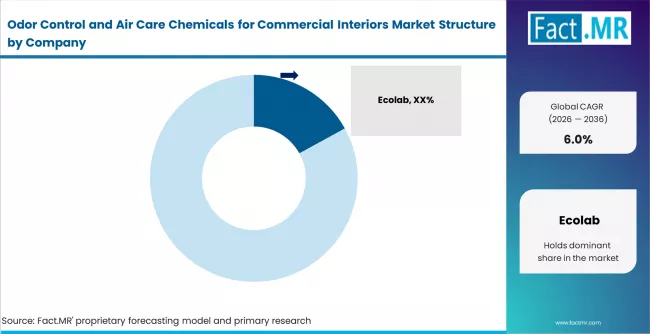
Odor Control And Air Care Chemicals For Commercial Interiors Market Analysis By Company | Source: Fact.MR
The market is moderately concentrated at the branded chemistry and managed-program level, while local distribution remains fragmented. Competitive strength comes from the ability to connect odor-control chemistry with measurable malodor reduction, managed dispensing, and lower occupant burden. Suppliers need more than a room-freshening claim. They need a clear explanation of how the product manages odor in restrooms, shared interiors, soft surfaces, HVAC systems, and public common spaces without creating a stronger air-quality complaint.
Competitive advantage is defined by odor-neutralization performance, dispenser compatibility, scent restraint, and fit with broader facility-care programs. Buyers in this category usually choose on program reliability and occupant acceptability as much as on fragrance profile. This competitive framing is an analytical view derived from current IAQ and supplier materials rather than a published market-share table.
Key Players
- Diversey / Solenis
- Hospeco Brands
- SC Johnson Professional
- Zep
- Spartan Chemical
- P&G Professional
- Reckitt Professional
- 3M
- AeroWest
Bibliography
- [1] ASHRAE. Indoor Air Quality position document emphasizing source control and limiting fragranced or scented products.
- [2] EPA. Volatile Organic Compounds’ impact on indoor air quality.
- [3] Hospeco Brands. Commercial odor control and air care product positioning for facilities.
- [4] Ecolab. Commercial odor control solutions for schools, hotels, and commercial facilities.
- [5] NIOSH. Office-building odor investigation recommending minimizing air fresheners and room deodorizers for sensitive individuals.
- [6] NIOSH workplace IEQ report noting fragrance-related symptoms in some office settings.
This Report Addresses
- Strategic intelligence on odor control and air care chemical demand across offices, retail interiors, hospitality interiors, healthcare sites, and institutional buildings.
- Market forecast from USD 4.4 billion in 2026 to USD 7.9 billion by 2036 at a CAGR of 6.0%.
- Growth opportunity mapping across liquid odor neutralizers, metered air-care chemicals, bio-enzymatic odor-control products, and HVAC deodorizing chemicals.
- Segment analysis by product type, application method, end use setting, and distribution channel.
- Regional outlook covering North America, Europe, Asia Pacific, Latin America, and Middle East and Africa.
- Competitive analysis of major suppliers serving institutional odor control, restroom air care, and commercial-interior air-care programs.
- Indoor-environment and occupant-comfort analysis covering malodor control, fragrance burden, dispenser control, and lower-emission product positioning.
- Market interpretation built around source control, shared-space odor management, and recurring commercial-facility service demand.
Odor Control and Air Care Chemicals for Commercial Interiors Market Definition
The market covers chemical products used to neutralize, suppress, absorb, or manage odors in occupied commercial interiors. It includes restroom air care chemicals, room refreshers, bio-enzymatic odor eliminators, metered air-care refills, HVAC deodorizing chemicals, and related commercial odor-control formats used in offices, retail sites, hospitality interiors, healthcare buildings, and institutional spaces.
Odor Control and Air Care Chemicals for Commercial Interiors Market Inclusions
Covers global and regional forecasts from 2026 to 2036. Includes liquid odor neutralizers, metered aerosols, bio-enzymatic odor eliminators, gel and solid passive air care, restroom deodorizing chemicals, and HVAC deodorizing chemicals sold for commercial interior use. Covers products positioned around malodor control, reduced scent burden, managed dispensing, and compatibility with occupied spaces. [3]
Odor Control and Air Care Chemicals for Commercial Interiors Market Exclusions
Excludes household air fresheners sold mainly through consumer retail, candles and decorative home-fragrance products, consumer laundry scent boosters, and cleaning agents where air care is not the main product function. It also excludes mechanical air purification equipment unless chemical air care remains the core commercial offering. This exclusion logic is an analytical market boundary rather than a quoted source definition.
Odor Control and Air Care Chemicals for Commercial Interiors Market Research Methodology
- Primary Research:Interviews with facility-service contractors, jan-san distributors, building operations teams, commercial cleaning supervisors, and institutional procurement managers.
- Desk Research:Uses ASHRAE indoor air quality materials, EPA VOC and greener-product guidance, NIOSH indoor environmental quality materials, and current supplier positioning for commercial odor control and air care. [2]
- Market-Sizing and Forecasting:Hybrid model using commercial-building density, restroom and shared-space service frequency, recurring refill demand, fragrance-reduction preference, and managed-dispensing adoption.
- Data Validation and Update Cycle:Validated using indoor-air guidance, workplace fragrance and odor-control materials, and supplier evidence on commercial odor-control program design.
Segmentation
Scope of Report
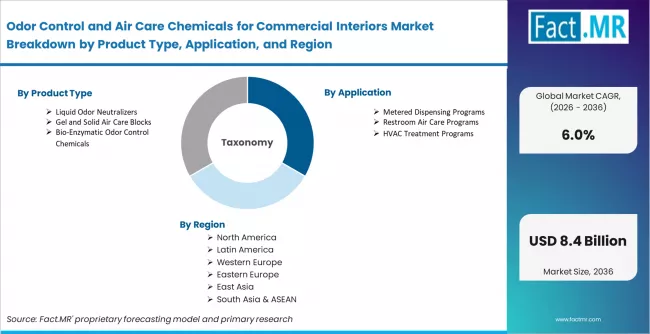
Odor Control And Air Care Chemicals For Commercial Interiors Market Breakdown By Product Type, Application, And Region | Source: Fact.MR
| Attribute | Details |
|---|---|
| Quantitative Units | USD 4.4 billion (2026) to USD 7.9 billion (2036), at a CAGR of 6.0% |
| Market Definition | Chemical odor-control and air-care products used in occupied commercial interiors to neutralize, suppress, absorb, or manage malodors |
| Product Type Segmentation | Liquid Odor Neutralizers, Aerosol and Metered Air Care Chemicals, Gel and Solid Air Care Blocks, Bio-Enzymatic Odor Control Chemicals, HVAC and Duct Deodorizing Chemicals, Others |
| Application Segmentation | Manual Spray Programs, Metered Dispensing Programs, Restroom Air Care Programs, HVAC Treatment Programs, Others |
| End Use Segmentation | Commercial Office Buildings, Retail Stores and Malls, Hospitality Interiors, Healthcare and Clinic Interiors, Institutional and Education Buildings, Others |
| Regions Covered | North America, Europe, Asia Pacific, Latin America, Middle East and Africa |
| Countries Covered | United States, Canada, Mexico, China, India, Brazil, Germany, France, and 40+ countries |
| Forecast Period | 2026 to 2036 |
| Approach | Hybrid top-down and bottom-up model using commercial-building density, restroom and shared-space service frequency, fragrance-reduction preference, and primary interviews with operators, distributors, and facility-care advisors |
Source: Fact.MR analysis. Updated May 13, 2026
Odor Control and Air Care Chemicals for Commercial Interiors Market by Segments
-
By Product Type:
- Liquid Odor Neutralizers
- Aerosol and Metered Air Care Chemicals
- Gel and Solid Air Care Blocks
- Bio-Enzymatic Odor Control Chemicals
- HVAC and Duct Deodorizing Chemicals
- Others
-
By Application:
- Manual Spray Programs
- Metered Dispensing Programs
- Restroom Air Care Programs
- HVAC Treatment Programs
- Others
-
By End Use Setting:
- Commercial Office Buildings
- Retail Stores and Malls
- Hospitality Interiors
- Healthcare and Clinic Interiors
- Institutional and Education Buildings
- Others
-
By Region:
- North America
- United States
- Canada
- Mexico
- Latin America
- Brazil
- Argentina
- Chile
- Rest of Latin America
- Western Europe
- Germany
- France
- United Kingdom
- Italy
- Spain
- Nordic Countries
- BENELUX
- Rest of Western Europe
- Eastern Europe
- Russia
- Poland
- Hungary
- Balkan and Baltic
- Rest of Eastern Europe
- East Asia
- China
- Japan
- South Korea
- South Asia and Pacific
- India
- ASEAN
- Australia and New Zealand
- Rest of South Asia and Pacific
- Middle East and Africa
- Kingdom of Saudi Arabia
- Other GCC Countries
- Turkey
- South Africa
- Rest of Middle East and Africa
- North America
Frequently Asked Questions
How large is the global odor control and air care chemicals for commercial interiors market in 2025?
What will the market size be in 2026?
What is the projected market size by 2036?
What is the expected CAGR from 2026 to 2036?
Which product type is poised to lead the market?
Which application segment holds the largest share?
Which end-use setting is expected to remain strongest?
Which country shows the fastest growth?
What is driving demand for odor control and air care chemicals in commercial interiors?
What is the key challenge in this market?
Who worked on this report


Preview the report firsthand - request a free sample
Free SampleGet the brochure for pricing and purchase details
Download PDF