- Base Value(2025): 4.4 Bn
- Estimated Value(2026): 4.6 Bn
- Forecast Value (2036): 7.0 Bn
- CAGR (2026 - 2036): 4.3%
Air Compressor Lubricants Market Forecast 2026 to 2036
In 2025, the air compressor lubricants market was valued at USD 4.4 billion. Based on Fact MR's analysis, demand for air compressor lubricants is estimated to grow to USD 4.6 billion in 2026 and USD 7.0 billion by 2036. FMR projects a CAGR of 4.3% during the forecast period.
The absolute dollar growth from 2026 to 2036 is USD 2.4 billion. This growth is driven by increasing demand for air compressors in industrial applications, automotive sectors, and manufacturing industries, where high-quality lubricants play a crucial role in enhancing performance and longevity. However, the market faces challenges such as fluctuating raw material prices and increasing regulatory pressures regarding environmental impact.
India leads with a CAGR of 5.9%, supported by rapid industrialization and increasing demand for air compressor solutions. Indonesia follows with a 5.6% CAGR, fueled by growing industrial and manufacturing sectors. Vietnam grows at 5.4%, driven by the rise in infrastructure development and industrial activities. Mexico grows at 5.1%, supported by increasing industrial production and automation. Turkey and Brazil grow at 4.8% and 4.6%, respectively, due to expanding manufacturing industries and infrastructure projects. The USA shows a slower growth rate of 2.7%, driven by a mature market and established demand. Germany grows at 2.3%, reflecting a stable, mature market with consistent demand for lubricants in industrial machinery.
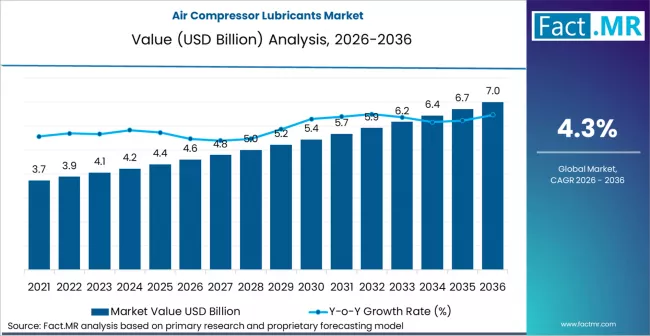
Air Compressor Lubricants Market Market Value Analysis | Source: Fact.MR
Air Compressor Lubricants Market Definition
The air compressor lubricants market refers to the production and sale of specialized lubricants formulated for air compressors to reduce friction, dissipate heat, and prevent wear in moving parts. These lubricants include oils, greases, and synthetic formulations designed to support reliable operation and extend service life of rotary, reciprocating, and centrifugal compressors. Their primary function is to protect internal components, maintain efficiency, and enable continuous operation under variable loads and temperatures. Key end uses include manufacturing facilities, construction, oil and gas, mining, HVAC systems, and industrial plants where compressed air is essential.
Market Inclusions
This report covers global and regional market sizes for air compressor lubricants with a defined forecast period. It includes segment breakdowns by lubricant type (mineral oil, synthetic, semi‑synthetic), compressor type (reciprocating, rotary screw, centrifugal), and end use industry (manufacturing, oil and gas, construction, HVAC, mining). Pricing trends, base oil supply analysis, and trade flow data are included to reflect comprehensive market dynamics.
Market Exclusions
The scope excludes general industrial lubricants not formulated for air compressors, such as engine oils, turbine oils, and hydraulic fluids. Finished air compressors and complete compressor systems are not covered. Niche lubricant products used exclusively in non‑compressor applications, such as specialty greases for bearings outside compressed air systems, are omitted.
Research Methodology
- Primary Research: Interviews were conducted with lubricant formulators, compressor OEM engineers, and procurement specialists.
- Desk Research: Data was sourced from industry reports, manufacturing statistics, and trade association publications.
- Market‑Sizing and Forecasting: A hybrid model was used, combining top‑down industrial demand estimates with bottom‑up shipment and revenue data.
- Data Validation and Update Cycle: Findings were validated through expert review and aligned with recent production and trade figures, with periodic updates.
Air Compressor Lubricants Market Summary
-
Air Compressor Lubricants Market Definition
- The Air Compressor Lubricants Market encompasses lubricants specifically formulated to reduce friction, dissipate heat, and prevent wear in moving parts of air compressors. These lubricants, including oils, greases, and synthetic formulations, are designed to support reliable operation and extend the service life of rotary, reciprocating, and centrifugal compressors. Their primary function is to protect internal components, maintain efficiency, and enable continuous operation under variable loads and temperatures. The key industries utilizing air compressors include manufacturing, energy, oil and gas, mining, HVAC, and industrial plants where compressed air is essential.
-
Demand Drivers in the Market
- Growing Industrial Applications: The increasing demand for air compressors in various industrial sectors such as manufacturing, automotive, and construction is driving the demand for high-quality lubricants. These lubricants ensure that compressors run efficiently and reliably, enhancing performance and reducing downtime.
- Focus on Energy Efficiency and Sustainability: With industries increasingly focused on reducing operational costs and improving energy efficiency, air compressor lubricants, especially synthetic formulations, offer enhanced performance and longer service life, contributing to reduced energy consumption and operational costs.
- Expansion of the Oil & Gas Sector: The oil and gas industry continues to be a major end-user of air compressors, which require high-performance lubricants to ensure their optimal operation in demanding environments.
- Rising Demand for Food-Grade Lubricants: The food and beverage industry, requiring NSF H1 food-grade lubricants, is experiencing steady growth, contributing to the increasing demand for specialized lubricants in air compressors used in production lines and packaging operations.
-
Key Segments Analyzed in the FMR Report
- Compressor Type: Rotary screw compressors are expected to dominate the market due to their efficiency, reliability, and low maintenance requirements in industrial applications, including manufacturing and HVAC systems.
- Lubricant Type: Synthetic lubricants (PAO/Ester) are expected to capture the largest market share, driven by their superior performance in extreme conditions, providing better temperature stability, longer service life, and improved efficiency.
- End Use: The manufacturing sector is projected to lead the market, followed by energy and utilities, which require robust and reliable lubrication solutions for air compressors to maintain continuous operations.
-
Analyst Opinion at FMR
- Fact MR analyst Shambhu Nath Jha predicts that "The air compressor lubricants market will experience steady growth, driven by the increasing demand for high-quality lubricants in various industrial applications, including manufacturing, energy, and food and beverage sectors."
-
Strategic Implications/Executive Takeaways
- Invest in Synthetic Lubricants: As industries continue to prioritize energy efficiency and performance, manufacturers should focus on developing advanced synthetic lubricants that offer superior protection and reduce operational costs in air compressor systems.
- Expand Food-Grade Lubricant Offerings: With the rising demand for food-grade lubricants in the food and beverage sector, companies should diversify their product portfolios to include NSF H1 lubricants to cater to this growing market segment.
- Capitalize on Emerging Markets: With rapid industrialization in countries like India, Indonesia, and Vietnam, companies should consider expanding their presence in these emerging markets to tap into the growing demand for air compressors and their lubricants.
- Focus on Compliance with Environmental Regulations: As regulatory pressures regarding environmental impact increase, companies should invest in developing eco-friendly lubricants that meet stringent emission and safety standards.
-
Methodology
- Primary Research: Interviews with lubricant formulators, compressor OEM engineers, and procurement specialists were conducted to gather insights into market trends, demand drivers, and challenges.
- Desk Research: Data was sourced from industry reports, manufacturing statistics, and trade publications.
- Market Sizing and Forecasting: A hybrid model combining top-down industrial demand estimates with bottom-up shipment and revenue data was used for accurate market sizing and forecasting, which was validated through expert reviews and insights.
Segmental Analysis
Air Compressor Lubricants Market Analysis by Compressor Type
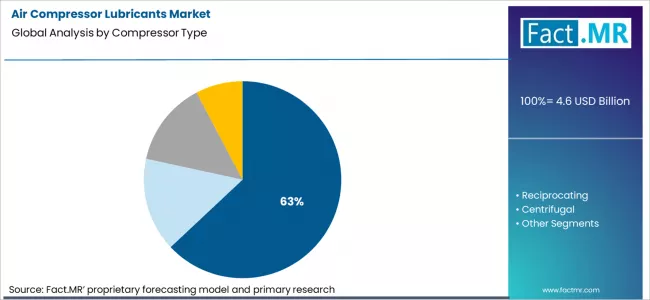
Air Compressor Lubricants Market Analysis By Compressor Type | Source: Fact.MR
- Market Overview: Rotary screw compressors are expected to capture 63% of the market share by 2026. Rotary screw compressors are widely used in industrial applications due to their efficiency, reliability, and ability to provide continuous airflow with minimal maintenance. The growing demand for air compressors in manufacturing, construction, and other industries drives the need for specialized lubricants to optimize compressor performance.
- Demand Drivers:
- Efficiency and Continuous Operation: Rotary screw compressors are preferred for applications requiring continuous and steady airflow, such as in manufacturing plants, workshops, and HVAC systems. The demand for lubricants that enhance the efficiency and operational lifespan of these compressors continues to rise.
- Low Maintenance Requirements: Rotary screw compressors require minimal maintenance compared to other compressor types, making them a popular choice for industries looking to reduce downtime and maintenance costs. Specialized lubricants are essential for maintaining their performance and longevity.
- Growing Industrial Applications: As industries expand and the demand for compressed air increases, the need for rotary screw compressors-and the lubricants that ensure their optimal operation-continues to grow.
Air Compressor Lubricants Market Analysis by Lubricant Type
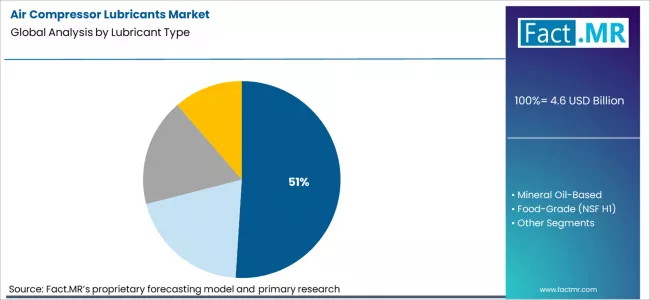
Air Compressor Lubricants Market Analysis By Lubricant Type | Source: Fact.MR
- Market Overview: Synthetic lubricants (PAO/Ester) are projected to hold 51% of the market share by 2026. These lubricants, made from synthetic oils like polyalphaolefins (PAO) and esters, are highly valued for their superior performance in extreme conditions. They offer better temperature stability, longer service life, and improved efficiency compared to mineral oils.
- Demand Drivers:
- Enhanced Performance in Extreme Conditions: Synthetic lubricants provide superior protection and performance in high-temperature environments, which is critical for the efficient operation of air compressors. They help reduce wear and prevent breakdowns, making them ideal for demanding industrial applications.
- Longer Oil Life and Lower Maintenance Costs: Synthetic oils, with their higher stability and resistance to degradation, offer longer service intervals, reducing the need for frequent oil changes and decreasing maintenance costs.
- Increasing Focus on Operational Efficiency: As industries prioritize energy efficiency and sustainability, synthetic lubricants are preferred due to their ability to enhance compressor performance and reduce energy consumption over time.
Air Compressor Lubricants Market Drivers, Restraints, and Opportunities
FMR analysts observe that the air compressor lubricants market is a mature, performance‑anchored segment driven by long‑standing industrial and commercial demand for reliable lubrication in stationary and mobile compressors. Historically, general‑purpose oils served many applications, but variations in compressor types (reciprocating, rotary screw, centrifugal) and duty cycles created structural demand for formulated lubricants that manage wear, oxidation, and foaming. The 2026 valuation reflects this reality, with baseline demand anchored to global manufacturing output, construction activity, and maintenance cycles where lubricant quality directly affects equipment reliability.
While demand for basic mineral oils remains significant in cost‑sensitive segments, advanced formulated compressor lubricants (synthetic blends, high‑viscosity index fluids) are gaining share because they enhance performance under higher loads and temperatures. These higher‑value liquids command elevated per‑unit pricing, contributing to net market value growth even as total unit volumes align with broader industrial activity. The market exists at its current size because effective lubrication remains essential to compressor efficiency, uptime, and lifecycle cost, and regulatory performance standards increasingly influence formulation selection.
- Performance & Reliability Needs: Users of industrial air compressors are specifying formulated lubricants that reduce wear and extend service intervals, replacing basic oils that underperform in heavy‑duty cycles.
- Regulatory & Emissions Standards: Standards such as ISO 21469 for lubrication safety and compatibility push adoption of certified compressor lubricants that meet defined quality and health criteria.
- Regional Industrial Dynamics: In Asia‑Pacific and North America, strong manufacturing and construction sectors drive higher uptake of advanced compressor lubricants, while cost‑led segments persist where industrial budgets are constrained.
Regional Analysis
Here is the content for the Air Compressor Lubricants Market, with the CAGR table for each country and region:
The market analysis covers key global regions, including South Asia and Pacific, Latin America, North America, and Western Europe. It is segmented geographically, with specific market dynamics for each region. The full report provides a detailed market attractiveness analysis.
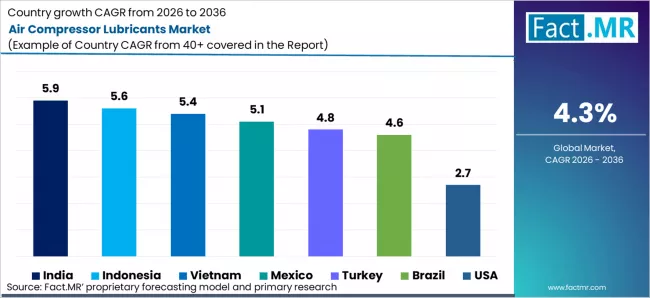
Air Compressor Lubricants Market Cagr Analysis By Country | Source: Fact.MR
| Country | CAGR (%) |
|---|---|
| India | 5.9% |
| Indonesia | 5.6% |
| Vietnam | 5.4% |
| Mexico | 5.1% |
| Turkey | 4.8% |
| Brazil | 4.6% |
| USA | 2.7% |
| Germany | 2.3% |
Source: Fact.MR analysis. Updated Feb 20, 2026
Source: Fact MR (FMR) analysis, based on proprietary forecasting model and primary research.
South Asia and Pacific:
South Asia and Pacific represent "growing markets" for air compressor lubricants, driven by increasing industrialization, growing infrastructure projects, and rising demand for energy-efficient systems in countries like India, Indonesia, and Vietnam.
- India: Demand for air compressor lubricants in India is projected to rise at 5.9% CAGR through 2036. India’s expanding manufacturing sector and increased industrial activity continue to drive the demand for air compressors and their lubricants.
- Indonesia: Demand for air compressor lubricants in Indonesia is projected to rise at 5.6% CAGR through 2036. The growing industrial base and increase in manufacturing activities drive demand for air compressor lubricants.
- Vietnam: Demand for air compressor lubricants in Vietnam is projected to rise at 5.4% CAGR through 2036. Vietnam’s industrial growth and rising demand for energy-efficient compressor solutions continue to boost the market for lubricants.
Latin America:
In Latin America, Mexico and Brazil are experiencing steady growth in demand for air compressor lubricants, driven by growing industrialization, infrastructure projects, and investments in energy-efficient systems.
- Mexico: Demand for air compressor lubricants in Mexico is projected to rise at 5.1% CAGR through 2036. Mexico’s expanding manufacturing sector and rising energy needs continue to drive market growth for lubricants in compressors.
- Brazil: Demand for air compressor lubricants in Brazil is projected to rise at 4.6% CAGR through 2036. Brazil’s industrial expansion and focus on energy efficiency in industrial applications support steady growth in the lubricant market.
Middle East:
In Turkey, the market for air compressor lubricants is driven by the expansion of industrial applications and infrastructure development projects.
- Turkey: Demand for air compressor lubricants in Turkey is projected to rise at 4.8% CAGR through 2036. Turkey’s industrial and construction growth, along with increasing demand for efficient air compressor systems, supports growth in the lubricant market.
North America:
The USA continues to be a major market for air compressor lubricants, supported by the industrial sector's need for high-performance and energy-efficient lubricants.
- USA: Demand for air compressor lubricants in the U.S. is projected to rise at 2.7% CAGR through 2036. The demand for high-efficiency systems in manufacturing and industrial sectors continues to drive steady growth in air compressor lubricants.
Western Europe:
In Germany, the air compressor lubricants market is mature, driven by industrial demand and the push for energy efficiency in manufacturing processes.
- Germany: Demand for air compressor lubricants in Germany is projected to rise at 2.3% CAGR through 2036. Germany’s industrial sector and increasing demand for energy-efficient equipment continue to support the market for lubricants in compressors.
Fact MR's analysis of the Air Compressor Lubricants Market in South Asia and Pacific, Latin America, North America, and Western Europe consists of country-wise assessments that include India, Indonesia, Vietnam, Mexico, Turkey, Brazil, the USA, and Germany. Readers can find detailed trends, regulatory updates, and company-specific investments shaping the market’s growth in these countries.
How Are Key Players Competing in the Air Compressor Lubricants Market?
Air Compressor Lubricants Market Analysis By Company | Source: Fact.MR
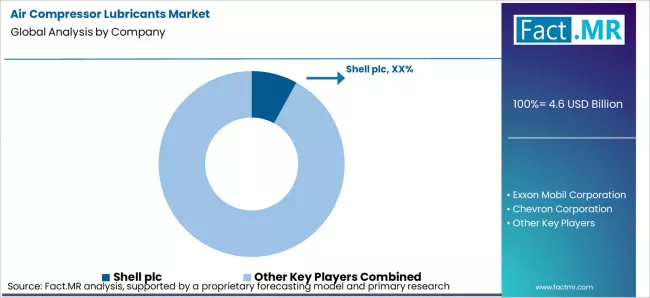
The air compressor lubricants market is marked by competition centered on performance, cost-effectiveness, and sustainability. Shell plc, Exxon Mobil Corporation, and Chevron Corporation lead by offering a diverse range of lubricants that meet the demanding specifications of air compressors across various industries. TotalEnergies SE and BP p.l.c. (Castrol Limited) focus on developing high-quality lubricants that improve energy efficiency and equipment lifespan. FUCHS SE and Petro-Canada Lubricants Inc. emphasize advanced formulations that enhance performance under extreme conditions, addressing the growing demand for reliable and eco-friendly solutions. Idemitsu Kosan Co., Ltd. and PJSC LUKOIL (LLK-International) continue to expand their market presence by innovating lubricants tailored for both industrial and portable air compressor systems, offering added value in terms of extended service intervals and reducing wear and tear. These companies differentiate themselves through cutting-edge research, improved formulations, and effective marketing strategies, aimed at providing high-performance air compressor lubricants that address both technical and environmental challenges.
Recent Industry Developments
- ExxonMobil | Technology Launch | February 2024 ExxonMobil introduced its next-generation synthetic compressor oil specifically engineered for industrial air compressors. The formulation is designed to improve overall energy efficiency and reduce maintenance costs by extending oil drain intervals in high-demand rotary screw and reciprocating systems.
- Honeywell | Strategic Acquisition | March 2025 Honeywell completed a $2.16 billion acquisition of Sundyne, a leading manufacturer of high-speed centrifugal compressors and pumps. This acquisition integrates Sundyne’s hardware with Honeywell’s IoT platforms, facilitating a shift toward predictive maintenance and digital lubrication monitoring in the 2026 compressor market.
- TotalEnergies | Product Launch and Sustainability Milestone | August 2025 TotalEnergies expanded its biodegradable compressor oil portfolio to support sustainable manufacturing practices. The new formulations are designed to comply with European environmental standards while providing high-performance lubrication for medical and food-processing metalworking applications.
Key Players of the Air Compressor Lubricants Market
- Shell plc
- Exxon Mobil Corporation
- Chevron Corporation
- TotalEnergies SE
- BP p.l.c. (Castrol Limited)
- FUCHS SE
- Petro-Canada Lubricants Inc.
- Idemitsu Kosan Co.,Ltd.
- PJSC LUKOIL (LLK-International)
Report Scope
| Metric | Value |
|---|---|
| Quantitative Units | USD 4.6 billion (2026) to USD 7.0 billion (2036), at a CAGR of 4.3% |
| Market Definition | The Air Compressor Lubricants Market includes lubricants designed for use in air compressors, ensuring optimal performance and longevity of compressors in various industries, including manufacturing, energy, and food & beverage. |
| By Lubricant Type | Synthetic (PAO/Ester), Mineral Oil-Based, Food-Grade (NSF H1), Other |
| By Compressor Type | Rotary Screw, Reciprocating, Centrifugal, Other |
| By End Use | Manufacturing, Energy & Utilities, Food & Beverage, Others |
| By Sales Channel | Direct (Oil Majors), OEM-Branded Lubricants, Distributors, Other |
| Regions Covered | North America, Latin America, Europe, East Asia, South Asia, Oceania, Middle East and Africa |
| Countries Covered | United States, Canada, Mexico, Brazil, Argentina, Germany, France, United Kingdom, Italy, Spain, China, India, Japan, South Korea, Indonesia, Australia, and 40+ countries |
| Key Companies Profiled | Shell plc, Exxon Mobil Corporation, Chevron Corporation, TotalEnergies SE, BP p.l.c. (Castrol Limited), FUCHS SE, Petro-Canada Lubricants Inc., Idemitsu Kosan Co.,Ltd., PJSC LUKOIL (LLK-International) |
| Forecast Period | 2026 to 2036 |
| Approach | Hybrid top-down and bottom-up market modeling validated through primary interviews with manufacturers and supported by trade data benchmarking and market research. |
Source: Fact.MR analysis. Updated Feb 20, 2026
Bibliographies
- Exxon Mobil Corporation. (2024, February). ExxonMobil introduces next-generation synthetic compressor oil for industrial applications [Press release]. Exxon Mobil Corporation.
- Honeywell International Inc.. (2025, March). Honeywell completes acquisition of Sundyne for $2.16 billion [Press release]. Honeywell International Inc.
- TotalEnergies SE. (2025, August). TotalEnergies expands biodegradable lubricant portfolio for industrial compressor applications [Press release]. TotalEnergies SE.
- Shell plc. (2025). Industrial lubricants for air compressor applications. Shell plc.
- Exxon Mobil Corporation. (2025). Industrial air compressor lubrication solutions. Exxon Mobil Corporation.
- Chevron Corporation. (2025). Compressor oil technologies for industrial efficiency. Chevron Corporation.
Segmentation
Air Compressor Lubricants Market Key Segments
-
By Lubricant Type :
- Synthetic (PAO/Ester)
- Mineral Oil-Based
- Food-Grade (NSF H1)
- Other
-
By Compressor Type :
- Rotary Screw
- Reciprocating
- Centrifugal
- Other
-
By End Use :
- Manufacturing
- Energy & Utilities
- Food & Beverage
- Others
-
By Sales Channel :
- Direct (Oil Majors)
- OEM-Branded Lubricants
- Distributors
- Other
-
Region :
- North America
- USA
- Canada
- Mexico
- Europe
- Germany
- UK
- France
- Italy
- Spain
- Nordic Countries
- BENELUX
- Rest of Europe
- Asia Pacific
- China
- Japan
- South Korea
- India
- Australia
- Rest of Asia Pacific
- Latin America
- Brazil
- Argentina
- Rest of Latin America
- Middle East and Africa
- Kingdom of Saudi Arabia
- United Arab Emirates
- South Africa
- Rest of Middle East and Africa
- Other Regions
- Oceania
- Central Asia
- Other Markets
- North America
Frequently Asked Questions
How large is the demand for Air Compressor Lubricants in the global market in 2026?
What will be the market size of Air Compressor Lubricants in the global market by 2036?
What is the expected demand growth for Air Compressor Lubricants in the global market between 2026 and 2036?
Which compressor type is expected to dominate the market?
Which region is expected to show the highest growth rate for Air Compressor Lubricants?
How significant is the growth outlook for Indonesia in this market?
What is the growth outlook for the United States in this report?
What is the growth forecast for Germany in the Air Compressor Lubricants market?
Which company is identified as a leading player in the Air Compressor Lubricants market?
What are Air Compressor Lubricants used for?
What does the Air Compressor Lubricants market include in this report?
How is the market forecast developed in this report?
What is meant by the Air Compressor Lubricants market in this report?
Who worked on this report


Preview the report firsthand - request a free sample
Free SampleGet the brochure for pricing and purchase details
Download PDF