Anti-Static Carbon Core Filament Yarns Market (2026 - 2036)

Anti-Static Carbon Core Filament Yarns Market Size and Share Forecast Outlook 2026 to 2036

Core Findings

    Anti-Static Carbon Core Filament Yarns Market Forecast and Outlook 2026 to 2036

    The anti-static carbon core filament yarns market is projected to grow at a 7.5% CAGR from 2026 to 2036, increasing from USD 0.6 billion to USD 1.3 billion.

    Summary of Anti-Static Carbon Core Filament Yarns Market - Key Takeaways

    • The market includes carbon/graphite core systems, stainless steel core alternatives, and other conductive core technologies designed for anti-static textile applications.
    • The defined scope covers revenue generated by core material type, sheath polymer composition, application category, and end market segmentation across global manufacturing regions.
    • The anti-static carbon core filament yarns market is projected to grow at a CAGR of 7.5% from 2026 to 2036, expanding from USD 0.6 billion to USD 1.3 billion based on Fact.MR forecasting.
    • Carbon/Graphite Core systems lead the material segment with a 48% share in 2026, supported by superior conductivity characteristics and compatibility with advanced cleanroom contamination control requirements.
    • ESD Garments & Cleanroom Textiles account for 40% of total demand, reflecting critical role in semiconductor fabrication and pharmaceutical manufacturing where electrostatic discharge protection maintains production integrity.
    • China records the fastest growth at 8.7% CAGR, supported by 15th Five-Year Plan mandates driving domestic substitution of high-performance fibers in localized electronics manufacturing hubs.
    • Competition is led by major players such as Coats Group, Madeira Garnfabrik, Yantai Tayho, Toray Industries, Teijin Frontier, Monofil Technik, FilSpec, Sinterama, Unitika, and Huvis.
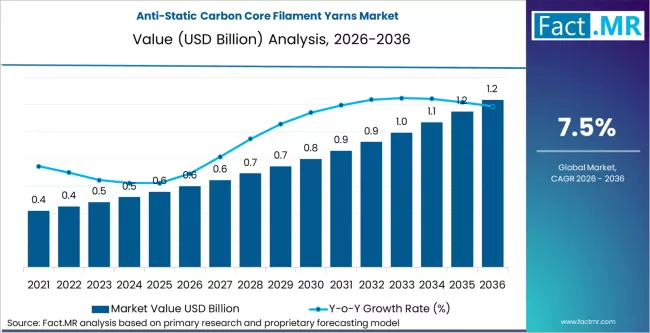
    Anti Static Carbon Core Filament Yarns Market Market Value Analysis

    Growth is closely tied to the rapid expansion of semiconductor fabrication and advanced electronics manufacturing, where even minimal electrostatic discharge can damage sensitive components. These specialized yarns are widely used in cleanroom garments that protect high-value production processes from contamination and voltage disruption. Pharmaceutical facilities also depend on carbon-core textiles to safely dissipate static in sterile environments handling fine powders and volatile substances.

    As Akihiko Ohtani, President of Teijin Carbon America, explains, “The semiconductor industry's relentless pursuit of smaller process nodes creates increasingly stringent cleanroom requirements where traditional anti-static solutions prove inadequate.” This highlights the need for more advanced conductive textile systems.

    Beyond garments, these yarns are increasingly used in conveyor belts, filtration media, carpets, and upholstery in electronics facilities. With stricter ESD standards and continued semiconductor investment, demand for reliable, high-performance conductive yarns is expected to remain strong.

    Anti-Static Carbon Core Filament Yarns Market

    Metric Value
    Estimated Value in (2026) USD 0.6 billion
    Forecast Value in (2036) USD 1.3 billion
    Forecast CAGR (2026 to 2036) 7.5%

    Category 

    Category Segments
    Core Material Carbon/Graphite Core, Stainless Steel Core, Other Conductive Cores
    Sheath Polymer Polyester, Polyamide, Other Polymers
    Application ESD Garments & Cleanroom Textiles, Industrial/Conveyor & Filtration, Carpets/Upholstery & Others
    End Market Electronics & Semiconductor, Pharma & Healthcare, Industrial & Other
    Region North America; Europe; Asia Pacific; Latin America; Middle East & Africa

    Segmental Analysis

    What positions Carbon/Graphite Core to lead market?
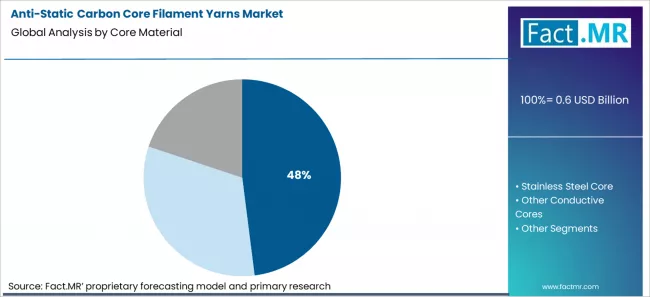
    Anti Static Carbon Core Filament Yarns Market Analysis By Core Material

    Carbon and graphite core systems hold a dominant 48% market share because they deliver highly reliable electrical conductivity while minimizing particle shedding, a critical requirement in advanced cleanroom environments. These materials maintain stable resistance levels even under changing temperature and humidity conditions, ensuring consistent ESD protection through repeated industrial laundering cycles. Graphite-based cores provide a lightweight alternative to metallic conductors, offering comparable static dissipation without the risk of metal contamination in sensitive pharmaceutical or semiconductor facilities. Technologies such as Teijin Tenax have improved manufacturing efficiency while lowering carbon emissions and achieving precise resistance specifications. Production accuracy down to micrometer-level core diameters ensures uniform conductivity throughout textile construction. In addition, carbon-core systems resist chemical degradation from harsh cleaning agents and sterilization processes, extending service life beyond traditional stainless-steel or coated alternatives.

    What establishes ESD Garments & Cleanroom Textiles leadership at 40% market share?
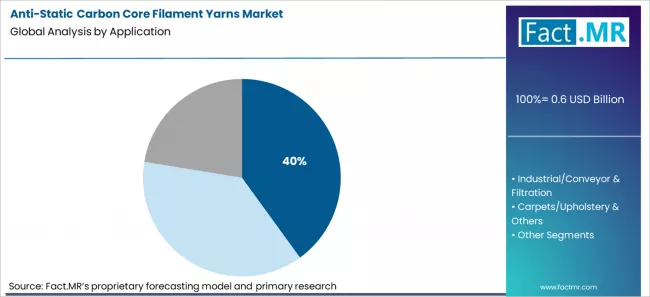
    Anti Static Carbon Core Filament Yarns Market Analysis By Application

    ESD garments and cleanroom textiles represent 40% of total demand, driven by expanding semiconductor fabrication and sterile pharmaceutical manufacturing. Cleanroom apparel must provide built-in conductive pathways that safely dissipate static charges capable of damaging microelectronics during handling. As semiconductor process nodes shrink below seven nanometers, contamination control standards become even stricter, making traditional anti-static finishes insufficient. Advanced systems such as KB Seiren Belltron integrate controlled static dissipation technologies that reduce dust attraction without creating airborne particles. Durable, wash-fast properties allow garments to maintain conductivity through more than 50 industrial laundering cycles, lowering replacement costs. Hybrid yarn systems developed by companies like Noble Biomaterials combine carbon-core conductivity with additional energy management benefits, addressing both electrostatic discharge and electromagnetic interference concerns.

    Market Drivers

    • Drivers :Semiconductor fabrication expansion remains the primary demand driver worldwide. In the United States, CHIPS Act funding exceeding 50 billion dollars is supporting new facilities that require advanced ESD-protected cleanroom infrastructure. Major investments by Samsung and SK Hynix in South Korea introduce super-clean specifications demanding zero-sparking textile systems. China’s industrial planning initiatives promote domestic production of high-performance fibers to reduce reliance on imports. European Digital Product Passport regulations encourage full material traceability, favoring carbon-core yarns with documented lifecycle performance. Growth in pharmaceutical sterile manufacturing also increases the need for intrinsically safe textiles near volatile compounds.
    • Restraints:Despite strong growth, cost remains a barrier. Carbon-core filament yarns carry price premiums compared to standard polyester or nylon with topical anti-static treatments. Limited specialized production capacity can create supply constraints during semiconductor demand cycles. Maintaining uniform electrical properties through complex textile processing stages increases quality control requirements. Alternative technologies such as metallized fibers and conductive coatings compete for market share. Carbon fiber precursor supply volatility can impact pricing stability. Additionally, improper grounding practices among end users can reduce the effectiveness of advanced textiles. Recycling composite carbon-polymer structures remains challenging compared to mono-material fabrics, limiting circular economy adoption.
    • Trend 1: Intrinsically Safe Particle-Free Cleanroom Systems The industry is shifting toward intrinsically safe cleanroom textile systems that combine low particle shedding with consistent static dissipation. Next-generation carbon-core technologies achieve dramatically reduced particle generation compared to conventional conductive yarns. These systems actively manage electrostatic behavior to prevent dust attraction rather than relying only on passive conductivity. Japan has emerged as a leader in integrating advanced carbon science into commercial cleanroom textile production.
    • Trend 2: Wash-Fast Hybrid Yarn Systems for Extended Service Life Hybrid yarn designs that combine carbon-core conductivity with metallic bonding technologies are gaining traction in round-the-clock manufacturing environments. Systems integrating silver-bonded fibers with carbon structures create redundant conductive pathways that maintain electrical performance through more than 100 industrial laundering cycles. These solutions address wear, abrasion, and chemical exposure that may degrade single-technology systems. Semiconductor facilities specify durable ESD uniforms to reduce total ownership costs and minimize replacement frequency.

    Anti-Static Carbon Core Filament Yarns Market Analysis by Key Country
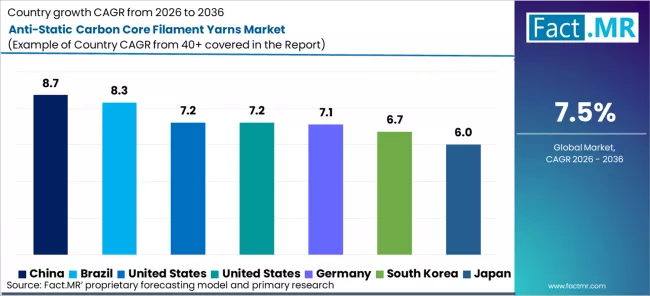
    Anti Static Carbon Core Filament Yarns Market Cagr Analysis By Country

    Country CAGR (2026 to 2036)
    China 8.7%
    Brazil 8.3%
    United States 7.2%
    United Kingdom 7.2%
    Germany 7.1%
    South Korea 6.7%
    Japan 6.0%

    What is accelerating China’s anti-static carbon core yarn industry?

    China’s market is expanding at an 8.7% CAGR, largely driven by its 15th Five-Year Plan focus on replacing imported high-performance fibers with domestically produced alternatives. The government is prioritizing self-sufficiency in materials used across semiconductor and electronics manufacturing clusters. Investments supported by Sinopec partnerships have created integrated production chains that connect carbon precursor manufacturing to finished anti-static textile systems. Regional hubs in Jiangsu and Guangdong coordinate closely with electronics assembly operations, ensuring localized supply for cleanroom garments and ESD textiles. Export competitiveness is also strengthening, as Chinese manufacturers balance cost efficiency with the strict quality standards required in global semiconductor supply chains.

    What is fueling Brazil’s steady expansion in anti-static textiles?

    Brazil is growing at an 8.3% CAGR, supported by pharmaceutical manufacturing growth and automotive electronics production. Domestic polyester and polyamide capacity allows local development of technical yarns, reducing import dependence. Industrial safety regulations in mining and agriculture require anti-static garments in hazardous environments. São Paulo’s automotive cluster adds demand for ESD protection in electronic control and battery assembly operations, while expanding medical device manufacturing increases cleanroom textile requirements.

    What is driving United States market momentum?

    The United States is progressing at a 7.2% CAGR, largely tied to CHIPS Act investments boosting domestic semiconductor fabrication. New facilities require durable, wash-fast ESD garments and hybrid conductive yarn systems. Pharmaceutical and battery production growth also increases demand for intrinsically safe textiles. Re-shoring initiatives are strengthening domestic supply chains, encouraging innovation in carbon-core and silver-bonded hybrid technologies.

    What is influencing the United Kingdom’s anti-static textile development?

    The UK market is expanding at a 7.2% CAGR, supported by compliance alignment with IEC 61340 standards in pharmaceutical and energy storage manufacturing. Growth in biologics production and renewable energy battery facilities requires advanced anti-static protection. Strong academic research and carbon fiber expertise are helping accelerate innovation in conductive yarn systems.

    How is Germany strengthening its market position?

    Germany is recording a 7.1% CAGR, driven by automotive electrification and battery manufacturing infrastructure. Partnerships within the supply chain support traceability compliance and Digital Product Passport requirements. Precision engineering expertise and pharmaceutical manufacturing strength create consistent demand for high-quality carbon-core systems.

    What is supporting South Korea’s market expansion?

    South Korea is growing at a 6.7% CAGR, propelled by semiconductor leaders Samsung and SK Hynix expanding super-clean facilities. Domestic partnerships are building local capacity for advanced carbon-core yarn production. Display panel and electronics manufacturing concentration increases demand for contamination-free ESD textiles integrated into automated cleanroom systems.

    What factors are sustaining Japan’s anti-static yarn growth?

    Japan is advancing at a 6.0% CAGR, supported by technology leadership in intrinsically safe cleanroom textiles. Companies such as Teijin Carbon and KB Seiren continue refining carbon-core systems with lower particle generation and improved environmental performance. While overall capacity growth is moderate, strong semiconductor and pharmaceutical sectors maintain demand for premium, precision-engineered conductive textile solutions.

    Competitive Landscape for Anti-Static Carbon Core Filament Yarns Market
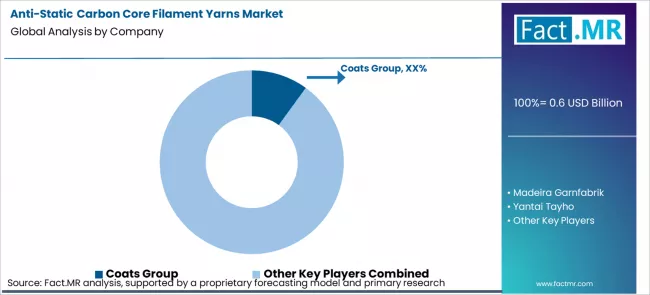
    Anti Static Carbon Core Filament Yarns Market Analysis By Company

    The anti-static carbon core filament yarns market is shaped by a mix of advanced materials expertise and traditional textile know-how. Carbon fiber specialists such as Teijin Frontier and Toray Industries bring deep experience from aerospace and high-performance materials into the textile space. By integrating Tenax carbon fiber or similar technologies into yarn core structures, they deliver consistent electrical conductivity and performance that meets demanding semiconductor and electronics standards. Their vertically integrated operations, spanning carbon precursor production to finished yarn manufacturing, allow tight quality control and reliable supply.

    At the same time, established textile players like Coats Group and Madeira Garnfabrik use their long-standing customer relationships and global distribution networks to introduce carbon-core yarns alongside existing industrial thread and specialty products. Companies such as Noble Biomaterials differentiate through hybrid systems that combine silver bonding with carbon-core conductivity to improve wash durability.

    In China, producers including Yantai Tayho and Huvis are expanding capacity to support domestic substitution policies, offering cost-competitive alternatives. Competition is intensifying as conventional polyester manufacturers develop their own carbon-core capabilities to remain relevant in this evolving technical textile segment.

    Recent Development

    • In January 2026, Noble Biomaterials expanded X-STATIC and Circuitex hybrid yarn production capacity across North American manufacturing facilities, responding to CHIPS Act semiconductor fabrication expansion creating 24/7 demand for wash-fast ESD uniforms with multi-spectral energy management capabilities.
    • In 2025, Teijin Carbon and KB Seiren launched Tenax Next generation carbon-core filaments achieving 35% carbon dioxide reduction while maintaining particle shedding characteristics below one-tenth conventional conductive yarn levels through high-density corona discharge technology serving intrinsically safe cleanroom textile applications.

    Key Market Players in Anti-Static Carbon Core Filament Yarns Market

    • Coats Group
    • Madeira Garnfabrik
    • Yantai Tayho
    • Toray Industries
    • Teijin Frontier
    • Monofil Technik
    • FilSpec
    • Sinterama
    • Unitika
    • Huvis

    Bibliography

    • Teijin Carbon America. 2025-2026. Tenax Next generation carbon fiber technologies for intrinsically safe cleanroom textile applications. Official company publications and technical white papers.
    • Noble Biomaterials. 2026. X-STATIC and Circuitex hybrid yarn systems for wash-fast ESD protection in semiconductor manufacturing. Corporate technology briefs and product documentation.
    • KB Seiren Corporation. 2026. Belltron corona discharge anti-static technologies for super-clean room environments. Company press releases and technical application guides.
    • European Union. 2026. Digital Product Passport implementation guidelines for material traceability in technical textile supply chains. Official EU regulatory publications.
    • Government of China. 2026. 15th Five-Year Plan mandates for domestic substitution of high-performance fibers in electronics manufacturing. State Administration for Market Regulation documentation.
    • IEC International Electrotechnical Commission. 2026. IEC 61340 standards for electrostatic discharge control in manufacturing environments. International standards documentation.

    Scope of Report

    Items Values
    Quantitative Units (2026) USD 0.6 Billion
    Core Material Carbon/Graphite Core, Stainless Steel Core, Other Conductive Cores
    Sheath Polymer Polyester, Polyamide, Other Polymers
    Application ESD Garments & Cleanroom Textiles, Industrial/Conveyor & Filtration, Carpets/Upholstery & Others
    End Market Electronics & Semiconductor, Pharma & Healthcare, Industrial & Other
    Regions Covered North America, Europe, Asia Pacific, Latin America, Middle East & Africa
    Countries Covered U.S., Canada, Germany, Italy, UK, France, Japan, China, Brazil, South Korea, Australia, and other countries
    Key Companies Profiled Coats Group, Madeira Garnfabrik, Yantai Tayho, Toray Industries, Teijin Frontier, Monofil Technik, FilSpec, Sinterama, Unitika, Huvis
    Additional Attributes Dollar revenue in the anti-static carbon core filament yarns market is segmented by core material (carbon/graphite core, stainless steel core, other conductive cores), sheath polymer (polyester, polyamide, other polymers), application (ESD garments & cleanroom textiles, industrial/conveyor & filtration, carpets/upholstery & others), end market (electronics & semiconductor, pharma & healthcare, industrial & other), and region.

    Anti-Static Carbon Core Filament Yarns Market by Segments

    • Core Material :

      • Carbon/Graphite Core
      • Stainless Steel Core
      • Other Conductive Cores
    • Sheath Polymer :

      • Polyester
      • Polyamide
      • Other Polymers
    • Application :

      • ESD Garments & Cleanroom Textiles
      • Industrial/Conveyor & Filtration
      • Carpets/Upholstery & Others
    • End Market :

      • Electronics & Semiconductor
      • Pharma & Healthcare
      • Industrial & Other
    • Region :

      • Asia Pacific
        • China
        • Japan
        • South Korea
        • Rest of Asia Pacific
      • North America
        • United States
        • Canada
        • Mexico
      • Europe
        • Germany
        • France
        • UK
        • Spain
        • Rest of Europe
      • Latin America
        • Brazil
        • Mexico
        • Rest of Latin America

    Table of Content

    1. Executive Summary
      • Global Market Outlook
      • Demand to side Trends
      • Supply to side Trends
      • Technology Roadmap Analysis
      • Analysis and Recommendations
    2. Market Overview
      • Market Coverage / Taxonomy
      • Market Definition / Scope / Limitations
    3. Research Methodology
      • Chapter Orientation
      • Analytical Lens and Working Hypotheses
        • Market Structure, Signals, and Trend Drivers
        • Benchmarking and Cross-market Comparability
        • Market Sizing, Forecasting, and Opportunity Mapping
      • Research Design and Evidence Framework
        • Desk Research Programme (Secondary Evidence)
          • Company Annual and Sustainability Reports
          • Peer-reviewed Journals and Academic Literature
          • Corporate Websites, Product Literature, and Technical Notes
          • Earnings Decks and Investor Briefings
          • Statutory Filings and Regulatory Disclosures
          • Technical White Papers and Standards Notes
          • Trade Journals, Industry Magazines, and Analyst Briefs
          • Conference Proceedings, Webinars, and Seminar Materials
          • Government Statistics Portals and Public Data Releases
          • Press Releases and Reputable Media Coverage
          • Specialist Newsletters and Curated Briefings
          • Sector Databases and Reference Repositories
          • FMR Internal Proprietary Databases and Historical Market Datasets
          • Subscription Datasets and Paid Sources
          • Social Channels, Communities, and Digital Listening Inputs
          • Additional Desk Sources
        • Expert Input and Fieldwork (Primary Evidence)
          • Primary Modes
            • Qualitative Interviews and Expert Elicitation
            • Quantitative Surveys and Structured Data Capture
            • Blended Approach
          • Why Primary Evidence is Used
          • Field Techniques
            • Interviews
            • Surveys
            • Focus Groups
            • Observational and In-context Research
            • Social and Community Interactions
          • Stakeholder Universe Engaged
            • C-suite Leaders
            • Board Members
            • Presidents and Vice Presidents
            • R&D and Innovation Heads
            • Technical Specialists
            • Domain Subject-matter Experts
            • Scientists
            • Physicians and Other Healthcare Professionals
          • Governance, Ethics, and Data Stewardship
            • Research Ethics
            • Data Integrity and Handling
        • Tooling, Models, and Reference Databases
      • Data Engineering and Model Build
        • Data Acquisition and Ingestion
        • Cleaning, Normalisation, and Verification
        • Synthesis, Triangulation, and Analysis
      • Quality Assurance and Audit Trail
    4. Market Background
      • Market Dynamics
        • Drivers
        • Restraints
        • Opportunity
        • Trends
      • Scenario Forecast
        • Demand in Optimistic Scenario
        • Demand in Likely Scenario
        • Demand in Conservative Scenario
      • Opportunity Map Analysis
      • Product Life Cycle Analysis
      • Supply Chain Analysis
      • Investment Feasibility Matrix
      • Value Chain Analysis
      • PESTLE and Porter’s Analysis
      • Regulatory Landscape
      • Regional Parent Market Outlook
      • Production and Consumption Statistics
      • Import and Export Statistics
    5. Global Market Analysis 2021 to 2025 and Forecast, 2026 to 2036
      • Historical Market Size Value (USD Million) Analysis, 2021 to 2025
      • Current and Future Market Size Value (USD Million) Projections, 2026 to 2036
        • Y to o to Y Growth Trend Analysis
        • Absolute $ Opportunity Analysis
    6. Global Market Pricing Analysis 2021 to 2025 and Forecast 2026 to 2036
    7. Global Market Analysis 2021 to 2025 and Forecast 2026 to 2036, By Core Material
      • Introduction / Key Findings
      • Historical Market Size Value (USD Million) Analysis By Core Material, 2021 to 2025
      • Current and Future Market Size Value (USD Million) Analysis and Forecast By Core Material, 2026 to 2036
        • Carbon/Graphite Core
        • Stainless Steel Core
        • Other Conductive Cores
      • Y to o to Y Growth Trend Analysis By Core Material, 2021 to 2025
      • Absolute $ Opportunity Analysis By Core Material, 2026 to 2036
    8. Global Market Analysis 2021 to 2025 and Forecast 2026 to 2036, By Application
      • Introduction / Key Findings
      • Historical Market Size Value (USD Million) Analysis By Application, 2021 to 2025
      • Current and Future Market Size Value (USD Million) Analysis and Forecast By Application, 2026 to 2036
        • ESD Garments & Cleanroom Textiles
        • Industrial/Conveyor & Filtration
        • Carpets/Upholstery & Others
      • Y to o to Y Growth Trend Analysis By Application, 2021 to 2025
      • Absolute $ Opportunity Analysis By Application, 2026 to 2036
    9. Global Market Analysis 2021 to 2025 and Forecast 2026 to 2036, By Region
      • Introduction
      • Historical Market Size Value (USD Million) Analysis By Region, 2021 to 2025
      • Current Market Size Value (USD Million) Analysis and Forecast By Region, 2026 to 2036
        • North America
        • Latin America
        • Western Europe
        • Eastern Europe
        • East Asia
        • South Asia and Pacific
        • Middle East & Africa
      • Market Attractiveness Analysis By Region
    10. North America Market Analysis 2021 to 2025 and Forecast 2026 to 2036, By Country
      • Historical Market Size Value (USD Million) Trend Analysis By Market Taxonomy, 2021 to 2025
      • Market Size Value (USD Million) Forecast By Market Taxonomy, 2026 to 2036
        • By Country
          • USA
          • Canada
          • Mexico
        • By Core Material
        • By Application
      • Market Attractiveness Analysis
        • By Country
        • By Core Material
        • By Application
      • Key Takeaways
    11. Latin America Market Analysis 2021 to 2025 and Forecast 2026 to 2036, By Country
      • Historical Market Size Value (USD Million) Trend Analysis By Market Taxonomy, 2021 to 2025
      • Market Size Value (USD Million) Forecast By Market Taxonomy, 2026 to 2036
        • By Country
          • Brazil
          • Chile
          • Rest of Latin America
        • By Core Material
        • By Application
      • Market Attractiveness Analysis
        • By Country
        • By Core Material
        • By Application
      • Key Takeaways
    12. Western Europe Market Analysis 2021 to 2025 and Forecast 2026 to 2036, By Country
      • Historical Market Size Value (USD Million) Trend Analysis By Market Taxonomy, 2021 to 2025
      • Market Size Value (USD Million) Forecast By Market Taxonomy, 2026 to 2036
        • By Country
          • Germany
          • UK
          • Italy
          • Spain
          • France
          • Nordic
          • BENELUX
          • Rest of Western Europe
        • By Core Material
        • By Application
      • Market Attractiveness Analysis
        • By Country
        • By Core Material
        • By Application
      • Key Takeaways
    13. Eastern Europe Market Analysis 2021 to 2025 and Forecast 2026 to 2036, By Country
      • Historical Market Size Value (USD Million) Trend Analysis By Market Taxonomy, 2021 to 2025
      • Market Size Value (USD Million) Forecast By Market Taxonomy, 2026 to 2036
        • By Country
          • Russia
          • Poland
          • Hungary
          • Balkan & Baltic
          • Rest of Eastern Europe
        • By Core Material
        • By Application
      • Market Attractiveness Analysis
        • By Country
        • By Core Material
        • By Application
      • Key Takeaways
    14. East Asia Market Analysis 2021 to 2025 and Forecast 2026 to 2036, By Country
      • Historical Market Size Value (USD Million) Trend Analysis By Market Taxonomy, 2021 to 2025
      • Market Size Value (USD Million) Forecast By Market Taxonomy, 2026 to 2036
        • By Country
          • China
          • Japan
          • South Korea
        • By Core Material
        • By Application
      • Market Attractiveness Analysis
        • By Country
        • By Core Material
        • By Application
      • Key Takeaways
    15. South Asia and Pacific Market Analysis 2021 to 2025 and Forecast 2026 to 2036, By Country
      • Historical Market Size Value (USD Million) Trend Analysis By Market Taxonomy, 2021 to 2025
      • Market Size Value (USD Million) Forecast By Market Taxonomy, 2026 to 2036
        • By Country
          • India
          • ASEAN
          • Australia & New Zealand
          • Rest of South Asia and Pacific
        • By Core Material
        • By Application
      • Market Attractiveness Analysis
        • By Country
        • By Core Material
        • By Application
      • Key Takeaways
    16. Middle East & Africa Market Analysis 2021 to 2025 and Forecast 2026 to 2036, By Country
      • Historical Market Size Value (USD Million) Trend Analysis By Market Taxonomy, 2021 to 2025
      • Market Size Value (USD Million) Forecast By Market Taxonomy, 2026 to 2036
        • By Country
          • Kingdom of Saudi Arabia
          • Other GCC Countries
          • Turkiye
          • South Africa
          • Other African Union
          • Rest of Middle East & Africa
        • By Core Material
        • By Application
      • Market Attractiveness Analysis
        • By Country
        • By Core Material
        • By Application
      • Key Takeaways
    17. Key Countries Market Analysis
      • USA
        • Pricing Analysis
        • Market Share Analysis, 2025
          • By Core Material
          • By Application
      • Canada
        • Pricing Analysis
        • Market Share Analysis, 2025
          • By Core Material
          • By Application
      • Mexico
        • Pricing Analysis
        • Market Share Analysis, 2025
          • By Core Material
          • By Application
      • Brazil
        • Pricing Analysis
        • Market Share Analysis, 2025
          • By Core Material
          • By Application
      • Chile
        • Pricing Analysis
        • Market Share Analysis, 2025
          • By Core Material
          • By Application
      • Germany
        • Pricing Analysis
        • Market Share Analysis, 2025
          • By Core Material
          • By Application
      • UK
        • Pricing Analysis
        • Market Share Analysis, 2025
          • By Core Material
          • By Application
      • Italy
        • Pricing Analysis
        • Market Share Analysis, 2025
          • By Core Material
          • By Application
      • Spain
        • Pricing Analysis
        • Market Share Analysis, 2025
          • By Core Material
          • By Application
      • France
        • Pricing Analysis
        • Market Share Analysis, 2025
          • By Core Material
          • By Application
      • India
        • Pricing Analysis
        • Market Share Analysis, 2025
          • By Core Material
          • By Application
      • ASEAN
        • Pricing Analysis
        • Market Share Analysis, 2025
          • By Core Material
          • By Application
      • Australia & New Zealand
        • Pricing Analysis
        • Market Share Analysis, 2025
          • By Core Material
          • By Application
      • China
        • Pricing Analysis
        • Market Share Analysis, 2025
          • By Core Material
          • By Application
      • Japan
        • Pricing Analysis
        • Market Share Analysis, 2025
          • By Core Material
          • By Application
      • South Korea
        • Pricing Analysis
        • Market Share Analysis, 2025
          • By Core Material
          • By Application
      • Russia
        • Pricing Analysis
        • Market Share Analysis, 2025
          • By Core Material
          • By Application
      • Poland
        • Pricing Analysis
        • Market Share Analysis, 2025
          • By Core Material
          • By Application
      • Hungary
        • Pricing Analysis
        • Market Share Analysis, 2025
          • By Core Material
          • By Application
      • Kingdom of Saudi Arabia
        • Pricing Analysis
        • Market Share Analysis, 2025
          • By Core Material
          • By Application
      • Turkiye
        • Pricing Analysis
        • Market Share Analysis, 2025
          • By Core Material
          • By Application
      • South Africa
        • Pricing Analysis
        • Market Share Analysis, 2025
          • By Core Material
          • By Application
    18. Market Structure Analysis
      • Competition Dashboard
      • Competition Benchmarking
      • Market Share Analysis of Top Players
        • By Regional
        • By Core Material
        • By Application
    19. Competition Analysis
      • Competition Deep Dive
        • Coats Group
          • Overview
          • Product Portfolio
          • Profitability by Market Segments (Product/Age /Sales Channel/Region)
          • Sales Footprint
          • Strategy Overview
            • Marketing Strategy
            • Product Strategy
            • Channel Strategy
        • Madeira Garnfabrik
        • Yantai Tayho
        • Toray Industries
        • Teijin Frontier
        • Monofil Technik
        • FilSpec
        • Sinterama
        • Value (USD Million)ika
        • Huvis
    20. Assumptions & Acronyms Used

    List Of Table

    • Table 1: Global Market Value (USD Million) Forecast by Region, 2021 to 2036
    • Table 2: Global Market Value (USD Million) Forecast by Core Material, 2021 to 2036
    • Table 3: Global Market Value (USD Million) Forecast by Application, 2021 to 2036
    • Table 4: North America Market Value (USD Million) Forecast by Country, 2021 to 2036
    • Table 5: North America Market Value (USD Million) Forecast by Core Material, 2021 to 2036
    • Table 6: North America Market Value (USD Million) Forecast by Application, 2021 to 2036
    • Table 7: Latin America Market Value (USD Million) Forecast by Country, 2021 to 2036
    • Table 8: Latin America Market Value (USD Million) Forecast by Core Material, 2021 to 2036
    • Table 9: Latin America Market Value (USD Million) Forecast by Application, 2021 to 2036
    • Table 10: Western Europe Market Value (USD Million) Forecast by Country, 2021 to 2036
    • Table 11: Western Europe Market Value (USD Million) Forecast by Core Material, 2021 to 2036
    • Table 12: Western Europe Market Value (USD Million) Forecast by Application, 2021 to 2036
    • Table 13: Eastern Europe Market Value (USD Million) Forecast by Country, 2021 to 2036
    • Table 14: Eastern Europe Market Value (USD Million) Forecast by Core Material, 2021 to 2036
    • Table 15: Eastern Europe Market Value (USD Million) Forecast by Application, 2021 to 2036
    • Table 16: East Asia Market Value (USD Million) Forecast by Country, 2021 to 2036
    • Table 17: East Asia Market Value (USD Million) Forecast by Core Material, 2021 to 2036
    • Table 18: East Asia Market Value (USD Million) Forecast by Application, 2021 to 2036
    • Table 19: South Asia and Pacific Market Value (USD Million) Forecast by Country, 2021 to 2036
    • Table 20: South Asia and Pacific Market Value (USD Million) Forecast by Core Material, 2021 to 2036
    • Table 21: South Asia and Pacific Market Value (USD Million) Forecast by Application, 2021 to 2036
    • Table 22: Middle East & Africa Market Value (USD Million) Forecast by Country, 2021 to 2036
    • Table 23: Middle East & Africa Market Value (USD Million) Forecast by Core Material, 2021 to 2036
    • Table 24: Middle East & Africa Market Value (USD Million) Forecast by Application, 2021 to 2036

    List Of Figures

    • Figure 1: Global Market Pricing Analysis
    • Figure 2: Global Market Value (USD Million) Forecast 2021 to 2036
    • Figure 3: Global Market Value Share and BPS Analysis by Core Material, 2026 and 2036
    • Figure 4: Global Market Y to o to Y Growth Comparison by Core Material, 2026 to 2036
    • Figure 5: Global Market Attractiveness Analysis by Core Material
    • Figure 6: Global Market Value Share and BPS Analysis by Application, 2026 and 2036
    • Figure 7: Global Market Y to o to Y Growth Comparison by Application, 2026 to 2036
    • Figure 8: Global Market Attractiveness Analysis by Application
    • Figure 9: Global Market Value (USD Million) Share and BPS Analysis by Region, 2026 and 2036
    • Figure 10: Global Market Y to o to Y Growth Comparison by Region, 2026 to 2036
    • Figure 11: Global Market Attractiveness Analysis by Region
    • Figure 12: North America Market Incremental Dollar Opportunity, 2026 to 2036
    • Figure 13: Latin America Market Incremental Dollar Opportunity, 2026 to 2036
    • Figure 14: Western Europe Market Incremental Dollar Opportunity, 2026 to 2036
    • Figure 15: Eastern Europe Market Incremental Dollar Opportunity, 2026 to 2036
    • Figure 16: East Asia Market Incremental Dollar Opportunity, 2026 to 2036
    • Figure 17: South Asia and Pacific Market Incremental Dollar Opportunity, 2026 to 2036
    • Figure 18: Middle East & Africa Market Incremental Dollar Opportunity, 2026 to 2036
    • Figure 19: North America Market Value Share and BPS Analysis by Country, 2026 and 2036
    • Figure 20: North America Market Value Share and BPS Analysis by Core Material, 2026 and 2036
    • Figure 21: North America Market Y to o to Y Growth Comparison by Core Material, 2026 to 2036
    • Figure 22: North America Market Attractiveness Analysis by Core Material
    • Figure 23: North America Market Value Share and BPS Analysis by Application, 2026 and 2036
    • Figure 24: North America Market Y to o to Y Growth Comparison by Application, 2026 to 2036
    • Figure 25: North America Market Attractiveness Analysis by Application
    • Figure 26: Latin America Market Value Share and BPS Analysis by Country, 2026 and 2036
    • Figure 27: Latin America Market Value Share and BPS Analysis by Core Material, 2026 and 2036
    • Figure 28: Latin America Market Y to o to Y Growth Comparison by Core Material, 2026 to 2036
    • Figure 29: Latin America Market Attractiveness Analysis by Core Material
    • Figure 30: Latin America Market Value Share and BPS Analysis by Application, 2026 and 2036
    • Figure 31: Latin America Market Y to o to Y Growth Comparison by Application, 2026 to 2036
    • Figure 32: Latin America Market Attractiveness Analysis by Application
    • Figure 33: Western Europe Market Value Share and BPS Analysis by Country, 2026 and 2036
    • Figure 34: Western Europe Market Value Share and BPS Analysis by Core Material, 2026 and 2036
    • Figure 35: Western Europe Market Y to o to Y Growth Comparison by Core Material, 2026 to 2036
    • Figure 36: Western Europe Market Attractiveness Analysis by Core Material
    • Figure 37: Western Europe Market Value Share and BPS Analysis by Application, 2026 and 2036
    • Figure 38: Western Europe Market Y to o to Y Growth Comparison by Application, 2026 to 2036
    • Figure 39: Western Europe Market Attractiveness Analysis by Application
    • Figure 40: Eastern Europe Market Value Share and BPS Analysis by Country, 2026 and 2036
    • Figure 41: Eastern Europe Market Value Share and BPS Analysis by Core Material, 2026 and 2036
    • Figure 42: Eastern Europe Market Y to o to Y Growth Comparison by Core Material, 2026 to 2036
    • Figure 43: Eastern Europe Market Attractiveness Analysis by Core Material
    • Figure 44: Eastern Europe Market Value Share and BPS Analysis by Application, 2026 and 2036
    • Figure 45: Eastern Europe Market Y to o to Y Growth Comparison by Application, 2026 to 2036
    • Figure 46: Eastern Europe Market Attractiveness Analysis by Application
    • Figure 47: East Asia Market Value Share and BPS Analysis by Country, 2026 and 2036
    • Figure 48: East Asia Market Value Share and BPS Analysis by Core Material, 2026 and 2036
    • Figure 49: East Asia Market Y to o to Y Growth Comparison by Core Material, 2026 to 2036
    • Figure 50: East Asia Market Attractiveness Analysis by Core Material
    • Figure 51: East Asia Market Value Share and BPS Analysis by Application, 2026 and 2036
    • Figure 52: East Asia Market Y to o to Y Growth Comparison by Application, 2026 to 2036
    • Figure 53: East Asia Market Attractiveness Analysis by Application
    • Figure 54: South Asia and Pacific Market Value Share and BPS Analysis by Country, 2026 and 2036
    • Figure 55: South Asia and Pacific Market Value Share and BPS Analysis by Core Material, 2026 and 2036
    • Figure 56: South Asia and Pacific Market Y to o to Y Growth Comparison by Core Material, 2026 to 2036
    • Figure 57: South Asia and Pacific Market Attractiveness Analysis by Core Material
    • Figure 58: South Asia and Pacific Market Value Share and BPS Analysis by Application, 2026 and 2036
    • Figure 59: South Asia and Pacific Market Y to o to Y Growth Comparison by Application, 2026 to 2036
    • Figure 60: South Asia and Pacific Market Attractiveness Analysis by Application
    • Figure 61: Middle East & Africa Market Value Share and BPS Analysis by Country, 2026 and 2036
    • Figure 62: Middle East & Africa Market Value Share and BPS Analysis by Core Material, 2026 and 2036
    • Figure 63: Middle East & Africa Market Y to o to Y Growth Comparison by Core Material, 2026 to 2036
    • Figure 64: Middle East & Africa Market Attractiveness Analysis by Core Material
    • Figure 65: Middle East & Africa Market Value Share and BPS Analysis by Application, 2026 and 2036
    • Figure 66: Middle East & Africa Market Y to o to Y Growth Comparison by Application, 2026 to 2036
    • Figure 67: Middle East & Africa Market Attractiveness Analysis by Application
    • Figure 68: Global Market - Tier Structure Analysis
    • Figure 69: Global Market - Company Share Analysis

    - Frequently Asked Questions -

    How big is the anti-static carbon core filament yarns market in 2026?

    The global anti-static carbon core filament yarns market is estimated to be valued at USD 0.6 billion in 2026.

    What will be the size of anti-static carbon core filament yarns market in 2036?

    The market size for the anti-static carbon core filament yarns market is projected to reach USD 1.2 billion by 2036.

    How much will be the anti-static carbon core filament yarns market growth between 2026 and 2036?

    The anti-static carbon core filament yarns market is expected to grow at a 7.5% CAGR between 2026 and 2036.

    What are the key product types in the anti-static carbon core filament yarns market?

    The key product types in anti-static carbon core filament yarns market are carbon/graphite core, stainless steel core and other conductive cores.

    Which application segment to contribute significant share in the anti-static carbon core filament yarns market in 2026?

    In terms of application, esd garments & cleanroom textiles segment to command 40.0% share in the anti-static carbon core filament yarns market in 2026.

    Anti-Static Carbon Core Filament Yarns Market