- Base Value(2025): 1.5 Bn
- Estimated Value(2026): 1.6 Bn
- Forecast Value (2036): 2.7 Bn
- CAGR (2026 - 2036): 5.5%
Aquaculture Lighting and Environmental Control Systems Market Forecast and Outlook 2026 to 2036
In 2025, the aquaculture lighting and environmental control systems market was valued at USD 1.5 billion. Based on Fact.MR analysis, demand for aquaculture lighting and environmental control systems is estimated to grow to USD 1.6 billion in 2026 and USD 2.7 billion by 2036. FACT.MR projects a CAGR of 5.5% during the forecast period.
The absolute dollar growth from 2026 to 2036 represents an incremental gain of USD 1.1 billion. This growth reflects a measured yet structurally sound expansion trajectory, propelled by the global shift toward precision aquaculture as operators seek to maximize yield-per-unit-volume in response to declining wild capture fisheries and tightening food safety regulations. Growth momentum remains consistent rather than explosive, constrained by high upfront capital intensity for RAS infrastructure and the relatively slow technology adoption curve among SME-scale cage and pond operations in developing aquaculture economies.
As Trond Williksen, CEO of Grieg Seafood, stated in an investor briefing regarding the company's precision farming investments, 'Achieving biological and operational efficiency across our farming sites requires control systems that give us real-time visibility into the full environmental envelope our fish experience from lighting spectrum through oxygen saturation to water temperature because any single parameter failure translates directly into growth losses and elevated mortality.' [1]
China leads among profiled markets at 6.7% CAGR through 2036, driven by large-scale RAS facility construction programs under national food security policy and government subsidies for smart aquaculture equipment. Brazil follows at 6.3% supported by freshwater aquaculture expansion and shrimp farming intensification in the Northeast region. Europe registers 5.3% growth, sustained by stringent environmental compliance requirements and Nordic salmon farming capital investments. The United States grows at 5.2% alongside the United Kingdom at 5.2%, supported by domestic seafood security priorities and recirculating aquaculture investments near coastal urban markets. Germany records 5.1% CAGR on the strength of RAS technology development hubs and precision aquaculture export markets. South Korea advances at 4.7% through its national smart fisheries program, while Japan posts 4.0% CAGR as a technologically mature market focused on energy-efficient LED replacement cycles and water quality monitoring upgrades rather than greenfield system deployment.
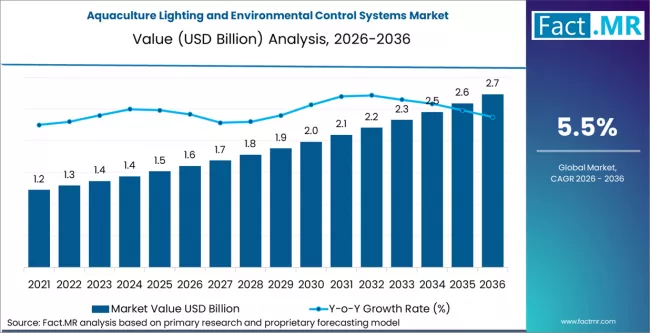
Aquaculture Lighting And Environmental Control Systems Market Market Value Analysis | Source: Fact.MR
Market Definition
Aquaculture lighting and environmental control systems encompass the integrated hardware and software technologies deployed within fish and shellfish farming facilities to precisely manage the biological environment of aquatic species. This market covers LED and spectrum-tunable lighting systems that regulate photoperiod and biological cycles, aeration and oxygenation equipment that maintains dissolved oxygen at optimal levels, water quality sensors monitoring parameters including pH, salinity, temperature, and ammonia concentration, and automated feeding and management systems.
Market Inclusions
The report covers global and regional aquaculture lighting and environmental control systems market sizes from 2026 to 2036, with detailed segment breakdowns by system type (LED lighting, aeration and oxygenation, water quality sensors, feeding and automation), species (salmonids, tilapia, shrimp, others), farm type (land-based, offshore marine, RAS, cage farms), and buyer type (large farms, SME farms, research and other). Analysis includes hardware procurement trends, software integration patterns, capital expenditure benchmarks by farm type, and emerging precision aquaculture technology adoption rates across major seafood-producing geographies.
Market Exclusions
The scope excludes fish processing and post-harvest handling equipment, aquafeed manufacturing and distribution, and aquatic veterinary pharmaceutical products unless directly integrated with automated dosing systems. It also omits offshore marine cage structural engineering and installation services, focusing strictly on the sensing, lighting, oxygenation, and automated control equipment deployed within farming environments. Vessel-based and open-ocean mariculture infrastructure, ornamental fish and aquarium systems, and water treatment chemicals not bundled with monitoring hardware are excluded from the scope of this report.
Research Methodology
- Primary Research: Primary research involved structured interviews with aquaculture technology suppliers, RAS facility operators, salmon farming companies, large-scale shrimp producers, and aquaculture equipment distributors across North America, Europe, Asia-Pacific, and Latin America.
- Desk Research: Desk research synthesized data from national fisheries ministries, FAO aquaculture production statistics, multilateral development bank lending records for blue economy projects, company annual reports, and industry association analyses of capital investment patterns in precision aquaculture.
- Market-Sizing and Forecasting: Market sizing employed a hybrid top-down and bottom-up approach, triangulating global aquaculture production volume data with equipment penetration rates by farm type and species to derive technology-specific demand forecasts validated against disclosed supplier revenues.
Data Validation and Update Cycle
Outputs were cross-validated against disclosed capital expenditure from listed aquaculture operators and reconciled semi-annually with major equipment contract announcements, trade show product launches, and regulatory compliance timeline disclosures.
Key Takeaways
Market Definition
- Aquaculture lighting and environmental control systems comprise integrated LED lighting, aeration, water quality sensors, and automated feeding technologies deployed in fish and shellfish farming operations to optimize biological performance and production efficiency.
Demand Drivers
- Expansion of land-based recirculating aquaculture systems by large integrated seafood companies in Europe and North America is driving adoption of full-stack environmental control platforms as operators seek biosecure, year-round production independent of seasonal and geographic constraints.
- Regulatory tightening on wild fish meal and fishoil use in aquafeed, combined with stricter discharge and water quality standards from environmental agencies, is compelling producers to deploy precision sensor networks to demonstrate compliance and optimize feed conversion ratios.
- Growing global protein demand and declining wild-capture fisheries are accelerating RAS and land-based aquaculture investments in China, Brazil, and Southeast Asia, where government aquaculture development programs are offering subsidized financing for smart farming equipment procurement.
Key Segments Analyzed
- By System Type, LED Lighting commands 40% share in 2025, reflecting its fundamental role as the primary environmental control input that governs photoperiod, circadian rhythm management, and spawning cycle regulation across all commercially significant species and farm configurations.
- By Species, Salmonids represent the leading application segment at 35% share, concentrated in Norwegian, Chilean, and Scottish Atlantic salmon operations where precision environmental control has demonstrated measurable improvements in smolt quality, sea transfer timing, and harvest weight consistency.
- By Buyer Type, Large Farms and SME represent the leading segment with 30% share, supported by vertically integrated aquaculture companies operating multi-site facilities and investing in advanced monitoring, automation, and environmental control systems to optimize feed conversion ratios and survival rates.
- By Farm Type, RAS leads the global market in 2025 with 35% share, driven by demand for biosecure, water-efficient, and land-based intensive production systems near urban consumption centers.
- By Region, Europe leads the global market, anchored by Norway's technically advanced salmon farming sector and EU regulatory frameworks mandating environmental monitoring and reporting standards across licensed aquaculture sites.
Analyst Opinion at FACT.MR
- Shambhu Nath Jha, Principal Consultant at Fact.MR, opines, 'CXOs will find in this report detailed evidence that the competitive boundary in aquaculture technology is moving from hardware reliability toward data integration capability operators who can unify lighting control, oxygen management, feeding automation, and water quality telemetry into a single decision-support platform will achieve 15-25% superior feed conversion ratios over those managing parameters in isolation, making integration architecture the primary differentiator for technology vendor selection by 2028.'
Strategic Implications / Executive Takeaways
- Technology vendors should prioritize open-architecture IoT platforms with standardized API connectivity to third-party farm management software, as large aquaculture operators are increasingly mandating interoperability across environmental control, ERP, and logistics systems as a prerequisite for new equipment procurement.
- Capital equipment manufacturers must develop modular, scalable product families that can be deployed incrementally in SME cage and pond operations, as the SME segment representing 40% of buyer share lacks the capital for full RAS-grade system installations but represents the largest addressable market for entry-level monitoring and LED lighting upgrades.
- Investors and operators evaluating RAS expansion should factor environmental control system capex at 12-18% of total facility construction cost, recognizing that LED spectrum tuning and dissolved oxygen management directly determine the biological performance ceiling achievable in closed-system production models.
Methodology
- Market sizing triangulated FAO global aquaculture production volumes with per-farm equipment penetration rates derived from supplier shipment data and primary interviews with 45 aquaculture operators across 12 countries.
- Technology adoption curves for LED aquaculture lighting, inline water quality sensors, and automated feeding systems were calibrated using disclosed installation data from Signify, AKVA Group, and Xylem covering fiscal years 2022 to 2024.
- Country-level forecast assumptions were validated against national aquaculture development plan targets, approved RAS facility pipeline data, and disclosed capital expenditure from publicly listed salmon farmers including Mowi, Cermaq, and Grieg Seafood.
Segmental Analysis
Aquaculture Lighting and Environmental Control Systems Market Analysis by System Type
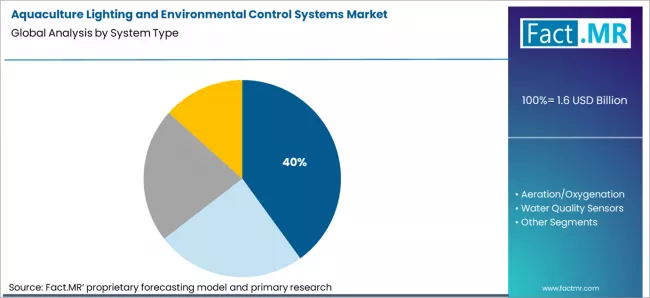
Aquaculture Lighting And Environmental Control Systems Market Analysis By System Type | Source: Fact.MR
Based on FACT.MR's aquaculture lighting and environmental control systems market report, consumption of LED Lighting systems is estimated to hold 40% share in 2025. LED lighting dominates because it functions as the primary biological control input across farm configurations, directly influencing photoperiod management, smoltification timing, maturation control, and feeding behavior. Its measurable impact on yield consistency and energy savings supports strong retrofit and greenfield demand across capital-intensive RAS and land-based facilities.
- Signify AquaGrow deployment: Expanded spectrum-tunable LED systems were deployed across 12 Norwegian hatcheries, demonstrating reduced seawater transfer rejection rates and improved smolt performance [2].
- ams OSRAM underwater modules: Development of IP68-rated, anti-biofouling underwater LED systems addressed durability barriers in marine cage environments [3].
- LED energy efficiency economics: FAO reports energy represents 20-35% of RAS operating costs, with LED retrofits delivering 60-70% energy reduction, driving upgrade cycles in Norway, Canada, and Japan [4].
Aquaculture Lighting and Environmental Control Systems Market Analysis by Species
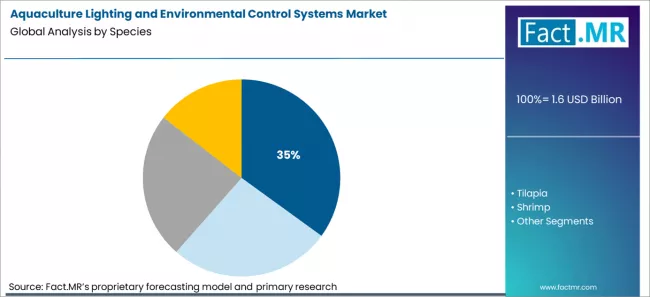
Aquaculture Lighting And Environmental Control Systems Market Analysis By Species | Source: Fact.MR
Based on FACT.MR's aquaculture lighting and environmental control systems market report, consumption for Salmonids is estimated to hold 35% share in 2025. Salmonid farming requires precise photoperiod and environmental control to manage smoltification, maturation suppression, and spawning cycles, sustaining demand for integrated, high-specification systems.
- Mowi RAS investment: NOK 3.2 billion committed to post-smolt RAS facilities requiring full environmental control integration across Norway and Canada [5].
- Shrimp technology intensification: Automated monitoring adoption reached 38% among Tier 1 certified shrimp farms, up from 21% in 2021, reflecting biosecurity-driven system upgrades [6].
- Tilapia controlled-environment adoption: Commercial RAS monitoring deployments in the United States and Brazil highlight diversification of sensor-dense architectures beyond salmonid operations. [7]
Aquaculture Lighting and Environmental Control Systems Market Drivers, Restraints, And Opportunities
Fact.MR analysis indicates the market is anchored by aquaculture’s shift from extensive production to precision-managed, technology-intensive farming. The USD 1.5 billion base reflects early penetration within a 90+ million metric ton global industry still dominated by minimally instrumented operations. Growth has historically centered on premium salmon farming markets, where biological performance requirements justified early adoption of integrated lighting and monitoring systems.
The central tension lies between high-capex RAS and land-based installations priced at USD 50,000-USD 500,000 per system and SME pond or cage farms requiring USD 2,000-USD 15,000 entry-level solutions. Adoption barriers in SME segments stem from capital intensity and limited financing access, particularly across Southeast Asia and Latin America.
- EU regulatory mandates: Strategic Guidelines for Aquaculture 2021-2030 require environmental monitoring integration, sustaining compliance-driven procurement cycles across Europe.
- China smart aquaculture program: CNY 8.2 billion in subsidies targets deployment of precision systems across 30% of licensed farms by 2025.
- Financing innovation opportunity: Leasing, credit-backed procurement, and subscription sensor models are critical to unlocking adoption in price-sensitive SME markets.
Regional Analysis
Based on regional assessment, aquaculture lighting and environmental control systems market is analyzed across North America, Latin America, Europe, Asia Pacific spanning more than 40+ countries. Regional performance varies according to infrastructure activity, regulatory stringency, and industrial coatings demand. The report also presents a comparative market attractiveness evaluation grounded in region-specific demand trends.
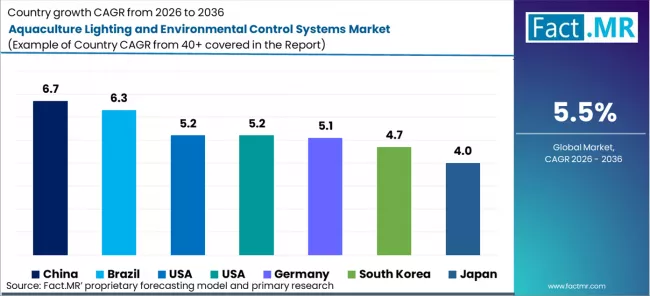
Aquaculture Lighting And Environmental Control Systems Market Cagr Analysis By Country | Source: Fact.MR
| Country | CAGR% |
|---|---|
| China | 6.7% |
| Brazil | 6.3% |
| United States | 5.2% |
| United Kingdom | 5.2% |
| Germany | 5.1% |
| South Korea | 4.7% |
| Japan | 4.0% |
Source: Fact.MR analysis. Updated Feb 17, 2026
Source: Fact.MR (FACT.MR) analysis, based on proprietary forecasting model and primary research
North America Aquaculture Lighting and Environmental Control Systems Market Analysis
North America operates as a technology-pioneering aquaculture market where land-based RAS investment is transforming domestic seafood production economics. The region is characterized by strong regulatory compliance demands, proximity-to-consumer premium seafood economics, and concentrated technology development activity. Key players including Innovasea and Pentair hold structurally advantaged positions through integrated hardware and digital service offerings targeting the North American RAS installation base.
- United States: Demand for aquaculture lighting and environmental control systems in the United States is projected to rise at 5.2% CAGR through 2036. Growth is driven by the National Oceanic and Atmospheric Administration's Marine Aquaculture Strategic Plan 2023-2028, which targets tripling domestic aquaculture production and includes USD 35 million in dedicated technology deployment grants for precision aquaculture infrastructure. Atlantic Sapphire's Bluehouse facility in Miami.
FACT.MR's analysis of aquaculture lighting and environmental control systems market in North America consists of country-wise assessment that includes United States. Readers can find RAS facility pipeline data, technology procurement benchmarks, and federal aquaculture incentive program impacts on environmental control system demand.
Asia-Pacific Aquaculture Lighting and Environmental Control Systems Market Analysis
Asia-Pacific operates as the global aquaculture production epicenter, accounting for over 70% of world farmed seafood output, and is transitioning from extensive low-technology operations toward instrumented intensive systems under national smart aquaculture mandates. Investment is anchored by China's large-scale RAS development programs and Japan's technology-upgrade cycles, with regional players including AKVA Group (operating through regional subsidiaries) and OxyGuard building distribution presence across the production-intensive ASEAN corridor.
- China: Demand for aquaculture lighting and environmental control systems in China is projected to rise at 6.7% CAGR through 2036. Growth is anchored by the Ministry of Agriculture and Rural Affairs' 14th Five-Year Fisheries Plan mandating smart aquaculture technology deployment across 30% of licensed farms by 2025, with CNY 8.2 billion in allocated subsidies covering equipment procurement, digital infrastructure, and training programs. China National Fisheries Expo 2024 featured 134 exhibiting companies in the precision aquaculture equipment category, a 42% increase from 2022, reflecting accelerating domestic market activity according to Fact.MR.
- Japan: Demand for aquaculture lighting and environmental control systems in Japan is projected to rise at 4.0% CAGR through 2036. Consumption is sustained by Japan's Fisheries Agency Smart Aquaculture Promotion Program launched in April 2023, which provides two-thirds subsidized financing for IoT sensor deployment and automated monitoring systems at licensed RAS and pond facilities.
- South Korea: Demand for aquaculture lighting and environmental control systems in South Korea is projected to rise at 4.7% CAGR through 2036. Growth is linked to the Ministry of Oceans and Fisheries' Smart Fisheries Valley Project, which has established three government-funded precision aquaculture demonstration and commercial production complexes.
FACT.MR's analysis of aquaculture lighting and environmental control systems market in Asia-Pacific consists of country-wise assessment that includes China, Japan, South Korea, and other regional economies. Readers can find national smart aquaculture program investment timelines, species-specific technology adoption rates, and equipment subsidy program utilization data.
Europe Aquaculture Lighting and Environmental Control Systems Market Analysis
Europe operates as the global regulatory laboratory for precision aquaculture, where Norwegian salmon farming investment cycles and EU environmental compliance mandates together drive the most technically advanced environmental control system deployments worldwide. The region is characterized by high system specification, mature vendor ecosystems, and cross-border standardization pressure. AKVA Group, OxyGuard, and ScaleAQ hold dominant regional positions built on long-term service relationships with Atlantic salmon operators.
- Germany: Demand for aquaculture lighting and environmental control systems in Germany is projected to rise at 5.1% CAGR through 2036. Consumption is driven by Germany's National Aquaculture Strategy 2030, which allocates EUR 120 million in federal and state support for sustainable RAS facility development, with environmental control system procurement qualifying for investment grants covering up to 30% of eligible hardware costs under the German Federal Ministry of Food and Agriculture's Aquaculture Innovation Programme launched in January 2024, based on Fact.MR analysis.
- United Kingdom: Demand for aquaculture lighting and environmental control systems in the United Kingdom is projected to rise at 5.2% CAGR through 2036. Uptake is linked to the UK Government's Aquaculture Growth Programme under the Seafood Industry Levy, which disbursed GBP 14 million in 2023-2024 to support technology adoption at Scottish salmon and trout farming sites, with water quality monitoring and LED photoperiod management systems among the highest-funded equipment categories.
FACT.MR's analysis of aquaculture lighting and environmental control systems market in Europe consists of country-wise assessment that includes Germany, United Kingdom, Norway, and other regional economies. Readers can find EU regulatory compliance timelines, Nordic RAS investment pipeline data, and species-specific lighting protocol adoption benchmarks.
Latin America Aquaculture Lighting and Environmental Control Systems Market Analysis
Latin America operates as a high-growth aquaculture expansion market where shrimp and tilapia production intensification is the primary driver of environmental control system demand. Brazil's freshwater aquaculture sector and Chilean salmon farming operations represent the dominant technology investment hubs, with public credit agency financing mechanisms making premium equipment accessible to mid-scale operators. LumenAqua and regional distributors of international brands are building market presence through localized service and financing partnerships.
- Brazil: Demand for aquaculture lighting and environmental control systems in Brazil is projected to rise at 6.3% CAGR through 2036. Growth is supported by BNDES (Brazilian Development Bank) credit lines under the ABC+ Programme offering preferential financing for sustainable aquaculture equipment including monitoring and automation systems at rates 3-5 percentage points below commercial lending rates.
FACT.MR's analysis of aquaculture lighting and environmental control systems market in Latin America consists of country-wise assessment that includes Brazil, Chile, Ecuador, and other regional economies. Readers can find development bank financing program utilization data, shrimp and tilapia production intensification trends, and technology adoption rates by farm size category.
Competitive Aligners for Market Players
Aquaculture Lighting And Environmental Control Systems Market Analysis By Company | Source: Fact.MR
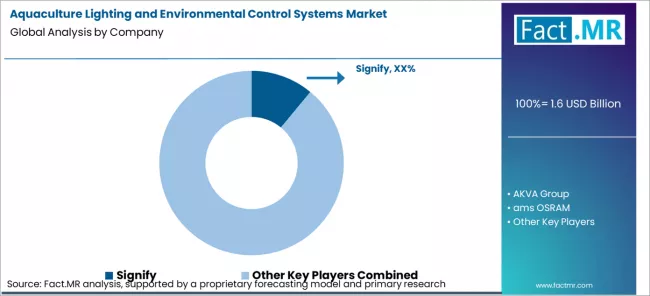
The aquaculture lighting and environmental control systems market is moderately concentrated in the LED lighting and integrated RAS control segments, while remaining fragmented in standalone sensor and aeration equipment categories. Signify, AKVA Group, and Pentair collectively hold significant shares in the premium integrated system market serving large-scale salmonid and RAS operations, supported by proprietary control software platforms, long-term service contracts, and established species-specific performance data that lower buyer risk in high-stakes facility investment decisions. Competitive intensity is higher in the SME and value market segments, where lower-cost Asian manufacturers are increasing their presence through competitive pricing and simplified product designs.
Structural competitive advantage increasingly concentrates among vendors who can offer end-to-end environmental management platforms combining hardware, connectivity, cloud analytics, and agronomic advisory services. This integration capability reduces the total cost of farm management for large operators while creating high switching costs operators who have calibrated growth models, feeding algorithms, and compliance reporting workflows to a specific vendor's platform face significant operational disruption and retraining costs if they transition systems. AKVA Group's Fishtalk platform and Innovare’s InnovaSea Connect exemplify this platform lock-in dynamic.
Buyer leverage is concentrated in large integrated aquaculture companies with multi-site procurement volumes. These operators negotiate multi-year framework agreements with preferred vendors and leverage competitive bids to maintain pricing discipline. SME buyers have limited leverage and typically purchase through regional distributors at list pricing. This bifurcation creates a market dynamic where large enterprise accounts are contested intensely by full-portfolio vendors while the SME segment remains accessible to regional players and new entrants with cost-competitive hardware offerings.
Recent Developments
- In August 2025, NorseAqua entered a strategic partnership with HATO to introduce a new range of advanced lighting systems tailored for aquaculture operations in Europe, aimed at improving energy efficiency and species-specific light management.
- In November 2025, AquaTech Systems completed its acquisition of MarineSense Technologies, combining AquaTech’s LED lighting and environmental control portfolio with MarineSense’s advanced water quality sensor suite to offer fully integrated precision aquaculture solutions targeting RAS and offshore marine farms.
Key Players
- Signify
- AKVA Group
- ams OSRAM
- Innovasea
- Xylem
- Pentair
- Monitorfish
- LumenAqua
- ScaleAQ
- OxyGuard
Bibliography
- [1] Williksen, T. (2024). Investor Briefing on Precision Farming and Environmental Control Investments. Grieg Seafood ASA.
- [2] Signify. (2024). AquaGrow LED Aquaculture Lighting Deployment at SalmoBreed Hatcheries. Signify Corporate Press Release.
- [3] ams OSRAM. (2024). Annual Report 2024: Aquaculture LED Module Development. ams OSRAM AG.
- [4] Food and Agriculture Organization of the United Nations. (2024). The State of World Fisheries and Aquaculture 2024. FAO Fisheries Division, Rome.
- [5] Mowi ASA. (2024). Annual Report 2024: RAS Post-Smolt Investment Programme. Mowi ASA Investor Relations.
- [6] Global Aquaculture Alliance. (2024). BAP Certified Shrimp Farm Technology Adoption Survey 2024. GAA Research and Standards Division.
- [7] Innovasea Systems. (2024). InnovaSea Connect Platform Tilapia Deployment Case Studies 2024. Innovasea Corporate Communications.
Segmentation
Scope of Report
| Items | Values |
|---|---|
| Quantitative Units | USD 1.6 billion (2026) to USD 2.7 billion (2036), at a CAGR of 5.5% |
| Market Definition | Aquaculture lighting and environmental control systems encompass LED and spectrum-tunable lighting, aeration and oxygenation equipment, water quality sensors, and automated feeding systems deployed in fish and shellfish farming facilities to precisely manage the biological environment and optimize production performance. |
| System Type | LED Lighting, Aeration/Oxygenation, Water Quality Sensors, Feeding/Automation |
| Species | Salmonids, Tilapia, Shrimp, Others |
| Farm Type | Land-Based, Offshore Marine, RAS, Cage Farms |
| Buyer Type | Large Farms, SME Farms, Research/Other |
| Regions Covered | Asia Pacific, Europe, North America, Latin America, Middle East & Africa |
| Countries Covered | China, Japan, South Korea, Australia & New Zealand, India, ASEAN, Rest of Asia Pacific, Norway, Germany, United Kingdom, France, Spain, Netherlands, Nordics, Rest of Europe, United States, Canada, Mexico, Brazil, Chile, Ecuador, Rest of Latin America, Kingdom of Saudi Arabia, United Arab Emirates, South Africa, Turkey, Rest of Middle East & Africa |
| Key Companies Profiled | Signify, AKVA Group, ams OSRAM, Innovasea, Xylem, Pentair, Monitorfish, LumenAqua, ScaleAQ, OxyGuard |
| Forecast Period | 2026 to 2036 |
| Approach | Top-down and bottom-up market modeling validated through primary interviews with aquaculture operators, environmental control system vendors, RAS technology integrators, and fisheries ministry officials, supported by FAO production statistics, national aquaculture development plans, and company disclosed capex data. |
Source: Fact.MR analysis. Updated Feb 17, 2026
Aquaculture Lighting and Environmental Control Systems Market Analysis by Segments
-
By System Type :
- LED Lighting
- Aeration/Oxygenation
- Water Quality Sensors
- Feeding/Automation
-
By Species :
- Salmonids
- Tilapia
- Shrimp
- Others
-
By Farm Type :
- Land-Based
- Offshore Marine
- RAS
- Cage Farms
-
By Buyer Type :
- Large Farms
- SME Farms
- Research/Other
-
Region :
- Asia Pacific
- China
- Japan
- South Korea
- Australia & New Zealand
- India
- ASEAN
- Rest of Asia Pacific
- Europe
- Norway
- Germany
- United Kingdom
- France
- Spain
- Netherlands
- Nordics
- Rest of Europe
- North America
- United States
- Canada
- Mexico
- Latin America
- Brazil
- Chile
- Ecuador
- Rest of Latin America
- Middle East & Africa
- Kingdom of Saudi Arabia
- United Arab Emirates
- South Africa
- Turkey
- Rest of Middle East & Africa
- Asia Pacific
Frequently Asked Questions
How large is the aquaculture lighting and environmental control systems market in 2025?
What will the market size be in 2026?
What will the market size be in 2036?
What is the expected CAGR for the forecast period?
Which system type segment is poised to lead the market?
Which species segment commands the highest system demand?
What farm type is the primary driver of advanced system procurement?
Which country is expected to record the fastest growth?
How significant is the SME farm buyer segment?
Which region leads the global aquaculture environmental control systems market?
What are the primary barriers to adoption in developing aquaculture markets?
How does Brazil's aquaculture market growth compare globally?
What is the absolute dollar growth expected between 2026 and 2036?
Who worked on this report


Preview the report firsthand - request a free sample
Free SampleGet the brochure for pricing and purchase details
Download PDF