- Market Value (2025): USD 4.8 Bn
- Estimated Value (2026): USD 5.2 Bn
- Forecast Value (2036): USD 11.0 Bn
- CAGR (2026-2036): 7.8%
What is the Aramid Fiber Reinforced Polymer Market forecast to be worth by 2036?
USD 11.0 billion by 2036.
- The Aramid Fiber Reinforced Polymer Market reached approximately USD 4.8 billion in 2025.
- Demand is projected to increase from USD 5.2 billion in 2026 to USD 11.0 billion by 2036.
- The market is forecast to record a 7.8% CAGR from 2026 to 2036.
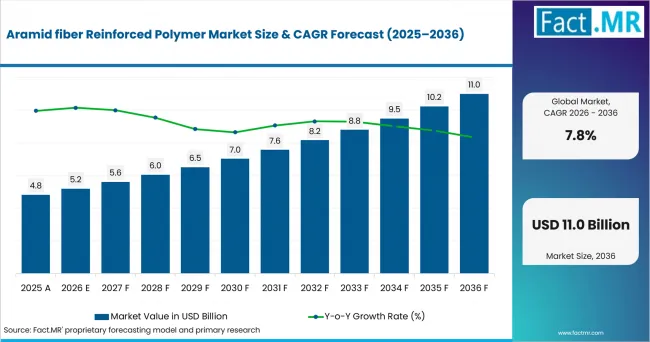
Aramid Fiber Reinforced Polymer Market Value Analysis | Source: Fact.MR
What are the defining numbers behind Aramid Fiber Reinforced Polymer Market growth?
An absolute opportunity of USD 5.8 billion is expected between 2026 and 2036.
- Demand Drivers in the Market
- Aerospace qualification supports A-FRP demand because aramid is among the fiber reinforcements covered by FAA guidance for polymer composite aircraft structures.
- Lightweight structural design remains important where engineers need high strength without the mass associated with conventional metallic structures. NASA identifies aramid fibers such as Kevlar in lightweight composite aircraft structures.
- Automotive lightweighting creates another demand path. The U.S. Department of Energy identifies aramid among the reinforcement fibers used in lightweight FRP composites and links lower structural mass with vehicle energy savings.
- Civil and infrastructure applications broaden the addressable base. The Federal Highway Administration maintains dedicated technical resources for fiber-reinforced polymer composite structures.
- Material suppliers continue to develop aramid grades for composites and other demanding reinforcement applications. DuPont and Teijin document aerospace or high-performance composite uses for Kevlar and Twaron.
- Key Segments Analyzed
- Aramid Fiber Reinforced Thermoset Polymers account for 66.8% of Product in 2026, supported by their established use in structural composite applications requiring dimensional stability and effective load transfer.
- Aerospace & Defense Applications hold 42.6% of Application in 2026, driven by demand for lightweight materials with high impact resistance and structural performance.
- Aerospace Industry represents 61.4% of End Use in 2026, supported by stringent material qualification requirements and the need for lightweight composite structures.
- Resin Transfer Molding (RTM) captures 53.9% of Technology in 2026, reflecting its ability to support controlled resin flow and repeatable production of shaped composite components.
- High Strength Structural Formulations account for 74.3% of Formulation in 2026, supported by demand for load-bearing and impact-resistant composite systems.
- Direct OEM Sales hold 58.7% of Distribution Channel in 2026, reflecting the need for direct technical coordination during material qualification and production-scale adoption.
- Analyst Opinion at Fact.MR
- Shambhu Nath Jha, Principal Consultant at Fact.MR, states, “Buyer decisions in the Aramid Fiber Reinforced Polymer Market will centre on structural performance under the actual load, temperature and impact conditions of the finished component. Aerospace qualification supports a demanding performance benchmark, while automotive and industrial buyers will compare weight reduction against processing cost and cycle time. Suppliers that support material qualification and maintain consistent fiber-resin performance can improve their position in repeat OEM programmes.”
- Strategic Implications
- Suppliers should document composite performance under the processing route used by the customer rather than rely on fiber-level specifications alone.
- Thermoset suppliers need to defend established aerospace applications while preparing for greater interest in thermoplastic A-FRP systems.
- RTM suppliers should focus on resin flow consistency and repeatable fiber placement for production parts.
- Hybrid composite developers can target applications where impact tolerance is valued alongside stiffness or lower structural mass.
- OEM support matters because qualification history can make material substitution slower after a composite system enters production.
How does the Aramid Fiber Reinforced Polymer Market break down by segment?
The market is segmented by Product, Application, End Use, Technology, Formulation and Distribution Channel.
Why do Aramid Fiber Reinforced Thermoset Polymers lead Product?
Aramid Fiber Reinforced Thermoset Polymers are projected to account for a 66.8% share in 2026.
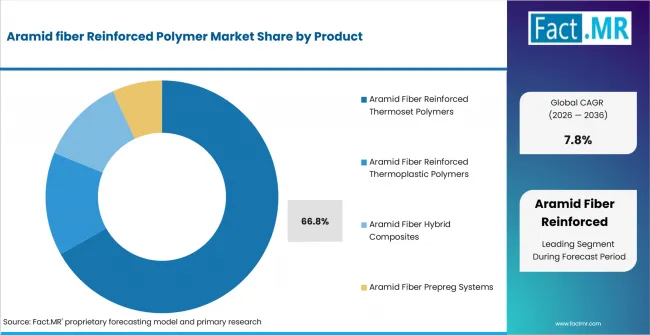
Aramid Fiber Reinforced Polymer Market Analysis By Product | Source: Fact.MR
Thermoset matrices provide an established route for converting aramid reinforcement into structural composite parts where dimensional stability and load transfer matter. Epoxy-based and polyester-based A-FRP composites extend the segment across different performance and processing requirements.
Why do Aerospace & Defense Applications lead Application?
Aerospace & Defense Applications are projected to account for a 42.6% share in 2026.
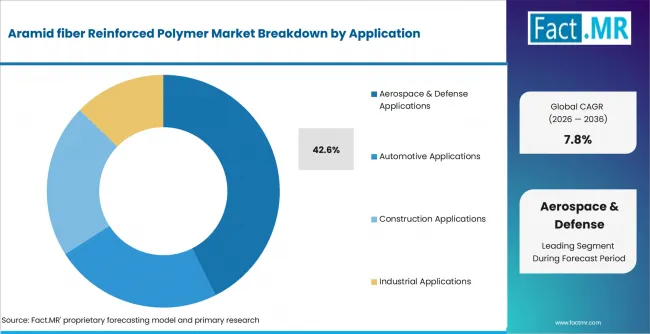
Aramid Fiber Reinforced Polymer Market Analysis By Application | Source: Fact.MR
The segment benefits from the combination of low weight and impact performance available from aramid reinforcement. FAA guidance explicitly recognizes aramid-reinforced polymeric materials within composite aircraft structures, while DuPont documents Kevlar use in aircraft composite applications.
Why does Aerospace Industry lead End Use?
Aerospace Industry is projected to account for a 61.4% share in 2026.
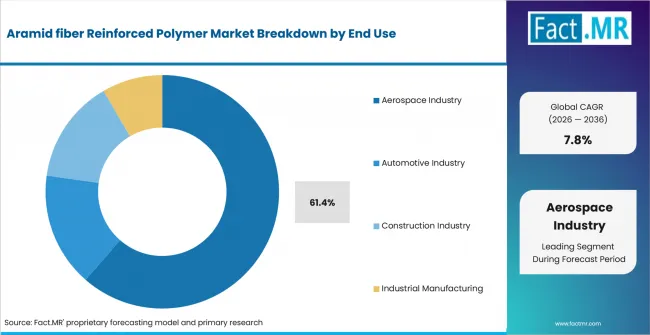
Aramid Fiber Reinforced Polymer Market Analysis By End Use | Source: Fact.MR
Aircraft manufacturers operate under qualification requirements that reward repeatable material properties and controlled composite processing. NASA identifies aramid-based honeycomb structures as a route to light and tough aircraft construction, reinforcing the technical fit of the material class.
Why does Resin Transfer Molding (RTM) lead Technology?
Resin Transfer Molding (RTM) is projected to account for a 53.9% share in 2026.
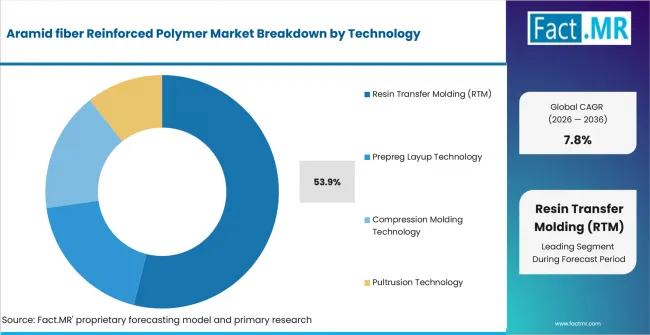
Aramid Fiber Reinforced Polymer Market Analysis By Technology | Source: Fact.MR
RTM supports controlled resin introduction into reinforced structures and can be used for shaped composite components requiring repeatable processing. The technology fits applications where manufacturers need closer control over part geometry and finished structural performance.
Why do High Strength Structural Formulations lead Formulation?
High Strength Structural Formulations are projected to account for a 74.3% share in 2026.
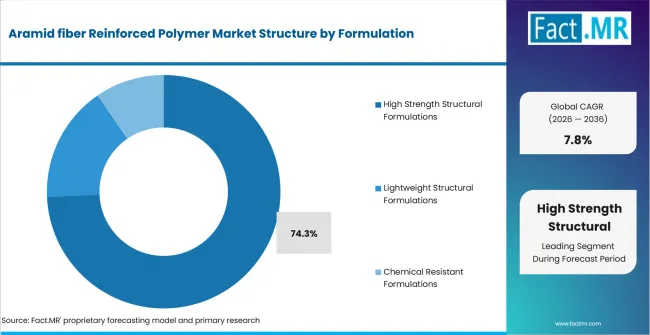
Aramid Fiber Reinforced Polymer Market Analysis By Formulation | Source: Fact.MR
The category aligns directly with the mechanical reason for selecting aramid reinforcement in load-bearing or impact-sensitive composite components. Teijin describes para-aramid as a high-performance fiber developed for demanding mechanical loads, while DuPont positions Kevlar around lightweight strength and durability.
Why does Direct OEM Sales lead Distribution Channel?
Direct OEM Sales are projected to account for a 58.7% share in 2026.
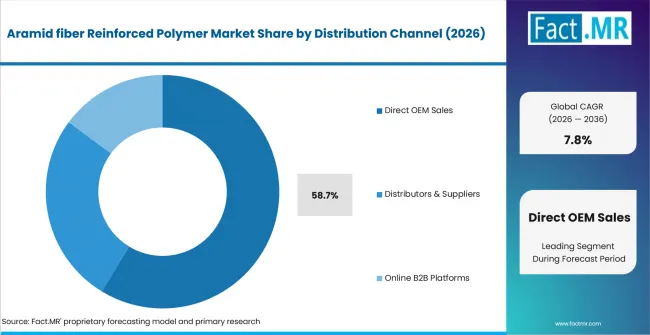
Aramid Fiber Reinforced Polymer Market Analysis By Distribution Channel | Source: Fact.MR
Structural composite materials frequently require customer-specific qualification before repeat production. Direct supplier-to-OEM relationships allow technical teams to align material grade with processing conditions and finished-part requirements before commercial scale-up.
What is accelerating Aramid Fiber Reinforced Polymer Market adoption, and what is holding it back?
Drivers Impact Analysis
| Factor | (~) % Impact on CAGR | Geographic Relevance | Impact Timeline |
|---|---|---|---|
| Aerospace lightweight structural demand | +2.1% | USA | Short term (<= 2 years) |
| Thermoset A-FRP qualification across structural applications | +1.7% | Germany | Medium term (2-4 years) |
| OEM demand for impact-resistant molded components | +1.3% | Japan | Long term (>= 4 years) |
Opportunity Impact Analysis
| Factor | (~) % Impact on CAGR | Geographic Relevance | Impact Timeline |
|---|---|---|---|
| Thermoplastic A-FRP systems | +1.1% | Germany | Medium term (2-4 years) |
| Carbon-Aramid and Glass-Aramid hybrid systems | +0.9% | USA | Long term (>= 4 years) |
| Infrastructure reinforcement applications | +0.7% | Brazil | Medium term (2-4 years) |
Restraints Impact Analysis
| Factor | (~) % Impact on CAGR | Geographic Relevance | Impact Timeline |
|---|---|---|---|
| High material and processing cost | -1.0% | Brazil | Short term (<= 2 years) |
| Fiber-resin interface and process-control requirements | -0.8% | USA | Medium term (2-4 years) |
| Qualification and composite repair complexity | -0.6% | Germany | Long term (>= 4 years) |
Which countries are scaling the Aramid Fiber Reinforced Polymer Market through 2036?
- Germany is projected to expand at an 8.97% CAGR through 2036, supported by lightweight transport research and the use of fiber-reinforced composites in mobility applications.
- Brazil is forecast to grow at an 8.19% CAGR, with demand supported by its aerospace manufacturing base and ongoing development of composite structures.
- The USA is projected to expand at a 7.41% CAGR as aerospace qualification requirements and automotive lightweight-material research continue to support A-FRP adoption.
- The UK is forecast to grow at a 6.63% CAGR, supported by continued investment in aerospace composite capability and related manufacturing technologies.
- Japan is projected to expand at a 5.85% CAGR, with growth linked to established expertise in advanced composite processing across aerospace and automotive applications.
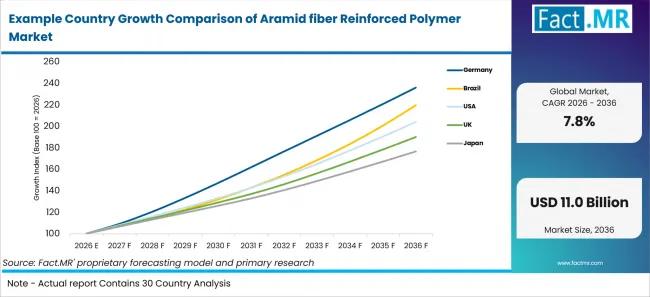
Example Country Growth Comparison Of Aramid Fiber Reinforced Polymer Market | Source: Fact.MR
Country CAGR (2026-2036)
| Country | CAGR (2026-2036) |
|---|---|
| Germany | 8.97% |
| Brazil | 8.19% |
| USA | 7.4% |
| UK | 6.63% |
| Japan | 5.85% |
What is driving Germany's growth through 2036?
Germany is forecast to expand at an 8.97% CAGR from 2026 to 2036.
Germany has an established transport manufacturing base where lightweight materials are evaluated against manufacturing repeatability and structural requirements. Germany's Federal Ministry for Economic Affairs has identified fiber-reinforced composites among the lightweight material routes relevant to mobility and transport technologies.
What is driving Brazil's growth through 2036?
Brazil is forecast to expand at an 8.19% CAGR from 2026 to 2036.
Aerospace manufacturing provides a technically demanding use case for structural composites within the country. Embraer and Brazilian public-sector partners have supported work involving the development and validation of high-efficiency composite wing technologies.
What is driving the USA's growth through 2036?
The USA is forecast to expand at a 7.4% CAGR from 2026 to 2036.
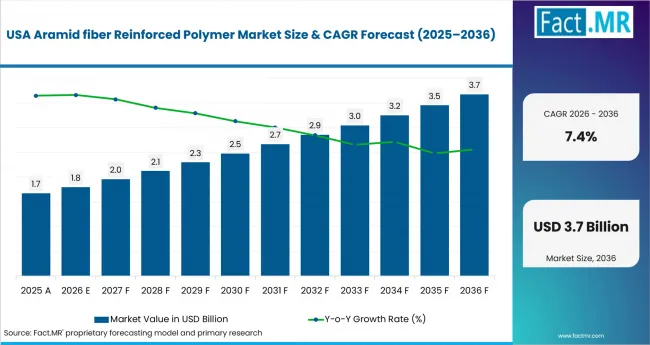
Aramid Fiber Reinforced Polymer Market Country Value Analysis | Source: Fact.MR
The market benefits from aerospace qualification requirements and continued lightweight-material development. FAA guidance covers composite aircraft structures using aramid reinforcement, while U.S. Department of Energy programmes address lightweight composite materials for transportation.
What is driving the UK's growth through 2036?
The UK is forecast to expand at a 6.63% CAGR from 2026 to 2036.
Aerospace programmes are creating a strong technical environment for composite processing and qualification. The Aerospace Technology Institute published a composites framework in July 2026 aimed at increasing UK capability in aerospace composite technologies.
What is driving Japan's growth through 2036?
Japan is forecast to expand at a 5.85% CAGR from 2026 to 2036.
Demand is supported by established aerospace and automotive manufacturing capabilities that require tightly controlled advanced-material processing. Japan's Ministry of Economy, Trade and Industry has documented domestic expertise in molding and processing composite materials for aerospace programmes.
Who leads the Aramid Fiber Reinforced Polymer Market?
Teijin Aramid is positioned within the competitive set through its established aramid portfolio and composite applications. DuPont competes through Kevlar-based reinforcement materials, while Yantai Tayho Advanced Materials and Hyosung Advanced Materials maintain their own para-aramid offerings.
Competition depends on fiber performance after conversion into the finished polymer system. Suppliers must therefore compete on consistency during molding and on technical support during customer qualification.
The source also includes Jiangsu Hongbo Communication Technology Co., Ltd, X-Fiper and Celanese within the competitive set. Celanese maintains a broader engineered-polymer and composite materials portfolio that includes aerospace applications.
Which companies are the key providers?
Key companies include Teijin Aramid; Jiangsu Hongbo Communication Technology Co., Ltd.; DuPont; X-Fiper; Yantai Tayho Advanced Materials Co., Ltd.; Hyosung Advanced Material; and Celanese.
- Teijin Aramid
- Jiangsu Hongbo Communication Technology Co., Ltd
- DuPont
- X-Fiper
- Yantai Tayho Advanced Materials Co., Ltd.
- Hyosung Advanced Material
- Celanese
Bibliography
- Federal Aviation Administration. AC 21-26A: Quality Control for the Manufacture of Composite Structures. U.S. Department of Transportation.
- Federal Aviation Administration. AC 43-214A: Repairs and Alterations to Composite and Bonded Aircraft Structure. U.S. Department of Transportation.
- NASA. Composite Materials. NASA Spinoff.
- U.S. Department of Energy. Composite Materials Technology Assessment.
- U.S. Department of Energy. Materials Technology.
- Federal Highway Administration. Fiber Reinforced Polymer Composite Technology. U.S. Department of Transportation.
- Federal Ministry for Economic Affairs, Germany. Mobility and Transport Technologies.
- Aerospace Technology Institute. Framework for Growth to Secure the UK's Composites Advantage.
- Embraer. Embraer, MCTI and Finep Agreement for Development and Validation of Composite Wing Technologies.
- Ministry of Economy, Trade and Industry, Japan. Aerospace Industry and Composite Material Processing.
- DuPont. Kevlar for Aerospace.
- Teijin Aramid. Twaron.
- Teijin. Aramid Products and Applications.
- Yantai Tayho Advanced Materials. Taparan Para-Aramid.
- Hyosung Advanced Materials. ALKEX Aramid Yarn.
- Celanese. Aviation Polymers and Composite Materials.
This Report Answers
- The report examines demand across Product, Application, End Use, Technology, Formulation and Distribution Channel.
- Segment analysis explains the operating reasons behind the major categories in each part of the market.
- Country analysis evaluates adoption conditions across the covered national markets through the forecast period.
- Competitive analysis reviews the profiled companies and their relevance to aramid or composite-material supply.
- The analysis considers material qualification and processing requirements that influence commercial purchasing decisions.
What does the Aramid Fiber Reinforced Polymer Market cover?
The Aramid Fiber Reinforced Polymer Market covers polymer composite materials in which aramid fiber provides structural reinforcement. The assessment includes thermoset systems and thermoplastic systems along with hybrid composites and prepreg configurations listed in the segmentation.
Aramid fibers are used where designers require a combination of low weight and high mechanical performance. FAA and NASA material guidance recognizes aramid within aerospace composite structures, while commercial suppliers position para-aramid for demanding reinforcement applications.
What is included in the scope?
The scope includes Aramid Fiber Reinforced Thermoset Polymers and Aramid Fiber Reinforced Thermoplastic Polymers. It also covers Aramid Fiber Hybrid Composites and Aramid Fiber Prepreg Systems.
Application coverage includes Aerospace & Defense Applications and Automotive Applications. Construction Applications and Industrial Applications are also included.
The assessment covers the stated End Use categories and the four listed Technology routes. Formulation coverage follows High Strength Structural Formulations and Lightweight Structural Formulations together with Chemical Resistant Formulations.
Distribution coverage includes Direct OEM Sales and Distributors & Suppliers. Online B2B Platforms are included where the transaction relates to an in-scope A-FRP system.
What is excluded from the scope?
Standalone aramid textiles or protective garments are excluded when the material is not incorporated into a polymer composite system.
Unreinforced polymer resins are outside the market. Carbon-fiber or glass-fiber composites are excluded where aramid reinforcement is absent.
Metal components and conventional plastic parts are also excluded unless the commercial product contains an in-scope aramid fiber reinforced polymer structure.
How Was the Analysis Built?
The analysis combines the supplied market forecast and segmentation with public technical evidence relevant to aramid fiber reinforced polymer applications.
- Primary Research: Validation focuses on material suppliers and composite processors as well as OEM engineering or procurement teams responsible for structural materials.
- Desk Research: The review covers government composite-material guidance and supplier technical documentation from organizations active in aramid fibers or engineered composites.
- Market Sizing and Forecasting: Estimates assess the stated segment mix and country outlook against application requirements and commercial adoption conditions.
- Data Validation and Update Cycle: Findings are checked against supplier portfolios and public technical evidence. Updates review qualification changes and manufacturing developments that can influence demand.
What is the report's scope and coverage?
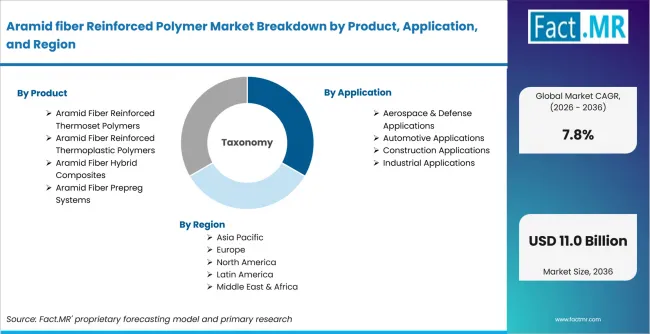
Aramid Fiber Reinforced Polymer Market Breakdown By Product, Application, And Region | Source: Fact.MR
| Attribute | Details |
|---|---|
| Quantitative Units | USD Billion |
| Market Definition | Polymer composite systems reinforced with aramid fiber and supplied for structural, protective or industrial applications within the stated segmentation. |
| Segments Covered | Product; Application; End Use; Technology; Formulation; Distribution Channel |
| Regions Covered | North America; Latin America; Europe; East Asia; South Asia and Oceania; Middle East and Africa |
| Countries Covered | Germany; Brazil; USA; UK; Japan |
| Key Companies Profiled | Teijin Aramid; Jiangsu Hongbo Communication Technology Co., Ltd; DuPont; X-Fiper; Yantai Tayho Advanced Materials Co., Ltd.; Hyosung Advanced Material; Celanese |
| Forecast Period | 2026 to 2036 |
| Base Year | 2025 |
| Market Value, 2026 | USD 5.2 billion |
| Market Value, 2036 | USD 11.0 billion |
| CAGR, 2026-2036 | 7.8% |
| Absolute Opportunity | USD 5.8 billion |
| Approach | Combines segment demand with composite processing requirements, OEM procurement patterns and application-level qualification conditions. |
How is the market segmented?
-
By Product:
- Aramid Fiber Reinforced Thermoset Polymers
- Epoxy Based A-FRP Composites
- Polyester Based A-FRP Composites
- Aramid Fiber Reinforced Thermoplastic Polymers
- Polyamide (Nylon) Based A-FRP
- Polypropylene Based A-FRP
- Aramid Fiber Hybrid Composites
- Carbon-Aramid Hybrid Systems
- Glass-Aramid Hybrid Systems
- Aramid Fiber Prepreg Systems
- Pre-Impregnated Sheets
- Custom Prepreg Solutions
- Aramid Fiber Reinforced Thermoset Polymers
-
By Application:
- Aerospace & Defense Applications
- Aircraft Structural Components
- Defense Protection Systems
- Automotive Applications
- Lightweight Vehicle Structures
- EV Structural Systems
- Construction Applications
- Infrastructure Reinforcement
- Building Materials
- Industrial Applications
- Machinery Components
- Process Equipment
- Aerospace & Defense Applications
-
By End Use:
- Aerospace Industry
- Commercial Aviation
- Defense Aviation
- Automotive Industry
- OEM Automotive Manufacturers
- Tier 1 Suppliers
- Construction Industry
- Infrastructure Developers
- Real Estate Developers
- Industrial Manufacturing
- Heavy Equipment Manufacturers
- Chemical Industry
- Aerospace Industry
-
By Technology:
- Resin Transfer Molding (RTM)
- High Pressure RTM Systems
- Low Pressure RTM Systems
- Prepreg Layup Technology
- Manual Layup Systems
- Automated Layup Systems
- Compression Molding Technology
- Hot Compression Molding
- Cold Compression Molding
- Pultrusion Technology
- Continuous Fiber Pultrusion
- Custom Pultrusion Systems
- Resin Transfer Molding (RTM)
-
By Formulation:
- High Strength Structural Formulations
- Load Bearing Composite Systems
- Impact Resistant Formulations
- Lightweight Structural Formulations
- Weight Optimized Systems
- Fuel Efficiency Optimized Systems
- Chemical Resistant Formulations
- Corrosion Resistant Systems
- Thermal Resistant Systems
- High Strength Structural Formulations
-
By Distribution Channel:
- Direct OEM Sales
- Aerospace OEM Contracts
- Automotive OEM Contracts
- Distributors & Suppliers
- Industrial Material Distributors
- Regional Distributors
- Online B2B Platforms
- Industrial E-Commerce Portals
- Manufacturer Direct Portals
- Direct OEM Sales
-
By Region:
- North America
- Latin America
- Western Europe
- Eastern Europe
- East Asia
- South Asia and Pacific
- Middle East & Africa