- Market Value (2025): USD 408.4 Mn
- Estimated Value (2026): USD 425.6 Mn
- Forecast Value (2036): USD 642.2 Mn
- CAGR (2026-2036): 4.2%
What is the Asphalt Release Agents Market forecast to be worth by 2036?
USD 425.6 million in 2026 to USD 642.2 million by 2036, at 4.2% CAGR.
- The asphalt release agents market crossed a valuation of USD 408.4 million in 2025 as road contractors maintained recurring chemical usage across loading and paving operations.
- Demand is projected to increase from USD 425.6 million in 2026 to USD 642.2 million by 2036 across road construction process chemistry programs.
- The market is forecast to record a 4.2% CAGR from 2026 to 2036 as asphalt plants and paving contractors replace petroleum substitutes with purpose-built release formulations.
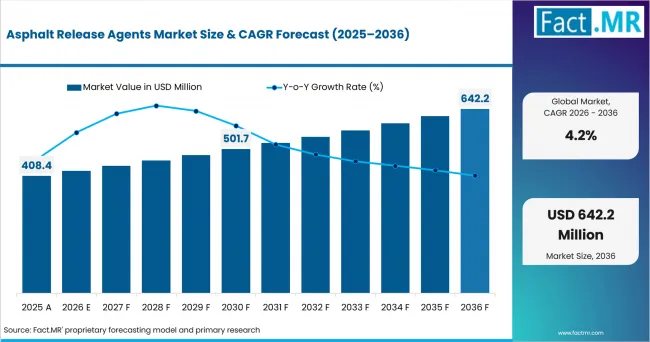
Asphalt Release Agents Market Market Value Analysis | Source: Fact.MR
What are the defining numbers behind Asphalt Release Agents Market growth?
USD 216.6 million absolute opportunity by 2036, led by Bio-based products and Liquid formulations across Road Construction end uses.
- Demand Drivers in the Market
- Road contractors need reliable release products that prevent asphalt buildup across truck beds during repeated hauling cycles.
- Asphalt plant operators favor liquid formulations that can be applied consistently across loading equipment and transport surfaces.
- Public road programs support recurring chemical demand because each paving cycle creates repeated release-agent application requirements.
- Procurement teams increasingly test bio-based formulations where performance documentation supports equipment protection and operating compliance.
- Key Segments Analyzed
- By Product Type: Bio-based is expected to account for 43.0% share in 2026, supported by lower dependence on petroleum-derived release oils.
- By Form: Liquid is projected to represent 68.0% share in 2026, reflecting simple handling across spray equipment and manual application routines.
- By Application: Truck Beds are estimated to capture 39.0% share in 2026, owing to treatment before recurring hot-mix loading cycles.
- By End Use: Road Construction is forecast to account for 55.0% share in 2026, driven by recurring paving and resurfacing programs.
- Analyst Opinion at Fact.MR
- Shambhu Nath Jha, Senior Analyst at Fact.MR, states, “Purchasing decisions are shifting toward products that combine reliable asphalt release with simple field application. Suppliers with bio-based formulations and liquid delivery options can address frequent truck-bed treatment across road construction programs. Commercial positioning will depend on application support and consistent regional availability.”
- Strategic Implications
- Producers should document bio-based product performance across hot-mix conditions before contractors expand use across larger fleets.
- Distributors should position liquid formulations near road construction corridors where paving seasons create concentrated replenishment demand.
- Contractors should test application rates on truck beds before changing procedures across entire hauling fleets.
- Suppliers should separate release-agent claims from asphalt removers because buyers evaluate preventative and corrective products differently.
FUCHS currently markets the RENOCAST AP range for asphalt release applications across mineral-oil and vegetable-oil bases. The portfolio also includes emulsions and concentrates that address different equipment requirements and field application procedures. This portfolio breadth reflects the market shift toward application-specific product choices across recurring road construction operations.
India is expected to record a 6.0% CAGR during the forecast period, supported by highway construction and maintenance activity. China is projected to post a 5.3% CAGR between 2026 and 2036, owing to transport investment and extensive paving corridors. Australia is anticipated to advance at a 4.0% CAGR over the assessment period, driven by funded road and rail infrastructure delivery. The United Kingdom is estimated to record a 3.7% CAGR by 2036, shaped by road maintenance and renewal programs. The United States is forecast to post a 3.5% CAGR across the forecast horizon, attributable to public infrastructure project delivery. Germany is projected to record a 3.2% CAGR during the assessment period, supported by transport infrastructure renewal. Japan is expected to advance at a 2.9% CAGR through 2036, reflecting ongoing road maintenance and network modernization needs.
How does the Asphalt Release Agents Market break down by segment?
Bio-based is estimated at 43.0% share in Product Type, while Liquid is projected at 68.0% share in Form during 2026.
Which Product Type is expected to account for the significant share?
Bio-based products are estimated to account for 43.0% share in 2026.
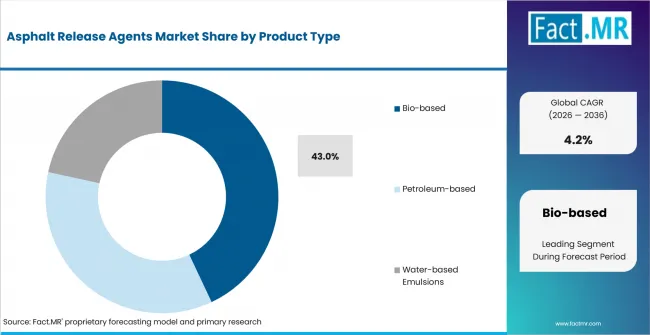
Asphalt Release Agents Market Analysis By Product Type | Source: Fact.MR
Bio-based products are expected to account for 43.0% share in 2026, supported by demand for alternatives to petroleum-derived release oils. Petroleum-based products remain relevant where contractors prioritize established handling characteristics and broad distributor availability during recurring paving programs. Water-based emulsions serve buyers that need low-residue application across frequent equipment contact points during busy shifts. FUCHS markets asphalt release products based on vegetable oils alongside mineral-oil formulations and emulsions for varied asphalt operations.
Which Form is projected to garner the notable share?
Liquid formulations are projected to garner 68.0% share in 2026.
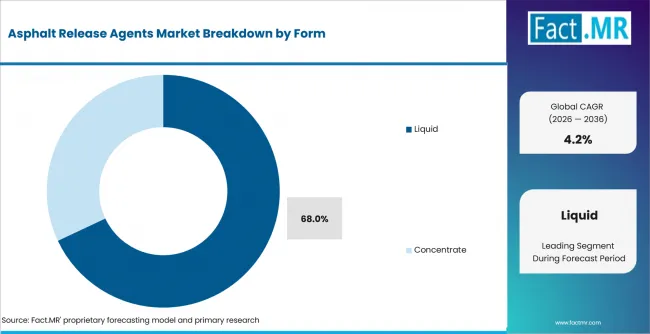
Asphalt Release Agents Market Analysis By Form | Source: Fact.MR
Liquid formulations are projected to account for 68.0% share in 2026, reflecting straightforward spraying and coverage across equipment surfaces. Concentrates remain useful where operators control dilution rates and seek lower freight burden per treated unit. Cortec markets a water-based ready-to-use release agent that prevents asphalt buildup on construction equipment across recurring road work. Form selection therefore depends on application frequency and the operator’s ability to control preparation procedures.
How does Application shape demand?
Truck Beds are estimated to record 39.0% share in 2026
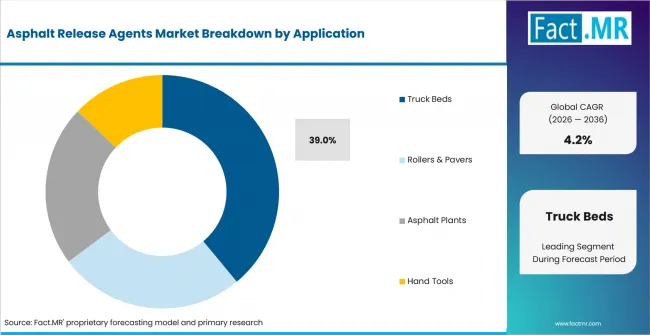
Asphalt Release Agents Market Analysis By Application | Source: Fact.MR
Truck Beds are anticipated to capture 39.0% share in 2026, supported by treatment before repeated hot-mix loading cycles. Rollers and Pavers require release protection where asphalt contact creates cleanup work during active paving shifts. Asphalt Plants use release products across chutes and handling areas while Hand Tools represent smaller recurring use points. FUCHS identifies dump truck beds and rollers among the application areas for its asphalt release portfolio.
Which End Use accounts for the leading share?
Road Construction is forecast to account for 55.0% share in 2026
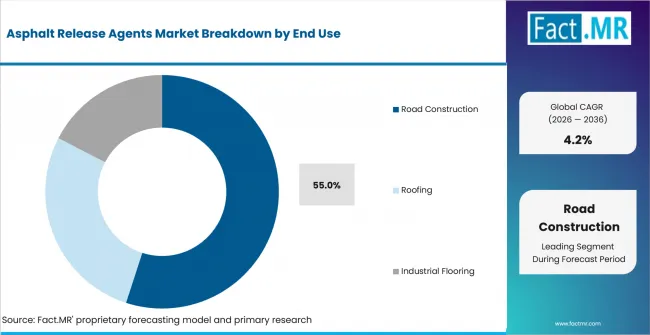
Asphalt Release Agents Market Analysis By End Use | Source: Fact.MR
Road Construction is expected to represent 55.0% share in 2026, driven by recurring paving and resurfacing activity. Roofing applications use release agents where bituminous materials contact production or handling equipment during manufacturing cycles. Industrial Flooring represents a smaller demand base linked to specialized asphalt and bituminous surface operations. Road project pipelines keep release-agent consumption connected to repeated loading and paving equipment cycles during active paving schedules.
What is accelerating Asphalt Release Agents Market adoption, and what is holding it back?
Road construction activity supports recurring usage while substitution practices and qualification requirements can slow product switching.
Drivers Impact Analysis
| DRIVER | (~) % IMPACT ON CAGR | GEOGRAPHIC RELEVANCE | IMPACT TIMELINE |
|---|---|---|---|
| Road construction and resurfacing activity | +0.7% | Asia Pacific and North America | Medium term (2-4 years) |
| Agency preference for approved non-petroleum products | +0.5% | North America and Europe | Short term (<= 2 years) |
| Polymer-modified mix adhesion control | +0.4% | Global paving corridors | Medium term (2-4 years) |
| Automated truck-bed spraying | +0.3% | North America and Europh | Medium term (2-4 years) |
| Recycling and warm-mix process variation | +0.2% | North America and Europe | Long term (>= 4 years) |
Source: Fact.MR analysis. Updated Jul 9, 2026
- Road program delivery: Road building and resurfacing create repeated coating cycles before hauling and placement equipment touches hot mix. In January 2025, the United States Department of Transportation reported USD 247 billion in obligated infrastructure law funding through fiscal year 2024. Active project pipelines are expected to sustain chemical consumption across plant loading lanes and contractor fleets. Providers gain more value when replenishment schedules match regional construction calendars and planned project starts across contractor territories.
- Qualified non-petroleum products: Public specifications push asphalt operators toward products that protect mix integrity without using diesel or aggressive solvents. MassDOT maintains a Qualified Construction Materials List for products used on Highway Division construction contracts. Adoption is projected to favor suppliers that prepare technical records before field trials and plant demonstrations begin across qualified projects. Qualification support shortens the distance between a successful test and wider contractor use across several paving crews and project locations.
- Mix adhesion control: Sticky asphalt mixtures increase the operating cost of poor release performance across truck beds and paving equipment. FUCHS offers asphalt release agents for hot and mastic asphalt applications across equipment contact surfaces. Demand is anticipated to expand for products that release material without interfering with asphalt handling requirements. Field testing remains important where mix conditions and surface temperatures vary across repeated road construction operations.
- Application consistency: Uneven spraying can increase both sticking risk and chemical use across busy plants. Liquid formulations fit spray-based routines that help crews apply a repeatable surface film across truck beds. Equipment compatibility is expected to influence supplier selection where contractors treat large fleets during narrow paving windows. Training and field support remain important during product changes across active contractor fleets and plant operations.
- Changing asphalt process conditions: Release agents must work across conventional hot mix and lower-temperature processes without creating residue problems. EAPA reported an average 14.6% warm-mix share during 2024 among countries with complete reporting series. Procurement is forecast to reward suppliers that give specific dilution guidance for changing production temperatures. Consistent field performance reduces the risk of operators reverting to unauthorized substitutes during high-output paving periods and demanding project schedules.
Opportunity Impact Analysis
| OPPORTUNITY | (~) % IMPACT ON CAGR | GEOGRAPHIC RELEVANCE | IMPACT TIMELINE |
|---|---|---|---|
| Bio-based ester release systems | +0.4% | North America and Europe | Medium term (2-4 years) |
| High-dilution concentrates | +0.3% | Global contractor fleets | Short term (<= 2 years) |
| Automated dispensing and telemetry | +0.3% | North America and Europe | Medium term (2-4 years) |
| Asia Pacific local service networks | +0.2% | India and China | Long term (>= 4 years) |
Source: Fact.MR analysis. Updated Jul 9, 2026
- Bio-based product systems: Vegetable-oil chemistry gives contractors an alternative to petroleum-derived release products across frequent paving applications. FUCHS markets asphalt release agents based on vegetable oils alongside other product formats for varied operating requirements. Opportunity is expected to expand where suppliers document release performance across hot-mix conditions and recurring field applications. Application guidance can support adoption across contractor fleets that operate different equipment surfaces during paving programs.
- Liquid delivery formats: Liquid products support direct spraying across truck beds and construction equipment during repeated loading cycles. Cortec markets a water-based ready-to-use release agent that prevents asphalt and other debris from sticking to equipment surfaces. Commercial opportunity is projected to favor suppliers that combine simple application with clear coverage guidance. Consistent handling can reduce operator variation across high-frequency road construction work and recurring equipment treatment cycles.
- Adjacent asphalt chemistry channels: Established asphalt-material suppliers can use existing customer relationships to support broader road construction chemical portfolios. Cargill markets bio-based asphalt rejuvenators for recycled pavement applications and works with road-sector customers across infrastructure markets. This adjacent presence can improve account access even though rejuvenators and release agents serve different technical functions. Suppliers with credible road construction relationships may gain cross-selling opportunities across contractor and plant accounts.
- Asia Pacific service coverage: India and China combine road investment with long travel distances between chemical production and active paving corridors. India reported a national highway network of 146,204 km in June 2025 across the country’s major transport corridors. Opportunity is estimated to increase for local distributors that stock concentrates near contractor clusters and large project corridors requiring regular replenishment. Field technicians who support dilution trials gain a clearer route to repeat orders across new contractor accounts and recurring project programs.
Restraints Impact Analysis
| RESTRAINT | (~) % IMPACT ON CAGR | GEOGRAPHIC RELEVANCE | IMPACT TIMELINE |
|---|---|---|---|
| Qualification and list-entry cycles | -0.4% | North America and Europe | Short term (<= 2 years) |
| Dilution errors and residue risk | -0.3% | Global contractor fleets | Medium term (2-4 years) |
| Feedstock and formulation cost variability | -0.2% | Global chemical supply | Medium term (2-4 years) |
| Use of diesel or unapproved substitutes | -0.2% | Price-sensitive local projects | Long term (>= 4 years) |
Source: Fact.MR analysis. Updated Jul 9, 2026
- Qualification cycles: A formulation change often requires documentation and field evaluation before a public road contractor changes the approved product. Qualified product systems reduce uncertainty but extend the commercial conversion period for new suppliers entering public work programs and contractor shortlists. Demand is expected to move slowly where procurement teams avoid mid-season chemistry changes across qualified project fleets and established operating procedures. Vendors need technical preparation before price discussions reach the final sourcing stage with plant managers and contractor procurement accounts.
- Dilution errors: Concentrates create economic value only when operators apply the correct ratio and cover the full equipment surface. Over-dilution increases sticking risk while under-dilution raises chemical cost and residue concerns during repeated loading cycles and equipment coating routines. Adoption is projected to remain selective where suppliers provide product without dosing support and regular field follow-up during initial plant conversion. Clear visual procedures and calibrated equipment reduce avoidable performance disputes at the plant during fast production shifts and frequent truck movements.
- Input cost variability: Water-based and ester-based formulations depend on surfactants and lubricant inputs that move under different cost conditions. Formulators must balance release performance against concentrate economics without weakening asphalt compatibility across multiple use conditions and changing contractor requirements. Procurement is anticipated to scrutinize delivered cost per treated truck more closely than price per container. Suppliers with flexible formulations gain room to protect account economics during input changes without weakening customer performance or qualification support.
- Unapproved substitutes: Some operators still compare purpose-built agents against inexpensive diesel or solvent practices during cost reviews. Those comparisons ignore mix-quality risk and approval requirements that shape public work and contractor operating practices across regulated projects. Market conversion is estimated to slow where contractors lack clear instructions from agencies or prime contractors. Demonstrations that measure cleanup time and treated loads help shift the discussion toward operating cost.
Which countries are scaling Asphalt Release Agents Market rapidly?
India 6.0%; China 5.3%; Australia 4.0%; United Kingdom 3.7%; United States 3.5%; Germany 3.2%; Japan 2.9% between 2026 and 2036.
Regional analysis covers North America and Europe alongside Asia Pacific while Latin America and the Middle East & Africa complete the regional framework.
| COUNTRY | CAGR |
|---|---|
| India | 6.0% |
| China | 5.3% |
| Australia | 4.0% |
| United Kingdom | 3.7% |
| United States | 3.5% |
| Germany | 3.2% |
| Japan | 2.9% |
Source: Fact.MR analysis. Updated Jul 9, 2026
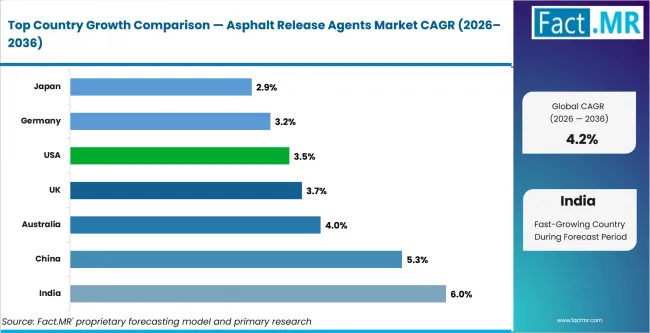
Asphalt Release Agents Market Cagr Analysis By Country | Source: Fact.MR
What is pushing Asphalt Release Agents Market growth in India?
6.0% CAGR during the forecast period, supported by highway construction and recurring maintenance across major paving corridors.
India’s market is supported by a large highway construction pipeline that creates repeated demand across truck beds and paving equipment. The Ministry of Road Transport and Highways reported 5,614 km of National Highway construction during fiscal year 2024-25. Demand is expected to record a 6.0% CAGR during the forecast period as contractors expand paving activity across national and regional corridors. Suppliers with local inventory and application support can serve short construction windows more effectively across active paving corridors.
How is China supporting asphalt release agent demand?
5.3% CAGR between 2026 and 2036, driven by transport investment and extensive paving activity across major economic corridors.
China’s market is supported by large transport investment programs and extensive highway paving activity across major economic corridors. In 2024, China added nearly 50,000 km of new highways, including more than 8,000 km of newly built or upgraded expressways. Demand is projected to post a 5.3% CAGR between 2026 and 2036 as infrastructure programs sustain equipment usage across asphalt plants and contractors. Local distribution coverage remains important because project activity is spread across several large paving regions.
What supports the Australia outlook?
4.0% CAGR over the assessment period, supported by funded transport projects and recurring road maintenance across dispersed regions.
Australia’s market is supported by road construction programs that require chemical supply across widely separated contractor locations. The market is anticipated to advance at a 4.0% CAGR over the assessment period as infrastructure delivery sustains paving and equipment treatment cycles. Regional distributors gain relevance when they maintain stock near active project corridors during concentrated paving schedules.
What underpins United Kingdom growth?
3.7% CAGR by 2036, shaped by local road maintenance and longer-term highway renewal programs across established contractor networks.
United Kingdom demand is supported by recurring road maintenance programs that create steady use across contractor fleets and local authority work. The Department for Transport notes that 2025-26 local highways maintenance funding includes an additional uplift versus 2024-25, with incentive requirements tied to transparency reporting and sustainable highways asset management. Demand is estimated to record a 3.7% CAGR by 2036 as resurfacing programs support repeated truck-bed and equipment treatment. Suppliers with approved formulations and local replenishment can compete effectively across short paving windows throughout recurring maintenance programs.
How is United States demand developing?
3.5% CAGR across the forecast horizon, attributable to public infrastructure projects and extensive asphalt paving activity across state markets.
United States demand is supported by federal and state road programs that keep asphalt production and paving equipment in frequent use. The U.S. Department of Transportation announced USD 1.32 billion for more than one hundred infrastructure projects in January 2025. The market is forecast to post a 3.5% CAGR across the forecast horizon as project delivery supports recurring release-agent use. Suppliers gain an advantage when technical support and distributor inventory remain close to contractor accounts.
What is supporting the Germany market outlook?
3.2% CAGR during the assessment period, supported by transport infrastructure renewal and sustained maintenance across federal road networks.
Demand in Germany is shaped by transport infrastructure renewal and the need to maintain high-use road networks across industrial regions. The 2026 federal budget framework keeps transport-sector investment at a historically elevated level while shifting part of infrastructure financing through a dedicated modernization fund. Demand is projected to record a 3.2% CAGR during the assessment period as maintenance programs sustain asphalt handling and paving activity. Release-agent suppliers can benefit from technical documentation and reliable distribution across regional contractor networks during recurring maintenance cycles.
How is Japan expected to progress?
2.9% CAGR through 2036, reflecting road maintenance requirements and continued modernization across established transport networks.
Japan’s industry expansion is supported by preventive road maintenance and network improvement programs across densely used transport corridors. The Ministry of Land Infrastructure Transport and Tourism continues to emphasize preventive maintenance and pavement management within its road policy framework. Demand is expected to advance at a 2.9% CAGR through 2036 as maintenance activity sustains recurring equipment treatment requirements. Suppliers that provide consistent product handling guidance can support contractors working within narrow operating schedules.
Who leads the Asphalt Release Agents Market?
FUCHS, Cargill and Cortec Corporation add broader asphalt and release-chemistry capabilities.
FUCHS has a dedicated asphalt release agent portfolio, and Its RENOCAST AP range covers vegetable-oil and mineral-oil bases alongside emulsions and concentrates for varied application requirements. Cortec Corporation offers a water-based ready-to-use release agent for construction equipment exposed to asphalt and other sticky materials. These suppliers compete through formulation breadth and application suitability across recurring road construction operations and contractor requirements.
Cargill brings adjacent asphalt chemistry access through its Anova rejuvenator portfolio for recycled pavement applications.
Which companies are the key providers?
- FUCHS
- Cargill
- Cortec Corporation
- REKTOL
- Mabanol
Bibliography
- Cortec Corporation. (2025, December 5). MCI-2050 release agent. Cortec Corporation.
- European Asphalt Pavement Association. (2026). Asphalt in Figures 2024. EAPA.
- Federal Ministry of Finance. (2025, July 30). 2026 federal budget and fiscal plan to 2029 adopted. Federal Republic of Germany.
- FUCHS. (2026). Bitumen and asphalt release agents. FUCHS.
- FUCHS. (2026). RENOCAST AP 5150 C. FUCHS.
- Government of China. (2024, December 25). China’s fixed-asset investment in transportation to reach 3.8 trillion yuan. The State Council of the People’s Republic of China.
- Massachusetts Department of Transportation. (2026, March 18). Asphalt Release Agents (M3.01.6). Commonwealth of Massachusetts.
- Ministry of Land, Infrastructure, Transport and Tourism. (2024). Roads in Japan 2024. Government of Japan.
- Ministry of Road Transport and Highways. (2025, April 2). NHAI achieves robust growth in National Highway construction during FY 2024–25. Press Information Bureau, Government of India.
- Ministry of Road Transport and Highways. (2025, June 11). Transforming India’s transport infrastructure (2014–2025). Press Information Bureau, Government of India.
- National Asphalt Pavement Association. (2026, April 21). Reclaimed asphalt pavement nears 100% recycling rate and remains America’s most recycled product. NAPA.
- U.S. Department of Transportation. (2025, January 10). Biden-Harris Administration announces USD 1.32 billion for infrastructure projects nationwide. U.S. Department of Transportation.
- REKTOL. (2026). Release agents. REKTOL.
- Mabanol. (2026). Release agents. Mabanol.
This Report Addresses
- The report provides strategic intelligence on Asphalt Release Agents across Product Type and Form choices that shape road construction chemical procurement.
- Segment analysis covers Bio-based products and Liquid formulations as the projected share leaders within the 2026 market structure.
- Application and End Use assessment covers Truck Beds and Road Construction as the leading categories in the analyst dataset.
- Regional outlook evaluates India and China alongside Australia while the United Kingdom and United States complete the higher-growth comparison. Germany and Japan provide additional established-market coverage.
- Competitive analysis profiles FUCHS alongside Cargill and Cortec Corporation.
- Product Type assessment covers Bio-based and Petroleum-based products alongside Water-based Emulsions used across different paving conditions.
- Application assessment covers Truck Beds and Rollers & Pavers alongside Asphalt Plants while Hand Tools complete the defined application set.
What does the Asphalt Release Agents Market cover?
Bio-based and Petroleum-based products sit alongside Water-based Emulsions used to prevent asphalt adhesion across equipment surfaces.
The Asphalt Release Agents Market covers preventative formulations applied before hot or warm asphalt contacts equipment surfaces. Coverage includes Bio-based and Petroleum-based products alongside Water-based Emulsions used across truck beds and road construction equipment.
The market differs from asphalt removers because commercial value comes from preventing adhesion before buildup occurs. Solvent cleaners and degreasers remain outside the boundary unless they are sold within a dedicated release-agent program for asphalt operations.
What is included in the scope?
Asphalt release products used on truck beds and paving equipment across road construction and related industrial operations.
The scope includes Bio-based and Petroleum-based products alongside Water-based Emulsions sold in Liquid or Concentrate form. Application coverage spans Truck Beds and Rollers & Pavers alongside Asphalt Plants while Hand Tools complete the defined application set. End Use coverage includes Road Construction and Roofing alongside Industrial Flooring operations. The market excludes asphalt rejuvenators unless the purchased product is sold specifically as a release agent. Adjacent bitumen and asphalt additive portfolios provide competitive context without being counted as release-agent revenue.
What is excluded from the scope?
Asphalt removers and general equipment degreasers remain outside the defined market boundary for preventative asphalt release formulations and services.
The scope excludes solvents purchased mainly to dissolve hardened asphalt after buildup has occurred during routine paving operations and maintenance work. General truck washes and concrete form release agents are also excluded unless the purchased product is formulated and sold for preventative asphalt release on defined equipment surfaces.
How was the analysis built?
The methodology covers 120+ sources and 35+ company portfolios across 25+ countries alongside 20+ interviews.
- Primary Research
- Primary research includes interviews with asphalt plant managers and road contractors alongside fleet maintenance heads and chemical distributors. The work also includes procurement personnel and equipment service technicians who evaluate application performance and product handling needs. Seasonal inventory planning is tested across regional paving programs and contractor accounts with recurring chemical requirements.
- Desk Research
- Desk research reviews road investment releases and asphalt production statistics alongside supplier portfolios and application guides. Company product pages are mapped against Product Type and Form claims alongside defined Application and End Use coverage. Current commercial availability completes the portfolio review across active provider websites and product catalogs.
- Market-Sizing and Forecasting
- Forecasting uses road construction activity and asphalt production intensity alongside release-agent attachment rates and treated equipment cycles. The model also considers Product Type mix and Liquid versus Concentrate usage across regional project profiles. Application frequency and End Use demand are evaluated across paving seasons and recurring construction programs.
- Data Validation and Update Cycle
- Forecasts are validated through provider checks and buyer interviews that test assumptions on product selection and site usage. Portfolio mapping and regional distributor checks support company relevance while official road investment updates and asphalt statistics guide periodic forecast revisions.
Segmentation
What is the report’s scope and coverage?
| Attribute | Details |
|---|---|
| Quantitative Units | USD million |
| Market Definition | Preventative formulations applied before hot or warm asphalt contacts equipment surfaces to reduce adhesion across truck beds, paving equipment, asphalt plants and hand tools. |
| Product Type | Bio-based; Petroleum-based; Water-based Emulsions |
| Form | Liquid; Concentrate |
| Application | Truck Beds; Rollers & Pavers; Asphalt Plants; Hand Tools |
| End Use | Road Construction; Roofing; Industrial Flooring |
| Regions Covered | North America; Europe; Asia Pacific; Latin America; Middle East and Africa |
| Countries Covered | India; China; Australia; United Kingdom; United States; Germany; Japan |
| Key Companies Profiled | FUCHS; Cargill; Cortec Corporation; REKTOL; Mabanol |
| Forecast Period | 2026 to 2036 |
| Approach | Hybrid top-down and bottom-up approach using road construction activity; asphalt production intensity; release-agent attachment rates; treated equipment cycles; product type mix; liquid and concentrate usage; application frequency; end-use demand; regional project profiles and buyer validation |
Source: Fact.MR analysis. Updated Jul 9, 2026
How is the market segmented?
-
By Product Type
- Bio-based
- Petroleum-based
- Water-based Emulsions
-
By Form
- Liquid
- Concentrate
- By Application
- Truck Beds
- Rollers & Pavers
- Asphalt Plants
- Hand Tools
-
By End Use
- Road Construction
- Roofing
- Industrial Flooring
-
By Region
- North America
- United States
- Canada
- Europe
- United Kingdom
- Germany
- France
- Italy
- Spain
- Asia Pacific
- India
- China
- Australia
- Japan
- South Korea
- Latin America
- Brazil
- Argentina
- Mexico
- Chile
- Middle East and Africa
- UAE
- Saudi Arabia
- South Africa
- North America
Frequently Asked Questions
What share is Bio-based Product Type expected to capture?
How large is the Liquid Form projected to be?
What 2026 share could Truck Beds record?
What portion could Road Construction account for?
How fast is India expected to expand?
What growth rate is projected for China?
How is Australia expected to progress?
What pace is anticipated for the United Kingdom?
How is United States demand forecast to grow?
What growth pace is expected in Germany?
How is Japan expected to advance?
What is expected to drive recurring demand?
What is estimated to slow supplier conversion?
Why are liquid formulations projected to influence purchasing?
Who worked on this report


Preview the report firsthand - request a free sample
Free SampleGet the brochure for pricing and purchase details
Download PDF