Asset Performance Management Market (2026 - 2036)

The Asset Performance Management Market is segmented by Component (Solution and Services), Deployment Type (Cloud-Based and On-Premises), Organization Size (Very Large Enterprise, Large Enterprise, Medium Enterprise, and Small Enterprise), and Region. Forecast for 2026 to 2036.

Core Findings

    Asset Performance Management Market Forecast and Outlook 2026 to 2036

    In 2025, the asset performance management market was valued at USD 3.2 billion. Based on Future Market Insights' analysis, demand for asset performance management solutions is estimated to grow to USD 3.4 billion in 2026 and USD 8.0 billion by 2036. FMI projects a CAGR of 9.6% during the forecast period.

    Between 2026 and 2036, the market is projected to create an absolute dollar opportunity of USD 4.6 billion. This more than doubling of market value reflects structural enterprise demand for predictive maintenance platforms replacing reactive maintenance models across energy, manufacturing, and utilities. Growth is moderated by long enterprise procurement cycles, high integration complexity with legacy SCADA and ERP systems, and cybersecurity concerns around connected industrial data.

    Country growth reflects industrial digitalization investment, energy transition asset complexity, and manufacturing competitiveness mandates. India leads at 12.0% CAGR, driven by the National Industrial Corridor Programme and manufacturing sector APM investment under the PLI scheme. China follows at 11.7%, supported by smart manufacturing policy under Made in China 2025 and industrial IoT platform expansion. Germany posts 11.2% as Industry 4.0 frameworks and EU industrial decarbonisation mandates push energy and manufacturing operators toward predictive asset management. Brazil registers 10.5% tied to Petrobras digital oilfield investment and expanding industrial maintenance outsourcing. The United States posts 9.8%, the most mature market, sustained by energy sector decarbonisation investment and continuous upgrade cycles at refining, power, and chemical facilities.
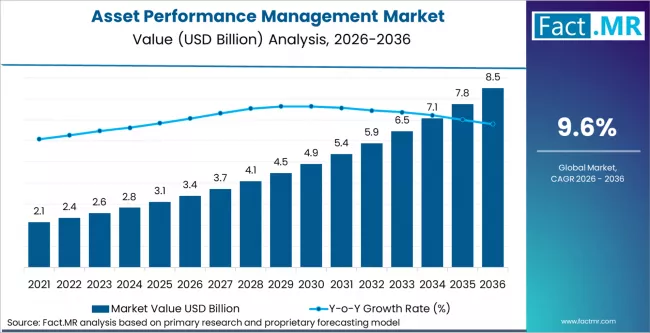
    Asset Performance Management Market Market Value Analysis

    Metric Value
    Estimated Value in 2026 USD 3.4 billion
    Forecast Value in 2036 USD 8.0 billion
    Forecast CAGR (2026 to 2036) 9.6%

    Market Definition

    Asset performance management (APM) includes software and services that monitor, analyse, and optimise industrial asset health, reliability, and performance using sensor data and AI analytics.

    Market Inclusions

    Includes global and regional forecasts from 2026–2036 by component, deployment type, and organization size across cloud and on-premises platforms.

    Market Exclusions

    Excludes basic CMMS tools without predictive analytics, ERP systems, automation hardware, IT monitoring platforms, and consulting services without APM software.

    Research Methodology

    • Primary Research: Interviews with APM vendors, industrial IT directors, maintenance heads, OEM digital teams, and enterprise software procurement managers.
    • Desk Research: Sources include OEM earnings reports, industrial IoT surveys, digitalisation programme records, and industry publications from 2024–2025.
    • Market Sizing and Forecasting: A hybrid model using enterprise software spending, APM adoption rates by sector, contract values, and deployment trends.
    • Data Validation and Update Cycle: Results validated through vendor revenues, enterprise procurement data, and industrial software deal databases with annual updates.

    Asset Performance Management Market Summary

    • Market Definition
      • Asset performance management platforms use predictive analytics, condition monitoring, and digital twins to improve asset reliability and reduce downtime.
    • Demand Drivers
      • Industrial sectors adopt APM to cut maintenance costs and reduce unplanned downtime.
      • Manufacturing digitalization programmes in India, China, and Germany are accelerating APM adoption.
      • Energy transition assets like wind and battery systems increase demand for advanced asset monitoring.
    • Key Segments Analyzed
      • By Component: Solutions hold about 60% share in 2026 due to integrated analytics and monitoring capabilities.
      • By Deployment Type: Cloud deployment leads with around 54% share in 2026 due to scalability and lower infrastructure costs.
      • By Organization Size: Large enterprises hold roughly 32.5% share due to complex asset networks and higher digital budgets.
      • By Geography: North America leads revenue through mature digital transformation programs and vendor concentration.
    • Analyst Opinion at FACT.MR
      • Shambhu Nath Jha states that CXOs will find the APM market driven by industrial digitalization, cloud platform adoption, and energy transition asset complexity.
    • Strategic Implications
      • Vendors should develop industry-specific APM solutions for energy, chemicals, and manufacturing sectors.
      • Companies entering India and China should build local cloud and system integration partnerships.
      • Providers should introduce modular pricing to encourage adoption among mid-sized enterprises.
    • Methodology
      • Market sizing used enterprise software spending and APM adoption rates validated with vendor revenue data.
      • Government manufacturing policies and industrial IoT surveys supported demand projections.
      • Forecasts used industrial output data, OEM investment disclosures, and interviews with IT and APM leaders.

    Drivers, Restraints, and Opportunities

    FACT.MR analysts observe that the asset performance management market has evolved from a niche industrial software segment into a critical operational technology investment. Growth is supported by industrial IoT expansion, predictive analytics adoption, and the rising cost of unplanned equipment failures.

    The market shows a balance between cloud platform adoption and on-premises deployment needs. While cloud APM is expanding among new users, large utilities and regulated industries still require hybrid or on-premises systems due to data security and operational network requirements.

    • EU Industrial Decarbonisation and Energy Efficiency Mandates: The EU Energy Efficiency Directive 2023/1791 requires industrial facilities to monitor asset-level efficiency by 2025, increasing APM adoption across European energy and manufacturing sectors. [2]
    • India PLI Scheme Manufacturing Digitalisation Investment: India’s Production-Linked Incentive programme is driving smart industry investment where APM platforms are integrated into new manufacturing facilities. [3]
    • AI-Native Predictive Analytics Platform Emergence: Vendors are integrating generative AI and advanced analytics into APM platforms to automate maintenance insights and root cause analysis. [4]

    Regional Analysis

    The asset performance management market is analysed across Asia Pacific, Europe, North America, Latin America, and Middle East and Africa, covering 40+ countries with distinct demand profiles shaped by industrial digitalization investment, energy sector complexity, manufacturing competitiveness programmes, and enterprise software procurement maturity. The full report offers market attractiveness analysis based on industrial policy timelines and APM adoption rates.
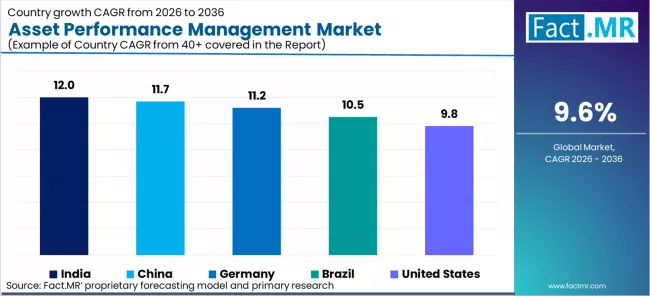
    Asset Performance Management Market Analysis By Country

    Country CAGR (2026-2036)
    India 12.0%
    China 11.7%
    Germany 11.2%
    Brazil 10.5%
    United States 9.8%

    Source: Fact.MR (FACT.MR) analysis, based on proprietary forecasting model and primary research

    Asia Pacific Asset Performance Management Market Analysis
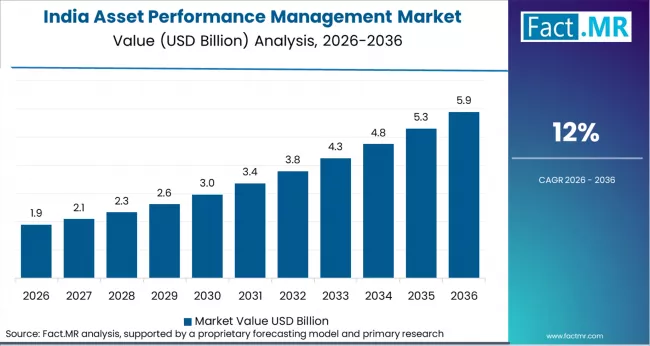
    Asset Performance Management Market Country Value Analysis

    Asia Pacific is the fastest-growing APM region due to manufacturing digitalization programmes in China and India and rapid industrial asset expansion. Global vendors compete for large enterprise deployments while domestic platforms target mid-sized manufacturers with locally hosted solutions.

    • India: Asset performance management demand in India is expected to expand at nearly 12.0% CAGR through 2036. smat investment under the PLI scheme and new industrial corridor projects are increasing adoption of predictive maintenance and industrial IoT platforms.
    • China: Asset performance management demand in China is projected to grow at about 11.7% CAGR through 2036. Smart manufacturing certification standards and Industry 4.0 programmes are encouraging factories to deploy predictive maintenance and asset monitoring platforms.

    FACT.MR's Asia Pacific analysis of the APM market covers China, Japan, South Korea, India, Australia and New Zealand, ASEAN, and Rest of Asia Pacific. Readers can find country CAGR forecasts, manufacturing digitalization timelines, industrial IoT adoption trends, and competitive platform positioning.

    Europe Asset Performance Management Market Analysis

    Europe represents a regulatory-driven APM adoption market supported by energy efficiency mandates and Industry 4.0 initiatives across manufacturing and energy sectors.

    • Germany: Asset performance management demand in Germany is forecast to rise at around 11.2% CAGR through 2036. Energy efficiency regulations and hydrogen infrastructure investment are increasing deployment of predictive maintenance and asset monitoring platforms.

    FACT.MR's European analysis of the APM market covers Germany, France, the United Kingdom, Italy, Spain, the Netherlands, the Nordics, and Rest of Europe. Readers can find EU directive compliance demand data, Industry 4.0 adoption trends, energy sector APM investment insights, and country-level growth forecasts.

    North America Asset Performance Management Market Analysis

    North America remains the largest APM revenue market due to strong enterprise software adoption, energy sector digitalization, and continuous platform upgrades across industrial facilities.

    • United States: Asset performance management demand in the United States is anticipated to grow at roughly 9.8% CAGR through 2036. Energy transition infrastructure and grid modernisation programmes are driving predictive asset monitoring investments.

    FACT.MR's North American analysis of the APM market covers the United States, Canada, and Mexico. Readers can find energy sector digitalization timelines, enterprise software adoption trends, and country forecasts by component and deployment type.

    Latin America Asset Performance Management Market Analysis

    Latin America is an emerging APM market supported by industrial digitalization initiatives and strong demand from energy and mining sectors.

    • Brazil: Asset performance management demand in Brazil is expected to increase at about 10.5% CAGR through 2036. Digital oilfield programmes and manufacturing technology investment are encouraging predictive maintenance platform adoption.

    FACT.MR's Latin American analysis of the APM market covers Brazil, Chile, Ecuador, and Rest of Latin America. Readers can find industrial digitalization programme impact data, energy sector APM investment trends, and country-level forecasts by component and deployment type.

    Competitive Aligners for Market Players
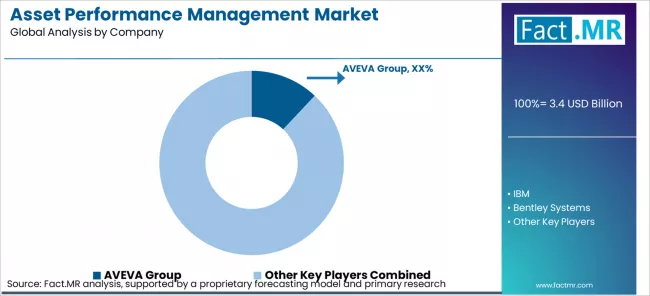
    Asset Performance Management Market Analysis By Company

    The global asset performance management (APM) market is moderately concentrated at the enterprise level, with major technology providers such as AVEVA, Aspen Technology, GE Digital, IBM, and SAP capturing a significant share of large industrial contracts. These companies compete mainly on the strength of their analytics capabilities, digital twin technology, and the ability to integrate APM platforms with existing industrial systems such as SCADA, DCS, and ERP. As many industrial companies seek to consolidate maintenance and asset software tools, vendors offering full end-to-end platforms have a clear advantage.

    Strategic partnerships with industrial cloud providers and operational technology ecosystems also strengthen vendor positioning. AVEVA benefits from integration with Schneider Electric infrastructure, while Aspen Technology leverages deep expertise in process industries. IBM’s Maximo platform remains widely adopted due to its enterprise asset management foundation.

    Although enterprises periodically review APM vendors, switching platforms is complex. Migrating historical data, rebuilding digital twins, and retraining staff create significant switching costs. This often results in long-term customer relationships once a platform is established.

    Key Players

    • AVEVA Group
    • IBM
    • Bentley Systems
    • SAP
    • Detechtion Technologies
    • Siemens Energy AB
    • Oracle
    • ABB
    • GE Digital
    • Rockwell Automation
    • Aspen Technology Inc.
    • ARMS Reliability
    • Uptake

    Scope of Report

    Metric Value
    Quantitative Units USD 3.4 billion (2026) to USD 8.0 billion (2036), at a CAGR of 9.6%
    Market Definition Software solutions and services integrating predictive analytics, condition monitoring, and digital twins to optimise industrial asset reliability and reduce unplanned downtime across energy, manufacturing, and utilities.
    Component Segmentation Solution (60%), Services
    Deployment Type Segmentation Cloud-Based (54%), On-Premises
    Organization Size Segmentation Very Large Enterprise 1,000+ (32.5%), Large Enterprise 500–1,000, Medium Enterprise 100–500, Small Enterprise <100
    Application Coverage Predictive maintenance, condition monitoring, reliability-centred maintenance, failure mode analysis, digital twin asset health, energy efficiency compliance, and maintenance work order optimisation.
    Regions Covered Asia Pacific, Europe, North America, Latin America, Middle East and Africa
    Countries Covered India, China, Japan, South Korea, Australia and New Zealand, ASEAN, Germany, UK, France, Italy, Spain, Nordic, BENELUX, Russia, Poland, USA, Canada, Mexico, Brazil, Chile, Saudi Arabia, GCC, Turkey, South Africa, Rest of MEA
    Key Companies Profiled AVEVA Group, IBM, Bentley Systems, SAP, Siemens Energy AB, Oracle, ABB, GE Digital, Rockwell Automation, Aspen Technology Inc., ARMS Reliability, Uptake, Detechtion Technologies
    Forecast Period 2026 to 2036
    Approach Hybrid top-down and bottom-up model using industrial software spend, APM penetration rates by sector, average contract values by organisation size, and primary interviews with APM product managers and industrial IT directors.

    Asset Performance Management Market by Segment

    • By Component :

      • Solution
      • Services
    • By Deployment Type :

      • Cloud-Based
      • On-Premises
    • By Organization Size :

      • Very Large Enterprise (1,000+ employees)
      • Large Enterprise (500 to 1,000 employees)
      • Medium Enterprise (100 to 500 employees)
      • Small Enterprise (Less than 100 employees)
    • By Region :

      • North America
        • United States
        • Canada
        • Mexico
      • Latin America
        • Brazil
        • Chile
        • Ecuador
        • Rest of Latin America
      • Western Europe
        • Germany
        • United Kingdom
        • France
        • Italy
        • Spain
        • Nordic
        • BENELUX
        • Rest of Western Europe
      • Eastern Europe
        • Russia
        • Poland
        • Hungary
        • Balkan and Baltic
        • Rest of Eastern Europe
      • East Asia
        • China
        • Japan
        • South Korea
        • South Asia and Pacific
        • India
        • ASEAN
        • Australia and New Zealand
        • Rest of South Asia and Pacific
      • Middle East and Africa
        • Kingdom of Saudi Arabia
        • Other GCC Countries
        • Turkey
        • South Africa
        • Other African Union
        • Rest of Middle East and Africa

    Bibliography

    • [1] AVEVA Group / Schneider Electric. (2024). Annual Report 2024: APM Solution Demand from European Energy Efficiency Directive Compliance Customers. November 2024. aveva.com
    • [2] Ministry of Heavy Industries, Government of India. (2024). PLI Scheme Progress Report: Smart Factory Digitalisation Requirements and APM Platform Deployment at PLI-Qualifying Facilities. October 2024. dhi.gov.in
    • [3] IBM Corporation. (2025). IBM Maximo Application Suite Release Notes: AI-Augmented Maintenance Recommendation Features and Generative AI Asset Health Integration. January 2025. ibm.com
    • [4] AVEVA Group. (2025). Product Press Release: APM Suite Expansion with AI-Driven Failure Mode and Effects Analysis for Refining and Chemical Sector Customers. February 2025. aveva.com
    • [5] GE Digital. (2025). Product Update: Predix APM Generative AI Maintenance Work Order Generation Feature Launch for Operations Teams. January 2025. ge.com/digital
    • [6] Rockwell Automation Inc. (2024). Q4 FY2024 Earnings Call Transcript: Managed APM Service Contract Growth in Food and Beverage and Pharmaceutical Sectors. November 2024. rockwellautomation.com
    • [7] Aspen Technology Inc. (2025). Product Launch: Cloud-Native APM Reliability Platform with Multi-Site Dashboards and ISO 55000 Compliance Reporting. March 2025. aspentech.com
    • [8] SAP SE. (2024). Press Release: SAP Asset Intelligence Network On-Premises Integration with SAP S/4HANA for Utilities and Defence Sector APM Customers. September 2024. sap.com
    • [9] IBM Corporation. (2024). Annual Report 2024: Maximo Application Suite Hybrid Deployment Growth Among North American Utility Customers. December 2024. ibm.com

    This Report Addresses

    • Strategic intelligence on AI-native APM platform consolidation, EU industrial energy efficiency compliance investment, India and China manufacturing digitalisation programmes, and energy transition asset complexity creating new APM demand.
    • Market forecast from USD 3.4 billion in 2026 to USD 8.0 billion by 2036 at 9.6% CAGR, segmented by component, deployment type, organisation size, and region.
    • Growth opportunity mapping across India PLI scheme smart factory deployments, China Made in China 2025 maintenance certification requirements, EU EED compliance APM procurement, and U.S. grid modernisation infrastructure demand.
    • Country CAGR outlook for India 12.0%, China 11.7%, Germany 11.2%, Brazil 10.5%, and United States 9.8%, with key industrial policy and sector investment drivers by country.
    • Competitive analysis of AVEVA, Aspen Technology, GE Digital, IBM, SAP, Bentley Systems, and ABB covering platform capabilities, sector specialisation, AI analytics depth, and cloud infrastructure partnerships.
    • Technology tracking including AI-driven failure mode analysis, generative AI maintenance recommendations, digital twin reliability integration, hybrid cloud APM deployment models, and industrial IoT connectivity platforms.
    • Regulatory analysis covering EU Energy Efficiency Directive 2023/1791, India PLI smart factory standards, China MIIT smart manufacturing evaluation criteria, U.S. DOE Grid Modernisation Initiative requirements, and ISO 55000 asset management standards.

    Report delivered in PDF, Excel datasets, PowerPoint summary, and dashboard formats supported by vendor disclosures, industrial policy records, and primary research.

    Table of Content

    1. Executive Summary
      • Global Market Outlook
      • Demand to side Trends
      • Supply to side Trends
      • Technology Roadmap Analysis
      • Analysis and Recommendations
    2. Market Overview
      • Market Coverage / Taxonomy
      • Market Definition / Scope / Limitations
    3. Research Methodology
      • Chapter Orientation
      • Analytical Lens and Working Hypotheses
        • Market Structure, Signals, and Trend Drivers
        • Benchmarking and Cross-market Comparability
        • Market Sizing, Forecasting, and Opportunity Mapping
      • Research Design and Evidence Framework
        • Desk Research Programme (Secondary Evidence)
          • Company Annual and Sustainability Reports
          • Peer-reviewed Journals and Academic Literature
          • Corporate Websites, Product Literature, and Technical Notes
          • Earnings Decks and Investor Briefings
          • Statutory Filings and Regulatory Disclosures
          • Technical White Papers and Standards Notes
          • Expert Input and Fieldwork (Primary Evidence)
            • Primary Modes
              • Qualitative Interviews and Expert Elicitation
              • Quantitative Surveys and Structured Data Capture
              • Blended Approach
            • Why Primary Evidence is Used
            • Field Techniques
              • Interviews
              • Surveys
              • Focus Groups
              • Observational and In-context Research
              • Social and Community Interactions
            • Stakeholder Universe Engaged
              • C-suite Leaders
              • Board Members
              • Presidents and Vice Presidents
              • R&D and Innovation Heads
              • Technical Specialists
              • Domain Subject-matter Experts
              • Scientists
              • Physicians and Other Healthcare Professionals
            • Governance, Ethics, and Data Stewardship
              • Research Ethics
              • Data Integrity and Handling
          • Tooling, Models, and Reference Databases
        • Data Engineering and Model Build
          • Data Acquisition and Ingestion
          • Cleaning, Normalisation, and Verification
          • Synthesis, Triangulation, and Analysis
        • Quality Assurance and Audit Trail
      • Market Background
        • Market Dynamics
          • Drivers
          • Restraints
          • Opportunity
          • Trends
        • Scenario Forecast
          • Demand in Optimistic Scenario
          • Demand in Likely Scenario
          • Demand in Conservative Scenario
        • Opportunity Map Analysis
        • Product Life Cycle Analysis
        • Supply Chain Analysis
        • Investment Feasibility Matrix
        • Value Chain Analysis
        • PESTLE and Porter’s Analysis
        • Regulatory Landscape
        • Regional Parent Market Outlook
        • Production and Consumption Statistics
        • Import and Export Statistics
      • Global Market Analysis 2021 to 2025 and Forecast, 2026 to 2036
        • Historical Market Size Value (USD Million) Analysis, 2021 to 2025
        • Current and Future Market Size Value (USD Million) Projections, 2026 to 2036
          • Y to o to Y Growth Trend Analysis
          • Absolute $ Opportunity Analysis
      • Global Market Pricing Analysis 2021 to 2025 and Forecast 2026 to 2036
      • Global Market Analysis 2021 to 2025 and Forecast 2026 to 2036, By Component
        • Introduction / Key Findings
        • Historical Market Size Value (USD Million) Analysis By Component , 2021 to 2025
        • Current and Future Market Size Value (USD Million) Analysis and Forecast By Component , 2026 to 2036
          • Solution
          • Services
        • Y to o to Y Growth Trend Analysis By Component , 2021 to 2025
        • Absolute $ Opportunity Analysis By Component , 2026 to 2036
      • Global Market Analysis 2021 to 2025 and Forecast 2026 to 2036, By Deployment Type
        • Introduction / Key Findings
        • Historical Market Size Value (USD Million) Analysis By Deployment Type, 2021 to 2025
        • Current and Future Market Size Value (USD Million) Analysis and Forecast By Deployment Type, 2026 to 2036
          • Cloud-Based
          • On-Premises
        • Y to o to Y Growth Trend Analysis By Deployment Type, 2021 to 2025
        • Absolute $ Opportunity Analysis By Deployment Type, 2026 to 2036
      • Global Market Analysis 2021 to 2025 and Forecast 2026 to 2036, By Region
        • Introduction
        • Historical Market Size Value (USD Million) Analysis By Region, 2021 to 2025
        • Current Market Size Value (USD Million) Analysis and Forecast By Region, 2026 to 2036
          • North America
          • Latin America
          • Western Europe
          • Eastern Europe
          • East Asia
          • South Asia and Pacific
          • Middle East & Africa
        • Market Attractiveness Analysis By Region
      • North America Market Analysis 2021 to 2025 and Forecast 2026 to 2036, By Country
        • Historical Market Size Value (USD Million) Trend Analysis By Market Taxonomy, 2021 to 2025
        • Market Size Value (USD Million) Forecast By Market Taxonomy, 2026 to 2036
          • By Country
            • USA
            • Canada
            • Mexico
          • By Component
          • By Deployment Type
        • Market Attractiveness Analysis
          • By Country
          • By Component
          • By Deployment Type
        • Key Takeaways
      • Latin America Market Analysis 2021 to 2025 and Forecast 2026 to 2036, By Country
        • Historical Market Size Value (USD Million) Trend Analysis By Market Taxonomy, 2021 to 2025
        • Market Size Value (USD Million) Forecast By Market Taxonomy, 2026 to 2036
          • By Country
            • Brazil
            • Chile
            • Rest of Latin America
          • By Component
          • By Deployment Type
        • Market Attractiveness Analysis
          • By Country
          • By Component
          • By Deployment Type
        • Key Takeaways
      • Western Europe Market Analysis 2021 to 2025 and Forecast 2026 to 2036, By Country
        • Historical Market Size Value (USD Million) Trend Analysis By Market Taxonomy, 2021 to 2025
        • Market Size Value (USD Million) Forecast By Market Taxonomy, 2026 to 2036
          • By Country
            • Germany
            • UK
            • Italy
            • Spain
            • France
            • Nordic
            • BENELUX
            • Rest of Western Europe
          • By Component
          • By Deployment Type
        • Market Attractiveness Analysis
          • By Country
          • By Component
          • By Deployment Type
        • Key Takeaways
      • Eastern Europe Market Analysis 2021 to 2025 and Forecast 2026 to 2036, By Country
        • Historical Market Size Value (USD Million) Trend Analysis By Market Taxonomy, 2021 to 2025
        • Market Size Value (USD Million) Forecast By Market Taxonomy, 2026 to 2036
          • By Country
            • Russia
            • Poland
            • Hungary
            • Balkan & Baltic
            • Rest of Eastern Europe
          • By Component
          • By Deployment Type
        • Market Attractiveness Analysis
          • By Country
          • By Component
          • By Deployment Type
        • Key Takeaways
      • East Asia Market Analysis 2021 to 2025 and Forecast 2026 to 2036, By Country
        • Historical Market Size Value (USD Million) Trend Analysis By Market Taxonomy, 2021 to 2025
        • Market Size Value (USD Million) Forecast By Market Taxonomy, 2026 to 2036
          • By Country
            • China
            • Japan
            • South Korea
          • By Component
          • By Deployment Type
        • Market Attractiveness Analysis
          • By Country
          • By Component
          • By Deployment Type
        • Key Takeaways
      • South Asia and Pacific Market Analysis 2021 to 2025 and Forecast 2026 to 2036, By Country
        • Historical Market Size Value (USD Million) Trend Analysis By Market Taxonomy, 2021 to 2025
        • Market Size Value (USD Million) Forecast By Market Taxonomy, 2026 to 2036
          • By Country
            • India
            • ASEAN
            • Australia & New Zealand
            • Rest of South Asia and Pacific
          • By Component
          • By Deployment Type
        • Market Attractiveness Analysis
          • By Country
          • By Component
          • By Deployment Type
        • Key Takeaways
      • Middle East & Africa Market Analysis 2021 to 2025 and Forecast 2026 to 2036, By Country
        • Historical Market Size Value (USD Million) Trend Analysis By Market Taxonomy, 2021 to 2025
        • Market Size Value (USD Million) Forecast By Market Taxonomy, 2026 to 2036
          • By Country
            • Kingdom of Saudi Arabia
            • Other GCC Countries
            • Turkiye
            • South Africa
            • Other African Union
            • Rest of Middle East & Africa
          • By Component
          • By Deployment Type
        • Market Attractiveness Analysis
          • By Country
          • By Component
          • By Deployment Type
        • Key Takeaways
      • Key Countries Market Analysis
        • USA
          • Pricing Analysis
          • Market Share Analysis, 2025
            • By Component
            • By Deployment Type
        • Canada
          • Pricing Analysis
          • Market Share Analysis, 2025
            • By Component
            • By Deployment Type
        • Mexico
          • Pricing Analysis
          • Market Share Analysis, 2025
            • By Component
            • By Deployment Type
        • Brazil
          • Pricing Analysis
          • Market Share Analysis, 2025
            • By Component
            • By Deployment Type
        • Chile
          • Pricing Analysis
          • Market Share Analysis, 2025
            • By Component
            • By Deployment Type
        • Germany
          • Pricing Analysis
          • Market Share Analysis, 2025
            • By Component
            • By Deployment Type
        • UK
          • Pricing Analysis
          • Market Share Analysis, 2025
            • By Component
            • By Deployment Type
        • Italy
          • Pricing Analysis
          • Market Share Analysis, 2025
            • By Component
            • By Deployment Type
        • Spain
          • Pricing Analysis
          • Market Share Analysis, 2025
            • By Component
            • By Deployment Type
        • France
          • Pricing Analysis
          • Market Share Analysis, 2025
            • By Component
            • By Deployment Type
        • India
          • Pricing Analysis
          • Market Share Analysis, 2025
            • By Component
            • By Deployment Type
        • ASEAN
          • Pricing Analysis
          • Market Share Analysis, 2025
            • By Component
            • By Deployment Type
        • Australia & New Zealand
          • Pricing Analysis
          • Market Share Analysis, 2025
            • By Component
            • By Deployment Type
        • China
          • Pricing Analysis
          • Market Share Analysis, 2025
            • By Component
            • By Deployment Type
        • Japan
          • Pricing Analysis
          • Market Share Analysis, 2025
            • By Component
            • By Deployment Type
        • South Korea
          • Pricing Analysis
          • Market Share Analysis, 2025
            • By Component
            • By Deployment Type
        • Russia
          • Pricing Analysis
          • Market Share Analysis, 2025
            • By Component
            • By Deployment Type
        • Poland
          • Pricing Analysis
          • Market Share Analysis, 2025
            • By Component
            • By Deployment Type
        • Hungary
          • Pricing Analysis
          • Market Share Analysis, 2025
            • By Component
            • By Deployment Type
        • Kingdom of Saudi Arabia
          • Pricing Analysis
          • Market Share Analysis, 2025
            • By Component
            • By Deployment Type
        • Turkiye
          • Pricing Analysis
          • Market Share Analysis, 2025
            • By Component
            • By Deployment Type
        • South Africa
          • Pricing Analysis
          • Market Share Analysis, 2025
            • By Component
            • By Deployment Type
      • Market Structure Analysis
        • Competition Dashboard
        • Competition Benchmarking
        • Market Share Analysis of Top Players
          • By Regional
          • By Component
          • By Deployment Type
      • Competition Analysis
        • Competition Deep Dive
          • AVEVA Group
            • Overview
            • Product Portfolio
            • Profitability by Market Segments (Product/Age /Sales Channel/Region)
            • Sales Footprint
            • Strategy Overview
              • Marketing Strategy
              • Product Strategy
              • Channel Strategy
          • IBM
          • Bentley Systems
          • SAP
          • Detechtion Technologies
          • Siemens Energy AB
          • Oracle
          • ABB
          • GE Digital
          • Rockwell Automation
          • Aspen Technology Inc.
          • ARMS Reliability
          • Uptake
    4. Assumptions & Acronyms Used

    List Of Table

    • Table 1: Global Market Value (USD Million) Forecast by Region, 2021 to 2036
    • Table 2: Global Market Value (USD Million) Forecast by Component, 2021 to 2036
    • Table 3: Global Market Value (USD Million) Forecast by Deployment Type, 2021 to 2036
    • Table 4: North America Market Value (USD Million) Forecast by Country, 2021 to 2036
    • Table 5: North America Market Value (USD Million) Forecast by Component, 2021 to 2036
    • Table 6: North America Market Value (USD Million) Forecast by Deployment Type, 2021 to 2036
    • Table 7: Latin America Market Value (USD Million) Forecast by Country, 2021 to 2036
    • Table 8: Latin America Market Value (USD Million) Forecast by Component, 2021 to 2036
    • Table 9: Latin America Market Value (USD Million) Forecast by Deployment Type, 2021 to 2036
    • Table 10: Western Europe Market Value (USD Million) Forecast by Country, 2021 to 2036
    • Table 11: Western Europe Market Value (USD Million) Forecast by Component, 2021 to 2036
    • Table 12: Western Europe Market Value (USD Million) Forecast by Deployment Type, 2021 to 2036
    • Table 13: Eastern Europe Market Value (USD Million) Forecast by Country, 2021 to 2036
    • Table 14: Eastern Europe Market Value (USD Million) Forecast by Component, 2021 to 2036
    • Table 15: Eastern Europe Market Value (USD Million) Forecast by Deployment Type, 2021 to 2036
    • Table 16: East Asia Market Value (USD Million) Forecast by Country, 2021 to 2036
    • Table 17: East Asia Market Value (USD Million) Forecast by Component, 2021 to 2036
    • Table 18: East Asia Market Value (USD Million) Forecast by Deployment Type, 2021 to 2036
    • Table 19: South Asia and Pacific Market Value (USD Million) Forecast by Country, 2021 to 2036
    • Table 20: South Asia and Pacific Market Value (USD Million) Forecast by Component, 2021 to 2036
    • Table 21: South Asia and Pacific Market Value (USD Million) Forecast by Deployment Type, 2021 to 2036
    • Table 22: Middle East & Africa Market Value (USD Million) Forecast by Country, 2021 to 2036
    • Table 23: Middle East & Africa Market Value (USD Million) Forecast by Component, 2021 to 2036
    • Table 24: Middle East & Africa Market Value (USD Million) Forecast by Deployment Type, 2021 to 2036

    List Of Figures

    • Figure 1: Global Market Pricing Analysis
    • Figure 2: Global Market Value (USD Million) Forecast 2021-2036
    • Figure 3: Global Market Value Share and BPS Analysis by Component, 2026 and 2036
    • Figure 4: Global Market Y to o to Y Growth Comparison by Component, 2026 to 2036
    • Figure 5: Global Market Attractiveness Analysis by Component
    • Figure 6: Global Market Value Share and BPS Analysis by Deployment Type, 2026 and 2036
    • Figure 7: Global Market Y to o to Y Growth Comparison by Deployment Type, 2026 to 2036
    • Figure 8: Global Market Attractiveness Analysis by Deployment Type
    • Figure 9: Global Market Value (USD Million) Share and BPS Analysis by Region, 2026 and 2036
    • Figure 10: Global Market Y to o to Y Growth Comparison by Region, 2026 to 2036
    • Figure 11: Global Market Attractiveness Analysis by Region
    • Figure 12: North America Market Incremental Dollar Opportunity, 2026 to 2036
    • Figure 13: Latin America Market Incremental Dollar Opportunity, 2026 to 2036
    • Figure 14: Western Europe Market Incremental Dollar Opportunity, 2026 to 2036
    • Figure 15: Eastern Europe Market Incremental Dollar Opportunity, 2026 to 2036
    • Figure 16: East Asia Market Incremental Dollar Opportunity, 2026 to 2036
    • Figure 17: South Asia and Pacific Market Incremental Dollar Opportunity, 2026 to 2036
    • Figure 18: Middle East & Africa Market Incremental Dollar Opportunity, 2026 to 2036
    • Figure 19: North America Market Value Share and BPS Analysis by Country, 2026 and 2036
    • Figure 20: North America Market Value Share and BPS Analysis by Component, 2026 and 2036
    • Figure 21: North America Market Y to o to Y Growth Comparison by Component, 2026 to 2036
    • Figure 22: North America Market Attractiveness Analysis by Component
    • Figure 23: North America Market Value Share and BPS Analysis by Deployment Type, 2026 and 2036
    • Figure 24: North America Market Y to o to Y Growth Comparison by Deployment Type, 2026 to 2036
    • Figure 25: North America Market Attractiveness Analysis by Deployment Type
    • Figure 26: Latin America Market Value Share and BPS Analysis by Country, 2026 and 2036
    • Figure 27: Latin America Market Value Share and BPS Analysis by Component, 2026 and 2036
    • Figure 28: Latin America Market Y to o to Y Growth Comparison by Component, 2026 to 2036
    • Figure 29: Latin America Market Attractiveness Analysis by Component
    • Figure 30: Latin America Market Value Share and BPS Analysis by Deployment Type, 2026 and 2036
    • Figure 31: Latin America Market Y to o to Y Growth Comparison by Deployment Type, 2026 to 2036
    • Figure 32: Latin America Market Attractiveness Analysis by Deployment Type
    • Figure 33: Western Europe Market Value Share and BPS Analysis by Country, 2026 and 2036
    • Figure 34: Western Europe Market Value Share and BPS Analysis by Component, 2026 and 2036
    • Figure 35: Western Europe Market Y to o to Y Growth Comparison by Component, 2026 to 2036
    • Figure 36: Western Europe Market Attractiveness Analysis by Component
    • Figure 37: Western Europe Market Value Share and BPS Analysis by Deployment Type, 2026 and 2036
    • Figure 38: Western Europe Market Y to o to Y Growth Comparison by Deployment Type, 2026 to 2036
    • Figure 39: Western Europe Market Attractiveness Analysis by Deployment Type
    • Figure 40: Eastern Europe Market Value Share and BPS Analysis by Country, 2026 and 2036
    • Figure 41: Eastern Europe Market Value Share and BPS Analysis by Component, 2026 and 2036
    • Figure 42: Eastern Europe Market Y to o to Y Growth Comparison by Component, 2026 to 2036
    • Figure 43: Eastern Europe Market Attractiveness Analysis by Component
    • Figure 44: Eastern Europe Market Value Share and BPS Analysis by Deployment Type, 2026 and 2036
    • Figure 45: Eastern Europe Market Y to o to Y Growth Comparison by Deployment Type, 2026 to 2036
    • Figure 46: Eastern Europe Market Attractiveness Analysis by Deployment Type
    • Figure 47: East Asia Market Value Share and BPS Analysis by Country, 2026 and 2036
    • Figure 48: East Asia Market Value Share and BPS Analysis by Component, 2026 and 2036
    • Figure 49: East Asia Market Y to o to Y Growth Comparison by Component, 2026 to 2036
    • Figure 50: East Asia Market Attractiveness Analysis by Component
    • Figure 51: East Asia Market Value Share and BPS Analysis by Deployment Type, 2026 and 2036
    • Figure 52: East Asia Market Y to o to Y Growth Comparison by Deployment Type, 2026 to 2036
    • Figure 53: East Asia Market Attractiveness Analysis by Deployment Type
    • Figure 54: South Asia and Pacific Market Value Share and BPS Analysis by Country, 2026 and 2036
    • Figure 55: South Asia and Pacific Market Value Share and BPS Analysis by Component, 2026 and 2036
    • Figure 56: South Asia and Pacific Market Y to o to Y Growth Comparison by Component, 2026 to 2036
    • Figure 57: South Asia and Pacific Market Attractiveness Analysis by Component
    • Figure 58: South Asia and Pacific Market Value Share and BPS Analysis by Deployment Type, 2026 and 2036
    • Figure 59: South Asia and Pacific Market Y to o to Y Growth Comparison by Deployment Type, 2026 to 2036
    • Figure 60: South Asia and Pacific Market Attractiveness Analysis by Deployment Type
    • Figure 61: Middle East & Africa Market Value Share and BPS Analysis by Country, 2026 and 2036
    • Figure 62: Middle East & Africa Market Value Share and BPS Analysis by Component, 2026 and 2036
    • Figure 63: Middle East & Africa Market Y to o to Y Growth Comparison by Component, 2026 to 2036
    • Figure 64: Middle East & Africa Market Attractiveness Analysis by Component
    • Figure 65: Middle East & Africa Market Value Share and BPS Analysis by Deployment Type, 2026 and 2036
    • Figure 66: Middle East & Africa Market Y to o to Y Growth Comparison by Deployment Type, 2026 to 2036
    • Figure 67: Middle East & Africa Market Attractiveness Analysis by Deployment Type
    • Figure 68: Global Market - Tier Structure Analysis
    • Figure 69: Global Market - Company Share Analysis

    - FAQs -

    How large is the asset performance management market in 2025?

    The market was valued at USD 3.2 billion in 2025.

    What will the market size be in 2026?

    The market is estimated to reach USD 3.4 billion in 2026.

    What is the projected market size by 2036?

    The market is projected to reach USD 8.0 billion by 2036, representing an absolute dollar opportunity of USD 4.6 billion over the forecast period.

    What is the expected CAGR from 2026 to 2036?

    The market is forecast to grow at a CAGR of 9.6% during the period.

    Which component segment leads the market?

    Solution-based APM is expected to lead with approximately 60% share in 2026.

    Which deployment type holds the largest share?

    Cloud-based deployment leads with approximately 54% share in 2026.

    Which organization size dominates?

    Very large enterprises with 1,000-plus employees hold approximately 32.5% share in 2026.

    Which country shows the fastest growth?

    India leads at 12.0% CAGR through 2036, driven by PLI scheme smart factory investments and the National Industrial Corridor Programme.

    What is the forecast CAGR for China?

    China is projected to grow at 11.7% CAGR through 2036, supported by Made in China 2025 smart factory certification requirements and domestic industrial cloud APM platform expansion.

    What is the primary restraint?

    Long enterprise procurement cycles, high integration complexity with legacy SCADA and ERP systems, and cybersecurity concerns around connected industrial data are the main structural constraints on APM market growth.

    Asset Performance Management Market