- Base Value(2025): 2.6 Bn
- Estimated Value(2026): 2.9 Bn
- Forecast Value (2036): 7.1 Bn
- CAGR (2026 - 2036): 9.4%
Data Center Asset Management Market Forecast and Outlook (2026 to 2036)
The data center asset management market was valued at USD 2.6 billion in 2025. According to Fact.MR, demand is projected to reach USD 2.9 billion in 2026 and expand to USD 7.1 billion by 2036, reflecting a CAGR of 9.4% during the forecast period.
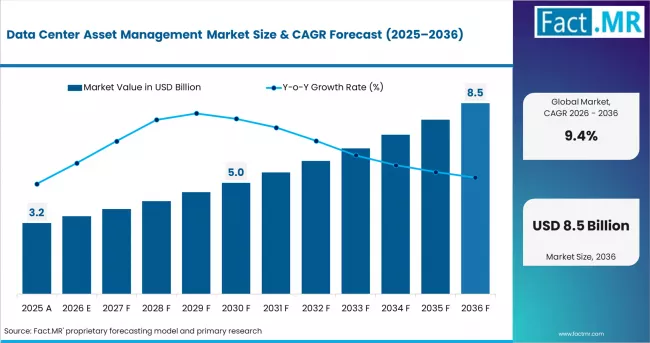
Data Center Asset Management Market Market Value Analysis | Source: Fact.MR
| Metric | Value |
|---|---|
| Estimated Value in 2026 | USD 2.9 billion |
| Forecast Value in 2036 | USD 7.1 billion |
| Forecast CAGR (2026 to 2036) | 9.4% |
Source: Fact.MR analysis. Updated May 14, 2026
Summary of Data Center Asset Management Market
- Market Definition
- The market includes software and management systems used to track, map, govern, and optimize data center assets through their lifecycle.
- Demand Drivers
- Data center operators need complete visibility and control over infrastructure to support resilience and operational efficiency.
- Accurate asset knowledge supports resource allocation, planning, faster repair, and better capacity use.
- Centralized asset management helps automate reporting, aggregation, and lifecycle governance across complex environments.
- Key Segments Analyzed
- By Solution Type: Asset Discovery and Inventory Management is estimated to lead with approximately 30% share in 2026, supported by its foundational role in all downstream asset-control functions.
- By Deployment Type: On-Premise is expected to hold approximately 38% share in 2026, driven by control and integration needs in large facilities.
- By Data Center Type: Enterprise Data Centers are projected to account for approximately 34% share in 2026, supported by broad infrastructure governance needs.
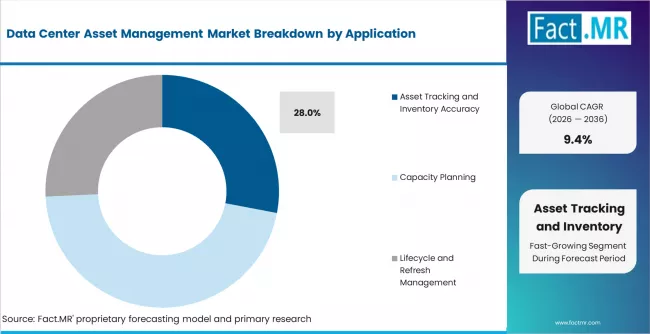
- By Application: Asset Tracking and Inventory Accuracy is expected to contribute approximately 28% share in 2026, backed by its role as the base layer for planning and control.
- By Geography: India leads growth at 10.8% CAGR through 2036, supported by stronger digital infrastructure expansion.
- These share values are model-based estimates rather than figures directly published in the cited sources.
- Analyst Opinion at FACT.MR
- Shambhu Nath Jha, Senior Analyst at Fact.MR, opines, “this market as an infrastructure-governance and lifecycle-intelligence category rather than an inventory-software niche. Buyers are not only paying for asset records. They are paying for operational clarity, better planning, and lower risk in fast-changing data center environments.”
- This is a modeled analyst view, not a quoted external statement.
- Strategic Implications
- Invest in asset platforms that connect inventory, capacity, and lifecycle visibility in one system.
- Build technical sales capability around change control, dependency mapping, and planning value rather than inventory capture alone.
- Position data center asset management where operators want stronger operational clarity across increasingly dense and distributed environments.
The market is expected to generate an absolute opportunity of USD 4.2 billion between 2026 and 2036, supported by increasing infrastructure complexity. Growth is being driven by rising rack density, expansion of hybrid IT environments, stronger audit and change-control requirements, and wider adoption of data center infrastructure management (DCIM) platforms for planning and lifecycle control. Schneider Electric states that its EcoStruxure Data Center Solutions integrate power, cooling, racks, and management systems to support deployment from edge environments to large-scale cloud data centers. As data centers scale and diversify, asset management systems are becoming essential for visibility, efficiency, and operational governance. [1]
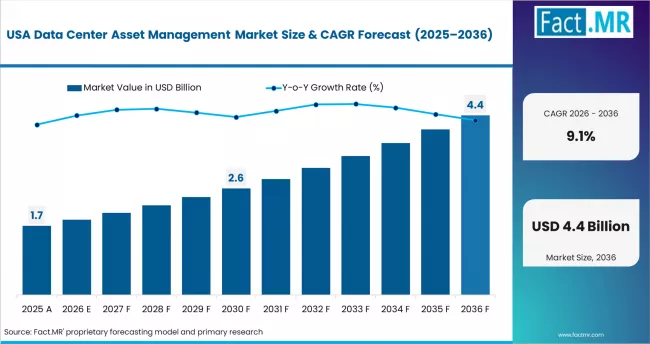
India is projected to lead with a CAGR of 10.8% through 2036, driven by expanding data center capacity, stronger enterprise digitization, and broader asset-governance needs in new facilities. China follows at 10.2%, supported by large-scale data center buildout and stronger lifecycle-control requirements. The United States is expected to grow at 9.1%, underpinned by mature DCIM adoption and ongoing refresh cycles. Germany records 8.6%, backed by structured operations practices and stronger compliance requirements. Singapore grows at 8.3%, supported by dense colocation and edge-related asset-control needs.
Segmental Analysis
Data Center Asset Management Market Analysis by Solution Type
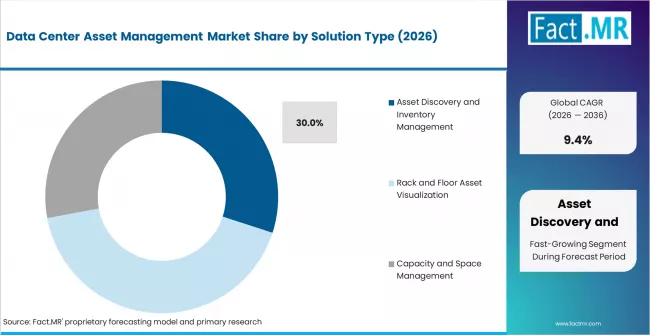
Data Center Asset Management Market Analysis By Solution Type | Source: Fact.MR
Asset Discovery and Inventory Management is estimated to hold 30% share in 2026. It leads because knowing what assets exist, where they are, and how they are connected remains the base requirement for all other asset-management functions. Vertiv states that knowing accurately what assets exist and where they are located is integral to data center management. NIST’s centralized IT asset management guidance also reinforces the role of automated discovery, aggregation, reporting, and lifecycle tracking. [3]
- Asset discovery and inventory lead because they create the baseline for planning and operational control.
- Rack and floor visualization remains attractive where operators need faster physical asset location and space planning.
- Connectivity and dependency mapping gains relevance where digital infrastructure complexity raises change-risk and troubleshooting cost.
Data Center Asset Management Market Analysis by Deployment Type
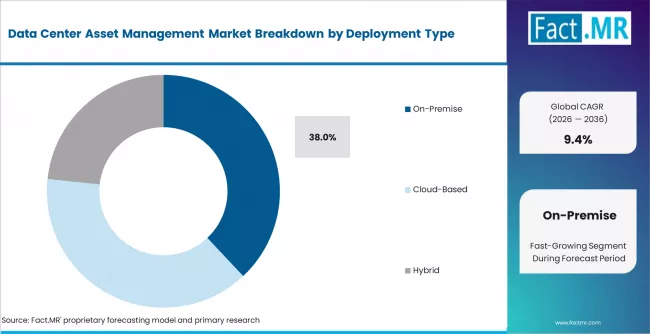
Data Center Asset Management Market Analysis By Deployment Type | Source: Fact.MR
On-premise deployment is expected to hold approximately 38% share in 2026, as many large operators continue to prioritize direct control, custom integration, and internal governance for infrastructure-critical systems. Schneider Electric positions its DCIM solutions around secure and resilient infrastructure management, reinforcing the preference for on-premise environments where control, data security, and operational reliability are central requirements. [4]
- On-premise leads because many operators want tighter control over infrastructure governance tools.
- Cloud-based deployment remains important where distributed and edge-heavy environments need broader accessibility.
- Hybrid deployment gains relevance where enterprises want to balance local control with multi-site visibility.
Data Center Asset Management Market Analysis by Data Center Type
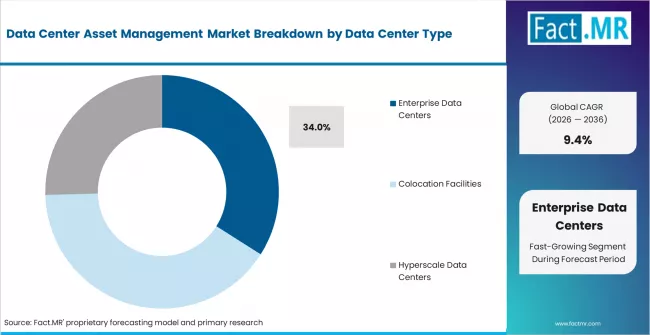
Data Center Asset Management Market Analysis By Data Center Type | Source: Fact.MR
Enterprise data centers continue to lead due to their need to manage complex, mixed infrastructure environments with strong emphasis on lifecycle control, audit readiness, and refresh planning. These facilities often operate under strict governance frameworks, making asset visibility and change tracking critical to operations. Enterprise data centers are projected to account for approximately 34% share in 2026. Uptime Institute highlights the importance of lifecycle management and risk reduction, reinforcing why enterprise environments remain a primary driver for data center asset management adoption. [5]
- Enterprise data centers lead because they face broad lifecycle and governance needs across mixed environments.
- Colocation facilities remain attractive where shared infrastructure requires precise asset and tenancy control.
- Edge data centers gain traction where remote-site visibility and asset standardization become more important.
Data Center Asset Management Market Analysis by Application
Data Center Asset Management Market Analysis By Application | Source: Fact.MR
Asset tracking and inventory accuracy is expected to contribute approximately 28% share over the forecast period, as it represents the most direct and essential function of data center asset management, forming the foundation for visibility, control, and operational efficiency. Vertiv highlights that accurate asset location improves repair speed, supports better budgeting, and enables more effective resource allocation, reinforcing its central role in data center operations.
- Asset tracking leads because every other planning and lifecycle function depends on accurate records.
- Capacity planning remains important where rack density and space efficiency are major operating constraints.
- Change and configuration control gains relevance where infrastructure complexity increases operational risk.
Drivers, Restraints, and Opportunities
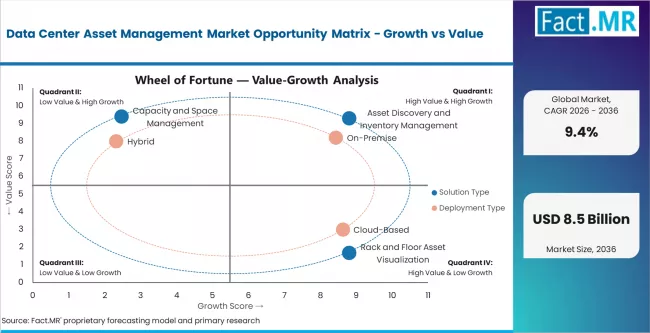
Data Center Asset Management Market Opportunity Matrix Growth Vs Value | Source: Fact.MR
The market is being shaped by the need to manage denser, more distributed, and more operationally complex infrastructure. Structural demand is anchored in the fact that data center teams need accurate asset knowledge, lifecycle control, and centralized reporting to keep operations efficient and predictable.
The main restraint is integration burden and data quality discipline. Asset management systems are only as useful as the consistency of data capture, change processes, and system integration around them. Uptime Institute’s operational materials emphasize that hidden inefficiencies, skills gaps, and weak operational practices can undermine performance.
- Integrated DCIM-linked asset management remains the clearest opportunity where operators want one system for planning, mapping, and governance.
- Lifecycle and refresh management creates stronger value where operators need better planning around aging assets and expansion cycles.
- Multi-site and edge-oriented asset visibility offers higher-value opportunity where infrastructure is becoming more distributed and harder to govern centrally.
Regional Analysis
The market is assessed across North America, Europe, Asia Pacific, Latin America, and Middle East and Africa, covering 40+ countries with demand profiles shaped by data center buildout, infrastructure density, lifecycle-governance needs, and operational maturity. The country growth rates below are model-based estimates.
.webp "Top Country Growth Comparison Data Center Asset Management Market Cagr (2026 2036)")
Top Country Growth Comparison Data Center Asset Management Market Cagr (2026 2036) | Source: Fact.MR
| Country | CAGR (2026 to 2036) |
|---|---|
| India | 10.8% |
| China | 10.2% |
| United States | 9.1% |
| Germany | 8.6% |
| Singapore | 8.3% |
Source: Fact.MR analysis. Updated May 14, 2026
North America Data Center Asset Management Market Analysis
Data Center Asset Management Market Country Value Analysis | Source: Fact.MR
North America remains a key commercial region because it combines mature data center ecosystems, widespread use of DCIM platforms, and continuous infrastructure refresh cycles. Operators in this region increasingly treat asset visibility and lifecycle governance as essential to uptime, cost control, and operational resilience rather than optional management layers.
- United States: Strong infrastructure governance and sustained refresh activity continue to support growth. The market is projected to expand at approximately 9.1% CAGR by 2036, driven by large-scale hyperscale and colocation operations that require accurate asset tracking, predictive maintenance, and integrated monitoring systems. Demand is particularly strong where operators manage complex, multi-site environments and require real-time asset intelligence.
Europe Data Center Asset Management Market Analysis
Data Center Asset Management Market Europe Country Market Share Analysis, 2026 & 2036 | Source: Fact.MR
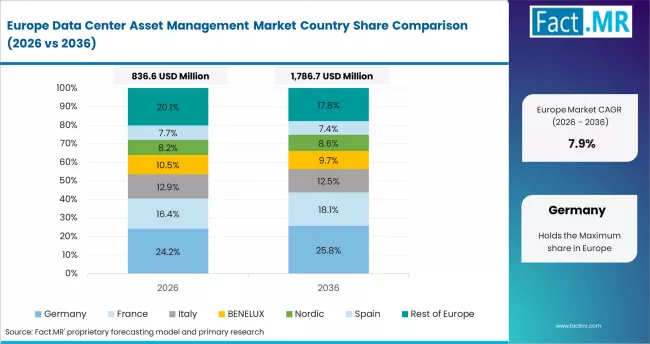
Europe remains a technically structured region where adoption is closely tied to operational discipline, compliance requirements, and lifecycle-governance standards. Data center operators place strong emphasis on risk reduction, audit readiness, and efficiency optimization across infrastructure assets.
- Germany: Germany plays a central role in the European data center ecosystem due to its strong enterprise IT base and growing colocation footprint. The market is projected to grow at close to 8.6% CAGR from 2026 to 2036, supported by increasing demand for structured asset governance, regulatory compliance, and operational transparency. Operators are prioritizing centralized asset-management systems to improve lifecycle tracking, optimize utilization, and reduce operational risk across high-density facilities. Integration of asset data into broader DCIM and facility-management platforms remains a key development trend.
Asia Pacific and Latin America Data Center Asset Management Market Analysis
Asia Pacific offers the strongest long-term expansion potential because it combines rapid digital infrastructure buildout, increasing enterprise data demand, and growing complexity in data center operations. As facilities scale, operators are shifting from fragmented asset tracking methods toward centralized, software-driven lifecycle management systems.
- India: Expanding digital infrastructure and new facility development support strong growth. The market is projected to grow at around 10.8% CAGR over the forecast period, driven by hyperscale expansion, cloud adoption, and increasing need for structured asset governance across new data center deployments.
- China: Large-scale data center construction and rising capacity-management requirements support continued expansion. The market is expected to grow at approximately 10.2% CAGR through 2036, with increasing adoption of integrated asset-management platforms to handle complex infrastructure environments.
- Singapore: High-density colocation environments and strong regional connectivity needs support steady growth. The market is projected to grow at close to 8.3% CAGR by 2036, driven by demand for precise asset tracking, efficient space utilization, and real-time infrastructure visibility in space-constrained facilities.
Competitive Aligners for Market Players
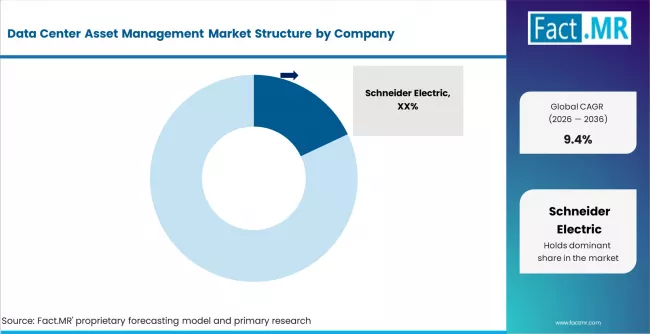
Data Center Asset Management Market Analysis By Company | Source: Fact.MR
The market is moderately concentrated at the DCIM, asset-visualization, and lifecycle-governance platform level, while broader deployment remains operator-controlled. Competitive strength comes from the ability to combine discovery, mapping, connectivity visibility, and planning support in one environment. Suppliers need more than an inventory claim. They need a clear explanation of how the platform improves operational clarity, capacity use, and lifecycle governance in real data center settings.
Competitive advantage is defined by discovery accuracy, visualization quality, lifecycle workflow support, integration depth, and ability to scale across enterprise, colocation, and edge environments. This competitive framing is an analytical view derived from current official materials rather than a published market-share table.
Key Players
- Schneider Electric
- Vertiv
- Nlyte software ecosystem participants
- Sunbird DCIM ecosystem participants
- IBM-related data center asset ecosystem participants
- Siemens
- Huawei
Bibliography
- [1] Schneider Electric. EcoStruxure IT DCIM software materials describing complete visibility and control for secure, resilient, and optimized IT infrastructure at scale.
- [2] Vertiv. Trellis Asset Management materials describing visual asset mapping, ownership, connectivity, and capacity visibility across physical and virtual infrastructure.
- [3] NIST NCCoE. IT asset management guidance describing centralized data aggregation, reporting, alerting, and lifecycle management from an automated platform.
- [4] Schneider Electric. EcoStruxure Data Center Solutions materials describing integrated power, cooling, racks, and management systems across edge to cloud environments.
- [5] Uptime Institute. Professional services and management materials describing lifecycle management, infrastructure assessment, and operational discipline in modern data centers.
This Report Addresses
- Strategic intelligence on data center asset management demand across inventory accuracy, capacity planning, lifecycle control, and connectivity mapping.
- Market forecast from USD 2.9 billion in 2026 to USD 7.1 billion by 2036 at a CAGR of 9.4%.
- Growth opportunity mapping across DCIM-linked asset discovery, rack and floor visualization, lifecycle-governance platforms, and multi-site asset-control systems.
- Segment analysis by solution type, deployment type, data center type, application, and end use.
- Regional outlook covering North America, Europe, Asia Pacific, Latin America, and Middle East and Africa.
- Competitive analysis of major participants serving DCIM, asset visibility, lifecycle-governance, and infrastructure mapping ecosystems.
- Operational-governance analysis covering inventory accuracy, capacity use, lifecycle planning, and change-control readiness.
- Market interpretation built around denser infrastructure, broader distributed environments, and stronger operator need for centralized asset clarity.
Market Definition
The market covers software platforms, management tools, and related systems used to discover, track, visualize, govern, and optimize physical and virtual data center assets throughout their lifecycle. It includes inventory systems, DCIM-linked asset management, rack and floor mapping tools, dependency mapping, lifecycle management, and change-control support systems.
Data Center Asset Management Market Inclusions
Covers global and regional forecasts from 2026 to 2036. Includes asset discovery, inventory tracking, rack and floor visualization, capacity and space management, connectivity mapping, lifecycle and refresh management, and compliance-linked asset control for enterprise, colocation, hyperscale, and edge data centers.
Data Center Asset Management Market Exclusions
Excludes pure IT service management platforms without core data center asset functionality, generic enterprise asset management tools not positioned for data center environments, and standalone infrastructure monitoring tools where asset lifecycle or inventory control is not the core product role. This exclusion logic is an analytical market boundary rather than a quoted source definition.
Data Center Asset Management Market Research Methodology
- Primary Research:Interviews with data center operations managers, DCIM specialists, infrastructure planners, colocation operators, lifecycle-governance stakeholders, and asset-management software providers.
- Desk Research:Uses current official materials from Schneider Electric, Vertiv, Uptime Institute, and NIST tied to DCIM, asset lifecycle control, capacity visibility, and centralized IT asset management. [2]
- Market-Sizing and Forecasting:Hybrid model using data center expansion, DCIM adoption, asset-density growth, lifecycle-control needs, and operational-efficiency demand across enterprise, colocation, hyperscale, and edge environments.
- Data Validation and Update Cycle:Validated using official product materials, operational best-practice sources, and recurring checks on infrastructure visibility, lifecycle management, and capacity-planning direction.
Segmentation
Scope of Report
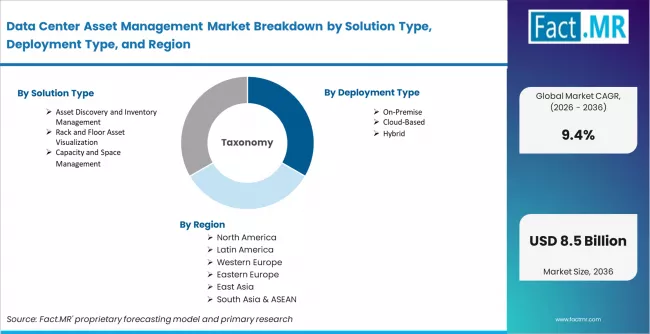
Data Center Asset Management Market Breakdown By Solution Type, Deployment Type, And Region | Source: Fact.MR
| Attribute | Details |
|---|---|
| Quantitative Units | USD 2.9 billion (2026) to USD 7.1 billion (2036), at a CAGR of 9.4% |
| Market Definition | Software platforms, management tools, and related systems used to discover, track, visualize, govern, and optimize physical and virtual data center assets throughout their lifecycle |
| Solution Type Segmentation | Asset Discovery and Inventory Management, Rack and Floor Asset Visualization, Capacity and Space Management, Lifecycle and Change Management, Asset Connectivity and Dependency Mapping, Others |
| Deployment Type Segmentation | On-Premise, Cloud-Based, Hybrid, Others |
| Data Center Type Segmentation | Enterprise Data Centers, Colocation Facilities, Hyperscale Data Centers, Edge Data Centers, Others |
| Application Segmentation | Asset Tracking and Inventory Accuracy, Capacity Planning, Lifecycle and Refresh Management, Change and Configuration Control, Compliance and Audit Readiness, Others |
| End Use Segmentation | IT and Telecom, BFSI, Healthcare, Government, Manufacturing, Others |
| Regions Covered | North America, Europe, Asia Pacific, Latin America, Middle East and Africa |
| Countries Covered | United States, Germany, China, India, Singapore, Japan, and 40+ countries |
| Forecast Period | 2026 to 2036 |
| Approach | Hybrid top-down and bottom-up model using data center buildout, DCIM adoption, asset-density growth, lifecycle-control needs, and primary interviews with operators, planners, and asset-management specialists |
Source: Fact.MR analysis. Updated May 14, 2026
Data Center Asset Management Market by Segments
-
By Solution Type:
- Asset Discovery and Inventory Management
- Rack and Floor Asset Visualization
- Capacity and Space Management
- Lifecycle and Change Management
- Asset Connectivity and Dependency Mapping
- Others
-
By Deployment Type:
- On-Premise
- Cloud-Based
- Hybrid
- Others
-
By Data Center Type:
- Enterprise Data Centers
- Colocation Facilities
- Hyperscale Data Centers
- Edge Data Centers
- Others
-
By Application:
- Asset Tracking and Inventory Accuracy
- Capacity Planning
- Lifecycle and Refresh Management
- Change and Configuration Control
- Compliance and Audit Readiness
- Others
-
By End Use:
- IT and Telecom
- BFSI
- Healthcare
- Government
- Manufacturing
- Others
-
By Region:
- North America
- United States
- Canada
- Mexico
- Latin America
- Brazil
- Argentina
- Chile
- Rest of Latin America
- Western Europe
- Germany
- France
- United Kingdom
- Italy
- Spain
- Nordic Countries
- BENELUX
- Rest of Western Europe
- Eastern Europe
- Russia
- Poland
- Hungary
- Balkan and Baltic
- Rest of Eastern Europe
- East Asia
- China
- Japan
- South Korea
- South Asia and Pacific
- India
- ASEAN
- Australia and New Zealand
- Rest of South Asia and Pacific
- Middle East and Africa
- Kingdom of Saudi Arabia
- Other GCC Countries
- Turkey
- South Africa
- Rest of Middle East and Africa
- North America
Frequently Asked Questions
How large is the global data center asset management market in 2025?
What will the market size be in 2026?
What is the projected market size by 2036?
What is the expected CAGR from 2026 to 2036?
Which solution type is poised to lead the market?
Which application segment holds the largest share?
Which data center type is expected to remain strongest?
Which country shows the fastest growth?
What is driving demand for data center asset management?
What is the key challenge in this market?
Who worked on this report


Preview the report firsthand - request a free sample
Free SampleGet the brochure for pricing and purchase details
Download PDF