- Market Value (2025): USD 118.5 Mn
- Estimated Value (2026): USD 124 Mn
- Forecast Value (2036): USD 195 Mn
- CAGR (2026-2036): 4.6%
What is the ATF Colorant Dyes Market forecast to be worth by 2036?
USD 124 million in 2026 to USD 195 million by 2036, at 4.6% CAGR.
- An estimated 2025 value of approximately USD 118.5 million shows that ATF dyes already occupy a specialized position in automotive fluid formulation.
- The market is expected to move from USD 124 million in 2026 to USD 195 million in 2036 as transmission architectures and service-fluid portfolios become more varied.
- The forecast 4.6% CAGR reflects continued passenger-car ATF demand, color differentiation for newer fluid families, and ongoing replacement-market production.
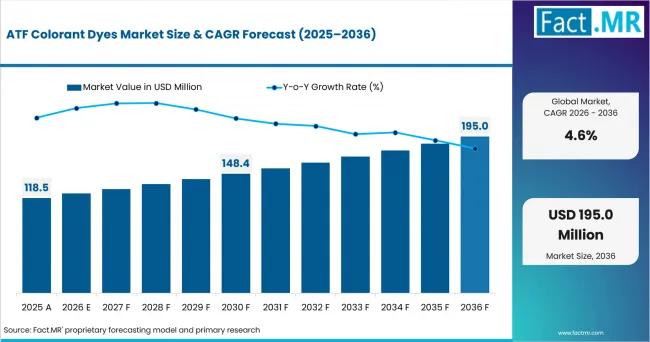
Atf Colorant Dyes Market Value Analysis | Source: Fact.MR
What are the defining numbers behind ATF Colorant Dyes Market growth?
USD 71 million absolute opportunity by 2036, led by Passenger car ATF and Traditional red within their respective segments.
- Demand Drivers in the Market
- Passenger-car ATF remains a large formulation base in which an established red visual standard helps technicians recognize fluid and detect obvious cross-contamination.
- CVT, DCT, heavy-duty, and electric-drivetrain fluids create additional colorant briefs because each chemistry must be distinguished without compromising its performance package.
- Blenders favor dyes with strong color at low dosage, since excessive loading can increase staining, complicate clarity, or add unnecessary formulation variables.
- Formal fluid approvals and long service intervals raise the commercial value of lot consistency, documented composition, and controlled change notification from dye suppliers.
- Key Segments Analyzed
- By Transmission Fluid Type: Passenger car ATF leads at 52.0% of demand because passenger vehicles carry the largest global automatic transmission population of any vehicle class, and dye consumption tracks fluid volume rather than per-unit value, so the segment with the most factory-fill and service-fill gallons also pulls the most colorant.
- By Color Standard: Traditional red leads with a 61.0% share of demand, supported by its broad use across automatic transmission fluid products and strong recognition among vehicle service centers, mechanics, and customers.
- By Customer Group: ATF blenders leads at 36.0% of demand because OEM-licensed formulations such as ATF+4 restrict production to a small set of approved blenders working from a fixed base oil and additive recipe, and blenders are the ones who actually buy and meter the dye into each batch rather than the OEM licensor or the downstream rebranders who market the finished fluid.
- By Dye Type: Solvent red dyes leads at 41.0% of demand because ATF is a nonpolar hydrocarbon medium that only takes color from nonpolar, oil-soluble dyes, and azo-based solvent reds such as C.I. Solvent Red 24 and 164 became the entrenched default decades before newer anthraquinone alternatives reached commercial scale, even though anthraquinone dyes hold color better under sustained heat.
- By Performance Requirement: Oxidation stability leads at 31.0% of demand because dye color and fluid condition degrade together: accelerated heat testing on conventional azo dyes such as C.I. Solvent Red 164 shows most of their color intensity lost within 48 hours at elevated temperature, while one anthraquinone-based alternative in the same patent retained nearly all of its color over the same period, and a dye that fades before the fluid itself breaks down defeats the purpose of color-coding it.
- Analyst Opinion at Fact.MR
- Shambhu Nath Jha, Senior Analyst at Fact.MR, states, "ATF dye is inexpensive relative to the finished fluid, yet a poor choice can create disproportionate qualification and service problems. The winning supplier will treat color as part of fluid engineering and provide evidence on stability, staining, and compatibility before the customer asks."
- Strategic Implications
- Colorant producers should separate conventional red products from specialty shades designed for CVT, DCT, heavy-duty, and electric-drivetrain fluids.
- ATF blenders need locked master standards and supplier change-control agreements so shade variation does not become a false signal in the field.
- Automotive additive companies can reduce customer approval work by screening preferred dyes alongside friction and oxidation packages.
- Aftermarket packers should avoid color-only compatibility messaging and tie every dyed fluid to its applicable performance specification.
Allison Transmission introduced TES 668 in 2020 as a synthetic ATF formulation focused on oxidation stability, anti-wear performance, friction durability, and operation across temperature variation. Allison's March 2026 approved-fluids list contains many licensed products, illustrating how formal approval systems continue to shape the formulations into which ATF dyes must fit.
The United States is projected to expand at a 6.0% CAGR from 2026 to 2036 on the strength of a deep automatic-transmission fleet and a formal fluid-approval culture. Germany is anticipated to advance at 5.7% because specification discipline and complex fluid portfolios keep well-documented dyes in demand, while France follows at 5.5% as blenders extend approved colorant lists toward electrified drivetrains. South Korea's integrated vehicle, transmission, and lubricant manufacturing supports 6.2% growth, and Japan's strong CVT base underpins a 5.8% CAGR.
How does the ATF Colorant Dyes Market break down by segment?
The leading shares are Passenger car ATF at 52.0% by Transmission Fluid Type and Traditional red at 61.0% by Color Standard.
Why does passenger-car ATF dominate fluid-type demand?
At 52.0% share in 2026, the leading position goes to Passenger car ATF because its broad installed base sustains both factory-fill and service-fill coloration.
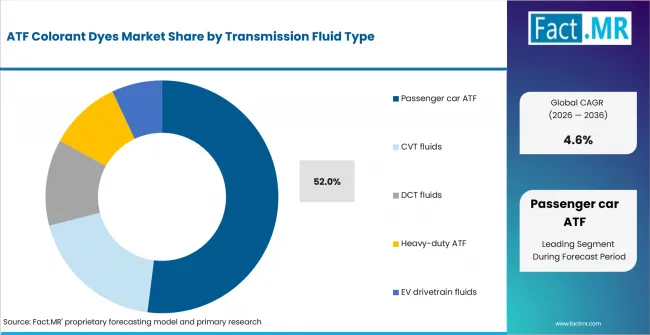
Atf Colorant Dyes Market Analysis By Transmission Fluid Type | Source: Fact.MR
Passenger-car ATF accounts for 52% of the source mix, more than all other fluid types individually. Its scale comes from mature automatic-transmission fleets and the need for a recognizable service fluid across branded portfolios. CVT fluids hold 19% and demand closer chemistry-specific screening because their friction systems and labeling conventions differ from conventional ATF.
What explains the enduring lead of traditional red?
The 2026 leader is Traditional red at 61.0% share because service channels already associate red with automatic transmission fluid.
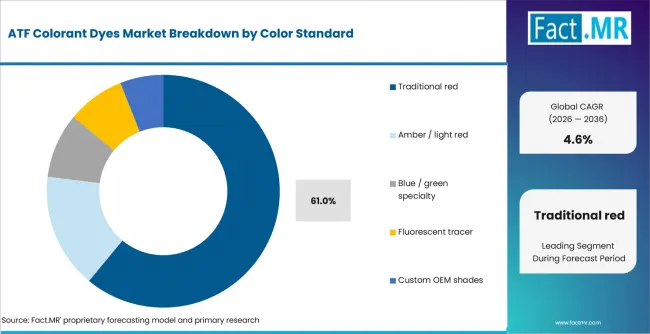
Atf Colorant Dyes Market Analysis By Color Standard | Source: Fact.MR
Traditional red commands a 61% share, reflecting a deeply established identification convention. Familiarity makes the shade useful to technicians, distributors, and consumers, but consistent color still requires control over base-oil hue and aging. Amber and light red represent 16%, serving formulations that need differentiation without abandoning the broad red family.
Which customers have the greatest influence over ATF dye selection?
A 36.0% share puts ATF blenders first in 2026 because ATF blenders own the finished formulation and approval evidence.
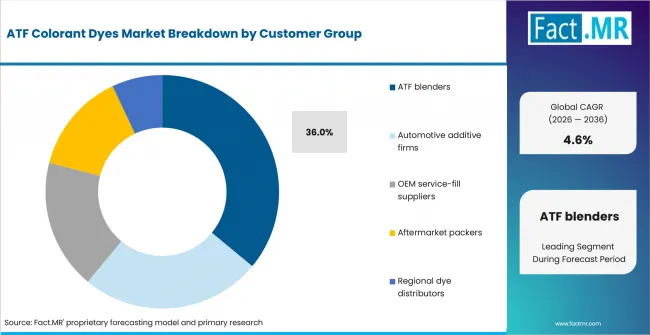
Atf Colorant Dyes Market Analysis By Customer Group | Source: Fact.MR
ATF blenders lead the customer mix with 36% because they combine the dye with the final base stocks and additive system. Automotive additive firms follow at 25% and can shape decisions by recommending compatible colorants during package development. OEM service-fill suppliers hold 18% and bring demanding traceability and consistency expectations even when their absolute volumes are lower.
Why are solvent red dyes the principal dye chemistry?
For Dye Type, the top 2026 position is Solvent red dyes at 41.0% share because they deliver the conventional ATF shade in hydrocarbon-based fluid systems.
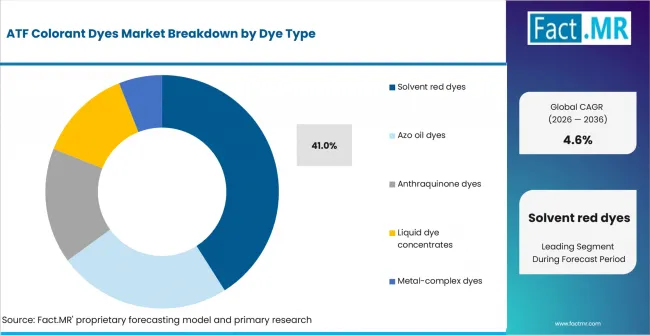
Atf Colorant Dyes Market Analysis By Dye Type | Source: Fact.MR
Solvent red dyes hold 41% of the Dye Type segment, aligning with the 61% share of traditional red color standards. Their formulation value comes from oil solubility and efficient color development at controlled dosage. Azo oil dyes account for 24%, while anthraquinone products at 16% can be considered where different hue or stability profiles are needed.
Which requirement sets the first technical hurdle for ATF colorants?
The leading 2026 share is 31.0% for Oxidation stability because long fluid life exposes shade chemistry to prolonged oxidative stress.
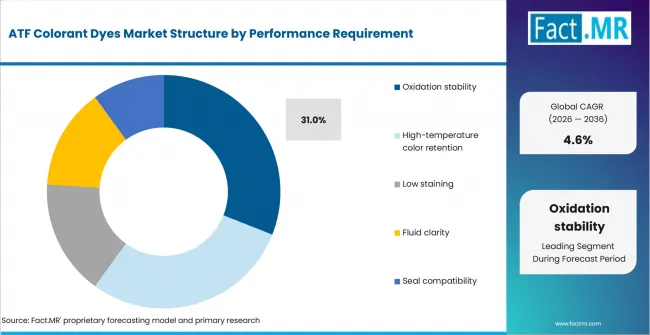
Atf Colorant Dyes Market Analysis By Performance Requirement | Source: Fact.MR
Oxidation stability leads at 31%, just ahead of high-temperature color retention at 29%. The narrow gap shows that buyers evaluate both chemical endurance and the visible result after heat exposure. Low staining, fluid clarity, and seal compatibility together form a second qualification layer that can disqualify an otherwise attractive shade.
What is accelerating ATF Colorant Dyes Market adoption, and what is holding it back?
Adoption is accelerated by a large conventional ATF base and the need to distinguish a growing number of transmission-fluid families. The central restraint is the burden of proving that a small dose of dye will not interfere with an approval-sensitive fluid system.
Drivers Impact Analysis
| DRIVER | (~) % IMPACT ON CAGR | GEOGRAPHIC RELEVANCE | IMPACT TIMELINE |
|---|---|---|---|
| Passenger-car service base | +0.7% | USA, Germany, and Japan | Short term (<= 2 years) |
| Transmission architecture variety | +0.6% | United States, Japan, and South Korea | Medium term (2-4 years) |
| Formal fluid approvals | +0.5% | North America and Europe | Long term (>= 4 years) |
| Aftermarket brand separation | +0.4% | Global | Short term (<= 2 years) |
| Long-life fluid formulations | +0.3% | USA and Japan | Medium term (2-4 years) |
Source: Fact.MR analysis. Updated Jul 16, 2026
- Passenger-car service base: Existing automatic-transmission fleets sustain recurring demand for service-fill fluids. Traditional red dyes benefit because the visual convention is already understood throughout the maintenance chain.
- Transmission architecture variety: Conventional automatics, CVTs, DCTs, and electrified drivetrains coexist in vehicle production. Each fluid family gives blenders a reason to reconsider shade, dosage, and colorant compatibility.
- Formal fluid approvals: Approval lists make formulation control commercially visible. Dye suppliers that document composition and notify customers before making changes are easier to retain in qualified products.
Opportunity Impact Analysis
| OPPORTUNITY | (~) % IMPACT ON CAGR | GEOGRAPHIC RELEVANCE | IMPACT TIMELINE |
|---|---|---|---|
| EV drivetrain shades | +0.4% | United States, Japan, and South Korea | Long term (>= 4 years) |
| Low-staining red concentrates | +0.3% | Global aftermarket | Short term (<= 2 years) |
| Approval-ready data packs | +0.3% | USA and Europe | Medium term (2-4 years) |
| Custom OEM shade control | +0.2% | Germany and Japan | Medium term (2-4 years) |
Source: Fact.MR analysis. Updated Jul 16, 2026
- EV drivetrain shades: Electric-drivetrain fluids are a small 7% source segment today, but they create new briefs around electrical, thermal, and material compatibility. Suppliers can participate early by offering low-dosage shades with disciplined screening data.
- Low-staining red concentrates: Service-fill products need a recognizable color without excessive staining on components or shop surfaces. A concentrate that balances visual strength and cleaner handling can command a technical premium.
- Approval-ready data packs: Dye vendors can package thermal aging, oxidation, seal, and clarity evidence in a format aligned with blender qualification. Better documentation reduces repeated testing and makes customer decisions easier to defend.
Restraints Impact Analysis
| RESTRAINT | (~) % IMPACT ON CAGR | GEOGRAPHIC RELEVANCE | IMPACT TIMELINE |
|---|---|---|---|
| Requalification risk | -0.3% | Global | Long term (>= 4 years) |
| Color-based misapplication | -0.3% | Aftermarket channels | Short term (<= 2 years) |
| Material interaction concerns | -0.2% | Global | Medium term (2-4 years) |
| Lower fluid turnover | -0.2% | Mature vehicle markets | Long term (>= 4 years) |
Source: Fact.MR analysis. Updated Jul 16, 2026
- Requalification risk: Changing a dye or carrier can trigger additional testing in a qualified ATF. Customers may remain with an incumbent colorant even when a lower-cost alternative is available.
- Color-based misapplication: Similar red shades do not establish interchangeability between transmission-fluid specifications. Misuse risk limits how aggressively marketers can rely on color as a selection cue.
- Material interaction concerns: Blenders must screen staining, seal contact, sediment, and fluid clarity in the complete formulation. A candidate dye can fail for a secondary interaction even when it dissolves readily.
Where is ATF colorant demand growing across key countries?
United States 6.0% CAGR. Germany 5.7%. France 5.5%. South Korea 6.2%. Japan 5.8%.
Regional analysis covers North America, Europe, and Asia Pacific, with dedicated country sections for the United States, Germany, France, South Korea, and Japan. The full report broadens this same view across more than 30 countries.
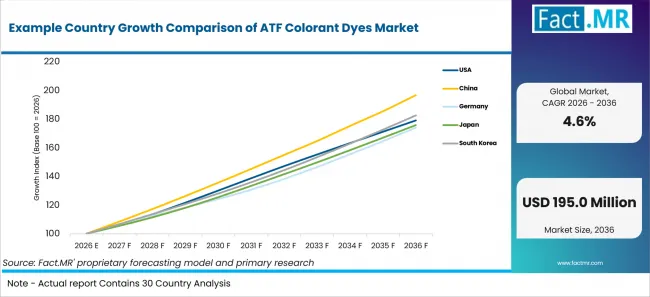
Example Country Growth Comparison Of Atf Colorant Dyes Market | Source: Fact.MR
| COUNTRY | CAGR |
|---|---|
| United States | 6.0% |
| Germany | 5.7% |
| Japan | 5.8% |
Source: Fact.MR analysis. Updated Jul 16, 2026
Why Is US ATF Colorant Demand Anchored to Open, Multi-Vehicle Licensing Rather Than Single-OEM Specs?
US demand for ATF colorants tracks a market where automatic transmissions are nearly universal, expanding at a 6.0% CAGR from 2026 to 2036.
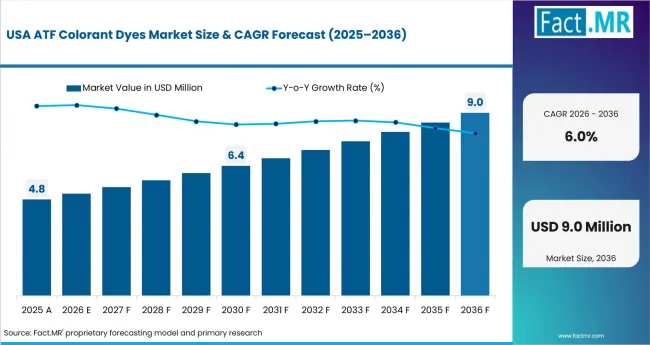
Atf Colorant Dyes Market Country Value Analysis | Source: Fact.MR
Roughly 96% of Americans now drive vehicles with automatic transmissions, and manual gearboxes have fallen to well under 1% of new light-vehicle sales in recent years. Unlike closed, single-brand fluid systems elsewhere, GM, Ford, Stellantis and Allison each publish their own ATF specifications and license third-party formulators to produce compatible fluid, including Stellantis's ATF+4 program administered through the Center for Quality Assurance, which requires a licensed fluid to display the OEM trademark and license number on its label. That open structure favors large-batch, multi-vehicle red dye supply moving through a vast DIY and quick-lube service-fill channel rather than small, OEM-locked production runs.
How Does Germany's Generation-Locked OEM Fluid System Shape ATF Colorant Demand?
Germany's ATF colorant demand is shaped less by total volume than by how many distinct, OEM-locked fluid specifications a formulator has to match, growing at a 5.7% CAGR from 2026 to 2036.
ZF Friedrichshafen, headquartered in Baden-Wuerttemberg, supplies automatic and dual-clutch transmissions across most of the German OEM network, and Germany's export-heavy vehicle industry, which shipped over 75% of the roughly 4.15 million passenger cars it built in 2025, skews toward the premium segment led by Mercedes-Benz, BMW, Porsche and Audi. Mercedes-Benz's own 236-series ATF specifications illustrate the pattern: parts suppliers and owner documentation consistently describe 236.10 as gold and 236.12/236.14 as red, with 236.15 arriving later as a separate, blue-tinted formulation, generation-specific dye choices tied to individual gearbox families rather than one universal red masterbatch.
Why Does Japan's ATF Colorant Demand Split Between JASO-Spec Fluid and CVT-Specific Dye?
Japan's ATF colorant demand splits across two separate fluid families instead of one, and it grows at a 5.8% CAGR from 2026 to 2036.
Japanese automakers run their own domestic ATF standard, JASO M315 ("JASO 1A"), distinct from the DEXRON/MERCON lineage used in North America and covering Nissan, Subaru and Toyota T-IV-compatible transmissions. Japan is also the world's largest CVT market, holding roughly 55% share, with CVTs fitted across nearly all of the country's 45 best-selling models; domestic supplier JATCO alone builds CVT units for Nissan, Mazda, Subaru and Suzuki. Because CVT fluids such as Honda HCF-2, Nissan NS-2/NS-3 and Toyota FE are chemically distinct, proprietary formulations sold and dyed separately from conventional ATF, colorant suppliers serve two parallel product lines rather than one common red fluid.
Who leads the ATF Colorant Dyes Market?
Solar Organics, Keystone Aniline, Neelikon, Abbey Color, and Vipul Organics compete for ATF dye programs where qualification support matters as much as shade availability.
Solar Organics leads the source set at 9%, followed by Keystone Aniline at 8% and Neelikon at 7%. The small gaps point to a contest built around solvent-red depth, carrier choices, technical responsiveness, and the ability to reproduce a qualified shade over time.
Abbey Color and Vipul Organics hold source shares of 5% and 4%. They can challenge larger suppliers through focused oil-soluble portfolios, custom lots, and quicker service for regional blenders, while every participant remains exposed to the long switching cycle of approved ATF formulations.
Which companies are the key providers?
The company set includes Solar Organics, Keystone Aniline, Neelikon, Abbey Color, and Vipul Organics.
- Solar Organics
- Keystone Aniline
- Neelikon
- Abbey Color
- Vipul Organics
Bibliography
- Allison Transmission. (2020). Allison Transmission Builds on Demonstrated Performance and Improved Shift Quality with Newly Formulated Automatic Transmission Fluid.
- Allison Transmission. (2026). Allison TES 668 Approved Fluids.
- ASTM International. (2024). ASTM D1500-24: Standard Test Method for ASTM Color of Petroleum Products.
- ASTM International. (2020). ASTM D6045-20: Standard Test Method for Color of Petroleum Products by the Automatic Tristimulus Method.
- Abbey Color. (n.d.). Solvent Dyes.
- Organic Dyes and Pigments. (n.d.). OrcoSolve Dyes for Petroleum Fuel, Lubricants, Oil, Solvents and Wax.
- European Chemicals Agency. (n.d.). Registration under REACH.
This Report Addresses
- It establishes the 2025 base and tracks market value from 2026 through 2036.
- It compares ATF colorant growth in the United States, Germany, France, Japan, and South Korea, within country coverage that spans more than 30 markets.
- It profiles Solar Organics, Keystone Aniline, Neelikon, Abbey Color, and Vipul Organics in depth, alongside analysis on 30+ companies active in oil-soluble colorants.
- It assesses traditional red, specialty colors, fluorescent tracers, and custom OEM shades.
- It separates demand among passenger-car ATF, CVT, DCT, heavy-duty, and electric-drivetrain fluids.
- It tests the forecast against approval practice, oxidation stability, high-temperature color retention, staining, clarity, and seal compatibility.
What does the ATF Colorant Dyes Market cover?
The report examines the commercial and technical path from ATF dye manufacture to qualified finished-fluid coloration.
It covers dye type, color standard, transmission-fluid type, customer group, and performance requirement, with country-level analysis of more than 30 markets led by the United States and Europe.
Competitive analysis considers portfolio fit, approval support, custom shade control, documentation, and regional service.
What is included in the scope?
Included colorants are sold with a stated or validated role in automatic transmission fluid.
Products include solvent and oil-soluble dyes, concentrates, specialty shades, and tracer colors used in conventional and advanced ATF formulations.
Demand from blenders, additive companies, OEM service-fill suppliers, aftermarket packers, and regional distributors is included.
What is excluded from the scope?
The boundary stops before the value of the finished transmission fluid and its non-color additive package.
Excluded revenue covers base oils, friction systems, viscosity modifiers, antioxidants, seals, filters, transmissions, and packaged finished ATF.
Fuel dyes and general diagnostic tracers without an ATF formulation use are also excluded.
How was the analysis built?
Fluid-approval records, supplier portfolios, buyer interviews, and forecast cross-checks drawn from more than 30 countries.
- Primary Research: Primary research includes discussions with manufacturers, service providers, technology developers, distributors, end users, procurement teams, and subject-matter experts. These conversations examine purchasing priorities, product adoption, operational challenges, approval requirements, competitive positioning, and the factors that influence wider market acceptance.
- Desk Research: Desk research covers government statistics, regulatory publications, company filings, trade data, technical studies, industry associations, standards, public policy, and other authoritative sources. Every source used in the analysis is documented in the bibliography.
- Market Sizing and Forecasting: Market estimates combine historical performance, demand indicators, pricing and volume trends, segment shares, company participation, country-level growth, adoption patterns, investment activity, and barriers to market expansion.
- Data Validation and Update Cycle: Findings are validated by comparing primary interviews with public data, company activity, regulatory changes, trade patterns, and industry developments. Regular updates review new product launches, capacity changes, partnerships, approvals, procurement trends, and shifts in commercial adoption.
Segmentation
What is the report's scope and coverage?
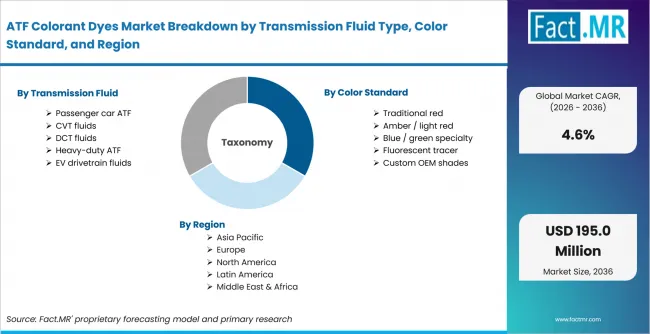
Atf Colorant Dyes Market Breakdown By Transmission Fluid Type, Color Standard, And Region | Source: Fact.MR
| ATTRIBUTE | DETAILS |
|---|---|
| Quantitative Units | USD 124 million in 2026 to USD 195 million by 2036 at 4.6% CAGR |
| Market Definition | ATF colorant dyes are oil-soluble dyes and prepared concentrates formulated to impart a controlled identification color to automatic transmission fluids. |
| Transmission Fluid Type | Passenger car ATF; CVT fluids; DCT fluids; Heavy-duty ATF; EV drivetrain fluids |
| Color Standard | Traditional red; Amber / light red; Blue / green specialty; Fluorescent tracer; Custom OEM shades |
| Customer Group | ATF blenders; Automotive additive firms; OEM service-fill suppliers; Aftermarket packers; Regional dye distributors |
| Dye Type | Solvent red dyes; Azo oil dyes; Anthraquinone dyes; Liquid dye concentrates; Metal-complex dyes |
| Performance Requirement | Oxidation stability; High-temperature color retention; Low staining; Fluid clarity; Seal compatibility |
| Regions Covered | North America; Europe; Asia Pacific |
| Countries Covered | United States; Germany; France; South Korea; Japan (analysis on 30+ countries in the full report) |
| Key Companies Profiled | Solar Organics; Keystone Aniline; Neelikon; Abbey Color; Vipul Organics |
| Forecast Period | 2026 to 2036 |
| Approach | Sizing reconciles colorant consumption by ATF type and customer group with supplier revenue, dosage ranges, concentrate strength, and average selling price. |
Source: Fact.MR analysis. Updated Jul 16, 2026
How is the market segmented?
-
By Transmission Fluid Type
- Passenger car ATF
- CVT fluids
- DCT fluids
- Heavy-duty ATF
- EV drivetrain fluids
-
By Color Standard
- Traditional red
- Amber / light red
- Blue / green specialty
- Fluorescent tracer
- Custom OEM shades
-
By Customer Group
- ATF blenders
- Automotive additive firms
- OEM service-fill suppliers
- Aftermarket packers
- Regional dye distributors
-
By Dye Type
- Solvent red dyes
- Azo oil dyes
- Anthraquinone dyes
- Liquid dye concentrates
- Metal-complex dyes
-
By Performance Requirement
- Oxidation stability
- High-temperature color retention
- Low staining
- Fluid clarity
- Seal compatibility
-
By Region
- North America
- United States
- Europe
- Germany
- France
- Asia Pacific
- South Korea
- Japan
Frequently Asked Questions
How large is the ATF colorant dyes market?
Which transmission fluid type accounts for the most dye demand?
Which ATF color standard is most common?
What dye type leads the market?
What is the main performance requirement?
How is ATF dye demand developing in the United States and Europe?
Who are the principal ATF dye suppliers in the source set?
Does the study include finished ATF revenue?
Who worked on this report


Preview the report firsthand - request a free sample
Free SampleGet the brochure for pricing and purchase details
Download PDF