- Base Value(2025): 214.8 Mn
- Estimated Value(2026): 236.9 Mn
- Forecast Value (2036): 742.6 Mn
- CAGR (2026 - 2036): 12.1%
Intrinsically Safe HMIs for Offshore Platform Automation Market Forecast and Outlook Fact.MR
In 2025, the intrinsically safe HMIs for offshore platform automation market was valued at USD 214.8 million. Based on Fact MR analysis, demand for intrinsically safe human machine interfaces used in offshore platform automation is estimated to grow to USD 236.9 million in 2026 and USD 742.6 million by 2036. FMR projects a CAGR of 12.1% during the forecast period.
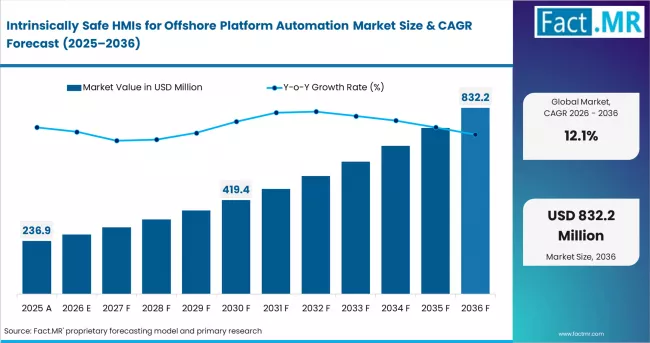
Intrinsically Safe Hmis For Offshore Platform Automation Market Value Analysis | Source: Fact.MR
Summary of Intrinsically Safe HMIs for Offshore Platform Automation Market
- Market Definition
- The market comprises human machine interface devices engineered to operate safely in hazardous offshore environments by limiting electrical and thermal energy levels to prevent ignition of flammable gases while enabling monitoring, visualization, and control of drilling, processing, and production automation systems.
- Demand Drivers
- Increasing offshore safety compliance requirements supporting deployment of certified hazardous area operator interfaces.
- Rising need for real time monitoring of drilling and production parameters across offshore platforms.
- Growing integration of distributed control systems requiring certified interface devices in explosive environments.
- Expansion of offshore oil and gas infrastructure requiring explosion protected visualization technologies.
- Increasing modernization of legacy offshore control panels supporting digital monitoring capability.
- Rising adoption of ruggedized interface systems supporting corrosion resistant performance in marine environments.
- Key Segments Analyzed
- Zone Certification: Zone 1 HMIs lead with 46% share supported by requirement for certified hazardous area operation.
- End Use: Offshore oil platforms hold 44% share driven by process monitoring and control interface demand.
- Interface Role: Panel mount and touchscreen HMIs support real time visualization of offshore automation parameters.
- Technology Role: Industrial PC based interfaces support integration with distributed control architectures.
- Geography: Europe and Asia Pacific maintain steady adoption supported by offshore infrastructure modernization requirements.
- Analyst Opinion at Fact MR
- Shambhu Nath Jha, Principal Consultant, Fact MR, opines, 'In this updated edition of the Intrinsically Safe HMIs for Offshore Platform Automation Market report, industry participants observe stable demand linked to modernization of hazardous area control infrastructure supporting safe operator interaction with offshore automation systems. Certified interface technologies remain critical for maintaining operational continuity across drilling, separation, and processing environments exposed to flammable atmospheres through 2036.'
- Strategic Implications/Executive Takeaways
- Invest in intrinsically safe interface designs supporting compliance with IECEx and ATEX certification requirements.
- Develop ruggedized HMI platforms supporting stable operation in corrosive offshore environments.
- Strengthen compatibility with distributed control systems supporting real time process visualization capability.
- Expand touchscreen interface capability supporting improved usability across offshore operator control stations.
- Focus on lifecycle upgrade opportunities across aging offshore platform automation infrastructure.
- Improve integration capability with industrial communication protocols supporting reliable data transmission performance.
- Methodology
- Primary interviews conducted with industrial automation vendors, offshore platform operators, hazardous area equipment manufacturers, and system integrators.
- Benchmarked against offshore safety compliance indicators influencing demand for intrinsically safe interface technologies.
- Evaluated utilization across drilling control systems, process monitoring platforms, and offshore automation visualization workflows.
- Hybrid modeling applied combining top down offshore automation demand assessment with bottom up intrinsically safe HMI deployment analysis.
- Validation conducted using hazardous area equipment certification data, offshore infrastructure activity indicators, and industrial automation adoption benchmarks.
- Peer review applied using Fact MR analytical frameworks linking offshore control modernization patterns with hazardous area interface demand trends.
Intrinsically Safe HMIs for Offshore Platform Automation Market
| Metric | Details |
|---|---|
| Industry Size (2026E) | USD 236.9 million |
| Industry Value (2036F) | USD 742.6 million |
| CAGR (2026 to 2036) | 12.1% |
Source: Fact.MR analysis. Updated Apr 16, 2026
A CAGR of 12.1% indicates transformational expansion supported by demand for explosion-proof human machine interfaces in hazardous offshore environments. Growth remains driven by safety compliance and remote monitoring needs, while constraints persist from certification complexity, high installation costs, and long procurement cycles in offshore energy projects.
China leads with a projected CAGR of 13.0%, supported by expansion of offshore energy infrastructure requiring explosion-protected operator interface systems. India follows with a CAGR of 12.7%, driven by increasing deployment of certified industrial interface devices across hazardous marine environments. The United Kingdom records a CAGR of 12.5%, reflecting steady adoption of safety-compliant control interfaces across offshore automation systems. Germany shows a CAGR of 12.3%, supported by consistent integration of explosion-protected HMI platforms across process control networks. The United States records the slowest growth at 12.1%, reflecting a relatively mature offshore automation ecosystem tied to replacement cycles within existing hazardous area control infrastructure.
Segmental Analysis
Intrinsically Safe HMIs for Offshore Platform Automation Market Analysis by Zone Certification
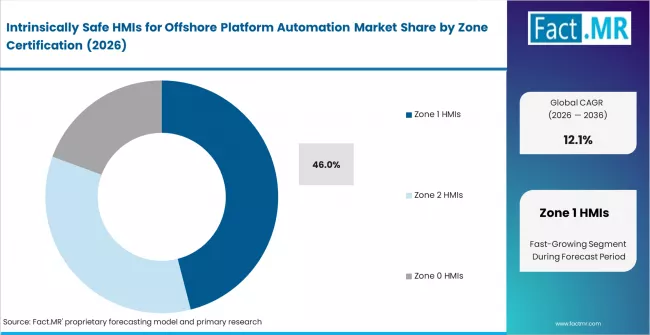
Intrinsically Safe Hmis For Offshore Platform Automation Market Analysis By Zone Certification | Source: Fact.MR
- Market Overview: Based on Fact MR assessment, Zone 1 HMIs are projected to account for 46% share of the intrinsically safe HMIs for offshore platform automation market in 2026. Zone 1 certified human machine interface systems are deployed within hazardous areas where explosive gas atmospheres are likely during normal operations. Device architecture incorporates explosion protection techniques including energy limitation circuits and sealed enclosures designed to prevent ignition sources within flammable environments. Compliance with ATEX and IECEx certification frameworks supports integration across process control stations requiring safe operator interaction with automation systems installed within classified offshore operational zones.
- Demand Drivers:
- Explosion Protection Requirements: Zone 1 certified HMIs support safe operator interface functionality across hazardous environments requiring controlled electrical energy limitation.
- Regulatory Compliance Parameters: Certification alignment supports deployment across offshore automation infrastructure requiring adherence to defined hazardous area equipment standards.
- Operational Interface Stability: Ruggedized interface design supports reliable system interaction across environments exposed to vibration, humidity, and corrosive conditions.
Intrinsically Safe HMIs for Offshore Platform Automation Market Analysis by End Use
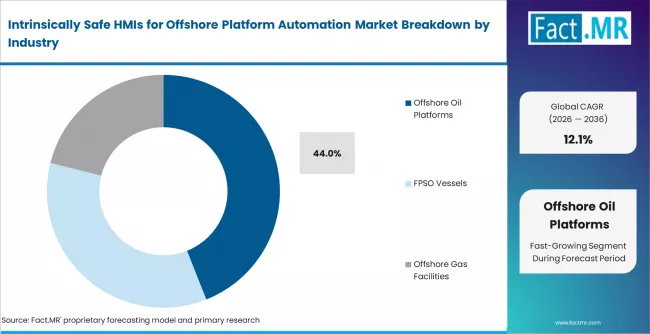
Intrinsically Safe Hmis For Offshore Platform Automation Market Analysis By End Use | Source: Fact.MR
- Market Overview: Offshore oil platforms are estimated to hold 44% share of the intrinsically safe HMIs for offshore platform automation market in 2026, supported by requirement for real time monitoring of drilling systems, fluid handling equipment, and safety control instrumentation across offshore extraction environments. HMI units enable visualization of process parameters including pressure levels, flow rate readings, and equipment diagnostics across distributed control architectures supporting offshore production operations. Equipment integration supports stable interface performance across remote installations requiring durable electronics capable of operating under high humidity and saline exposure conditions.
- Demand Drivers:
- Process Monitoring Requirements: Offshore platforms utilize intrinsically safe HMIs enabling visualization of operational parameters across drilling and production control systems.
- Environmental Durability Parameters: Rugged electronic interface systems demonstrate resistance to corrosion and vibration across offshore marine operating conditions.
- Automation Integration Needs: HMI units support interaction with distributed control systems enabling consistent access to equipment status information across offshore production workflows.
Key Dynamics
Intrinsically Safe HMIs for Offshore Platform Automation Market Drivers, Restraints, and Opportunities
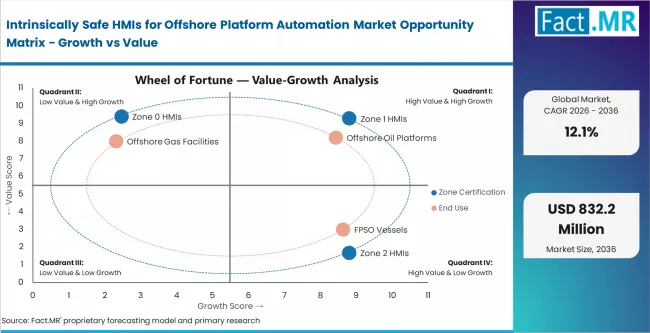
Intrinsically Safe Hmis For Offshore Platform Automation Market Opportunity Matrix Growth Vs Value | Source: Fact.MR
FMR analysts observe that historical demand originates from offshore oil and gas control environments where explosion-risk zones require certified operator interfaces capable of functioning within hazardous atmospheres containing flammable gases. The present market size reflects a structurally stable industrial safety segment shaped by long lifecycle offshore assets where control system upgrades occur incrementally rather than through complete platform replacement. Structural reality indicates a mature but gradually modernizing market because offshore automation systems must comply with strict ignition protection requirements while maintaining high operational reliability under corrosive marine conditions and continuous process monitoring requirements.
The current structural shift reflects declining reliance on non-networked operator panels as digital control architectures increasingly require intrinsically safe HMIs capable of supporting remote diagnostics, visualization, and integrated distributed control system connectivity. Higher per-unit cost of certified explosion-protected interfaces is offset by reduced downtime risk and improved operational visibility across drilling, separation, and compression modules. Demand remains linked to brownfield automation upgrades and life extension projects rather than large volumes of new offshore platform construction activity.
- Explosion Protection Compliance: IEC 60079 intrinsic safety certification and ATEX Zone 1 classification requirements sustain baseline demand for ignition-protected operator interface equipment.
- Brownfield Control Upgrades: Offshore operators retrofit legacy panel interfaces with network-capable HMIs to improve process visualization and remote maintenance capability.
- North Sea Retrofit Demand: United Kingdom and Norway maintain steady replacement cycles due to aging offshore infrastructure requiring control system modernization under strict safety regulation.
Regional Analysis
The intrinsically safe HMIs for offshore platform automation market is assessed across North America, Europe, and Asia Pacific, segmented by country-level demand in explosion-proof operator interfaces, hazardous zone control panels, offshore drilling automation systems, and marine process monitoring displays. Regional demand reflects offshore safety compliance requirements and adoption of certified human-machine interface technologies. The full report offers market attractiveness analysis.
.webp "Top Country Growth Comparison Intrinsically Safe Hmis For Offshore Platform Automation Market Cagr (2026 2036)")
Top Country Growth Comparison Intrinsically Safe Hmis For Offshore Platform Automation Market Cagr (2026 2036) | Source: Fact.MR
CAGR Table
| Country | CAGR (2026–2036) |
|---|---|
| China | 13.0% |
| India | 12.7% |
| United Kingdom | 12.5% |
| Germany | 12.3% |
| United States | 12.1% |
Source: Fact.MR analysis. Updated Apr 16, 2026
Source: Fact MR analysis, based on proprietary forecasting model and primary research
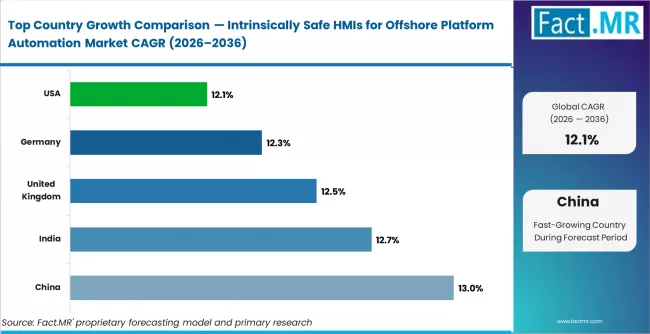
Intrinsically Safe Hmis For Offshore Platform Automation Market Cagr Analysis By Country | Source: Fact.MR
Asia Pacific
Asia Pacific functions as the offshore energy digital control adoption hub, supported by expansion of offshore exploration activity and increased deployment of explosion-proof operator interface systems. Siemens AG strengthens hazardous area HMI engineering capability. Advantech Co. Ltd. expands intrinsically safe industrial display portfolio. Pepperl+Fuchs SE supports certified interface integration technologies.
- China: China is projected to record 13.0% CAGR in intrinsically safe HMIs for offshore platform automation through 2036. Offshore equipment safety guideline update (National Energy Administration, February 2024) supports certified interface deployment in hazardous environments. Advantech Co. Ltd. expanded intrinsically safe panel system engineering capability (July 2023).
- India: Adoption of intrinsically safe HMIs for offshore platform automation in India is forecast to grow at 12.7% CAGR through 2036. Directorate General of Hydrocarbons offshore safety compliance update (January 2024) supports hazardous zone operator interface installation. Siemens AG expanded marine automation interface integration capability (May 2023).
Europe
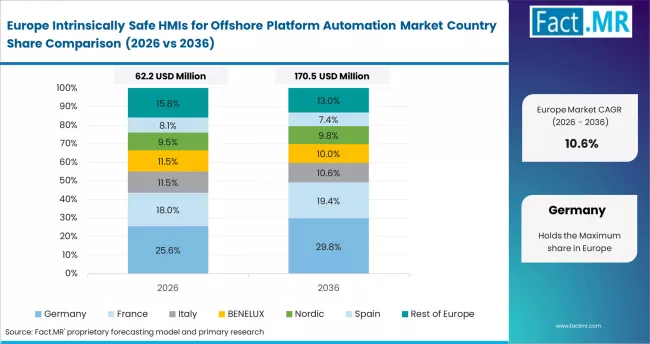
Intrinsically Safe Hmis For Offshore Platform Automation Market Europe Country Market Share Analysis, 2026 & 2036 | Source: Fact.MR
Europe operates as the hazardous area certification benchmark, supported by ATEX compliance frameworks and strong presence of offshore automation engineering providers. ABB Ltd. strengthens explosion-proof control interface capabilities. Schneider Electric SE expands certified HMI platform offerings. Siemens AG supports offshore digital interface system integration.
- United Kingdom: Deployment of intrinsically safe HMIs for offshore platform automation in United Kingdom is expected to expand at 12.5% CAGR through 2036. Offshore Safety Directive compliance alignment update (HSE, March 2024) supports hazardous area control interface adoption. ABB Ltd. expanded explosion-proof interface system capability (June 2023).
- Germany: Germany is anticipated to observe 12.3% CAGR in intrinsically safe HMIs for offshore platform automation through 2036. IECEx certification alignment update (DKE, October 2023) supports hazardous location display integration. Pepperl+Fuchs SE expanded intrinsically safe HMI module production capability (April 2023).
North America
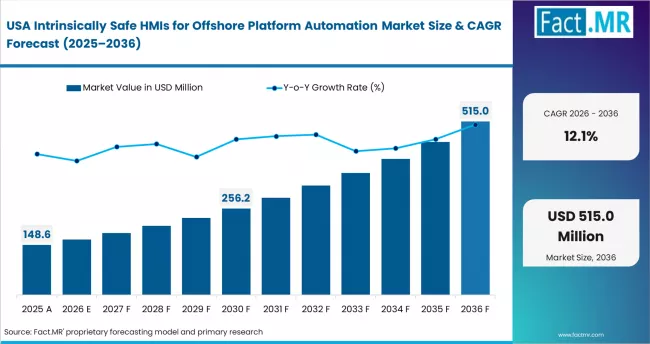
Intrinsically Safe Hmis For Offshore Platform Automation Market Country Value Analysis | Source: Fact.MR
North America represents the offshore automation interface modernization environment, supported by digital oilfield initiatives and strong demand for certified operator visualization platforms. Rockwell Automation Inc. strengthens hazardous environment control interface capability. Honeywell International Inc. expands offshore process monitoring display technologies. Emerson Electric Co. supports explosion-proof interface integration.
- United States: The United States is forecast to witness 12.1% CAGR in intrinsically safe HMIs for offshore platform automation through 2036. Bureau of Safety and Environmental Enforcement offshore safety compliance update (April 2024) supports certified operator interface deployment. Emerson Electric Co. expanded hazardous location visualization platform capability (August 2023).
Fact MR's analysis of intrinsically safe HMIs for offshore platform automation market in global regions consists of country-wise assessment that includes China, India, United Kingdom, Germany, and United States. Readers can find hazardous environment interface trends, offshore automation developments, certification frameworks, and competitive positioning across key markets.
Competitive Landscape
Competitive Structure and Buyer Dynamics in the Intrinsically Safe HMIs for Offshore Platform Automation Market
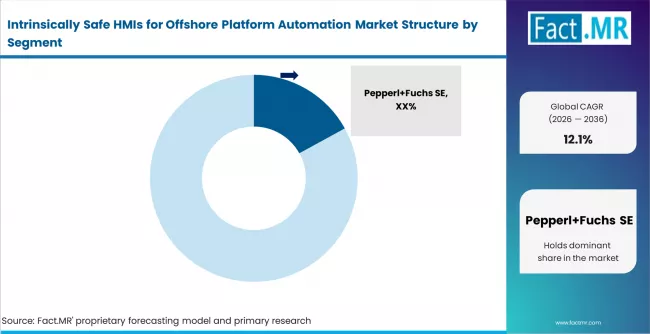
Intrinsically Safe Hmis For Offshore Platform Automation Market Analysis By Company | Source: Fact.MR
The competitive structure of the Intrinsically Safe HMIs for Offshore Platform Automation Market is moderately concentrated, with industrial automation and explosion protected equipment manufacturers controlling a significant share of certified interface solutions. Companies such as Pepperl+Fuchs SE, R Stahl AG, Siemens AG, Schneider Electric SE, Honeywell International Inc., ABB Ltd., Emerson Electric Co., Bartec GmbH, Beijer Electronics Group, and Extronics Ltd. maintain strong positions through established hazardous area control technologies and global industrial automation distribution networks. Competition is primarily influenced by intrinsic safety certification compliance, interface reliability, system durability, and compatibility with distributed control systems used in offshore energy environments.
Several companies maintain structural advantages through specialized expertise in explosion protected electrical equipment and established relationships with oil and gas operators. Firms such as Pepperl+Fuchs SE, R Stahl AG, and Bartec GmbH benefit from strong technical capabilities in hazardous area certified hardware design. Siemens AG, Schneider Electric SE, and ABB Ltd. maintain advantages through integrated automation platforms supporting seamless system compatibility. Offshore operators typically adopt multi vendor sourcing strategies to reduce dependence on a single equipment provider and ensure operational continuity. Procurement decisions evaluate suppliers based on certification standards, system reliability, and long term technical support, moderating supplier pricing leverage across offshore automation applications.
Key Players of the Intrinsically Safe HMIs for Offshore Platform Automation Market
- Pepperl+Fuchs SE
- R Stahl AG
- Siemens AG
- Schneider Electric SE
- Honeywell International Inc.
- ABB Ltd.
- Bartec GmbH
- Beijer Electronics Group
- Emerson Electric Co.
- Extronics Ltd.
Report Scope
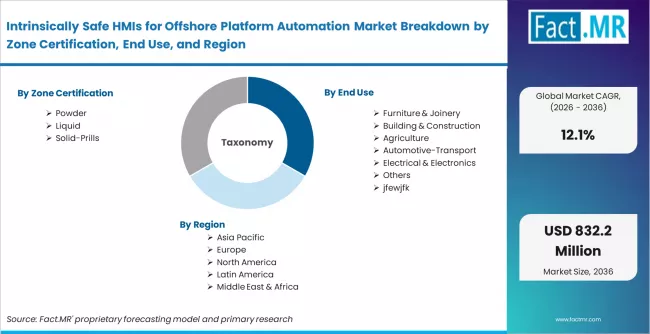
Intrinsically Safe Hmis For Offshore Platform Automation Market Breakdown By Zone Certification, End Use, And Region | Source: Fact.MR
| Metric | Value |
|---|---|
| Quantitative Units | USD 236.9 million (2026) to USD 742.6 million (2036), at a CAGR of 12.1% |
| Market Definition | The intrinsically safe HMIs for offshore platform automation market includes human machine interface systems engineered to operate safely in explosive offshore environments, enabling monitoring and control of critical processes across oil and gas production, subsea operations, and floating production systems. |
| Zone Certification Segmentation | Zone 1 HMIs, Zone 2 HMIs, Zone 0 HMIs |
| Interface Type Segmentation | Panel mount, Touchscreen, Mobile handheld, Industrial PC based |
| End Use Segmentation | Offshore oil platforms, FPSO vessels, Offshore gas facilities, Subsea control stations |
| Regions Covered | North America, Latin America, Europe, East Asia, South Asia, Oceania, Middle East and Africa |
| Countries Covered | United States, Canada, Brazil, Norway, United Kingdom, Netherlands, Germany, Saudi Arabia, United Arab Emirates, Qatar, China, Japan, South Korea, India, Australia, Singapore, Malaysia, and 40+ countries |
| Key Companies Profiled | Pepperl+Fuchs SE, R Stahl AG, Siemens AG, Schneider Electric SE, Honeywell International Inc., ABB Ltd., Bartec GmbH, Beijer Electronics Group, Emerson Electric Co., Extronics Ltd. |
| Forecast Period | 2026 to 2036 |
| Approach | Hybrid top-down and bottom-up market estimation based on offshore automation deployment trends, hazardous area compliance requirements, oil and gas infrastructure modernization benchmarking, industrial control interface demand analysis, and validation through primary interviews with automation equipment manufacturers, offshore engineering firms, and energy companies. |
Source: Fact.MR analysis. Updated Apr 16, 2026
Intrinsically Safe HMIs for Offshore Platform Automation Market Key Segments
-
Zone Certification:
- Zone 1 HMIs
- Zone 2 HMIs
- Zone 0 HMIs
-
Interface Type:
- Panel Mounta
- Touchscreen
- Mobile Handheld
- Industrial PC Based
-
End Use:
- Offshore Oil Platforms
- FPSO Vessels
- Offshore Gas Facilities
- Subsea Control Stations
-
Region:
- North America
- USA
- Canada
- Mexico
- Europe
- Germany
- UK
- France
- Italy
- Spain
- Nordic Countries
- BENELUX
- Rest of Europe
- Asia Pacific
- China
- Japan
- South Korea
- India
- Australia
- Rest of Asia Pacific
- Latin America
- Brazil
- Argentina
- Rest of Latin America
- Middle East and Africa
- Kingdom of Saudi Arabia
- United Arab Emirates
- South Africa
- Rest of Middle East and Africa
- Other Regions
- Oceania
- Central Asia
- Other Markets
- North America
Bibliographies
- [1] International Electrotechnical Commission. (2023). IEC 60079-11:2023 Equipment protection by intrinsic safety i. IEC.
- [2] Health and Safety Executive. (2024, March). Offshore safety directive compliance alignment update. UK Government.
- [3] Bureau of Safety and Environmental Enforcement. (2024). FY2024 offshore safety and environmental enforcement budget. U.S. Department of the Interior.
- [4] National Energy Administration. (2024, February). Offshore equipment safety guideline update. Government of China.
- [5] Directorate General of Hydrocarbons. (2024, January). Offshore safety compliance update. Government of India.
- [6] European Union. (2023). ATEX directive 2014/34/EU zone 1 equipment requirements. European Commission.
This Report Addresses
- Market size forecasts for 2026 to 2036 based on offshore automation modernization demand and hazardous area interface deployment benchmarks.
- Opportunity mapping across Zone 0, Zone 1, and Zone 2 certified human machine interfaces supporting safe operator interaction in explosive environments.
- Segment and regional forecasts covering panel mount, touchscreen, mobile handheld, and industrial PC based intrinsically safe interface architectures.
- Competition assessment based on intrinsic safety certification capability, ruggedized interface durability, and compatibility with distributed control systems.
- Regulatory review covering IEC 60079 intrinsic safety framework, ATEX certification requirements, and offshore hazardous area compliance standards.
- Report delivery in PDF, Excel, PPT, and dashboard formats for offshore operators, automation vendors, and hazardous area equipment manufacturers.
- Technology risk assessment covering certification lead times, integration complexity with legacy control infrastructure, environmental durability constraints, and lifecycle maintenance requirements.
Intrinsically Safe HMIs for Offshore Platform Automation Market Definition
The Intrinsically Safe HMIs for Offshore Platform Automation Market includes human machine interface devices engineered to operate safely in hazardous offshore environments by limiting electrical and thermal energy levels to prevent ignition of flammable gases while enabling real time monitoring, control, and visualization of drilling, processing, and production systems.
Intrinsically Safe HMIs for Offshore Platform Automation Market Inclusions
The report includes global and regional market size estimates, forecast analysis, and segmentation by HMI type, protection certification level, interface technology, application area, end use industry, pricing structure, and integration with offshore automation and control systems.
Intrinsically Safe HMIs for Offshore Platform Automation Market Exclusions
The scope excludes standard industrial HMIs without hazardous area certification, explosion proof enclosures without intrinsic safety design, offshore control software not integrated with HMI hardware, and automation equipment not directly used for operator interface functions.
Intrinsically Safe HMIs for Offshore Platform Automation Market Research Methodology
- Primary Research
- Interviews were conducted with industrial automation vendors, offshore platform operators, HMI manufacturers, system integrators, and hazardous area equipment specialists.
- Desk Research
- Public sources included industrial safety standards documentation, certification guidelines, company technical specifications, offshore automation publications, and research papers on intrinsically safe instrumentation.
- Market-Sizing and Forecasting
- A hybrid model combining top-down offshore automation demand evaluation and bottom-up analysis of intrinsically safe HMI deployment across hazardous process environments was applied.
- Data Validation and Update Cycle
- Outputs were validated through cross comparison of supplier data, expert consultation, and periodic monitoring of offshore safety compliance and automation adoption trends.
Frequently Asked Questions
How large is the demand for Intrinsically Safe HMIs for Offshore Platform Automation in the global market in 2026?
What will be the market size of Intrinsically Safe HMIs for Offshore Platform Automation in the global market by 2036?
What is the expected demand growth for Intrinsically Safe HMIs for Offshore Platform Automation in the global market between 2026 and 2036?
Which company is identified as a leading manufacturer in the Intrinsically Safe HMIs for Offshore Platform Automation market?
Which zone certification category is projected to dominate intrinsically safe HMI deployment by 2026?
Why are Zone 1 intrinsically safe HMIs widely used in offshore automation systems?
What is driving demand for intrinsically safe HMIs in China?
What is the growth outlook for the Intrinsically Safe HMIs for Offshore Platform Automation market in China?
Why is India an important market for hazardous area automation interface systems?
What is the growth outlook for the Intrinsically Safe HMIs for Offshore Platform Automation market in India?
How is demand for intrinsically safe HMIs evolving in the United Kingdom offshore automation sector?
What is the growth outlook for the Intrinsically Safe HMIs for Offshore Platform Automation market in the United Kingdom?
What is the growth outlook for the Intrinsically Safe HMIs for Offshore Platform Automation market in Germany?
How is the United States positioned in the Intrinsically Safe HMIs for Offshore Platform Automation market?
What is the growth outlook for the Intrinsically Safe HMIs for Offshore Platform Automation market in the United States?
What are intrinsically safe HMIs and what are they mainly used for in offshore platform automation?
What does the Intrinsically Safe HMIs for Offshore Platform Automation market include in this report?
What applications are included in the scope of the Intrinsically Safe HMIs for Offshore Platform Automation market?
What is excluded from the scope of the Intrinsically Safe HMIs for Offshore Platform Automation market report?
What does market forecast mean in the Intrinsically Safe HMIs for Offshore Platform Automation market report?
How is the Intrinsically Safe HMIs for Offshore Platform Automation market forecast developed in this report?
What does primary validation indicate in the Intrinsically Safe HMIs for Offshore Platform Automation market analysis?
Who worked on this report


Preview the report firsthand - request a free sample
Free SampleGet the brochure for pricing and purchase details
Download PDF