- Market Value (2025): USD 3.1 Bn
- Estimated Value (2026): USD 3.3 Bn
- Forecast Value (2036): USD 6.6 Bn
- CAGR (2026-2036): 7.2%
What is the Automated Ingredient Weighing Stations Market forecast to be worth by 2036?
USD 3.3 billion in 2026 to USD 6.6 billion by 2036 at a 7.2% CAGR.
- The Automated Ingredient Weighing Stations Market reached USD 3.1 billion in 2025.
- Demand is projected to increase from USD 3.3 billion in 2026 to USD 6.6 billion by 2036.
- As per Fact.MR analysis, the automated ingredient weighing stations market is forecast to record a 7.2% CAGR from 2026 to 2036 as food plants expand recipe-controlled weighing and connected batch handling.
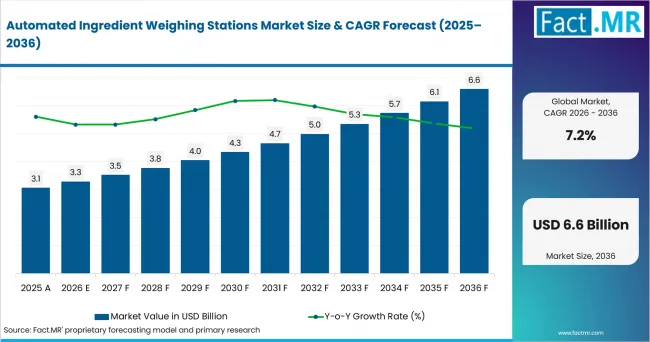
Automated Ingredient Weighing Stations Market Value Analysis | Source: Fact.MR
What are the defining numbers behind Automated Ingredient Weighing Stations Market growth?
Through 2036, an absolute opportunity for automated ingredient weighing stations market is of USD 3.3 billion.
- Demand Drivers in the Market
- Food plants need the same batch weight every time when they make a new product. Automated weighing stations help them measure the correct amount for every batch.
- High food spending supports food production in the U.S. In June 2026, the U.S. Department of Agriculture Economic Research Service reported that total U.S. food spending reached USD 2.51 trillion in 2025.
- Food plants that use allergens or colors need to check each ingredient before adding it to a product. Barcode scanning helps workers to make sure that they are using the correct ingredient for each recipe.
- Key Segments Analyzed
- By Weighing Architecture: Floor-scale batch is expected to hold 35.0% share in 2026 because staged weighing fits plants that prepare a complete ingredient set before transfer.
- By Ingredient: Bulk powders are projected to account for 31.0% share in 2026 since flour and starch often enter recipes at high batch weights.
- By Automation: PLC batch is anticipated to capture 38.0% share in 2026 with programmable controls linking scales to feeders and discharge devices.
- By Industry: Bakery is estimated to represent 34.0% share in 2026 reflecting repeated flour-based batches and regular use of smaller recipe additions.
- Analyst Opinion at Fact.MR
- Shambhu Nath Jha, Principal Consultant at Fact.MR states, “Ingredient weighing is easier to control when the scale is linked to the recipe and ingredient details. Food plants prefer systems that give the right weight and are easy to use and clean.”
- Strategic Implications
- For both large and small amounts of ingredients bakeries can use one system to weigh. This works well for recipes which use a lot of flour and small amounts of other ingredients.
- System providers make the weighing process easier for workers. The screen can clearly show the weight and ingredient details for each batch.
- Food equipment suppliers can show how well their machines work using clear results. In March 2025, Tetra Pak said its Ingredient Doser 4000 A3 reaches the set point up to three times faster and cuts start-up waste by 67% compared with the earlier version.
The USA grows the fastest at 8.1% CAGR, mainly due to its large food-processing industry and high demand for labor. The UK is slightly lower at 7.8%, a difference of only 0.3 percentage point, as food makes up a large part of its manufacturing sector. Germany follows at 7.5%, helped by ready-food production, while France is close at 7.2% with its large food-processing base. Japan grows at a slower 5.8%, but rising labor pressure is creating more demand for factory automation.
How does the Automated Ingredient Weighing Stations Market break down by segment?
PLC batch is projected to lead Automation at 38.0% share in 2026; Floor-scale batch accounts for 35.0% share in 2026.
Which Weighing Architecture dominates?
In 2026, the floor-scale batch holds 35.0% share.
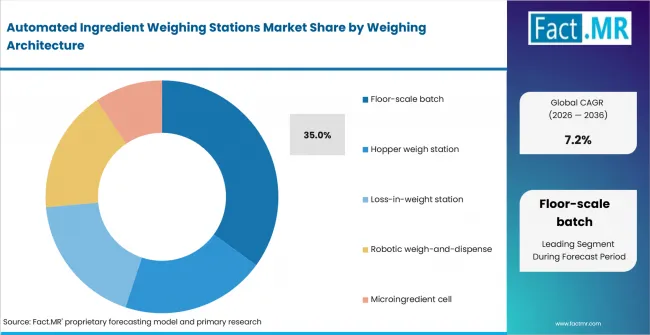
Automated Ingredient Weighing Stations Market Analysis By Weighing Architecture | Source: Fact.MR
Floor-scale batch stations use are increases because they can weigh all ingredients for a full recipe before mixing. Compare to floor-scale batch hopper stations work differently and are less focused on one batch. Loss-in-weight stations have better control on the final amount.
What leads the Ingredient segment?
Bulk powders are projected to account for 31.0% share in 2026.
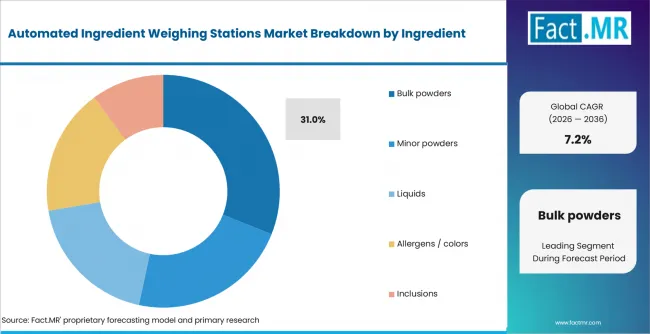
Automated Ingredient Weighing Stations Market Analysis By Ingredient | Source: Fact.MR
Bulk powders are projected to lead because many food recipes use large amounts of dry ingredients. Smaller powder additions need more precise dosing and careful refilling. Liquids need suitable valves and easy-to-clean flow paths. Allergens and colors require clear material checks. Inclusions may need gentler handling to protect their shape. These needs make ingredient type an important part of weighing system design.
How does Automation shape demand?
Among other segments, in 2026, the PLC batch account for 38.0% share.
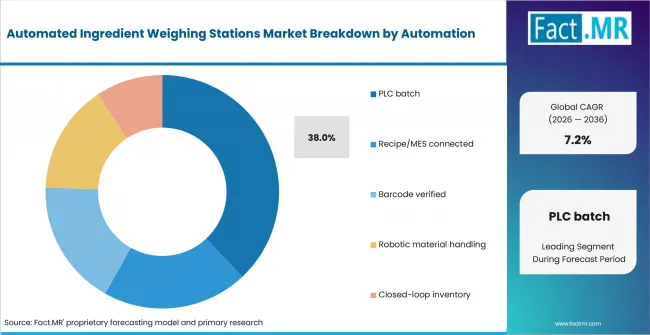
Automated Ingredient Weighing Stations Market Analysis By Automation | Source: Fact.MR
PLC batch control the higher use because it connects weighing with each recipe step. Recipe and MES further march with weights. Barcode checks focus on using the right ingredient. Robotic systems help to reduce lifting, while inventory system keep stock records updated. In April 2025, Coperion reported that its K3 vibratory feeders provide 35% higher accuracy on average than conventional models.
What supports Bakery within Industry?
Bakery is estimated to represent 34.0% share in 2026.
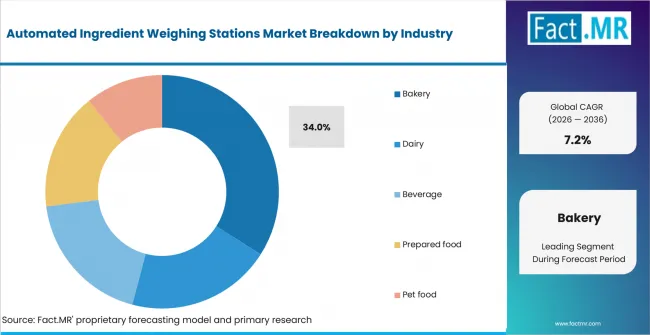
Automated Ingredient Weighing Stations Market Analysis By Industry | Source: Fact.MR
Among all other segments bakery lead this segment because recipes use a lot of flour compare with other smaller ingredients. Dairy plants need to handle powders and liquids. Beverage plants need a right amount of each ingredient even after mixing. Prepared-food plants use the same equipment to make different recipes.
What is accelerating Automated Ingredient Weighing Stations Market adoption, and what is holding it back?
Companies are using these systems to automate recipes and reduce manual work. However, setup costs and difficult cleaning can slow their use.
Drivers Impact Analysis
| DRIVER | (~) % IMPACT ON CAGR | GEOGRAPHIC RELEVANCE | IMPACT TIMELINE |
|---|---|---|---|
| Recipe-controlled batch automation | +1.2% | Global | Short term (<= 2 years) |
| Labor pressure in repetitive weighing | +0.9% | North America, Europe, Japan | Medium term (2-4 years) |
| Traceable ingredient identity | +0.7% | North America, Europe | Medium term (2-4 years) |
| Flexible multi-recipe production | +0.5% | Global | Long term (>= 4 years) |
Opportunity Impact Analysis
| OPPORTUNITY | (~) % IMPACT ON CAGR | GEOGRAPHIC RELEVANCE | IMPACT TIMELINE |
|---|---|---|---|
| Recipe and MES connectivity | +0.8% | Global | Medium term (2-4 years) |
| Microingredient automation | +0.6% | Europe, North America | Short term (<= 2 years) |
| Robotic container handling | +0.4% | Europe, Japan | Long term (>= 4 years) |
Restraints Impact Analysis
| RESTRAINT | (~) % IMPACT ON CAGR | GEOGRAPHIC RELEVANCE | IMPACT TIMELINE |
|---|---|---|---|
| Brownfield integration complexity | -0.6% | Global | Short term (<= 2 years) |
| Cleaning and cross-contact controls | -0.4% | Food-processing regions | Medium term (2-4 years) |
| Capital justification for low batch volumes | -0.3% | Global | Long term (>= 4 years) |
Which countries are scaling the Automated Ingredient Weighing Stations Market through 2036?
- Growth rates among the five countries differ by 2.3 percentage points during the forecast period.
- The USA is 0.3 percentage point above the UK owing to its large food-processing sector and repeated batch work.
- Food makes up a large share of manufacturing sales in the UK, placing its growth rate 0.3 percentage point above Germany.
- Prepared-food production supports the use of controlled ingredient systems in Germany. Its growth rate is 0.3 percentage point above France.
- France has a large food and beverage production base which supports equipment upgrades and placing it 1.4 percentage points above Japan.
- Labor pressure in Japan is increasing the use of automation for simple and repeatable ingredient handling.
Similar CAGRs can still result in different equipment needs. Factory layout and recipe needs can change from one country to another. The full report covers North America, Latin America, Western Europe, Eastern Europe, East Asia, South Asia & Pacific, and the Middle East & Africa.
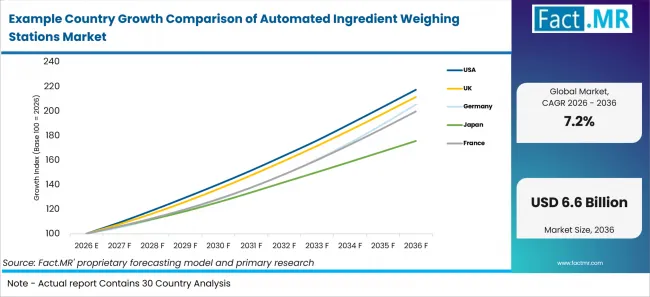
Example Country Growth Comparison Of Automated Ingredient Weighing Stations Market | Source: Fact.MR
| Country | CAGR (2026-2036) |
|---|---|
| United States | 8.1% |
| United Kingdom | 7.8% |
| Germany | 7.5% |
| France | 7.2% |
| Japan | 5.8% |
What supports USA adoption?
8.1% CAGR, supported by large food production and regular batch work.
Food production in the U.S. automated ingredient weighing stations market involves more of a batch work. In 2025, the U.S. Bureau of Labor Statistics counted 144,690 food batchmakers. Automated weighing systems definitely reduce the repeated weighing process.
Why are UK food plants using more automated weighing systems?
The UK market is forecast to grow at a 7.8% CAGR.
Food is a major part of UK manufacturing. In July 2026, according to the Office for National Statistics, it accounted for 22.9% of total product sales by UK manufacturers in 2025. As per Fact.MR analysis, compared with other plants, some systems automate the full weighing process, but others add weighing equipment only for product selection.
What is driving equipment use in Germany?
Through 2036, the Germany is forecast to record a 7.5% CAGR.
Ready to eat meals require the same amount of ingredient from one batch to the next. Germany produced 1.7 million tonnes of ready meals in 2024, according to Destatis. This also create the clear need for accurate ingredient weighing and easy powder handling.
How are changing production needs shaping the French market?
France is forecast to grow at a 7.2% CAGR.
Based on customer orders, food plants change their recipes and production plans. Automated weighing systems make it easier to handle these changes. In June 2026, INSEE reported food and beverage output stayed stable in April after rising 1.1% in March 2026.
Why can automation help Japanese food plants?
By 2036, Japan is forecast to grow at a 5.8% CAGR
Japan has less workers which work in manufacturing process. Manufacturing employment fell from 10.55 million people in 2023 to 10.33 million in 2025, according to the Ministry of Health, Labour and Welfare. Automated weighing can reduce repeated work.
Who leads the Automated Ingredient Weighing Stations Market?
Bühler provides weighing and dosing systems for powder and granular ingredients. Coperion offers feeding and weighing systems through its Coperion K-Tron range. GEA creates systems for preparing and mixing ingredients and managing recipes in food plants. AZO offers automated systems for handling and dosing ingredients which is in different amounts.
Qlar is the current name of the company which previously known as Schenck Process. The company changed its name in May 2024. Before this change, the Schenck Process Food & Performance Materials business was sold to Hillenbrand and later became part of Coperion. This means Qlar and Coperion now operate as separate companies.
Which companies are the key providers?
Key companies include Bühler; Coperion; GEA; AZO; Qlar Group (formerly Schenck Process); and Tetra Pak.
- Bühler
- Coperion
- GEA
- AZO
- Qlar Group (formerly Schenck Process)
- Tetra Pak
Bibliography
- Zeballos, E., & Sinclair, W. (2026, June 11). Total U.S. food spending reached $2.51 trillion in 2025. U.S. Department of Agriculture, Economic Research Service.
- Tetra Pak. (2025, March 11). Ice cream manufacturers can cut start-up waste by 67% with new Tetra Pak® Ingredient Doser 4000 A3.
- Coperion. (2025, April 15). Trailblazing technologies for manufacturing tasty, nutritious meat alternatives.
- Office for National Statistics. (2026, July 24). UK manufacturers’ sales by product: 2025.
- Statistisches Bundesamt (Destatis). (2026, January 14). Produktion von Fertiggerichten binnen fünf Jahren mengenmäßig um 25,6 % gestiegen.
- Institut national de la statistique et des études économiques. (2026, June 5). In April 2026, manufacturing output increased by 0.4%.
- Qlar Group. (2025, September 2). Qlar (formerly Schenck Process) returns to the food and pet food industry with bold rebrand.
This Report Answers
- The report explains where automated ingredient weighing stations are used across Weighing Architecture and Ingredient type. It also covers Automation, Industry, and regional demand.
- Segment analysis identifies the leading subsegments and explains why floor-scale batch systems, bulk powders, PLC batch control, and bakery applications hold prominent positions.
- Country analysis examines the United States, United Kingdom, Germany, France, and Japan. It considers food-processing scale, prepared-food production, labor pressure, and manufacturing conditions that influence automation adoption.
- Competitive analysis reviews Bühler, Coperion, GEA, AZO, Qlar Group, and Tetra Pak across weighing, dosing, feeding, ingredient handling, and connected food-processing systems.
- Application analysis assesses how weighing accuracy, recipe control, ingredient verification, cleaning needs, batch frequency, and system integration influence equipment selection. It also considers bulk ingredients, minor additions, liquids, allergens, colors, and inclusions across food-processing lines.
What does the Automated Ingredient Weighing Stations Market cover?
The Automated Ingredient Weighing Stations Market covers equipment used to measure ingredients before or during food-production batching. It includes floor scales and hopper weighing. Loss-in-weight dosing and robotic weigh-and-dispense cells are included alongside microingredient systems. The equipment can work as a stand-alone recipe room or as part of a larger processing line when weighing remains a defined operating function.
The assessment covers bakery and dairy production. Beverage lines are included along with prepared-food and pet-food production. Ingredient coverage includes bulk powders and smaller dry additions. It includes liquids and allergens or colors. Inclusions are covered where the station measures the amount delivered to the recipe. Automation ranges from PLC batch control to recipe or MES links and closed-loop inventory records.
What is included in the scope?
The scope includes automated scales and weighing cells that use stored setpoints to execute ingredient targets. It includes connected feeders and discharge devices when they form part of the weighing station. Barcode verification is included when material identity is checked before the dose enters the batch. Robotic material handling is included where the robot moves containers or ingredients through the weighing step.
The market includes food-grade equipment for bulk and minor ingredients. It also covers loss-in-weight stations used for controlled discharge and microingredient cells used for smaller additions. Systems can be installed on new lines or added around existing mixers when the weighing function remains distinct and measurable.
What is excluded from the scope?
Retail scales and laboratory balances used only for testing sit outside the scope. Finished-pack checkweighers belong to the post-processing inspection stage. General warehouse weighing remains outside the boundary when recipe execution is absent. Conveyors or feeders are treated as adjacent equipment when ingredient weighing is absent.
General plant software is outside the scope when ingredient weight control is absent. Mixing and cooking equipment remain outside the market when weighing is only an incidental function. Filling and packaging equipment follow the same boundary. Liquid metering pumps are adjacent equipment when ingredient weighing is outside their function.
How Was the Analysis Built?
The analysis draws on 120+ sources, 35+ company portfolios, 25+ countries, and more than 20 industry interviews.
- Primary Research: Primary research includes discussions with manufacturers, service providers, technology developers, distributors, end users, and subject-matter experts. These conversations examine purchasing priorities, product adoption, operational challenges, approval requirements, competitive positioning, and the factors that influence wider market acceptance.
- Desk Research: Desk research covers government statistics, regulatory publications, company filings, trade data, technical studies, industry associations, standards, public policy, and other authoritative sources. Every source used in the analysis is documented in the bibliography.
- Market Sizing and Forecasting: Market estimates combine historical performance, demand indicators, pricing and volume trends, segment shares, company participation, country-level growth, adoption patterns, investment activity, and barriers to market expansion.
- Data Validation and Update Cycle: Findings are validated by comparing primary interviews with public data, company activity, regulatory changes, trade patterns, and industry developments. Regular updates review new product launches, capacity changes, partnerships, approvals, and shifts in commercial adoption.
What is the report’s scope and coverage?
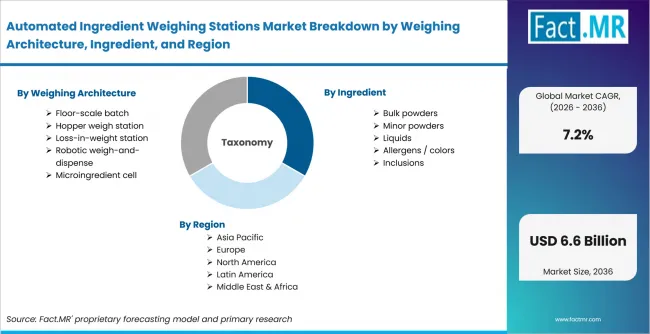
Automated Ingredient Weighing Stations Market Breakdown By Weighing Architecture, Ingredient, And Region | Source: Fact.MR
| Attribute | Details |
|---|---|
| Quantitative Units | USD billion |
| Market Definition | Automated stations that weigh and dispense food ingredients into controlled batches using scales, feeders, recipe controls and connected material-handling equipment. |
| Weighing Architecture | Floor-scale batch; Hopper weigh station; Loss-in-weight station; Robotic weigh-and-dispense; Microingredient cell |
| Ingredient | Bulk powders; Minor powders; Liquids; Allergens / colors; Inclusions |
| Automation | PLC batch; Recipe/MES connected; Barcode verified; Robotic material handling; Closed-loop inventory |
| Industry | Bakery; Dairy; Beverage; Prepared food; Pet food |
| Regions Covered | North America; Latin America; Western Europe; Eastern Europe; East Asia; South Asia & Pacific; Middle East & Africa |
| Countries Covered | United States; United Kingdom; Germany; France; Japan |
| Key Companies Profiled | Bühler; Coperion; GEA; AZO; Qlar Group; Tetra Pak |
| Forecast Period | 2026 to 2036 |
| Approach | Hybrid top-down and bottom-up approach using food-processing activity, ingredient-handling intensity, country evidence, segment shares and provider portfolio review. |
How is the market segmented?
-
By Weighing Architecture:
- Floor-scale batch
- Hopper weigh station
- Loss-in-weight station
- Robotic weigh-and-dispense
- Microingredient cell
-
By Ingredient:
- Bulk powders
- Minor powders
- Liquids
- Allergens / colors
- Inclusions
-
By Automation:
- PLC batch
- Recipe/MES connected
- Barcode verified
- Robotic material handling
- Closed-loop inventory
-
By Industry:
- Bakery
- Dairy
- Beverage
- Prepared food
- Pet food
-
By Region:
- North America
- Latin America
- Western Europe
- Eastern Europe
- East Asia
- South Asia & Pacific
- Middle East & Africa