- Market Value (2025): USD 505.6 Mn
- Estimated Value (2026): USD 540 Mn
- Forecast Value (2036): USD 1043 Mn
- CAGR (2026-2036): 6.8%
What is the Automated Drum Filling & Closing Systems Market forecast to be worth by 2036?
USD 540 million in 2026 to USD 1043 million by 2036 at a 6.8% CAGR.
- The Automated Drum Filling & Closing Systems Market was valued at USD 505.6 million in 2025.
- Demand is projected to increase from USD 540 million in 2026 to USD 1043 million by 2036.
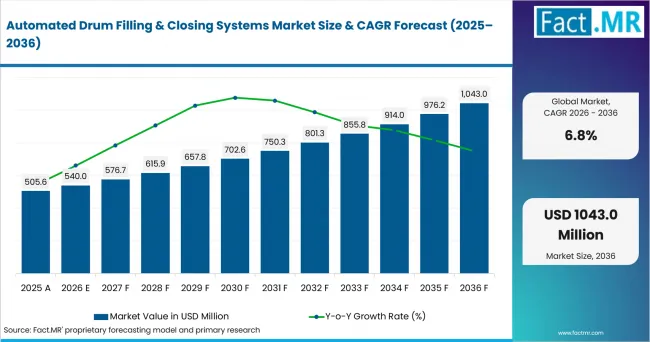
Automated Drum Filling & Closing Systems Market Value Analysis | Source: Fact.MR
What are the defining numbers behind Automated Drum Filling & Closing Systems Market growth?
An absolute opportunity of USD 503 million is expected between 2026 and 2036.
- Demand Drivers in the Market
- Hazardous-chemical handling is increasing the case for automated filling. OSHA process-safety rules are intended to prevent or limit releases of toxic and reactive chemicals. They also address flammable or explosive chemicals, while EU ATEX rules govern equipment used in potentially explosive atmospheres. Chemical and solvent plants can therefore reduce direct operator involvement by using enclosed or remotely controlled filling and closing stations.
- Dangerous-goods transport requirements make consistent packaging and closure important after filling. The UN Model Regulations define construction and testing requirements for packagings used for dangerous goods. Export-oriented chemical and lubricant producers therefore value lines that combine controlled filling with closure verification and traceable weight records before drums enter transport networks.
- Integrated fill-close lines reduce the number of manual transfers between weighing, filling and closure. A drum can be positioned, filled and closed within one controlled sequence, which lowers handling points and supports repeatable cycle times in plants with recurring drumming operations.
- Gravimetric filling is strengthening demand where buyers want repeatable net weight and lower product giveaway. Feige Filling publishes drum systems that use fill-by-weight technology from semi-automatic equipment through fully automatic lines, showing how weight control is built directly into industrial drum filling workflows.
- Container flexibility supports investment because the same plant may use steel, plastic or fibre/composite drums for different products. Equipment that can accommodate changes in drum dimensions or material gives chemical and food producers more utilization from the installed filling line. Lubricant and coatings producers receive the same benefit.
- Key Segments Analyzed
- Filling stations account for 44.0% of Product Type in 2026 because filling is the core automation step and can be installed before downstream closing equipment is automated.
- Liquid holds 48.0% of Fill Type in 2026, supported by chemical, lubricant and food applications that use weight-controlled drum filling.
- Steel drums account for 52.0% of Drum Material in 2026 because their rigid construction suits automated conveying and industrial packaging of liquid and hazardous products.
- Chemicals represent 34.0% of End-Use Industry in 2026 as hazardous-liquid handling and transport packaging create a direct case for automated filling and closure control.
- Analyst Opinion at Fact.MR
- Shambhu Nath Jha, Principal Consultant at Fact.MR, states, "Automated drum filling investment is increasingly tied to safer handling and repeatable net weight rather than throughput alone. Chemical and lubricant producers want systems that can meter accurately, verify closure and work across more than one drum format. Suppliers that combine hazardous-area execution with integrated filling and capping are aligned with plants replacing manual or semi-automatic drumming."
- Strategic Implications
- Equipment suppliers serving solvent and chemical plants should offer hazardous-area configurations with clear documentation for applicable ATEX, IECEx or local electrical requirements.
- Integrated filling, check-weighing and closing should be positioned around fewer handling steps and consistent shipment preparation rather than around line speed alone.
- Modular upgrade paths can address plants that automate filling first and add capping, conveying or labeling as volumes increase.
- Multi-format designs should accommodate the drum materials in the market taxonomy so buyers can use one line across more product or packaging programs.
- Calibration, spare parts and service response remain relevant purchase criteria because filling accuracy and line availability directly affect finished-drum output.
How does the Automated Drum Filling & Closing Systems Market break down by segment?
The market is segmented by Product Type, Fill Type, Drum Material and End-Use Industry.
Why do Filling stations lead Product Type?
Filling stations lead Product Type in 2026.
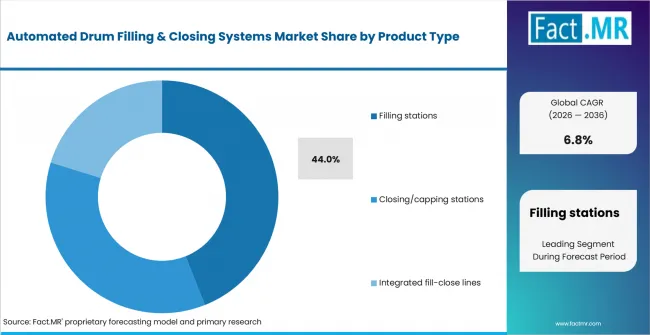
Automated Drum Filling & Closing Systems Market Analysis By Product Type | Source: Fact.MR
Filling is the point where product flow and net weight are controlled, so it is the first operation many plants automate. A standalone filling station can replace manual dispensing while leaving existing drum handling or closure steps in place, which lowers the scope of an initial automation project.
The same equipment can also become part of a wider line. Feige Filling describes drum fillers that operate as individual stations or as fully automatic systems with opening and closing stages. This upgrade path supports purchasing by plants that want to automate in phases.
Why does Liquid lead Fill Type?
Liquid leads Fill Type in 2026.
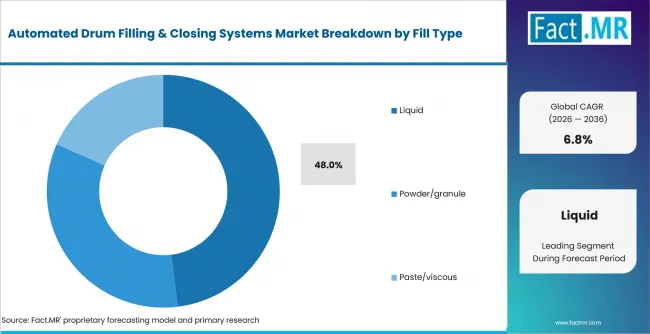
Automated Drum Filling & Closing Systems Market Analysis By Fill Type | Source: Fact.MR
Liquid products are well suited to automated metering because flow can be controlled against a target weight and stopped when the required net content is reached. This is useful for chemicals, lubricants and selected food products where filling consistency affects shipment weight and product loss.
Industrial liquid-filling suppliers offer drum systems with gravimetric control and automatic closing options. Buyers therefore have established equipment architectures that can be configured around product viscosity, hazard classification and required throughput.
Why do Steel drums lead Drum Material?
Steel drums lead Drum Material in 2026.
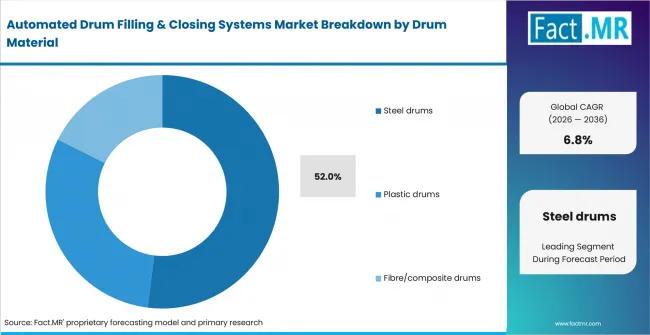
Automated Drum Filling & Closing Systems Market Analysis By Drum Material | Source: Fact.MR
Steel drums provide a rigid package that can move through conveyors, positioning devices and closure stations with predictable geometry. They are also used for industrial liquids and dangerous goods, where package integrity and repeatable closure are important during handling and transport.
The UN Model Regulations set packaging construction and testing requirements for dangerous goods. This makes consistent drum condition and closure part of the operating workflow for regulated shipments and supports equipment that can fill and close steel drums under controlled conditions.
Why do Chemicals lead End-Use Industry?
Chemicals lead End-Use Industry in 2026.
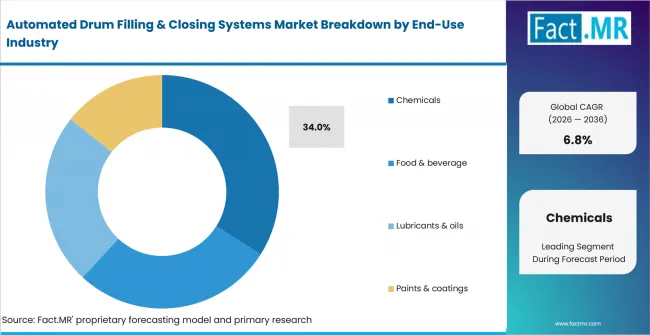
Automated Drum Filling & Closing Systems Market Analysis By End Use Industry | Source: Fact.MR
Chemical plants handle products that may be flammable, corrosive or otherwise hazardous. Automating the transfer into drums can reduce routine operator contact with the product while making weight and closure steps more repeatable.
Safety requirements reinforce this purchase logic. OSHA process-safety rules address facilities handling specified quantities of highly hazardous chemicals, while ATEX applies to equipment intended for potentially explosive atmospheres in the EU. Filling systems configured for these environments are therefore directly relevant to chemical buyers.
What is accelerating Automated Drum Filling & Closing Systems Market adoption, and what is holding it back?
Drivers Impact Analysis
| Driver | (~) % Impact on CAGR | Geographic Relevance | Impact Timeline |
|---|---|---|---|
| OSHA PSM and EU Seveso III compliance driving automation of hazardous-chemical drumming | +0.9% | North America, Europe | Near term |
| Export chemical and lubricant logistics requiring documented fill weights and closure verification | +0.7% | Global | Near term |
| Adoption of integrated fill-close lines reducing labor and spillage per drum | +0.6% | Europe, Asia-Pacific | Mid term |
| Precision gravimetric and Coriolis metering for high-value liquid products | +0.5% | North America, Europe | Mid term |
Source: Fact.MR analysis. Updated Aug 19, 2026
Opportunity Impact Analysis
| Opportunity | (~) % Impact on CAGR | Geographic Relevance | Impact Timeline |
|---|---|---|---|
| Plastic and composite drum filling for food-ingredient and pharmaceutical sectors | +0.6% | Global | Mid term |
| ATEX-certified filling stations for flammable-solvent drumming in classified areas | +0.5% | Europe, Middle East | Mid term |
| Chemical capacity expansion in Latin America, Middle East and Southeast Asia | +0.4% | Latin America, Asia-Pacific, Middle East | Long term |
Source: Fact.MR analysis. Updated Aug 19, 2026
Restraints Impact Analysis
| Restraint | (~) % Impact on CAGR | Geographic Relevance | Impact Timeline |
|---|---|---|---|
| High capital cost of integrated fill-close lines limiting adoption among small chemical packagers | -0.5% | Asia-Pacific, Latin America | Near term |
| Availability of low-cost manual and semi-automatic filling equipment in price-sensitive markets | -0.4% | Asia-Pacific, Africa | Near term |
| Drum-supply chain consolidation reducing the number of independent filling-line investment decisions | -0.3% | Global | Long term |
Source: Fact.MR analysis. Updated Aug 19, 2026
Which countries are scaling the Automated Drum Filling & Closing Systems Market through 2036?
- Germany: Chemical and pharmaceutical manufacturing remains a tracked part of the country's industrial base, while EU ATEX requirements keep hazardous-area equipment compliance visible. Drum-line demand is therefore linked to plant modernization and controlled handling in chemical production.
- United States: Chemical manufacturing supports recurring requirements for drum filling across industrial sites, and OSHA process-safety requirements influence how hazardous chemicals are handled. Automation purchases can reduce direct exposure and improve repeatability in high-volume drumming operations.
- Italy: Istat continues to track chemicals and chemical products within manufacturing trade. Export-oriented producers need consistent package weight and closure before products enter logistics networks, supporting investment in automated filling and closing equipment.
- South Korea: Petrochemical exports remain a material part of the country's manufacturing trade. Plants serving export markets have an operating reason to standardize fill weight, drum closure and traceable handling across repeated production runs.
- Brazil: IBGE industrial data continue to track chemical products within manufacturing output. Growth in chemical and related process industries creates opportunities for plants to replace manual or semi-automatic drumming with controlled filling systems.
- Japan: METI's Current Survey of Production separately tracks the chemical industry, reflecting an established manufacturing base. Replacement and retrofit demand is supported where producers need stable process control across liquid, powder or viscous drum-filling applications.
Country CAGR (2026-2036)
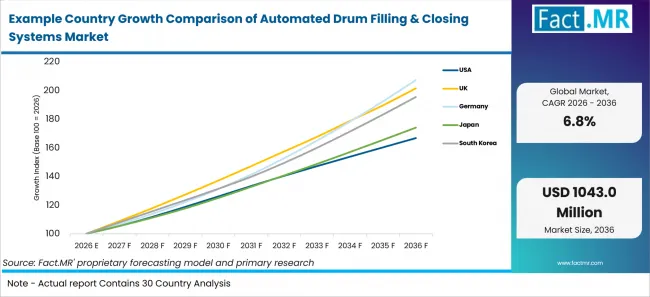
Example Country Growth Comparison Of Automated Drum Filling & Closing Systems Market | Source: Fact.MR
| Country | CAGR (2026-2036) |
|---|---|
| Germany | 7.0% |
| United States | 7.8% |
| Italy | 6.4% |
| South Korea | 8.0% |
| Brazil | 8.9% |
| Japan | 6.6% |
Source: Fact.MR analysis. Updated Aug 19, 2026
What is driving Germany's growth through 2036?
Germany is forecast to expand at a 7.0% CAGR from 2026 to 2036.
Demand is supported by an established chemical manufacturing base and by plants that package liquid or hazardous products for industrial distribution. Automated filling helps standardize weight control while integrated closing reduces manual handling between process steps.
European hazardous-area rules also affect equipment selection. ATEX requirements apply to equipment intended for potentially explosive atmospheres, so suppliers serving solvent and chemical applications need compliant electrical and mechanical designs.
What is driving the United States' growth through 2036?
The United States is forecast to expand at a 7.8% CAGR from 2026 to 2036.
Chemical manufacturing creates recurring demand for drum packaging across plants producing industrial chemicals and formulated products. Automated systems are useful where operators must fill repeated batches while controlling net weight and minimizing product contact.
OSHA process-safety requirements add an operational reason to reduce uncontrolled exposure in facilities handling covered hazardous chemicals. Buyers can use enclosed filling, remote controls and integrated closure to reduce routine manual intervention around the transfer point.
What is driving Italy's growth through 2036?
Italy is forecast to expand at a 6.4% CAGR from 2026 to 2036.
Italy's manufacturing trade includes chemicals and chemical products, supporting demand for packaging equipment used before domestic distribution or export. Producers shipping drums need repeatable weights and secure closure across recurring production lots.
The opportunity is concentrated in plants that can justify automation through lower handling effort and better process consistency. Modular filling stations are relevant where buyers want to modernize the fill step without replacing the complete downstream line at once.
What is driving South Korea's growth through 2036?
South Korea is forecast to expand at an 8.0% CAGR from 2026 to 2036.
South Korea's petrochemical industry serves substantial export demand, which keeps shipment preparation and process repeatability important. Automated drum lines help producers maintain controlled net weight and closure across frequent production cycles.
High plant utilization also increases the value of integrated fill-close configurations because fewer manual transfers can reduce handling interruptions. Equipment that supports hazardous liquid service and consistent documentation is therefore relevant to chemical and petrochemical facilities.
What is driving Brazil's growth through 2036?
Brazil is forecast to expand at an 8.9% CAGR from 2026 to 2036.
Brazilian industrial statistics continue to show active chemical-product manufacturing within the broader factory sector. Chemical, lubricant and coatings producers can use drum-filling automation to improve repeatability as output expands or packaging lines are modernized.
The market also includes plants moving from manual or semi-automatic equipment to weight-controlled stations. This creates demand for systems that can be added without requiring a fully integrated line from the first investment cycle.
What is driving Japan's growth through 2036?
Japan is forecast to expand at a 6.6% CAGR from 2026 to 2036.
Japan maintains an established chemical production base tracked through METI's Current Survey of Production. This supports replacement demand for filling equipment used in industrial liquid and formulated-product packaging.
Purchasing is likely to focus on stable fill accuracy and equipment reliability, especially where existing plants are retrofitted rather than built from scratch. Flexible systems that handle more than one drum format can improve utilization within space-constrained production sites.
Who leads the Automated Drum Filling & Closing Systems Market?
Feige Filling, a Haver & Boecker brand, is positioned as a key provider in the market because its current portfolio includes gravimetric drum fillers that can operate as standalone stations or as fully automatic lines with opening and closing stages. This directly matches the filling-station and integrated fill-close categories in the market taxonomy.
The competitive set also includes companies with adjacent packaging and processing capabilities. Fischbach GmbH currently supplies cartridge filling systems and drum presses. ROTA Verpackungstechnik focuses on filling and closing equipment for pharmaceutical vials and bottles. Greif, Inc. manufactures industrial drums and provides filling and packaging services, while Müller DrumTec GmbH supplies drum and process-handling systems. Adelphi Group includes businesses that design liquid filling and capping machinery.
Buyer selection depends on fill accuracy, hazardous-area capability and the level of closure automation. Compatibility with steel, plastic or fibre/composite drums also affects equipment choice. Service availability and the ability to integrate filling with conveying, labeling or capping influence projects where plants are replacing manual drumming in stages.
The competitive field therefore spans direct drum-filling machinery and adjacent packaging participants. For equipment-led projects, suppliers with published drum-filling and closing capability are more directly comparable than companies focused on containers, cartridge systems or pharmaceutical primary packaging.
Which companies are the key providers?
Key companies include Feige Filling (Haver & Boecker); Fischbach GmbH; ROTA Verpackungstechnik; Greif, Inc.; Müller DrumTec GmbH; and Adelphi Group.
- Feige Filling (Haver & Boecker)
- Fischbach GmbH
- ROTA Verpackungstechnik
- Greif, Inc.
- Müller DrumTec GmbH
- Adelphi Group
Research Sources and Bibliography
- Occupational Safety and Health Administration. (2026). Process Safety Management of Highly Hazardous Chemicals, 29 CFR 1910.119. U.S. Department of Labor.
- European Commission. (2026). Equipment for Potentially Explosive Atmospheres (ATEX). Directorate-General for Internal Market, Industry, Entrepreneurship and SMEs.
- United Nations Economic Commission for Europe. (2025). UN Recommendations on the Transport of Dangerous Goods, Model Regulations, 24th Revised Edition. United Nations.
- Federal Statistical Office of Germany. (2026). Industry and Manufacturing: Chemical and Pharmaceutical Industry. Destatis.
- U.S. Census Bureau. (2025). Manufacturers' Shipments, Inventories, and Orders: Chemical Products. U.S. Department of Commerce.
- Italian National Institute of Statistics. (2026). Note on the Italian Economy: Manufacturing Exports and Imports by Economic Activity. Istat.
- Ministry of Trade, Industry and Resources, Republic of Korea. (2026). Monthly Export Performance: Petrochemical Products. Government of the Republic of Korea.
- Brazilian Institute of Geography and Statistics. (2026). Monthly Survey of Industry. IBGE.
- Ministry of Economy, Trade and Industry, Japan. (2026). Current Survey of Production. Government of Japan.
- Haver & Boecker. (2026). Liquid Filling Equipment: Drum Fillers. Feige Filling.
- Fischbach GmbH. (2026). Machine Systems. Fischbach GmbH.
- ROTA Verpackungstechnik. (2026). Filling and Closing Applications. ROTA.
- Greif, Inc. (2026). Industrial Packaging Products and Services. Greif, Inc.
- Müller DrumTec GmbH. (2026). DrumTec Products and Drum Handling Systems. Müller Group.
- Adelphi Group. (2026). Group Companies and Liquid Filling and Capping Machinery. Adelphi Healthcare Packaging.
This Report Answers
- How automated drum filling and closing demand is distributed across Product Type and Fill Type. It also covers Drum Material and End-Use Industry.
- Why filling stations and liquid applications hold leading positions. It also explains the leadership of steel drums and chemicals.
- How hazardous-area requirements, controlled net weight and integrated filling and closure affect equipment purchasing decisions.
- How demand conditions differ across Germany and the United States. The comparison also covers Italy and South Korea, with Brazil and Japan.
- How direct drum-filling equipment suppliers and adjacent industrial packaging companies differ in their current market roles.
What does the Automated Drum Filling & Closing Systems Market cover?
The market covers automated equipment used to fill and close industrial drums. It includes standalone filling stations, closing or capping stations and integrated fill-close lines used for liquid, powder/granule and paste/viscous products.
The assessment is organized by Product Type, Fill Type, Drum Material and End-Use Industry. Drum-material coverage includes steel, plastic and fibre/composite formats, while end-use coverage is limited to chemicals, food & beverage, lubricants & oils and paints & coatings.
What is included in the scope?
The scope includes automated drum filling stations, automated closing or capping stations and integrated systems that combine both functions. Equipment can use gravimetric or other industrial metering methods when these are integral to the filling system.
The analysis includes equipment configured for the drum materials and fill types in the market scope. It also includes line controls, weighing and closure functions when these are supplied as part of the automated drum filling or closing system.
What is excluded from the scope?
Manual filling tools and small-container filling machines are excluded. Equipment designed only for bottles, vials, cartridges, pails or IBCs is outside the market unless it is supplied as part of a drum-capable system covered by the stated taxonomy.
Empty drums, drum manufacturing, drum reconditioning, standalone conveyors, labeling equipment and after-sales services are excluded when sold independently of the automated filling or closing system. Drum emptying equipment and process vessels are treated as adjacent markets.
How Was the Analysis Built?
Fact.MR is of the opinion that this assessment combines primary research with a structured review of public information and industry evidence relevant to the market.
- Primary Research: Interviews with filling-equipment manufacturers, packaging-line integrators and plant-side engineering, operations and procurement teams examine automation priorities, hazardous-area requirements, fill accuracy and equipment replacement decisions.
- Desk Research: The review covers industrial production data, hazardous-chemical and explosive-atmosphere rules, dangerous-goods packaging requirements and current company technical portfolios. Sources used in the analysis are listed in the bibliography.
- Market Sizing and Forecasting: Estimates combine installed drum-filling equipment demand, average system pricing, automation level, replacement cycles, end-use production and country-level growth. Product Type, Fill Type, Drum Material and End-Use Industry shares are applied within the stated market structure.
- Data Validation and Update Cycle: Evidence is reviewed against the defined market scope, segment boundaries and forecast period. The assessment is updated when source data, technology conditions, regulation or supplier activity materially changes the outlook.
Segmentation
Research Scope and Coverage
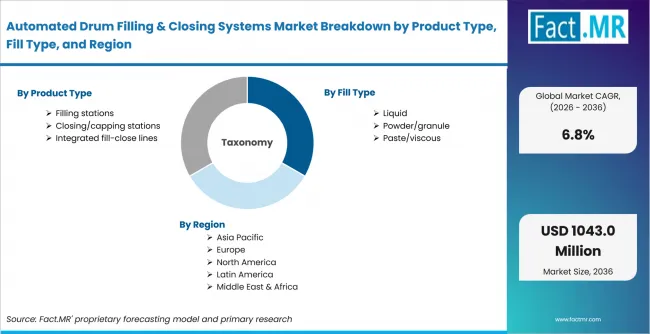
Automated Drum Filling & Closing Systems Market Breakdown By Product Type, Fill Type, And Region | Source: Fact.MR
| Attribute | Details |
|---|---|
| Quantitative Units | USD Million |
| Market Definition | Automated systems used to fill, weigh, cap or seal industrial drums across the stated product, fill, drum-material and end-use categories |
| Segments Covered | Product Type; Fill Type; Drum Material; End-Use Industry |
| Regions Covered | North America; Latin America; Western Europe; Eastern Europe; East Asia; South Asia & Pacific; Middle East & Africa |
| Countries Covered | Germany; United States; Italy; South Korea; Brazil; Japan |
| Key Companies Profiled | Feige Filling (Haver & Boecker); Fischbach GmbH; ROTA Verpackungstechnik; Greif, Inc.; Müller DrumTec GmbH; Adelphi Group |
| Forecast Period | 2026 to 2036 |
| Approach | Hybrid top-down and bottom-up approach using installed equipment demand, system pricing, automation level, replacement activity, end-use production and country growth |
Source: Fact.MR analysis. Updated Aug 19, 2026
Market Breakdown by Segments
-
By Product Type:
- Filling stations
- Closing/capping stations
- Integrated fill-close lines
-
By Fill Type:
- Liquid
- Powder/granule
- Paste/viscous
-
By Drum Material:
- Steel drums
- Plastic drums
- Fibre/composite drums
-
By End-Use Industry:
- Chemicals
- Food & beverage
- Lubricants & oils
- Paints & coatings
-
By Region:
- North America
- Latin America
- Western Europe
- Eastern Europe
- East Asia
- South Asia & Pacific
- Middle East & Africa
Frequently Asked Questions
What is the Automated Drum Filling & Closing Systems Market value in 2026?
At what CAGR is the market projected to grow?
What is the projected market value by 2036?
Which Product Type leads the market?
Which Fill Type leads the market?
Which Drum Material leads the market?
Which End-Use Industry leads the market?
What CAGR is projected for Brazil?
What is the primary driver in this market?
What is the main restraint?
Which companies are included in the market assessment?
Who worked on this report


Preview the report firsthand - request a free sample
Free SampleGet the brochure for pricing and purchase details
Download PDF